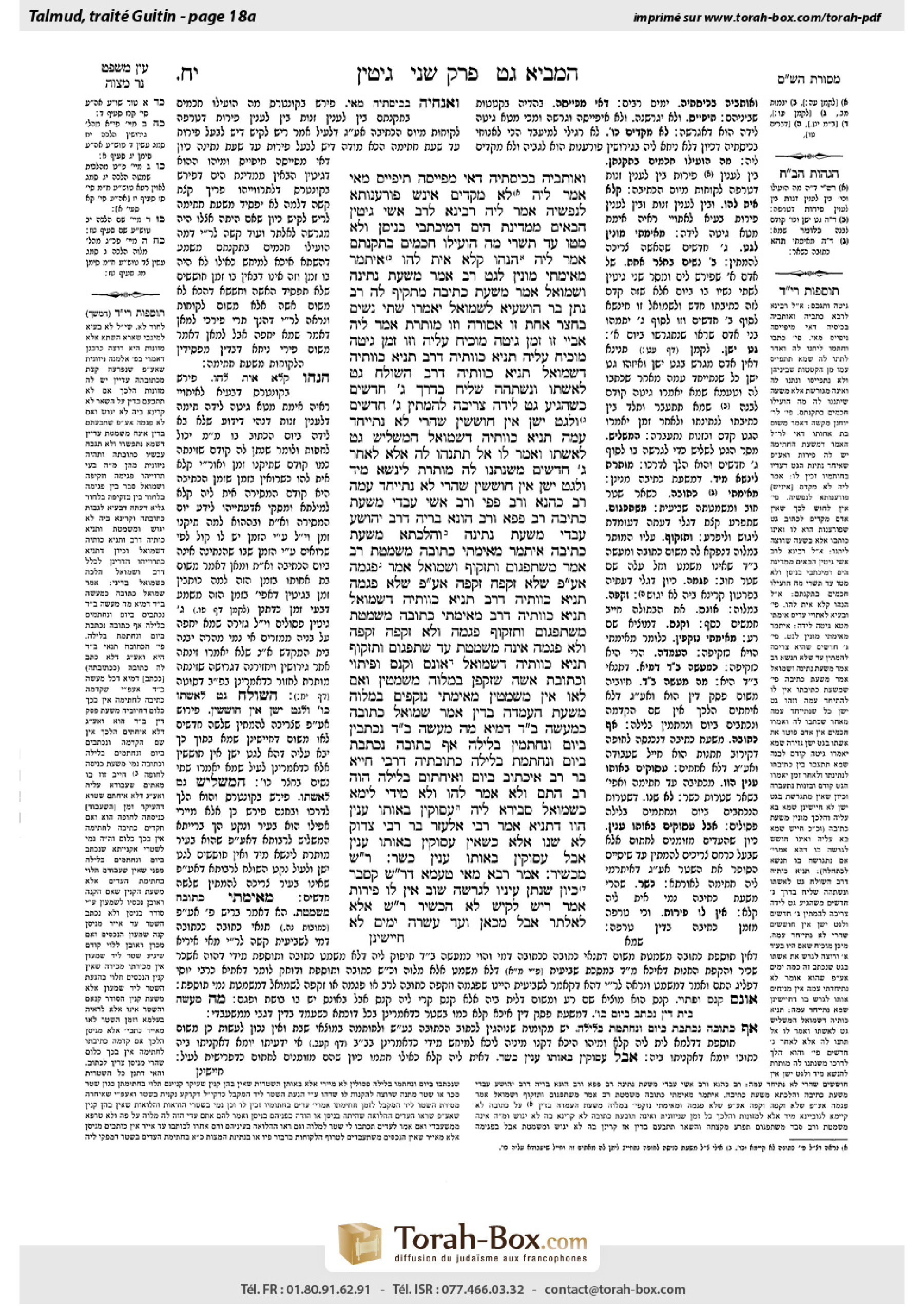
Gittin 18a: Talmud study for Daf Yomi
Study the Talmud for Daf Yomi with scanned pages, Hebrew text, English translations from Sefaria and AI-generated French translations.
Passage selection and English or AI-generated French translation are available where the scan has annotations. Daf Study is independent of Torah-Box and Sefaria.
Browse Gittin · גיטין · All tractatesGittin 18a text and translations
This page of Gittin includes the Aramaic text, an English translation and an AI-generated French translation, alongside the scan above.
גיטין י״ח א · Aramaic and Hebrew text
וְאוֹתְבֵיהּ בְּכִיסְתֵּיהּ – דְּאִי מִפַּיְּיסָהּ תִּיפַּיַּיס, מַאי?
אֲמַר לֵיהּ: לָא מַקְדֵּים אִינָשׁ פּוּרְעָנוּתָא לְנַפְשֵׁיהּ.
אֲמַר לֵיהּ רָבִינָא לְרַב אָשֵׁי: גִּיטִּין הַבָּאִים מִמְּדִינַת הַיָּם, דְּמִיכַּתְבִי בְּנִיסָן וְלָא מָטוּ עַד תִּשְׁרֵי – מָה הוֹעִילוּ חֲכָמִים בְּתַקָּנָתָם? אֲמַר לֵיהּ: הָנְהוּ, קָלָא אִית לְהוּ.
אִיתְּמַר: מֵאֵימָתַי מוֹנִין לַגֵּט? רַב אָמַר: מִשְּׁעַת נְתִינָה, וּשְׁמוּאֵל אָמַר: מִשְּׁעַת כְּתִיבָה.
מַתְקֵיף לַהּ רַב נָתָן בַּר הוֹשַׁעְיָא לִשְׁמוּאֵל, יֹאמְרוּ: שְׁתֵּי נָשִׁים בְּחָצֵר אַחַת – זוֹ אֲסוּרָה וְזוֹ מוּתֶּרֶת! אֲמַר לֵיהּ אַבָּיֵי: זוֹ זְמַן גִּיטָּהּ מוֹכִיחַ עָלֶיהָ, וְזוֹ זְמַן גִּיטָּהּ מוֹכִיחַ עָלֶיהָ.
תַּנְיָא כְּווֹתֵיהּ דְּרַב, תַּנְיָא כְּווֹתֵיהּ דִּשְׁמוּאֵל. תַּנְיָא כְּווֹתֵיהּ דְּרַב: הַשּׁוֹלֵחַ גֵּט לְאִשְׁתּוֹ, וְנִשְׁתַּהָה שָׁלִיחַ בַּדֶּרֶךְ שְׁלֹשָׁה חֳדָשִׁים, כְּשֶׁהִגִּיעַ גֵּט לְיָדָהּ – צְרִיכָה לְהַמְתִּין שְׁלֹשָׁה חֳדָשִׁים; וּלְגֵט יָשָׁן אֵין חוֹשְׁשִׁין, שֶׁהֲרֵי לֹא נִתְיַיחֵד עִמָּהּ.
תַּנְיָא כְּווֹתֵיהּ דִּשְׁמוּאֵל: הַמַּשְׁלִישׁ גֵּט לְאִשְׁתּוֹ, וְאָמַר לוֹ: אַל תִּתְּנֵהוּ לָהּ אֶלָּא לְאַחַר שְׁלֹשָׁה חֳדָשִׁים, מִשֶּׁנְּתָנוֹ לָהּ – מוּתֶּרֶת לִינָּשֵׂא מִיָּד; וּלְגֵט יָשָׁן אֵין חוֹשְׁשִׁין, שֶׁהֲרֵי לֹא נִתְיַיחֵד עִמָּהּ.
רַב כָּהֲנָא וְרַב פַּפֵּי וְרַב אָשֵׁי – עָבְדִי מִשְּׁעַת כְּתִיבָה, רַב פָּפָּא וְרַב הוּנָא בְּרֵיהּ דְּרַב יְהוֹשֻׁעַ – עָבְדִי מִשְּׁעַת נְתִינָה. וְהִלְכְתָא: מִשְּׁעַת כְּתִיבָה.
אִיתְּמַר: מֵאֵימָתַי כְּתוּבָּה מְשַׁמֶּטֶת?
רַב אָמַר: מִשֶּׁתִּפְגּוֹם – וְתִזְקוֹף. וּשְׁמוּאֵל אָמַר: פָּגְמָה – אַף עַל פִּי שֶׁלֹּא זָקְפָה, זָקְפָה – אַף עַל פִּי שֶׁלֹּא פָּגְמָה.
תַּנְיָא כְּווֹתֵיהּ דְּרַב, תַּנְיָא כְּווֹתֵיהּ דִּשְׁמוּאֵל. תַּנְיָא כְּווֹתֵיהּ דְּרַב: מֵאֵימָתַי כְּתוּבָּה מְשַׁמֶּטֶת? מִשֶּׁתִּפְגּוֹם וְתִזְקוֹף. פָּגְמָה וְלֹא זָקְפָה, זָקְפָה וְלֹא פָּגְמָה – אֵינָהּ מְשַׁמֶּטֶת, עַד שֶׁתִּפְגּוֹם וְתִזְקוֹף.
תַּנְיָא כְּווֹתֵיהּ דִּשְׁמוּאֵל: אוֹנֶס, וּקְנָס, וּפִיתּוּי, וּכְתוּבַּת אִשָּׁה – שֶׁזְּקָפָן בְּמִלְוָה, מְשַׁמְּטִין; וְאִם לָאו – אֵין מְשַׁמְּטִין. מֵאֵימָתַי נִזְקָפִים בְּמִלְוָה? מִשְּׁעַת הַעֲמָדָה בַּדִּין.
אָמַר שְׁמוּאֵל: כְּתוּבָּה כְּמַעֲשֵׂה בֵּית דִּין דָּמְיָא – מָה מַעֲשֵׂה בֵּית דִּין נִכְתָּבִין בַּיּוֹם וְנֶחְתָּמִין בַּלַּיְלָה, אַף כְּתוּבָּה נִכְתֶּבֶת בַּיּוֹם וְנֶחְתֶּמֶת בַּלַּיְלָה. כְּתוּבְּתֵיהּ דְּרַבִּי חִיָּיא בַּר רַב אִיכְּתוּב בַּיּוֹם וְאִיחֲתוּם בַּלַּיְלָה; הֲוָה רַב הָתָם וְלָא אֲמַר לְהוּ וְלָא מִידֵּי.
לֵימָא כִּשְׁמוּאֵל סְבִירָא לֵיהּ? עֲסוּקִין בְּאוֹתוֹ עִנְיָן הֲווֹ. דְּתַנְיָא, אָמַר רַבִּי אֶלְעָזָר בַּר רַבִּי צָדוֹק: לֹא שָׁנוּ, אֶלָּא כְּשֶׁאֵין עֲסוּקִין בְּאוֹתוֹ עִנְיָן, אֲבָל עֲסוּקִין בְּאוֹתוֹ עִנְיָן – כָּשֵׁר.
רַבִּי שִׁמְעוֹן מַכְשִׁיר: אָמַר רָבָא: מַאי טַעְמָא דְּרַבִּי שִׁמְעוֹן? קָסָבַר: כֵּיוָן שֶׁנָּתַן עֵינָיו לְגָרְשָׁהּ, שׁוּב אֵין לוֹ פֵּירוֹת.
אָמַר רֵישׁ לָקִישׁ: לֹא הִכְשִׁיר רַבִּי שִׁמְעוֹן אֶלָּא לְאַלְתַּר, אֲבָל מִכָּאן וְעַד עֲשָׂרָה יָמִים – לֹא;
Gittin 18a · English translation
and puts it in his pocket without giving it to her, as he thought that if she appeases [mippayyesa] him he will be appeased, what is the halakha when he then does give it to her? Since the date on the document is incorrect, did the Sages institute an ordinance that such a bill of divorce should not be used?
Rava said to him: A person does not hasten a calamity on himself and will not ordinarily prepare a bill of divorce in advance. Rather, he will wait until he is ready to divorce his wife. Since this scenario is unlikely, the Sages did not see a need to institute an ordinance pertaining to it.
Ravina said to Rav Ashi: When there are bills of divorce that come from a country overseas which are written, for example, in the month of Nisan, and they do not reach the woman until the month of Tishrei, what did the Sages accomplish with their ordinance to date the bill of divorce? All of the concerns about an undated bill of divorce still apply. He said to him: Concerning these bills of divorce from overseas, it is public knowledge that they do not take effect from the date on which they were written. Therefore, if there is a conflict over produce the husband has sold, the woman must bring witnesses to testify as to when she received her bill of divorce.
§ The Sages decreed that it is prohibited for a woman to remarry within three months of her divorce or her becoming a widow, in order to prevent a situation of doubt concerning the paternity of a child. It was stated: From when does one begin counting the three months with regard to a bill of divorce? Rav says: From the time of the giving of the bill of divorce, and Shmuel says: From the time of the writing of the bill of divorce.
Rav Natan bar Hoshaya objects to this: According to the statement of Shmuel, now people will say: If two women who live in one courtyard received their bills of divorce at the same time, but the first document was written at the time of the divorce and the second one was written earlier, then this woman is still prohibited from remarrying, as three months have not yet passed from when her bill of divorce was written; and that woman is already permitted to remarry. This does not seem reasonable. Abaye said to him: This is not difficult. With regard to this woman, the date of her bill of divorce proves concerning her that she may not remarry yet; and with regard to that woman, the date on her bill of divorce proves concerning her that she may remarry already.
The Gemara comments: It is taught in a baraita in accordance with the opinion of Rav, and it is taught in a baraita in accordance with the opinion of Shmuel. The Gemara explains: It is taught in a baraita in accordance with the opinion of Rav that the three-month count begins from when the bill of divorce is given: In the case of one who sends a bill of divorce to his wife, and the agent tarries on the way for three months, once the bill of divorce reaches her hand she must wait three months before remarrying. And one need not be concerned that it is an outdated bill of divorce, i.e., that the husband and wife were secluded after it was written, rendering the bill of divorce invalid, because he was not secluded with her during the time the bill of divorce was being delivered.
It is taught in another baraita in accordance with the opinion of Shmuel that the count begins from the time of the writing: In the case of one who is about to travel and deposits a bill of divorce for his wife with a trustee and says to him: Give it to her only after three months, once he gives it to her, she is permitted to marry immediately and is not required to wait an additional three months. And one need not be concerned that it is an outdated bill of divorce, as he was not secluded with her in the interim.
It is told that Rav Kahana and Rav Pappi and Rav Ashi would in practice count three months from the time of the writing, but Rav Pappa and Rav Huna, son of Rav Yehoshua, would in practice count these three months from the time of the giving. And the halakha is that the counting begins from the time of the writing.
§ The Gemara discusses another dispute between Rav and Shmuel with regard to documents. According to the terms of a marriage contract, a widow is entitled to payment of its value upon the death of her husband. By Torah law, all outstanding debts are canceled at the close of the Sabbatical Year. A woman need not take her marriage settlement as soon as her husband dies. The issue at hand is at what point the marriage contract generates a concrete debt that will be canceled by the Sabbatical Year. It was stated: From when is the debt established by a marriage contract canceled in the Sabbatical Year?
Rav says: The marriage contract becomes like a debt and will be canceled in the Sabbatical Year from the time when the woman collects partial payment and establishes the rest as a debt in court. And Shmuel says: This occurs when she either collects partial payment although she did not establish it as debt, or she established the entire value of the marriage contract as a debt in court although she did not collect partial payment.
With regard to this dispute, it is taught in a baraita in accordance with the opinion of Rav, and it is taught in a baraita in accordance with the opinion of Shmuel. It is taught in a baraita in accordance with the opinion of Rav: From when is the debt established by a marriage contract canceled? From when she accepts partial payment and establishes the rest as a debt in court. However, if she accepted partial payment but did not establish the debt, or established the debt but did not accept partial payment, then it is not canceled until she accepts partial payment and establishes the debt.
It is taught in another baraita in accordance with the opinion of Shmuel: If the fine and damages paid by one who commits rape; or the fine paid by one who falsely claims his wife was not a virgin at the time of their wedding; or the fine paid for seduction; or the debt established by a woman’s marriage contract was established as a loan, then the Sabbatical Year cancels it. And if one did not establish these payments as loans, then the Sabbatical Year does not cancel them. From when is it considered that these payments have been established as a loan? From the time of standing trial, because the abstract obligation to pay becomes a debt once the court ruled that one is required to pay.
§ The Gemara discusses other aspects of the marriage contract. Shmuel said: A marriage contract is considered to be like a court enactment. Just as court enactments may be written during the day and then signed at night, and the fact that the writing and signing were not performed on the same day does not present a problem, so too, a marriage contract may be written during the day and then signed at night. It is told: Rabbi Ḥiyya bar Rav’s marriage contract was written during the day and then signed at night, and Rav was there and he did not say anything to the people who wrote and signed it. This indicates that Rav agrees with the ruling of Shmuel.
The Gemara asks: Shall we say he holds in accordance with the opinion of Shmuel? The Gemara rejects this: This cannot be proven from here because the scribe and witnesses were continuously engaged in that matter of writing the marriage contract, from when it was written in the day until they signed it at night, as it is taught in a baraita that Rabbi Elazar bar Rabbi Tzadok said: The Sages taught that a document written during the day and signed at night is invalid only when the scribe and witnesses were not continuously engaged in that matter, but if they were continuously engaged in that matter until nightfall, then it is valid.
§ The mishna taught that Rabbi Shimon deems valid a bill of divorce written during the day and signed at night. Rava said: What is the reason for the opinion of Rabbi Shimon? He holds that once the husband has decided to divorce her, he no longer has the rights to the produce from his wife’s property, and it is clear that he has decided to divorce her when he writes a bill of divorce. Consequently, the woman obtains the rights to the produce from the moment the bill of divorce was written, regardless of when it was signed.
Reish Lakish says: Rabbi Shimon deems such a bill of divorce valid only if it is signed immediately, when the witnesses signed the bill of divorce during the night after it was written. However, if the delay in signing was from now, i.e., when the bill of divorce was written, until ten days have elapsed, i.e., when there is an extended delay, he does not deem it valid.
Gittin 18a · Traduction française (IA)
et il le met dans sa poche sans le donner à elle, car il croyait que si elle le calme [mippayyesa], il serait calmé, quelle est la halakha lorsqu'il lui donne finalement le document ? Puisque la date du document est incorrecte, les Sages ont-ils institué un décret selon lequel un tel divorce ne doit pas être utilisé ?
Rava dit à lui : Une personne ne précipite pas une calamité sur soi et ne prépare généralement pas un document de divorce à l'avance. Plutôt, il attend jusqu'à ce qu'il soit prêt à divorcer de sa femme. Puisque cette situation est peu probable, les Sages n'ont pas jugé nécessaire d'instituer un décret concernant cela.
Ravina dit à Rav Ashi : Lorsqu'il y a des documents de divorce provenant d'un pays étranger, qui sont rédigés, par exemple, en Nisan, et qui n'atteignent la femme qu'en Tishrei, qu'est-ce que les Sages ont accompli avec leur décret concernant la date du document de divorce ? Toutes les préoccupations concernant un document de divorce non daté restent applicables. Il lui dit : Concernant ces documents de divorce étrangers, il est public que ceux-ci ne prennent effet pas à la date de leur rédaction. Par conséquent, en cas de conflit concernant les produits que le mari a vendus, la femme doit présenter des témoins pour témoigner de la date à laquelle elle a reçu son document de divorce.
§ Les Sages ont décrété que c'est interdit à une femme de se remarier dans les trois mois suivant son divorce ou sa veuvage, afin d'éviter une situation de doute concernant la paternité d'un enfant. On a dit : À partir de quel moment commence-t-on à compter les trois mois concernant un document de divorce ? Rav dit : À partir du moment de la remise du document de divorce, et Shmuel dit : À partir du moment de la rédaction du document de divorce.
Rav Natan bar Hoshaya s'oppose à cela : Selon l'opinion de Shmuel, maintenant les gens diront : Si deux femmes vivant dans le même courtil ont reçu leurs documents de divorce en même temps, mais le premier document a été rédigé au moment du divorce et le second plus tôt, alors cette femme est encore interdite de remariage, car les trois mois n'ont pas encore passé depuis la rédaction de son document de divorce ; et celle-ci est déjà autorisée à remariage. Cela ne semble pas raisonnable. Abaye lui dit : Ce n'est pas difficile. Concernant cette femme, la date de son document de divorce prouve qu'elle ne peut pas encore remariage ; et concernant celle-ci, la date de son document de divorce prouve qu'elle peut déjà remariage.
La Guemara commente : Il est enseigné dans une baraïta selon l'opinion de Rav, et il est enseigné dans une baraïta selon l'opinion de Shmuel. La Guemara explique : Il est enseigné dans une baraïta selon l'opinion de Rav que le compte des trois mois commence à partir du moment de la remise du document de divorce : Dans le cas d'une personne qui envoie un document de divorce à sa femme, et que l'agent tarde sur le chemin pendant trois mois, une fois que le document de divorce arrive entre ses mains, elle doit attendre trois mois avant de remettre mariage. On n'a pas à craindre qu'il s'agisse d'un document de divorce obsolète, c'est-à-dire que le mari et la femme se sont retrouvés seuls après sa rédaction, ce qui rendrait le document de divorce invalide, car il n'était pas seul avec elle pendant la livraison du document de divorce.
Il est enseigné dans une autre baraïta selon l'opinion de Shmuel que le compte commence à partir du moment de la rédaction : Dans le cas d'une personne qui prévoit de voyager et dépose un document de divorce pour sa femme auprès d'un mandataire et lui dit : Donne-le-lui seulement après trois mois, une fois qu'il lui donne le document, elle est autorisée à se remarier immédiatement et n'a pas besoin d'attendre un autre trois mois. On n'a pas à craindre qu'il s'agisse d'un document de divorce obsolète, car il n'était pas seul avec elle pendant l'intervalle.
On dit que Rav Kahana et Rav Pappi et Rav Ashi comptaient en pratique trois mois à partir du moment de la rédaction, mais Rav Pappa et Rav Huna, fils de Rav Yehoshua, comptaient en pratique ces trois mois à partir du moment de la remise. Et la halakha est que le compte commence à partir du moment de la rédaction.
§ La Guemara discute d'un autre débat entre Rav et Shmuel concernant les documents. Selon les termes d'un contrat de mariage, une veuve est dûment redevable de la valeur du contrat en cas de décès de son mari. Selon la loi divine, toutes les dettes en suspens sont annulées à la fin de l'année sabbatique. Une femme n'a pas besoin de prendre sa dot dès que son mari meurt. La question est de savoir à quel moment le contrat de mariage génère une dette concrète qui sera annulée par l'année sabbatique. On a dit : À partir de quel moment la dette générée par un contrat de mariage est-elle annulée dans l'année sabbatique ?
Rav dit : Le contrat de mariage devient comme une dette et sera annulé dans l'année sabbatique à partir du moment où la femme accepte un paiement partiel et établit le reste comme dette en cour. Et Shmuel dit : Cela arrive lorsque elle accepte un paiement partiel même si elle n'a pas établi la dette, ou qu'elle a établi la valeur totale du contrat de mariage comme dette en cour même si elle n'a pas accepté un paiement partiel.
Concernant ce débat, il est enseigné dans une baraïta selon l'opinion de Rav, et il est enseigné dans une baraïta selon l'opinion de Shmuel. Il est enseigné dans une baraïta selon l'opinion de Rav : À partir de quel moment la dette générée par un contrat de mariage est-elle annulée ? À partir du moment où elle accepte un paiement partiel et établit le reste comme dette en cour. Cependant, si elle a accepté un paiement partiel sans établir la dette, ou si elle a établi la dette sans accepter un paiement partiel, alors la dette n'est annulée qu'après qu'elle accepte un paiement partiel et établisse la dette.
Il est enseigné dans une autre baraïta, conformément à l'opinion de Shmuel : Si la somme d'amende et les dommages payés par celui qui a commis un viol ; ou la somme d'amende payée par celui qui a prétendu faussement que sa femme n'était pas vierge au moment de leur mariage ; ou la somme d'amende payée pour la séduction ; ou la dette établie par le contrat de mariage d'une femme a été établie comme un prêt, alors la année sabbatique annule cette dette. Et si ces paiements n'ont pas été établis comme des prêts, alors la année sabbatique ne les annule pas. À partir de quel moment est-il considéré que ces paiements ont été établis comme un prêt ? À partir du moment de l'audience, car l'obligation abstraite de payer devient une dette une fois que le tribunal a décidé que l'on devait payer.
§ La Guemara discute d'autres aspects du contrat de mariage. Shmuel a dit : Un contrat de mariage est considéré comme un édikt du tribunal. Tout comme les édikts peuvent être rédigés pendant la journée et signés la nuit, et le fait que la rédaction et la signature n'aient pas eu lieu le même jour ne constitue pas un problème, de même un contrat de mariage peut être rédigé pendant la journée et signé la nuit. On raconte : Le contrat de mariage de Rabbi Ḥiyya bar Rav a été rédigé pendant la journée et signé la nuit, et Rav était présent et n'a pas dit quoi que ce soit aux personnes qui ont rédigé et signé ce contrat. Cela indique que Rav est d'accord avec la décision de Shmuel.
La Guemara pose la question : Devons-nous dire qu'il suit l'opinion de Shmuel ? La Guemara rejette cette idée : cela ne peut pas être prouvé à partir de là, car le scribe et les témoins étaient continuellement occupés par cette affaire de rédaction du contrat de mariage, du moment où il a été rédigé en journée jusqu'à ce qu'ils le signent la nuit, comme il est enseigné dans une baraïta que Rabbi Elazar bar Rabbi Tzadok a dit : Les Sages ont enseigné qu'un document rédigé pendant la journée et signé la nuit est invalide uniquement lorsque le scribe et les témoins n'étaient pas continuellement occupés par cette affaire, mais si ils étaient continuellement occupés par cette affaire jusqu'au coucher du soleil, alors il est valide.
§ La Michna a enseigné que Rabbi Shimon considère comme valide un acte de divorce rédigé pendant la journée et signé la nuit. Rava a dit : Quelle est la raison de l'opinion de Rabbi Shimon ? Il considère que dès que le mari a décidé de divorcer, il ne possède plus les droits sur les produits provenant des biens de sa femme, et il est clair qu'il a décidé de divorcer lorsqu'il rédige un acte de divorce. Par conséquent, la femme obtient les droits sur les produits à partir du moment où l'acte de divorce a été rédigé, indépendamment de la date de signature.
Reish Lakish dit : Rabbi Shimon considère ce type d'acte de divorce comme valide uniquement s'il est signé immédiatement, lorsque les témoins ont signé l'acte de divorce pendant la nuit après qu'il ait été rédigé. Cependant, si le délai de signature était depuis maintenant, c'est-à-dire lorsque l'acte de divorce a été rédigé, jusqu'à ce que dix jours aient passé, c'est-à-dire lorsqu'il y a un délai prolongé, il ne le considère pas comme valide.
Traduction française générée par IA à partir de l’édition anglaise de Sefaria. Vérifie toujours un passage avec le texte source.
Text from Sefaria: William Davidson Edition - Vocalized Aramaic (CC BY NC); William Davidson Edition - English (CC BY NC).