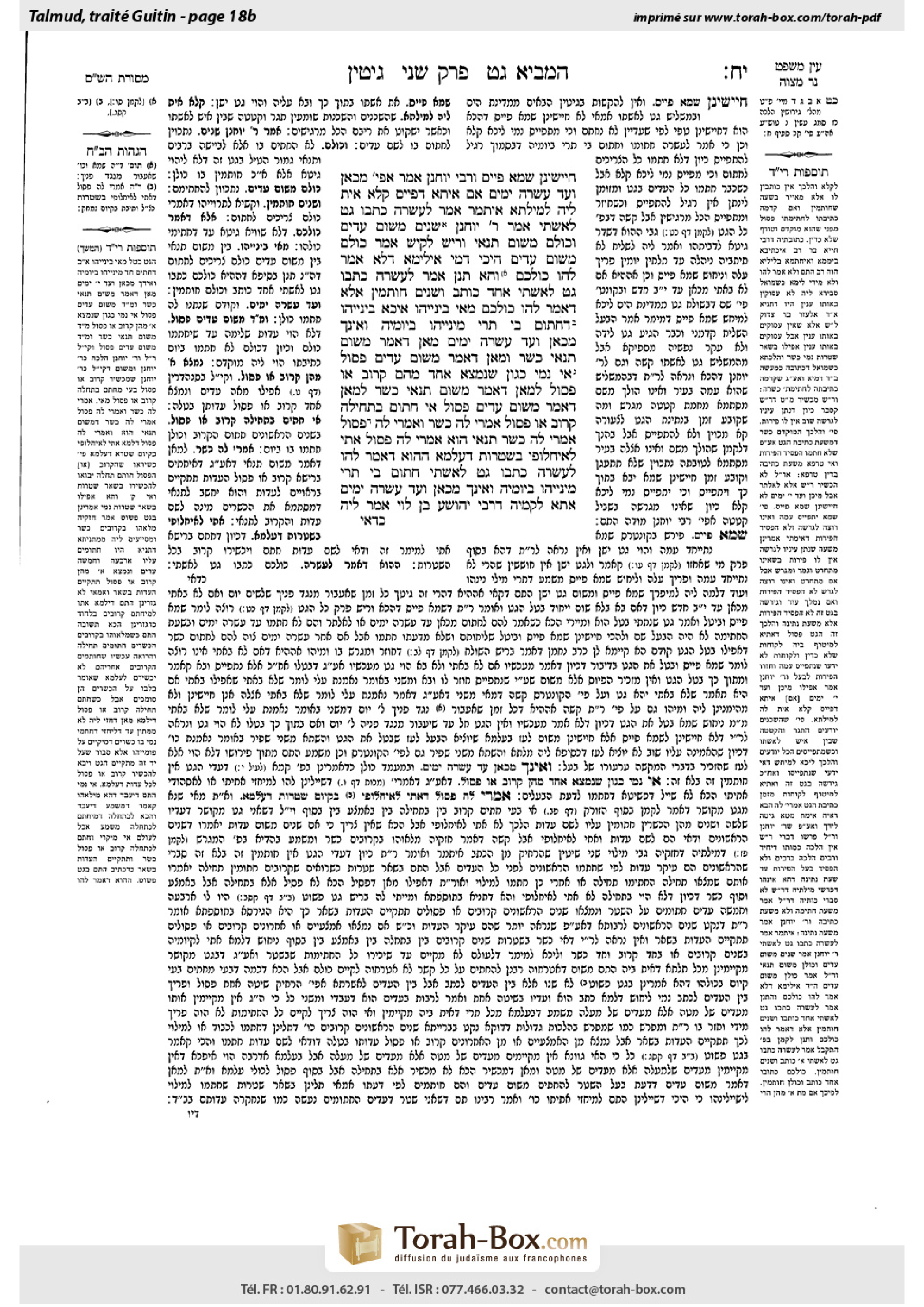
Gittin 18b: Talmud study for Daf Yomi
Study the Talmud for Daf Yomi with scanned pages, Hebrew text, English translations from Sefaria and AI-generated French translations.
Passage selection and English or AI-generated French translation are available where the scan has annotations. Daf Study is independent of Torah-Box and Sefaria.
Browse Gittin · גיטין · All tractatesGittin 18b text and translations
This page of Gittin includes the Aramaic text, an English translation and an AI-generated French translation, alongside the scan above.
גיטין י״ח ב · Aramaic and Hebrew text
חָיְישִׁינַן שֶׁמָּא פִּיֵּיס. וְרַבִּי יוֹחָנָן אָמַר: אֲפִילּוּ מִכָּאן וְעַד עֲשָׂרָה יָמִים; אִם אִיתָא דְּפַיֵּיס – קָלָא אִית לַיהּ לְמִילְּתָא.
אִיתְּמַר: אָמַר לַעֲשָׂרָה ״כִּתְבוּ גֵּט לְאִשְׁתִּי״; אָמַר רַבִּי יוֹחָנָן: שְׁנַיִם מִשּׁוּם עֵדִים, וְכוּלָּם מִשּׁוּם תְּנַאי. וְרֵישׁ לָקִישׁ אָמַר: כּוּלָּם מִשּׁוּם עֵדִים.
הֵיכִי דָמֵי? אִילֵּימָא דְּלָא אֲמַר לְהוּ: ״כּוּלְּכֶם״; וְהָא תְּנַן, אָמַר לַעֲשָׂרָה: ״כִּתְבוּ גֵּט לְאִשְׁתִּי״ – אֶחָד כּוֹתֵב וּשְׁנַיִם חוֹתְמִין! אֶלָּא דַּאֲמַר לְהוּ ״כּוּלְּכֶם״.
מַאי בֵּינַיְיהוּ? אִיכָּא בֵּינַיְיהוּ – דַּחֲתוּם בֵּי תְרֵי מִינַּיְיהוּ בְּיוֹמֵיהּ, וְאִינָךְ מִכָּאן וְעַד עֲשָׂרָה יָמִים. מַאן דְּאָמַר מִשּׁוּם תְּנַאי – כָּשֵׁר; וּמַאן דְּאָמַר מִשּׁוּם עֵדִים – פָּסוּל.
אִי נָמֵי – כְּגוֹן שֶׁנִּמְצָא אֶחָד מֵהֶם קָרוֹב אוֹ פָּסוּל. לְמַאן דְּאָמַר מִשּׁוּם תְּנַאי – כָּשֵׁר; לְמַאן דְּאָמַר מִשּׁוּם עֵדִים – פָּסוּל.
אִי חֲתִים בִּתְחִילָּה קָרוֹב אוֹ פָּסוּל; אָמְרִי לָהּ כָּשֵׁר, וְאָמְרִי לַהּ פָּסוּל. אָמְרִי לָהּ כָּשֵׁר – תְּנַאי הוּא; אָמְרִי לַהּ פָּסוּל – אָתֵי לְאִיחַלּוֹפֵי בִּשְׁטָרוֹת דְּעָלְמָא.
הָהוּא דַּאֲמַר לְהוּ לַעֲשָׂרָה: ״כִּתְבוּ גֵּט לְאִשְׁתִּי״; חֲתוּם בֵּי תְרֵי מִינַּיְיהוּ בְּיוֹמֵיהּ, וְאִינָךְ – מִכָּאן וְעַד עֲשָׂרָה יָמִים. אֲתָא לְקַמֵּיהּ דְּרַבִּי יְהוֹשֻׁעַ בֶּן לֵוִי, אֲמַר לֵיהּ:
Gittin 18b · English translation
Why not? Because we are concerned that perhaps he appeased his wife and engaged in sexual intercourse with her, thereby invalidating the bill of divorce. And Rabbi Yoḥanan said: Even if the delay in signing was from now until ten days later Rabbi Shimon deems it valid. There is no concern that he appeased her because if it is so that he appeased her, then the matter becomes public knowledge, and all would hear of it.
§ It was stated that Rabbi Yoḥanan and Reish Lakish disagreed with regard to the following case: If the husband says to ten men: Write a bill of divorce for my wife, Rabbi Yoḥanan says: He means that all of them should sign the bill of divorce. Two of them function as witnesses, and all the rest of them sign the bill of divorce only due to the stipulation that the husband had stated. He made the bill of divorce dependent upon all of them signing, but he did not mean that ten men need to actually function as witnesses. And Reish Lakish says: All of them function as witnesses.
The Gemara asks: What are the circumstances in which all of them have to sign? If we say that he did not say to them: All of you, but just said to them: You should write a bill of divorce for my wife, didn’t we learn in a mishna (66b) that if one said to ten people: Write a bill of divorce for my wife, then one would write, and two would sign, and not all ten of them are required to sign. Rather, the case of their dispute is when he said to them: All of you write a bill of divorce for my wife, and in this instance is was taught later on in that mishna that one person writes the bill of divorce and everyone else must sign it.
The Gemara asks: What is the difference between Rabbi Yoḥanan and Reish Lakish; what is the difference if the rest of the men function as witnesses or just in order to fulfill the man’s stipulation? The Gemara answers: There is a difference between them in a case where two of them signed on that day and the rest signed not on the day it was written but from now until ten days later. According to the one who says that the other signatures are due to the stipulation, the bill of divorce is valid, because two witnesses signed the bill of divorce on the same day that it was written, and the stipulation was also fulfilled. And according to the one who says that all these people sign due to his wish that they all function as witnesses, it is invalid because not all the witnesses signed the bill of divorce on the day it was written.
Alternatively, there is another difference between them, in a case where one of these ten people is found to be a relative of the husband or wife, or is otherwise found to be disqualified to serve as a witness. According to the one who says that the other signatures are due to the stipulation, this bill of divorce is valid because the disqualified person did not serve as a witness. He just signed the bill of divorce in order to fulfill the stipulation, and the bill of divorce has the signature of two qualified witnesses. According to the one who says that all these people sign due to the man’s wish that they all function as witnesses, the bill of divorce would be invalid, as is the case whenever one member of a group of witnesses is disqualified.
The Gemara adds another point of dispute: According to Rabbi Yoḥanan, who holds that the other witnesses sign due to the husband’s stipulation, if a relative or other disqualified witness signed at the beginning, before two valid witnesses had signed, then some say the bill of divorce is valid and some say that it is invalid. Some say that it is valid because the request for ten signatures is a stipulation. Since these ten people are not meant to serve as witnesses and are meant only to fulfill the stipulation, it makes no difference if they signed at the beginning or at the end. Some say that it is invalid because there is a concern that the courts will come to confuse it with typical documents, and they will rely on disqualified witnesses in those cases.
It is told: There was a certain person who said to ten men: Write a bill of divorce for my wife. Two of them signed that day and the others signed after a delay from now until ten days later. He came before Rabbi Yehoshua ben Levi to ask what the halakha is with regard to such a bill of divorce. Rabbi Yehoshua ben Levi said to him:
Gittin 18b · Traduction française (IA)
Pourquoi pas ? Parce que nous craignons qu'il ait apaisé sa femme et ait eu des relations sexuelles avec elle, ce qui annulerait le divorce. Rabbi Yoḥanan a dit : Même si le retard dans la signature s'est produit depuis maintenant jusqu'à dix jours plus tard, Rabbi Shimon considère cela comme valide. Il n'y a pas de crainte qu'il ait apaisé sa femme, car si c'était le cas, cela serait devenu public, et tout le monde en saurait quelque chose.
§ On a dit que Rabbi Yoḥanan et Reish Lakish étaient en désaccord concernant le cas suivant : Si le mari dit à dix hommes : Écrivez un divorce pour ma femme, Rabbi Yoḥanan dit : Il veut dire que tous doivent signer le divorce. Deux d'entre eux agissent comme témoins, et les autres signent le divorce uniquement en raison de la stipulation que le mari avait formulée. Il a rendu le divorce dépendant de la signature de tous, mais il n'avait pas l'intention que dix hommes agissent effectivement comme témoins. Et Reish Lakish dit : Tous agissent comme témoins.
La Guemara pose la question : Dans quelles circonstances tous doivent signer ? Si nous disons qu'il n'a pas dit à eux : Tous vous, mais simplement : Vous devriez écrire un divorce pour ma femme, n'avons-nous pas appris dans une mitsna (66b) que si l'on dit à dix personnes : Écrivez un divorce pour ma femme, alors un seul écrirait et deux signeraient, et pas tous les dix n'auraient besoin de signer. Plutôt, le cas de leur désaccord est celui où il a dit à eux : Tous vous, écrivez un divorce pour ma femme, et dans ce cas, cela a été enseigné plus tard dans cette mitsna que l'un écrirait le divorce et que tous les autres doivent le signer.
La Guemara pose la question : Quelle est la différence entre Rabbi Yoḥanan et Reish Lakish ; quelle est la différence si les autres hommes agissent comme témoins ou simplement pour remplir la volonté du mari ? La Guemara répond : Il y a une différence entre eux dans le cas où deux d'entre eux ont signé ce jour-là et les autres ont signé pas le jour où le divorce a été écrit mais depuis maintenant jusqu'à dix jours plus tard. Selon celui qui dit que les autres signatures sont dues à la stipulation, le divorce est valide, car deux témoins ont signé le divorce le même jour où il a été écrit, et la stipulation a également été remplie. Et selon celui qui dit que tous ces gens signent en raison de la volonté du mari qu'ils agissent tous comme témoins, le divorce est invalide, car tous les témoins n'ont pas signé le divorce le jour où il a été écrit.
Une autre différence entre eux est le cas où l'un de ces dix hommes est trouvé être un parent du mari ou de la femme, ou est autrement trouvé incompétent pour être témoin. Selon celui qui dit que les autres signatures sont dues à la stipulation, ce divorce est valide, car la personne incompétente n'a pas agi comme témoin. Il a simplement signé le divorce pour remplir la stipulation, et le divorce a la signature de deux témoins compétents. Selon celui qui dit que tous ces gens signent en raison de la volonté du mari qu'ils agissent tous comme témoins, le divorce serait invalide, comme c'est le cas chaque fois qu'un membre d'un groupe de témoins est incompétent.
La Guemara ajoute un autre point de débat : Selon Rabbi Yoḥanan, qui affirme que les autres témoins signent en raison de la stipulation du mari, si un parent ou un autre témoin incompétent a signé au début, avant que deux témoins valides n'aient signé, alors certains disent que le divorce est valide et d'autres disent qu'il est invalide. Certains disent qu'il est valide car la demande de dix signatures est une stipulation. Puisque ces dix personnes ne sont pas censées agir comme témoins mais seulement pour remplir la stipulation, cela n'a pas d'importance si elles ont signé au début ou à la fin. D'autres disent qu'il est invalide car il y a une crainte que les tribunaux confondent cela avec des documents ordinaires et fassent confiance aux témoins incompétents dans ces cas.
On raconte : Il y avait un certain homme qui a dit à dix hommes : Écrivez un divorce pour ma femme. Deux d'entre eux ont signé ce jour-là et les autres ont signé après un retard depuis maintenant jusqu'à dix jours plus tard. Il est venu devant Rabbi Yehoshua ben Levi pour demander quelle est la halakha concernant un tel divorce. Rabbi Yehoshua ben Levi a dit à lui :
Traduction française générée par IA à partir de l’édition anglaise de Sefaria. Vérifie toujours un passage avec le texte source.
Text from Sefaria: William Davidson Edition - Vocalized Aramaic (CC BY NC); William Davidson Edition - English (CC BY NC).