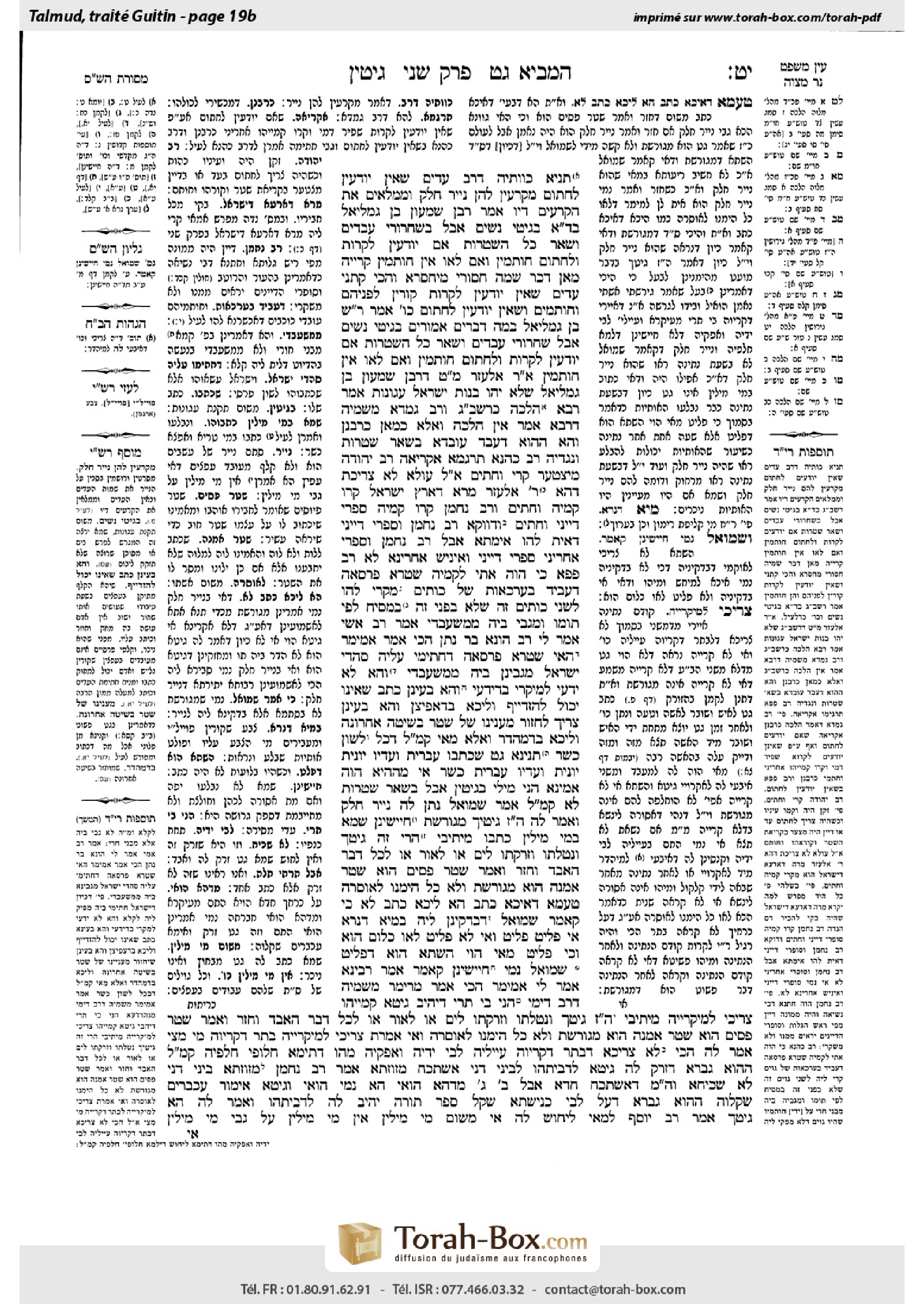
Gittin 19b: Talmud study for Daf Yomi
Study the Talmud for Daf Yomi with scanned pages, Hebrew text, English translations from Sefaria and AI-generated French translations.
Passage selection and English or AI-generated French translation are available where the scan has annotations. Daf Study is independent of Torah-Box and Sefaria.
Browse Gittin · גיטין · All tractatesGittin 19b text and translations
This page of Gittin includes the Aramaic text, an English translation and an AI-generated French translation, alongside the scan above.
גיטין י״ט ב · Aramaic and Hebrew text
תַּנְיָא כְּווֹתֵיהּ דְּרַב: עֵדִים שֶׁאֵין יוֹדְעִין לַחְתּוֹם, מְקָרְעִין לָהֶן נְיָיר חָלָק וּמְמַלְּאִים אֶת הַקְּרָעִים דְּיוֹ.
אָמַר רַבָּן שִׁמְעוֹן בֶּן גַּמְלִיאֵל: בַּמֶּה דְּבָרִים אֲמוּרִים – בְּגִיטֵּי נָשִׁים; אֲבָל בְּשִׁחְרוּרֵי עֲבָדִים וּשְׁאָר כׇּל הַשְּׁטָרוֹת, אִם יוֹדְעִין לִקְרוֹת וְלַחְתּוֹם – חוֹתְמִין, וְאִם לָאו – אֵין חוֹתְמִין.
קְרִיָּיה מַאן דְּכַר שְׁמַהּ? חַסּוֹרֵי מִיחַסְּרָא, וְהָכִי קָתָנֵי: עֵדִים שֶׁאֵין יוֹדְעִין לִקְרוֹת – קוֹרִין לִפְנֵיהֶם וְחוֹתְמִים, וְשֶׁאֵין יוֹדְעִין לַחְתּוֹם כּוּ׳. אָמַר רַבִּי שִׁמְעוֹן בֶּן גַּמְלִיאֵל: בַּמֶּה דְּבָרִים אֲמוּרִים, בְּגִיטֵּי נָשִׁים; אֲבָל שִׁחְרוּרֵי עֲבָדִים וּשְׁאָר כׇּל הַשְּׁטָרוֹת, אִם יוֹדְעִין לִקְרוֹת וְלַחְתּוֹם – חוֹתְמִין, וְאִם לָאו – אֵין חוֹתְמִין.
אָמַר רַבִּי אֶלְעָזָר: מַאי טַעְמָא דְּרַבָּן שִׁמְעוֹן בֶּן גַּמְלִיאֵל? שֶׁלֹּא יְהוּ בְּנוֹת יִשְׂרָאֵל עֲגוּנוֹת.
אָמַר רָבָא: הֲלָכָה כְּרַבָּן שִׁמְעוֹן בֶּן גַּמְלִיאֵל. וְרַב גַּמָּדָא מִשְּׁמֵיהּ דְּרָבָא אָמַר: אֵין הֲלָכָה. וְאֶלָּא כְּמַאן, כְּרַבָּנַן?!
וְהָא הָהוּא דַּעֲבַד עוֹבָדָא בִּשְׁאָר שְׁטָרוֹת, וְנַגְּדֵיהּ רַב כָּהֲנָא! תַּרְגְּמַהּ אַקְּרִיאָה.
רַב יְהוּדָה מִיצְטַעַר קָרֵי וְחָתֵים. אֲמַר לֵיהּ עוּלָּא: לָא צְרִיכַתְּ, דְּהָא רַבִּי אֶלְעָזָר מָרָא דְּאֶרֶץ יִשְׂרָאֵל – קָרוּ קַמֵּיהּ וְחָתֵים, וְרַב נַחְמָן – קָרוּ קַמֵּיהּ סָפְרֵי דַּיָּינֵי וְחָתֵים. וְדַוְוקָא רַב נַחְמָן וְסָפְרֵי דַּיָּינֵי, דְּאִית לְהוּ אֵימְתָא, אֲבָל רַב נַחְמָן וְסָפְרֵי אַחֲרִינֵי, סָפְרֵי דַּיָּינֵי וְאִינִישׁ אַחֲרִינָא – לָא.
רַב פָּפָּא, כִּי הֲוָה אָתֵי לְקַמֵּיהּ שְׁטָרָא פָּרְסָאָה דַּעֲבִיד בְּעַרְכָּאוֹת שֶׁל גּוֹיִם, מַקְרֵי לְהוּ לִשְׁנֵי גוֹיִם זֶה שֶׁלֹּא בִּפְנֵי זֶה בְּמֵסִיחַ לְפִי תּוּמּוֹ, וּמַגְבֵּי בֵּיהּ מִמְּשַׁעְבְּדִי.
אָמַר רַב אָשֵׁי: אָמַר לִי רַב הוּנָא בַּר נָתָן, הָכִי אָמַר אַמֵּימָר: הַאי שְׁטָרָא פָּרְסָאָה דַּחֲתִימִי עֲלֵיהּ סָהֲדִי יִשְׂרָאֵל, מַגְבֵּינַן בֵּיהּ מִמְּשַׁעְבְּדִי.
וְהָא לָא יָדְעִי לְמִיקְרֵי! בִּדְיָדְעִי. וְהָא בָּעֵינַן כְּתָב שֶׁאֵינוֹ יָכוֹל לְהִזְדַּיֵּיף, וְלֵיכָּא! בְּדַאֲפִיצָן. וְהָא בָּעֵינַן ״צָרִיךְ לַחֲזוֹר מֵעִנְיָנוֹ שֶׁל שְׁטָר בְּשִׁיטָה אַחֲרוֹנָה״, וְלֵיכָּא! בִּדְמַהְדַּר.
וְאֶלָּא מַאי קָא מַשְׁמַע לַן – דְּכׇל לָשׁוֹן כָּשֵׁר?! תְּנֵינָא: גֵּט שֶׁכְּתָבוֹ עִבְרִית וְעֵדָיו יְוָנִית, יְוָנִית וְעֵדָיו עִבְרִית – כָּשֵׁר!
אִי מֵהַהִיא, הֲוָה אָמֵינָא: הָנֵי מִילֵּי בְּגִיטִּין, אֲבָל בִּשְׁאָר שְׁטָרוֹת – לָא, קָא מַשְׁמַע לַן.
אָמַר שְׁמוּאֵל: נָתַן לָהּ נְיָיר חָלָק, וְאָמַר לַהּ: ״הֲרֵי זֶה גִּיטֵּיךְ״ – מְגוֹרֶשֶׁת; חָיְישִׁינַן שֶׁמָּא בְּמֵי מֵילִין כְּתָבוֹ.
מֵיתִיבִי: ״הֲרֵי זֶה גִּיטֵּךְ״; וּנְטָלַתּוּ וּזְרָקַתּוּ לַיָּם, אוֹ לָאוּר, אוֹ לְכׇל דָּבָר הָאָבֵד; וְחָזַר וְאָמַר: ״שְׁטַר פַּסִּים הוּא״, ״שְׁטַר אֲמָנָה הוּא״ – מְגוֹרֶשֶׁת, וְלֹא כׇּל הֵימֶנּוּ לְאוֹסְרָהּ.
טַעְמָא דְּאִיכָּא כְּתָב, הָא לֵיכָּא כְּתָב – לָא! כִּי קָאָמַר שְׁמוּאֵל, דְּבָדְקִינַן לֵיהּ בְּמַיָּא דְנָרָא; אִי פָּלֵיט – פָּלֵיט, וְאִי לָא פָּלֵיט – לָאו כְּלוּם הוּא.
וְכִי פָּלֵיט מַאי הָוֵי? הַשְׁתָּא הוּא דְּפָלֵיט! שְׁמוּאֵל נָמֵי, ״חָיְישִׁינַן״ קָאָמַר.
אָמַר רָבִינָא: אֲמַר לִי אַמֵּימָר, הָכִי אָמַר מָרִימָר מִשְּׁמֵיהּ דְּרַב דִּימִי: הָנֵי בֵּי תְרֵי דְּיָהֵיב גִּיטָּא קַמַּיְיהוּ, צְרִיכִי לְמִיקְרְיֵיהּ. מֵיתִיבִי: ״הֲרֵי זֶה גִּיטֵּךְ״; וּנְטָלַתּוּ וּזְרָקַתּוּ לַיָּם, אוֹ לָאוּר, אוֹ לְכׇל דָּבָר הָאָבֵד; וְחָזַר וְאָמַר ״שְׁטַר פַּסִּים הוּא״, ״שְׁטַר אֲמָנָה הוּא״ – מְגוֹרֶשֶׁת, וְלֹא כׇל הֵימֶנּוּ לְאוֹסְרָהּ. וְאִי אָמְרַתְּ צְרִיכִי לְמִיקְרְיֵיהּ, בָּתַר דְּקַרְיוּהּ מִי מָצֵי אָמַר לַהּ הָכִי?!
לָא צְרִיכָא, דְּבָתַר דְּקַרְיוּהּ עַיְּילֵיהּ לְבֵי יְדֵיהּ וְאַפְּקֵיהּ, מַהוּ דְּתֵימָא: חַלּוֹפֵי חַלְּפֵיהּ, קָא מַשְׁמַע לַן.
הָהוּא גַּבְרָא דִּזְרַק לָהּ גִּיטָּא לִדְבֵיתְהוּ לְבֵינֵי דַנֵּי, אִשְׁתְּכַח מְזוּזְתָּא. אָמַר רַב נַחְמָן: מְזוּזְתָּא בֵּינֵי דַנֵּי לָא שְׁכִיחָא.
וְהָנֵי מִילֵּי דְּאִשְׁתְּכַח חֲדָא, אֲבָל שְׁנַיִם שְׁלֹשָׁה – מִדְּהָא הֲוַאי, הָא נָמֵי הֲוַאי; וְגִיטָּא – אֵימוֹר עַכְבָּרִים שַׁקְלוּהּ.
הָהוּא גַּבְרָא דְּעָל לְבֵי כְנִישְׁתָּא, שְׁקַל סֵפֶר תּוֹרָה יְהַב לָהּ לִדְבֵיתְהוּ, וַאֲמַר לַהּ: הֵא גִּיטִּיךְ. אֲמַר רַב יוֹסֵף: לְמַאי לֵיחוּשׁ לַהּ? אִי מִשּׁוּם מֵי מֵילִין – אֵין מֵי מֵילִין עַל גַּבֵּי מֵי מֵילִין;
Gittin 19b · English translation
It is taught in a baraita in accordance with the opinion of Rav: In the case of witnesses who do not know how to sign, one tears a blank piece of paper for them, and they fill in the gaps with ink.
Rabban Shimon ben Gamliel said: In what case is this statement said? For bills of divorce. However, for bills of manumission and for all other documents, if the witnesses know how to read and how to sign, then they sign, and if they do not know how to read and sign they do not sign.
The Gemara asks: With regard to reading, who mentioned anything about it? Why does Rabban Shimon ben Gamliel mention the need for witnesses to be able to read when the discussion is about a witness who does not know how to sign? The Gemara answers: The baraita is incomplete, and this is what it is teaching: In the case of witnesses who do not know how to read, one reads the document in their presence and they sign. And in the case where they do not know how to sign, then one tears paper in the form of a stencil and they fill in the gaps with ink. With regard to this, Rabban Shimon ben Gamliel said: In what case is this statement said? For bills of divorce. However, for bills of manumission and for all other documents, if the witnesses know how to read and how to sign, then they sign, and if not they do not sign.
Rabbi Elazar says: What is the reason of Rabban Shimon ben Gamliel, who permitted this only for bills of divorce? He holds that there is reason to be lenient with bills of divorce, so that the daughters of Israel should not be deserted. Requiring literate witnesses for bills of divorce could lead to a scenario in which a husband wishes to travel and wants to give his wife a bill of divorce in case he shall not return, but if he does not find literate witnesses he may leave without divorcing her, leaving her unable to remarry.
Rava says: The halakha is in accordance with Rabban Shimon ben Gamliel. And Rav Gamda said in the name of Rava: The halakha is not in accordance with Rabban Shimon ben Gamliel. The Gemara asks: Rather, in accordance with whose opinion is the halakha? Is it in accordance with the opinion of the Rabbis, and it is permitted to do this for any document?
But wasn’t there a certain person who performed an action, and allowed witnesses to trace their names in a case of other documents that were not bills of divorce, and Rav Kahana ordered that he be flogged for doing so? The Gemara answers: Rav Gamda interpreted the statement of Rava only with regard to reading, meaning that the halakha is in accordance with the Rabbis and not Rabban Shimon ben Gamliel only with regard to the question of whether other documents may be read to the witnesses, but not with regard to whether they may sign other documents by means of a stencil.
It is told that Rav Yehuda was nearly blind in his old age. He could barely read and he took great pains to read and sign documents as a witness or a judge. Ulla said to him: It is not necessary for you to do this, as the court scribes would read in the presence of Rabbi Elazar the master, i.e., the halakhic authority of Eretz Yisrael, and he would sign; and the court scribes would read documents before Rav Naḥman and he would sign; and you may do the same. The Gemara notes: And this was done specifically in a case like that of Rav Naḥman and the court scribes, as they had fear of him because he was a great man and a judge to whom they were subservient. Therefore, there was no concern that they would not read it correctly. However, for Rav Naḥman and other scribes, or the court scribes and another person, no; the document may not be read to the witness, as the scribes may read it incorrectly to him.
The Gemara recounts the behavior of another amora who had documents read to him: When documents that were written in Persian and that were produced in gentile courts came before Rav Pappa, who did not know how to read Persian, he would have it be read by two gentiles, each one not in the presence of the other and in a way that each one would speak offhandedly, without knowing that they were giving testimony. Once he clarified what was written in the document he would collect payment with it even from liened property that had been sold, as he held that such a document is entirely valid with regard to monetary law.
Rav Ashi said that Rav Huna bar Natan said to me that so said Ameimar: With regard to this Persian document, on which Jews are signed as witnesses, the court is able to collect payment with it, even from liened property that had been sold.
The Gemara asks: But they don’t know how to read, as most Jews did not read Persian. The Gemara answers: Ameimar’s statement applies when they know how to read Persian. The Gemara questions how the court can rely upon such a document: But don’t we require all legal documents to be written in a writing that cannot be forged; and it is not so in documents produced by Persians, as the Persians were not particular about this when writing their legal documents. The Gemara answers: His statement applies in a case where the paper of the documents was processed with gall. Consequently, it is not possible to forge the writing. But we require a document to recap the essential topic of the document in its last line; and it is not so in the case of Persian documents. The Gemara answers: Ameimar’s statement applies in a case where the document recapped the essential topic of the document in the final line.
The Gemara asks: But if Ameimar’s statement applies only when all these conditions are met, then what is he teaching us, that a document that is properly written in any language is valid? We already learned in a mishna (87b): In the case of a bill of divorce that he wrote in Hebrew and its witnesses signed in Greek, or one that he wrote in Greek and its witnesses signed in Hebrew, it is valid. If this is written in the mishna, Ameimar’s statement would not simply repeat it.
The Gemara answers: This cannot serve as a clear proof, because if the only source for this halakha were from that mishna then I would say: This statement applies only for bills of divorce, where the Sages were lenient so that a woman would not be unable to remarry. However, for other documents, no. Consequently, Ameimar teaches us that other types of documents are valid if they are written in other languages as well.
§ Shmuel says: If a man gave his wife a blank piece of paper and said to her: This is hereby your bill of divorce, then she is divorced. Why? We are concerned that perhaps he wrote it with gall water, rendering it a valid bill of divorce, and the writing was subsequently absorbed into the paper so that it was no longer visible.
The Gemara raises an objection based on what was taught in a baraita (Tosefta 8:2): If a husband said to his wife: This is hereby your bill of divorce, and instead of opening it and looking at it she took it and threw it into the sea, or into a fire, or into anything that destroys it; and he later said: It wasn’t actually a bill of divorce, rather it is a document of appeasement [shetar passim], a symbolic promissory note meant only for display so that the person holding it will be considered to be wealthy; or he said: It is a document of trust, which is a false promissory note given by one person to another, trusting that he will not make use of it until there has been an actual loan; then she is divorced. And he does not have the power to make her forbidden to everyone else as a married woman by saying that it was not a bill of divorce and they are still married.
The Gemara makes an inference from the baraita: The reason she is divorced is because this bill of divorce has writing, and there is no way to ascertain what was written, but if it did not have writing, then no, there is no concern that perhaps it was a valid bill of divorce written with gall water. This runs counter to the statement of Shmuel. The Gemara answers: When Shmuel said that the woman was divorced with a blank piece of paper, it was in a case where we check the paper with a colored liquid [maya denara]. If the paper expels the writing, then it expels it and it is a valid bill of divorce. And if it does not expel it, then the document is nothing and she is not divorced.
The Gemara asks: And if the paper expels the writing, what of it? It is possible that only now it expels the writing and the letters become visible, but from the beginning there was no legible writing and therefore the document should be considered invalid. The Gemara answers that even Shmuel said only: We are concerned, and he does not hold that it is a valid bill of divorce. Rather, the court takes into account the possibility that what he gave her in the beginning was a valid bill of divorce, and the halakha is that it is uncertain if she is divorced.
Ravina said: Ameimar said to me that so said Mareimar in the name of Rav Dimi: These two witnesses who testify that the bill of divorce was given in their presence are required to read it. The Gemara raises an objection to this based on what was taught in a baraita: If a man says to a woman: This is hereby your bill of divorce, and instead of opening it and looking at it she took it and threw it into the sea, or into a fire, or into anything that destroys it, and he later said: It wasn’t actually a bill of divorce, but rather, it is a document of appeasement, or it is a document of trust; then she is divorced, and he does not have the power to make her forbidden to everyone else as a married woman by saying that it was not a bill of divorce and they are still married. And if you say that the witnesses need to read the bill of divorce, then is the husband able to say this to her after they read it?
The Gemara answers: No, it is necessary for Rav Dimi to teach his halakha in a case where after they read it, the husband placed it under his arm, and later took it out, and gave it to the woman without it being read again. Lest you say that he switched it with another document, and what he gave her was not a bill of divorce but a document of appeasement or trust as he claims, Rav Dimi teaches us that the court need not be concerned that he switched it.
The Gemara tells: There was a certain man who threw what he claimed was a bill of divorce to his wife, into her courtyard, among the barrels, and in the end a mezuza was found there. The question is: Is there a concern that he threw her a bill of divorce, and the bill of divorce was destroyed, and the mezuza happened to be in the same location? Or perhaps he threw her the mezuza and only claimed that it was a bill of divorce. Rav Naḥman said: A mezuza is infrequently placed among the barrels, and it can be assumed that he threw the mezuza and not a bill of divorce.
The Gemara comments: And this statement applies only when one mezuza was found. However, if two or three mezuzot were found, then the assumption is that as this, the other mezuza, was there, this mezuza was also there before the husband came, and as to the bill of divorce, say that the mice later took it, and the woman was already divorced from the moment it reached her courtyard.
It is told: There was a certain man who entered the synagogue, took a Torah scroll, and gave it to his wife. And he said to her: This is your bill of divorce. Rav Yosef said: For what is there to be concerned for it? If you say that there should be a concern due to gall water, that perhaps he wrote a bill of divorce on the outside of the Torah scroll’s parchment with gall water, and this writing is now invisible, gall water is not permanent when applied on top of gall water. Since parchment for the Torah scroll is processed with gall water, it is not possible to write something with gall water that will remain permanently on the parchment itself. Therefore, there is no concern that he wrote a bill of divorce on the parchment.
Gittin 19b · Traduction française (IA)
Il est enseigné dans une baraïta selon l'opinion de Rava : Dans le cas de témoins qui ne savent pas signer, on leur donne un morceau de papier vide à remplir, et ils remplissent les lacunes avec de l'encre.
Rabban Shimon ben Gamliel dit : Dans quel cas cette déclaration est-elle faite ? Pour les parchemins de divorce. Cependant, pour les parchemins de manumission et pour tous les autres documents, si les témoins savent lire et signer, ils signent, et si ils ne savent pas lire et signer, ils ne signent pas.
La Guemara pose la question : Concernant la lecture, qui a mentionné quelque chose ? Pourquoi Rabban Shimon ben Gamliel mentionne-t-il la nécessité que les témoins sachent lire alors que la discussion porte sur un témoin qui ne sait pas signer ? La Guemara répond : La baraïta est incomplète, et c'est ce qu'elle enseigne : Dans le cas de témoins qui ne savent pas lire, on lit le document devant eux et ils signent. Et dans le cas où ils ne savent pas signer, on déchire un papier en forme de masque et ils remplissent les lacunes avec de l'encre. Concernant cela, Rabban Shimon ben Gamliel dit : Dans quel cas cette déclaration est-elle faite ? Pour les parchemins de divorce. Cependant, pour les parchemins de manumission et pour tous les autres documents, si les témoins savent lire et signer, ils signent, et si non, ils ne signent pas.
Rabbi Elazar dit : Quel est le fondement de Rabban Shimon ben Gamliel, qui permet cela uniquement pour les parchemins de divorce ? Il considère qu'il y a une raison d'être indulgent avec les parchemins de divorce, afin que les filles d'Israël ne soient pas abandonnées. Exiger des témoins lettrés pour les parchemins de divorce pourrait entraîner une situation où un mari souhaite voyager et veut donner à sa femme un parchemin de divorce en cas de non-retour, mais s'il ne trouve pas des témoins lettrés, il peut partir sans divorcer, laissant sa femme incapable de se remarier.
Rava dit : La halakha suit l'opinion de Rabban Shimon ben Gamliel. Et Rav Gamda dit au nom de Rava : La halakha ne suit pas l'opinion de Rabban Shimon ben Gamliel. La Guemara pose la question : Plutôt, selon l'opinion de qui la halakha est-elle ? Est-elle selon l'opinion des Rabbins, et est-ce permis de le faire pour tout document ?
Mais n'y avait-il pas un certain homme qui a accompli une action, et qui a permis aux témoins de tracer leurs noms dans un cas de documents autres que les parchemins de divorce, et Rav Kahana a ordonné qu'il soit battu pour cela ? La Guemara répond : Rav Gamda a interprété la déclaration de Rava uniquement concernant la lecture, c'est-à-dire que la halakha suit les Rabbins et non Rabban Shimon ben Gamliel uniquement concernant la question de savoir si d'autres documents peuvent être lus aux témoins, mais pas concernant savoir si les témoins peuvent signer d'autres documents par le biais d'un masque.
On raconte que Rav Yehuda était presque aveugle à son âge avancé. Il pouvait à peine lire et il prenait de grandes peines pour lire et signer des documents en tant que témoin ou juge. Ulla lui a dit : Il n'est pas nécessaire que vous fassiez cela, car les scribes du tribunal liraient devant le maître, c'est-à-dire l'autorité halakhique d'Israël, et il signerait ; et les scribes du tribunal liraient les documents devant Rav Naḥman et il signerait ; et vous pouvez faire de même. La Guemara note : Et cela a été fait spécifiquement dans un cas semblable à celui de Rav Naḥman et des scribes, car ils avaient peur de lui car il était un grand homme et un juge auquel ils étaient soumis. Par conséquent, il n'y avait pas de préoccupation qu'ils ne liraient pas correctement. Cependant, pour Rav Naḥman et d'autres scribes, ou les scribes du tribunal et une autre personne, non ; le document ne peut pas être lu aux témoins, car les scribes pourraient le lire incorrectement.
La Guemara raconte le comportement d'un autre amora qui avait des documents lus : Lorsque des documents écrits en persan et produits devant des tribunaux païens étaient présents devant Rav Pappa, qui ne savait pas lire le persan, il les faisait lire par deux païens, chacun en privé et de manière qu'ils parlassent sans savoir qu'ils témoignaient. Une fois qu'il avait clarifié ce qui était écrit dans le document, il pouvait récupérer le paiement même sur des biens liés vendus, car il considérait que ce document était entièrement valide concernant la loi civile.
Rav Ashi a dit que Rav Huna bar Natan m'avait dit que Ameimar avait dit : Concernant ce document persan, sur lequel des Juifs sont signés comme témoins, le tribunal peut récupérer le paiement avec lui, même sur des biens liés vendus.
La Guemara pose la question : Mais ils ne savent pas lire, car la plupart des Juifs ne lisaient pas le persan. La Guemara répond : La déclaration d'Ameimar s'applique lorsque ils savent lire le persan. La Guemara questionne comment le tribunal peut se fier à ce document : Mais ne demandons-nous pas que tous les documents légaux soient écrits dans une écriture qui ne puisse pas être falsifiée ; et ce n'est pas le cas des documents produits par les Perses, car les Perses ne s'occupaient pas de cela lorsqu'ils écrivaient leurs documents légaux. La Guemara répond : Sa déclaration s'applique dans un cas où le papier des documents était traité avec du gall. Par conséquent, il n'est pas possible de falsifier l'écriture. Mais nous exigeons qu'un document recapitule le sujet essentiel du document dans sa dernière ligne ; et ce n'est pas le cas des documents persans. La Guemara répond : La déclaration d'Ameimar s'applique dans un cas où le document recapitulait le sujet essentiel du document dans la dernière ligne.
La Guemara pose la question : Mais si la déclaration d'Ameimar s'applique uniquement lorsque toutes ces conditions sont remplies, alors que nous apprend-il, que tout document correctement écrit dans toute langue est valide ? Nous avons déjà appris dans une mishna (87b) : Dans le cas d'un parchemin de divorce qu'il a écrit en hébreu et dont les témoins ont signé en grec, ou un qui a écrit en grec et dont les témoins ont signé en hébreu, il est valide. Si cela est écrit dans la mishna, la déclaration d'Ameimar ne répéterait pas simplement cela.
La Guemara répond : Cela ne peut pas servir de preuve claire, car si la seule source de cette halakha provenait de cette mitsna, je dirais : cette déclaration s'applique uniquement aux parchemins de divorce, où les Sages ont été indulgents afin que la femme ne soit pas empêchée de se remarier. Cependant, pour d'autres documents, non. Ainsi, Ameimar nous apprend que d'autres types de documents sont valides même s'ils sont rédigés dans d'autres langues.
§ Shmuel dit : Si un homme donne à sa femme un morceau de papier vierge et dit à elle : C'est ici votre parchemin de divorce, alors elle est divorcée. Pourquoi ? Nous craignons qu'il ait écrit avec de l'eau de gall, rendant le document valide, et que l'écriture ait ensuite été absorbée par le papier, de sorte qu'elle ne soit plus visible.
La Guemara soulève une objection basée sur ce qui a été enseigné dans une baraïta (Tosefta 8:2) : Si un mari dit à sa femme : C'est ici votre parchemin de divorce, et au lieu d'ouvrir et de le consulter, elle le prend et le jette dans la mer, ou dans le feu, ou dans toute chose qui le détruit ; et plus tard il dit : Ce n'était pas vraiment un parchemin de divorce, mais plutôt un document de réconciliation [shetar passim], une note symbolique de promesse destinée à l'affichage afin que la personne qui le détient soit considérée comme riche ; ou il dit : C'est un document de confiance, qui est une note de promesse fausse donnée par une personne à une autre, en confiant qu'il ne l'utilisera pas avant qu'un prêt réel n'ait eu lieu ; alors elle est divorcée. Et il n'a pas le pouvoir de la rendre interdite à tous les autres comme femme mariée en disant qu'il ne s'agissait pas d'un parchemin de divorce et qu'ils sont encore mariés.
La Guemara tire une conséquence de cette baraïta : La raison pour laquelle elle est divorcée est que ce parchemin de divorce a une écriture, et il n'y a aucun moyen de savoir ce qui a été écrit, mais si celui-ci n'avait pas d'écriture, alors non, il n'y a pas de crainte qu'il s'agisse d'un parchemin de divorce valide écrit avec de l'eau de gall. Cela contredit la déclaration de Shmuel. La Guemara répond : Lorsque Shmuel a dit que la femme était divorcée avec un morceau de papier vierge, c'était dans un cas où nous vérifions le papier avec un liquide coloré [maya denara]. Si le papier expulse l'écriture, alors il l'expulse et c'est un parchemin de divorce valide. Et si ce n'est pas le cas, alors le document est vide et elle n'est pas divorcée.
La Guemara pose une question : Et si le papier expulse l'écriture, qu'est-ce que cela signifie ? Il est possible que seulement maintenant il expulse l'écriture et les lettres deviennent visibles, mais depuis le début il n'y avait pas d'écriture lisible et donc le document devrait être considéré comme invalide. La Guemara répond que même Shmuel a dit seulement : Nous craignons, et il ne considère pas que c'est un parchemin de divorce valide. Plutôt, le tribunal tient compte de la possibilité que ce qu'il lui a donné au début était un parchemin de divorce valide, et la halakha est que c'est incertain si elle est divorcée.
Ravina dit : Ameimar m'a dit que Mareimar a dit en nom de Rav Dimi : Ces deux témoins qui témoignent que le parchemin de divorce a été donné en leur présence doivent le lire. La Guemara soulève une objection à cela, basée sur ce qui a été enseigné dans une baraïta : Si un homme dit à une femme : C'est ici votre parchemin de divorce, et au lieu d'ouvrir et de le consulter, elle le prend et le jette dans la mer, ou dans le feu, ou dans toute chose qui le détruit, et plus tard il dit : Ce n'était pas vraiment un parchemin de divorce, mais plutôt un document de réconciliation, ou un document de confiance ; alors elle est divorcée, et il n'a pas le pouvoir de la rendre interdite à tous les autres comme femme mariée en disant qu'il ne s'agissait pas d'un parchemin de divorce et qu'ils sont encore mariés. Et si vous dites que les témoins doivent lire le parchemin de divorce, alors le mari peut-il dire cela à elle après qu'ils l'ont lu ?
La Guemara répond : Non, il est nécessaire que Rav Dimi enseigne sa halakha dans un cas où, après qu'ils l'ont lu, le mari le place sous son bras, et plus tard le sort, et le donne à la femme sans le relire à nouveau. De peur qu'il l'ait remplacé par un autre document, et ce qu'il lui a donné n'était pas un parchemin de divorce mais un document de réconciliation ou de confiance comme il le prétend, Rav Dimi nous apprend que le tribunal n'a pas besoin de s'inquiéter qu'il l'ait remplacé.
La Guemara dit : Il y avait un certain homme qui jeta ce qu'il affirmait être un parchemin de divorce à sa femme, dans son courtil, parmi les barriques, et à la fin un mezuza fut trouvé là. La question est : y a-t-il une crainte qu'il ait jeté à sa femme un parchemin de divorce, et que ce dernier ait été détruit, et que le mezuza ait été trouvé là par hasard ? Ou peut-être qu'il ait jeté à sa femme le mezuza et qu'il ait seulement affirmé qu'il s'agissait d'un parchemin de divorce. Rav Naḥman dit : Le mezuza est rarement placé parmi les barriques, et on peut supposer qu'il a jeté le mezuza et non le parchemin de divorce.
La Guemara commente : Et cette déclaration s'applique uniquement lorsqu'un seul mezuza a été trouvé. Cependant, si deux ou trois mezuzot ont été trouvés, alors on suppose que, comme celle-ci, l'autre mezuza était là, et que cette mezuza était déjà là avant que le mari n'arrive, et concernant le parchemin de divorce, on dit que les rats l'ont emporté plus tard, et la femme était déjà divorcée depuis le moment où il a atteint son courtil.
On raconte : Il y avait un certain homme qui est entré dans la synagogue, a pris un rouleau de Torah, et l'a donné à sa femme. Et il a dit à elle : C'est votre parchemin de divorce. Rav Yosef dit : Pourquoi y aurait-il une crainte ? Si vous dites qu'il y a une crainte en raison de l'eau de gall, que peut-être il a écrit un parchemin de divorce sur l'extérieur du parchemin du rouleau de Torah avec de l'eau de gall, et que cette écriture est maintenant invisible, l'eau de gall n'est pas permanente lorsqu'elle est appliquée sur l'eau de gall. Puisque le parchemin du rouleau de Torah est traité avec de l'eau de gall, il n'est pas possible d'écrire quelque chose avec de l'eau de gall qui reste permanent sur le parchemin lui-même. Ainsi, il n'y a pas de crainte qu'il ait écrit un parchemin de divorce sur le parchemin.
Traduction française générée par IA à partir de l’édition anglaise de Sefaria. Vérifie toujours un passage avec le texte source.
Text from Sefaria: William Davidson Edition - Vocalized Aramaic (CC BY NC); William Davidson Edition - English (CC BY NC).