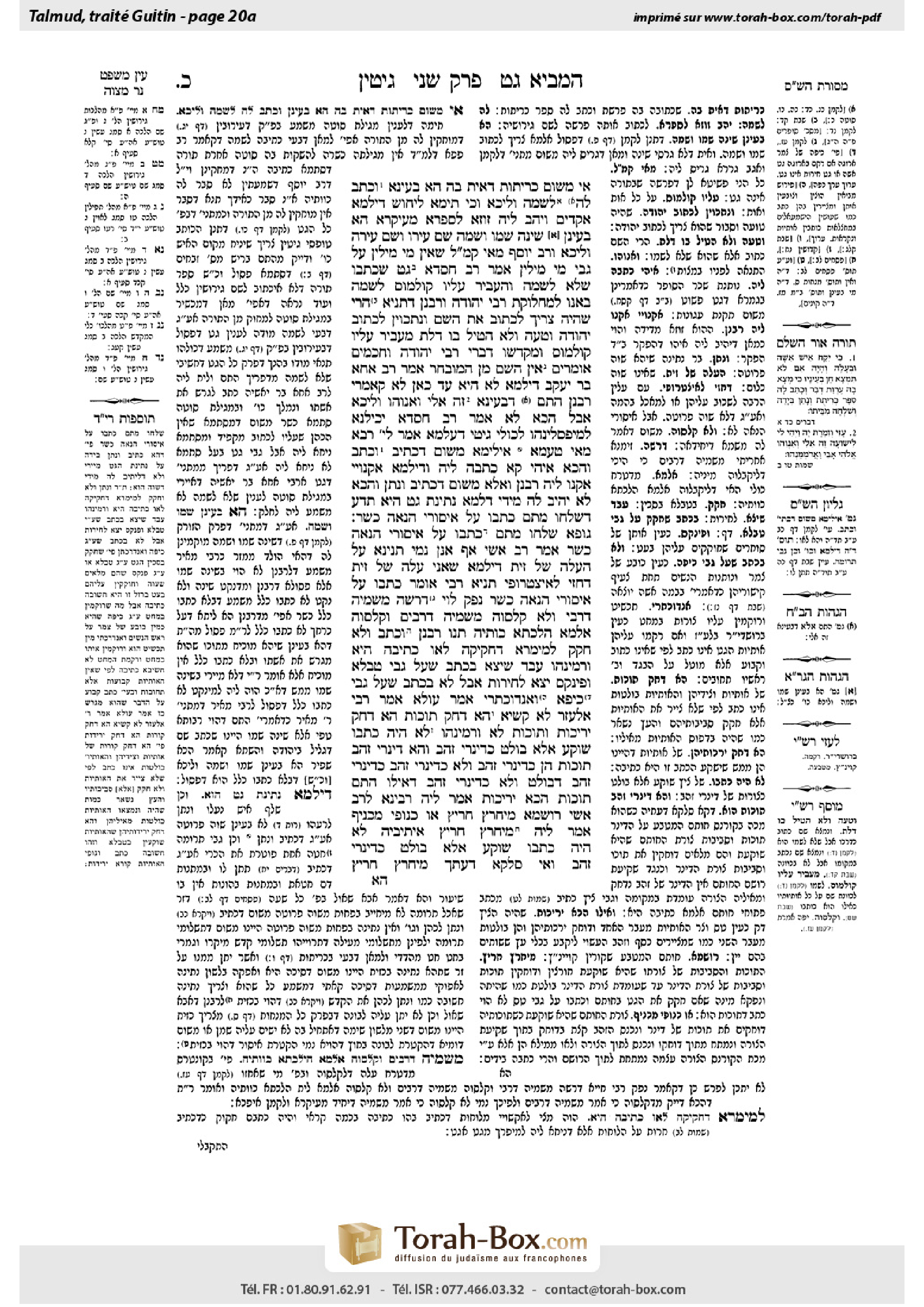
Gittin 20a: Talmud study for Daf Yomi
Study the Talmud for Daf Yomi with scanned pages, Hebrew text, English translations from Sefaria and AI-generated French translations.
Passage selection and English or AI-generated French translation are available where the scan has annotations. Daf Study is independent of Torah-Box and Sefaria.
Browse Gittin · גיטין · All tractatesGittin 20a text and translations
This page of Gittin includes the Aramaic text, an English translation and an AI-generated French translation, alongside the scan above.
גיטין כ׳ א · Aramaic and Hebrew text
אִי מִשּׁוּם כְּרִיתוּת דְּאִית בַּהּ – הָא בָּעֵינָא ״וְכָתַב לָהּ״ – לִשְׁמָהּ, וְלֵיכָּא.
וְכִי תֵּימָא, לֵיחוּשׁ דִּילְמָא אַקְדֵּים וִיהַב לֵיהּ זוּזָא לְסָפְרָא מֵעִיקָּרָא; הָא בָּעֵינַן ״שִׁינָּה שְׁמוֹ וּשְׁמָהּ, שֵׁם עִירוֹ וְשֵׁם עִירָהּ״, וְלֵיכָּא.
וְרַב יוֹסֵף מַאי קָא מַשְׁמַע לַן? שֶׁאֵין מֵי מֵילִין עַל גַּבֵּי מֵי מֵילִין.
אָמַר רַב חִסְדָּא: גֵּט שֶׁכְּתָבוֹ שֶׁלֹּא לִשְׁמָהּ, וְהֶעֱבִיר עָלָיו קוּלְמוֹס לִשְׁמָהּ, בָּאנוּ לְמַחְלוֹקֶת רַבִּי יְהוּדָה וְרַבָּנַן.
דְּתַנְיָא: הֲרֵי שֶׁהָיָה צָרִיךְ לִכְתּוֹב אֶת הַשֵּׁם, וְנִתְכַּוֵּין לִכְתּוֹב ״יְהוּדָה״ וְטָעָה וְלֹא הֵטִיל בּוֹ דָּלֶת, מַעֲבִיר עָלָיו קוּלְמוֹס וּמְקַדְּשׁוֹ, דִּבְרֵי רַבִּי יְהוּדָה. וַחֲכָמִים אוֹמְרִים: אֵין הַשֵּׁם מִן הַמּוּבְחָר.
אָמַר רַב אַחָא בַּר יַעֲקֹב: דִּילְמָא לָא הִיא; עַד כָּאן לָא קָאָמְרִי רַבָּנַן הָתָם, דְּבָעֵינָא זֶה אֵלִי וְאַנְוֵהוּ, וְלֵיכָּא; אֲבָל הָכָא לָא.
אָמַר רַב חִסְדָּא: יָכֵילְנָא לְמִיפְסְלִינְהוּ (לְכוּלֵּי) [לְכוּלְּהוּ] גִּיטֵּי דְּעָלְמָא. אֲמַר לֵיהּ רָבָא: מַאי טַעְמָא? אִילֵּימָא מִשּׁוּם דִּכְתִיב ״וְכָתַב״, וְהָכָא אִיהִי קָא כָּתְבָה לֵיהּ; וְדִילְמָא אַקְנוֹיֵי אַקְנוֹ לֵיהּ רַבָּנַן?
וְאֶלָּא מִשּׁוּם דִּכְתִיב: ״וְנָתַן״, וְהָכָא לָא יָהֵיב לַהּ מִידֵּי?! דִּלְמָא נְתִינַת גֵּט הִיא! תֵּדַע, דִּשְׁלַחוּ מִתָּם: כְּתָבוֹ עַל אִיסּוּרֵי הֲנָאָה – כָּשֵׁר.
גּוּפָא – שְׁלַחוּ מִתָּם: כְּתָבוֹ עַל אִיסּוּרֵי הֲנָאָה – כָּשֵׁר. אָמַר רַב אָשֵׁי: אַף אֲנַן נָמֵי תְּנֵינָא: ״עַל הֶעָלֶה שֶׁל זַיִת״! דִּילְמָא שָׁאנֵי עָלֶה שֶׁל זַיִת, דַּחֲזֵי לְאִיצְטְרוֹפֵי.
תַּנְיָא, רַבִּי אוֹמֵר: כְּתָבוֹ עַל אִיסּוּרֵי הֲנָאָה – כָּשֵׁר. נְפַק לֵוִי, דַּרְשַׁהּ מִשְּׁמֵיהּ דְּרַבִּי, וְלָא קַלְּסוּהּ. מִשְּׁמֵיהּ דְּרַבִּים, וְקַלְּסוּהּ. אַלְמָא הִלְכְתָא כְּוָתֵיהּ.
תָּנוּ רַבָּנַן: ״וְכָתַב״ – וְלֹא חָקַק. לְמֵימְרָא דַּחֲקִיקָה לָאו כְּתִיבָה הִיא?! וּרְמִינְהוּ: עֶבֶד שֶׁיָּצָא בִּכְתָב שֶׁעַל גַּבֵּי טַבְלָא, וּפִינְקָס, יָצָא לְחֵירוּת. אֲבָל לֹא בִּכְתָב שֶׁעַל גַּבֵּי כִּיפָּא וְאַנְדּוּכְתַּרִי!
אָמַר עוּלָּא, אָמַר רַבִּי אֶלְעָזָר: לָא קַשְׁיָא – הָא דְּחַק תּוֹכוֹת, הָא דְּחַק יְרֵיכוֹת.
וְתוֹכוֹת – לָא?! וּרְמִינְהוּ: לֹא הָיָה כְּתָבוֹ שׁוֹקֵעַ, אֶלָּא בּוֹלֵט – כְּדִינְרֵי זָהָב. וְהָא דִּינְרֵי זָהָב תּוֹכוֹת הֵן!
כְּדִינְרֵי זָהָב, וְלֹא כְּדִינְרֵי זָהָב. כְּדִינְרֵי זָהָב – דְּבוֹלֵט; וְלֹא כְּדִינְרֵי זָהָב – דְּאִילּוּ הָתָם תּוֹכוֹת, הָכָא יְרֵיכוֹת.
אֲמַר לֵיהּ רָבִינָא לְרַב אָשֵׁי: רוּשְׁמָא – מִיחְרָץ חֲרִיץ, אוֹ כַּנּוֹפֵי מְכַנֵּיף? אֲמַר לֵיהּ: מִיחְרָץ חֲרִיץ.
אֵיתִיבֵיהּ: לֹא הָיָה כְּתָבוֹ שׁוֹקֵעַ, אֶלָּא בּוֹלֵט כְּדִינְרֵי זָהָב. וְאִי סָלְקָא דַעְתָּךְ מִיחְרָץ חֲרִיץ –
Gittin 20a · English translation
If there is a concern that the Torah scroll can effect a divorce due to the verses concerning severance of marriage that there are in it, as it is written: “And he writes her a scroll of severance” (Deuteronomy 24:1), this is also not problematic, since it is required, as it states: “And he writes her.” This indicates that the bill of divorce must be written for her sake, i.e., it must be written for the express intent of being used to effect divorce between this specific man and this specific woman, and this is not so in the case of a Torah scroll.
And if you would say that there is reason to be concerned that perhaps he first gave a dinar to the scribe at the outset, when he wrote the Torah scroll, and told him to write the verses discussing divorce for his wife’s sake, isn’t there a need for other things to be written in a bill of divorce as well, as the mishna (80a) teaches: If the scribe changed his name or her name, the name of his city or the name of her city, then the bill of divorce is invalid. The validity of a bill of divorce depends upon these details being written, and they are not in the Torah scroll.
The Gemara asks: But if so, what is Rav Yosef teaching us with his statement? It seems obvious that there is no reason why a Torah scroll could be used as a bill of divorce. The Gemara says: He is teaching us that gall water is not permanent when applied on top of gall water. The novel idea is that there is no need to be concerned that the scribe wrote a bill of divorce in gall water on the outside of the Torah scroll.
§ Rav Ḥisda says: If a bill of divorce was written not for her sake, and the scribe passed over it with a reed pen, meaning that he wrote on top of what was already written, for her sake, then here we have arrived at the dispute between Rabbi Yehuda and the Rabbis.
As it is taught in a baraita: If a scribe writing a Torah scroll was at a point in the text that he needed to write the name of God, spelled yod, heh, vav, heh; and he erred and intended to write Yehuda, spelled yod, heh, vav, dalet, heh, but he made a mistake when writing Yehuda and did not place a dalet in the word, thereby unintentionally writing the name of God in the correct place, then he should pass over it with a reed pen. He writes over what was written and sanctifies it with the intention that he is writing the name of God. This is the statement of Rabbi Yehuda. And the Rabbis say: Even if he adds a second layer of ink, the name has not been written in the optimal manner. According to Rabbi Yehuda, one can supply the intention of writing the name of God for its own sake even when adding a second layer of writing over the first, while according to the Rabbis one cannot. The same dispute would presumably apply in the case of a bill of divorce.
Rav Aḥa bar Ya’akov said: Perhaps that is not so, and the Rabbis say only there, in the case of a Torah scroll, that one may not write the name of God in this manner, because it is required that one perform anything sacred, including the writing of a Torah scroll, in accordance with the verse: “This is my God, and I will glorify Him” (Exodus 15:2). This verse requires that mitzvot be performed in a way that is glorious and aesthetically pleasing, and rewriting in this manner is not considered beautiful. But here, with regard to a bill of divorce, there is no requirement that the bill of divorce be written beautifully, and therefore writing over the bill of divorce is acceptable according to the Rabbis as well.
§ Rav Ḥisda said: I am able to invalidate all the bills of divorce in the world. Most bills of divorce are written in a way that they could be declared invalid. If one were to be particular about certain details, then there would be no valid bills of divorce. Rava said to him: What is the reason that you could invalidate them? If we say: Most bills of divorce are invalid because it is written in the Torah: “And he writes her a scroll of severance” (Deuteronomy 24:1), and here, in the case of most bills of divorce, she writes it for him, as it is customary for a woman to pay a scribe to write the bill of divorce, but then perhaps it could be maintained that the Sages transferred the ownership of the bill of divorce to him, and it is considered as if he wrote it.
But rather, you might say that it is because it is written: “And gives” (Deuteronomy 24:1), which is usually understood to mean that the item given must have some monetary value, and here in the case of most bills of divorce he doesn’t give her anything of value. Perhaps the mere giving of the bill of divorce is the giving mentioned in the Torah, even if it does not have any monetary value. Know that it is not a requirement that the bill of divorce have monetary value, as the Sages sent this message from there, from Eretz Yisrael: If he wrote a bill of divorce on items from which benefit is forbidden, then although the bill of divorce is completely lacking monetary value, the bill of divorce is valid.
§ The Gemara discusses the matter itself: The Sages sent this message from there, from Eretz Yisrael: If he wrote a bill of divorce on items from which benefit is forbidden, the bill of divorce is valid. Rav Ashi said: We, too, learn in the mishna that a bill of divorce may be written on an olive leaf, which has virtually no monetary value. This teaches that the bill of divorce need not have any value on its own, and even forbidden items, which have no value at all, may be used as the base on which the bill of divorce is written. The Gemara rejects this: Perhaps an olive leaf is different, because it can combine with more leaves, and they will add up to have monetary value. However, an item from which one is prohibited from benefiting lacks value entirely, even in large quantities.
With regard to the same halakha, the Gemara quotes an additional source. It is taught in a baraita that Rabbi Yehuda HaNasi says: If the scribe wrote a bill of divorce on items from which benefit is forbidden, it is valid. Levi went out and expounded upon this halakha in the name of Rabbi Yehuda HaNasi, and they did not praise him. He then expounded this halakha in the name of the majority, as an unattributed halakha, and they praised him. Apparently, the halakha is in accordance with the opinion of Rabbi Yehuda HaNasi. Therefore, when he stated the halakha in the name of Rabbi Yehuda HaNasi, an individual, which may have led the listeners to think that it was a minority opinion and not the accepted halakha, they did not praise him.
§ The Sages taught that it is said in the Torah with regard to a bill of divorce: “And he writes her a scroll of severance,” in order to emphasize that one must write the document and not chisel it. The Gemara asks: Is this to say that chiseling is not writing? And the Gemara raises a contradiction based on what was taught in a baraita: If a slave is emancipated through a bill of manumission that was written by being chiseled on a slate [tavla] or on a tablet [pinekas], then he goes free. However, he does not go free through writing on a cap or on an embroidered adornment. If the master embroidered the bill of manumission onto a cloth and gave it to the slave, this is not considered to be like the writing of a document. In any case, the baraita teaches that a bill of manumission that is chiseled onto a slate is valid.
Ulla said that Rabbi Elazar said: It is not difficult. This case, where the document is not valid because engraving is not considered to be writing, occurs when the scribe chiseled the area surrounding the letters, i.e., he chiseled on the surface around the shape of the letters, leaving the letters raised on the tablet. This case, where the document is valid because chiseling is considered to be writing, occurs when he chiseled the parts of the letters, i.e., he chiseled the shape of the letters themselves onto the slate. Since he formed the letters directly, it is considered like writing.
The Gemara asks: And if he chiseled the area surrounding the letters, is this not considered to be writing at all? And the Gemara raises a contradiction based on what was taught: The writing of the High Priest’s frontplate was not embedded, i.e., it was not carved into the frontplate; rather, it protruded like the form on gold dinars. And isn’t the shape on gold dinars formed by chiseling the area surrounding the letters, by applying pressure around the shape, so that the image and writing protrudes, and yet this is considered to be writing?
The Gemara answers: It means that the frontplate was fashioned like the form of gold dinars but not entirely like the form of gold dinars. It was fashioned like the form of gold dinars in that the writing protrudes, but it was not fashioned like the form of gold dinars entirely, as there, in the case of gold dinars, they chiseled the area surrounding the letters. Here, when making the frontplate, the inscription was done by chiseling the parts of the letter, i.e., they would carve the letters from the back of the frontplate so that they protruded from the front. Since the letters were carved directly, it was considered to be writing.
With regard to this issue, Ravina said to Rav Ashi: Does the press that forms a metal coin carve out the background in the metal and the image of the coin is formed on its own, or does it compress the metal inward toward the empty space in the press and the letters are formed through this? He said to him: It carves out the background.
He raised an objection to his opinion based on what was taught earlier: The writing of the High Priest’s frontplate was not embedded, i.e., it was not carved into the frontplate; rather, it protruded like the form on gold dinars. And if it enters your mind to say that a press only carves out the background,
Gittin 20a · Traduction française (IA)
Si l'on craint que le livre de la Torah puisse provoquer un divorce en raison des versets relatifs à la rupture du mariage qu'il contient, comme il est écrit : « Et il écrit à elle un livre de séparation » (Deutéronome 24:1), cela n'est pas problématique non plus, car il est requis, comme il dit : « Et il écrit à elle. » Cela indique que le document de divorce doit être écrit à son intention, c'est-à-dire qu'il doit être écrit avec l'intention spécifique de provoquer le divorce entre ce mari particulier et cette femme particulière, et cela n'est pas le cas pour un livre de la Torah.
Et si l'on dit que l'on a une raison de craindre que peut-être il ait d'abord donné un dinar au scribe au début, lorsqu'il écrivait le livre de la Torah, et lui ait dit d'écrire les versets relatifs au divorce à l'intention de sa femme, n'y a-t-il pas besoin d'autres choses d'être écrites dans un document de divorce également, comme l'enseigne la mitsva (80a) : Si le scribe a changé le nom de lui ou de elle, le nom de sa ville ou le nom de sa ville, alors le document de divorce est invalide. La validité d'un document de divorce dépend de ces détails être écrits, et ils ne sont pas dans le livre de la Torah.
La Guemara pose la question : Mais si c'est ainsi, que nous apprend le maître Rav Yosef avec son déclaration ? Il semble évident qu'il n'y a pas de raison pour laquelle un livre de la Torah puisse être utilisé comme un document de divorce. La Guemara dit : Il nous apprend que l'eau de gall ne reste pas permanente lorsqu'elle est appliquée sur l'eau de gall. L'idée nouvelle est que l'on n'a pas besoin de craindre que le scribe ait écrit un document de divorce avec l'eau de gall sur l'extérieur du livre de la Torah.
§ Rav Ḥisda dit : Si un document de divorce a été écrit non à son intention, et que le scribe l'a passé avec un pinceau en roseau, c'est-à-dire qu'il a écrit sur ce qui avait déjà été écrit à son intention, alors nous arrivons à la dispute entre Rabbi Yehuda et les Rabbins.
Comme il est enseigné dans une baraïta : Si un scribe écrivant un livre de la Torah était à un point du texte où il devait écrire le nom de Dieu, écrit yod, heh, vav, heh ; et s'il s'était trompé et avait voulu écrire Yehuda, écrit yod, heh, vav, dalet, heh, mais s'était trompé lors de l'écriture de Yehuda et n'avait pas mis un dalet dans le mot, écrivant ainsi par inadvertance le nom de Dieu à l'endroit correct, alors il devrait le passer avec un pinceau en roseau. Il écrit sur ce qui avait été écrit et le sanctifie avec l'intention qu'il écrit le nom de Dieu. C'est l'opinion de Rabbi Yehuda. Et les Rabbins disent : Même s'il ajoute une couche d'encre secondaire, le nom n'a pas été écrit de manière optimale. Selon Rabbi Yehuda, on peut fournir l'intention d'écrire le nom de Dieu à son propre sujet même lorsqu'on ajoute une couche d'écriture secondaire, tandis que selon les Rabbins on ne peut pas. La même dispute s'appliquerait probablement dans le cas d'un document de divorce.
Rav Aḥa bar Ya’akov dit : Peut-être que cela n'est pas ainsi, et les Rabbins disent seulement là, dans le cas d'un livre de la Torah, que l'on ne peut pas écrire le nom de Dieu de cette manière, car il est requis de faire tout ce qui est sacré, y compris l'écriture d'un livre de la Torah, conformément au verset : « C'est mon Dieu, et je le glorifierai » (Exode 15:2). Ce verset exige que les mitsvot soient exécutés d'une manière glorieuse et esthétique, et l'écriture de cette manière n'est pas considérée comme belle. Mais ici, concernant un document de divorce, il n'y a pas de nécessité que le document de divorce soit écrit de manière belle, et donc l'écriture sur le document de divorce est acceptable selon les Rabbins également.
§ Rav Ḥisda dit : Je suis capable d'invalider tous les gueures de divorce du monde. La plupart des gueures de divorce sont écrites d'une manière qui pourrait être déclarée nulles. Si l'on était particulier sur certains détails, alors il n'y aurait plus de gueures de divorce valides. Rava dit à lui : Quelle est la raison que tu puisses les invalider ? Si nous disons : La plupart des gueures de divorce sont nulles parce qu'il est écrit dans la Torah : « Et il écrit à elle un livre de séparation » (Deutéronome 24:1), et ici, dans le cas de la plupart des gueures de divorce, elle l'écrit à son intention, car c'est la coutume qu'une femme paie un scribe pour écrire la gueure de divorce, mais alors peut-être on pourrait maintenir que les Sages ont transféré la propriété de la gueure de divorce à lui, et il est considéré comme s'il l'avait écrit.
Mais plutôt, tu pourrais dire que c'est parce qu'il est écrit : « Et il donne » (Deutéronome 24:1), ce qui est généralement compris pour signifier que l'objet donné doit avoir une valeur monétaire, et ici, dans le cas de la plupart des documents de divorce, il ne lui donne rien de valeur. Peut-être que le simple don du document de divorce est le don mentionné dans la Torah, même s'il n'a pas de valeur monétaire. Sache que ce n'est pas une exigence que le document de divorce ait une valeur monétaire, comme les Sages ont envoyé ce message d'origine, d'Eretz Yisrael : Si l'on a écrit un document de divorce sur des objets dont l'avantage est interdit, alors même si le document de divorce est totalement manquant de valeur monétaire, le document de divorce est valide.
§ La Guemara discute la question elle-même : Les Sages ont envoyé ce message d'Eretz Yisrael : Si l'on a écrit un document de divorce sur des objets dont l'avantage est interdit, le document de divorce est valide. Rav Ashi dit : Nous aussi, nous apprenons dans la Michna que le document de divorce peut être écrit sur une feuille d'olivier, qui a pratiquement une valeur monétaire nulle. Cela enseigne que le document de divorce n'a pas besoin d'avoir une valeur propre, et même des objets interdits, qui n'ont aucune valeur, peuvent être utilisés comme base pour écrire le document de divorce. La Guemara rejette cela : Peut-être que la feuille d'olivier est différente, car elle peut se combiner avec d'autres feuilles, et elles feront un total de valeur monétaire. Cependant, un objet dont on est interdit d'avoir un avantage manque entièrement de valeur, même en grande quantité.
Concernant la même halakha, la Guemara cite une source supplémentaire. Elle est enseignée dans une baraïta que Rabbi Yéhuda HaNasi dit : Si l'écrivain a rédigé un acte de divorce sur des objets dont l'usage est interdit, il est valide. Lévi est sorti et a développé cette halakha en nom de Rabbi Yéhuda HaNasi, et ils ne l'ont pas loué. Il a ensuite développé cette halakha en nom de la majorité, comme une halakha non attribuée, et ils l'ont loué. Apparemment, la halakha suit l'opinion de Rabbi Yéhuda HaNasi. Par conséquent, lorsqu'il a énoncé la halakha en nom de Rabbi Yéhuda HaNasi, une personne, ce qui pourrait avoir fait penser aux auditeurs que c'était une opinion minoritaire et non la halakha acceptée, ils ne l'ont pas loué.
§ Les Sages enseignent que cela est dit dans la Torah concernant un acte de divorce : « Et il écrit à elle un rouleau de séparation », afin d'insister sur le fait qu'il faut écrire le document et non le graver. La Guemara demande : cela signifie-t-il que le gravage n'est pas l'écriture ? Et la Guemara soulève une contradiction basée sur ce qui a été enseigné dans une baraïta : Si un esclave est libéré par un acte de manumission rédigé par gravure sur une plaque [tavla] ou sur une tablette [pinekas], alors il est libre. Cependant, il n'est pas libre par l'écriture sur un couvre-chef ou sur un ornement brodé. Si le maître a brodé l'acte de manumission sur un tissu et l'a donné à l'esclave, cela n'est pas considéré comme l'écriture d'un document. En tout cas, la baraïta enseigne que l'acte de manumission gravé sur une plaque est valide.
Ulla dit que Rabbi Eléazar dit : Ce n'est pas difficile. Ce cas, où le document n'est pas valide car le gravage n'est pas considéré comme l'écriture, se produit lorsque l'écrivain a gravé la zone autour des lettres, c'est-à-dire qu'il a gravé sur la surface autour de la forme des lettres, laissant les lettres émergées de la tablette. Ce cas, où le document est valide car le gravage est considéré comme l'écriture, se produit lorsque l'écrivain a gravé les parties des lettres, c'est-à-dire qu'il a gravé la forme des lettres elles-mêmes sur la plaque. Puisque les lettres ont été formées directement, cela est considéré comme l'écriture.
La Guemara demande : Et si l'écrivain a gravé la zone autour des lettres, n'est-ce pas considéré comme l'écriture du tout ? Et la Guemara soulève une contradiction basée sur ce qui a été enseigné : L'écriture du frontale du grand prêtre n'était pas encastrée, c'est-à-dire qu'elle n'était pas gravée dans le frontale ; plutôt, elle projetait comme la forme des dinars d'or. Et n'est-ce pas la forme des dinars d'or formée en gravant la zone autour des lettres, en appliquant une pression autour de la forme, de sorte que l'image et l'écriture émergent, et pourtant cela est considéré comme l'écriture ?
La Guemara répond : Cela signifie que le frontale était façonné comme la forme des dinars d'or mais pas entièrement comme la forme des dinars d'or. Il était façonné comme la forme des dinars d'or dans la mesure où l'écriture émergeait, mais il n'était pas façonné comme la forme des dinars d'or entièrement, car là, dans le cas des dinars d'or, ils ont gravé la zone autour des lettres. Ici, lors de la fabrication du frontale, l'inscription a été faite en gravant les parties des lettres, c'est-à-dire qu'ils ont sculpté les lettres du dos du frontale de sorte qu'elles émergent du devant. Puisque les lettres ont été sculptées directement, cela était considéré comme l'écriture.
Concernant cette question, Ravina a dit à Rav Ashi : Le moulage qui forme une pièce métallique est-il celui qui creuse le fond du métal et la forme de la pièce est formée par elle-même, ou est-ce celui qui comprime le métal vers l'intérieur de l'espace vide du moulage et les lettres sont formées par cela ? Il a dit à lui : Il creuse le fond.
Il a soulevé une objection contre son opinion basée sur ce qui a été enseigné plus tôt : L'écriture du frontale du grand prêtre n'était pas encastrée, c'est-à-dire qu'elle n'était pas gravée dans le frontale ; plutôt, elle projetait comme la forme des dinars d'or. Et si cela entre dans votre esprit de dire qu'un moulage ne creuse que le fond,
Traduction française générée par IA à partir de l’édition anglaise de Sefaria. Vérifie toujours un passage avec le texte source.
Text from Sefaria: William Davidson Edition - Vocalized Aramaic (CC BY NC); William Davidson Edition - English (CC BY NC).