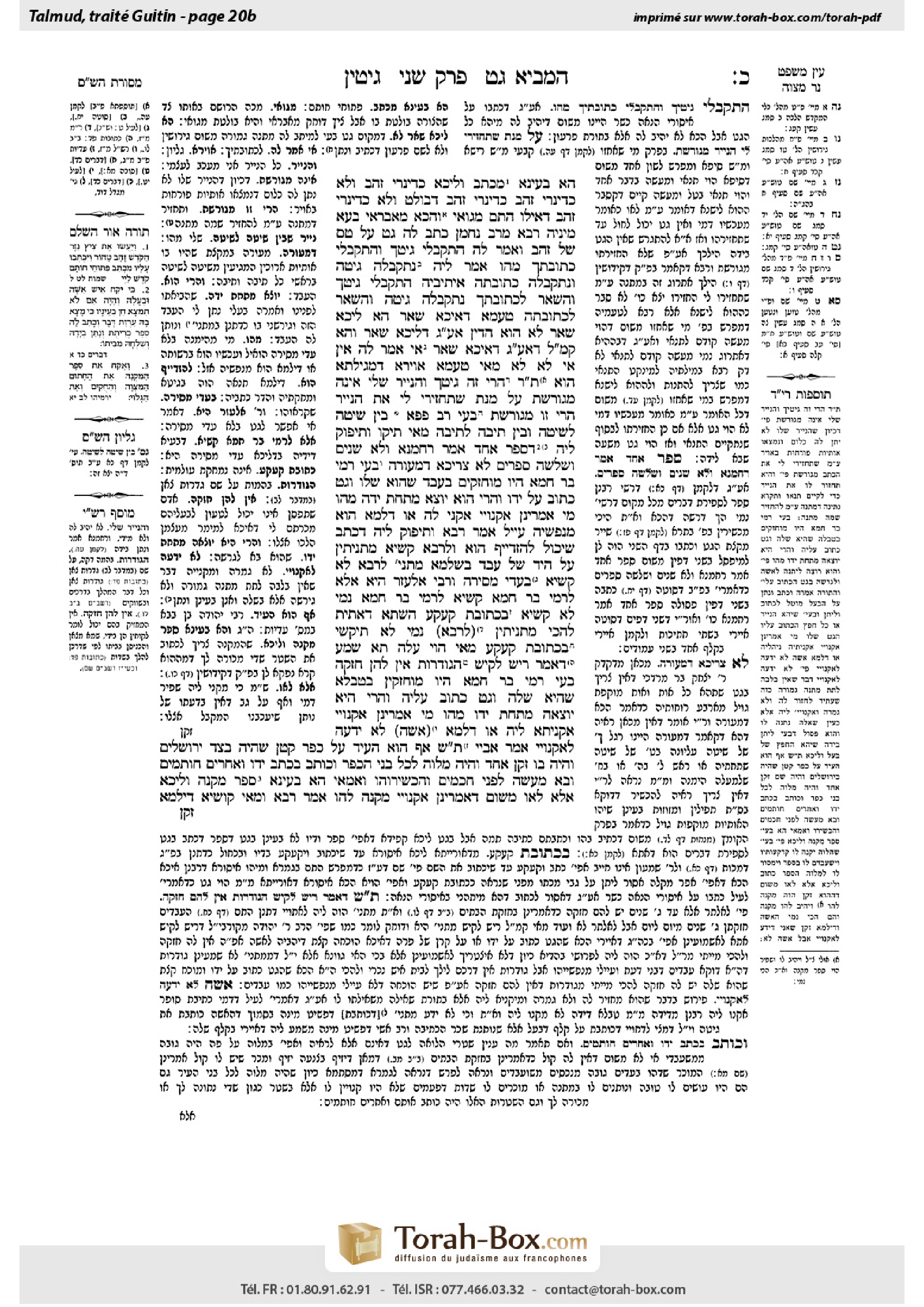
Gittin 20b: Talmud study for Daf Yomi
Study the Talmud for Daf Yomi with scanned pages, Hebrew text, English translations from Sefaria and AI-generated French translations.
Passage selection and English or AI-generated French translation are available where the scan has annotations. Daf Study is independent of Torah-Box and Sefaria.
Browse Gittin · גיטין · All tractatesGittin 20b text and translations
This page of Gittin includes the Aramaic text, an English translation and an AI-generated French translation, alongside the scan above.
גיטין כ׳ ב · Aramaic and Hebrew text
הָא בָּעֵינָא ״מִכְתַּב״, וְלֵיכָּא! כְּדִינְרֵי זָהָב, וְלֹא כְּדִינְרֵי זָהָב. כְּדִינְרֵי זָהָב – דְּבוֹלֵט; וְלֹא כְּדִינְרֵי זָהָב – דְּאִילּוּ הָתָם, מִגַּוַּאי; וְהָכָא – מֵאַבָּרַאי.
בְּעָא מִינֵּיהּ רָבָא מֵרַב נַחְמָן: כָּתַב לָהּ גֵּט עַל טַס שֶׁל זָהָב, וְאָמַר לָהּ: ״הִתְקַבְּלִי גִּיטִּיךְ וְהִתְקַבְּלִי כְּתוּבָּתִךְ״, מַהוּ? אֲמַר לֵיהּ: נִתְקַבְּלָה גִּיטָּהּ וְנִתְקַבְּלָה כְּתוּבָּתָהּ.
אֵיתִיבֵיהּ: ״הִתְקַבְּלִי גִּיטִּיךְ, וְהַשְּׁאָר לִכְתוּבָּתִךָ״ – נִתְקַבְּלָה גִּיטָּהּ, וְהַשְּׁאָר לִכְתוּבָּתָהּ.
טַעְמָא דְּאִיכָּא שְׁאָר, הָא לֵיכָּא שְׁאָר – לֹא!
הוּא הַדִּין אַף עַל גַּב דְּלֵיכָּא שְׁאָר; וְהָא קָא מַשְׁמַע לַן – דְּאַף עַל גַּב דְּאִיכָּא שְׁאָר, אִי אָמַר לַהּ – אִין, אִי לָא – לָא.
מַאי טַעְמָא? אַוֵּירָא דִמְגִילְּתָא הוּא.
תָּנוּ רַבָּנַן: ״הֲרֵי זֶה גִּיטִּיךְ וְהַנְּיָיר שֶׁלִּי״ – אֵינָהּ מְגוֹרֶשֶׁת. ״עַל מְנָת שֶׁתַּחְזִירִי לִי אֶת הַנְּיָיר״ – הֲרֵי זוֹ מְגוֹרֶשֶׁת.
בָּעֵי רַב פָּפָּא: בֵּין שִׁיטָה לְשִׁיטָה וּבֵין תֵּיבָה לְתֵיבָה, מַאי? תֵּיקוּ.
וְתִיפּוֹק לֵיהּ ״דְּסֵפֶר״ אֶחָד אָמַר רַחֲמָנָא, וְלֹא שְׁנַיִם וּשְׁלֹשָׁה סְפָרִים! לָא צְרִיכָא, דִּמְעוֹרֶה.
בָּעֵי רָמֵי בַּר חָמָא: הָיוּ מוּחְזָקִים בְּעֶבֶד שֶׁהוּא שֶׁלּוֹ – וְגֵט כָּתוּב עַל יָדוֹ, וַהֲרֵי הוּא יוֹצֵא מִתַּחַת יָדָהּ, מַהוּ?
מִי אָמְרִינַן אַקְנוֹיֵי אַקְנִי לַהּ, אוֹ דִלְמָא, הוּא מִנַּפְשֵׁיהּ עָיֵיל?
אָמַר רָבָא: וְתִיפּוֹק לֵיהּ דִּכְתָב שֶׁיָּכוֹל לְהִזְדַּיֵּיף הוּא! וּלְרָבָא, קַשְׁיָא מַתְנִיתִין ״עַל הַיָּד שֶׁל עֶבֶד״!
בִּשְׁלָמָא מַתְנִיתִין לְרָבָא לָא קַשְׁיָא, בְּעֵדֵי מְסִירָה וְרַבִּי אֶלְעָזָר הִיא. אֶלָּא לְרָמֵי בַּר חָמָא קַשְׁיָא!
לְרָמֵי בַּר חָמָא נָמֵי לָא קַשְׁיָא – בִּכְתוֹבֶת קַעֲקַע. הַשְׁתָּא דְּאָתֵית לְהָכִי, מַתְנִיתִין (לְרָבָא) נָמֵי לָא תִּיקְשֵׁי – בִּכְתוֹבֶת קַעֲקַע.
מַאי הָוֵי עֲלַהּ? תָּא שְׁמַע, דְּאָמַר רֵישׁ לָקִישׁ: הַגּוֹדְרוֹת, אֵין לָהֶן חֲזָקָה.
בָּעֵי רָמֵי בַּר חָמָא: הָיוּ מוּחְזָקִין בְּטַבְלָא שֶׁהִיא שֶׁלָּהּ – וְגֵט כָּתוּב עָלֶיהָ; וַהֲרֵי הִיא יוֹצְאָה מִתַּחַת יָדוֹ, מַהוּ? מִי אָמְרִינַן אַקְנוֹיֵי אַקְנִיתַהּ לֵיהּ, אוֹ דִלְמָא (אִשָּׁה) לָא יָדְעָה לְאַקְנוֹיֵי?
אָמַר אַבָּיֵי, תָּא שְׁמַע: אַף הוּא הֵעִיד עַל כְּפָר קָטָן שֶׁהָיָה בְּצַד יְרוּשָׁלַיִם, וְהָיָה בּוֹ זָקֵן אֶחָד, וְהָיָה מַלְוֶה לְכׇל בְּנֵי הַכְּפָר, וְכוֹתֵב בִּכְתַב יָדוֹ וַאֲחֵרִים חוֹתְמִים, וּבָא מַעֲשֶׂה לִפְנֵי חֲכָמִים וְהִכְשִׁירוּהוּ. וְאַמַּאי? הָא בָּעֵינָא ״סֵפֶר מִקְנָה״, וְלֵיכָּא!
אֶלָּא לָאו, מִשּׁוּם דְּאָמְרִינַן אַקְנוֹיֵי מַקְנֵה לְהוּ!
אָמַר רָבָא: וּמַאי קוּשְׁיָא? דִּילְמָא
Gittin 20b · English translation
isn’t there a need to write it, as the verse states with regard to the frontplate: “Wrote upon it a writing, like the engravings of a signet” (Exodus 39:30), and there is no writing here? The Gemara answers: It means that the frontplate was fashioned like the form of gold dinars but not entirely like the form of gold dinars. It was fashioned like the form of gold dinars in that the writing protrudes. But it was not fashioned like the form of gold dinars entirely, as there, in the case of gold dinars, the pressing of the stamp is done from the inside, by pushing back the surrounding area to allow the form to be visible, and here, when fashioning the frontplate, it was done from the outside, by applying pressure to the opposite side so that the letters were pushed outward. Since the letters were carved directly, it was considered to be writing.
§ Rava raised a dilemma before Rav Naḥman: In the case of a husband who wrote for her a bill of divorce on a plate [tas] of gold and said to her: Receive your bill of divorce and also receive the payment of your marriage contract through this act, as the piece of gold is worth enough to pay for the value of her marriage contract, what is the halakha? Rav Naḥman said to him: Her bill of divorce has been received and the payment of her marriage contract has been received.
Rava raised an objection to his statement from a baraita: If a husband gave his wife a bill of divorce on an oversized paper and said to her: Receive your bill of divorce, and the remainder of the paper, on which nothing is written, is designated for the payment of your marriage contract, then her bill of divorce has been received and the remainder should be for the payment of her marriage contract.
The Gemara explains the objection: This indicates that the reason why the material upon which the bill of divorce is written may also serve as the payment for her marriage contract is that there is the remainder of the paper, on which the bill of divorce was not written. If there is not the remainder of the paper, then no, the bill of divorce may not serve as payment of the marriage contract. This is because the husband must give the bill of divorce to his wife for it to become hers. If so, even if the bill of divorce was written on a plate of gold, if there was no part of the plate of gold other than the space where the bill of divorce was written, it should not serve as payment of her marriage contract.
Rav Naḥman responded: The same is true although there is no remainder of the paper, and he wrote the bill of divorce on the entire paper. And by stating the halakha in a case where there was an additional part of the paper, the baraita teaches us this: Although there is the remainder of the paper upon which nothing is written, if he explicitly said to her that it should be for the payment of her marriage contract, yes, it is considered to be a payment for her marriage contract. If he did not say this explicitly, then no, it is not for the payment of her marriage contract, and he must give her the value of her marriage contract in its entirety through a separate payment.
The Gemara explains: What is the reason for this? If he did not explicitly say that the remainder of the paper is designated toward the payment of her marriage contract, then the remainder is considered to be the margin around the border of the scroll, and all of the paper constitutes the bill of divorce. Therefore, it is necessary to inform her that the remainder of the paper is for the payment of her marriage contract.
The Sages taught: If the husband said to his wife: Behold this is your bill of divorce, but the paper on which it is written is still mine, then she is not divorced, as he must give her the actual bill of divorce in order for the divorce to take effect. Since the paper still belongs to him, it is as if he had given her only the writing. But if he said to her: Behold this is your bill of divorce on the condition that you return the paper to me, then she is divorced. The bill of divorce belongs entirely to her, and the returning of the paper is only a stipulation that must be fulfilled later.
Rav Pappa raises a dilemma: If he said that the paper between each line or between each word in the bill of divorce will still belong to him but the paper where the words are written will be hers, what is the halakha? A solution is not found for this question, and the dilemma shall stand unresolved.
The Gemara asks: Why isn’t a solution offered for Rav Pappa’s question? Let him derive an answer to this question from elsewhere, as the Merciful One speaks of one scroll in regard to the bill of divorce in the Torah: “And he writes her a scroll of severance” (Deuteronomy 24:1), and not two or three scrolls. If the woman receives only the paper on which the words are written but the rest of the paper belongs to the man, then this is not viewed as a single scroll. Rather, it is multiple scrolls, thereby invalidating it. The Gemara answers: No, it is necessary to discuss the question in a case where the letters are intertwined, meaning that they were written in such a manner that even if the paper between them was removed, the writing in the bill of divorce would remain attached as a single entity.
Rami bar Ḥama raises a dilemma: If the judges had a presumption that a slave was his, i.e., that it belonged to the husband; and the bill of divorce that this man gave his wife was written on that slave’s hand; and now the slave emerges from her possession, i.e., he is with the woman, what is the halakha with regard to this bill of divorce?
The Gemara explains the elements of the question: Do we say that the husband transferred the slave to his wife? Therefore, it is as though he gave her the bill of divorce in the proper manner, as is explained in the mishna, and she is divorced. Or perhaps we say that he, the slave, entered the possession of the woman on his own, because he prefers to be under her ownership rather than under her husband’s ownership, in which case the husband did not give him to the woman at all, and she is not divorced, as the husband needs to give the bill of divorce to the woman?
Rava said: And let Rami bar Ḥama derive an answer to his question from a different reason, that writing on a person’s body is writing that can be forged, as it is easily erased and replaced with other writing, and a bill of divorce that is written in a manner susceptible to forgery is invalid. The Gemara clarifies: But according to Rava, who raised this challenge, the mishna is difficult, as it taught that a bill of divorce may be written on a slave’s hand.
The Gemara responds: Granted, the mishna is not difficult for Rava, as it is possible to say that the mishna is referring to a case where the husband gave her the slave with witnesses present who observe the transmission of a legal document. In other words, they were present when the slave, who has the legal document written on him, was given to the woman. And it is in accordance with Rabbi Elazar, who holds that the essential witnesses are those who witness the delivery, and since they witnessed the delivery, she is divorced. However, for Rami bar Ḥama it is difficult. In his case, there were no witnesses to the transfer of the slave, so the possibility that the writing was forged should invalidate it.
The Gemara answers: According to Rami bar Ḥama it is also not difficult, as he did not ask his question in a case where the bill of divorce was written on the slave with ink but with regard to a case where it was written as a tattoo, so the writing certainly cannot be erased and forged. The Gemara notes: Now that you have arrived at this, the mishna, which deemed valid a bill of divorce that was written on the hand of the slave, will not be difficult for Rava either, as it is also stating the halakha with regard to a case where it was written as a tattoo.
In any case, Rami bar Ḥama’s question remains unresolved. If so, what halakhic conclusion was reached about this matter? The Gemara suggests: Come and hear a proof based on that which Reish Lakish says: With regard to livestock, there is no presumption of ownership, since they wander from place to place. Therefore, a person cannot claim that his mere possession of livestock demonstrates ownership, because they may have wandered into his property on their own. The same halakha should apply to a slave. If there are no witnesses who saw the transfer to the woman, then her mere possession of the slave should not serve as proof that the slave, and by extension the bill of divorce, was given to her, and consequently the woman is not divorced.
Rami bar Ḥama raises another dilemma: If the judges had a presumption that a slate was hers, and a bill of divorce was written on it, and now this slate emerges from his possession, and he wants to divorce his wife by giving her the slate, what is the halakha? Do we say that she transferred the ownership of the slate to him, and he may give it to her as a bill of divorce, and the divorce takes effect? Or perhaps a woman does not understand how to transfer an object that will be given back to her, and she believes it is a formality and not an actual legal transfer. If this were to be the case, they would not be divorced, as the slate did not in fact belong to the husband.
Abaye said: Come and hear a proof based on what is stated in a mishna (Eduyyot 2:3): Even he, Rabbi Yehuda ben Bava, who was quoted earlier in this mishna, testified about a small village that was adjacent to Jerusalem, and there was an old man there who would lend money to all the residents of the village. And he would write the documents in his handwriting and others would sign. And the incident came before the Sages and they deemed it valid. And why did they deem it valid? Isn’t there a need to fulfill this verse: “I took the deed of purchase” (Jeremiah 32:11), requiring that the document itself be transferred from the seller to the buyer, and this is not the case here, as the document attesting to the loan was in the possession of the creditor the entire time?
Rather, is it not because we say that he certainly transferred the ownership of the documents to them in a legally binding manner, although he knew that they would be returned to him immediately afterward. The same should apply in this case, and the assumption should be that the woman transferred ownership of the slate to the husband, and he then gave it back to her.
Rava said: And what is the difficulty? How can one prove anything from the mishna? Perhaps
Gittin 20b · Traduction française (IA)
N’est-ce pas qu’il y a besoin d’écrire cela, comme le dit la parabole concernant la plaque de devant : « Écris sur elle un écrit, comme les gravures d’un sceau » (Exode 39:30), et ici il n’y a pas d’écriture ? La Guemara répond : Cela signifie que la plaque de devant était façonnée comme la forme des dinars d’or, mais pas entièrement comme la forme des dinars d’or. Elle était façonnée comme la forme des dinars d’or dans la mesure où l’écriture saillait. Mais elle n’était pas façonnée entièrement comme la forme des dinars d’or, car là, dans le cas des dinars d’or, l’empreinte du sceau est faite depuis l’intérieur, en repoussant la zone environnante pour permettre que la forme soit visible, et ici, lors de la façonnage de la plaque de devant, cela a été fait depuis l’extérieur, en appliquant la pression du côté opposé afin que les lettres soient poussées vers l’extérieur. Puisque les lettres étaient gravées directement, cela était considéré comme un écrit.
§ Rava a soulevé un dilemme devant Rav Naḥman : Dans le cas d’un mari qui a écrit pour elle un acte de divorce sur une plaque d’or [tas] et qui lui a dit : Reçois ton acte de divorce et aussi reçois le paiement de ton contrat de mariage par cet acte, car la pièce d’or est suffisamment valorisée pour couvrir la valeur de son contrat de mariage, quelle est la halakha ? Rav Naḥman a répondu à lui : Son acte de divorce a été reçu et le paiement de son contrat de mariage a été reçu.
Rava a soulevé une objection contre cette déclaration à partir d’une baraïta : Si un mari donne à sa femme un acte de divorce sur un papier trop grand et lui dit : Reçois ton acte de divorce, et la partie restante du papier, sur laquelle rien n’est écrit, est désignée pour le paiement de ton contrat de mariage, alors son acte de divorce a été reçu et la partie restante devrait être pour le paiement de son contrat de mariage.
La Guemara explique l’objection : Cela indique que la raison pour laquelle le matériel sur lequel l’acte de divorce est écrit peut aussi servir comme paiement pour son contrat de mariage est que la partie restante du papier, sur laquelle l’acte de divorce n’est pas écrit, existe. Si la partie restante du papier n’existe pas, alors non, l’acte de divorce ne peut pas servir comme paiement du contrat de mariage. Cela est dû au fait que le mari doit donner l’acte de divorce à sa femme pour qu’il devienne sien. Si tel est le cas, même si l’acte de divorce était écrit sur une plaque d’or, si la plaque d’or n’avait pas d’autre partie que l’espace où l’acte de divorce était écrit, il ne devrait pas servir comme paiement de son contrat de mariage.
Rav Naḥman a répondu : La même chose est vraie même s’il n’y a pas de partie restante du papier, et il a écrit l’acte de divorce sur l’intégralité du papier. Et en énonçant la halakha dans un cas où il y avait une partie supplémentaire du papier, la baraïta nous enseigne cela : Bien que la partie restante du papier, sur laquelle rien n’est écrit, existe, si il a explicitement dit à elle qu’il devait être utilisé pour le paiement de son contrat de mariage, oui, cela est considéré comme un paiement pour son contrat de mariage. Si il n’a pas dit cela explicitement, alors non, cela n’est pas pour le paiement de son contrat de mariage, et il doit lui donner la valeur totale de son contrat de mariage par un paiement séparé.
La Guemara explique : Quelle est la raison de cela ? Si il n’a pas explicitement dit que la partie restante du papier est désignée pour le paiement de son contrat de mariage, alors la partie restante est considérée comme la marge autour de la bordure du rouleau, et toute la feuille constitue l’acte de divorce. Par conséquent, il est nécessaire d’informer elle que la partie restante du papier est pour le paiement de son contrat de mariage.
Les Sages ont enseigné : Si le mari a dit à sa femme : Voici ton acte de divorce, mais la feuille sur laquelle il est écrit reste à moi, alors elle n’est pas divorcée, car il doit lui donner l’acte de divorce lui-même pour que le divorce prenne effet. Puisque la feuille appartient encore à lui, cela est comme s’il avait donné à elle seulement l’écriture. Mais si il a dit à elle : Voici ton acte de divorce à la condition que tu me rendes la feuille, alors elle est divorcée. L’acte de divorce appartient entièrement à elle, et le rendement de la feuille est seulement une stipulation qui doit être accomplie ultérieurement.
Rav Pappa soulève un dilemme : Si il a dit que la feuille entre chaque ligne ou entre chaque mot de l’acte de divorce restera à lui mais la feuille où les mots sont écrits sera à elle, quelle est la halakha ? Une solution n’est pas trouvée pour cette question, et le dilemme restera sans réponse.
La Guemara pose la question : Pourquoi n’est-il pas offert une solution à la question de Rav Pappa ? Laisse-le dériver une réponse à cette question d’ailleurs, car l’Éternel parle d’un seul rouleau concernant l’acte de divorce dans la Torah : « Et il écrit à elle un rouleau de séparation » (Deutéronome 24:1), et non deux ou trois rouleaux. Si la femme reçoit seulement la feuille sur laquelle les mots sont écrits mais la partie restante de la feuille appartient au mari, alors cela n’est pas vu comme un seul rouleau. Au contraire, cela est plusieurs rouleaux, invalidant ainsi l’acte. La Guemara répond : Non, il est nécessaire de discuter la question dans un cas où les lettres sont entrelacées, c’est-à-dire qu’elles ont été écrites de manière telle que même si la feuille entre elles était retirée, l’écriture de l’acte de divorce resterait attachée comme un seul objet.
Rami bar Ḥama soulève un dilemme : Si les juges avaient une présomption que l’esclave était à lui, c’est-à-dire qu’il appartenait au mari ; et l’acte de divorce que cet homme a donné à sa femme était écrit sur la main de cet esclave ; et maintenant l’esclave sort de sa possession, c’est-à-dire qu’il est avec la femme, quelle est la halakha concernant cet acte de divorce ?
La Guemara explique les éléments de la question : Disons-nous que le mari a transféré l’esclave à sa femme ? Ainsi, cela est comme s’il lui avait donné l’acte de divorce de la manière appropriée, comme expliqué dans la Michna, et elle est divorcée. Ou peut-être disons-nous que l’esclave est entré dans la possession de la femme de lui-même, car il préfère être sous son autorité plutôt que sous celle de son mari, dans ce cas le mari n’a pas donné l’esclave à la femme du tout, et elle n’est pas divorcée, car le mari doit donner l’acte de divorce à la femme ?
Rava a dit : Et que Rami bar Ḥama puisse tirer une réponse à sa question d'une autre raison, à savoir que l'écriture sur le corps d'une personne est une écriture qui peut être falsifiée, car elle est facile à effacer et à remplacer par d'autres écritures, et un acte de divorce écrit de manière susceptible de falsification est invalide. La Guemara précise : Mais selon Rava, qui a soulevé ce défi, la mitsna est difficile, car elle a enseigné que l'acte de divorce peut être écrit sur la main d'un esclave.
La Guemara répond : Cela est permis, la mitsna n'est pas difficile pour Rava, car on peut dire qu'elle fait référence à un cas où l'homme lui donnait l'esclave en présence de témoins qui observaient la transmission d'un document légal. En d'autres termes, ils étaient présents lorsque l'esclave, qui avait le document légal écrit sur lui, était donné à la femme. Et c'est selon Rabbi Eléazar, qui considère que les témoins essentiels sont ceux qui assistent à la remise, et puisque ceux-ci ont assisté à la remise, elle est divorcée. Cependant, pour Rami bar Ḥama, cela est difficile. Dans son cas, il n'y avait pas de témoins à la remise de l'esclave, donc la possibilité que l'écriture ait été falsifiée devrait invalider l'acte.
La Guemara répond : Selon Rami bar Ḥama, cela n'est pas non plus difficile, car il n'a pas posé sa question dans un cas où l'acte de divorce était écrit sur l'esclave avec de l'encre, mais concernant un cas où il était écrit comme un tatouage, donc l'écriture ne peut certainement pas être effacée ni falsifiée. La Guemara note : Maintenant que vous en arrivez là, la mitsna, qui a considéré comme valide un acte de divorce écrit sur la main de l'esclave, ne sera pas difficile pour Rava non plus, car elle énonce également la halakha dans un cas où l'écriture était un tatouage.
Dans tous les cas, la question de Rami bar Ḥama reste sans réponse. Si c'est ainsi, quelle conclusion halakhique a-t-on tirée de cette affaire ? La Guemara suggère : Venez écouter une preuve basée sur ce que dit Reish Lakish : En ce qui concerne les bêtes, il n'y a pas de présomption d'appartenance, car elles se déplacent d'un lieu à un autre. Ainsi, une personne ne peut pas affirmer que sa possession de bêtes démontre son appartenance, car elles peuvent avoir pénétré dans ses terres par elles-mêmes. La même halakha devrait s'appliquer à un esclave. Si aucun témoin n'a vu la transmission à la femme, alors sa possession seule de l'esclave ne devrait pas servir de preuve que l'esclave, et par extension l'acte de divorce, lui a été donné, et par conséquent la femme n'est pas divorcée.
Rami bar Ḥama soulève un autre dilemme : Si les juges avaient une présomption que la plaque était sienne, et qu'un acte de divorce y avait été écrit, et maintenant cette plaque émerge de sa possession, et qu'il veut divorcer sa femme en lui donnant la plaque, quelle est la halakha ? Disons-nous qu'elle a transféré la propriété de la plaque à lui, et qu'il peut la lui donner comme acte de divorce, et le divorce prend effet ? Ou peut-être une femme ne comprend pas comment transférer un objet qui sera rendu à elle, et elle croit que c'est une formalité et non un transfert légal. Si c'était le cas, ils ne seraient pas divorcés, car la plaque n'appartenait pas effectivement à l'homme.
Abaye a dit : Venez écouter une preuve basée sur ce qui est dit dans une mitsna (Eduyyot 2:3) : Même lui, Rabbi Yéhuda ben Bava, qui a été cité plus tôt dans cette mitsna, a témoigné sur une petite ville adjacente à Jérusalem, et il y avait un vieil homme qui prêtait de l'argent à tous les habitants de la ville. Et il écrivait les documents à sa main et d'autres y signaient. Et l'incident est venu devant les Sages et ils l'ont considéré comme valide. Et pourquoi l'ont-ils considéré comme valide ? N'y a-t-il pas besoin de remplir cette verset : « J'ai pris le contrat de vente » (Jérémie 32:11), exigeant que le document lui-même soit transféré du vendeur au acheteur, et cela n'est pas le cas ici, car le document atténuant le prêt était en possession du créancier tout le temps ?
Plutôt, n'est-ce pas parce que nous disons qu'il a certainement transféré la propriété des documents à eux de manière légale, même s'il savait qu'ils seraient immédiatement rendus à lui. La même chose devrait s'appliquer dans ce cas, et l'assumption devrait être que la femme a transféré la propriété de la plaque à l'homme, et qu'il l'a ensuite rendue à elle.
Rava a dit : Et quelle est la difficulté ? Comment peut-on prouver quelque chose à partir de la mitsna ? Peut-être
Traduction française générée par IA à partir de l’édition anglaise de Sefaria. Vérifie toujours un passage avec le texte source.
Text from Sefaria: William Davidson Edition - Vocalized Aramaic (CC BY NC); William Davidson Edition - English (CC BY NC).