Gittin 21a: Talmud study for Daf Yomi
Study the Talmud for Daf Yomi with scanned pages, Hebrew text, English translations from Sefaria and AI-generated French translations.
Passage selection and English or AI-generated French translation are available where the scan has annotations. Daf Study is independent of Torah-Box and Sefaria.
Browse Gittin · גיטין · All tractatesGittin 21a text and translations
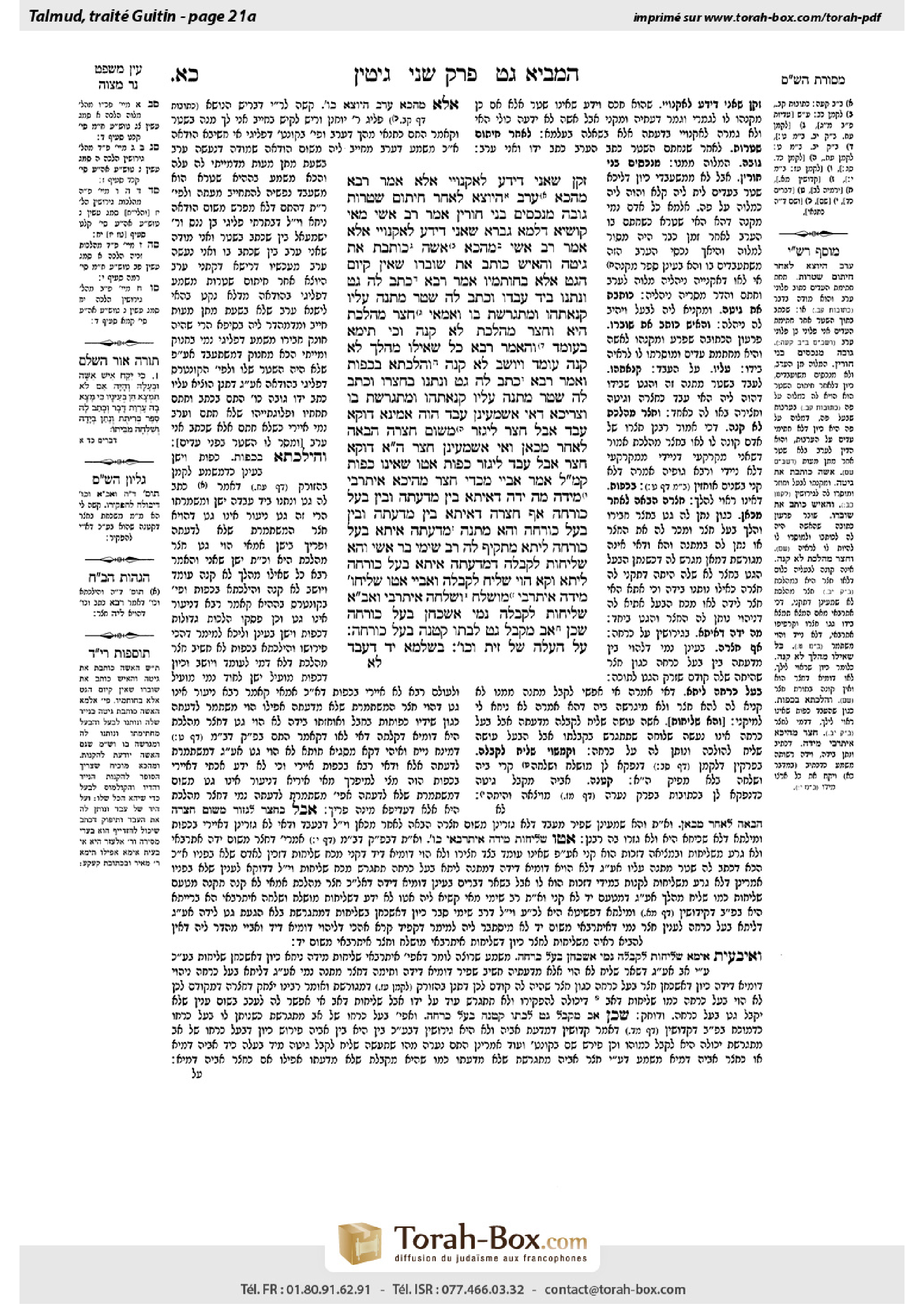
This page of Gittin includes the Aramaic text, an English translation and an AI-generated French translation, alongside the scan above.
גיטין כ״א א · Aramaic and Hebrew text
זָקֵן שָׁאנֵי, דְּיָדַע לְאַקְנוֹיֵי.
אֶלָּא אָמַר רָבָא: מֵהָכָא – עָרֵב הַיּוֹצֵא לְאַחַר חִיתּוּם שְׁטָרוֹת, גּוֹבֶה מִנְּכָסִים בְּנֵי חוֹרִין!
אָמַר רַב אָשֵׁי: מַאי קוּשְׁיָא? דִּלְמָא גַּבְרָא שָׁאנֵי, דְּיָדַע לְאַקְנוֹיֵי! אֶלָּא אָמַר רַב אָשֵׁי: מֵהָכָא – אִשָּׁה כּוֹתֶבֶת אֶת גִּיטָּהּ, וְהָאִישׁ כּוֹתֵב אֶת שׁוֹבָרוֹ, שֶׁאֵין קִיּוּם הַגֵּט אֶלָּא בְּחוֹתְמָיו.
אָמַר רָבָא: כָּתַב לָהּ גֵּט, וּנְתָנוֹ בְּיַד עַבְדּוֹ, וְכָתַב לָהּ שְׁטַר מַתָּנָה עָלָיו – קְנָאַתְהוּ, וּמִתְגָּרֶשֶׁת בּוֹ.
וְאַמַּאי? חָצֵר מְהַלֶּכֶת הִיא, וְחָצֵר מְהַלֶּכֶת לֹא קָנָה! וְכִי תֵּימָא בְּעוֹמֵד, וְהָאָמַר רָבָא: כׇּל שֶׁאִילּוּ מְהַלֵּךְ לֹא קָנָה, עוֹמֵד וְיוֹשֵׁב לֹא קָנָה! וְהִלְכְתָא – בְּכָפוּת.
וְאָמַר רָבָא: כָּתַב לָהּ גֵּט וּנְתָנוֹ בַּחֲצֵרוֹ, וְכָתַב לָהּ שְׁטַר מַתָּנָה עָלָיו – קְנָאַתְהוּ, וּמִתְגָּרֶשֶׁת בּוֹ.
וּצְרִיכָא; דְּאִי אַשְׁמְעִינַן עֶבֶד, הֲוָה אָמֵינָא: דַּוְקָא עֶבֶד, אֲבָל חָצֵר – לִיגְזַר, מִשּׁוּם חֲצֵרָהּ הַבָּאָה לְאַחַר מִכָּאן;
וְאִי אַשְׁמְעִינַן חָצֵר, הֲוָה אָמֵינָא דַּוְקָא חָצֵר, אֲבָל עֶבֶד – לִיגְזַר כָּפוּת אַטּוּ שֶׁאֵינוֹ כָּפוּת; קָא מַשְׁמַע לַן.
אָמַר אַבָּיֵי: מִכְּדֵי חָצֵר מֵהֵיכָא אִיתְרַבַּי? מִ״יָּדָהּ״;
מַה יָדָהּ דְּאִיתַהּ בֵּין מִדַּעְתַּהּ וּבֵין בְּעַל כּוּרְחַהּ, אַף חֲצֵרָהּ דְּאִיתַהּ בֵּין מִדַּעְתַּהּ וּבֵין בְּעַל כּוּרְחַהּ; וְהָא מַתָּנָה – מִדַּעְתַּהּ אִיתַהּ, בְּעַל כּוּרְחַהּ לֵיתַהּ!
מַתְקֵיף לַהּ רַב שִׁימִי בַּר אָשֵׁי: וְהָא שְׁלִיחוּת לְקַבָּלָה, דְּמִדַּעְתַּהּ אִיתַהּ בְּעַל כּוּרְחַהּ לֵיתַהּ, וְקָא הָוֵי שָׁלִיחַ לְִקַבָּלָה!
וְאַבָּיֵי – אַטּוּ שְׁלִיחוּת מִ״יָּדָהּ״ אִיתְרַבַּי?! מִ״וְּשִׁלַּח וְשִׁלְּחָהּ״ אִיתְרַבַּי!
וְאִיבָּעֵית אֵימָא: שְׁלִיחוּת לְקַבָּלָה נָמֵי אַשְׁכְּחַן בְּעַל כּוּרְחַהּ, שֶׁכֵּן אָב מְקַבֵּל גֵּט לְבִתּוֹ קְטַנָּה בְּעַל כּוֹרְחָהּ.
עַל הֶעָלֶה שֶׁל זַיִת וְכוּ׳: בִּשְׁלָמָא יָד דְּעֶבֶד
Gittin 21a · English translation
a knowledgeable old man is different, as he understands the need to transfer the documents, and this may not be true in the case of a woman and the bill of divorce.
Rather, Rava said: A proof may be brought from here: If there was a guarantor whose commitment emerged after the promissory note was signed, then the creditor may collect only from the guarantor’s unsold property. However, he does not have a lien on the guarantor’s property with which he could collect from property sold after he signed on as a guarantor. Rava’s proof is that it must be that ownership of the promissory note was transferred to the guarantor before he signed it, in order for his commitment to take effect. It may therefore be seen from this baraita that the participants understand the need to transfer ownership of the document.
Rav Ashi said: What is the difficulty raised by this baraita? Perhaps a man is different, in that he understands the need to transfer the document, and the question of the Gemara pertains to a woman, who may not be as well versed in the minutiae of monetary law. Rather, Rav Ashi said: There is a proof from what was taught here (22b): A woman may write her bill of divorce on her own or allow a scribe to write it on her behalf, and then give it to her husband, so that he will give it to her. Similarly, a man may write his receipt that he will receive from the woman after paying her marriage contract, as the ratification of a bill of divorce is only through its signatories, i.e., the witnesses who sign it, and the mere writing of the document or its receipt has no legal ramifications and may be done by anyone. In any case, it is clear from here that a woman understands the need to transfer the bill of divorce that will be given to her by her husband in the future.
§ Rava says: If he wrote her a bill of divorce and placed it in the hand of his slave, and he wrote her a deed of gift with regard to the slave, then she acquired the slave due to the document, and she is divorced immediately by the bill of divorce that is in his hand. The slave is considered to be like her property, and it is as though the husband had placed the bill of divorce in her domain at the time that he transferred the slave to her, and she acquires the bill of divorce as though it were in her courtyard.
The Gemara asks: And why does she acquire the bill of divorce? The slave is considered a mobile courtyard, and a mobile courtyard does not acquire property. One’s courtyard can acquire items for him only when the courtyard is fixed in its location. Since a slave is considered to be like land with regard to other areas of halakha, he should also be defined as a mobile courtyard, as he can move from place to place. And if you would say that Rava was referring to a slave who happens to be standing, who is not mobile, but didn’t Rava say: Anything that does not acquire when moving also does not acquire when it is standing or sitting. The fact that the slave could move gives him the status of a moving courtyard, regardless if he is currently moving or not. The Gemara answers: And the halakha taught by Rava could apply in a case where the slave was bound and unable to move, as in that case he is not even able to move, and is not considered to be a mobile courtyard.
And Rava also says: If he wrote her a bill of divorce and placed it in his courtyard, and he wrote a deed of gift with regard to the courtyard, then she has acquired the courtyard and is divorced immediately by the bill of divorce in the courtyard.
The Gemara comments: And it is necessary for Rava to teach his halakha both with regard to a slave and with regard to a courtyard. One could not have been learned from the other, as had he taught us only about a slave, I would say that the husband may transfer the bill of divorce to his wife specifically through a slave, but in the case of a courtyard the Sages may decide to enact a decree that this should not be a valid bill of divorce, due to the case of her courtyard that comes afterward. People may not differentiate between this case and a similar case, where the husband places the bill of divorce in the courtyard of a third party, and that courtyard is subsequently acquired by her. In that case, the couple is not divorced, as the bill of divorce was not given by the husband to the wife. Therefore, Rava has to teach that the Sages did not make this decree, and in this case, where the husband gave the courtyard together with the bill of divorce, it is valid.
And had Rava taught us only about a courtyard, then I would say that a woman is divorced specifically if her husband placed the bill of divorce in a courtyard, but in the case of a slave the Sages may decide to decree with regard to a bound slave that the divorce will not take effect, due to the similarity to an unbound slave, where the divorce would not take effect, as explained above. Therefore, Rava teaches us that it is a valid bill of divorce in both cases.
Abaye said as a challenge to Rava: Now, from where was a courtyard included? What is the source for the halakha that a man can divorce a woman by placing a bill of divorce in her courtyard? This can be derived from the phrase: “And gives it in her hand” (Deuteronomy 24:1), and the Sages derived that this is not limited to her actual hand but also includes anything that is an extension of her hand, such as her courtyard.
Consequently, the following reasoning should apply: Just as with regard to her hand, that it acquires property for her whether with her consent or against her will, so too, with regard to her courtyard, it should be that it acquires property for her whether with her consent or against her will. And with regard to a gift, it is so that she acquires it with her consent, but it is not so that she acquires it against her will. Therefore, a courtyard that a husband transfers to his wife as a gift along with a bill of divorce is not the same as a bill of divorce that he gives into her hand. As a courtyard is different from her hand in this sense, it should not be able to be used as a means of transferring a bill of divorce.
Rav Shimi bar Ashi objects to the reasoning of Abaye: But what of agency for receipt of the bill of divorce, where the woman appoints an agent to receive a bill of divorce on her behalf, concerning which the agent can act with her consent, but not against her will. No one other than the wife can appoint an agent to receive the bill of divorce, and despite this he is an agent for receipt. Yet a woman is able to appoint an agent for receipt. Evidently, the comparison of other methods of acquisition to acquisition by placing the bill of divorce in her hand is not absolute.
And Abaye would respond: Is that to say that the halakha of agency is included from the words “her hand”? It is not learned from there; rather, it is included based on the additional wording of the verse, as the verse does not state: And he sent [veshillaḥ]. Rather, it states: “And sends her out [veshilleḥa]” (Deuteronomy 24:1). The expanded term teaches that a woman can also appoint an agent to receive a bill of divorce on her behalf. Since agency has a different source in the Torah, it is not impacted by the limitations of her hand. The halakha that a bill of divorce can be given to her by placing it in her courtyard is an extension of the halakha that it can be placed in her hand and does carry the limitations of her hand. Therefore, it must be able to work whether with her consent or against her will.
And if you wish, say a different answer: We also have found that agency for receipt can be effective against her will. How so? As the halakha is that a father can receive a bill of divorce for his minor daughter against her will. The halakhot of agency are therefore consistent with the halakhot with regard to her hand, and Abaye’s objection stands.
§ The mishna taught that a bill of divorce may be written on an olive leaf, on the horn of a cow, or on the hand of a slave, provided that the husband then gives her the slave or the cow. The Gemara asks: Granted, with regard to the hand of a slave,
Gittin 21a · Traduction française (IA)
Un homme âgé et savant est différent, car il comprend la nécessité de transférer les documents, et cela ne s'applique pas dans le cas d'une femme et du contrat de divorce.
En effet, Rava a dit : On peut établir une preuve à partir de cela : Si un garant a donné son engagement après que le billet de change ait été signé, alors le créancier ne peut récupérer que les biens non vendus du garant. Cependant, il n'a pas de privilège sur les biens du garant avec lesquels il pourrait récupérer les biens vendus après qu'il ait signé comme garant. La preuve de Rava est que l'acquisition du billet de change par le garant doit avoir eu lieu avant qu'il ne le signe, afin que son engagement soit efficace. On peut donc voir à partir de cette baraïta que les participants comprennent la nécessité de transférer la possession du document.
Rav Ashi a dit : Quel est le problème soulevé par cette baraïta ? Peut-être un homme est différent, car il comprend la nécessité de transférer le document, et la question de la Guemara concerne une femme, qui ne maîtrise peut-être pas aussi bien les détails de la loi monétaire. En effet, Rav Ashi a dit : Il y a une preuve à partir de ce qui a été enseigné ici (22b) : Une femme peut écrire elle-même son contrat de divorce ou permettre à un scribe de le faire à sa place, puis le donner à son mari, afin qu'il le donne à sa femme. De même, un homme peut écrire sa réception qu'il recevra de la femme après avoir payé son mariage, car la ratification d'un contrat de divorce n'est possible que par ses signataires, c'est-à-dire les témoins qui le signent, et l'écriture du document ou sa réception n'a pas de conséquences juridiques et peut être faite par n'importe qui. En tout cas, il est clair à partir de cela que la femme comprend la nécessité de transférer le contrat de divorce qu'elle recevra à l'avenir de son mari.
Rava dit : Si l'on a écrit à sa femme un contrat de divorce et l'on l'a mis entre les mains de son serviteur, et si l'on a écrit un don concernant le serviteur, alors elle acquiert le serviteur grâce au document, et elle est immédiatement divorcée par le contrat de divorce qui est entre ses mains. Le serviteur est considéré comme étant de sa propriété, et c'est comme si le mari avait mis le contrat de divorce dans son domaine au moment où il a transféré le serviteur à elle, et elle acquiert le contrat de divorce comme s'il était dans son jardin.
La Guemara pose la question : Et pourquoi elle acquiert le contrat de divorce ? Le serviteur est considéré comme un jardin mobile, et un jardin mobile ne peut pas acquérir de propriété. Un jardin fixe peut acquérir des objets pour lui seulement lorsque le jardin est fixe. Puisque le serviteur est considéré comme étant comme la terre concernant d'autres domaines de la halakha, il devrait également être défini comme un jardin mobile, car il peut se déplacer d'un lieu à un autre. Et si l'on dit que Rava faisait référence à un serviteur qui est debout et qui n'est pas mobile, mais n'a-t-il pas dit : Tout ce qui ne peut pas acquérir lorsqu'il se déplace ne peut pas non plus acquérir lorsqu'il est debout ou assis. Le fait que le serviteur puisse se déplacer lui donne le statut de jardin mobile, indépendamment du fait qu'il soit actuellement en mouvement ou non. La Guemara répond : Et la halakha enseignée par Rava pourrait s'appliquer dans un cas où le serviteur était lié et ne pouvait pas se déplacer, car dans ce cas il ne peut pas se déplacer et n'est pas considéré comme un jardin mobile.
Et Rava dit aussi : Si l'on a écrit à sa femme un contrat de divorce et l'on l'a mis dans son jardin, et si l'on a écrit un don concernant le jardin, alors elle acquiert le jardin et est immédiatement divorcée par le contrat de divorce dans le jardin.
La Guemara commente : Il est nécessaire que Rava enseigne sa halakha à la fois concernant un serviteur et concernant un jardin. On ne pouvait pas l'apprendre à partir de l'autre, car s'il nous avait enseigné seulement concernant un serviteur, je dirais que le mari peut transférer le contrat de divorce à sa femme spécifiquement par le biais d'un serviteur, mais dans le cas d'un jardin, les Sages pourraient décider d'édicter un décret selon lequel cela ne serait pas un contrat de divorce valide, en raison du cas du jardin de sa femme qui vient après. Les gens ne pourraient pas distinguer ce cas d'un cas similaire, où le mari place le contrat de divorce dans le jardin d'un tiers, et ce jardin est ensuite acquis par elle. Dans ce cas, le couple ne serait pas divorcé, car le contrat de divorce n'a pas été donné par le mari à la femme. Par conséquent, Rava doit enseigner que les Sages n'ont pas édicté ce décret, et dans ce cas, où le mari a donné le jardin avec le contrat de divorce, cela est valide.
Et s'il avait enseigné seulement concernant un jardin, je dirais que la femme est divorcée spécifiquement si son mari a placé le contrat de divorce dans un jardin, mais dans le cas d'un serviteur, les Sages pourraient décider d'édicter un décret concernant un serviteur lié, selon lequel le divorce ne prendrait pas effet, en raison de la similitude avec un serviteur non lié, où le divorce ne prendrait pas effet, comme expliqué ci-dessus. Par conséquent, Rava enseigne que c'est un contrat de divorce valide dans les deux cas.
Abaye a dit comme un défi à Rava : Maintenant, d'où vient l'inclusion d'un jardin ? Quelle est la source de la halakha selon laquelle un homme peut divorcer une femme en plaçant un contrat de divorce dans son jardin ? Cela peut être déduit de la phrase : « Et il le donne en sa main » (Deutéronome 24:1), et les Sages ont déduit que cela n'est pas limité à sa main réelle, mais inclut aussi tout ce qui est une extension de sa main, comme son jardin.
Par conséquent, le raisonnement suivant devrait s'appliquer : Tout comme concernant sa main, qui acquiert des biens pour elle, qu'elle le fasse avec son consentement ou non, de même concernant son jardin, il devrait être que celui-ci acquiert des biens pour elle, qu'elle le fasse avec son consentement ou non. Concernant un don, c'est ainsi qu'elle l'acquiert avec son consentement, mais ce n'est pas ainsi qu'elle l'acquiert contre son gré. Par conséquent, un jardin que le mari transfère à sa femme comme don avec un contrat de divorce n'est pas le même qu'un contrat de divorce qu'il donne en sa main. Comme un jardin est différent de sa main dans ce sens, il ne devrait pas pouvoir être utilisé comme moyen de transférer un contrat de divorce.
Rav Shimi bar Ashi s'oppose à la raison d'Abaye : Mais que dire de l'agence pour la réception du contrat de divorce, où la femme désigne un agent pour recevoir le contrat de divorce à sa place, concernant lequel l'agent peut agir avec son consentement, mais pas contre sa volonté. Nul autre que la femme ne peut désigner un agent pour recevoir le contrat de divorce, et malgré cela il est un agent pour la réception. Cependant, la femme peut désigner un agent pour la réception. Évidemment, la comparaison des autres méthodes d'acquisition à l'acquisition par la mise du contrat de divorce dans sa main n'est pas absolue.
Et Abaye répondrait : Est-ce que cela signifie que la halakha de l'agence est tirée des mots « sa main » ? Ce n'est pas tiré d'ici ; plutôt, elle est tirée de la formulation supplémentaire du verset, car le verset ne dit pas : « et il envoya [veshillaḥ] », mais plutôt : « et il l'expulsa [veshilleḥa] » (Deutéronome 24:1). La formulation étendue enseigne que la femme peut aussi désigner un agent pour recevoir le contrat de divorce à sa place. Puisque l'agence a une source différente dans la Torah, elle n'est pas affectée par les limites de sa main. La halakha selon laquelle le contrat de divorce peut être donné à elle en le plaçant dans son jardin est une extension de la halakha selon laquelle il peut être placé dans sa main et porte donc les limites de sa main. Ainsi, il doit être possible qu'il fonctionne soit avec son consentement soit contre sa volonté.
Et si vous le souhaitez, dites une autre réponse : Nous avons également trouvé que l'agence pour la réception peut être efficace contre sa volonté. Comment cela ? Car la halakha est que le père peut recevoir un contrat de divorce pour sa fille mineure contre sa volonté. Les halakhot de l'agence sont donc cohérentes avec les halakhot concernant sa main, et l'objection d'Abaye tient.
§ La mitsva a enseigné que le contrat de divorce peut être écrit sur une feuille d'olivier, sur la corne d'un bœuf, ou sur la main d'un esclave, à condition que le mari lui donne ensuite l'esclave ou le bœuf. La Guemara demande : D'accord, concernant la main de l'esclave,
Traduction française générée par IA à partir de l’édition anglaise de Sefaria. Vérifie toujours un passage avec le texte source.
Text from Sefaria: William Davidson Edition - Vocalized Aramaic (CC BY NC); William Davidson Edition - English (CC BY NC).