Gittin 21b: Talmud study for Daf Yomi
Study the Talmud for Daf Yomi with scanned pages, Hebrew text, English translations from Sefaria and AI-generated French translations.
Passage selection and English or AI-generated French translation are available where the scan has annotations. Daf Study is independent of Torah-Box and Sefaria.
Browse Gittin · גיטין · All tractatesGittin 21b text and translations
This page of Gittin includes the Aramaic text, an English translation and an AI-generated French translation, alongside the scan above.
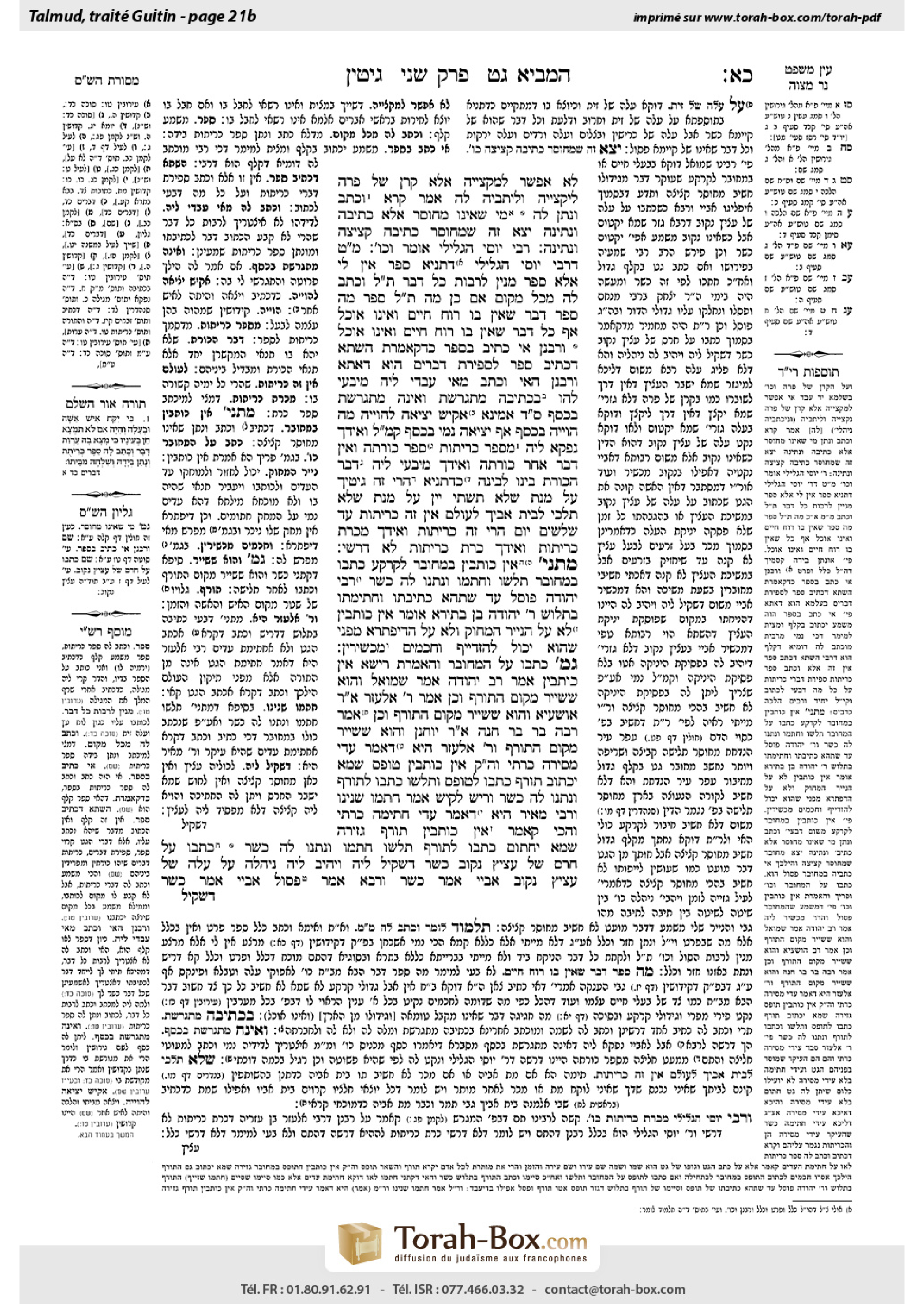
גיטין כ״א ב · Aramaic and Hebrew text
לָא אֶפְשָׁר לְמִקְצְיַיהּ, אֶלָּא קֶרֶן שֶׁל פָּרָה – לִיקְצְיַיהּ וְלִיתְּבַהּ לָהּ!
אָמַר קְרָא: ״וְכָתַב״ – ״וְנָתַן לַהּ״, מִי שֶׁאֵינוֹ מְחוּסָּר אֶלָּא כְּתִיבָה וּנְתִינָה; יָצָא זֶה – שֶׁמְחוּסָּר כְּתִיבָה, קְצִיצָה וּנְתִינָה.
רַבִּי יוֹסֵי הַגְּלִילִי אוֹמֵר וְכוּ׳: מַאי טַעְמָא דְּרַבִּי יוֹסֵי הַגְּלִילִי? דְּתַנְיָא: ״סֵפֶר״ – אֵין לִי אֶלָּא סֵפֶר, מִנַּיִן לְרַבּוֹת כׇּל דָּבָר? תַּלְמוּד לוֹמַר: ״וְכָתַב לָהּ״ – מִכׇּל מָקוֹם. אִם כֵּן, מָה תַּלְמוּד לוֹמַר ״סֵפֶר״? מָה סֵפֶר – דָּבָר שֶׁאֵין בּוֹ רוּחַ חַיִּים, וְאֵינוֹ אוֹכֶל; אַף כׇּל דָּבָר – שֶׁאֵין בּוֹ רוּחַ חַיִּים וְאֵינוֹ אוֹכֶל.
וְרַבָּנַן – אִי כְּתִיב ״בְּסֵפֶר״, כִּדְקָאָמְרַתְּ; הַשְׁתָּא דִּכְתִיב ״סֵפֶר״ – לִסְפִירַת דְּבָרִים הוּא דַּאֲתָא.
וְרַבָּנַן, הַאי ״וְכָתַב״ מַאי עָבְדִי לֵיהּ? מִיבְּעֵי לְהוּ ״בִּכְתִיבָה מִתְגָּרֶשֶׁת, וְאֵינָהּ מִתְגָּרֶשֶׁת בְּכֶסֶף״ – סָלְקָא דַּעְתָּךְ אָמֵינָא, אַקֵּישׁ יְצִיאָה לַהֲוָיָיהּ: מָה הֲוָיָיה בְּכֶסֶף, אַף יְצִיאָה נָמֵי בְּכֶסֶף; קָא מַשְׁמַע לַן.
וְאִידַּךְ – נָפְקָא לֵיהּ מִ״סֵּפֶר כְּרִיתוּת״ – סֵפֶר כּוֹרְתָהּ, וְאֵין דָּבָר אַחֵר כּוֹרְתָהּ.
וְאִידָּךְ – מִיבְּעֵי לֵיהּ ״דָּבָר הַכּוֹרֵת בֵּינוֹ לְבֵינָהּ״, כִּדְתַנְיָא: ״הֲרֵי זֶה גִּיטִּיךְ עַל מְנָת שֶׁלֹּא תִּשְׁתִּי יַיִן״; ״עַל מְנָת שֶׁלֹּא תֵּלְכִי לְבֵית אָבִיךְ״; ״לְעוֹלָם״ – אֵין זֶה כְּרִיתוּת. ״עַד שְׁלֹשִׁים יוֹם״ – הֲרֵי זֶה כְּרִיתוּת.
וְאִידָּךְ – מִ״כָּרֵת–כְּרִיתוּת״.
וְאִידַּךְ – ״כָּרֵת–כְּרִיתוּת״ לָא דָּרְשִׁי.
מַתְנִי׳ אֵין כּוֹתְבִין בִּמְחוּבָּר לַקַּרְקַע. כְּתָבוֹ בִּמְחוּבָּר, תְּלָשׁוֹ וַחֲתָמוֹ וּנְתָנוֹ לָהּ – כָּשֵׁר. רַבִּי יְהוּדָה פּוֹסֵל, עַד שֶׁתְּהֵא כְּתִיבָתוֹ וַחֲתִימָתוֹ בְּתָלוּשׁ.
רַבִּי יְהוּדָה בֶּן בְּתִירָא אוֹמֵר: אֵין כּוֹתְבִין לֹא עַל הַנְּיָיר הַמָּחוּק וְלֹא עַל הַדִּיפְתְּרָא, מִפְּנֵי שֶׁהוּא יָכוֹל לְהִזְדַּיֵּיף. וַחֲכָמִים מַכְשִׁירִין.
גְּמָ׳ כְּתָבוֹ עַל הַמְחוּבָּר?! וְהָאָמְרַתְּ רֵישָׁא ״אֵין כּוֹתְבִין״! אָמַר רַב יְהוּדָה, אָמַר שְׁמוּאֵל: וְהוּא שֶׁשִּׁיֵּיר מְקוֹם הַתּוֹרֶף.
וְכֵן אָמַר רַבִּי אֶלְעָזָר, אָמַר רַבִּי אוֹשַׁעְיָא: וְהוּא שֶׁשִּׁיֵּיר מְקוֹם הַתּוֹרֶף. וְכֵן אָמַר רַבָּה בַּר בַּר חָנָה, אָמַר רַבִּי יוֹחָנָן: וְהוּא שֶׁשִּׁיֵּיר מְקוֹם הַתּוֹרֶף – וְרַבִּי אֶלְעָזָר הִיא, דְּאָמַר: עֵדֵי מְסִירָה כָּרְתִי.
וְהָכִי קָאָמַר: אֵין כּוֹתְבִין טוֹפֶס שֶׁמָּא יִכְתּוֹב תּוֹרֶף. כְּתָבוֹ לַטּוֹפֶס וּתְלָשׁוֹ, כְּתָבוֹ לַתּוֹרֶף וּנְתָנוֹ לָהּ – כָּשֵׁר.
וְרֵישׁ לָקִישׁ אָמַר: ״חָתְמוּ״ שָׁנִינוּ; וְרַבִּי מֵאִיר הִיא דְּאָמַר עֵדֵי חֲתִימָה כָּרְתִי.
וְהָכִי קָאָמַר: אֵין כּוֹתְבִין תּוֹרֶף, גְּזֵירָה שֶׁמָּא יַחְתּוֹם. כְּתָבוֹ לַתּוֹרֶף, תְּלָשׁוֹ, חֲתָמוֹ וּנְתָנוֹ לָהּ – כָּשֵׁר.
כְּתָבוֹ עַל חֶרֶס שֶׁל עָצִיץ נָקוּב – כָּשֵׁר, דְּשָׁקֵיל לֵיהּ וְיָהֵיב לֵיהּ נִיהֲלַהּ. עַל עָלֶה שֶׁל עָצִיץ נָקוּב; אַבָּיֵי אָמַר: כָּשֵׁר, וְרָבָא אָמַר: פָּסוּל. אַבָּיֵי אָמַר כָּשֵׁר –
Gittin 21b · English translation
it is not possible to cut it off, as it is certainly prohibited to cut off the hand of a slave, and he therefore must give her the slave. But if he wrote the bill of divorce on the horn of a cow, let him cut it off and give it to her. Why does the mishna state that he must give her the cow?
The Gemara answers: The verse states: “And he writes her a scroll of severance, and gives it in her hand” (Deuteronomy 24:1), meaning that something is valid as a bill of divorce when it is lacking only writing and giving, excluding this, a cow’s horn, which is lacking writing, cutting, and giving. Since the additional step of cutting would be required in order for him to give her the horn alone, the horn would not be a valid bill of divorce, so he must give her the cow.
§ The mishna taught that Rabbi Yosei HaGelili says that a bill of divorce may not be written on something living, nor on food. The Gemara asks: What is the reason for Rabbi Yosei HaGelili’s opinion? As it is taught in a baraita: It is said in the Torah with regard to a bill of divorce: “And he writes her a scroll of severance” (Deuteronomy 24:1). From the word “scroll,” I have derived only that a scroll is valid; from where do I derive that it is correct to include all objects as valid materials upon which a bill of divorce may be written? The verse states: “And he writes her,” in any case, i.e., a bill of divorce can be written on any type of surface. If so, what is the meaning when the verse states “scroll”? This teaches: Just as a scroll is neither alive nor food, so too, a bill of divorce may be written on any object that is neither alive nor food. This is why Rabbi Yosei HaGelili deems invalid a bill of divorce written on a living being.
The Gemara asks: And how do the Rabbis, who disagree and say that a bill of divorce may be written even on a living creature or on food, interpret the verse? They contend: If the verse were written: And he shall write for her in the scroll [besefer], then it would be as you said, and it would indicate the type of surface on which the bill of divorce may be written. Now that it is written: “Scroll [sefer],” it comes to teach that a mere account of the matters [sefirat devarim] is required. In other words, sefer is referring not to the surface on which a bill of divorce must be written, but rather, to the essence of the bill of divorce. The verse teaches that the bill of divorce must contain particular content.
The Gemara continues: And the Rabbis, what do they do with this phrase in the verse: “And he writes her”? The Gemara answers: For them, that phrase is required to teach the principle that a woman is divorced only via writing, i.e., a bill of divorce, and she is not divorced via giving money. It might enter your mind to say: I should juxtapose leaving marriage, i.e., divorce, to becoming married, i.e., betrothal, and I will say that just as becoming married is effected with giving money, so too, leaving marriage can also be effected with giving money. Therefore, the Torah teaches us: “And he writes her”; divorce can be effected only with a written bill of divorce.
The Gemara asks: And the other tanna, Rabbi Yosei HaGelili, from where does he derive this reasoning? He derives it from the phrase “scroll of severance,” which teaches that a scroll, i.e., a written document, severs her from her husband and nothing else severs her from him.
The Gemara asks: And those who hold the other opinion, the Rabbis, how do they explain this phrase? For them, the phrase “scroll of severance” is required to teach that a bill of divorce must be a matter that severs all connection between him and her, as it is taught in a baraita: If a man says to his wife: This is your bill of divorce, on the condition that you will not ever drink wine, or on condition that you will never go to your father’s house, that is not severance, and the bill of divorce is not valid. If a bill of divorce imposes a condition upon the woman that permanently binds her to her husband, her relationship with her husband has not been completely severed, which is a prerequisite for divorce. If, however, he imposes a condition until thirty days have passed, or for any other limited period of time, that is severance. The bill of divorce is valid, as the relationship will be completely terminated at the end of the thirty-day period.
The Gemara asks: And the other tanna, Rabbi Yosei HaGelili, from where does he derive that a stipulation without a termination point invalidates the divorce? From the fact that instead of using the term karet, the verse uses the more expanded term keritut. Inasmuch as both terms denote severance, using the longer term teaches us two things: Divorce can be effected only via writing and not through money, and divorce requires total severance.
And the other, the Rabbis, what do they derive from this? The Gemara answers: They do not derive anything from the expansion of karet to keritut.
MISHNA: One may not write a bill of divorce on anything that is attached to the ground. If one wrote it on something that was attached to the ground, and afterward he detached it, signed it, and gave it to her, then it is valid. Rabbi Yehuda deems a bill of divorce invalid unless its writing and its signing were performed when it was already detached.
Rabbi Yehuda ben Beteira says: One may not write a bill of divorce on erased paper or on unfinished leather [diftera], because writing on these surfaces can be forged. And the Rabbis deem valid a bill of divorce that was written on either of these items.
GEMARA: The mishna taught: If one wrote it on something that was attached to the ground, and detached it before he gave it to her, then it is valid. The Gemara challenges: But didn’t you say in the first clause of the mishna that one may not write a bill of divorce on something that is attached to the ground? Rav Yehuda says that Shmuel says: The mishna’s statement that if something was detached and signed then it is a valid bill of divorce is applicable only when one left a place for the essential part of the document. He did not write the entire bill of divorce while it was attached to the ground. Rather, he wrote only the standard part of the bill of divorce. However, he left a place for the essential part of the bill of divorce, which includes the names of the man and woman, and wrote that part only after it was detached.
And so Rabbi Elazar says that Rabbi Oshaya says: And this is a case where he left a place for the essential part of the document. And so Rabba bar bar Ḥana says that Rabbi Yoḥanan says: And this is when he left a place for the essential part of the document. And all these Sages hold that the mishna is in accordance with the opinion of Rabbi Elazar, who says: Witnesses of the transmission of the bill of divorce effect the divorce. It is not the signatures of the witnesses on a bill of divorce that validate it. Rather, the divorce is effected by the transmission of the document in the presence of witnesses. Therefore, the phrase: “And he writes” (Deuteronomy 24:1), must be referring to the writing of the bill of divorce and not to the signing of the witnesses, and the restrictions derived from this verse will apply to the writing of the bill of divorce, so the essential part may not be written on something that is attached to the ground.
And this is what the mishna is saying: One may not write even the standard part on something that is attached to the ground ab initio, lest he write the essential part of the document in this manner as well. However, if he wrote the standard part while it was attached to the ground, and then detached it, wrote the essential part, and gave it to her, it is valid.
And Reish Lakish says: The mishna should not be understood in that way, where the phrase: And signed it, is referring to the writing of the essential part, since we learned that they signed it, which is referring to the signatures of the witnesses. And it is taught in accordance with the opinion of Rabbi Meir, who says that the signatory witnesses on the bill of divorce effect the divorce.
And this is what the mishna is saying: One may not write the essential part on something that is attached to the ground due to a rabbinic decree, lest he also have the witnesses sign while it is attached. However, even if he wrote the essential part while it was attached, then detached it, had it signed, and gave it to her, it is valid. According to Rabbi Meir, when the verse states: “And he writes her,” it is referring to when he has the bill of divorce signed. Therefore, by Torah law, the limitation that it not be attached while he writes applies only to the signing but not to the writing. The Sages decreed that the essential part of the bill of divorce also not be written while it is attached to the ground, but if he violated this decree, it is still valid after the fact.
§ In connection with this discussion, the Gemara mentions several halakhot that are affected by items being attached to the ground or detached. If he wrote the bill of divorce on the clay of a perforated pot [atzitz], which is considered to be attached to the ground, then it is valid, as he can take this pot and give it to her. However, if he wrote it on a leaf of a plant growing in a perforated pot, then what is the halakha? Abaye says: It is valid. And Rava says: It is invalid. The Gemara clarifies their dispute in detail: Abaye says that it is valid
Gittin 21b · Traduction française (IA)
Il n'est pas possible de le couper, car il est certainement interdit de couper la main d'un esclave, et il doit donc lui donner l'esclave. Mais si l'on a écrit le livre de divorce sur la corne d'une vache, qu'on le coupe et qu'on le lui donne. Pourquoi la Michna affirme-t-elle qu'il doit lui donner la vache ?
La Guemara répond : La Parashah dit : « Et il écrit à elle un rouleau de séparation, et il lui donne » (Deutéronome 24:1), ce qui signifie que quelque chose est valable comme livre de divorce lorsqu'il manque seulement l'écriture et la remise, excluant cela, la corne d'une vache, qui manque l'écriture, le tranchant et la remise. Puisque la démarche supplémentaire de trancher serait nécessaire pour qu'il puisse lui donner la corne seule, la corne ne serait pas un livre de divorce valide, donc il doit lui donner la vache.
§ La Michna enseigne que Rabbi Yosei HaGelili dit qu'un livre de divorce ne peut être écrit sur quelque chose de vivant ni sur de la nourriture. La Guemara demande : Quelle est la raison de l'opinion de Rabbi Yosei HaGelili ? Comme il est enseigné dans une baraïta : Il est dit dans la Torah concernant un livre de divorce : « Et il écrit à elle un rouleau de séparation » (Deutéronome 24:1). Du mot « rouleau », j'ai déduit seulement que le rouleau est valide ; d'où déduit-on que c'est correct d'inclure tous les objets comme matériaux valides pour écrire un livre de divorce ? La Parashah dit : « Et il écrit à elle », en tout cas, c'est-à-dire qu'un livre de divorce peut être écrit sur n'importe quel type de surface. Si c'est ainsi, quelle est la signification lorsque la Parashah dit « rouleau » ? Cela enseigne : Comme le rouleau n'est ni vivant ni nourriture, de même, un livre de divorce peut être écrit sur n'importe quel objet qui n'est ni vivant ni nourriture. C'est pourquoi Rabbi Yosei HaGelili considère comme invalide un livre de divorce écrit sur un être vivant.
La Guemara demande : Et comment les Rabbins, qui s'opposent et disent qu'un livre de divorce peut être écrit même sur un être vivant ou sur de la nourriture, interprètent-ils la parole ? Ils contestent : Si la parole avait dit : « Et il écrira pour elle dans le rouleau [besefer] », alors ce serait comme vous le dites, et cela indiquerait le type de surface sur lequel un livre de divorce peut être écrit. Maintenant qu'elle dit : « Rouleau [sefer] », cela vient enseigner que seule une simple énumération des affaires [sefirat devarim] est requise. En d'autres termes, « sefer » ne désigne pas la surface sur laquelle un livre de divorce doit être écrit, mais plutôt l'essence du livre de divorce. La parole enseigne que le livre de divorce doit contenir un contenu particulier.
La Guemara continue : Et les Rabbins, qu'ont-ils à dire de cette phrase dans la parole : « Et il écrit à elle » ? La Guemara répond : Pour eux, cette phrase est requise pour enseigner le principe que la femme est divorcée uniquement par écrit, c'est-à-dire par un livre de divorce, et elle n'est pas divorcée par l'argent. Il pourrait entrer en vous l'idée de dire : Je devrais juxtaposer le divorce, c'est-à-dire la séparation, à l'union, c'est-à-dire le mariage, et je dirais que tout comme l'union est effectuée par l'argent, de même, la séparation peut être effectuée par l'argent. Ainsi, la Torah nous enseigne : « Et il écrit à elle » ; le divorce peut être effectué uniquement par un livre de divorce écrit.
La Guemara demande : Et l'autre tanna, Rabbi Yosei HaGelili, d'où dérive-t-il cette raisonnement ? Il le dérive du mot « rouleau de séparation », qui enseigne que le rouleau, c'est-à-dire un document écrit, sépare elle de son mari et rien d'autre ne la sépare de lui.
La Guemara demande : Et ceux qui adoptent l'autre opinion, les Rabbins, comment interprètent-ils cette phrase ? Pour eux, la phrase « rouleau de séparation » est requise pour enseigner que le livre de divorce doit être une affaire qui sépare toute connexion entre lui et elle, comme il est enseigné dans une baraïta : Si un homme dit à sa femme : C'est ton livre de divorce, à la condition que tu ne boiras jamais de vin, ou à la condition que tu ne vas jamais chez ton père, cela n'est pas une séparation, et le livre de divorce n'est pas valide. Si un livre de divorce impose une condition à la femme qui l'attache définitivement à son mari, leur relation avec son mari n'a pas été complètement rompue, ce qui est une condition préalable au divorce. Si, cependant, il impose une condition jusqu'à ce que trente jours aient passé, ou pour toute autre période limitée, cela est une séparation. Le livre de divorce est valide, car la relation sera complètement terminée à la fin de la période de trente jours.
La Guemara demande : Et l'autre tanna, Rabbi Yosei HaGelili, d'où dérive-t-il que une stipulation sans point de fin invalide le divorce ? De la constatation que, au lieu d'utiliser le terme karet, la Parashah utilise le terme plus développé keritut. En ce sens que les deux termes désignent la séparation, l'utilisation du terme plus long enseigne deux choses : le divorce peut être effectué uniquement par écrit et non par l'argent, et le divorce exige une séparation totale.
Et l'autre, les Rabbins, qu'ont-ils à en déduire ? La Guemara répond : Ils ne déduisent rien de l'expansion de karet à keritut.
MICHNA : On ne peut pas écrire un acte de divorce sur quelque chose qui est attaché au sol. Si l'on a écrit sur quelque chose qui était attaché au sol, et ensuite l'on a détaché, signé et donné à elle, alors cela est valide. Rabbi Yehuda considère un acte de divorce comme invalide à moins que l'écriture et la signature aient été effectuées lorsque l'objet était déjà détaché.
Rabbi Yehuda ben Beteira dit : On ne peut pas écrire un acte de divorce sur du papier effacé ou sur du cuir inachevé [diftera], car l'écriture sur ces surfaces peut être falsifiée. Et les Rabbins considèrent comme valide un acte de divorce écrit sur l'un de ces objets.
GUEMARA : La Michna enseigne : Si l'on écrit sur quelque chose qui était attaché au sol, et qu'on le détache avant de le donner à elle, alors cela est valide. La Guemara conteste : Mais n'avez-vous pas dit dans la première partie de la Michna que l'on ne doit pas écrire un acte de divorce sur quelque chose qui est attaché au sol ? Rav Yehuda dit que Shmuel dit : La déclaration de la Michna selon laquelle si quelque chose a été détaché et signé alors c'est un acte de divorce valide s'applique uniquement lorsque l'on a laissé une place pour la partie essentielle du document. Il n'a pas écrit l'acte de divorce entier pendant qu'il était attaché au sol. Plutôt, il a écrit seulement la partie standard de l'acte de divorce. Cependant, il a laissé une place pour la partie essentielle de l'acte de divorce, qui comprend les noms du mari et de la femme, et a écrit cette partie seulement après qu'il avait été détaché.
Et Rabbi Elazar dit que Rabbi Oshaya dit : Et c'est un cas où l'on a laissé une place pour la partie essentielle du document. Et Rabba bar bar Ḥana dit que Rabbi Yoḥanan dit : Et c'est lorsqu'il a laissé une place pour la partie essentielle du document. Et tous ces Sages partagent l'opinion que la Michna s'inspire de l'opinion de Rabbi Elazar, qui dit : Les témoins de la transmission de l'acte de divorce accomplissent le divorce. Ce n'est pas les signatures des témoins sur l'acte de divorce qui valident celui-ci. Plutôt, le divorce est accompli par la transmission du document en présence de témoins. Par conséquent, la phrase : « Et il écrit » (Deutéronome 24:1), doit se référer à l'écriture de l'acte de divorce et non à la signature des témoins, et les restrictions dérivées de cette verset s'appliquent à l'écriture de l'acte de divorce, de sorte que la partie essentielle ne doit pas être écrite sur quelque chose qui est attaché au sol.
Et c'est ce que la Michna dit : On ne doit pas écrire même la partie standard sur quelque chose qui est attaché au sol dès le début, de peur qu'on écrive aussi la partie essentielle du document ainsi. Cependant, si l'on a écrit la partie standard pendant qu'il était attaché au sol, puis l'a détaché, a écrit la partie essentielle, et l'a donné à elle, cela est valide.
Et Reish Lakish dit : La Michna ne doit pas être comprise ainsi, où la phrase : « Et il l'a signé », se réfère à l'écriture de la partie essentielle, puisque nous avons appris que l'on a signé, ce qui se réfère aux signatures des témoins. Et cela est enseigné selon l'opinion de Rabbi Meir, qui dit que les témoins signataires de l'acte de divorce accomplissent le divorce.
Et c'est ce que la Michna dit : On ne doit pas écrire la partie essentielle sur quelque chose qui est attaché au sol en raison d'un décret rabbinique, de peur qu'on ait aussi les témoins signer pendant qu'il est attaché. Cependant, même si l'on a écrit la partie essentielle pendant qu'il était attaché, puis l'a détaché, l'a fait signer, et l'a donné à elle, cela est valide. Selon Rabbi Meir, lorsque le verset dit : « Et il écrit à elle », cela se réfère à lorsqu'il fait signer l'acte de divorce. Par conséquent, selon la loi divine, la limitation selon laquelle il ne doit pas être attaché pendant qu'il écrit s'applique uniquement à la signature mais pas à l'écriture. Les Sages ont décrété que la partie essentielle de l'acte de divorce ne doit pas non plus être écrite pendant qu'il est attaché au sol, mais si l'on a violé ce décret, cela reste valide après coup.
§ En lien avec cette discussion, la Guemara mentionne plusieurs halakhot qui sont affectées par l'attachement ou la détachement d'un objet au sol. Si l'on écrit l'acte de divorce sur la terre d'une jarre percée [atzitz], qui est considérée comme étant attachée au sol, alors cela est valide, car l'on peut prendre cette jarre et la donner à elle. Cependant, si l'on écrit sur une feuille d'une plante poussant dans une jarre percée, alors quelle est la halakha ? Abaye dit : C'est valide. Et Rava dit : C'est invalide. La Guemara clarifie leur débat en détail : Abaye dit que c'est valide
Traduction française générée par IA à partir de l’édition anglaise de Sefaria. Vérifie toujours un passage avec le texte source.
Text from Sefaria: William Davidson Edition - Vocalized Aramaic (CC BY NC); William Davidson Edition - English (CC BY NC).