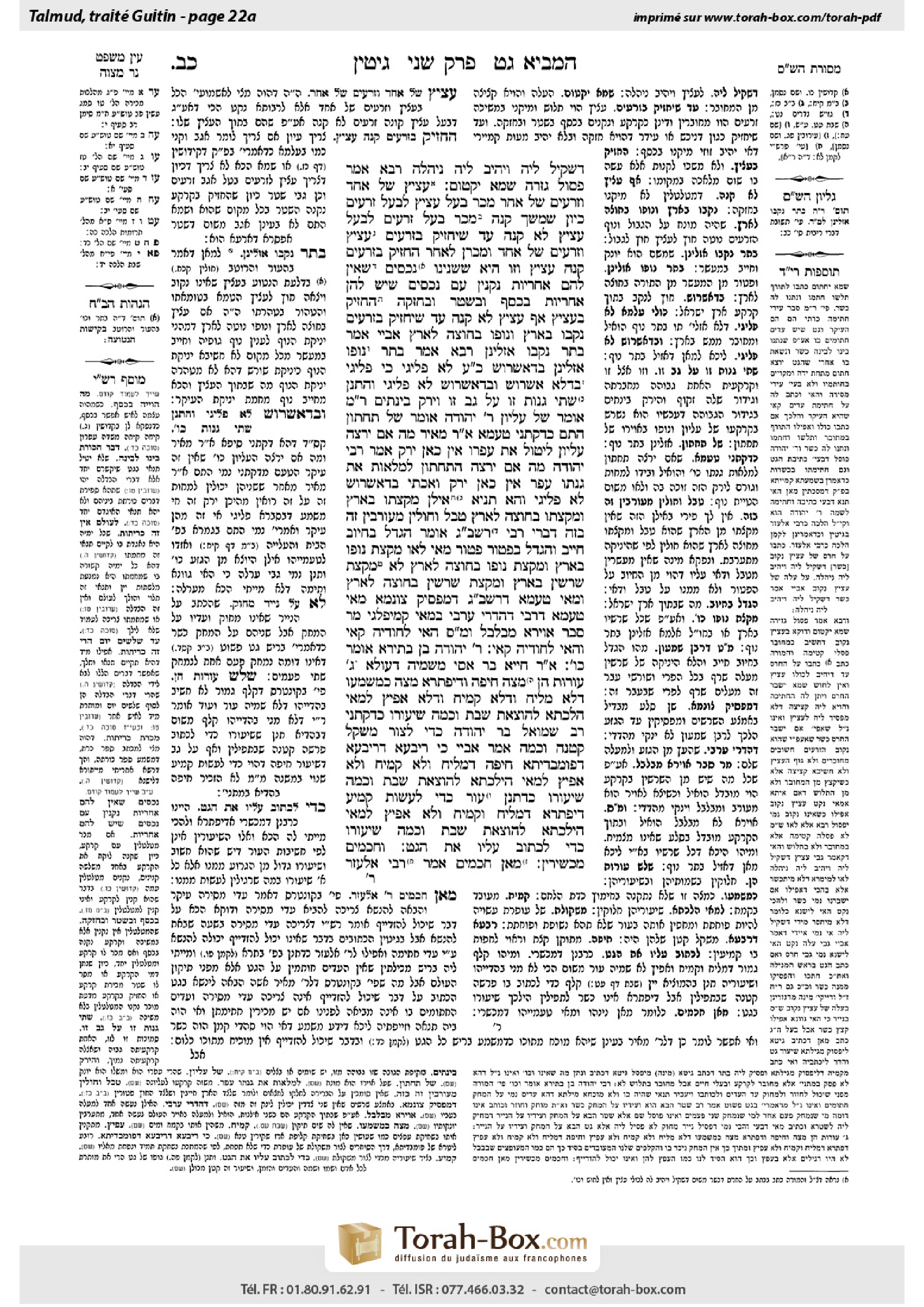
Gittin 22a: Talmud study for Daf Yomi
Study the Talmud for Daf Yomi with scanned pages, Hebrew text, English translations from Sefaria and AI-generated French translations.
Passage selection and English or AI-generated French translation are available where the scan has annotations. Daf Study is independent of Torah-Box and Sefaria.
Browse Gittin · גיטין · All tractatesGittin 22a text and translations
This page of Gittin includes the Aramaic text, an English translation and an AI-generated French translation, alongside the scan above.
גיטין כ״ב א · Aramaic and Hebrew text
דְּשָׁקֵיל לֵיהּ וְיָהֵיב לֵיהּ נִיהֲלַהּ. רָבָא אָמַר פָּסוּל – גְּזֵרָה שֶׁמָּא יִקְטוֹם.
עָצִיץ שֶׁל אֶחָד וּזְרָעִים שֶׁל אַחֵר; מָכַר בַּעַל עָצִיץ לְבַעַל זְרָעִים – כֵּיוָן שֶׁמָּשַׁךְ, קָנָה. מָכַר בַּעַל זְרָעִים לְבַעַל עָצִיץ – לֹא קָנָה עַד שֶׁיַּחְזִיק בִּזְרָעִים.
עָצִיץ וּזְרָעִים שֶׁל אֶחָד, וּמְכָרָן לְאַחֵר; הֶחְזִיק בִּזְרָעִים – קָנָה עָצִיץ. וְזוֹ הִיא שֶׁשָּׁנִינוּ: נְכָסִים שֶׁאֵין לָהֶם אַחְרָיוּת נִקְנִין עִם נְכָסִים שֶׁיֵּשׁ לָהֶן אַחְרָיוּת – בְּכֶסֶף וּבִשְׁטָר וּבַחֲזָקָה.
הֶחְזִיק בְּעָצִיץ – אַף עָצִיץ לֹא קָנָה, עַד שֶׁיַּחְזִיק בִּזְרָעִים.
נִקְבּוֹ בָּאָרֶץ וְנוֹפוֹ בְּחוּצָה לָאָרֶץ? אַבָּיֵי אָמַר: בָּתַר נִקְבּוֹ אָזְלִינַן. רָבָא אָמַר: בָּתַר נוֹפוֹ אָזְלִינַן.
בִּדְאַשְׁרוּשׁ, כּוּלֵּי עָלְמָא לָא פְלִיגִי. כִּי פְּלִיגִי – בִּדְלָא אַשְׁרוּשׁ.
וּבִדְאַשְׁרוּשׁ לָא פְּלִיגִי?! וְהָתְנַן: שְׁתֵּי גִּינּוֹת זוֹ עַל גַּב זוֹ, וְיָרָק בֵּינְתַיִם, רַבִּי מֵאִיר אוֹמֵר: שֶׁל עֶלְיוֹן. רַבִּי יְהוּדָה אוֹמֵר: שֶׁל תַּחְתּוֹן!
הָתָם, כִּדְקָתָנֵי טַעְמָא – אָמַר רַבִּי מֵאִיר: מָה אִם יִרְצֶה עֶלְיוֹן לִיטּוֹל אֶת עֲפָרוֹ, אֵין כָּאן יָרָק!
אָמַר רַבִּי יְהוּדָה: מָה אִם יִרְצֶה הַתַּחְתּוֹן לְמַלּאוֹת אֶת גִּנָּתוֹ עָפָר, אֵין כָּאן יָרָק!
וְאַכַּתִּי, בִּדְאַשְׁרוּשׁ לָא פְּלִיגִי?! וְהָא תַּנְיָא: אִילָן – מִקְצָתוֹ בָּאָרֶץ וּמִקְצָתוֹ בְּחוּצָה לָאָרֶץ; טֶבֶל וְחוּלִּין מְעוֹרָבִין זֶה בָּזֶה, דִּבְרֵי רַבִּי. רַבָּן שִׁמְעוֹן בֶּן גַּמְלִיאֵל אוֹמֵר: הַגָּדֵל בְּחִיּוּב – חַיָּיב, וְהַגָּדֵל בִּפְטוּר – פָּטוּר.
מַאי לָאו, מִקְצָת נוֹפוֹ בָּאָרֶץ וּמִקְצָת נוֹפוֹ בְּחוּצָה לָאָרֶץ?
לֹא; מִקְצָת שׇׁרָשִׁין בָּאָרֶץ וּמִקְצָת שׇׁרָשִׁין בְּחוּצָה לָאָרֶץ. וּמַאי טַעְמָא דְּרַבָּן שִׁמְעוֹן בֶּן גַּמְלִיאֵל? דְּמַפְסִיק צוּנְמָא.
מַאי טַעְמָא דְּרַבִּי? דְּהָדְרִי עׇרְבִי.
בְּמַאי קָמִיפַּלְגִי? מָר סָבַר: אַוֵּירָא מְבַלְבֵּל, וּמָר סָבַר: הַאי לְחוֹדֵיהּ קָאֵי וְהַאי לְחוֹדֵיהּ קָאֵי.
רַבִּי יְהוּדָה בֶּן בְּתֵירָא אוֹמֵר כּוּ׳: אָמַר רַבִּי חִיָּיא בַּר אַסִּי מִשְּׁמֵיהּ דְּעוּלָּא, שְׁלֹשָׁה עוֹרוֹת הֵן: מַצָּה, חִיפָּה וְדִיפְתְּרָא.
מַצָּה – כְּמַשְׁמָעוֹ, דְּלָא מְלִיחַ וּדְלָא קְמִיחַ וּדְלָא אֲפִיץ. לְמַאי הִלְכְתָא? לְהוֹצָאַת שַׁבָּת. וְכַמָּה שִׁיעוּרוֹ? כִּדְקָתָנֵי רַב שְׁמוּאֵל בַּר יְהוּדָה: כְּדֵי לָצוּר מִשְׁקָל קְטַנָּה. וְכַמָּה? אָמַר אַבָּיֵי: כִּי רִיבְעָא דְרִיבְעָא דְּפוּמְבְּדִיתָא.
חִיפָּה – דִּמְלִיחַ, וְלָא קְמִיחַ וְלָא אֲפִיץ. לְמַאי הִילְכְתָא? לְהוֹצָאַת שַׁבָּת. וְכַמָּה שִׁיעוּרוֹ? כְּדִתְנַן: עוֹר – כְּדֵי לַעֲשׂוֹת קָמֵיעַ.
דִּיפְתְּרָא – דִּמְלִיחַ וּקְמִיחַ, וְלָא אֲפִיץ. לְמַאי הִילְכְתָא? לְהוֹצָאַת שַׁבָּת. וְכַמָּה שִׁיעוּרוֹ? כְּדֵי לִכְתּוֹב עָלָיו אֶת הַגֵּט.
וַחֲכָמִים מַכְשִׁירִין: מַאן חֲכָמִים? אָמַר רַבִּי אֶלְעָזָר:
Gittin 22a · English translation
as he can take the pot with the leaf inside it and give it to her. Rava says that it is invalid. Although it should be valid if he gave her the leaf together with the potted plant, the Sages instituted a decree that it is invalid, lest one detach the leaf and give it to her. In that case, all agree that a bill of divorce that is fully written while attached is invalid.
§ The Gemara has another discussion with regard to a perforated pot: In the case of a pot that belongs to one person and the plants in it belong to another person, if the owner of the pot sold it to the owner of the plants, then once the owner of the plants pulled the pot, he has acquired the pot, as it is a movable object, which can be acquired via pulling. However, if the owner of the plants sold the plants to the owner of the pot, then the owner of the pot does not acquire the plants until he takes possession of the plants themselves, e.g., by raking or weeding the dirt surrounding them. Since the plants are considered to be attached to the ground, as they are in a perforated pot, they are considered to be part of the ground, which cannot be acquired by pulling.
If the pot and plants belong to one person, and he sold them to another person, then once the buyer took possession of the plants and acquired them, he acquired the pot as well. And this is an example of the principle that we learned in a mishna (Kiddushin 26a): Property that does not serve as a guarantee, i.e., movable property, can be acquired with property that serves as a guarantee, i.e., land, through the giving of money, or with a document, or by taking possession. Therefore, once one takes possession of the plants, which are considered to be like land, he also acquires the pot, which is a movable object.
However, if the buyer took possession of just the pot, then he does not even acquire the pot, as movable property cannot be acquired through taking possession, until he takes possession of the plants. To acquire the pot, one must either perform an act of acquisition specific to movable items, such as pulling, or acquire the plants through taking possession of them, resulting in the acquisition of the pot, as stated earlier.
The Gemara discusses another issue with regard to perforated pots: If a perforated pot was on the border of Eretz Yisrael, and its perforation was in Eretz Yisrael but its branches were outside of Eretz Yisrael, then what is the halakha with regard to mitzvot that apply to produce grown in Eretz Yisrael, such as terumot and tithes? Abaye said: We follow its perforation, and it is considered to be growing in Eretz Yisrael. Rava said: We follow its branches, and it is considered to be growing outside of Eretz Yisrael.
The Gemara notes: In a case where the plant in the pot took root in the ground, everyone agrees that it has the status of a plant that grows in the place where its roots are. When they disagree, it is with regard to a case where it did not take root. Since its roots are contained within the pot, there is a disagreement whether we follow the perforation or the branches in determining its status.
The Gemara challenges: And do they not disagree with regard to a case where it took root? Do all agree that its status is determined by where the roots are? But didn’t we learn in a mishna (Bava Metzia 118b): In a case of two gardens that belong to two different people that are on adjacent terraces one above the other, and leafy vegetables are growing between them on the wall of the step between the two gardens, Rabbi Meir says: These leafy vegetables belong to the owner of the upper garden, and Rabbi Yehuda says: These leafy vegetables belong to the owner of the lower garden. In this case, the roots emerge from the upper garden, but the vegetables grow into the airspace of the lower garden. This seems to be analogous to the case where the roots are in Eretz Yisrael and the branches are outside of Eretz Yisrael, or vice versa, and there is a dispute as to who is the owner of the vegetables.
The Gemara makes a distinction between the two cases: There, in the case cited in the mishna in Bava Metzia, the reason for that halakha is as is taught in the mishna, that Rabbi Meir said: What if the owner of the upper garden would wish to take his earth? This would result in a situation where there are no more vegetables, as the vegetables would not have earth from which to draw nutrients. The fact that the owner of the upper garden has the ability to destroy the vegetables is an indication that he is the owner.
Rabbi Yehuda said: What if the owner of the lower garden would wish to fill the airspace above his garden with earth? This would result in a situation where there are no more vegetables, as they would be covered in the earth added by the owner of the lower garden. The fact that the owner of the lower garden has the ability to destroy the vegetables is an indication that he is the owner. Their dispute is not with regard to how to define where the vegetables are growing; rather, they disagree with regard to who has control over the continued existence of these plants. Therefore, this dispute is not related to the issue of the plant that is growing on the border.
The Gemara asks: But still, do they not disagree with regard to a case where the plant took root? But isn’t it taught in a baraita (Tosefta, Ma’asrot 2:22): If there is a tree, and part of it is in Eretz Yisrael and part of it is outside of Eretz Yisrael, then untithed produce and non-sacred produce are mixed together in each one of these tree’s fruits; this is the statement of Rabbi Yehuda HaNasi. Rabban Shimon ben Gamliel says: The fruits in the part of the tree that is growing in a place that has an obligation to separate tithes, in Eretz Yisrael, are obligated. And the fruits that are growing in a place that has an exemption from separating tithes, outside of Eretz Yisrael, are exempt.
What, is it not discussing a case where some of its branches are in Eretz Yisrael and some of its branches are outside of Eretz Yisrael, although its roots are in one of the two locations, and both Rabbi Yehuda HaNasi and Rabban Shimon ben Gamliel agree that the place of the roots does not define the status of the tree?
The Gemara rejects this: No, it discusses a case where some of the roots are in Eretz Yisrael and some of the roots are outside of Eretz Yisrael. The Gemara asks: And what is the reasoning of Rabban Shimon ben Gamliel? It is not possible to determine which fruits drew nutrients from which roots, so how can he rule that some of the fruits are obligated in tithes and some are not? The Gemara answers: Rabban Shimon ben Gamliel’s statement is referring to a case where a rock divides the roots up to the trunk, and therefore it is possible to distinguish between the parts of the tree that draw nutrients from Eretz Yisrael and the parts that draw nutrients from outside of Eretz Yisrael.
The Gemara asks: If it is so that the roots are clearly distinguishable, what is the reasoning of Rabbi Yehuda HaNasi? Why does he view the fruits as being a mixture? The Gemara answers: He holds that although there is a division between the roots, they cannot be distinguished from one another, as they then become mixed in the body of the tree.
The Gemara asks: With regard to what principle do they disagree? The Gemara answers: One Sage, Rabbi Yehuda HaNasi, holds: The air above the ground mixes the nutrients, and one Sage, Rabban Shimon ben Gamliel, holds: This part of the tree stands alone and this part of the tree stands alone. From the roots up to the branches, it is as if the tree were cut along the line of the border.
§ The mishna taught that Rabbi Yehuda ben Beteira says that one may not write a bill of divorce on a material that enables forgery. Consequently, one may not write a bill of divorce on erased paper or on unfinished leather. The Gemara now clarifies what is defined as unfinished leather. Rabbi Ḥiyya bar Ami said in the name of Ulla: There are three hides, i.e., three stages in the process of tanning hides. At each stage, the hide has a different name: Matza, ḥifa, and diftera.
Matza, as per its plain meaning, with no additives. It is not salted, and not treated with flour, and not treated with gallnuts. The Gemara clarifies: For what halakha is this type of leather mentioned? There is a halakha that mentions the minimum measure of this type of leather for which one is liable if he carries it out from one domain to another on Shabbat. And how much is the measure that determines liability for carrying out this hide on Shabbat? As Rav Shmuel bar Rav Yehuda teaches: It is equivalent to that which is used to wrap around a small weight. And how big is this small weight? Abaye said: A quarter of a quarter of a litra in the system of weights in use in Pumbedita.
Ḥifa is hide that is salted, and not treated with flour, and not treated with gallnuts. For what halakha was this type of leather mentioned? There is a halakha that mentions the minimum measure of this type of leather for which one is liable if he carries it out from one domain to another on Shabbat. And how much is the measure that determines liability for carrying out this hide on Shabbat? As we learned in a mishna (Shabbat 78b): The measure that determines liability for carrying out this hide is equivalent to that which is used to make an amulet.
Diftera is hide that is salted, and treated with flour, and not treated with gallnuts. For what halakha was this type of leather mentioned? There is a halakha that mentions the minimum measure of this type of leather for which one is liable if he carries it out from one domain to another on Shabbat. And how much is the measure that determines liability for carrying out this hide on Shabbat? The measure that determines liability for carrying it out is equivalent to the amount on which a bill of divorce is written.
The mishna taught that the Rabbis deem valid bills of divorce that were written on erased paper or on unfinished leather. The Gemara asks: Who are these Rabbis? The amora Rabbi Elazar said:
Gittin 22a · Traduction française (IA)
car il peut prendre le pot avec la feuille à l'intérieur et le lui donner. Rava dit qu'il est invalide. Bien qu'il devrait être valide s'il lui avait donné la feuille avec la plante, les Sages ont institué un décret selon lequel il est invalide, de peur qu'on détache la feuille et la lui donne. Dans ce cas, tous conviennent qu'un acte de divorce parfaitement rédigé et attaché est invalide.
§ Le Guemara a une autre discussion concernant un pot percé : Dans le cas d'un pot appartenant à une personne et les plantes à l'intérieur appartenant à une autre personne, si l'propriétaire du pot le vend à l'propriétaire des plantes, alors une fois que l'propriétaire des plantes a tiré le pot, il l'a acquis, car il s'agit d'un objet mobile, qui peut être acquis par le simple fait de le tirer. Cependant, si l'propriétaire des plantes vend les plantes à l'propriétaire du pot, alors l'propriétaire du pot ne peut pas acquérir les plantes avant de prendre possession des plantes elles-mêmes, c'est-à-dire en les arrosant ou en les débarrassant de la terre qui les entoure. Puisque les plantes sont considérées comme étant attachées au sol, étant donné qu'elles sont dans un pot percé, elles sont considérées comme faisant partie du sol, qui ne peut être acquis par le simple fait de les tirer.
Si le pot et les plantes appartiennent à une même personne, et qu'ils sont vendus à une autre personne, alors une fois que l'acheteur a pris possession des plantes et les a acquis, il a aussi acquis le pot. Et c'est un exemple du principe que nous avons appris dans une mitsna (Kiddushin 26a) : La propriété qui ne sert pas de garantie, c'est-à-dire une propriété mobile, peut être acquise avec une propriété qui sert de garantie, c'est-à-dire la terre, par le paiement d'argent, ou par un document, ou par la prise de possession. Ainsi, une fois qu'on prend possession des plantes, qui sont considérées comme étant comme la terre, on acquiert aussi le pot, qui est une propriété mobile.
Cependant, si l'acheteur a pris possession du pot seul, alors il ne l'acquiert même pas, car les biens mobiles ne peuvent être acquis par la prise de possession, jusqu'à ce qu'il prenne possession des plantes. Pour acquérir le pot, il faut soit effectuer un acte d'acquisition spécifique aux biens mobiles, comme le tirer, soit acquérir les plantes par la prise de possession, ce qui entraîne l'acquisition du pot, comme mentionné plus haut.
Le Guemara discute d'un autre point concernant les pots percés : Si un pot percé était sur la frontière d'Eretz Yisrael, et sa perforation était en Eretz Yisrael mais ses branches étaient en dehors d'Eretz Yisrael, alors quelle est la halakha concernant les mitsvot qui s'appliquent aux produits cultivés en Eretz Yisrael, tels que la terouma et les dîmes ? Abaye a dit : Nous suivons sa perforation, et il est considéré comme poussant en Eretz Yisrael. Rava a dit : Nous suivons ses branches, et il est considéré comme poussant en dehors d'Eretz Yisrael.
Le Guemara note : Dans un cas où la plante dans le pot a pris racine dans le sol, tout le monde convient qu'elle a le statut d'une plante poussant dans la place où ses racines sont. Lorsqu'ils divergent, c'est concernant un cas où elle n'a pas pris racine. Puisque ses racines sont contenues dans le pot, il y a un désaccord sur le fait de suivre la perforation ou les branches pour déterminer son statut.
Le Guemara soulève un doute : Et ne divergent-ils pas concernant un cas où elle a pris racine ? Tout le monde ne convient-il pas que son statut est déterminé par la place où ses racines sont ? Mais n'avons-nous pas appris dans une mitsna (Bava Metzia 118b) : Dans un cas de deux jardins appartenant à deux personnes différentes, situés sur des plateaux adjacents l'un au-dessus de l'autre, et des légumes feuillus poussant entre eux sur le mur du marchepied entre les deux jardins, Rabbi Meir dit : Ces légumes feuillus appartiennent à l'propriétaire du jardin supérieur, et Rabbi Yehuda dit : Ces légumes feuillus appartiennent à l'propriétaire du jardin inférieur. Dans ce cas, les racines sortent du jardin supérieur, mais les légumes poussent dans l'espace aérien du jardin inférieur. Cela semble être analogue au cas où les racines sont en Eretz Yisrael et les branches en dehors d'Eretz Yisrael, ou inversement, et il y a un désaccord sur qui est l'propriétaire des légumes.
Le Guemara fait une distinction entre les deux cas : Là, dans le cas cité dans la mitsna de Bava Metzia, la raison de cette halakha est comme enseignée dans la mitsna, que Rabbi Meir a dit : Qu'est-ce qui se passerait si l'propriétaire du jardin supérieur voulait prendre sa terre ? Cela entraînerait une situation où il n'y a plus de légumes, car les légumes n'auraient plus de terre d'où tirer leurs nutriments. Le fait que l'propriétaire du jardin supérieur ait la capacité de détruire les légumes est une indication qu'il est l'propriétaire.
Rabbi Yehuda a dit : Qu'arriverait-il si l'propriétaire du jardin inférieur voulait remplir l'espace aérien au-dessus de son jardin avec de la terre ? Cela entraînerait une situation où il n'y aurait plus de légumes, car ils seraient recouverts par la terre ajoutée par l'propriétaire du jardin inférieur. Le fait que l'propriétaire du jardin inférieur ait la capacité de détruire les légumes est une indication qu'il est l'propriétaire. Leur désaccord ne porte pas sur la manière de définir où les légumes poussent ; plutôt, ils divergent sur la question de qui a le contrôle sur la pérennité de ces plantes. Par conséquent, ce désaccord n'est pas lié au problème de la plante poussant sur la frontière.
Le Guemara pose une question : Mais tout de même, ne divergent-ils pas concernant un cas où la plante a pris racine ? Mais n'est-il pas enseigné dans une baraïta (Tosefta, Ma’asrot 2:22) : Si un arbre existe, et une partie de lui est en Eretz Yisrael et une autre partie en dehors d'Eretz Yisrael, alors les produits non titrés et les produits non sacrés sont mélangés dans chaque fruit de cet arbre ; c'est la déclaration de Rabbi Yehuda HaNasi. Rabban Shimon ben Gamliel dit : Les fruits de la partie de l'arbre qui pousse dans un lieu où il y a une obligation de séparer les dîmes, en Eretz Yisrael, sont soumis à cette obligation. Et les fruits qui pousse dans un lieu où il y a une exemption de séparation des dîmes, en dehors d'Eretz Yisrael, sont exemptés.
Qu'est-ce que cela signifie, ne parle-t-il pas d'un cas où certaines de ses branches sont en Terre d'Israël et d'autres en dehors de Terre d'Israël, bien que ses racines soient dans l'une des deux localisations, et que tant Rabbi Yéhuda haNasi que Rabban Shimon ben Gamliel s'accordent à dire que la localisation des racines ne définit pas le statut de l'arbre ?
La Guemara rejette cette interprétation : Non, elle parle d'un cas où certaines des racines sont en Terre d'Israël et d'autres en dehors de Terre d'Israël. La Guemara pose la question : Et quelle est la raison de Rabban Shimon ben Gamliel ? Il est impossible de déterminer quels fruits ont tiré leur nutriments de quelles racines, donc comment peut-il décider que certains fruits sont soumis à la dîme et d'autres non ? La Guemara répond : La déclaration de Rabban Shimon ben Gamliel fait référence à un cas où une roche divise les racines jusqu'au tronc, et donc il est possible de distinguer entre les parties de l'arbre qui tirent leur nutriments de Terre d'Israël et celles qui tirent leur nutriments en dehors de Terre d'Israël.
La Guemara pose la question : Si c'est ainsi que les racines sont clairement distinguables, quelle est la raison de Rabbi Yéhuda haNasi ? Pourquoi considère-t-il les fruits comme étant un mélange ? La Guemara répond : Il considère que bien qu'il y ait une division entre les racines, elles ne peuvent pas être distinguées les unes des autres, car elles deviennent ensuite mélangées dans le corps de l'arbre.
La Guemara pose la question : Sur quel principe se déroule leur désaccord ? La Guemara répond : Un Sage, Rabbi Yéhuda haNasi, considère que l'air au-dessus du sol mélange les nutriments, et un autre Sage, Rabban Shimon ben Gamliel, considère que cette partie de l'arbre est isolée et que cette autre partie de l'arbre est isolée. De la racine jusqu'aux branches, c'est comme si l'arbre avait été coupé le long de la ligne du bord.
§ La Michna enseignait que Rabbi Yéhuda ben Bétéira disait qu'on ne peut pas écrire un divorce sur un matériau qui permet la contrefaçon. Par conséquent, on ne peut pas écrire un divorce sur du papier effacé ou sur du cuir inachevé. La Guemara clarifie maintenant ce qui est considéré comme du cuir inachevé. Rabbi Ḥiyya bar Ami a dit en nom de Ulla : Il y a trois peaux, c'est-à-dire trois étapes dans le processus de tanneur de peaux. À chaque étape, la peau a un nom différent : Matza, ḥifa et diftera.
Matza, selon son sens littéral, sans additif. Elle n'est pas salée, et non traitée avec de la farine, et non traitée avec des noyaux de chêne. La Guemara clarifie : Pour quelle halakha ce type de cuir est-il mentionné ? Il y a une halakha qui mentionne la mesure minimale de ce type de cuir pour laquelle on est tenu responsable si l'on transporte ce cuir d'un domaine à un autre le sabbat. Et quelle est la mesure qui détermine la responsabilité de transporter ce cuir le sabbat ? Comme Rav Shmuel bar Rav Yéhuda enseigne : Elle est équivalente à ce qui est utilisé pour envelopper un petit poids. Et combien est-ce que ce petit poids ? Abaye a dit : Un quart d'un quart d'un litra dans le système de poids utilisé à Pumbedita.
Ḥifa est une peau qui est salée, et non traitée avec de la farine, et non traitée avec des noyaux de chêne. Pour quelle halakha ce type de cuir est-il mentionné ? Il y a une halakha qui mentionne la mesure minimale de ce type de cuir pour laquelle on est tenu responsable si l'on transporte ce cuir d'un domaine à un autre le sabbat. Et quelle est la mesure qui détermine la responsabilité de transporter ce cuir le sabbat ? Comme nous l'avons appris dans une Michna (Shabbat 78b) : La mesure qui détermine la responsabilité de transporter ce cuir est équivalente à ce qui est utilisé pour fabriquer un amulet.
Diftera est une peau salée, traitée avec de la farine et non traitée avec des noyaux de chêne. Pour quelle halakha ce type de cuir est-il mentionné ? Il existe une halakha qui mentionne la mesure minimale de ce type de cuir pour laquelle on est tenu responsable si l'on transporte ce cuir d'un domaine à un autre le sabbat. Et quelle est la mesure qui détermine la responsabilité de transporter ce cuir le sabbat ? La mesure qui détermine la responsabilité de le transporter est équivalente à la quantité nécessaire pour écrire un divorce.
La Michna enseignait que les Sages considèrent comme valides les divorces écrits sur du papier effacé ou sur du cuir inachevé. La Guemara pose la question : De quels Sages s'agit-il ? L'amora Rabbi Eléazar a dit :
Traduction française générée par IA à partir de l’édition anglaise de Sefaria. Vérifie toujours un passage avec le texte source.
Text from Sefaria: William Davidson Edition - Vocalized Aramaic (CC BY NC); William Davidson Edition - English (CC BY NC).