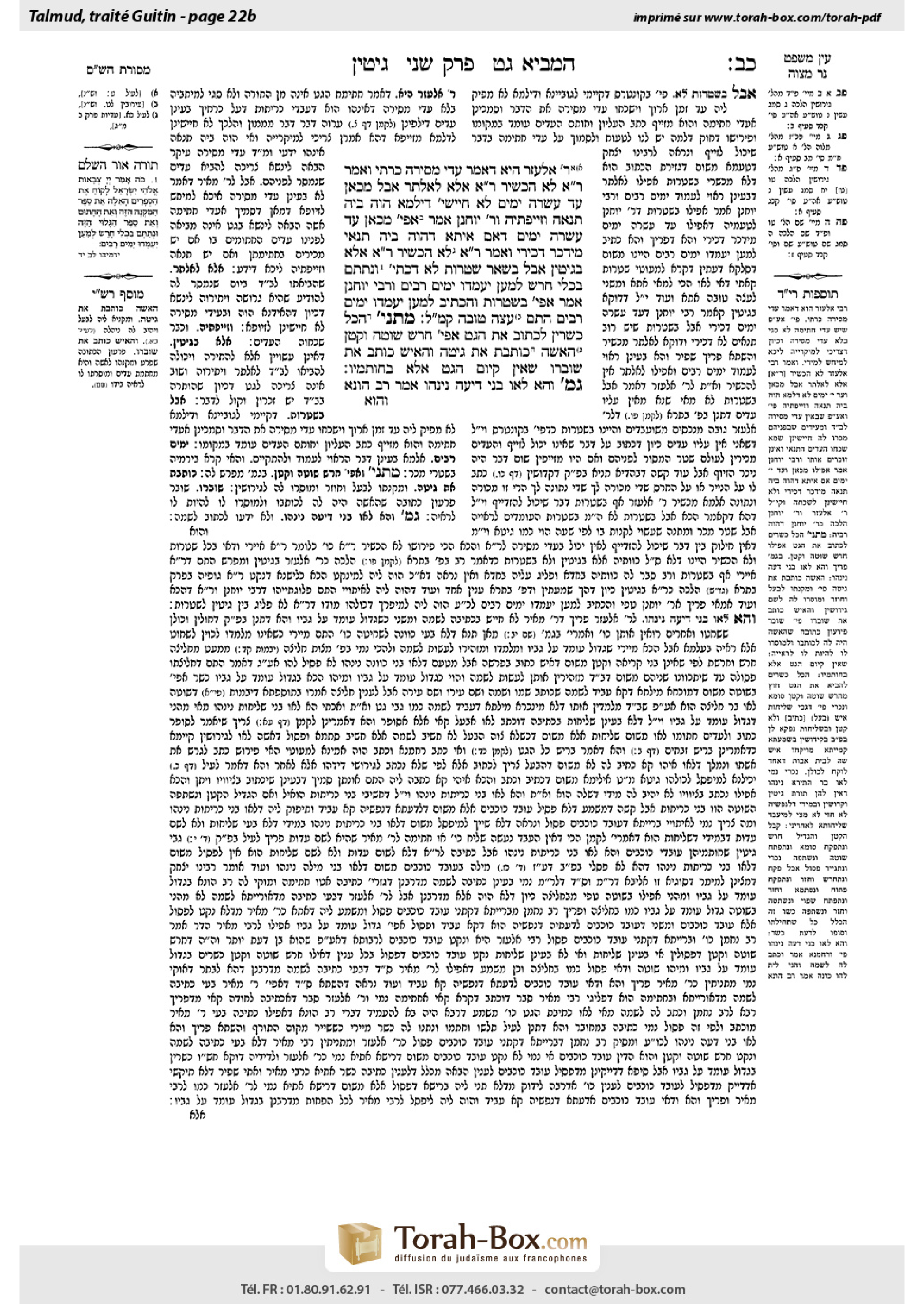
Gittin 22b: Talmud study for Daf Yomi
Study the Talmud for Daf Yomi with scanned pages, Hebrew text, English translations from Sefaria and AI-generated French translations.
Passage selection and English or AI-generated French translation are available where the scan has annotations. Daf Study is independent of Torah-Box and Sefaria.
Browse Gittin · גיטין · All tractatesGittin 22b text and translations
This page of Gittin includes the Aramaic text, an English translation and an AI-generated French translation, alongside the scan above.
גיטין כ״ב ב · Aramaic and Hebrew text
רַבִּי אֶלְעָזָר הִיא, דְּאָמַר: עֵדֵי מְסִירָה כָּרְתִי.
וְאָמַר רַבִּי אֶלְעָזָר: לֹא הִכְשִׁיר רַבִּי אֶלְעָזָר אֶלָּא לְאַלְתַּר, אֲבָל מִכָּאן עַד עֲשָׂרָה יָמִים – לָא; חָיְישִׁינַן דִּילְמָא הֲוָה בֵּיהּ תְּנָאָה וְזַיֵּיפְתֵּיהּ.
וְרַבִּי יוֹחָנָן אָמַר: אֲפִילּוּ מִכָּאן עַד עֲשָׂרָה יָמִים; דְּאִם אִיתָא דַּהֲוָה בֵּיהּ תְּנַאי – מִידְכָּר דְּכִירִי.
וְאָמַר רַבִּי אֶלְעָזָר: לֹא הִכְשִׁיר רַבִּי אֶלְעָזָר אֶלָּא בְּגִיטִּין, אֲבָל בִּשְׁאָר שְׁטָרוֹת – לָא, דִּכְתִיב: ״וּנְתַתָּם בִּכְלִי חָרֶשׂ לְמַעַן יַעַמְדוּ יָמִים רַבִּים״.
וְרַבִּי יוֹחָנָן אָמַר: אֲפִילּוּ בִּשְׁטָרוֹת. וְהָכְתִיב: ״לְמַעַן יַעַמְדוּ יָמִים רַבִּים״! הָתָם עֵצָה טוֹבָה קָא מַשְׁמַע לַן.
מַתְנִי׳ הַכֹּל כְּשֵׁרִין לִכְתּוֹב אֶת הַגֵּט, אֲפִילּוּ חֵרֵשׁ, שׁוֹטֶה וְקָטָן. הָאִשָּׁה כּוֹתֶבֶת אֶת גִּיטָּהּ, וְהָאִישׁ כּוֹתֵב אֶת שׁוֹבָרוֹ. שֶׁאֵין קִיּוּם הַגֵּט אֶלָּא בְּחוֹתְמָיו.
גְּמָ׳ וְהָא לָאו בְּנֵי דֵּיעָה נִינְהוּ! אָמַר רַב הוּנָא:
Gittin 22b · English translation
It is the opinion of the tanna Rabbi Elazar, who says: Witnesses of the transmission of the bill of divorce effect the divorce. Since the witnesses read the bill of divorce before it is transmitted in their presence, they may be relied upon to confirm the contents of the bill of divorce in court. Therefore, even if it was written on erased paper, there is no possibility that it would be forged, as the witnesses read what was written before it is given.
And the amora Rabbi Elazar says: The tanna Rabbi Elazar deemed such a bill of divorce valid only when it was taken to court in order to confirm the contents immediately after it was transferred to the woman. However, if the witnesses testify from now until ten days, i.e., sometime later, he did not deem it valid. Why? We are concerned that perhaps the bill of divorce had a stipulation written on it and she forged it by erasing the stipulation, as this bill of divorce was written on material that enables a person to easily alter what is written. Only if the witnesses testify immediately can the court be sure that they did not forget what is written.
And Rabbi Yoḥanan says: Even if they testify from now until ten days it is valid, as, if it is so that it had a stipulation, then the witnesses will remember it, as they would not forget something so obvious. Therefore, if the woman erased the stipulation, the witnesses would not verify the bill of divorce.
And Rabbi Elazar the amora also says: The tanna Rabbi Elazar deemed valid a document that is written on these surfaces only with regard to bills of divorce but not for other documents, as it is written with regard to a deed of purchase: “And put them in an earthen vessel; so that they will remain many days” (Jeremiah 32:14). This indicates that a deed of purchase and other similar documents must be made from a material that will last for a long time without being changed. A document that can be forged may not be relied upon long term.
And Rabbi Yoḥanan says: Rabbi Elazar deemed these surfaces valid even in the case of other documents. The Gemara asks with regard to Rabbi Yoḥanan’s opinion: But isn’t it written: “So that they will remain many days”? The Gemara answers: There the verse teaches us good advice, but it is not a halakhic requirement. It advised that the document be written in such a manner that it can remain for an extended period of time, as it may be needed to prove ownership of the land.
MISHNA: Anyone is qualified to write a bill of divorce, even a deaf-mute, an imbecile, or a minor. Additionally, a woman may write her own bill of divorce and give it to her husband so that he can present it to her. And a man may write his own receipt, which must be given to him by the woman to confirm that he has paid her the value of her marriage contract. This is because the ratification of a bill of divorce is only through its signatories, and it is irrelevant who wrote it.
GEMARA: The Gemara asks: But how can a deaf-mute, imbecile, or a minor write a bill of divorce? They are not halakhically competent, and they are not capable of writing a bill of divorce with the intent that it be for a particular woman. Rav Huna says:
Gittin 22b · Traduction française (IA)
C'est l'opinion du tanna Rabbi Elazar, qui dit : Les témoins de la transmission du document de divorce accomplissent le divorce. Puisque les témoins ont lu le document de divorce avant qu'il ne soit transmis devant eux, ils peuvent être considérés comme fiables pour confirmer le contenu du document de divorce en cour. Par conséquent, même si ce document était écrit sur du papier effacé, il n'y a pas de possibilité qu'il ait été falsifié, car les témoins avaient lu ce qui était écrit avant qu'il ne soit remis.
Et l'amora Rabbi Elazar dit : Le tanna Rabbi Elazar considérait un tel document de divorce comme valide uniquement lorsqu'il était présenté en cour afin de confirmer son contenu immédiatement après sa transmission à la femme. Cependant, si les témoins témoignent à partir de maintenant jusqu'à dix jours, c'est-à-dire plus tard, il ne le considérait pas comme valide. Pourquoi ? Nous craignons que le document de divorce ait pu comporter une stipulation écrite et qu'elle l'ait falsifié en effaçant cette stipulation, car ce document de divorce était écrit sur un support qui permet facilement de modifier ce qui est écrit. Seul si les témoins témoignent immédiatement la cour peut être certain qu'ils n'ont pas oublié ce qui était écrit.
Et Rabbi Yoḥanan dit : Même si ils témoignent jusqu'à dix jours, il est valide, car, si c'est le cas qu'il y avait une stipulation, les témoins se souviendront d'elle, car ils ne oublieraient pas quelque chose d'aussi évident. Par conséquent, si la femme a effacé la stipulation, les témoins ne vérifieraient pas le document de divorce.
Et Rabbi Elazar l'amora dit aussi : Le tanna Rabbi Elazar considérait valide un document écrit sur ces supports uniquement concernant les documents de divorce, mais pas pour d'autres documents, car il est écrit concernant un acte de vente : « Et place-les dans un vase terrestre ; afin qu'ils restent de nombreux jours » (Jérémie 32:14). Cela indique qu'un acte de vente et d'autres documents semblables doivent être rédigés sur un support qui durera longtemps sans être modifié. Un document qui peut être falsifié ne peut pas être considéré comme fiable à long terme.
Et Rabbi Yoḥanan dit : Rabbi Elazar considérait ces supports comme valides même dans le cas d'autres documents. La Guemara pose la question concernant l'opinion de Rabbi Yoḥanan : Mais n'est-il pas écrit : « Afin qu'ils restent de nombreux jours » ? La Guemara répond : Là, la parole divine nous donne un conseil, mais ce n'est pas une exigence halakhique. Elle conseille que le document soit rédigé de manière à pouvoir rester pendant une longue période, car il pourrait être nécessaire pour prouver la propriété de la terre.
MICHNA : Tout le monde est qualifié d'écrire un document de divorce, même un sourd-muet, un imbécile ou un mineur. De plus, une femme peut écrire elle-même son propre document de divorce et le donner à son mari afin qu'il le présente à elle. Et un homme peut écrire lui-même son propre reçu, qui doit être donné à lui par la femme afin de confirmer qu'il a payé la valeur de son contrat de mariage. Cela est dû au fait que la ratification d'un document de divorce se fait uniquement par ses signataires, et il n'est pas important qui l'a rédigé.
GUEMARA : La Guemara pose la question : Mais comment un sourd-muet, un imbécile ou un mineur peut-il écrire un document de divorce ? Ils ne sont pas halakhiquement compétents, et ils ne sont pas capables d'écrire un document de divorce avec l'intention qu'il soit adressé à une femme particulière. Rav Huna dit :
Traduction française générée par IA à partir de l’édition anglaise de Sefaria. Vérifie toujours un passage avec le texte source.
Text from Sefaria: William Davidson Edition - Vocalized Aramaic (CC BY NC); William Davidson Edition - English (CC BY NC).