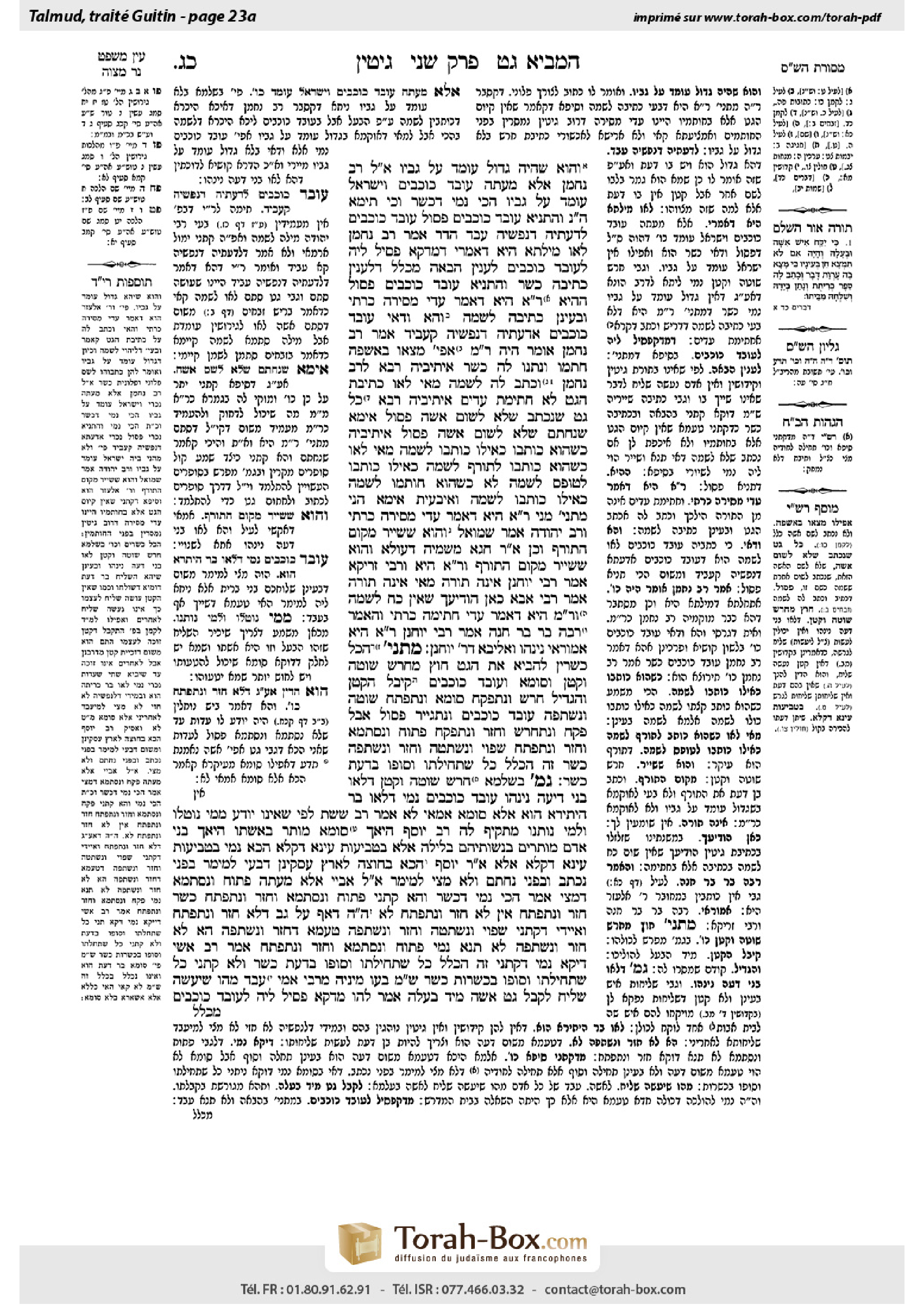
Gittin 23a: Talmud study for Daf Yomi
Study the Talmud for Daf Yomi with scanned pages, Hebrew text, English translations from Sefaria and AI-generated French translations.
Passage selection and English or AI-generated French translation are available where the scan has annotations. Daf Study is independent of Torah-Box and Sefaria.
Browse Gittin · גיטין · All tractatesGittin 23a text and translations
This page of Gittin includes the Aramaic text, an English translation and an AI-generated French translation, alongside the scan above.
גיטין כ״ג א · Aramaic and Hebrew text
וְהוּא שֶׁהָיָה גָּדוֹל עוֹמֵד עַל גַּבָּיו.
אֲמַר לֵיהּ רַב נַחְמָן: אֶלָּא מֵעַתָּה, גּוֹי – וְיִשְׂרָאֵל עוֹמֵד עַל גַּבָּיו, הָכִי נָמֵי דְּכָשֵׁר?! וְכִי תֵּימָא הָכִי נָמֵי, וְהָתַנְיָא: גּוֹי פָּסוּל! גּוֹי, לְדַעְתֵּיהּ דְּנַפְשֵׁיהּ עָבֵד.
הֲדַר אָמַר רַב נַחְמָן: לָאו מִילְּתָא הִיא דַּאֲמַרִי; דְּמִדְּקָא פָּסֵיל לֵיהּ לְגוֹי לְעִנְיַן הֲבָאָה, מִכְּלָל דִּלְעִנְיַן כְּתִיבָה – כָּשֵׁר.
וְהָתַנְיָא: גּוֹי פָּסוּל! הַהִיא רַבִּי אֶלְעָזָר הִיא, דְּאָמַר: עֵדֵי מְסִירָה כָּרְתִי, וּבָעֵינַן כְּתִיבָה לִשְׁמָהּ; וְהָא וַדַּאי גּוֹי אַדַּעְתֵּיהּ דְּנַפְשֵׁיהּ קָעָבֵיד.
אָמַר רַב נַחְמָן, אוֹמֵר הָיָה רַבִּי מֵאִיר: אֲפִילּוּ מְצָאוֹ בְּאַשְׁפָּה, חֲתָמוֹ, וּנְתָנוֹ לָהּ – כָּשֵׁר.
אֵיתִיבֵיהּ רָבָא לְרַב נַחְמָן: ״וְכָתַב לָהּ״ – לִשְׁמָהּ; מַאי, לָאו כְּתִיבַת הַגֵּט?! לֹא, חֲתִימַת עֵדִים.
אֵיתִיבֵיהּ רָבָא: כׇּל גֵּט שֶׁנִּכְתַּב שֶׁלֹּא לְשׁוּם אִשָּׁה – פָּסוּל! אֵימָא: שֶׁנֶּחְתַּם שֶׁלֹּא לְשׁוּם אִשָּׁה – פָּסוּל.
אֵיתִיבֵיהּ: כְּשֶׁהוּא כּוֹתְבוֹ – כְּאִילּוּ כּוֹתְבוֹ לִשְׁמָהּ. מַאי, לָאו כְּשֶׁהוּא כּוֹתְבוֹ לַתּוֹרֶף לִשְׁמָהּ – כְּאִילּוּ כּוֹתְבוֹ לַטּוֹפֶס לִשְׁמָהּ?!
לֹא; כְּשֶׁהוּא חוֹתְמוֹ לִשְׁמָהּ – כְּאִילּוּ כּוֹתְבוֹ לִשְׁמָהּ. וְאִיבָּעֵית אֵימָא: הָנֵי מַתְנִיתִין מַנִּי? רַבִּי אֶלְעָזָר הִיא, דְּאָמַר: עֵדֵי מְסִירָה כָּרְתִי.
וְרַב יְהוּדָה אָמַר שְׁמוּאֵל: וְהוּא שֶׁשִּׁיֵּיר מְקוֹם הַתּוֹרֶף. וְכֵן אָמַר רַבִּי חַגָּא מִשְּׁמֵיהּ דְּעוּלָּא: וְהוּא שֶׁשִּׁיֵּיר מְקוֹם הַתּוֹרֶף, וְרַבִּי אֶלְעָזָר הִיא.
וְרַבִּי זְרִיקָא אָמַר רַבִּי יוֹחָנָן: אֵינָהּ תּוֹרָה. מַאי ״אֵינָהּ תּוֹרָה״? אָמַר רַבִּי אַבָּא: כָּאן הוֹדִיעֲךָ שֶׁאֵין כֹּחַ לִשְׁמָהּ; וְרַבִּי מֵאִיר הִיא, דְּאָמַר: עֵדֵי חֲתִימָה כָּרְתִי.
וְהָאָמַר רַבָּה בַּר בַּר חָנָה, אָמַר רַבִּי יוֹחָנָן: רַבִּי אֶלְעָזָר הִיא! אָמוֹרָאֵי נִינְהוּ וְאַלִּיבָּא דְּרַבִּי יוֹחָנָן.
מַתְנִי׳ הַכֹּל כְּשֵׁרִין לְהָבִיא אֶת הַגֵּט, חוּץ מֵחֵרֵשׁ, שׁוֹטֶה, וְקָטָן, וְסוֹמֵא, וְגוֹי.
קִיבֵּל הַקָּטָן וְהִגְדִּיל; חֵרֵשׁ וְנִתְפַּקֵּחַ; סוֹמֵא וְנִתְפַּתֵּחַ; שׁוֹטֶה וְנִשְׁתַּפָּה; גּוֹי וְנִתְגַּיֵּיר – פָּסוּל.
אֲבָל פִּקֵּחַ וְנִתְחָרֵשׁ וְחָזַר וְנִתְפַּקֵּחַ; פָּתוּחַ וְנִסְתַּמֵּא וְחָזַר וְנִתְפַּתֵּחַ; שָׁפוּי וְנִשְׁתַּטָּה וְחָזַר וְנִשְׁתַּפָּה – כָּשֵׁר. זֶה הַכְּלָל: כׇּל שֶׁתְּחִילָּתוֹ וְסוֹפוֹ בְּדַעַת – כָּשֵׁר.
גְּמָ׳ בִּשְׁלָמָא חֵרֵשׁ, שׁוֹטֶה וְקָטָן – דְּלָאו בְּנֵי דֵּיעָה נִינְהוּ; גּוֹי נָמֵי – דְּלָאו בַּר הֶיתֵּירָא הוּא; אֶלָּא סוֹמֵא, אַמַּאי לָא? אָמַר רַב שֵׁשֶׁת: לְפִי שֶׁאֵינוֹ יוֹדֵעַ מִמִּי נוֹטְלוֹ וּלְמִי נוֹתְנוֹ.
מַתְקֵיף לַהּ רַב יוֹסֵף: הֵיאַךְ סוֹמֵא מוּתָּר בְּאִשְׁתּוֹ? הֵיאַךְ בְּנֵי אָדָם מוּתָּרִים בִּנְשׁוֹתֵיהֶם בַּלַּיְלָה? אֶלָּא בִּטְבִיעוּת עֵינָא דְּקָלָא, הָכָא נָמֵי בִּטְבִיעוּת עֵינָא דְּקָלָא!
אֶלָּא אָמַר רַב יוֹסֵף: הָכָא בְּחוּצָה לָאָרֶץ עָסְקִינַן; דְּבָעֵי לְמֵימַר: ״בְּפָנַי נִכְתַּב וּבְפָנַי נֶחְתַּם״, וְלָא מָצֵי לְמֵימַר.
אֲמַר לֵיהּ אַבָּיֵי: אֶלָּא מֵעַתָּה, פָּתוּחַ וְנִסְתַּמֵּא, דְּמָצֵי אָמַר, הָכִי נָמֵי דְּכָשֵׁר?! וְהָא קָתָנֵי: פָּתוּחַ וְנִסְתַּמֵּא וְחָזַר וְנִתְפַּתֵּחַ, כָּשֵׁר – חָזַר וְנִתְפַּתֵּחַ, אִין; לֹא חָזַר וְנִתְפַּתֵּחַ, לֹא!
הוּא הַדִּין דְּאַף עַל גַּב דְּלֹא חָזַר וְנִתְפַּתֵּחַ; וְאַיְּידֵי דְּקָתָנֵי שָׁפוּי וְנִשְׁתַּטָּה וְחָזַר וְנִשְׁתַּפָּה – טַעְמָא דְּחָזַר וְנִשְׁתַּפָּה, הָא לֹא חָזַר וְנִשְׁתַּפָּה – לָא; תְּנָא נָמֵי פָּתוּחַ וְנִסְתַּמֵּא וְחָזַר וְנִתְפַּתֵּחַ.
אָמַר רַב אָשֵׁי: דַּיְקָא נָמֵי – דְּקָתָנֵי, זֶה הַכְּלָל: כׇּל שֶׁתְּחִילָּתוֹ וְסוֹפוֹ בְּדַעַת – כָּשֵׁר; וְלָא קָתָנֵי: כׇּל שֶׁתְּחִילָּתוֹ וְסוֹפוֹ בְּכַשְׁרוּת – כָּשֵׁר; שְׁמַע מִינַּהּ.
בְּעוֹ מִינֵּיהּ מֵרַבִּי אַמֵּי: עֶבֶד, מַהוּ שֶׁיֵּעָשֶׂה שָׁלִיחַ לְקַבֵּל גֵּט אִשָּׁה מִיַּד בַּעְלָהּ? אֲמַר לְהוּ: מִדְּקָא פָּסֵיל לֵיהּ לְגוֹי,
Gittin 23a · English translation
And that is the case only when there was an adult standing over him. When the adult supervises the writing, and instructs him to write it for her sake, it will be valid.
Rav Naḥman said to him: If that is so, that anyone who is disqualified from writing a bill of divorce may do so with an adult supervising him, then if the one writing is a gentile, and a Jew stands over him and instructs him to write it for her sake, would you also say that it is valid? And if you would say that it is also valid, but isn’t it taught in a baraita: A gentile is disqualified from writing a bill of divorce in any event? Rav Huna answered: A gentile acts based on his own will. Since he is halakhically competent, he will have his own intentions while writing and may not be relied upon to carry out the intentions of the supervisor. In the case of the mishna, since those doing the writing are not halakhically competent, they will write according to the instructions of the supervisor.
Rav Naḥman then said: What I said when I raised a challenge from a case involving a gentile is not correct, as from the fact that the mishna later disqualifies a gentile with regard to acting as an agent in the bringing of the bill of divorce, one can learn by inference that he is qualified with regard to writing, where he is not listed among those who are disqualified.
The Gemara asks: But isn’t it taught in a baraita that a gentile is disqualified from writing a bill of divorce? The Gemara answers: That baraita is in accordance with the opinion of Rabbi Elazar, who says: Witnesses of the transmission of the bill of divorce effect the divorce, and when the verse states: “And he writes her” (Deuteronomy 24:1), which is the source for the halakha that the writing needs to be done for her sake, it is referring to the writing of the bill of divorce and not to its signing. Therefore, we need the writing to be for her sake, and certainly a gentile acts based on his own will and may not be relied upon to write the bill of divorce according to the instructions of a supervisor.
With regard to the requirement that a bill of divorce be written for her sake, Rav Naḥman says that Rabbi Meir would have said: Even if the husband found the bill of divorce in the garbage dump, and the names written on it happened to be the same as his and his wife’s names, if he had it signed by witnesses and he gave it to her, then it is valid, because the essential requirement is that it be signed for her sake.
Rava raised an objection to the statement of Rav Naḥman: The verse states: “And he writes her,” which is interpreted to mean that it must be written for her sake. What, is it not referring to the actual writing of the bill of divorce, that it must be written with the intent that it be used to sever this particular marriage? The Gemara rejects this: No, it is referring to the signing of the witnesses.
Rava raised another objection to him based on what was taught in a mishna (24a): Any bill of divorce that was not written for the sake of a specific woman is invalid. He responded: Say that according Rabbi Meir the mishna teaches: Any bill of divorce that was not signed for the sake of a specific woman is invalid.
Rava raised another objection to him based on another baraita: When he writes it, it is as though he writes it for her sake, meaning that writing one part for her sake makes it as if the entire document were written for her sake. What, it is not stating that when he writes the essential part of the document, which includes the names of the spouses; the date on which it was written; and the expression: Behold you are permitted to any man, for her sake, then is it as though he writes the standard part of the bill of divorce, containing the rest of the information, for her sake? This baraita indicates that there is a requirement that the bill of divorce, not just the signatures, be written for her sake.
Rav Naḥman rejects this: No, Rabbi Meir would explain that this baraita is referring to a case where he has witnesses sign it for her sake; it is as though he wrote it for her sake. And if you wish, say: Who is the tanna of these baraitot from which you raised challenges? They are in accordance with the opinion of Rabbi Elazar, who said: Witnesses of the transmission of the bill of divorce effect the divorce. According to him, the verse is referring to the writing and not the signing of the bill of divorce, and the writing must be for her sake.
And Rav Yehuda says that Shmuel says: And the statement of the mishna that one who is not halakhically competent is qualified to write a bill of divorce is the halakha only when he left unwritten the essential part of the document, which will be written later by a halakhically competent person, as only the essential part must be written for her sake. And so Rabbi Ḥagga says in the name of Ulla: And this is the halakha only when he left the essential part of the document unwritten, and the mishna is in accordance with the opinion of Rabbi Elazar, that the writing of the essential part must be done for her sake.
And Rabbi Zerika says that Rabbi Yoḥanan says: It is not Torah. The Gemara clarifies: What is meant by the expression: It is not Torah? Rabbi Abba says: Here Rabbi Yoḥanan informs you that there is no force to a requirement that a bill of divorce be written for her sake, as only the signing needs to be done for her sake. And it is in accordance with the opinion of Rabbi Meir, who says: Signatory witnesses on the bill of divorce effect the divorce.
The Gemara asks: But didn’t Rabba bar bar Ḥana say earlier that Rabbi Yoḥanan said that the mishna is in accordance with the opinion of Rabbi Elazar? How, then, can Rabbi Abba say that according to Rabbi Yoḥanan, the mishna is in accordance with the opinion of Rabbi Meir? The Gemara answers: They are amora’im and disagree with regard to the opinion of Rabbi Yoḥanan, whether he explains the mishna in accordance with the opinion of Rabbi Meir or that of Rabbi Elazar.
MISHNA: Anyone is fit to serve as an agent to bring a bill of divorce to a woman except for a deaf-mute, an imbecile, or a minor, or a blind person, or a gentile.
If a minor received the bill of divorce and then reached the age of majority, or one received it when he was a deaf-mute and then became able to hear, or one received it when he was blind and then became able to see, or one received it when he was an imbecile and then became halakhically competent, or one received it when he was a gentile and then converted, in all of these cases he is unfit to bring the bill of divorce.
However, if one received it when he was able to hear, and then became a deaf-mute, and then again became able to hear; or if one received it when he was able to see, and then became blind, and then again became able to see; or one received it when he was halakhically competent, and then became an imbecile, and then again became halakhically competent, in all of these cases he is fit to bring the bill of divorce. This is the principle: Anyone who is halakhically competent in the beginning and in the end is fit, even if there was time in the interim when he was unfit.
GEMARA: The Gemara asks with regard to those the mishna lists as not being qualified to bring a bill of divorce: Granted, a deaf-mute, an imbecile, and a minor are not qualified because they are not halakhically competent, and only one who is competent can be appointed as an agent. Additionally, a gentile also is not qualified, as he is not subject to the halakhot that permit a woman to remarry via a bill of divorce. A person cannot serve as an agent for a matter that does not apply to him. But why isn’t a blind person qualified to bring a bill of divorce? Rav Sheshet says: Because he does not know from whom he takes it and to whom he gives it, and since he is unaware of this he will not be able to testify about it.
Rav Yosef objects to this: If there is a concern that a blind person cannot distinguish between different people, then how is a blind man permitted to have sexual relations with his wife? How does he know that she is in fact his wife? Similarly, how are all people permitted to have sexual relations with their wives at night? If it is dark, they cannot see them. Rather, you must say that they are permitted through voice recognition [teviut eina dekala]. They can recognize each other based on their voices. Here too, with regard to a blind person, he can recognize the giver and receiver of the bill of divorce through voice recognition.
Rather, Rav Yosef says: Here we are dealing with a husband who sends a bill of divorce to his wife outside of Eretz Yisrael, where the agent needs to say: It was written in my presence and it was signed in my presence, and a blind man cannot say this because he is unable to see it being written or signed.
Abaye said to him: However, if that is so, then a person who is able to see when he receives the bill of divorce and then becomes blind, who can say: It was written and signed in my presence, as he was able to see when it was written and signed, would you say that he is also fit to bring the bill of divorce? But it is taught in the mishna: If one received it when he was able to see, and then became blind, and then again became able to see, then he is fit to bring the bill of divorce. It can be inferred from here that only when he again became able to see, yes, he may bring it. But if he did not again become able to see, then no, he may not bring it.
The Gemara answers this question: In fact, with regard to a blind person, the same is true, that although he did not again become able to see he can serve as an agent to bring the bill of divorce and testify that it was written and signed in his presence. And why does it teach that the blind man became able to see again? Since the mishna teaches that one who received the bill of divorce when he was halakhically competent, and then became an imbecile, and then again became halakhically competent is qualified to bring the bill of divorce. And in that case, the reason why he is qualified is specifically that he again became halakhically competent, but if he did not again become halakhically competent, then he is not qualified. Therefore, the mishna also teaches with regard to one who was able to see that he then became blind and then again became able to see.
Rav Ashi said: The language of the mishna is also precise, as it teaches that this is the principle: Anyone who is halakhically competent in the beginning and in the end is fit, and it does not teach: Anyone who is fit in the beginning and the end is fit. Learn from the mishna that it is not necessary for him to be fit in the beginning and the end, as there are times that being fit in the beginning is sufficient, as in the case of one who became blind after witnessing the writing and signing of the bill of divorce. However, it is clear that he must be halakhically competent both in the beginning and the end, which a blind person is.
§ They raised a dilemma before Rabbi Ami: With regard to a slave, what is the halakha? Can he be made an agent to receive a woman’s bill of divorce from the hand of her husband? Is he qualified to act as an agent or not? He said to them: From the fact that the mishna disqualified a gentile,
Gittin 23a · Traduction française (IA)
Et c'est le cas seulement lorsque quelqu'un adulte était présent auprès de lui. Lorsque l'adulte supervise l'écriture et instruit lui de l'écrire à son intention, cela sera valide.
Rav Naḥman dit à lui : Si c'est ainsi, c'est-à-dire que tout celui qui est disqualifié d'écrire un acte de divorce peut le faire avec un adulte qui le supervise, alors si celui qui écrit est un non-Juif, et un Juif est présent auprès de lui et l'instruit de l'écrire à son intention, dirais-tu aussi que cela est valide ? Et si tu dirais que cela est aussi valide, mais n'est-il pas enseigné dans une baraïta : Un non-Juif est disqualifié d'écrire un acte de divorce en tout cas ? Rav Huna répondit : Un non-Juif agit selon son propre vouloir. Puisqu'il est halakhiquement compétent, il aura ses propres intentions lors de l'écriture et ne peut pas être compté sur pour exécuter les intentions du superviseur. Dans le cas de la mitsva, puisque ceux qui écrivent ne sont pas halakhiquement compétents, ils écriront selon les instructions du superviseur.
Rav Naḥman dit alors : Ce que j'ai dit lorsqu'un cas impliquant un non-Juif a été soulevé n'est pas correct, car à partir du fait que la mitsva disqualifie un non-Juif concernant l'agence dans la transmission de l'acte de divorce, on peut en déduire qu'il est compétent concernant l'écriture, puisqu'il n'est pas mentionné parmi ceux qui sont disqualifiés.
La Guemara demande : Mais n'est-il pas enseigné dans une baraïta que le non-Juif est disqualifié d'écrire un acte de divorce ? La Guemara répond : Cette baraïta est selon l'opinion de Rabbi Elazar, qui dit : Les témoins de la transmission de l'acte de divorce accomplissent le divorce, et lorsque la parabole dit : « Et il écrit pour elle » (Deutéronome 24:1), qui est la source de la halakha que l'écriture doit être faite à son intention, il s'agit de l'écriture de l'acte de divorce et non de sa signature. Ainsi, nous avons besoin que l'écriture soit faite à son intention, et certainement un non-Juif agit selon son propre vouloir et ne peut pas être compté sur pour écrire l'acte de divorce selon les instructions du superviseur.
Concernant la nécessité que l'acte de divorce soit écrit à son intention, Rav Naḥman dit que Rabbi Meir aurait dit : Même si le mari trouvait l'acte de divorce dans un tas de détritus, et que les noms écrits dessus correspondaient justement aux noms de lui et de sa femme, si il le faisait signer par des témoins et le donnait à elle, alors cela est valide, car la nécessité essentielle est que cela soit signé à son intention.
Rava souleva une objection contre l'assertion de Rav Naḥman : La parabole dit : « Et il écrit pour elle », ce qui est interprété pour signifier qu'il doit être écrit à son intention. Qu'est-ce que cela ne signifie pas, ne s'agit-il pas de l'écriture réelle de l'acte de divorce, qui doit être faite avec l'intention qu'il serve à rompre ce mariage particulier ? La Guemara rejette cela : Non, il s'agit de la signature des témoins.
Rava souleva une autre objection contre lui basée sur ce qui fut enseigné dans une mitsna (24a) : Tout acte de divorce qui n'a pas été écrit à l'intention d'une femme spécifique est invalide. Il répondit : Dis que c'est selon Rabbi Meir, la mitsna enseigne : Tout acte de divorce qui n'a pas été signé à l'intention d'une femme spécifique est invalide.
Rava souleva une autre objection contre lui basée sur une autre baraïta : Lorsqu'il l'écrit, c'est comme s'il l'écrivait à son intention, c'est-à-dire que l'écriture d'une partie à son intention rend l'ensemble du document comme s'il avait été écrit à son intention. Qu'est-ce que cela ne signifie pas, ne dit-il pas que lorsqu'il écrit la partie essentielle du document, qui inclut les noms des époux, la date d'écriture et l'expression : « Voici que tu es libre à tout homme », à son intention, alors est-ce comme s'il écrivait la partie standard du document, contenant le reste des informations, à son intention ? Cette baraïta indique que l'acte de divorce, pas seulement les signatures, doit être écrit à son intention.
Rav Naḥman rejette cela : Non, Rabbi Meir expliquerait que cette baraïta fait référence à un cas où il a des témoins qui le signent à son intention ; c'est comme s'il l'avait écrit à son intention. Et si tu veux, dis : De quel tanna ces baraitot proviennent-elles, desquels tu as soulevé des objections ? Ils sont selon l'opinion de Rabbi Elazar, qui dit : Les témoins de la transmission de l'acte de divorce accomplissent le divorce. Selon lui, la parabole fait référence à l'écriture et non à la signature de l'acte de divorce, et l'écriture doit être faite à son intention.
Et Rav Yehuda dit que Shmuel dit : L'affirmation de la mitsva que celui qui n'est pas halakhiquement compétent est qualifié d'écrire un acte de divorce est la halakha seulement lorsqu'il a laissé l'essentiel du document non écrit, qui sera écrit plus tard par une personne halakhiquement compétente, car seul l'essentiel doit être écrit à son intention. Et ainsi Rabbi Ḥagga dit en nom d'Ulla : Et c'est la halakha seulement lorsqu'il a laissé l'essentiel du document non écrit, et la mitsva est selon l'opinion de Rabbi Elazar, que l'écriture de l'essentiel doit être faite à son intention.
Et Rabbi Zerika dit que Rabbi Yoḥanan dit : Ce n'est pas de la Torah. La Guemara clarifie : De quoi l'expression : Ce n'est pas de la Torah ? Rabbi Abba dit : Ici Rabbi Yoḥanan t'informe que la nécessité d'un acte de divorce écrit à son intention n'a pas de force, car seulement la signature a besoin d'être faite à son intention. Et c'est selon l'opinion de Rabbi Meir, qui dit : Les témoins signataires de l'acte de divorce accomplissent le divorce.
La Guemara demande : Mais n'a-t-il pas dit plus tôt Rabba bar bar Ḥana que Rabbi Yoḥanan dit que la mitsva est selon l'opinion de Rabbi Elazar ? Comment alors Rabbi Abba peut-il dire que selon Rabbi Yoḥanan, la mitsva est selon l'opinion de Rabbi Meir ? La Guemara répond : Ils sont des amora’im et ils divergent concernant l'opinion de Rabbi Yoḥanan, s'il explique la mitsva selon l'opinion de Rabbi Meir ou celle de Rabbi Elazar.
MICHNA : Tout le monde est digne de servir en tant qu'agent pour apporter un acte de divorce à une femme, sauf un sourd-muet, un imbécile, un mineur, un aveugle ou un non-Juif.
Si un mineur a reçu l'acte de divorce et est ensuite devenu majeur, ou s'il l'a reçu lorsqu'il était sourd-muet et est ensuite devenu capable d'entendre, ou s'il l'a reçu lorsqu'il était aveugle et est ensuite devenu capable de voir, ou s'il l'a reçu lorsqu'il était imbécile et est ensuite devenu compétent halakhiquement, ou s'il l'a reçu lorsqu'il était non-Juif et s'est ensuite converti, dans tous ces cas, il est indigne d'apporter l'acte de divorce.
Cependant, si l'on a reçu l'acte de divorce lorsqu'on était capable d'entendre et qu'on est ensuite devenu sourd-muet, puis à nouveau capable d'entendre ; ou si l'on a reçu l'acte de divorce lorsqu'on était capable de voir et qu'on est ensuite devenu aveugle, puis à nouveau capable de voir ; ou si l'on a reçu l'acte de divorce lorsqu'on était compétent halakhiquement et qu'on est ensuite devenu imbécile, puis à nouveau compétent halakhiquement, dans tous ces cas, on est digne d'apporter l'acte de divorce. C'est le principe : celui qui est compétent halakhiquement au début et à la fin est digne, même s'il y a eu une période intermédiaire où il n'était pas compétent.
GUEMARA : La Guemara pose la question concernant ceux que la Michna liste comme non qualifiés pour apporter un acte de divorce : C'est évident, un sourd-muet, un imbécile et un mineur ne sont pas qualifiés, car ils ne sont pas compétents halakhiquement, et seul celui qui est compétent peut être désigné comme agent. De plus, un non-Juif n'est pas non plus qualifié, car il n'est pas soumis aux halakhot qui permettent à une femme de remettre épouse via un acte de divorce. Une personne ne peut pas servir d'agent pour une affaire qui ne s'applique pas à elle. Mais pourquoi un aveugle n'est-il pas qualifié pour apporter un acte de divorce ? Rav Sheshet dit : Parce qu'il ne sait pas d'où il le prend et à qui il le donne, et puisqu'il est inconscient de cela, il ne pourra pas témoigner à son sujet.
Rav Yosef s'oppose à cela : Si l'inquiétude est que l'aveugle ne peut pas distinguer entre différentes personnes, alors comment un aveugle est-il autorisé à avoir des relations sexuelles avec sa femme ? Comment sait-il qu'il s'agit effectivement de sa femme ? De même, comment tous les gens sont-ils autorisés à avoir des relations sexuelles avec leur femme la nuit ? Si l'obscurité empêche la vue, ils ne peuvent pas la voir. Plutôt, vous devez dire qu'ils sont autorisés par la reconnaissance vocale [teviut eina dekala]. Ils peuvent se reconnaître par leur voix. De même, concernant l'aveugle, il peut reconnaître le donneur et le receveur de l'acte de divorce par la reconnaissance vocale.
Plutôt, Rav Yosef dit : Ici, nous parlons d'un mari qui envoie un acte de divorce à sa femme en dehors d'Israël, où l'agent doit dire : Il a été écrit devant moi et signé devant moi, et un homme aveugle ne peut pas dire cela, car il ne peut pas voir l'écriture ou la signature.
Abaye dit à lui : Cependant, si c'est ainsi, alors une personne qui pouvait voir lorsqu'elle recevait l'acte de divorce et devint ensuite aveugle, qui pourrait dire : Il a été écrit et signé devant moi, car il pouvait voir lorsqu'il a été écrit et signé, diriez-vous qu'il est également digne d'apporter l'acte de divorce ? Mais il est enseigné dans la Michna : Si l'on a reçu l'acte de divorce lorsqu'on était capable de voir, puis est devenu aveugle, puis à nouveau capable de voir, alors on est digne d'apporter l'acte de divorce. On peut en déduire ici que seul lorsqu'il est à nouveau capable de voir, oui, il peut l'apporter. Mais si l'on n'est pas devenu à nouveau capable de voir, alors non, on ne peut pas l'apporter.
La Guemara répond à cette question : En réalité, concernant une personne aveugle, c'est la même chose, que bien qu'elle n'ait pas à nouveau été capable de voir, elle peut servir d'agent pour apporter l'acte de divorce et témoigner qu'il a été écrit et signé devant elle. Et pourquoi enseigne-t-elle que l'aveugle est devenu capable de voir à nouveau ? Parce que la Michna enseigne que celui qui a reçu l'acte de divorce lorsqu'il était compétent halakhiquement, puis est devenu imbécile, puis à nouveau compétent halakhiquement est digne d'apporter l'acte de divorce. Et dans ce cas, la raison pour laquelle il est digne est spécifiquement qu'il est à nouveau compétent halakhiquement, mais si il n'est pas à nouveau compétent halakhiquement, alors il n'est pas digne. Par conséquent, la Michna enseigne aussi concernant celui qui était capable de voir, puis est devenu aveugle, puis à nouveau capable de voir.
Rav Ashi dit : La langue de la Michna est aussi précise, car elle enseigne que c'est le principe : celui qui est compétent halakhiquement au début et à la fin est digne, et elle ne dit pas : celui qui est digne au début et à la fin est digne. Apprenez de la Michna que cela n'est pas nécessaire qu'il soit digne au début et à la fin, car il y a des moments où être digne au début suffit, comme dans le cas de celui qui est devenu aveugle après avoir vu l'écriture et la signature de l'acte de divorce. Cependant, il est clair qu'il doit être compétent halakhiquement à la fois au début et à la fin, ce que l'aveugle n'est pas.
§ Ils ont soulevé un dilemme devant Rabbi Ami : Concernant un esclave, quelle est la halakha ? Peut-il être fait agent pour recevoir l'acte de divorce d'une femme de la main de son mari ? Est-il digne d'agir en tant qu'agent ou non ? Il a dit à eux : D'après le fait que la Michna a disqualifié un non-Juif,
Traduction française générée par IA à partir de l’édition anglaise de Sefaria. Vérifie toujours un passage avec le texte source.
Text from Sefaria: William Davidson Edition - Vocalized Aramaic (CC BY NC); William Davidson Edition - English (CC BY NC).