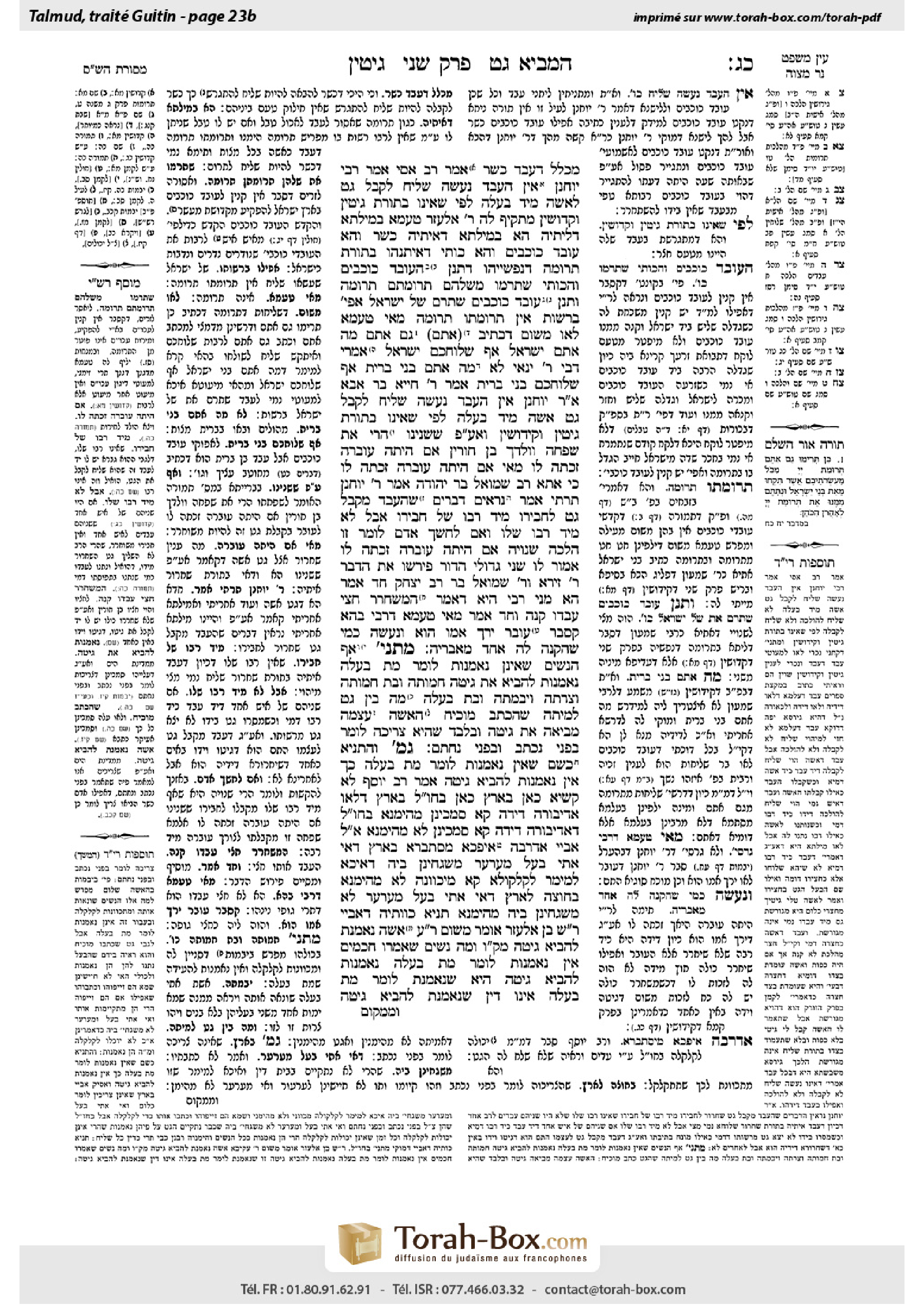
Gittin 23b: Talmud study for Daf Yomi
Study the Talmud for Daf Yomi with scanned pages, Hebrew text, English translations from Sefaria and AI-generated French translations.
Passage selection and English or AI-generated French translation are available where the scan has annotations. Daf Study is independent of Torah-Box and Sefaria.
Browse Gittin · גיטין · All tractatesGittin 23b text and translations
This page of Gittin includes the Aramaic text, an English translation and an AI-generated French translation, alongside the scan above.
גיטין כ״ג ב · Aramaic and Hebrew text
מִכְּלָל דְּעֶבֶד כָּשֵׁר. אָמַר רַב אַסִּי, אָמַר רַבִּי יוֹחָנָן: אֵין הָעֶבֶד נַעֲשֶׂה שָׁלִיחַ לְקַבֵּל גֵּט לְאִשָּׁה מִיַּד בַּעְלָהּ, לְפִי שֶׁאֵינוֹ בְּתוֹרַת גִּיטִּין וְקִדּוּשִׁין.
מַתְקֵיף לַהּ רַבִּי אֶלְעָזָר: טַעְמָא בְּמִילְּתָא דְּלֵיתֵיהּ, הָא בְּמִילְּתָא דְּאִיתֵיהּ – כָּשֵׁר?!
וְהָא גּוֹי וְהָא כּוּתִי; דְּאִיתַנְהוּ בְּתוֹרַת תְּרוּמָה דְּנַפְשַׁיְיהוּ, דִּתְנַן: הַגּוֹי וְהַכּוּתִי שֶׁתָּרְמוּ מִשֶּׁלָּהֶם – תְּרוּמָתָם תְּרוּמָה; וּתְנַן: גּוֹי שֶׁתָּרַם שֶׁל יִשְׂרָאֵל, אֲפִילּוּ בִּרְשׁוּת – אֵין תְּרוּמָתוֹ תְּרוּמָה!
מַאי טַעְמָא? לָאו מִשּׁוּם דִּכְתִיב: (אַתֶּם) ״גַּם אַתֶּם״ – מָה אַתֶּם יִשְׂרָאֵל, אַף שְׁלוּחֲכֶם יִשְׂרָאֵל?!
אָמְרִי דְּבֵי רַבִּי יַנַּאי: לֹא; מָה אַתֶּם בְּנֵי בְּרִית, אַף שְׁלוּחֲכֶם בְּנֵי בְּרִית.
אָמַר רַבִּי חִיָּיא בַּר אַבָּא, אָמַר רַבִּי יוֹחָנָן: אֵין הָעֶבֶד נַעֲשֶׂה שָׁלִיחַ לְקַבֵּל גֵּט אִשָּׁה מִיַּד בַּעְלָהּ, לְפִי שֶׁאֵינוֹ בְּתוֹרַת גִּיטִּין וְקִידּוּשִׁין, וְאַף עַל פִּי שֶׁשָּׁנִינוּ: ״הֲרֵי אַתְּ שִׁפְחָה וּוְלָדֵךְ בֶּן חוֹרִין״, אִם הָיְתָה עוּבָּרָה – זָכְתָה לוֹ.
מַאי ״אִם הָיְתָה עוּבָּרָה זָכְתָה לוֹ״? כִּי אֲתָא רַב שְׁמוּאֵל בַּר יְהוּדָה, אָמַר, רַבִּי יוֹחָנָן תַּרְתֵּי אָמַר: נִרְאִים דְּבָרִים שֶׁהָעֶבֶד מְקַבֵּל גֵּט לַחֲבֵירוֹ – מִיָּד רַבּוֹ שֶׁל חֲבֵירוֹ, אֲבָל לֹא מִיַּד רַבּוֹ שֶׁלּוֹ.
וְאִם לְחָשְׁךָ אָדָם לוֹמַר: זוֹ הֲלָכָה שְׁנוּיָה – אִם הָיְתָה עוּבָּרָה, זָכְתָה לוֹ! אֱמוֹר לוֹ: שְׁנֵי גְּדוֹלֵי הַדּוֹר פֵּירְשׁוּ אֶת הַדָּבָר – רַבִּי זֵירָא, וְרַבִּי שְׁמוּאֵל בַּר רַב יִצְחָק.
חַד אָמַר: הָא מַנִּי? רַבִּי הִיא, דְּאָמַר: הַמְשַׁחְרֵר חֲצִי עַבְדּוֹ – קָנָה; וְחַד אָמַר: מַאי טַעְמָא דְּרַבִּי בְּהָא? קָסָבַר: עוּבָּר יֶרֶךְ אִמּוֹ הוּא, וְנַעֲשָׂה כְּמִי שֶׁהִקְנָה לָהּ אֶחָד מֵאֵבָרֶיהָ.
מַתְנִי׳ אַף הַנָּשִׁים שֶׁאֵינָן נֶאֱמָנוֹת לוֹמַר ״מֵת בַּעְלָהּ״, נֶאֱמָנוֹת לְהָבִיא אֶת גִּיטָּהּ – חֲמוֹתָהּ, וּבַת חֲמוֹתָהּ, וְצָרָתָהּ, וִיבִמְתָּהּ, וּבַת בַּעְלָהּ.
מָה בֵּין גֵּט לְמִיתָה? שֶׁהַכְּתָב מוֹכִיחַ. הָאִשָּׁה עַצְמָהּ מְבִיאָה אֶת גִּיטָּהּ, וּבִלְבַד שֶׁהִיא צְרִיכָה לוֹמַר: ״בְּפָנַי נִכְתַּב וּבְפָנַי נֶחְתַּם״.
גְּמָ׳ וְהָתַנְיָא: כְּשֵׁם שֶׁאֵין נֶאֱמָנוֹת לוֹמַר ״מֵת בַּעְלָהּ״, כָּךְ אֵין נֶאֱמָנוֹת לְהָבִיא גִּיטָּהּ! אָמַר רַב יוֹסֵף: לָא קַשְׁיָא – כָּאן בָּאָרֶץ, כָּאן בְּחוּצָה לָאָרֶץ.
בָּאָרֶץ – דְּלָאו אַדִּיבּוּרַהּ דִּידַהּ קָא סָמְכִינַן, מְהֵימְנָא; בְּחוּצָה לָאָרֶץ – דְּאַדִּיבּוּרַהּ דִּידַהּ קָא סָמְכִינַן, לָא מְהֵימְנָא.
אֲמַר לֵיהּ אַבָּיֵי: אַדְּרַבָּה, אִיפְּכָא מִסְתַּבְּרָא! בָּאָרֶץ, דְּאִי אָתֵי בַּעַל מְעַרְעַר – מַשְׁגְּחִינַן בֵּיהּ, דְּאִיכָּא לְמֵימַר לְקִלְקוּלָא קָא מִיכַּוְּונָה, לָא מְהֵימְנָא; בְּחוּצָה לָאָרֶץ, דְּאִי אָתֵי בַּעַל מְעַרְעַר – לָא מַשְׁגְּחִינַן בֵּיהּ, מְהֵימְנָא.
תַּנְיָא כְּווֹתֵיהּ דְּאַבָּיֵי: רַבִּי שִׁמְעוֹן בֶּן אֶלְעָזָר אוֹמֵר מִשּׁוּם רַבִּי עֲקִיבָא: אִשָּׁה נֶאֱמֶנֶת לְהָבִיא גִּיטָּהּ – מִקַּל וָחוֹמֶר, וּמָה נָשִׁים שֶׁאָמְרוּ חֲכָמִים אֵין נֶאֱמָנוֹת לוֹמַר ״מֵת בַּעְלָהּ״ – נֶאֱמָנוֹת לְהָבִיא גִּיטָּהּ; הִיא, שֶׁנֶּאֱמֶנֶת לוֹמַר ״מֵת בַּעְלָהּ״ – אֵינוֹ דִּין שֶׁנֶּאֱמֶנֶת לְהָבִיא גִּיטָּהּ?!
Gittin 23b · English translation
one can learn by inference that a slave is fit. Rav Asi says that Rabbi Yoḥanan says: A slave cannot become an agent to receive a bill of divorce for a woman from the hand of her husband, because he is not included in the halakhot of divorce and betrothal, and one can act as an agent only in a matter that applies to him.
Rabbi Elazar objects to this explanation as to why a slave cannot act as an agent: The reason that a slave is unfit is that this agency pertains to a matter whose halakhot he is not included in, but for a matter whose halakhot he is included in, i.e., a mitzva that applies to a slave, is he fit to serve as an agent?
But what of a gentile and a Samaritan, who are included in the halakhot of teruma with regard to their own produce, i.e., they must designate a portion of it for the priest, as we learned in a mishna (Terumot 3:9): With regard to a gentile and a Samaritan that separated teruma from their own produce, their teruma is considered teruma. And yet we learned in a different mishna (Terumot 1:1): In the case of a gentile who separated teruma from a Jew’s produce, i.e., acted as his agent, even if he did so with permission from the Jew, his teruma is not teruma.
What is the reason for this? Is it not because it is written “you” in the verse that is the source for the halakhot of agency: “So you also shall set apart a gift unto the Lord of all your tithes” (Numbers 18:28), and the Sages expound the expression “so you also” to mean the following: Just as you, the ones appointing the agents, are Jews, so too, your agents must be Jews. Since slaves are not full-fledged Jews, they should be disqualified from ever acting as agents, even in a matter in which they are included in its halakhot.
The Sages from the school of Rabbi Yannai say: No, the verse should be expounded in the following manner: Just as you, the ones appointing the agents, are members of the covenant, so too, your agents must be members of the covenant. Gentiles cannot serve as agents because they are not members of the covenant. Slaves, whose masters are commanded to circumcise them and who are obligated in some of the mitzvot, are members of the covenant, and they can serve as agents in a matter in which they are included in its halakhot.
The Gemara quotes a related statement: Rabbi Ḥiyya bar Abba says that Rabbi Yoḥanan says: A slave cannot become an agent to receive a bill of divorce for a woman from the hand of her husband, because he is not included in the halakhot of divorce and betrothal. And although we learned: If a person said to his female slave: Behold you are still a maidservant and your unborn child is a freeman, if she was pregnant at that time, then she acquired freedom for the unborn child.
The Gemara first clarifies: What is the connection between the initial statement of Rabbi Yoḥanan and the clause: If she was pregnant at that time, she acquired freedom for the unborn child? When Rav Shmuel bar Yehuda came, he said: Rabbi Yoḥanan said two distinct statements: The first statement was that a slave cannot be appointed as an agent to receive a bill of divorce for a woman from her husband, and the other was: It appears that a slave can receive a bill of manumission for his fellow slave from the hand of his fellow’s master, but not from the hand of his own master if both of them are enslaved by the same person.
And if a person will whisper a question to you, saying: This ruling, that a slave cannot receive a bill of manumission for his fellow slave from their common master, is difficult, as a halakha was taught that states the opposite: If a maidservant was pregnant at that time, then she acquired freedom for the unborn child, and the child and mother both belong to the same master, then say to him that two greats of the generation already explained the matter, and they are Rabbi Zeira and Rabbi Shmuel bar Rav Yitzḥak.
One of them said: In accordance with whose opinion is this? It is in accordance with the opinion of Rabbi Yehuda HaNasi, who says: With regard to one who emancipates half of his slave, the slave acquires freedom for half of himself, and one of them added an explanation and said: What is the reasoning of Rabbi Yehuda HaNasi for this ruling? He holds: A fetus is considered as its mother’s thigh, i.e., a part of its mother’s body, and it is as though the master transferred ownership of one of her limbs to her. Since the maidservant is pregnant, the child is considered to be a part of her, and it is as though he emancipated a portion of her body. Therefore, the mother is not acting as an agent for the child, and this halakha does not present a difficulty for Rabbi Yoḥanan’s opinion.
MISHNA: There are instances in which a woman’s testimony that another woman’s husband has died is not deemed credible (Yevamot 117a). If there is a presumption that due to their familial relationship the two women hate each other, there is concern that the woman is testifying falsely in order to harm the other woman. By doing so, she can cause the other woman to remarry. If her original husband then proves to be living, she will be required to leave her second husband. This mishna teaches: Even the women who are not deemed credible to testify on behalf of a woman and say: Her husband died, and she is permitted to remarry, are deemed credible to bring her bill of divorce. The relatives of the woman who are not deemed credible to testify that her husband has died are: Her mother-in-law; and her mother-in-law’s daughter; and her rival wife, i.e., another wife of her husband’s; and her yevama, i.e., her husband’s brother’s wife; and her husband’s daughter.
The mishna explains: What is the difference between a bill of divorce and death, that certain women are deemed credible to testify about one but not the other? With regard to a bill of divorce, it is so that the writing proves that the husband is divorcing his wife, and the testimony is needed only to supplement the bill of divorce. Similarly, the woman herself may bring her own bill of divorce, provided that she is required by the court to state in its presence: It was written in my presence and it was signed in my presence, as the Gemara will explain.
GEMARA: The Gemara asks: But isn’t it taught in a baraita: Just as these women are not deemed credible to say: Her husband died, so too, they are not deemed credible to bring her bill of divorce. Rav Yosef said: It is not difficult. Here, this mishna is referring to a case that took place in Eretz Yisrael. There, the baraita is referring to a case that took place outside of Eretz Yisrael.
The Gemara explains the difference: In a case that takes place in Eretz Yisrael, where, to validate the bill of divorce we do not rely on her statement of: It was written in my presence and it was signed in my presence, she serves only as an agent. Consequently, she is deemed credible to bring the bill of divorce. However, in a case that takes place outside of Eretz Yisrael, where we rely on her statement of: It was written in my presence and it was signed in my presence, and no one can contest the validity of the bill of divorce after her statement has been accepted, she is not deemed credible, as there is a concern that this woman may be intentionally lying in order to cause harm.
Abaye said to him: On the contrary, the opposite is more reasonable, and the distinction should be: In Eretz Yisrael, where if the husband were to come and contest the validity of the bill of divorce, we would pay attention to him and rule that they are not divorced, where it could be said that the woman who hates her intends to do her harm by having her remarry based on a bill of divorce that was later contested, she is not deemed credible. However, outside of Eretz Yisrael, where if the husband were to come and contest the validity of the bill of divorce, we would not pay attention to him, she is deemed credible, as she does not have the power to make trouble for the other woman and cause her to have to leave her second husband.
The Gemara notes that it is taught in a baraita in accordance with the opinion of Abaye (Tosefta 2:6): Rabbi Shimon ben Elazar says in the name of Rabbi Akiva: A woman is deemed credible to bring her own bill of divorce through an a fortiori inference: Just as women about whom the Sages said: They are not deemed credible to say: Her husband died, are nevertheless deemed credible to bring her bill of divorce, with regard to the woman herself, who is deemed credible to say that her husband died, is it not right that she is deemed credible to bring her own bill of divorce?
Gittin 23b · Traduction française (IA)
On peut en déduire que l’esclave est digne d’être un agent. Rav Asi dit que Rabbi Yoḥanan dit : L’esclave ne peut pas être un agent pour recevoir un divorce d’une femme de la main de son mari, car il n’est pas inclus dans les halakhot du divorce et de l’engagement, et l’on peut agir comme agent uniquement dans une affaire qui le concerne.
Rabbi Elazar s’oppose à cette explication concernant pourquoi l’esclave ne peut pas agir comme agent : La raison pour laquelle l’esclave n’est pas digne est que cette agence concerne une affaire dont les halakhot ne le concernent pas, mais pour une affaire dont les halakhot le concernent, c’est-à-dire une mitsva qui s’applique à l’esclave, est-il digne d’agir comme agent ?
Mais qu’en est-il d’un non-Juif et d’un Samaritain, qui sont inclus dans les halakhot de la terouma concernant leur propre production, c’est-à-dire qu’ils doivent désigner une part de celle-ci pour le prêtre, comme nous l’avons appris dans une mitsva (Terumot 3:9) : Concernant un non-Juif et un Samaritain qui ont séparé de la terouma de leur propre production, leur terouma est considérée comme terouma. Et pourtant nous avons appris dans une autre mitsva (Terumot 1:1) : Dans le cas d’un non-Juif qui a séparé de la terouma de la production d’un Juif, c’est-à-dire qu’il a agi comme son agent, même s’il l’a fait avec l’autorisation du Juif, sa terouma n’est pas considérée comme terouma.
Quelle est la raison de cela ? N’est-ce pas parce que le texte dit « vous » dans le verset qui est la source des halakhot de l’agence : « Ainsi, vous aussi, vous séparerez un don au Seigneur de toutes vos dîmes » (Nombres 18:28), et les Sages expliquent l’expression « ainsi vous aussi » comme suit : Comme vous, ceux qui désignent les agents, êtes des Juifs, ainsi aussi vos agents doivent être des Juifs. Puisque les esclaves ne sont pas des Juifs complets, ils devraient être exclus de toute agence, même dans une affaire où ils sont inclus dans ses halakhot.
Les Sages de la maison de Rabbi Yannai disent : Non, le verset doit être interprété ainsi : Comme vous, ceux qui désignent les agents, êtes membres de la alliance, ainsi aussi vos agents doivent être membres de l’alliance. Les non-Juifs ne peuvent pas servir d’agents car ils ne sont pas membres de l’alliance. Les esclaves, dont les maîtres sont commandés à leur circonciser et qui sont obligés à certaines des mitsvot, sont membres de l’alliance, et peuvent servir d’agents dans une affaire où ils sont inclus dans ses halakhot.
La Guemara cite une déclaration liée : Rabbi Ḥiyya bar Abba dit que Rabbi Yoḥanan dit : L’esclave ne peut pas devenir un agent pour recevoir un divorce d’une femme de la main de son mari, car il n’est pas inclus dans les halakhot du divorce et de l’engagement. Et même si nous avons appris : Si un homme a dit à sa servante : Regarde, tu es encore une servante et ton enfant à naître est libre, si elle était enceinte à ce moment-là, alors elle a acquis la liberté pour l’enfant à naître.
La Guemara commence par clarifier : Quel est le lien entre la déclaration initiale de Rabbi Yoḥanan et la clause : Si elle était enceinte à ce moment-là, elle a acquis la liberté pour l’enfant à naître ? Quand Rav Shmuel bar Yehuda est venu, il a dit : Rabbi Yoḥanan a dit deux déclarations distinctes : La première déclaration était que l’esclave ne peut pas être désigné comme agent pour recevoir un divorce d’une femme de la main de son mari, et l’autre était : Il semble que l’esclave puisse recevoir un acte de manumission pour son esclave collègue de la main de son maître collègue, mais pas de la main de son propre maître si les deux sont esclaves du même homme.
Et si quelqu’un murmure une question à propos de cela, disant : Cette décision, que l’esclave ne peut pas recevoir un acte de manumission pour son esclave collègue de la main de leur maître commun, est difficile, car une halakha a été enseignée qui affirme le contraire : Si une servante était enceinte à ce moment-là, alors elle a acquis la liberté pour l’enfant à naître, et l’enfant et la mère appartiennent au même maître, alors dis-lui que deux grands de la génération ont déjà expliqué cette affaire, et ils sont Rabbi Zeira et Rabbi Shmuel bar Rav Yitzḥak.
L’un d’eux a dit : Sur quel opinion est-ce ? C’est sur l’opinion de Rabbi Yehuda HaNasi, qui dit : Concernant celui qui manumet la moitié de son esclave, l’esclave acquiert la liberté pour la moitié de lui-même, et l’un d’eux a ajouté une explication et a dit : Quelle est la raison de Rabbi Yehuda HaNasi pour cette décision ? Il maintient : Un fœtus est considéré comme la cuisse de sa mère, c’est-à-dire une partie de son corps, et il est comme si le maître transférait la propriété d’un de ses membres à sa mère. Puisque la servante est enceinte, l’enfant est considéré comme faisant partie d’elle, et il est comme si l’on avait manumis un de ses membres. Par conséquent, la mère ne sert pas d’agent pour l’enfant, et cette halakha ne présente pas de difficulté pour l’opinion de Rabbi Yoḥanan.
MICHNA : Il y a des cas où le témoignage d'une femme affirmant que l'homme d'une autre femme est mort n'est pas considéré comme crédible (Yevamot 117a). Si une présomption existe que, en raison de leur relation familiale, les deux femmes s'haïssent, il y a une crainte que la femme témoigne faussement afin de nuire à l'autre femme. En faisant cela, elle peut faire remettre en mariage l'autre femme. Si son mari original est ensuite découvert vivant, elle devra quitter son deuxième mari. Cette mitsna enseigne : Même les femmes qui ne sont pas considérées comme crédibles pour témoigner en faveur d'une femme et dire : Son mari est mort, et qui sont autorisées à remettre en mariage, sont considérées comme crédibles pour apporter un acte de divorce. Les parents de la femme qui ne sont pas considérés comme crédibles pour témoigner que son mari est mort sont : Sa belle-mère ; et la fille de sa belle-mère ; et sa rivale, c'est-à-dire une autre épouse de son mari ; et sa yevama, c'est-à-dire l'épouse de son frère ; et la fille de son mari.
La Michna explique : Quelle est la différence entre un acte de divorce et la mort, que certaines femmes sont considérées comme crédibles pour témoigner sur l'une mais pas sur l'autre ? En ce qui concerne l'acte de divorce, c'est parce que l'écriture prouve que l'époux divorce sa femme, et le témoignage est nécessaire uniquement pour compléter l'acte de divorce. De même, la femme elle-même peut présenter son propre acte de divorce, à condition qu'elle soit tenue par le tribunal de déclarer devant lui : Il a été écrit en ma présence et il a été signé en ma présence, comme l'expliquera la Guemara.
GUEMARA : La Guemara pose la question : Mais n'est-il pas enseigné dans une baraïta : Comme ces femmes ne sont pas considérées comme crédibles pour dire : Son époux est mort, ainsi elles ne sont pas considérées comme crédibles pour présenter son acte de divorce. Rav Yosef a dit : Ce n'est pas difficile. Ici, cette Michna fait référence à un cas qui s'est produit en Terre d'Israël. Là, la baraïta fait référence à un cas qui s'est produit en dehors de Terre d'Israël.
La Guemara explique la différence : Dans un cas qui s'est produit en Terre d'Israël, où, pour valider l'acte de divorce, nous ne nous appuyons pas sur sa déclaration : Il a été écrit en ma présence et il a été signé en ma présence, elle sert uniquement d'agent. Par conséquent, elle est considérée comme crédible pour présenter l'acte de divorce. Cependant, dans un cas qui s'est produit en dehors de Terre d'Israël, où nous nous appuyons sur sa déclaration : Il a été écrit en ma présence et il a été signé en ma présence, et personne ne peut contester la validité de l'acte de divorce après que sa déclaration ait été acceptée, elle n'est pas considérée comme crédible, car il y a une crainte que cette femme mente intentionnellement afin de causer un préjudice.
Abaye a dit à lui : Au contraire, l'inverse est plus raisonnable, et la distinction devrait être : En Terre d'Israël, où si l'époux viendrait contester la validité de l'acte de divorce, nous prêterions attention à lui et trancherions qu'ils ne sont pas divorcés, car il pourrait être dit que la femme qui déteste son époux veut le lui faire subir en le remariant sur la base d'un acte de divorce contesté plus tard, elle n'est pas considérée comme crédible. Cependant, en dehors de Terre d'Israël, où si l'époux viendrait contester la validité de l'acte de divorce, nous ne prêterions pas attention à lui, elle est considérée comme crédible, car elle n'a pas le pouvoir de causer des ennuis à l'autre femme et de la forcer à quitter son deuxième époux.
La Guemara note que cela est enseigné dans une baraïta selon l'opinion d'Abaye (Tosefta 2:6) : Rabbi Shimon ben Elazar dit en nom de Rabbi Akiva : Une femme est considérée comme crédible pour présenter son propre acte de divorce par une déduction a fortiori : Comme les femmes dont les Sages ont dit : Elles ne sont pas considérées comme crédibles pour dire : Son époux est mort, sont toutefois considérées comme crédibles pour présenter leur acte de divorce, concernant la femme elle-même, qui est considérée comme crédible pour dire que son époux est mort, n'est-il pas juste qu'elle soit considérée comme crédible pour présenter son propre acte de divorce ?
Traduction française générée par IA à partir de l’édition anglaise de Sefaria. Vérifie toujours un passage avec le texte source.
Text from Sefaria: William Davidson Edition - Vocalized Aramaic (CC BY NC); William Davidson Edition - English (CC BY NC).