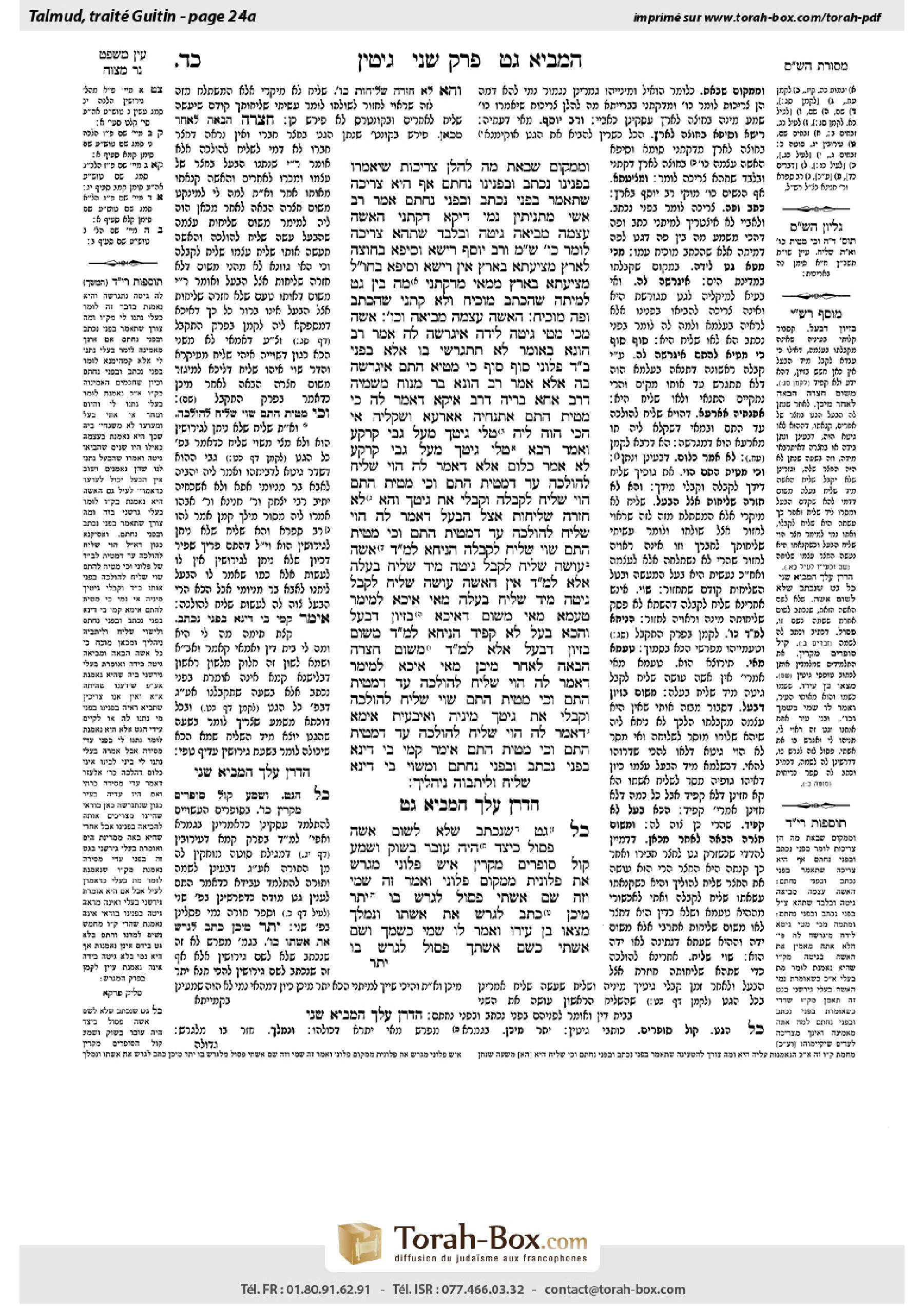
Gittin 24a: Talmud study for Daf Yomi
Study the Talmud for Daf Yomi with scanned pages, Hebrew text, English translations from Sefaria and AI-generated French translations.
Passage selection and English or AI-generated French translation are available where the scan has annotations. Daf Study is independent of Torah-Box and Sefaria.
Browse Gittin · גיטין · All tractatesGittin 24a text and translations
This page of Gittin includes the Aramaic text, an English translation and an AI-generated French translation, alongside the scan above.
גיטין כ״ד א · Aramaic and Hebrew text
וּמִמָּקוֹם שֶׁבָּאתָ, מָה לְהַלָּן צְרִיכוֹת שֶׁיֹּאמְרוּ: ״בְּפָנֵינוּ נִכְתַּב וּבְפָנֵינוּ נֶחְתַּם״, אַף הִיא צְרִיכָה שֶׁתֹּאמַר: ״בְּפָנַי נִכְתַּב וּבְפָנַי נֶחְתַּם״.
אָמַר רַב אָשֵׁי: מַתְנִיתִין נָמֵי דַּיְקָא, דְּקָתָנֵי: הָאִשָּׁה עַצְמָהּ מְבִיאָה גִּיטָּהּ, וּבִלְבַד שֶׁתְּהֵא צְרִיכָה לוֹמַר כּוּ׳; שְׁמַע מִינַּהּ.
וְרַב יוֹסֵף, רֵישָׁא וְסֵיפָא בְּחוּצָה לָאָרֶץ, מְצִיעֲתָא בָּאָרֶץ?! אִין; רֵישָׁא וְסֵיפָא בְּחוּצָה לָאָרֶץ, מְצִיעֲתָא בָּאָרֶץ.
מִמַּאי? מִדְּקָתָנֵי: מָה בֵּין גֵּט לְמִיתָה – שֶׁהַכְּתָב מוֹכִיחַ; וְלָא קָתָנֵי: שֶׁהַכְּתָב וּפֶה מוֹכִיחַ.
הָאִשָּׁה עַצְמָהּ מְבִיאָה וְכוּ׳: אִשָּׁה, מִכִּי מָטֵי גִּיטָּהּ לְיָדָהּ אִיגָּרַשָׁה לַהּ! אָמַר רַב הוּנָא: בְּאוֹמֵר ״לֹא תִּתְגָּרְשִׁי בּוֹ אֶלָּא בִּפְנֵי בֵּית דִּין פְּלוֹנִי״. סוֹף סוֹף, כִּי מָטְיָא הָתָם – אִיגָּרַשָׁה!
אֶלָּא אָמַר רַב הוּנָא בַּר מָנוֹחַ מִשְּׁמֵיהּ דְּרַב אַחָא בְּרֵיהּ דְּרַב אִיקָא: דְּאָמַר לַהּ: כִּי מָטֵית הָתָם, אַתְנְחֵיהּ אַאַרְעָא וְשִׁקְלֵיהּ.
אִי הָכִי, הֲוָה לֵיהּ: ״טְלִי גִּיטִּיךְ מֵעַל גַּבֵּי קַרְקַע״, וְאָמַר רָבָא: ״טְלִי גִּיטִּיךְ מֵעַל גַּבֵּי קַרְקַע״ – לֹא אָמַר כְּלוּם!
אֶלָּא דְּאָמַר לַהּ: הֱוַי שָׁלִיחַ לְהוֹלָכָה עַד דְּמָטְיַת הָתָם, וְכִי מָטְיַת הָתָם הֱוַי שָׁלִיחַ לְִקַבָּלָה, וְקַבִּלִי אַתְּ גִּיטִּיךְ.
וְהָא לֹא חָזְרָה שְׁלִיחוּת אֵצֶל הַבַּעַל! דְּאָמַר לַהּ: הֱוַי שָׁלִיחַ לְהוֹלָכָה עַד דְּמָטְיַת הָתָם, וְכִי מָטְיַת הָתָם שַׁוַּי שָׁלִיחַ לְִקַבָּלָה.
הָנִיחָא לְמַאן דְּאָמַר: אִשָּׁה עוֹשָׂה שָׁלִיחַ לְקַבֵּל גִּיטָּהּ מִיָּד שְׁלִיחַ בַּעְלָהּ. אֶלָּא לְמַאן דְּאָמַר: אֵין הָאִשָּׁה עוֹשָׂה שָׁלִיחַ לְקַבֵּל גִּיטָּהּ מִיָּד שְׁלִיחַ בַּעֲלָהּ, מַאי אִיכָּא לְמֵימַר?
טַעְמָא מַאי – מִשּׁוּם דְּאִיכָּא בִּזָּיוֹן דְּבַעַל, וְהָכָא בַּעַל לָא קָפֵיד.
הָנִיחָא לְמַאן דְּאָמַר: מִשּׁוּם בִּזָּיוֹן דְּבַעַל; אֶלָּא לְמַאן דְּאָמַר: מִשּׁוּם חֲצֵרָהּ הַבָּאָה לְאַחַר מִיכָּן, מַאי אִיכָּא לְמֵימַר?
דְּאָמַר לַהּ: הֱוַי שָׁלִיחַ לְהוֹלָכָה עַד דְּמָטְיַת הָתָם, וְכִי מָטְיַת הָתָם שַׁוַּי שָׁלִיחַ לְהוֹלָכָה, וְקַבִּלִי אַתְּ גִּיטִּיךְ מִינֵּיהּ.
וְאִיבָּעֵית אֵימָא, דְּאָמַר לַהּ: הֱוַי שָׁלִיחַ לְהוֹלָכָה עַד דְּמָטְיַת הָתָם, וְכִי מָטְיַת הָתָם אֵימַר קַמֵּי בֵּי דִינָא ״בְּפָנַי נִכְתַּב וּבְפָנַי נֶחְתַּם״, וּמְשַׁוֵּי בֵּי דִּינָא שָׁלִיחַ, וְלִיתְּבוּהּ נִיהֲלִיךְ.
הֲדַרַן עֲלָךְ הַמֵּבִיא גֵּט
כׇּל גֵּט שֶׁנִּכְתַּב שֶׁלֹּא לְשׁוּם אִשָּׁה, פָּסוּל. כֵּיצַד, הָיָה עוֹבֵר בַּשּׁוּק וְשָׁמַע קוֹל סוֹפְרִים מַקְרִין: ״אִישׁ פְּלוֹנִי מְגָרֵשׁ אֶת פְּלוֹנִית מִמָּקוֹם פְּלוֹנִי״, וְאָמַר: זֶה שְׁמִי וְזֶה שֵׁם אִשְׁתִּי; פָּסוּל לְגָרֵשׁ בּוֹ.
יָתֵר מִיכֵּן – כָּתַב לְגָרֵשׁ אֶת אִשְׁתּוֹ וְנִמְלַךְ, מְצָאוֹ בֶּן עִירוֹ וְאָמַר לוֹ: שְׁמִי כְּשִׁמְךָ וְשֵׁם אִשְׁתִּי כְּשֵׁם אִשְׁתְּךָ; פָּסוּל לְגָרֵשׁ בּוֹ.
Gittin 24a · English translation
And from the place that you came, i.e., from this inference itself, one establishes: Just as there, those who bring the bill of divorce must say: It was written in our presence and it was signed in our presence, so too, she herself must say: It was written in my presence and it was signed in my presence. This baraita must be referring to a case in which the wife brought the bill of divorce from outside of Eretz Yisrael, as it is only then that she must state that it was written and signed in her presence. Therefore, the baraita supports the opinion of Abaye.
Rav Ashi said: The mishna is also precisely formulated in a way that supports Abaye’s opinion, as it teaches: The woman herself may bring her own bill of divorce, provided that she is required by the court to say: It was written in my presence and it was signed in my presence. Learn from the mishna that it is referring to a case outside of Eretz Yisrael, as Abaye explained.
The Gemara asks: But according to Rav Yosef, is it possible to say that the first clause of the mishna (23a): Anyone is fit to serve as an agent to bring a bill of divorce, and the last clause of the mishna (23b): The woman herself may bring her own bill of divorce, discuss a case that takes place in a location outside of Eretz Yisrael, and the middle clause: Even the women who are not deemed credible, discusses a case that takes place in Eretz Yisrael? The Gemara answers: Yes, the first clause and the last clause discuss a case that takes place in a location outside of Eretz Yisrael, but the middle clause discusses a case that takes place in Eretz Yisrael.
The Gemara explains: From where does Rav Yosef infer this? From the fact that it teaches in the mishna: What is the difference between a bill of divorce and death, that certain women are deemed credible to testify about one but not the other? With regard to a bill of divorce, it is so that the writing proves that the husband is divorcing his wife. The mishna does not teach that the writing and statement prove this. Consequently, the statement of: It was written in my presence, is not needed. This indicates that the mishna is discussing a case that takes place in Eretz Yisrael.
§ The mishna teaches that the woman herself may bring her own bill of divorce and state that it was written and signed in her presence. The Gemara asks: Why does she need to bring it and testify that it was written and signed in her presence? With regard to this woman, once her bill of divorce reaches her hand, she is divorced. Rav Huna says: This mishna is referring to one who says to his wife: You will be divorced through it only in the presence of such and such court, and the divorce does not take effect when she receives the bill of divorce. The Gemara asks: Ultimately, once she arrives there, to that court, she is immediately divorced through it, as she has fulfilled the condition set forth by her husband. Why, then, is it necessary for her to bring the bill of divorce and to testify?
Rather, Rav Huna bar Manoaḥ said in the name of Rav Aḥa, son of Rav Ika: This mishna is referring to a case where he said to her: When you arrive there, place the bill of divorce on the ground and take it. Consequently, the divorce does not take effect immediately upon her arrival.
The Gemara challenges: If that is so, isn’t it like the case where he said to his wife: Take your bill of divorce from off the ground, and Rava says: If a husband says to his wife: Take your bill of divorce from off the ground, then it is as though he said nothing. He is not considered to have given her a bill of divorce; rather, she has taken it on her own.
Rather, the mishna should be explained as follows: This is referring to a case where he said to his wife: Be my agent for delivery of the bill of divorce until you arrive there. And when you arrive there, be your own agent for receipt, and receive your bill of divorce as an agent.
The Gemara challenges: But the agency has not returned to the husband. In other words, the first agency, where she acted as the agent for delivery, has not ended, because an agent must have the ability to complete his involvement in the act, return to the person who appointed him, and inform him that the agency has been carried out. In this case, once she arrives at the court, her agency ends when she assumes the role of the recipient of the bill of divorce, and her involvement does not end. Therefore, the appointment of the agent itself is deficient, and the divorce should not take effect. Rather, the mishna should be explained that he said to her: Be an agent for delivery until you arrive there, and when you arrive there, appoint an agent for receipt on your behalf and give him the bill of divorce.
The Gemara asks: This works out well according to the one who said: A woman can appoint an agent to receive her bill of divorce from the hand of the agent of her husband, and it is not required that she receive the bill of divorce herself. However, according to the one who says: A woman cannot appoint an agent to receive her bill of divorce from the hand of the agent of her husband, what can be said?
The Gemara answers: What is the reason of the one who said that the woman cannot appoint an agent to receive her bill of divorce from the agent of her husband? Because there is degradation of the husband in doing this, as he wishes to give the bill of divorce directly to the woman and not to an agent. And here the husband is not particular about the matter, as he instructed her to do so.
The Gemara clarifies: This works out well according to the one who said: The reason for this halakha is due to the concern about the degradation of the husband. But according to the one who says that this halakha is a decree due to the case of her courtyard that comes afterward, what can be said? Some say that the reason for the halakha that the woman cannot appoint an agent to receive the bill of divorce from the agent of her husband is that there was a concern that if she were able to do so, then the courts may eventually allow her to be divorced by purchasing a courtyard into which her husband had placed the bill of divorce. In the latter case, the divorce does not take effect. The courtyard needs to be an extension of the hand of the woman, into which the husband places the bill of divorce, but it does not act as her agent. In any event, according to this opinion, the fact that the husband is not particular does not prevent this halakha from applying, as it does not depend on him.
The Gemara answers: According to this opinion, the mishna should be explained as discussing a case when he said to her: Be an agent for delivery of this bill of divorce until you arrive there, and when you arrive there, appoint another agent for delivery, and receive your bill of divorce from him.
And if you wish, say that he said to her: Be an agent for delivery until you arrive there, and when you arrive there, say before the court: It was written in my presence and it was signed in my presence, and you should then appoint the court as an agent, and they will give the bill of divorce to you.
MISHNA: Any bill of divorce that was not written for the sake of a specific woman is invalid. How so? In a case of a man who was passing through the marketplace and heard the sound of scribes who write bills of divorce dictating the text to their students: The man so-and-so divorces so-and-so from the place of such and such; and the man said: This is my name and that is the name of my wife, and he wishes to use this bill for his divorce, this bill is unfit for him to divorce his wife with it, as it was not written for the sake of any woman.
Moreover, if one wrote a bill of divorce with which to divorce his wife but later reconsidered, and a resident of his town found him and said to him: My name is the same as your name, and my wife’s name is the same as your wife’s name, and we reside in the same town; give me the bill of divorce and I will use it; the bill of divorce is unfit for the second man to divorce his wife with it.
Gittin 24a · Traduction française (IA)
Et depuis le lieu d'où vous êtes venu, c'est-à-dire depuis cette déduction elle-même, on établit : Comme là-bas, ceux qui apportent le document de divorce doivent dire : Il a été écrit devant nous et il a été signé devant nous, ainsi aussi, elle-même doit dire : Il a été écrit devant moi et il a été signé devant moi. Cette baraïta doit faire référence à un cas où la femme apporte le document de divorce depuis l'extérieur de la Terre d'Israël, car c'est seulement alors qu'elle doit déclarer qu'il a été écrit et signé devant elle. Ainsi, cette baraïta soutient l'opinion d'Abaye.
Rav Ashi a dit : La mitsva est également formulée de manière précise de sorte à soutenir l'opinion d'Abaye, car elle enseigne : La femme elle-même peut apporter son propre document de divorce, à condition qu'elle soit tenue par le tribunal de dire : Il a été écrit devant moi et il a été signé devant moi. Apprenez-en à la mitsva qu'il s'agit d'un cas qui a lieu en dehors de la Terre d'Israël, comme l'explique Abaye.
La Guemara pose la question : Mais selon Rav Yosef, est-il possible de dire que la première clause de la mitsva (23a) : Tout le monde est digne de servir d'agent pour apporter un document de divorce, et la dernière clause de la mitsva (23b) : La femme elle-même peut apporter son propre document de divorce, discutent un cas qui a lieu en dehors de la Terre d'Israël, et la clause du milieu : Même les femmes qui ne sont pas considérées comme crédibles, discutent un cas qui a lieu en Terre d'Israël ? La Guemara répond : Oui, la première clause et la dernière clause discutent un cas qui a lieu en dehors de la Terre d'Israël, mais la clause du milieu discute un cas qui a lieu en Terre d'Israël.
La Guemara explique : D'où Rav Yosef infère-t-il cela ? Du fait que la mitsna enseigne : Quelle est la différence entre un document de divorce et la mort, que certaines femmes sont considérées comme crédibles pour témoigner sur l'une mais pas sur l'autre ? Concernant un document de divorce, c'est pour que l'écriture prouve que l'homme divorce de sa femme. La mitsna ne dit pas que l'écriture et la déclaration prouvent cela. Ainsi, la déclaration : Il a été écrit devant moi, n'est pas nécessaire. Cela indique que la mitsna discute un cas qui a lieu en Terre d'Israël.
§ La mitsna enseigne que la femme elle-même peut apporter son propre document de divorce et déclarer qu'il a été écrit et signé devant elle. La Guemara pose la question : Pourquoi a-t-elle besoin d'apporter le document et de témoigner qu'il a été écrit et signé devant elle ? Concernant cette femme, une fois que son document de divorce arrive entre ses mains, elle est divorcée. Rav Huna dit : Cette mitsna fait référence à celui qui dit à sa femme : Tu seras divorcée par cela seulement devant telle et telle cour, et le divorce ne prend effet lorsque elle reçoit le document de divorce. La Guemara pose la question : Finalement, une fois qu'elle arrive là, à cette cour, elle est immédiatement divorcée par cela, car elle a accompli la condition fixée par son mari. Pourquoi, alors, a-t-elle besoin d'apporter le document de divorce et de témoigner ?
Plutôt, Rav Huna bar Manoaḥ a dit en nom de Rav Aḥa, fils de Rav Ika : Cette mitsna fait référence à un cas où il a dit à elle : Quand tu arrives là, place le document de divorce sur le sol et le prends. Ainsi, le divorce ne prend effet immédiatement lorsqu'elle arrive.
La Guemara conteste : Si c'est ainsi, n'est-ce pas comme le cas où il a dit à sa femme : Prends ton document de divorce du sol, et Rava dit : Si un mari dit à sa femme : Prends ton document de divorce du sol, alors c'est comme s'il disait rien. Il n'est pas considéré comme ayant donné le document de divorce ; plutôt, elle l'a pris elle-même.
Plutôt, la mitsva devrait être expliquée comme suit : Cela fait référence à un cas où il a dit à sa femme : Sois mon agent pour la livraison du document de divorce jusqu'à ce que tu arrives là. Et quand tu arrives là, sois ton propre agent pour la réception, et reçois ton document de divorce en tant qu'agent.
La Guemara conteste : Mais l'agent n'a pas renvoyé au mari. En d'autres termes, l'agence initiale, où elle a agi en tant qu'agent pour la livraison, n'a pas pris fin, car un agent doit avoir la capacité de terminer son implication dans l'acte, de revenir à la personne qui l'a nommé et de l'informer que l'agence a été accomplie. Dans ce cas, une fois qu'elle arrive à la cour, son agence prend fin lorsqu'elle assume le rôle de réceptrice du document de divorce, et son implication ne prend pas fin. Ainsi, la nomination de l'agent elle-même est insuffisante, et le divorce ne devrait pas prendre effet. Plutôt, la mitsva devrait être expliquée en disant qu'il a dit à elle : Sois un agent pour la livraison jusqu'à ce que tu arrives là, et quand tu arrives là, nomme un agent pour la réception à ton compte et donne-lui le document de divorce.
La Guemara pose la question : Cela fonctionne bien selon celui qui dit : Une femme peut nommer un agent pour recevoir son document de divorce de la main de l'agent de son mari, et il n'est pas nécessaire qu'elle reçoive elle-même le document de divorce. Cependant, selon celui qui dit : Une femme ne peut pas nommer un agent pour recevoir son document de divorce de la main de l'agent de son mari, que peut-on dire ?
La Guemara répond : Quel est le motif de celui qui dit que la femme ne peut pas nommer un agent pour recevoir son document de divorce de la main de l'agent de son mari ? Parce qu'il y a une dégradation du mari dans cela, car il souhaite donner le document de divorce directement à la femme et non à un agent. Et ici, le mari n'est pas particulier à l'égard de la matière, car il a instruit elle-même de le faire.
La Guemara clarifie : Cela fonctionne bien selon celui qui dit : La raison de cette halakha est due à l'inquiétude concernant la dégradation du mari. Mais selon celui qui affirme que cette halakha est un décret en raison du cas de la cour de la femme qui vient après, que peut-on dire ? Certains disent que la raison de cette halakha selon laquelle la femme ne peut pas désigner un agent pour recevoir le contrat de divorce de l'agent de son mari est due à l'inquiétude qu'elle puisse, si elle le pouvait, permettre aux tribunaux de finalement autoriser son divorce en achetant une cour dans laquelle son mari avait placé le contrat de divorce. Dans ce cas, le divorce ne prend effet. La cour doit être une extension de la main de la femme, dans laquelle le mari place le contrat de divorce, mais elle ne fonctionne pas comme son agent. En tout cas, selon cet avis, le fait que le mari ne soit pas particulier ne bloque pas l'application de cette halakha, car elle ne dépend pas de lui.
La Guemara répond : Selon cet avis, la Michna devrait être expliquée comme discutant un cas où il a dit à elle : Sois un agent pour la livraison de ce contrat de divorce jusqu'à ce que tu arrives là-bas, et quand tu arrives là-bas, désigne un autre agent pour la livraison, et reçois ton contrat de divorce de lui.
Et si tu veux, dis qu'il a dit à elle : Sois un agent pour la livraison jusqu'à ce que tu arrives là-bas, et quand tu arrives là-bas, dis devant le tribunal : Cela a été écrit en mon présence et cela a été signé en mon présence, et tu devrais alors désigner le tribunal comme agent, et ils te donneront le contrat de divorce.
MICHNA : Tout divorce écrit qui n'a pas été rédigé à l'intention d'une femme spécifique est invalide. Comment cela se passe-t-il ? Dans le cas d'un homme qui traversait le marché et entendait le bruit des scribes qui rédigeaient des divorces en dictant le texte à leurs élèves : L'homme tel et tel divorce tel et tel de la place telle et telle ; et l'homme a dit : Ce nom est le mien et celui-ci est le nom de ma femme, et il souhaite utiliser ce divorce pour son divorce, ce divorce est inadapté pour lui afin de divorcer de sa femme, car il n'a pas été rédigé à l'intention de toute femme.
De plus, si l'on a écrit un contrat de divorce avec lequel divorcer de sa femme mais a ensuite changé d'avis, et un habitant de sa ville l'a trouvé et lui a dit : Mon nom est le même que le tien, et le nom de ma femme est le même que celui de ta femme, et nous habitons dans la même ville ; donne-moi le contrat de divorce et je l'utiliserai ; le contrat de divorce est inadapté pour l'homme second afin de divorcer de sa femme avec lui.
Traduction française générée par IA à partir de l’édition anglaise de Sefaria. Vérifie toujours un passage avec le texte source.
Text from Sefaria: William Davidson Edition - Vocalized Aramaic (CC BY NC); William Davidson Edition - English (CC BY NC).