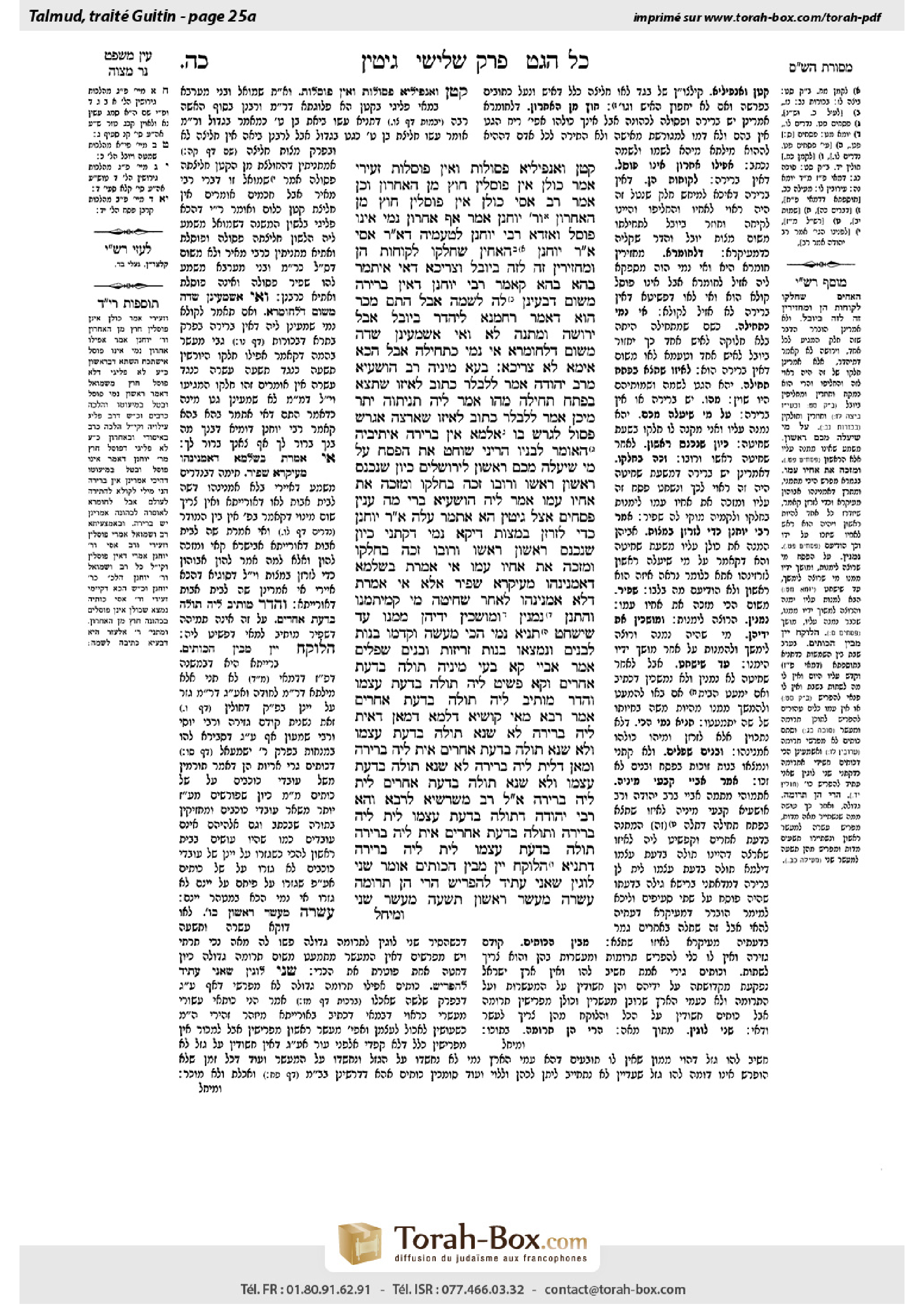
Gittin 25a: Talmud study for Daf Yomi
Study the Talmud for Daf Yomi with scanned pages, Hebrew text, English translations from Sefaria and AI-generated French translations.
Passage selection and English or AI-generated French translation are available where the scan has annotations. Daf Study is independent of Torah-Box and Sefaria.
Browse Gittin · גיטין · All tractatesGittin 25a text and translations
This page of Gittin includes the Aramaic text, an English translation and an AI-generated French translation, alongside the scan above.
גיטין כ״ה א · Aramaic and Hebrew text
קָטָן וְאַנְפִּילְיָא – פְּסוּלוֹת וְאֵין פּוֹסְלוֹת.
זְעֵירִי אָמַר: כּוּלָּן אֵין פּוֹסְלִין, חוּץ מִן הָאַחֲרוֹן.
וְכֵן אָמַר רַב אַסִּי: כּוּלָּן אֵין פּוֹסְלִין, חוּץ מִן הָאַחֲרוֹן. וְרַבִּי יוֹחָנָן אָמַר: אַף אַחֲרוֹן נָמֵי אֵינוֹ פּוֹסֵל.
וְאַזְדָּא רַבִּי יוֹחָנָן לְטַעְמֵיהּ – דְּאָמַר רַבִּי אַסִּי, אָמַר רַבִּי יוֹחָנָן: הָאַחִין שֶׁחָלְקוּ – לָקוֹחוֹת הֵן, וּמַחְזִירִין זֶה לָזֶה בַּיּוֹבֵל.
וּצְרִיכָא; דְּאִי אִיתְּמַר בְּהָא, בְּהָא קָאָמַר רַבִּי יוֹחָנָן דְּאֵין בְּרֵירָה, מִשּׁוּם דְּבָעֵינַן ״לַהּ״– לִשְׁמָהּ; אֲבָל הָתָם, מֶכֶר – הוּא דְּאָמַר רַחֲמָנָא לִיהְדַּר בְּיוֹבֵל, אֲבָל יְרוּשָּׁה וּמַתָּנָה – לָא.
וְאִי אַשְׁמְעִינַן שָׂדֶה, מִשּׁוּם דִּלְחוּמְרָא; אִי נָמֵי, כַּתְּחִילָּה; אֲבָל הָכָא – אֵימָא לָא, צְרִיכָא.
בְּעָא מִינֵּיהּ רַב הוֹשַׁעְיָא מֵרַב יְהוּדָה: אָמַר לְלַבְלָר: ״כְּתוֹב לְאֵיזוֹ שֶׁתֵּצֵא בַּפֶּתַח תְּחִילָּה״, מַהוּ? אֲמַר לֵיהּ, תְּנֵיתוּהָ: יָתֵר מִיכֵּן, אָמַר לְלַבְלָר ״כְּתוֹב לְאֵיזוֹ שֶׁאֶרְצֶה אֲגָרֵשׁ״ – פָּסוּל לְגָרֵשׁ בּוֹ, אַלְמָא אֵין בְּרֵירָה!
אֵיתִיבֵיהּ, הָאוֹמֵר לְבָנָיו: ״הֲרֵינִי שׁוֹחֵט אֶת הַפֶּסַח עַל מִי שֶׁיַּעֲלֶה מִכֶּם רִאשׁוֹן לִירוּשָׁלַיִם״; כֵּיוָן שֶׁנִּכְנַס רִאשׁוֹן רֹאשׁוֹ וְרוּבּוֹ – זָכָה בְּחֶלְקוֹ, וּמְזַכֶּה אֶת אֶחָיו עִמּוֹ.
אֲמַר לֵיהּ: הוֹשַׁעְיָא בְּרִי, מָה עִנְיַן פְּסָחִים אֵצֶל גִּיטִּין? הָא אִתְּמַר עֲלַהּ, אָמַר רַבִּי יוֹחָנָן: כְּדֵי לְזָרְזָן בְּמִצְוֹת!
דַּיְקָא נָמֵי, דְּקָתָנֵי: כֵּיוָן שֶׁנִּכְנַס רִאשׁוֹן רֹאשׁוֹ וְרוּבּוֹ – זָכָה בְּחֶלְקוֹ, וּמְזַכֶּה אֶת אֶחָיו עִמּוֹ. אִי אָמְרַתְּ בִּשְׁלָמָא דְּאַמְנִינְהוּ מֵעִיקָּרָא – שַׁפִּיר; אֶלָּא אִי אָמְרַתְּ דְּלָא אַמְנִינְהוּ, לְאַחַר שְׁחִיטָה מִי קָמִיתְמְנוּ?! וְהָתְנַן: נִמְנִין, וּמוֹשְׁכִין יְדֵיהֶן מִמֶּנּוּ, עַד שֶׁיִּשָּׁחֵט!
תַּנְיָא נָמֵי הָכִי: מַעֲשֶׂה, וְקָדְמוּ בָּנוֹת לַבָּנִים, וְנִמְצְאוּ בָּנוֹת זְרִיזוֹת וּבָנִים שְׁפָלִים.
אָמַר אַבָּיֵי: קָא בָּעֵי מִינֵּיהּ תּוֹלֶה בְּדַעַת אֲחֵרִים, וְקָא פָשֵׁיט לֵיהּ תּוֹלֶה בְּדַעַת עַצְמוֹ, וַהֲדַר מוֹתֵיב לֵיהּ תּוֹלֶה בְּדַעַת אֲחֵרִים!
אָמַר רָבָא: מַאי קוּשְׁיָא? דִּלְמָא, דְּמַאן דְּאִית לֵיהּ בְּרֵירָה – לָא שְׁנָא תּוֹלֶה בְּדַעַת עַצְמוֹ וְלָא שְׁנָא תּוֹלֶה בְּדַעַת אֲחֵרִים, אִית לֵיהּ בְּרֵירָה, וּמַאן דְּלֵית לֵיהּ בְּרֵירָה – לָא שְׁנָא תּוֹלֶה בְּדַעַת עַצְמוֹ וְלָא שְׁנָא תּוֹלֶה בְּדַעַת אֲחֵרִים, לֵית לֵיהּ בְּרֵירָה!
אֲמַר לֵיהּ רַב מְשַׁרְשְׁיָא לְרָבָא: וְהָא רַבִּי יְהוּדָה, דְּתוֹלֶה בְּדַעַת עַצְמוֹ לֵית לֵיהּ בְּרֵירָה, וְתוֹלֶה בְּדַעַת אֲחֵרִים אִית לֵיהּ בְּרֵירָה!
תּוֹלֶה בְּדַעַת עַצְמוֹ לֵית לֵיהּ בְּרֵירָה – דְּתַנְיָא: הַלּוֹקֵחַ יַיִן מִבֵּין הַכּוּתִים, אוֹמֵר: שְׁנֵי לוּגִּין שֶׁאֲנִי עָתִיד לְהַפְרִישׁ – הֲרֵי הֵן תְּרוּמָה; עֲשָׂרָה מַעֲשֵׂר רִאשׁוֹן; תִּשְׁעָה מַעֲשֵׂר שֵׁנִי;
Gittin 25a · English translation
However, if the yavam was a minor, or if the yevama performed ḥalitza while he was wearing a soft shoe made of cloth [anpileya] and not the shoe used for ḥalitza, then these acts of ḥalitza are invalid, and in these cases they do not disqualify her from entering into levirate marriage.
The Gemara quotes another opinion with regard to the question of which of the bills of divorce mentioned in the mishna would disqualify the woman from marrying a priest. Ze’eiri says: Reception of any of the bills of divorce mentioned in the mishna does not disqualify the woman from marrying a priest except in the final case, where the husband instructed the scribe to write a bill of divorce for one of his wives and explained that he would later decide which wife would be given the bill of divorce.
And similarly, Rav Asi says: Reception of any of the bills of divorce mentioned in the mishna does not disqualify the woman from marrying a priest except in the final case. But Rabbi Yoḥanan says: Even in the final case, that bill of divorce does not disqualify her from marrying a priest as well, as even that bill of divorce is not a bill of divorce at all. According to Rabbi Yoḥanan, there is no concern that retroactive clarification will determine that the bill of divorce was written for the sake of the woman who received it, while the amora’im who hold that the woman is disqualified from marrying a priest in the final case of the mishna regard the efficacy of retroactive clarification to be uncertain.
The Gemara comments: And Rabbi Yoḥanan follows his own line of reasoning. As Rabbi Asi says that Rabbi Yoḥanan says: Brothers who divided property they received as an inheritance are considered purchasers from each other, and as purchasers of land they must return the portions to each other in the Jubilee Year. In the Jubilee Year, all land that had been purchased since the previous Jubilee Year reverts to the possession of the original owner. In this case, the land the brothers inherited from their father reverts to their joint ownership. Evidently, when they divided the land, this is not viewed as if it is retroactively clarified who inherited which portion from their father.
And it is necessary for Rabbi Yoḥanan to state that there is no retroactive clarification both with regard to inheritance and with regard to a bill of divorce, as, if it were stated only with regard to this case, that of a bill of divorce, then one could say that with regard to this Rabbi Yoḥanan said that there is no retroactive clarification because we require that the bill of divorce be written in accordance with the verse: “He writes for her” (Deuteronomy 24:3), i.e., for her sake; but there, in the case of inheritance, one could say: It is only in the case of a sale that the Merciful One states that it will be returned in the Jubilee Year, but an inheritance and a gift will not be returned.
And if he had taught us that there is no retroactive clarification only with regard to the inheritance of a field, then one could say that this is due to the fact that he holds that they must redistribute the property only as a stringency, but he would hold that in this case one must also be stringent and be concerned that it is a divorce. Alternatively, perhaps Rabbi Yoḥanan’s ruling was not because there is no retroactive clarification but because the halakha of the Jubilee Year requires that all land be returned to its state as it was initially, when the land had been divided among the tribes; but here, with regard to a bill of divorce, say that this consideration is not relevant, and there is retroactive clarification. Therefore, it is necessary for Rabbi Yoḥanan to rule that there is no retroactive clarification in each case separately.
§ The Gemara continues its discussion of the final case of the mishna. Rav Hoshaya asked of Rav Yehuda: If a husband said to a scribe: Write a bill of divorce for whichever of my wives emerges from the entrance first, what is the halakha? Rav Yehuda said to him: You learned it already in the mishna: Moreover, even if he said to the scribe: Write a bill of divorce for whichever one of them that I will want and I will divorce her with it, it is unfit for him to divorce either wife with it. Apparently, there is no retroactive clarification.
Rav Hoshaya raised an objection to Rav Yehuda’s answer based on a mishna (Pesaḥim 89a): In the case of one who says to his children: I am slaughtering the Paschal offering on behalf of whichever of you goes up first to Jerusalem, once the first of the children has entered with his head and the majority of his body into Jerusalem, he has acquired his portion and acquires the portions of his brothers together with him on their behalf. This mishna indicates that there is retroactive clarification, as it becomes clear retroactively that the father slaughtered the Paschal offering on behalf of this son.
Rav Yehuda said to him: Hoshaya, my son, what do Paschal offerings have to do with bills of divorce? Wasn’t it stated concerning this mishna that Rabbi Yoḥanan says: The mishna is not based on retroactive clarification; rather, the father included all his children in his Paschal offering from the outset. He created this competition only in order to galvanize them, so that they would be expeditious in their fulfillment of mitzvot.
The Gemara comments that according to the explanation of Rabbi Yoḥanan, the language of the mishna is also precise, as it teaches: Once the first of the children has entered with his head and the majority of his body into Jerusalem, he has acquired his portion and acquires the portions of his brothers together with him on their behalf. Granted, if you say that the father registered them initially, before slaughtering the Paschal offering, the ruling is well understood. But if you say that he did not register them initially, can they then be registered after the slaughter of the Paschal offering? Didn’t we learn in a mishna (Pesaḥim 89a): People may be registered and withdraw themselves from being registered for a Paschal offering until it is slaughtered, but not after? Clearly, then, the children must have already been registered before the father said his statement.
That the competition was meant only to galvanize his children to be expeditious in their fulfillment of mitzvot is also taught in a baraita that records this type of competition: There was an incident such as this, and the daughters preceded the sons. And the daughters were found to have demonstrated that they were enthusiastic, whereas the sons were found to have demonstrated that they were lazy. The baraita is critical of the sons but does not say that they did not partake of the Paschal offering. Evidently the father slaughtered the offering for them as well.
Questioning Rav Yehuda’s original answer to Rav Hoshaya, Abaye said: He asks him about a case where one makes the clarification dependent on the decision of others, but he resolves it based on a case where the husband makes the clarification dependent on his own decision. Rav Hoshaya asked about a bill of divorce written for whichever wife exits first, which depends on someone other than the husband, and Rav Yehuda resolved the question based on the mishna where the husband reserved the right to decide which wife he will divorce with the bill of divorce, which depends on his own decision. And then Rav Hoshaya raised an objection to him based on the mishna concerning the Paschal offering, where one makes the clarification dependent on the decision of others.
Rava said: What is the difficulty here? Perhaps it is so that for the one who accepts the principle of retroactive clarification, it is no different if one makes it dependent on his own decision, and it is no different if one makes it dependent on the decision of others. In either case, he accepts the principle of retroactive clarification. And according to the one who does not accept the principle of retroactive clarification, it is no different if one makes it dependent on his own decision, and it is no different if one makes it dependent on the decision of others. In either case, he does not accept the principle of retroactive clarification.
Rav Mesharshiyya said to Rava: The issue of retroactive clarification is contingent upon the question of on whom the outcome is dependent. But isn’t there the opinion of Rabbi Yehuda, who in a case where one makes it dependent on his own decision, he does not accept the principle of retroactive clarification, but when one makes it dependent on the decision of others, he accepts the principle of retroactive clarification?
The Gemara elaborates: When one makes it dependent on his own decision, Rabbi Yehuda does not accept the principle of retroactive clarification, as it is taught in the Tosefta (Demai 8:7): In the case of one who purchases wine from among the Samaritans, about whom it is assumed that they did not separate teruma and tithes, and he is not in a position to now separate teruma, he acts as follows: If there are, for example, one hundred log of wine in the barrels, he says: Two log that I will separate in the future are teruma, as the mandated average measure of teruma is one-fiftieth; ten log are first tithe; and one-tenth of the remainder, which is approximately nine log, are second tithe.
Gittin 25a · Traduction française (IA)
Cependant, si le yavam était mineur, ou si la yevama accomplissait la ḥalitza alors qu'il portait un chaussure molle en tissu [anpileya] et non la chaussure utilisée pour la ḥalitza, alors ces actes de ḥalitza sont invalides, et dans ces cas, elle n'est pas disqualifiée de se marier en levirat.
Le Guemara cite un autre avis concernant la question de savoir quel des certificats de divorce mentionnés dans la mitsna disqualifie la femme de se marier avec un prêtre. Ze’eiri dit : La réception de tout certificat de divorce mentionné dans la mitsna ne disqualifie pas la femme de se marier avec un prêtre, sauf dans le dernier cas, où le mari instruisait l'écrivain de rédiger un certificat de divorce pour l'une de ses épouses et expliquait qu'il déciderait ultérieurement quelle épouse serait donnée ce certificat de divorce.
Et de même, Rav Asi dit : La réception de tout certificat de divorce mentionné dans la mitsna ne disqualifie pas la femme de se marier avec un prêtre, sauf dans le dernier cas. Mais Rabbi Yoḥanan dit : Même dans ce dernier cas, ce certificat de divorce ne disqualifie pas la femme de se marier avec un prêtre, car même ce certificat de divorce n'est pas un certificat de divorce. Selon Rabbi Yoḥanan, il n'y a pas de crainte que la clarification rétrospective détermine que le certificat de divorce a été rédigé à l'intention de la femme qui l'a reçu, tandis que les amoraïm qui pensent que la femme est disqualifiée de se marier avec un prêtre dans le dernier cas de la mitsna considèrent l'efficacité de la clarification rétrospective comme incertaine.
Le Guemara commente : Et Rabbi Yoḥanan suit sa propre ligne de raisonnement. Comme Rabbi Asi dit que Rabbi Yoḥanan dit : Les frères qui ont divisé des biens qu'ils avaient reçus en héritage sont considérés comme des acheteurs les uns des autres, et comme acheteurs de terre, ils doivent rendre les portions à l'autre lors du Jubilé. Lors du Jubilé, toute terre achetée depuis le précédent Jubilé reprend son propriétaire initial. Dans ce cas, la terre héritée par les frères de leur père reprend son possession commune. Évidemment, lorsqu'ils ont divisé la terre, cela n'est pas vu comme une clarification rétrospective de qui a hérité de quelle portion de leur père.
Et il est nécessaire que Rabbi Yoḥanan affirme qu'il n'y a pas de clarification rétrospective à la fois concernant l'héritage et concernant un certificat de divorce, car, si cela avait été dit uniquement concernant ce cas, celui du certificat de divorce, alors on pourrait dire que Rabbi Yoḥanan a dit qu'il n'y a pas de clarification rétrospective parce que nous exigeons que le certificat de divorce soit rédigé conformément à la parole : « Il écrit pour elle » (Deutéronome 24:3), c'est-à-dire à son intention ; mais là, dans le cas de l'héritage, on pourrait dire : C'est uniquement dans le cas d'une vente que l'Éternel a dit qu'il sera rendu au Jubilé, mais l'héritage et le don ne seront pas rendus.
Et si on avait appris que la clarification rétrospective n'existe que concernant l'héritage d'un champ, alors on pourrait dire que cela est dû au fait qu'il considère qu'ils doivent redistribuer les biens uniquement comme une stricte exigence, mais il considérerait que dans ce cas aussi on doit être strict et craindre que ce soit un divorce. Alternativement, peut-être la décision de Rabbi Yoḥanan n'était pas due à l'absence de clarification rétrospective mais à la halakha du Jubilé exigeant que toute la terre redevienne telle qu'elle était initialement, lorsque la terre avait été divisée entre les tribus ; mais ici, concernant un certificat de divorce, on dirait que cette considération n'est pas pertinente, et il y a une clarification rétrospective. Ainsi, il est nécessaire que Rabbi Yoḥanan règle que la clarification rétrospective n'existe pas dans chaque cas séparément.
§ Le Guemara continue sa discussion du dernier cas de la mitsna. Rav Hoshaya demanda à Rav Yehuda : Si un mari dit à un écrivain : Écris un certificat de divorce pour celle de mes épouses qui sortira en premier de la porte, quelle est la halakha ? Rav Yehuda répondit à lui : Tu as déjà appris cela dans la mitsna : De plus, même s'il dit à l'écrivain : Écris un certificat de divorce pour celle d'entre elles que je voudrai et que je divorerai avec cela, cela est inadapté pour lui de divorcer l'une ou l'autre des épouses avec cela. Apparemment, il n'y a pas de clarification rétrospective.
Rav Hoshaya souleva une objection contre la réponse de Rav Yehuda, basée sur une mitsna (Pesaḥim 89a) : Dans le cas d'une personne qui dit à ses enfants : Je sacrifie l'offrande pascal en faveur de celui d'entre vous qui entrera en premier à Jérusalem, une fois que le premier des enfants est entré avec sa tête et la majorité de son corps à Jérusalem, il a acquis sa part et acquiert les parts de ses frères à sa place. Cette mitsna indique qu'il y a une clarification rétrospective, car il devient clair rétrosivement que le père a sacrifié l'offrande pascal en faveur de ce fils.
Rav Yehuda répondit à lui : Hoshaya, mon fils, à quoi bon les offrandes pascals ont-ils à faire avec les certificats de divorce ? N'avait-on pas dit concernant cette mitsna que Rabbi Yoḥanan dit : La mitsna n'est pas basée sur la clarification rétrospective ; plutôt, le père a inclus tous ses enfants dans son offrande pascal dès le début. Il a créé cette compétition uniquement afin de stimuler les enfants, afin qu'ils soient rapides dans l'accomplissement de leurs mitsvot.
Le Guemara commente que selon l'explication de Rabbi Yoḥanan, la langue de la mitsna est aussi précise, car elle enseigne : Une fois que le premier des enfants est entré avec sa tête et la majorité de son corps à Jérusalem, il a acquis sa part et acquiert les parts de ses frères à sa place. Bien sûr, si vous dites qu'il a inscrit les enfants dès le départ, avant de sacrifier l'offrande pascal, la décision est bien comprise. Mais si vous dites qu'il n'a pas inscrit les enfants dès le départ, peuvent-ils être inscrits après la sacrifice de l'offrande pascal ? N'avons-nous pas appris dans une mitsna (Pesaḥim 89a) : Les gens peuvent être inscrits et se retirer de l'inscription pour une offrande pascal jusqu'à ce qu'elle soit sacrifiée, mais pas après ? Évidemment, alors les enfants devaient avoir été inscrits avant que le père ne dise sa déclaration.
Que la compétition avait pour seul but de stimuler ses enfants à accomplir rapidement leurs mitsvot est également enseigné dans une baraïta qui rapporte ce type de compétition : Il y avait un incident semblable, et les filles précédaient les fils. Et les filles étaient trouvées avoir démontré leur enthousiasme, tandis que les fils étaient trouvés avoir démontré leur lassitude. La baraïta critique les fils, mais ne dit pas qu'ils n'avaient pas participé à l'offrande pascal. Évidemment, le père sacrifia l'offrande pour eux également.
En questionnant la réponse originale de Rava à Rav Hoshaya, Abaye dit : Il lui pose une question sur un cas où l'élucidation dépend de la décision d'autrui, mais il la résout sur un cas où le mari fait dépendre l'élucidation de sa propre décision. Rav Hoshaya posait une question sur un acte de divorce écrit pour la femme qui sortira en premier, qui dépend de quelqu'un d'autre que le mari, et Rava résolvait la question sur la mitsva où le mari réservait le droit de décider quelle femme il divorcera avec l'acte de divorce, qui dépend de sa propre décision. Et ensuite Rav Hoshaya souleva une objection contre lui sur la mitsva concernant l'offrande pascal, où l'élucidation dépend de la décision d'autrui.
Rava dit : Quel est le problème ici ? Peut-être que c'est pour celui qui accepte le principe d'élucidation rétroactive, il n'y a pas de différence si l'on fait dépendre l'élucidation de sa propre décision, et il n'y a pas de différence si l'on fait dépendre l'élucidation de la décision d'autrui. Dans les deux cas, il accepte le principe d'élucidation rétroactive. Et selon celui qui ne l'accepte pas, il n'y a pas de différence si l'on fait dépendre l'élucidation de sa propre décision, et il n'y a pas de différence si l'on fait dépendre l'élucidation de la décision d'autrui. Dans les deux cas, il ne l'accepte pas.
Rav Mesharshiyya dit à Rava : La question de l'élucidation rétroactive dépend de la question de sur qui dépend le résultat. Mais n'y a-t-il pas l'opinion de Rabbi Yehuda, qui dans un cas où l'on fait dépendre l'élucidation de sa propre décision, il ne l'accepte pas, mais quand l'on fait dépendre l'élucidation de la décision d'autrui, il l'accepte ?
La Guemara développe : Quand l'élucidation dépend de sa propre décision, Rabbi Yehuda ne l'accepte pas, comme il est enseigné dans la Tosefta (Demai 8:7) : Dans le cas d'une personne qui achète du vin parmi les Samaritains, dont on suppose qu'ils n'ont pas séparé la terouma et les dîmes, et qu'il n'est pas en position de séparer la terouma maintenant, il agit ainsi : S'il y a, par exemple, cent log de vin dans les tonneaux, il dit : Deux log que je séparerai à l'avenir sont la terouma, car la mesure moyenne obligatoire de la terouma est un cinquantième ; dix log sont la première dîme ; et un dixième du reste, qui est environ neuf log, sont la deuxième dîme.
Traduction française générée par IA à partir de l’édition anglaise de Sefaria. Vérifie toujours un passage avec le texte source.
Text from Sefaria: William Davidson Edition - Vocalized Aramaic (CC BY NC); William Davidson Edition - English (CC BY NC).