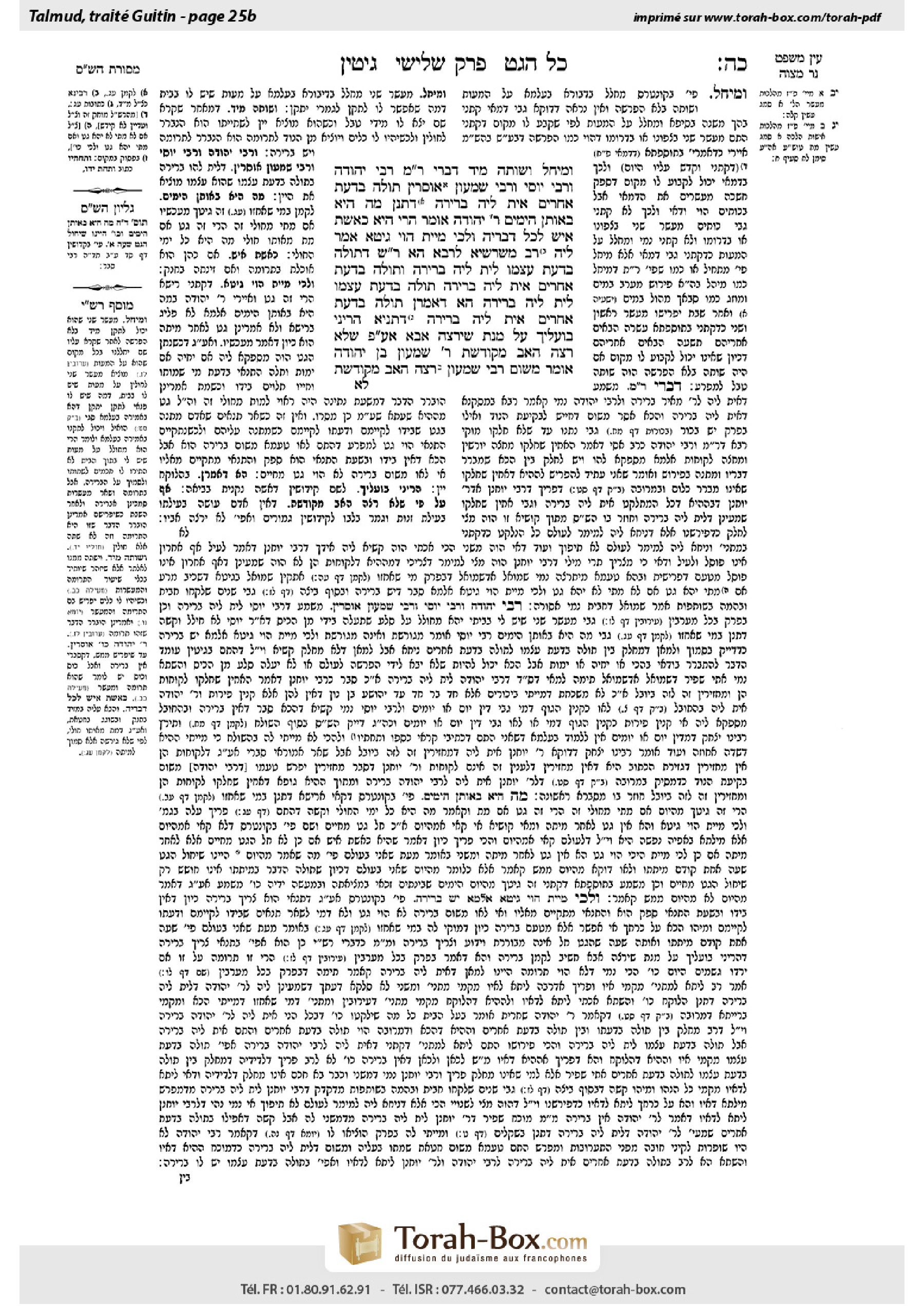
Gittin 25b: Talmud study for Daf Yomi
Study the Talmud for Daf Yomi with scanned pages, Hebrew text, English translations from Sefaria and AI-generated French translations.
Passage selection and English or AI-generated French translation are available where the scan has annotations. Daf Study is independent of Torah-Box and Sefaria.
Browse Gittin · גיטין · All tractatesGittin 25b text and translations
This page of Gittin includes the Aramaic text, an English translation and an AI-generated French translation, alongside the scan above.
גיטין כ״ה ב · Aramaic and Hebrew text
וּמֵיחֵל וְשׁוֹתֶה מִיָּד, דִּבְרֵי רַבִּי מֵאִיר. רַבִּי יְהוּדָה וְרַבִּי יוֹסֵי וְרַבִּי שִׁמְעוֹן אוֹסְרִין.
תּוֹלֶה בְּדַעַת אֲחֵרִים אִית לֵיהּ בְּרֵירָה – דִּתְנַן: מָה הִיא בְּאוֹתָן הַיָּמִים?
רַבִּי יְהוּדָה אוֹמֵר: הֲרֵי הִיא כְּאֵשֶׁת אִישׁ לְכׇל דְּבָרֶיהָ, וּלְכִי מָיֵית הָוֵי גִּיטָּא.
אֲמַר לֵיהּ רַב מְשַׁרְשְׁיָא לְרָבָא: הָא רַבִּי שִׁמְעוֹן, דְּתוֹלֶה בְּדַעַת עַצְמוֹ לֵית לֵיהּ בְּרֵירָה, וְתוֹלֶה בְּדַעַת אֲחֵרִים אִית לֵיהּ בְּרֵירָה!
תּוֹלֶה בְּדַעַת עַצְמוֹ לֵית לֵיהּ בְּרֵירָה – הָא דַּאֲמַרַן. תּוֹלֶה בְּדַעַת אֲחֵרִים אִית לֵיהּ בְּרֵירָה – דְּתַנְיָא: ״הֲרֵינִי בּוֹעֲלִיךְ עַל מְנָת שֶׁיִּרְצֶה אַבָּא״; אַף עַל פִּי שֶׁלֹּא רָצָה הָאָב – מְקוּדֶּשֶׁת. רַבִּי שִׁמְעוֹן בֶּן יְהוּדָה אוֹמֵר מִשּׁוּם רַבִּי שִׁמְעוֹן: רָצָה הָאָב – מְקוּדֶּשֶׁת,
Gittin 25b · English translation
And he deconsecrates the second tithe that he will separate in the future, transferring its sanctity to money, and he may drink the wine immediately, relying on the separation that he will perform later, which will clarify retroactively which log he designated for the tithes and for teruma. This is the statement of Rabbi Meir. However, Rabbi Yehuda and Rabbi Yosei and Rabbi Shimon prohibit this practice, as they hold that in this case there is no retroactive clarification. It is therefore evident that according to Rabbi Yehuda, there is no retroactive clarification where one makes the clarification dependent on his own decision.
By contrast, in a case where one makes the outcome dependent on the decision of others, Rabbi Yehuda accepts the principle of retroactive clarification, as we learned in a mishna (73a): In a case where an ill husband says to his wife: This is your bill of divorce from now if I die due to this illness, if he dies, the bill of divorce takes effect from the time of his statement. The mishna asks: What is the halakhic status of the wife in those days between when the bill of divorce was given but before the husband died?
Rabbi Yehuda says: She is like a married woman with regard to all of her matters, and she remains forbidden to other men; and when he will die, it is a bill of divorce. Death is equivalent to a matter that is dependent on the decision of others. Since Rabbi Yehuda agrees that the bill of divorce takes effect retroactively, as it cannot take effect after the death of the husband, he evidently holds that there is retroactive clarification where one makes the clarification dependent on the decision of others.
Furthermore, Rav Mesharshiyya said to Rava: But isn’t there Rabbi Shimon, who, in a case where one makes the outcome dependent on his own decision, does not accept the principle of retroactive clarification, but when one makes it dependent on the decision of others, he accepts the principle of retroactive clarification?
The Gemara elaborates: When one makes the outcome dependent on his own decision, Rabbi Shimon does not accept the principle of retroactive clarification. This is understood from that which we said in the case of wine purchased from Samaritans. When one makes the outcome dependent on the decision of others, Rabbi Shimon accepts the principle of retroactive clarification, as it is taught in a baraita in the Tosefta (Kiddushin 3:7): If a man said to a woman: I am engaging in sexual intercourse with you for the purpose of betrothal on the condition that my father will desire our betrothal, and then he married her without specification, then even if the father did not desire it she is nevertheless betrothed through this act of intercourse. Rabbi Shimon ben Yehuda says in the name of Rabbi Shimon: If the father desires it, she is betrothed,
Gittin 25b · Traduction française (IA)
Et il désacralise la dîme secondaire qu'il séparera à l'avenir, transférant sa sanctité à l'argent, et il peut boire le vin immédiatement, s'appuyant sur la séparation qu'il effectuera ultérieurement, ce qui clarifiera rétrospectivement quel log il a désigné pour les dîmes et pour la terouma. C'est la déclaration du Rabbi Meir. Cependant, les Rabbins Yéhuda, Yosei et Shim'on interdisent cette pratique, car ils considèrent que dans ce cas il n'y a pas de clarification rétrospective. Il est donc évident que selon le Rabbi Yéhuda, il n'y a pas de clarification rétrospective lorsque l'on fait dépendre la clarification de son propre choix.
Par contraste, dans un cas où l'on fait dépendre le résultat du choix d'autrui, le Rabbi Yéhuda accepte le principe de clarification rétrospective, comme nous l'avons appris dans une mitsva (73a) : Dans un cas où un mari malade dit à sa femme : C'est ton acte de divorce à partir de maintenant si je meurs à cause de cette maladie, si il meurt, l'acte de divorce prend effet à partir du moment de son déclaration. La mitsva pose la question : Quel est le statut halakhique de la femme durant la période entre la date de l'acte de divorce et la mort du mari ?
Le Rabbi Yéhuda dit : Elle est comme une femme mariée concernant toutes ses affaires, et elle reste interdite aux autres hommes ; et lorsque il mourra, c'est un acte de divorce. La mort est équivalente à une affaire dépendant du choix d'autrui. Puisque le Rabbi Yéhuda accepte que l'acte de divorce prenne effet rétrospectivement, comme il ne peut pas prendre effet après la mort du mari, il est donc évident qu'il considère qu'il y a une clarification rétrospective lorsque l'on fait dépendre la clarification du choix d'autrui.
De plus, Rav Mesharshiyya dit à Rava : Mais n'y a-t-il pas Rabbi Shimon, qui, dans un cas où l'on fait dépendre le résultat du choix personnel, ne reconnaît pas le principe de clarification rétrospective, mais lorsque l'on fait dépendre le résultat du choix d'autrui, il reconnaît le principe de clarification rétrospective ?
La Guemara développe : Lorsque l'on fait dépendre le résultat du choix personnel, Rabbi Shimon ne reconnaît pas le principe de clarification rétrospective. Cela est compris à partir du cas du vin acheté chez les Samaritains. Lorsque l'on fait dépendre le résultat du choix d'autrui, Rabbi Shimon reconnaît le principe de clarification rétrospective, comme il est enseigné dans une baraïta de la Tosefta (Kiddushin 3:7) : Si un homme dit à une femme : Je fais l'acte de betrothal avec toi à la condition que mon père désire notre betrothal, et ensuite il l'épouse sans précision, alors même que le père n'a pas désiré cela, elle est néanmoins betrothal par cet acte d'acte sexuel. Rabbi Shim'on ben Yéhuda dit en nom de Rabbi Shim'on : Si le père désire cela, elle est betrothal,
Traduction française générée par IA à partir de l’édition anglaise de Sefaria. Vérifie toujours un passage avec le texte source.
Text from Sefaria: William Davidson Edition - Vocalized Aramaic (CC BY NC); William Davidson Edition - English (CC BY NC).