Gittin 26a: Talmud study for Daf Yomi
Study the Talmud for Daf Yomi with scanned pages, Hebrew text, English translations from Sefaria and AI-generated French translations.
Passage selection and English or AI-generated French translation are available where the scan has annotations. Daf Study is independent of Torah-Box and Sefaria.
Browse Gittin · גיטין · All tractatesGittin 26a text and translations
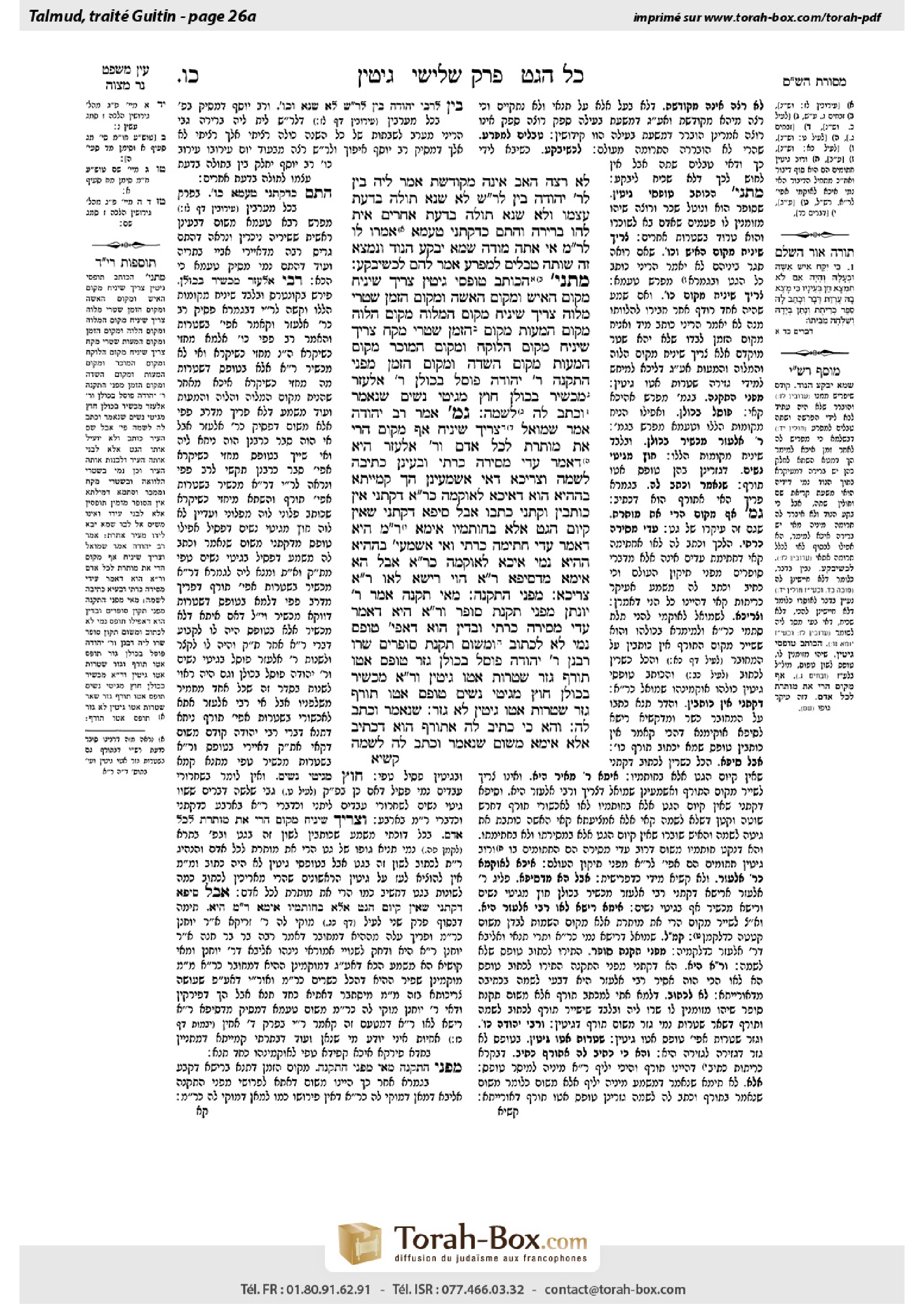
This page of Gittin includes the Aramaic text, an English translation and an AI-generated French translation, alongside the scan above.
גיטין כ״ו א · Aramaic and Hebrew text
לֹא רָצָה הָאָב – אֵינָהּ מְקוּדֶּשֶׁת.
אֲמַר לֵיהּ: בֵּין לְרַבִּי יְהוּדָה בֵּין לְרַבִּי שִׁמְעוֹן; לָא שְׁנָא תּוֹלֶה בְּדַעַת עַצְמוֹ וְלָא שְׁנָא תּוֹלֶה בְּדַעַת אֲחֵרִים – אִית לְהוּ בְּרֵירָה;
וְהָתָם – כִּדְקָתָנֵי טַעְמָא, אָמְרוּ לוֹ לְרַבִּי מֵאִיר: אִי אַתָּה מוֹדֶה שֶׁמָּא יִבָּקַע הַנּוֹד, וְנִמְצָא זֶה שׁוֹתֶה טְבָלִים לְמַפְרֵעַ? אָמַר לָהֶם: לִכְשֶׁיִּבָּקַע.
מַתְנִי׳ הַכּוֹתֵב טוֹפְסֵי גִּיטִּין, צָרִיךְ שֶׁיַּנִּיחַ מְקוֹם הָאִישׁ, וּמְקוֹם הָאִשָּׁה, וּמְקוֹם הַזְּמַן.
שְׁטָרֵי מִלְוָה – צָרִיךְ שֶׁיַּנִּיחַ מְקוֹם הַמִּלְוָה, מְקוֹם הַלֹּוֶה, מְקוֹם הַמָּעוֹת, מְקוֹם הַזְּמַן.
שְׁטָרֵי מִקָּח – צָרִיךְ שֶׁיַּנִּיחַ מְקוֹם הַלּוֹקֵחַ, וּמְקוֹם הַמּוֹכֵר, מָקוֹם הַמָּעוֹת, מְקוֹם הַשָּׂדֶה, וּמְקוֹם הַזְּמַן; מִפְּנֵי הַתַּקָּנָה.
רַבִּי יְהוּדָה פּוֹסֵל בְּכוּלָּן. רַבִּי אֶלְעָזָר מַכְשִׁיר בְּכוּלָּן חוּץ מִגִּיטֵּי נָשִׁים, שֶׁנֶּאֱמַר ״וְכָתַב לָהּ״ – לִשְׁמָהּ.
גְּמָ׳ אָמַר רַב יְהוּדָה אָמַר שְׁמוּאֵל: צָרִיךְ שֶׁיַּנִּיחַ אַף מְקוֹם ״הֲרֵי אַתְּ מוּתֶּרֶת לְכׇל אָדָם״; וְרַבִּי אֶלְעָזָר הִיא, דְּאָמַר: עֵדֵי מְסִירָה כָּרְתִי, וּבָעֵינַן כְּתִיבָה לִשְׁמָהּ.
וּצְרִיכָא;
דְּאִי אַשְׁמְעִינַן הָךְ קַמַּיְיתָא, בְּהַהִיא הוּא דְּאִיכָּא לְאוֹקֹמַהּ כְּרַבִּי אֶלְעָזָר, דְּקָתָנֵי ״אֵין כּוֹתְבִין״ וְקָתָנֵי ״כִּתְבוּ״;
אֲבָל סֵיפָא, דְּקָתָנֵי ״שֶׁאֵין קִיּוּם הַגֵּט אֶלָּא בְּחוֹתְמָיו״, אֵימָא רַבִּי מֵאִיר הִיא, דְּאָמַר: עֵדֵי חֲתִימָה כָּרְתִי.
וְאִי אַשְׁמְעִינַן בְּהַהִיא, הָהִיא נָמֵי אִיכָּא לְאוֹקֹמַהּ כְּרַבִּי אֶלְעָזָר; אֲבָל הָא, אֵימָא מִדְּסֵיפָא רַבִּי אֶלְעָזָר הָוֵי – רֵישָׁא לָאו רַבִּי אֶלְעָזָר; צְרִיכָא.
מִפְּנֵי הַתַּקָּנָה: מַאי תַּקָּנָה? אָמַר רַבִּי יוֹנָתָן: מִפְּנֵי תַּקָּנַת סוֹפֵר; וְרַבִּי אֶלְעָזָר הִיא, דְּאָמַר: עֵדֵי מְסִירָה כָּרְתִי; וּבְדִין הוּא דַּאֲפִילּוּ טוֹפֶס נָמֵי לָא לִכְתּוֹב, וּמִשּׁוּם תַּקָּנַת סוֹפְרִים שָׁרוּ רַבָּנַן.
רַבִּי יְהוּדָה פּוֹסֵל בְּכוּלָּן – גָּזַר טוֹפֶס אַטּוּ תּוֹרֶף, גָּזַר שְׁטָרוֹת אַטּוּ גִּיטִּין.
וְרַבִּי אֶלְעָזָר מַכְשִׁיר בְּכוּלָּן חוּץ מִגִּיטֵּי נָשִׁים – טוֹפֶס אַטּוּ תּוֹרֶף גָּזַר, שְׁטָרוֹת אַטּוּ גִּיטִּין לָא גָּזַר.
שֶׁנֶּאֱמַר ״וְכָתַב לָהּ״: וְהָא כִּי כְּתִיב ״לָהּ״ – אַתּוֹרֶף הוּא דִּכְתִיב!
אֶלָּא אֵימָא: מִשּׁוּם שֶׁנֶּאֱמַר ״וְכָתַב לָהּ״ – לִשְׁמָהּ.
Gittin 26a · English translation
and if the father does not desire it, she is not betrothed. It is therefore evident that according to Rabbi Shimon, there is retroactive clarification when one makes the outcome dependent on the decision of others, as in this case whether or not this betrothal takes effect is dependent on the desire of the father.
Rava said to Rav Mesharshiyya: Whether according to the opinion of Rabbi Yehuda or whether according to the opinion of Rabbi Shimon, it is no different if one makes the outcome dependent on his own decision, and it is no different if one makes it dependent on the decision of others; they both accept the principle of retroactive clarification.
Rava explains: And there, in the mishna about one who purchases wine from Samaritans, they do not prohibit him from relying on the separation that he will later perform because they do not accept the principle of retroactive clarification. Rather, the reason they do not prohibit him from relying on the separation that he will later perform is as the Tosefta (Demai 8:7) teaches: The Sages said to Rabbi Meir: Don’t you concede that perhaps the wineskin will burst before he manages to separate the teruma, and this person will have been found retroactively to be drinking untithed produce? Rabbi Meir said to them: When it actually bursts, there will be a concern. In any event, from the question that they addressed to Rabbi Meir, it is clear that they would accept the principle of retroactive clarification in this case.
MISHNA: With regard to a scribe who writes the standard part [tofes] of bills of divorce in advance, so that when one requests a bill of divorce, he will need to add only the details unique to this case, he must leave empty the place in the bill of divorce for the name of the man, and the place for the name of the woman, and the place for the date.
If a scribe writes the standard part of loan documents, he must leave empty the place of the name of the lender, the place of the name of the borrower, the place of the amount of the money being loaned, and the place of the date.
If the scribe writes the standard part of documents of sale of land, he must leave empty the place for the name of the purchaser, and the place for the name of the seller, the place for the amount of the money for which the land is being purchased, the place for the description of the field that is being purchased, and the place of the date when the sale occurs. This is necessary due to the ordinance, as the Gemara will explain.
Rabbi Yehuda invalidates all of these documents if their standard parts were written in advance. Rabbi Elazar deems all of them valid except for bills of divorce, as it is stated in the Torah: “And he writes for her” (Deuteronomy 24:1), indicating that he must write the bill of divorce for her sake. Therefore, one may not write even the standard part of the bill of divorce in advance, as that would not qualify as writing the bill of divorce for her sake.
GEMARA: Rav Yehuda says that Shmuel says: One writing a bill of divorce in advance must also leave the place on the standard portion of the bill of divorce to write the essential phrase of: You are hereby permitted to marry any man. And the unattributed opinion of the mishna is the opinion of Rabbi Elazar, who says: Witnesses of the transmission of the bill of divorce effect the divorce, and we require the writing of the essential part of the bill of divorce to be for her sake. If one holds the other opinion, that signatory witnesses on the bill of divorce effect the divorce, then the words “And he writes for her” are referring to the signing of the bill of divorce, and the writing itself need not be done for her sake.
The Gemara notes: And it is necessary for Shmuel to mention that the mishna is in accordance with the opinion of Rabbi Elazar in this mishna, as well as Rabbi Elazar’s opinion in the previous chapter with regard to the mishnayot that discuss writing a bill of divorce on a surface that is attached to the ground (21b) and the writing of a bill of divorce by a deaf-mute, an imbecile, or a minor (22b).
As, if he had taught us that the mishna is in accordance with the opinion of Rabbi Elazar only with regard to this first mishna (21b), which discusses writing a bill of divorce on a surface that is attached to the ground, one could have said it is only that mishna that can be interpreted in accordance with the opinion of Rabbi Elazar, as that mishna teaches: One may not write a bill of divorce on anything that is attached to the ground, and it teaches in the next clause: If one wrote it on something that is attached to the ground; and there the Gemara proves from the comparison between these two clauses that the mishna must be in accordance with the opinion of Rabbi Elazar.
However, in the latter clause of the next mishna (22b), which teaches that the reason a bill of divorce may be written by a deaf-mute, an imbecile, or a minor is that the ratification of a bill of divorce is only through its signatories, one could say that this is the opinion of Rabbi Meir, who said: Signatory witnesses on the bill of divorce effect the divorce, and the mishna is discussing a case where the entire bill of divorce was written by the deaf-mute, imbecile, or minor. Therefore, it was necessary for Shmuel to state that this mishna is in accordance with the opinion of Rabbi Elazar and is discussing a case where the essential part of the bill of divorce was left empty.
And if he had taught us with regard to that mishna (22b), then it would be possible to say: That mishna can also be interpreted in accordance with the opinion of Rabbi Elazar, as it is explained that the mishna is referring to the writing of the standard portion, but with regard to this mishna here, say: Since the last clause is explicitly attributed to Rabbi Elazar, the first clause must not be in accordance with the opinion of Rabbi Elazar. Therefore, it was necessary for Shmuel to note that each of three mishnayot is in accordance with the opinion of Rabbi Elazar.
The mishna teaches that the scribe may write the standard part of the document in advance, leaving empty the essential part, due to the ordinance. The Gemara asks: To what ordinance is the mishna referring? Rabbi Yonatan says: Due to the ordinance for the benefit of a scribe, i.e., to enable a scribe to write the standard part of a document in advance so that when a customer arrives he will not need to write the document hurriedly. And it is in accordance with the opinion of Rabbi Elazar, who says: Witnesses of the transmission of the bill of divorce effect the divorce. And according to Rabbi Elazar’s opinion, by right it should have been that the scribe would not write even the standard part of the document in advance, as that part must also be written for her sake, but due to the ordinance for the benefit of scribes, the Sages permitted it.
The mishna teaches: Rabbi Yehuda invalidates all of these documents, not only bills of divorce, even if only their standard parts were written in advance. The Gemara explains: Rabbi Yehuda decreed that one may not write the standard part of a document in advance due to the concern lest the scribes eventually come to write the essential part of a document [toref] in advance as well. Similarly, he decreed that this halakha applies to all documents, which need not be written for anyone’s sake, due to bills of divorce.
The mishna continues: And Rabbi Elazar deems all of them valid except for bills of divorce. The Gemara explains his reasoning: Rabbi Elazar decreed that one may not write the standard part of a document in advance due to the concern lest the scribes eventually come to write the essential part of the document in advance. However, he did not decree that this halakha applies to all documents, which need not be written for anyone’s sake, due to bills of divorce.
The mishna teaches that Rabbi Elazar invalidates bills of divorce when the standard part of the document was written in advance, as it is stated in the Torah: “And he writes for her” (Deuteronomy 24:1), which teaches that it must be written for her sake. The Gemara asks: But when it is written: “And he writes for her,” it is about the essential part of a document that it is written, and not about the standard part.
The Gemara answers: Rather, say that Rabbi Elazar invalidates bills of divorce when the standard part of the bill of divorce is written in advance because it is stated with regard to the essential part of the bill of divorce: “And he writes for her,” which teaches that it must be written for her sake. In other words, Rabbi Elazar decrees that even the standard part of the document must be written for her sake, due to the fact that the Torah delineates this requirement with regard to the essential part of the bill of divorce.
Gittin 26a · Traduction française (IA)
et si le père n'en a pas l'intention, elle n'est pas fiancée. Il est donc évident que selon Rabbi Shimon, il y a une clarification rétrospective lorsqu'on rend le résultat dépendant du choix d'autrui, comme dans ce cas-ci, si cette fiancée est effective dépend de l'intention du père.
Rava dit à Rav Mesharshiyya : Qu'importe l'opinion de Rabbi Yehuda ou celle de Rabbi Shimon, il n'y a pas de différence si l'on rend le résultat dépendant de son propre choix, et il n'y a pas de différence si l'on rend le résultat dépendant du choix d'autrui ; ils acceptent tous deux le principe de clarification rétrospective.
Rava explique : Et là, dans la mitsva concernant l'achat de vin des Samaritains, ils ne prohibent pas de se fier à la séparation qu'il effectuera plus tard, car ils ne reconnaissent pas le principe de clarification rétrospective. La raison pour laquelle ils ne prohibent pas de se fier à la séparation qu'il effectuera plus tard est comme enseigne la Tosefta (Demai 8:7) : Les Sages dirent à Rabbi Meir : N'êtes-vous pas d'accord pour admettre que le sac à vin peut éclater avant qu'il n'ait pu séparer la terouma, et que cette personne aura été trouvé rétrospectivement en train de boire des produits non titrés ? Rabbi Meir répondit à eux : Lorsqu'il éclatera effectivement, il y aura une préoccupation. En tout cas, à partir de la question qu'ils posèrent à Rabbi Meir, il est clair qu'ils accepteraient le principe de clarification rétrospective dans ce cas-ci.
MICHNA : Concernant un scribe qui écrit à l'avance la partie standard [tofes] des gittin, de sorte que lorsqu'on demande une gitta, il faudra seulement ajouter les détails spécifiques à ce cas, il doit laisser vide la place dans la gitta pour le nom de l'homme, la place pour le nom de la femme, et la place pour la date.
Si un scribe écrit la partie standard des documents de prêt, il doit laisser vide la place du nom du prêteur, la place du nom du débiteur, la place de la somme d'argent prêtée, et la place de la date.
Si le scribe écrit la partie standard des documents de vente de terre, il doit laisser vide la place pour le nom de l'acheteur, la place pour le nom du vendeur, la place pour la somme d'argent pour laquelle la terre est achetée, la place pour la description du champ acheté, et la place de la date de la vente. Cela est nécessaire en raison de l'ordonnance, comme l'explique la Guemara.
Rabbi Yehuda annule tous ces documents si leur partie standard a été écrite à l'avance. Rabbi Elazar considère tous ces documents comme valides sauf les gittin, car il est dit dans la Torah : « Et il écrit pour elle » (Deutéronome 24:1), indiquant qu'il doit écrire la gittin à son intention. Par conséquent, on ne peut pas écrire même la partie standard de la gittin à l'avance, car cela ne qualifierait pas d'écrire la gittin à son intention.
GUEMARA : Rav Yehuda dit que Shmuel dit : Celui qui écrit une gittin à l'avance doit aussi laisser la place sur la partie standard de la gittin pour écrire la phrase essentielle : « Vous êtes désormais autorisé à épouser n'importe quel homme ». L'opinion non attribuée de la mitsva est l'opinion de Rabbi Elazar, qui dit : Les témoins de la transmission de la gittin accomplissent le divorce, et nous exigeons que l'écriture de la partie essentielle de la gittin soit faite à son intention. Si l'on adopte l'autre opinion, selon laquelle les témoins signataires de la gittin accomplissent le divorce, alors les mots « Et il écrit pour elle » se réfèrent à la signature de la gittin, et l'écriture elle-même n'a pas besoin d'être faite à son intention.
La Guemara note : Et il est nécessaire que Shmuel mentionne que la mitsva est en conformité avec l'opinion de Rabbi Elazar dans cette mitsva, ainsi que l'opinion de Rabbi Elazar dans le chapitre précédent concernant les mitsvot qui discutent de l'écriture d'une gittin sur une surface attachée au sol (21b) et de l'écriture d'une gittin par un sourd-muet, un imbécile ou un mineur (22b).
Car, si l'on avait enseigné que la mitsva est en conformité avec l'opinion de Rabbi Elazar uniquement concernant cette première mitsva (21b), qui discute de l'écriture d'une gittin sur une surface attachée au sol, on aurait pu dire qu'il s'agit uniquement de cette mitsva que l'on peut interpréter en conformité avec l'opinion de Rabbi Elazar, car cette mitsva enseigne : On ne peut pas écrire une gittin sur quelque chose qui est attaché au sol, et elle enseigne dans la clause suivante : Si l'on a écrit sur quelque chose qui est attaché au sol ; et là, la Guemara prouve à partir de la comparaison entre ces deux clauses que la mitsva doit être en conformité avec l'opinion de Rabbi Elazar.
Cependant, dans la clause suivante de la mitsva suivante (22b), qui enseigne que la raison pour laquelle une gittin peut être écrite par un sourd-muet, un imbécile ou un mineur est que la ratification d'une gittin est uniquement par ses signataires, on pourrait dire que c'est l'opinion de Rabbi Meir, qui dit : Les témoins signataires de la gittin accomplissent le divorce, et la mitsva discute d'un cas où toute la gittin a été écrite par le sourd-muet, l'imbécile ou le mineur. Par conséquent, il était nécessaire que Shmuel affirme que cette mitsva est en conformité avec l'opinion de Rabbi Elazar et discute d'un cas où la partie essentielle de la gittin a été laissée vide.
Et s'il avait enseigné concernant cette mitsva (22b), on aurait pu dire : Cette mitsva peut aussi être interprétée en conformité avec l'opinion de Rabbi Elazar, car il est expliqué que la mitsva se réfère à l'écriture de la partie standard, mais concernant cette mitsva-ci, dis : Puisque la dernière clause est explicitement attribuée à Rabbi Elazar, la première clause ne doit pas être en conformité avec l'opinion de Rabbi Elazar. Par conséquent, il était nécessaire que Shmuel note que chaque une des trois mitsvot est en conformité avec l'opinion de Rabbi Elazar.
La Michna enseigne que le scribe peut écrire à l'avance la partie standard du document, laissant vide la partie essentielle, en raison de l'ordonnance. La Guemara demande : À quelle ordonnance la Michna fait-elle référence ? Rabbi Yonatan dit : En raison de l'ordonnance en faveur du scribe, c'est-à-dire afin de permettre au scribe d'écrire à l'avance la partie standard d'un document de sorte que lorsqu'un client arrive, il n'aurait pas besoin d'écrire le document précipitamment. Et cela correspond à l'opinion de Rabbi Elazar, qui dit : Les témoins de la transmission du livre de divorce accomplissent le divorce. Et selon l'opinion de Rabbi Elazar, par droit il aurait dû être que le scribe ne puisse pas écrire même la partie standard du document à l'avance, car cette partie doit aussi être écrite à son intention, mais en raison de l'ordonnance en faveur des scribes, les Sages l'ont permis.
La Michna enseigne : Rabbi Yehuda invalidate tous ces documents, pas seulement les livres de divorce, même si seulement leur partie standard avait été écrite à l'avance. La Guemara explique : Rabbi Yehuda a décrété qu'on ne doit pas écrire à l'avance la partie standard d'un document en raison de la crainte que les scribes finissent par écrire à l'avance la partie essentielle du document [toref]. De même, il a décrété que cette halakha s'applique à tous les documents, qui n'ont pas besoin d'être écrits à l'intention de quelqu'un, en raison des livres de divorce.
La Michna continue : Et Rabbi Elazar considère tous d'entre eux comme valides sauf les livres de divorce. La Guemara explique sa raisonnement : Rabbi Elazar a décrété qu'on ne doit pas écrire à l'avance la partie standard d'un document en raison de la crainte que les scribes finissent par écrire à l'avance la partie essentielle du document. Cependant, il n'a pas décrété que cette halakha s'applique à tous les documents, qui n'ont pas besoin d'être écrits à l'intention de quelqu'un, en raison des livres de divorce.
La Michna enseigne que Rabbi Elazar annule les livres de divorce lorsque la partie standard du document avait été écrite à l'avance, car il est dit dans la Torah : « Et il écrit pour elle » (Deutéronome 24:1), ce qui enseigne qu'il doit être écrit à son intention. La Guemara demande : Mais lorsque cela est dit : « Et il écrit pour elle », cela concerne la partie essentielle du document qui est écrite, et non la partie standard.
La Guemara répond : Plutôt, disons que Rabbi Elazar annule les livres de divorce lorsque la partie standard du livre de divorce est écrite à l'avance, car il est dit concernant la partie essentielle du livre de divorce : « Et il écrit pour elle », ce qui enseigne qu'il doit être écrit à son intention. En d'autres termes, Rabbi Elazar décrète que même la partie standard du document doit être écrite à son intention, en raison du fait que la Torah définit cette exigence concernant la partie essentielle du livre de divorce.
Traduction française générée par IA à partir de l’édition anglaise de Sefaria. Vérifie toujours un passage avec le texte source.
Text from Sefaria: William Davidson Edition - Vocalized Aramaic (CC BY NC); William Davidson Edition - English (CC BY NC).