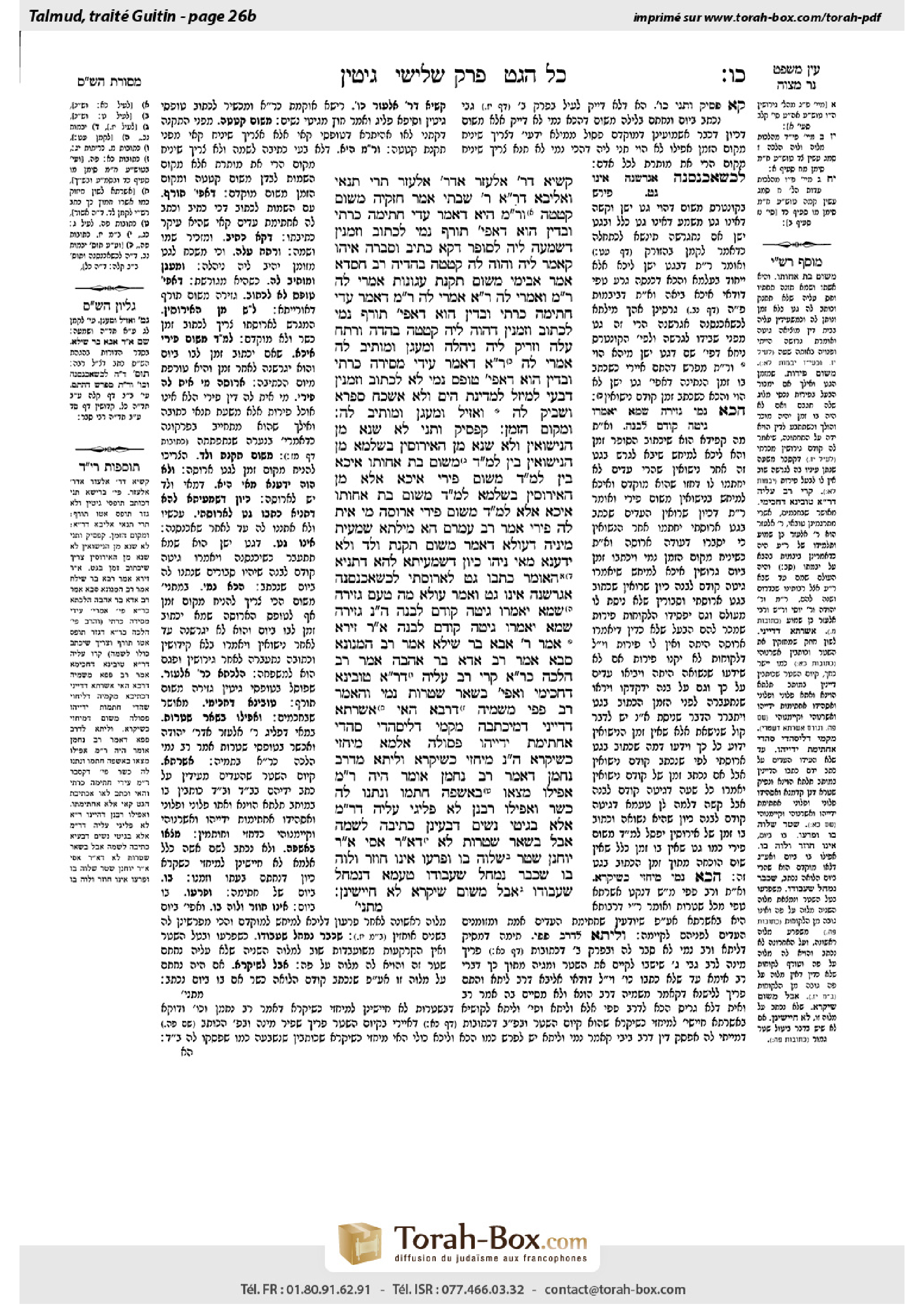
Gittin 26b: Talmud study for Daf Yomi
Study the Talmud for Daf Yomi with scanned pages, Hebrew text, English translations from Sefaria and AI-generated French translations.
Passage selection and English or AI-generated French translation are available where the scan has annotations. Daf Study is independent of Torah-Box and Sefaria.
Browse Gittin · גיטין · All tractatesGittin 26b text and translations
This page of Gittin includes the Aramaic text, an English translation and an AI-generated French translation, alongside the scan above.
גיטין כ״ו ב · Aramaic and Hebrew text
קַשְׁיָא דְּרַבִּי אֶלְעָזָר אַדְּרַבִּי אֶלְעָזָר! תְּרֵי תַּנָּאֵי וְאַלִּיבָּא דְּרַבִּי אֶלְעָזָר.
רַבִּי שַׁבְּתַי אָמַר חִזְקִיָּה: מִשּׁוּם קְטָטָה; וְרַבִּי מֵאִיר הִיא, דְּאָמַר: עֵדֵי חֲתִימָה כָּרְתִי,
וּבְדִין הוּא דַּאֲפִילּוּ תּוֹרֶף נָמֵי לִכְתּוֹב; וְזִמְנִין דְּשָׁמְעָה לֵיהּ לְסוֹפֵר דְּקָא כָתֵיב, וְסָבְרָה אִיהוּ קָאָמַר לֵיהּ, וְהָוֵה לַהּ קְטָטָה בַּהֲדֵיהּ.
רַב חִסְדָּא אָמַר אֲבִימִי: מִשּׁוּם תַּקָּנַת עֲגוּנוֹת; אָמְרִי לַהּ רַבִּי מֵאִיר, וְאָמְרִי לַהּ רַבִּי אֶלְעָזָר.
אָמְרִי לַהּ רַבִּי מֵאִיר – דְּאָמַר: עֵדֵי חֲתִימָה כָּרְתִי, וּבְדִין הוּא דַּאֲפִילּוּ תּוֹרֶף נָמֵי לִכְתּוֹב; וְזִמְנִין דְּהָוֵה לֵיהּ קְטָטָה בַּהֲדַהּ, וְרָתַח עֲלַהּ וְזָרֵיק לֵיהּ נִיהֲלַהּ, וּמְעַגֵּן וּמוֹתֵיב לַהּ.
אָמְרִי לַהּ רַבִּי אֶלְעָזָר – דְּאָמַר: עֵידֵי מְסִירָה כָּרְתִי, וּבְדִין הוּא דַּאֲפִילּוּ טוֹפֶס נָמֵי לָא לִכְתּוֹב; וְזִמְנִין דְּבָעֵי לְמֵיזַל לִמְדִינַת הַיָּם וְלָא אַשְׁכַּח סָפְרָא, וְשָׁבֵיק לַהּ וְאָזֵיל, וּמְעַגֵּן וּמוֹתֵיב לַהּ.
וּמְקוֹם הַזְּמַן: קָפָסֵיק וְתָנֵי; לָא שְׁנָא מִן הַנִּישּׂוּאִין, וְלָא שְׁנָא מִן הָאֵירוּסִין.
בִּשְׁלָמָא מִן הַנִּישּׂוּאִין; בֵּין לְמַאן דְּאָמַר מִשּׁוּם בַּת אֲחוֹתוֹ – אִיכָּא, בֵּין לְמַאן דְּאָמַר מִשּׁוּם פֵּירֵי – אִיכָּא;
אֶלָּא מִן הָאֵירוּסִין; בִּשְׁלָמָא לְמַאן דְּאָמַר מִשּׁוּם בַּת אֲחוֹתוֹ – אִיכָּא, אֶלָּא לְמַאן דְּאָמַר מִשּׁוּם פֵּירֵי, אֲרוּסָה מִי אִית לַהּ פֵּירֵי?!
אָמַר רַב עַמְרָם: הָא מִילְּתָא שְׁמַעִית מִינֵּיהּ דְּעוּלָּא דְּאָמַר מִשּׁוּם תַּקָּנַת וָלָד, וְלָא יָדַעְנָא מַאי נִיהוּ. כֵּיוָן דְּשַׁמְעִיתַהּ לְהָא דְּתַנְיָא: הָאוֹמֵר: ״כִּתְבוּ גֵּט לַאֲרוּסָתִי, לִכְשֶׁאֶכְנְסֶנָּה אֲגָרְשֶׁנָּה״, אֵינוֹ גֵּט. וְאָמַר עוּלָּא: מָה טַעַם? גְּזֵירָה שֶׁמָּא יֹאמְרוּ: גִּיטָּהּ קוֹדֵם לִבְנָהּ. הָכָא נָמֵי – גְּזֵירָה שֶׁמָּא יֹאמְרוּ: גִּיטָּהּ קוֹדֵם לִבְנָהּ.
אָמַר רַבִּי זֵירָא, אָמַר רַבִּי אַבָּא בַּר שֵׁילָא, אָמַר רַב הַמְנוּנָא סָבָא, אָמַר רַב אַדָּא בַּר אַהֲבָה, אָמַר רַב: הֲלָכָה כְּרַבִּי אֶלְעָזָר. קָרֵי רַב עֲלֵיהּ דְּרַבִּי אֶלְעָזָר: טוּבְיָנָא דְּחַכִּימֵי.
וַאֲפִילּוּ בִּשְׁאָר שְׁטָרוֹת נָמֵי?! וְהָאָמַר רַב פַּפִּי מִשְּׁמֵיהּ דְּרָבָא: הַאי אַשַּׁרְתָּא דְּדַיָּינֵי, דְּמִיכַּתְבָה מִקַּמֵּי דְּלִיסָהֲדֵי סָהֲדִי אַחֲתִימַת יְדַיְיהוּ – פְּסוּלָה; אַלְמָא מִיחְזֵי כְּשִׁיקְרָא, הָכָא נָמֵי מִיחְזֵי כְּשִׁיקְרָא!
וְלֵיתַהּ, מִדְּרַב נַחְמָן – דְּאָמַר רַב נַחְמָן, אוֹמֵר הָיָה רַבִּי מֵאִיר: אֲפִילּוּ מְצָאוֹ בְּאַשְׁפָּה, חֲתָמוֹ וּנְתָנוֹ לָהּ – כָּשֵׁר. וַאֲפִילּוּ רַבָּנַן לָא פְּלִיגִי עֲלֵיהּ דְּרַבִּי מֵאִיר אֶלָּא בְּגִיטֵּי נָשִׁים, דְּבָעֵינַן כְּתִיבָה לִשְׁמָהּ, אֲבָל בִּשְׁאָר שְׁטָרוֹת – לָא.
דְּאָמַר רַבִּי אַסִּי, אָמַר רַבִּי יוֹחָנָן: שְׁטָר שֶׁלָּוָה בּוֹ וּפְרָעוֹ – אֵינוֹ חוֹזֵר וְלֹוֶה בּוֹ, שֶׁכְּבָר נִמְחַל שִׁעְבּוּדוֹ. טַעְמָא דְּנִמְחַל שִׁעְבּוּדוֹ, אֲבָל מִשּׁוּם שִׁיקְרָא – לָא חָיְישִׁינַן.
Gittin 26b · English translation
The Gemara asks: If the first clause of the mishna is in accordance with the opinion of Rabbi Elazar, this is difficult, as there is a contradiction between the explicit statement of Rabbi Elazar in the last clause of the mishna, where he rules that a scribe may not write the standard part of a bill of divorce in advance, and the statement of Rabbi Elazar in the first clause of the mishna that a scribe may write the standard part of a bill of divorce in advance. The Gemara answers: There are two tanna’im, and they disagree with regard to the opinion of Rabbi Elazar.
The Gemara returns to discussing the ordinance mentioned in the mishna. Rabbi Shabbetai says that Ḥizkiyya says: The ordinance mentioned in the mishna was not instituted for the benefit of scribes, allowing them to prepare the standard part of bills of divorce in advance. The ordinance was instituted due to the desire to prevent a quarrel, and it is in accordance with the opinion of Rabbi Meir, who says: Signatory witnesses on the bill of divorce effect the divorce, and there is no need for the bill of divorce to be written for the sake of the woman.
He continues to explain the ordinance: And by right it should have been that the scribe would be permitted to write even the essential part of the bill of divorce as well. But sometimes there might be a wife who hears the scribe who by chance is writing in advance a bill of divorce with her name, and she thinks that her husband told him to write the bill of divorce on his behalf, and she will have a quarrel with him. Therefore, the Sages instituted an ordinance that the scribe may not write the essential part of the bill of divorce in advance, as it includes the names of the husband and the wife.
The Gemara suggests another understanding of the ordinance mentioned in the mishna. Rav Ḥisda said that Avimi said: The reason for the ordinance is due to the desire to provide a remedy for deserted wives. How so? Some say that he explained the mishna in accordance with the opinion of Rabbi Meir, and some say that he explained it in accordance with the opinion of Rabbi Elazar.
The Gemara clarifies: Some say that it is in accordance with the opinion of Rabbi Meir, who said: Signatory witnesses on the bill of divorce effect the divorce; and by right it should have been that the scribe would be permitted to write, in advance, even the essential part of the bill of divorce as well. But sometimes there could be a situation when the husband has a quarrel with his wife and becomes angry with her, and he might throw the bill of divorce to her and desert her and leave her divorced because he possessed a bill of divorce that had been prepared in advance. The Sages therefore instituted that a complete bill of divorce may not be prepared in advance to ensure that it would take time for the husband to obtain one, in the hope that he would calm down in the interim and reconsider.
Some say that he explains the mishna in accordance with the opinion of Rabbi Elazar, who said: Witnesses of the transmission of the bill of divorce effect the divorce; and by right it should have been that scribes would not be permitted to write in advance even the standard part of the bill of divorce as well, due to a decree lest they come to write the essential part in advance. But sometimes the husband needs to travel to a country overseas, and he will not find a scribe who can write the bill of divorce for him, and he will abandon her and go and desert her and leave her in this position. The Sages instituted that scribes may write the standard part of the bill of divorce in advance, so that they can finish it quickly by simply adding the essential part.
§ The mishna teaches that the scribe must leave a place for the names and a place for the date. The Gemara comments: The tanna categorically teaches this halakha; it is no different if the divorce is from the state of marriage, and it is no different if the divorce is from the state of betrothal.
The Gemara clarifies: Granted, in the case of a divorce from the state of marriage, it is understood why the bill of divorce must be dated. Whether according to the one who said that the reason for writing the date on a bill of divorce is due to a situation where one marries the daughter of his sister, to prevent the husband from protecting her if she commits adultery by giving her an undated bill of divorce and claiming that they had been divorced before she committed adultery with the other man, there is a reason to record the date, or whether according to the one who said that it is due to a concern for her produce, to enable her to collect the produce of her usufruct property from the moment they are divorced, there is a reason to record the date.
But in the case of a divorce from the state of betrothal, granted, according to the one who said that the date is written on a bill of divorce due to a situation where one marries the daughter of his sister, there is the same concern where she is divorced after being betrothed, as the halakhot of adultery take effect from the time of betrothal. But according to the one who said that it is due to a concern for her produce, does a betrothed woman have produce? In any case, the husband has a right to use his wife’s property only after they are married. Therefore, it is not necessary to protect her rights by dating the bill of divorce to show when the husband’s rights to her property terminate.
Rav Amram said: I heard this matter from Ulla, who said that the date is written on the bill of divorce for the benefit of the child, and I did not know what this benefit is. Once I heard that which is taught in a baraita: With regard to one who says: Write a bill of divorce for my betrothed, as when I will bring her in to my home in marriage I will divorce her with it, it is not a valid bill of divorce. And Ulla said: What is the reason that it is not a valid bill of divorce? Since once he marries her she may become pregnant, there is a rabbinic decree due to the concern lest they say that receipt of her bill of divorce precedes conception of her son, as it was written while they were betrothed. Here too, the reason the scribe must leave the place of the date in a bill of divorce for a betrothed woman is that the husband may marry her before divorcing her, and there is a rabbinic decree due to the concern lest they say that receipt of her bill of divorce precedes conception of her son.
§ Rabbi Zeira says that Rabbi Abba bar Sheila says that Rav Hamnuna Sava says that Rav Adda bar Ahava says that Rav says: The halakha with regard to writing the standard portion of the bill of divorce in advance is in accordance with the opinion of Rabbi Elazar that such a bill of divorce is invalid. Upon hearing this ruling, Rav proclaimed about Rabbi Elazar: He is the most gratified of the Sages, as the halakha is in accordance with his opinion.
The Gemara asks: And is the halakha in accordance with the opinion of Rabbi Elazar even with regard to other documents as well, that it is permitted for scribes to write the standard portion of other documents in advance? But didn’t Rav Pappi say in the name of Rava: With regard to this ratification of judges, which serves to confirm the authenticity of a promissory note that was written before the witnesses had testified about their signatures on the promissory note, it is invalid, even if the witnesses later attested that those were their signatures. Apparently it has the appearance of falsehood, because the court ratified the document before hearing the testimony. Here too, if one writes the documents in advance, they have the appearance of a falsehood.
The Gemara notes: And Rav Pappi’s statement that all documents written in advance are invalid because they have the appearance of falsehood is not accepted, because of the statement of Rav Naḥman. As Rav Naḥman said: Rabbi Meir, who holds that signatory witnesses on the bill of divorce effect the divorce, would say: Even if a husband found an unsigned bill of divorce in the garbage, and he had it signed and gave it to his wife, it is valid, as he holds that the manner of the writing of the bill of divorce does not affect whether or not it is a valid bill of divorce. And even the Rabbis disagree with the opinion of Rabbi Meir only with regard to bills of divorce, as they hold that we require the writing to be for her sake; but with regard to other documents, they do not disagree.
The Gemara comments: The proof of this is that Rabbi Asi says that Rabbi Yoḥanan says: In the case of a promissory note with which one borrowed money and the borrower then repaid the debt, he may not borrow money again with it. The reason is that its lien has already been forgiven. Once the debt has been repaid, the lien resulting from the loan is no longer in force. The witnesses did not sign the document again at the time of the second loan, so the lien will not be in effect, and the loan will have the status of one by oral agreement. The Gemara infers: The reason that he cannot reuse the document is that its lien has been forgiven, so that the document is no longer accurate. But as for the fact that it has the appearance of falsehood, as it was written prior to the second loan, we are not concerned.
Gittin 26b · Traduction française (IA)
Le Guemara pose la question : Si la première clause de la mitsna est conforme à l'opinion du Rabbi Elazar, cela pose un problème, car il y a une contradiction entre l'affirmation explicite du Rabbi Elazar dans la dernière clause de la mitsna, où il déclare qu'un scribe ne doit pas écrire à l'avance la partie standard d'un acte de divorce, et l'affirmation du Rabbi Elazar dans la première clause de la mitsna qui permet à un scribe d'écrire à l'avance la partie standard d'un acte de divorce. Le Guemara répond : Il y a deux tannaïm, et ils s'opposent quant à l'opinion du Rabbi Elazar.
Le Guemara reprend la discussion sur l'ordonnance mentionnée dans la mitsna. Le Rabbi Shabbetaï dit que Ḥizkiyya dit : L'ordonnance mentionnée dans la mitsna n'a pas été instituée pour le bénéfice des scribes, permettant ainsi à ces derniers de préparer à l'avance la partie standard des actes de divorce. L'ordonnance a été instituée en raison du désir de prévenir une querelle, et elle correspond à l'opinion du Rabbi Meir, qui dit : Les témoins signataires de l'acte de divorce accomplissent le divorce, et il n'est pas nécessaire d'écrire l'acte de divorce à l'intention de la femme.
Il continue d'expliquer l'ordonnance : Et par droit, il aurait dû être permis au scribe d'écrire même la partie essentielle de l'acte de divorce. Mais parfois, il peut y avoir une femme qui entend le scribe qui, par hasard, écrit à l'avance un acte de divorce portant son nom, et elle pense que son mari lui a demandé d'écrire l'acte de divorce à son intention, et elle aura une querelle avec lui. Par conséquent, les Sages ont institué une ordonnance selon laquelle le scribe ne doit pas écrire à l'avance la partie essentielle de l'acte de divorce, car celle-ci comprend les noms du mari et de la femme.
Le Guemara suggère une autre interprétation de l'ordonnance mentionnée dans la mitsna. Rav Ḥisda dit que Avimi dit : La raison de l'ordonnance est due au désir de fournir un remède aux femmes abandonnées. Comment cela se produit-il ? Certains disent qu'il a expliqué la mitsna selon l'opinion du Rabbi Meir, et d'autres disent qu'il l'a expliquée selon l'opinion du Rabbi Elazar.
Le Guemara clarifie : Certains disent qu'il s'agit de l'opinion du Rabbi Meir, qui dit : Les témoins signataires de l'acte de divorce accomplissent le divorce ; et par droit, il aurait dû être permis au scribe d'écrire à l'avance même la partie essentielle de l'acte de divorce. Mais parfois, il peut y avoir une situation où le mari a une querelle avec sa femme et devient en colère contre elle, et il pourrait jeter l'acte de divorce à ses pieds et l'abandonner, la laissant divorcée parce qu'il possède un acte de divorce préparé à l'avance. Les Sages ont donc institué que l'acte de divorce complet ne doit pas être préparé à l'avance afin de garantir qu'il faudra du temps au mari pour l'obtenir, en espérant qu'il se calmerait pendant ce temps et réfléchirait à nouveau.
Certains disent qu'il explique la mitsna selon l'opinion du Rabbi Elazar, qui dit : Les témoins de la transmission de l'acte de divorce accomplissent le divorce ; et par droit, il aurait dû être interdit aux scribes d'écrire à l'avance même la partie standard de l'acte de divorce, en raison d'un décret pour éviter qu'ils ne viennent à écrire à l'avance la partie essentielle. Mais parfois, le mari a besoin de voyager dans un pays éloigné, et il ne trouvera pas de scribe capable d'écrire l'acte de divorce pour lui, et il abandonnera sa femme et partira l'abandonner dans cette situation. Les Sages ont donc institué que les scribes peuvent écrire à l'avance la partie standard de l'acte de divorce, afin qu'ils puissent le terminer rapidement en ajoutant simplement la partie essentielle.
§ La mitsva enseigne que le scribe doit laisser une place pour les noms et une place pour la date. Le Guemara commente : Le tanna enseigne catégoriquement cette halakha ; il n'y a pas de différence si le divorce est issu de l'état de mariage, et il n'y a pas de différence si le divorce est issu de l'état de betrothal.
Le Guemara clarifie : En effet, dans le cas d'un divorce issu de l'état de mariage, on comprend pourquoi l'acte de divorce doit être daté. Qu'il s'agisse de celui qui dit que la raison d'écrire la date sur un acte de divorce est due à un cas où l'on épouse la fille de son frère, afin d'empêcher le mari de la protéger en cas d'adultère, en lui donnant un acte de divorce non daté et en affirmant qu'ils étaient déjà divorcés avant qu'elle ne commette l'adultère avec un autre homme, il y a une raison de noter la date, ou qu'il s'agisse de celui qui dit que c'est en raison d'une préoccupation pour ses récoltes, afin de lui permettre de récupérer les récoltes de son droit de jouissance à partir du moment où ils sont divorcés, il y a une raison de noter la date.
Mais dans le cas d'un divorce issu de l'état de betrothal, en effet, selon celui qui dit que la date est écrite sur un acte de divorce en raison d'un cas où l'on épouse la fille de son frère, il y a la même préoccupation lorsqu'elle est divorcée après avoir été betrothal, car les halakhot de l'adultère s'appliquent à partir du moment de la betrothal. Mais selon celui qui dit que c'est en raison d'une préoccupation pour ses récoltes, la femme betrothal a-t-elle des récoltes ? En tout cas, le mari a le droit d'utiliser les biens de sa femme uniquement après leur mariage. Par conséquent, il n'est pas nécessaire de protéger ses droits en datant l'acte de divorce pour montrer quand les droits du mari sur ses biens cessent.
Rav Amram a dit : J’ai entendu cette affaire de la part d’Ulla, qui disait que la date est inscrite sur le contrat de divorce à l’intention de l’enfant, et je ne savais pas ce que cette intention était. Une fois que j’ai entendu ce qui est enseigné dans une baraïta : Concernant celui qui dit : Écris un contrat de divorce pour ma fiancée, comme lorsque je l’aurai amenée chez moi en mariage, je la divorcerai avec cela, ce n’est pas un contrat de divorce valide. Et Ulla a dit : Pourquoi ce contrat de divorce n’est-il pas valide ? Parce que, une fois qu’il l’a épousée, elle pourrait tomber enceinte, et il y a un décret rabbinique en raison de la crainte qu’on dise que la réception du contrat de divorce précède la conception de son fils, comme il est écrit alors qu’ils étaient fiancés. Ici aussi, la raison pour laquelle l’écrivain doit laisser vide la place de la date sur le contrat de divorce d’une fiancée est que le mari pourrait l’épouser avant de la divorcer, et il y a un décret rabbinique en raison de la crainte qu’on dise que la réception du contrat de divorce précède la conception de son fils.
§ Rabbi Zeira dit que Rabbi Abba bar Sheila dit que Rav Hamnuna Sava dit que Rav Adda bar Ahava dit que Rav dit : La halakha concernant l'écriture à l'avance de la portion standard du contrat de divorce est selon l'opinion de Rabbi Elazar, selon laquelle ce contrat de divorce est invalide. En entendant cette décision, Rav a déclaré à propos de Rabbi Elazar : Il est le plus content des Sages, car la halakha suit son opinion.
Le Guemara pose la question : Et la halakha suit-elle l’opinion de Rabbi Elazar même concernant d’autres documents, de sorte que les écrivains puissent écrire à l’avance la portion standard d’autres documents ? Mais n’a-t-il pas dit Rav Pappi en nom de Rava : Concernant cette ratification des juges, qui sert à valider une note de promesse écrite avant que les témoins n’aient témoigné sur leurs signatures sur cette note de promesse, elle est invalide, même si les témoins attestent plus tard que ces signatures étaient les leurs. Elle a l’apparence de mensonge, car le tribunal a validé le document avant d’avoir entendu le témoignage. Ici aussi, si l’on écrit les documents à l’avance, ils ont l’apparence de mensonge.
Le Guemara note : Et la déclaration de Rav Pappi selon laquelle tous les documents écrits à l’avance sont invalides parce qu’ils ont l’apparence de mensonge n’est pas acceptée, en raison de la déclaration de Rav Naḥman. Comme Rav Naḥman a dit : Rabbi Meir, qui considère que les témoins signataires sur le contrat de divorce accomplissent le divorce, dirait : Même si un mari trouvait un contrat de divorce non signé dans la poubelle, et il le fit signer et le donna à sa femme, il est valide, car il considère que la manière d’écrire le contrat de divorce n’affecte pas la validité du contrat de divorce. Et même les Rabbins ne s’opposent pas à l’opinion de Rabbi Meir concernant les contrats de divorce, car ils considèrent que nous exigeons que l’écriture soit à son intention ; mais concernant d’autres documents, ils ne s’opposent pas.
Le Guemara commente : La preuve de cela est que Rabbi Asi dit que Rabbi Yoḥanan dit : Dans le cas d’une note de promesse avec laquelle on a emprunté de l’argent et que le prêteur a ensuite remboursé la dette, il ne peut pas emprunter à nouveau avec celle-ci. La raison est que son droit de gage a déjà été révoqué. Une fois que la dette a été remboursée, le droit de gage résultant du prêt n’est plus en vigueur. Les témoins n’ont pas signé le document à nouveau au moment du second prêt, donc le droit de gage ne sera plus en vigueur, et le prêt aura le statut d’un prêt par accord oral. Le Guemara infère : La raison pour laquelle il ne peut pas réutiliser le document est que son droit de gage a été révoqué, donc le document n’est plus exact. Mais concernant le fait qu’il ait l’apparence de mensonge, comme il a été écrit avant le second prêt, nous ne nous en souciions pas.
Traduction française générée par IA à partir de l’édition anglaise de Sefaria. Vérifie toujours un passage avec le texte source.
Text from Sefaria: William Davidson Edition - Vocalized Aramaic (CC BY NC); William Davidson Edition - English (CC BY NC).