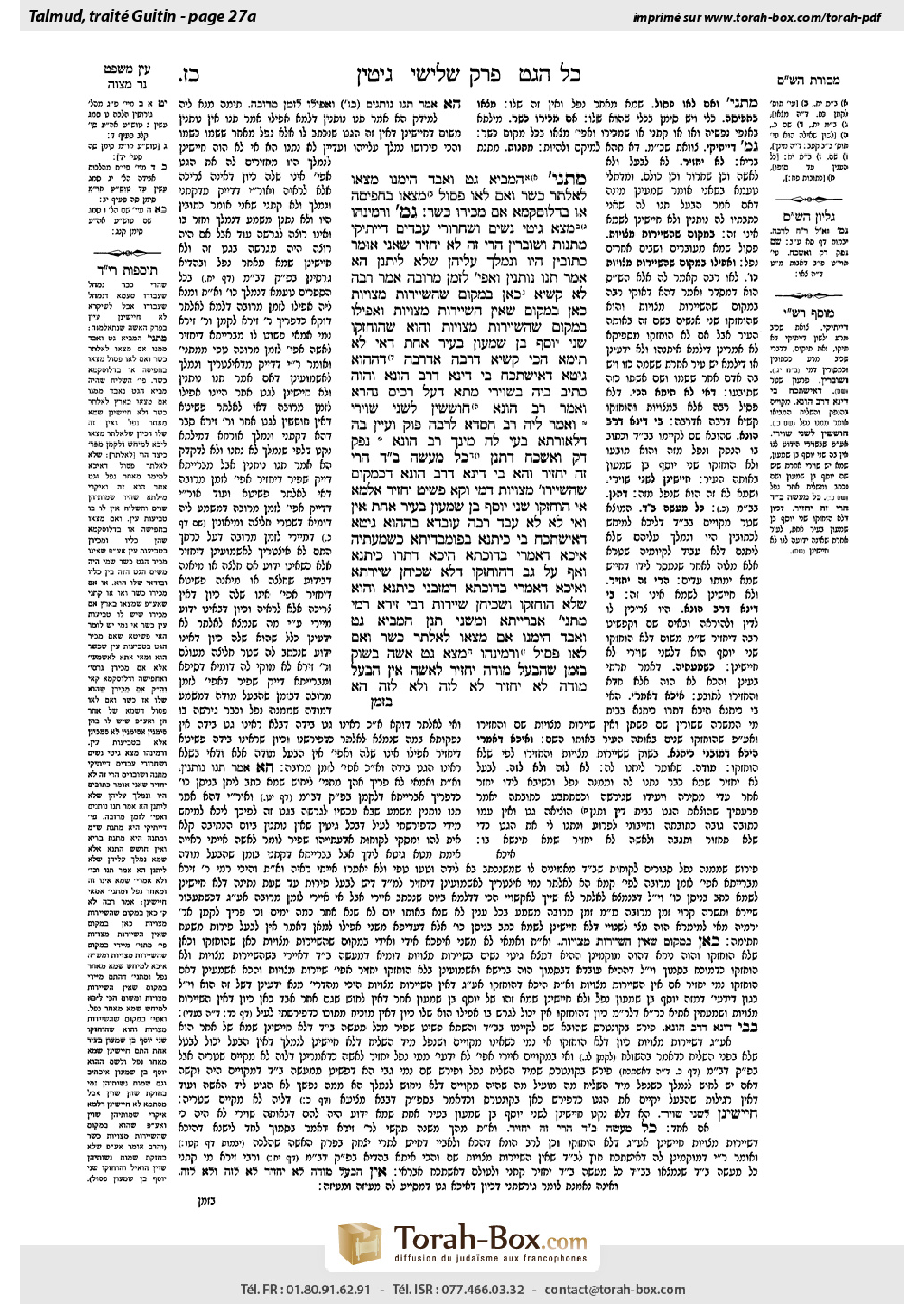
Gittin 27a: Talmud study for Daf Yomi
Study the Talmud for Daf Yomi with scanned pages, Hebrew text, English translations from Sefaria and AI-generated French translations.
Passage selection and English or AI-generated French translation are available where the scan has annotations. Daf Study is independent of Torah-Box and Sefaria.
Browse Gittin · גיטין · All tractatesGittin 27a text and translations
This page of Gittin includes the Aramaic text, an English translation and an AI-generated French translation, alongside the scan above.
גיטין כ״ז א · Aramaic and Hebrew text
מַתְנִי׳ הַמֵּבִיא גֵּט וְאָבַד הֵימֶנּוּ; מְצָאוֹ לְאַלְתַּר – כָּשֵׁר, וְאִם לָאו – פָּסוּל. מְצָאוֹ בַּחֲפִיסָה אוֹ בִּדְלוֹסְקָמָא, אִם מַכִּירוֹ – כָּשֵׁר.
גְּמָ׳ וּרְמִינְהוּ: מָצָא גִּיטֵּי נָשִׁים וְשִׁחְרוּרֵי עֲבָדִים, דְּיָיתֵיקֵי, מַתָּנוֹת וְשׁוֹבָרִין, הֲרֵי זֶה לֹא יַחֲזִיר – שֶׁאֲנִי אוֹמֵר כְּתוּבִין הָיוּ, וְנִמְלַךְ עֲלֵיהֶן שֶׁלֹּא לִיתְּנָן. הָא אָמַר ״תְּנו״ּ – נוֹתְנִין; וַאֲפִילּוּ לִזְמַן מְרוּבֶּה!
אָמַר רַבָּה, לָא קַשְׁיָא: כָּאן בִּמְקוֹם שֶׁהַשַּׁיָּירוֹת מְצוּיוֹת, כָּאן בִּמְקוֹם שֶׁאֵין הַשַּׁיָּירוֹת מְצוּיוֹת.
וַאֲפִילּוּ בִּמְקוֹם שֶׁהַשַּׁיָּירוֹת מְצוּיוֹת – וְהוּא שֶׁהוּחְזְקוּ שְׁנֵי יוֹסֵף בֶּן שִׁמְעוֹן בְּעִיר אַחַת.
דְּאִי לָא תֵּימָא הָכִי, קַשְׁיָא דְּרַבָּה אַדְּרַבָּה: דְּהָהוּא גִּיטָּא דְּאִישְׁתְּכַח בֵּי דִינָא דְּרַב הוּנָא, וַהֲוָה כְּתִיב בֵּיהּ ״בִּשְׁוִירֵי מָתָא דְּעַל רָכִיס נַהֲרָא״, וְאָמַר רַב הוּנָא: חוֹשְׁשִׁין לִשְׁנֵי שְׁוִירֵי;
וַאֲמַר לֵיהּ רַב חִסְדָּא לְרַבָּה: פּוֹק וְעַיֵּין בָּהּ, דִּלְאוּרְתָּא בָּעֵי לַהּ מִינָּךְ רַב הוּנָא. נְפַק, דַּק וְאַשְׁכַּח – דִּתְנַן: כׇּל מַעֲשֵׂה בֵּית דִּין – הֲרֵי זֶה יַחְזִיר.
וְהָא בֵּי דִינָא דְּרַב הוּנָא, דְּכִמְקוֹם שֶׁהַשַּׁיָּירוֹת מְצוּיוֹת דָּמֵי, וְקָא פָּשֵׁיט יַחְזִיר; אַלְמָא, אִי הוּחְזְקוּ שְׁנֵי יוֹסֵף בֶּן שִׁמְעוֹן בְּעִיר אַחַת – אִין, וְאִי לָא – לָא.
עֲבַד רַבָּה עוֹבָדָא בְּהָהוּא גִּיטָּא, דְּאִישְׁתְּכַח בֵּי כִיתָּנָא בְּפוּמְבְּדִיתָא, כִּשְׁמַעְתֵּיהּ. אִיכָּא דְּאָמְרִי בְּדוּכְתָּא הֵיכָא דְּתָרוּ כִּיתָּנָא, וְאַף עַל גַּב דְּהוּחְזְקוּ – דְּלָא שְׁכִיחָן שְׁיָירָתָא; וְאִיכָּא דְּאָמְרִי בְּדוּכְתָּא דִּמְזַבְּנִי כִּיתָּנָא, וְהוּא שֶׁלֹּא הוּחְזְקוּ, וּשְׁכִיחָן שַׁיָּירוֹת.
רַבִּי זֵירָא רָמֵי מַתְנִיתִין אַבָּרַיְיתָא, וּמְשַׁנֵּי. תְּנַן: הַמֵּבִיא גֵּט וְאָבַד הֵימֶנּוּ, אִם מְצָאוֹ לְאַלְתַּר – כָּשֵׁר, וְאִם לָאו – פָּסוּל. וּרְמִינְהוּ: מָצָא גֵּט אִשָּׁה בַּשּׁוּק, בִּזְמַן שֶׁהַבַּעַל מוֹדֶה – יַחְזִיר לְאִשָּׁה, אֵין הַבַּעַל מוֹדֶה – לֹא יַחְזִיר לֹא לָזֶה וְלֹא לָזֶה. הָא
Gittin 27a · English translation
MISHNA: With regard to an agent who brings a bill of divorce and it was lost from him, if he finds it immediately then the bill of divorce is valid. But if not, then it is invalid, as it is possible that the bill of divorce that he found is not the same one that he lost, and this second bill of divorce belongs to someone else whose name and wife’s name are identical to the names of the husband and wife in the lost bill of divorce. However, if he found it in a ḥafisa or in a deluskema that he knows is his, or if he recognizes the actual bill of divorce, then it is valid.
GEMARA: The mishna teaches that if a bill of divorce was lost before being received by the woman it is invalid unless it was found immediately. And the Gemara raises a contradiction from a mishna (Bava Metzia 18a): If one found bills of divorce, or bills of manumission, wills [dayetikei], deeds of gifts, or receipts, this finder should not return these items to the one who is presumed to have lost them, as I say it is possible that they were written and then the writer reconsidered about them and decided that he would not give them. One could infer from this mishna as follows: But if the writer said: Give these found documents to the intended recipient, one gives them, and this is true even if a long time passed since they were lost, and there is no concern that perhaps this document belongs to someone else with the same name.
Rabba said: This is not difficult. Here, in the mishna that rules that the bill of divorce cannot be used unless it was found immediately, it is stated with regard to a place where caravans are frequently found, and there is a concern that the found bill of divorce belongs to someone else with the identical name. There, in the mishna in tractate Bava Metzia, it is stated with regard to a place where caravans are not frequently found, so one may return the document if he knows that the writer did not reconsider.
The Gemara comments: And even in a place where caravans are frequently found, there is not always a concern that the bill of divorce may belong to another man with an identical name, but this concern is only where it has been established that there are two men named, e.g., Yosef ben Shimon, in that one town.
The Gemara continues: As, if you do not say so, that this concern is taken into account only in a place where it is known that there are two people with the same name, then there is a difficulty presented in the form of a contradiction between this statement of Rabba and another statement of Rabba. As there was a certain bill of divorce that was found, i.e., brought, in the court of Rav Huna, and the name of the place that was written in it was: In Sheviri the city, which is on the Rakhis River. And Rav Huna said: One is concerned about the possibility of the existence of two cities called Sheviri, and it is possible that this bill of divorce belongs to another man with an identical name.
The Gemara continues: And Rav Ḥisda said to Rabba, who was then a student: Go out and examine this halakha, as Rav Huna will ask you about it at night. Rabba went out, examined it, and discovered a relevant source. As we learned in a mishna (Bava Metzia 20a): One should return all court enactments, i.e., promissory notes that have been authenticated by the court, to their owner, and there is no concern that perhaps there are two towns with the identical name and that the promissory note belongs to someone else.
The Gemara explains: But isn’t the court of Rav Huna comparable to a place where caravans are frequently found, as there were always many people present there? And yet Rabba resolved the question and ruled that one should return the document to the owner, which appears to contradict his earlier ruling that one should not return a document found in a place where caravans are frequently found. Apparently he holds that if it is established that there are two people named Yosef ben Shimon in one town, then yes, there is a concern and the document should not be returned, but if not, there is no concern.
The Gemara relates: Rabba performed an action, i.e., issued a practical ruling, with regard to a certain bill of divorce that was found in the flax house in the city of Pumbedita, in accordance with his ruling of halakha. As to the details of this incident, there are those who say that this was in the place where people soaked flax, and although it was established that there were two people with the same name living in the city mentioned in the bill of divorce, he ruled this way since it was a place where caravans are not frequently found. And there are those who say that this occurred in a place where people sold flax, and it was not established that two people with the same name lived in the city where the bill of divorce was written, and this occurred in a place where caravans are frequently found.
Concerning this issue, the Gemara relates that Rabbi Zeira raises a contradiction between the mishna and a baraita and then answers it: We learned in the mishna: With regard to an agent who brings a bill of divorce and it was lost from him, if he finds it immediately then the bill of divorce is valid. And if not, it is invalid. And he raises a contradiction from a baraita that states: If one found a woman’s bill of divorce in the marketplace, then when the husband admits that he wrote it and gave it, the finder should return it to the woman. If the husband does not admit to this, then he should not return it, not to this man and not to this woman. One can infer from here: But
Gittin 27a · Traduction française (IA)
MICHNA : Concernant un agent qui apporte un acte de divorce et qui l'a perdu, si il le retrouve immédiatement, l'acte de divorce est valide. Mais s'il ne le retrouve pas, il est invalide, car il est possible que l'acte de divorce qu'il a trouvé ne soit pas le même que celui qu'il a perdu, et que ce second acte de divorce appartienne à quelqu'un d'autre dont les noms et celui de la femme sont identiques à ceux du mari et de la femme dans l'acte de divorce perdu. Cependant, si il le retrouve dans une ḥafisa ou dans un deluskema qu'il sait être le sien, ou s'il reconnaît l'acte de divorce réel, alors il est valide.
GUEMARA : La mishna enseigne que si un acte de divorce a été perdu avant d'être reçu par la femme, il est invalide à moins qu'il ne soit retrouvé immédiatement. Et la Guemara soulève une contradiction à partir d'une mishna (Bava Metzia 18a) : Si l'on trouve des actes de divorce, des actes de manumission, des testaments [dayetikei], des dons ou des reçus, ce trouver ne devrait pas rendre ces objets à celui qui est supposé avoir perdu. Car je dis qu'il est possible qu'ils aient été écrits et que l'écrivain ait réfléchi à leur contenu et décidé de ne pas les donner. On pourrait en déduire de cette mishna que : Mais si l'écrivain dit : Donnez ces documents trouvés à l'intéressé, on les donne, et cela est vrai même si un long temps s'est écoulé depuis leur perte, et il n'y a pas de crainte que ce document appartienne à quelqu'un d'autre avec le même nom.
Rabba a dit : Ce n'est pas difficile. Ici, dans la mishna qui stipule que l'acte de divorce ne peut être utilisé à moins qu'il ne soit retrouvé immédiatement, il est dit concernant un lieu où des caravanes sont fréquemment trouvées, et où il y a une crainte que l'acte de divorce trouvé appartienne à quelqu'un d'autre avec le même nom. Là, dans la mishna du traité Bava Metzia, il est dit concernant un lieu où des caravanes ne sont pas fréquemment trouvées, donc on peut rendre le document si l'écrivain n'a pas réfléchi.
La Guemara commente : Et même dans un lieu où des caravanes sont fréquemment trouvées, il n'y a pas toujours une crainte que l'acte de divorce appartienne à un autre homme ayant le même nom, mais cette crainte est seulement là où il a été établi qu'il y a deux hommes nommés, par exemple Yosef ben Shimon, dans cette même ville.
La Guemara continue : Car, si vous ne dites pas cela, c'est-à-dire que cette crainte est prise en compte uniquement dans un lieu où il est connu qu'il y a deux personnes ayant le même nom, alors il y a une difficulté présentée sous la forme d'une contradiction entre cette déclaration de Rabba et une autre déclaration de Rabba. Car il y avait un certain acte de divorce qui avait été trouvé, c'est-à-dire apporté, devant la cour de Rav Huna, et le nom de la ville écrit dans cet acte était : Dans Sheviri la ville, qui est sur le fleuve Rakhis. Et Rav Huna a dit : On est préoccupé par la possibilité qu'il y ait deux villes appelées Sheviri, et il est possible que cet acte de divorce appartienne à un autre homme ayant le même nom.
La Guemara continue : Et Rav Ḥisda a dit à Rabba, qui était alors un étudiant : Sortez et examinez cette halakha, car Rav Huna vous posera cette question la nuit. Rabba est sorti, a examiné et a découvert une source pertinente. Car nous avons appris dans une mishna (Bava Metzia 20a) : On doit rendre à leur propriétaire tous les ordonnances de la cour, c'est-à-dire les promesses de paiement authentifiées par la cour, et il n'y a pas de crainte que deux villes aient le même nom et que la promesse de paiement appartienne à quelqu'un d'autre.
La Guemara explique : Mais n'est-ce pas que la cour de Rav Huna est comparable à un lieu où des caravanes sont fréquemment trouvées, car il y avait toujours beaucoup de personnes présentes là-bas ? Et pourtant Rabba a résolu la question et a décidé que l'on devait rendre le document à l'propriétaire, ce qui semble contredire son précédent jugement selon lequel l'on ne devrait pas rendre un document trouvé dans un lieu où des caravanes sont fréquemment trouvées. Apparemment, il considère que si l'on a établi qu'il y a deux personnes nommées Yosef ben Shimon dans une même ville, alors oui, il y a une crainte et le document ne devrait pas être rendu, mais si ce n'est pas le cas, il n'y a pas de crainte.
La Guemara rapporte : Rabba a accompli une action, c'est-à-dire a émis un jugement pratique, concernant un certain acte de divorce trouvé dans la maison de lin de la ville de Pumbedita, conformément à son jugement halakhique. En ce qui concerne les détails de cet incident, il y a ceux qui disent que cela s'est produit dans le lieu où les gens trempaient le lin, et bien qu'il ait été établi qu'il y avait deux personnes avec le même nom vivant dans la ville mentionnée dans l'acte de divorce, il a rendu ce jugement car il s'agissait d'un lieu où des caravanes ne sont pas fréquemment trouvées. Et il y a ceux qui disent que cela s'est produit dans un lieu où des gens vendaient du lin, et il n'était pas établi qu'il y ait deux personnes avec le même nom vivant dans la ville où l'acte de divorce avait été écrit, et cela s'est produit dans un lieu où des caravanes sont fréquemment trouvées.
Concernant cette question, la Guemara rapporte que Rabbi Zeira soulève une contradiction entre la Michna et une baraïta, puis répond à cette contradiction : Nous avons appris dans la Michna : Concernant un agent qui apporte un acte de divorce et qui l'a perdu, si il le retrouve immédiatement, l'acte de divorce est valide. Et si non, il est invalide. Et il soulève une contradiction à partir d'une baraïta qui stipule : Si l'on a trouvé un acte de divorce d'une femme dans le marché, alors quand le mari admet qu'il l'a écrit et donné, le trouver doit le rendre à la femme. Si le mari ne reconnaît pas cela, alors il ne doit pas le rendre, ni à cet homme ni à cette femme. On peut en déduire de là : Mais
Traduction française générée par IA à partir de l’édition anglaise de Sefaria. Vérifie toujours un passage avec le texte source.
Text from Sefaria: William Davidson Edition - Vocalized Aramaic (CC BY NC); William Davidson Edition - English (CC BY NC).