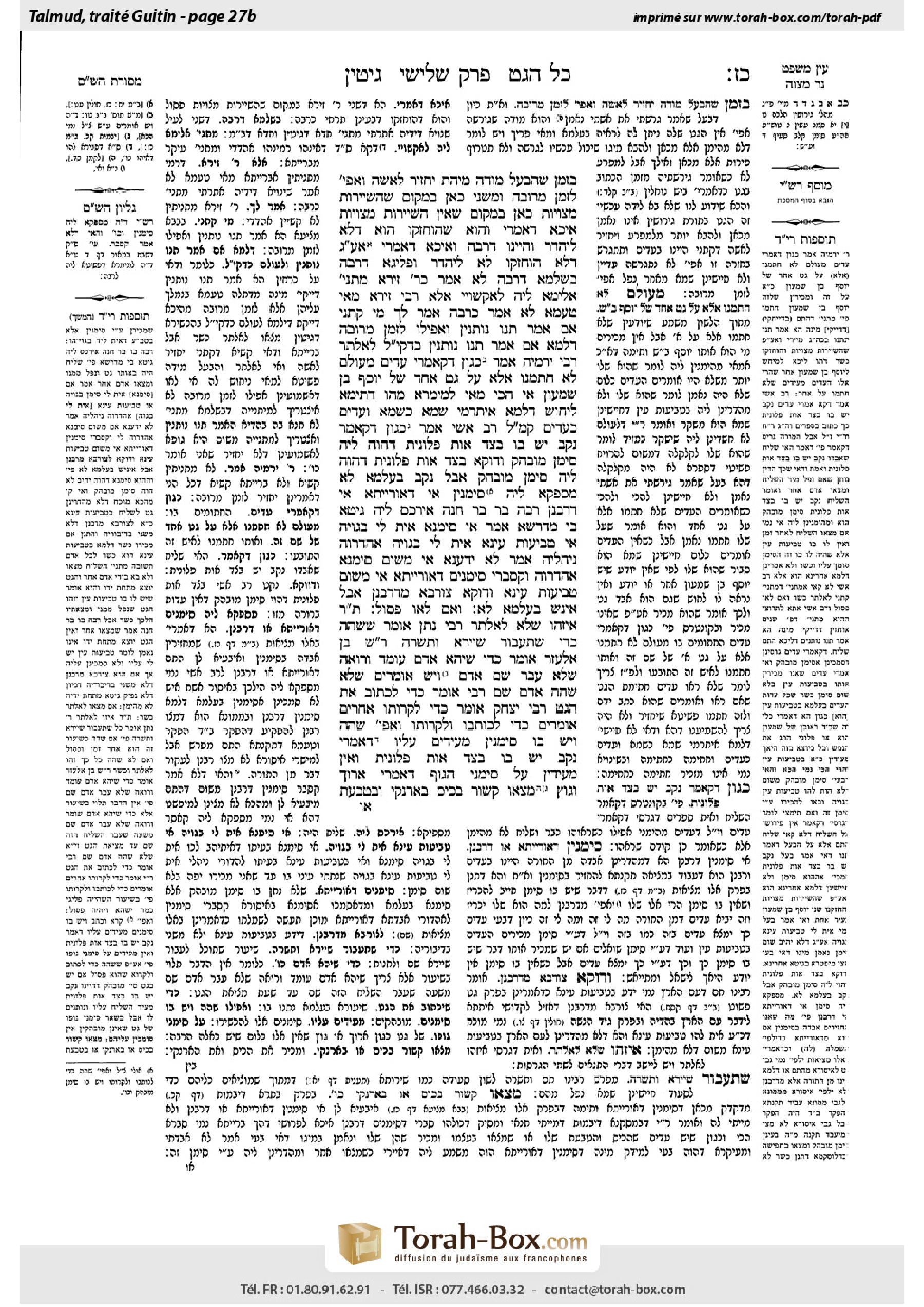
Gittin 27b: Talmud study for Daf Yomi
Study the Talmud for Daf Yomi with scanned pages, Hebrew text, English translations from Sefaria and AI-generated French translations.
Passage selection and English or AI-generated French translation are available where the scan has annotations. Daf Study is independent of Torah-Box and Sefaria.
Browse Gittin · גיטין · All tractatesGittin 27b text and translations
This page of Gittin includes the Aramaic text, an English translation and an AI-generated French translation, alongside the scan above.
גיטין כ״ז ב · Aramaic and Hebrew text
בִּזְמַן שֶׁהַבַּעַל מוֹדֶה מִיהַת – יַחְזִיר לָאִשָּׁה, וַאֲפִילּוּ לִזְמַן מְרוּבֶּה! וּמְשַׁנֵּי: כָּאן בִּמְקוֹם שֶׁהַשַּׁיָּירוֹת מְצוּיוֹת, כָּאן בִּמְקוֹם שֶׁאֵין הַשַּׁיָּירוֹת מְצוּיוֹת.
אִיכָּא דְּאָמְרִי וְהוּא שֶׁהוּחְזְקוּ הוּא דְּלָא לַיהְדַּר, וְהַיְינוּ דְּרַבָּה; וְאִיכָּא דְּאָמְרִי אַף עַל גַּב דְּלָא הוּחְזְקוּ לָא לַיהְדַּר, וּפְלִיגָא דְּרַבָּה.
בִּשְׁלָמָא דְּרַבָּה לָא אָמַר כְּרַבִּי זֵירָא, מַתְנִיתִין אַלִּימָא לֵיהּ לְאַקְשׁוֹיֵי; אֶלָּא רַבִּי זֵירָא, מַאי טַעְמָא לָא אָמַר כְּרַבָּה?
אָמַר לָךְ, מִי קָתָנֵי: אִם אָמַר ״תְּנוּ״ – נוֹתְנִין, וַאֲפִילּוּ לִזְמַן מְרוּבֶּה? דִּלְמָא אִם אָמַר ״תְּנוּ״ נוֹתְנִין כִּדְקַיְימָא לַן – לְאַלְתַּר.
רַבִּי יִרְמְיָה אָמַר, כְּגוֹן דְּקָאָמְרִי עֵדִים: מֵעוֹלָם לֹא חָתַמְנוּ אֶלָּא עַל גֵּט אֶחָד שֶׁל יוֹסֵף בֶּן שִׁמְעוֹן.
אִי הָכִי, מַאי לְמֵימְרָא? מַהוּ דְּתֵימָא לֵיחוּשׁ דִּלְמָא אִיתְרְמִי שְׁמָא כִּשְׁמָא וְעֵדִים כְּעֵדִים קָא מַשְׁמַע לַן.
רַב אָשֵׁי אָמַר, כְּגוֹן דְּקָאָמַר: נֶקֶב יֵשׁ בּוֹ בְּצַד אוֹת פְּלוֹנִית, דְּהָוֵה לֵיהּ סִימָן מוּבְהָק. וְדַוְקָא בְּצַד אוֹת פְּלוֹנִית, דְּהָוֵה לֵיהּ סִימָן מוּבְהָק, אֲבָל: נֶקֶב בְּעָלְמָא, לָא;
מְסַפְּקָא לֵיהּ סִימָנִין אִי דְּאוֹרָיְיתָא אִי דְּרַבָּנַן.
רַבָּה בַּר בַּר חָנָה אִירְכַס לֵיהּ גִּיטָּא בֵּי מִדְרְשָׁא, אֲמַר: אִי סִימָנָא – אִית לִי בְּגַוֵּיהּ, אִי טְבִיעוּת – עֵינָא אִית לִי בְּגַוֵּיהּ. אַהְדְּרוּהּ נִיהֲלֵיהּ. אֲמַר: לָא יָדַעְנָא אִי מִשּׁוּם סִימָנָא אַהְדְּרוּהּ – וְקָסָבְרִי סִימָנִים דְּאוֹרָיְיתָא, אִי מִשּׁוּם טְבִיעוּת עֵינָא – וְדַוְקָא צוּרְבָּא מִדְּרַבָּנַן, אֲבָל אִינָשׁ בְּעָלְמָא לָא.
וְאִם לָאו – פָּסוּל: תָּנוּ רַבָּנַן: אֵיזֶהוּ שֶׁלֹּא לְאַלְתַּר? רַבִּי נָתָן אוֹמֵר: שֶׁשָּׁהָה כְּדֵי שֶׁתַּעֲבוֹר שְׁיָירָא וְתִשְׁרֶה. רַבִּי שִׁמְעוֹן בֶּן אֶלְעָזָר אוֹמֵר: כְּדֵי שֶׁיְּהֵא אָדָם עוֹמֵד וְרוֹאֶה שֶׁלֹּא עָבַר שָׁם אָדָם. וְיֵשׁ אוֹמְרִים: שֶׁלֹּא שָׁהָה אָדָם שָׁם. רַבִּי אוֹמֵר: כְּדֵי לִכְתּוֹב אֶת הַגֵּט. רַבִּי יִצְחָק אוֹמֵר: כְּדֵי לִקְרוֹתוֹ. אֲחֵרִים אוֹמְרִים: כְּדֵי לְכוֹתְבוֹ וְלִקְרוֹתוֹ.
וַאֲפִילּוּ שָׁהָה, וְיֵשׁ בּוֹ סִימָנִין – מְעִידִים עָלָיו; דְּאָמְרִי: נֶקֶב יֵשׁ בּוֹ בְּצַד אוֹת פְּלוֹנִית. וְאֵין מְעִידִין עַל סִימָנֵי הַגּוּף; דְּאָמְרִי: אָרוֹךְ וְגוּץ.
מְצָאוֹ קָשׁוּר בְּכִיס, בְּאַרְנָקִי וּבְטַבַּעַת,
Gittin 27b · English translation
when the husband admits that he wrote it, in any event he should return it to the woman, and by omission this appears to be the halakha even if a long time has passed since the bill of divorce was lost. And Rabbi Zeira answers: Here, in the mishna where it states that he should not return it, it is stated with regard to a place where caravans are frequently found; there, in the baraita where it states that he should return it, it is stated with regard to a place where caravans are not frequently found.
The Gemara compares the rulings of Rabba and Rabbi Zeira. There are those who say with regard to Rabbi Zeira’s statement that he should not return it in a place where caravans are frequently found: And this is the case when it is established that there are two people in the town with the identical name. In that case, Rabbi Zeira holds that it should not be returned, and this is the same ruling as that of Rabba. And there are those who say: In a place where caravans are frequently found, even though it is not established that there are two people with identical names, it should not be returned, and he disagrees with the ruling of Rabba.
The Gemara clarifies: Granted that Rabba did not say a discourse like that of Rabbi Zeira and raise a contradiction from the baraita, as he holds that it is a stronger challenge to raise a difficulty from the mishna in tractate Bava Metzia because the Mishna, redacted by Rabbi Yehuda HaNasi, employs more precise language than baraitot. But what is the reason that Rabbi Zeira did not say a discourse like that of Rabba and raise a contradiction from the mishna in tractate Bava Metzia?
The Gemara answers: Rabbi Zeira could have said to you: Does the mishna teach that if he said: Give the found document to the intended recipient, one gives it, and this is so even if a long time passed? This was only an inference from the mishna. Perhaps the mishna should be interpreted differently, so as to teach: If he said: Give it, then one gives it, but this is only as we maintain in the mishna, when it is found immediately, not if a long time has passed.
The Gemara offers an alternative resolution to the contradiction between the mishna here, on the one hand, and the mishna in tractate Bava Metzia and the baraita, on the other hand. Rabbi Yirmeya said: It is possible to resolve the contradiction in a different way: The latter permit one to return a lost bill of divorce only in a case where the witnesses who signed the bill of divorce say: We have never signed a bill of divorce of Yosef ben Shimon other than this one, in which case there is no concern that the bill of divorce belongs to someone else.
The Gemara asks: If that is so, what is the purpose of stating that one returns the bill of divorce? Since it clearly belongs to her, there is no question that it must be returned to her. The Gemara answers: It is necessary lest you say that one should be concerned that perhaps it happened that another bill of divorce was written in which the names of the husband and the wife are identical to the names of the husband and wife of the second bill of divorce, and the names of the witnesses on that bill of divorce are identical to the names of the witnesses on this bill of divorce, when in fact they are different witnesses. Therefore, the mishna teaches us that this is not a concern.
The Gemara suggests an alternative resolution to the contradiction. Rav Ashi said: When do the mishna in tractate Bava Metzia and the baraita rule that one should return the bill of divorce? It is in a case where the one who lost it says: There is a hole in the bill of divorce, next to such and such a letter, as this is a clear-cut distinguishing mark for him. The Gemara comments: And Rav Ashi permits the returning of such a bill of divorce specifically when one says that the hole is next to such and such a letter, as that is a clear-cut distinguishing mark for him. But if he said only that it had a hole without mentioning its precise location, then one should not return the bill of divorce, as that is not considered a clear-cut distinguishing mark.
The Gemara explains: Rav Ashi is uncertain with regard to whether the obligation to return a lost item to its owner on the basis of distinguishing marks is by Torah law or if it is by rabbinic law. Therefore, in the case of a bill of divorce, he holds that one may rely only on a clear-cut distinguishing mark, as everyone agrees that the requirement to return a lost item to its owner on the basis of a clear-cut distinguishing mark is by Torah law.
Apropos this discussion the Gemara relates an incident: Rabba bar bar Ḥana lost the bill of divorce that he was transmitting, when he was in the study hall. He said: If they request a distinguishing mark, I have one for it. If it depends on visual recognition, I have methods of recognition for it. They returned the bill of divorce to him. He said afterward: I do not know if they returned it due to the distinguishing mark that I supplied, and they hold that distinguishing marks are used to return lost items by Torah law, or if it was due to my visual recognition, and it is specifically Torah scholars [tzurva miderabbanan] like me who are relied upon when they say that they recognize an item, but an ordinary man would not be relied upon to recognize the item and have it returned to him.
§ The mishna teaches that if one found the bill of divorce immediately, it is valid, but if not, then it is invalid. The Sages taught: What is considered not immediately? Rabbi Natan says: It is when there was a delay equivalent to the amount of time it would take for a caravan to pass by and camp there. Rabbi Shimon ben Elazar says: There is no fixed amount of time; rather, it is within the category of immediately as long as there will be a person that stands and sees that no other person passed there. And some say that he said: It is as long as no person stopped there. Rabbi Yehuda HaNasi says: It is within the category of immediately if there was not a delay equivalent to the amount of time it would take to write the bill of divorce. Rabbi Yitzḥak says: It is equivalent not to the amount of time needed write the bill of divorce, but equivalent to the amount of time it would take to read it. Others say: It is equivalent to the amount of time it would take to write it and to read it.
The Gemara adds: And even if there was a delay and the bill of divorce has distinguishing marks on it, the marks attest to it and it is considered a valid bill of divorce. This is the halakha where the distinguishing marks are clear-cut, e.g., when they say: It has a hole next to such and such a letter. And one may not testify with regard to distinguishing marks of the physical description of the bill of divorce itself, e.g., where they say: This bill of divorce is long or short, as these are not considered distinguishing marks.
In a case where one found a bill of divorce tied up in a pouch or in a purse [arnaki], or encircled in a ring, and he recognizes the document,
Gittin 27b · Traduction française (IA)
Quand le mari admet qu'il l'a écrit, il faut tout de même le rendre à la femme, et par omission, cela semble indiquer que c'est la halakha même si un long temps s'est écoulé depuis que le contrat de divorce a été perdu. Rabbi Zeira répond : Ici, dans la michna qui dit qu'il ne faut pas le rendre, cela est dit en référence à un lieu où les caravanes sont fréquemment présentes ; là, dans la baraïta qui dit qu'il faut le rendre, cela est dit en référence à un lieu où les caravanes ne sont pas fréquemment présentes.
La Guemara compare les décisions de Rabba et de Rabbi Zeira. Certains disent concernant la déclaration de Rabbi Zeira qu'il ne faut pas le rendre dans un lieu où les caravanes sont fréquemment présentes : Et cela est le cas lorsque l'on établit qu'il y a deux personnes dans la ville avec le même nom. Dans ce cas, Rabbi Zeira considère qu'il ne faut pas le rendre, et c'est la même décision que celle de Rabba. Et d'autres disent : Dans un lieu où les caravanes sont fréquemment présentes, même si l'on ne peut établir qu'il y a deux personnes avec le même nom, il ne faut pas le rendre, et il s'oppose à la décision de Rabba.
La Guemara clarifie : Cela étant, Rabba n'a pas dit un discours tel que celui de Rabbi Zeira et ne s'est pas élevé contre la baraïta, car il considère que c'est un défi plus fort de soulever une difficulté à partir de la michna dans le traité Bava Metzia, car la michna, rédigée par Rabbi Yéhouda HaNasi, utilise un langage plus précis que les baraïtotes. Mais quelle est la raison pour laquelle Rabbi Zeira n'a pas dit un discours tel que celui de Rabba et ne s'est pas élevé contre la michna dans le traité Bava Metzia ?
La Guemara répond : Rabbi Zeira aurait pu dire : La Michna enseigne-t-elle que si l'on dit : Donnez le document trouvé à l'intéressé, on le donne, et cela est ainsi même si un long temps s'est écoulé ? Cela n'était qu'une déduction de la Michna. Peut-être la Michna devrait être interprétée différemment, afin d'enseigner : Si l'on dit : Donnez-le, alors on le donne, mais cela est seulement dans le cas où il est trouvé immédiatement, pas si un long temps s'est écoulé.
La Guemara propose une résolution alternative à la contradiction entre la Michna ici, d'une part, et la Michna dans le traité Bava Metzia et la Baraïta, d'autre part. Rabbi Yirmeya dit : Il est possible de résoudre la contradiction d'une autre manière : L'interdiction de rendre un contrat de divorce perdu est seulement dans le cas où les témoins qui ont signé le contrat de divorce disent : Nous n'avons jamais signé un contrat de divorce de Yosef ben Shimon autre que celui-ci, dans ce cas, il n'y a pas de crainte que le contrat de divorce appartienne à quelqu'un d'autre.
La Guemara demande : Si c'est ainsi, à quoi sert de dire qu'on rend le contrat de divorce ? Puisque c'est clairement à elle, il n'y a pas de question à poser sur le fait qu'il doive être rendu à elle. La Guemara répond : Il est nécessaire pour éviter que l'on dise qu'on doive avoir une crainte que peut-être un autre contrat de divorce ait été écrit dans lequel les noms du mari et de la femme sont identiques aux noms du mari et de la femme du second contrat de divorce, et les noms des témoins sur ce contrat de divorce sont identiques aux noms des témoins sur ce contrat de divorce, alors que ce sont en réalité des témoins différents. Par conséquent, la Michna nous enseigne que cela n'est pas une crainte.
La Guemara suggère une résolution alternative à la contradiction. Rav Ashi dit : Dans quel cas les michnas du traité Bava Metzia et la baraïta décident qu'on doit rendre le contrat de divorce ? C'est dans le cas où celui qui l'a perdu dit : Il y a un trou dans le contrat de divorce, à côté de telle et telle lettre, car c'est un signe distinctif clair pour lui. La Guemara commente : Et Rav Ashi permet spécifiquement de rendre ce contrat de divorce lorsque l'on dit que le trou est à côté de telle et telle lettre, car c'est un signe distinctif clair pour lui. Mais si l'on dit seulement qu'il y a un trou sans mentionner son emplacement précis, alors on ne doit pas rendre le contrat de divorce, car cela n'est pas considéré comme un signe distinctif clair.
La Guemara explique : Rav Ashi est incertain quant à savoir si l'obligation de rendre un objet perdu à son propriétaire sur la base de signes distinctifs est une loi divine ou une loi rabbinique. Par conséquent, dans le cas d'un contrat de divorce, il considère qu'on peut se fier uniquement à un signe distinctif clair, car tout le monde convient que la loi divine exige de rendre un objet perdu à son propriétaire sur la base d'un signe distinctif clair.
A propos de cette discussion, la Guemara rapporte un incident : Rabba bar bar Ḥana a perdu le contrat de divorce qu'il transmettait, lorsqu'il était dans la salle de study. Il a dit : Si on demande un signe distinctif, j'en ai un. Si cela dépend de la reconnaissance visuelle, j'ai des méthodes de reconnaissance. Ils ont rendu le contrat de divorce à lui. Il a dit après : Je ne sais pas si ils l'ont rendu en raison du signe distinctif que j'ai fourni, et s'ils considèrent que les signes distinctifs sont utilisés pour rendre un objet perdu selon la loi divine, ou si c'était en raison de ma reconnaissance visual, et c'est spécifiquement les savants [tzurva miderabbanan] comme moi qui sont pris en compte lorsqu'ils disent qu'ils reconnaissent un objet, mais un homme ordinaire ne serait pas considéré comme capable de reconnaître l'objet et de le faire rendre à lui.
§ La Michna enseigne que si l'on trouve le document de divorce immédiatement, il est valide, mais s'il n'est pas trouvé immédiatement, il est invalide. Les Sages enseignent : Qu'est-ce qui est considéré comme non immédiat ? Rabbi Natan dit : C'est lorsqu'il y a eu un délai équivalent au temps nécessaire pour qu'un convoi passe et s'installe là. Rabbi Shim'on ben Elazar dit : Il n'y a pas de délai fixe ; plutôt, il est considéré comme immédiat tant qu'il y a une personne qui reste et qui voit que personne n'est passé par là. Et certains disent qu'il a dit : tant qu'aucune personne n'a pas arrêté là. Rabbi Yéhouda HaNasi dit : Il est considéré comme immédiat s'il n'y a pas eu un délai équivalent au temps nécessaire pour écrire le document de divorce. Rabbi Yitzhak dit : Il est équivalent non pas au temps nécessaire pour écrire le document de divorce, mais au temps nécessaire pour le lire. D'autres disent : Il est équivalent au temps nécessaire pour l'écrire et le lire.
La Guemara ajoute : Même s'il y a eu un délai et que le document de divorce présente des marques distinctives, ces marques attestent de sa validité et il est considéré comme un document de divorce valide. C'est la halakha lorsque les marques distinctives sont claires, par exemple lorsqu'on dit : Il a un trou à côté de telle et telle lettre. Et on ne peut témoigner en ce qui concerne les marques distinctives de la description physique du document de divorce lui-même, par exemple lorsqu'on dit : Ce document de divorce est long ou court, car ces éléments ne sont pas considérés comme des marques distinctives.
Dans le cas où l'on trouve un document de divorce lié dans une poche ou dans un sac [arnaki], ou entouré d'un anneau, et qu'on reconnaît le document,
Traduction française générée par IA à partir de l’édition anglaise de Sefaria. Vérifie toujours un passage avec le texte source.
Text from Sefaria: William Davidson Edition - Vocalized Aramaic (CC BY NC); William Davidson Edition - English (CC BY NC).