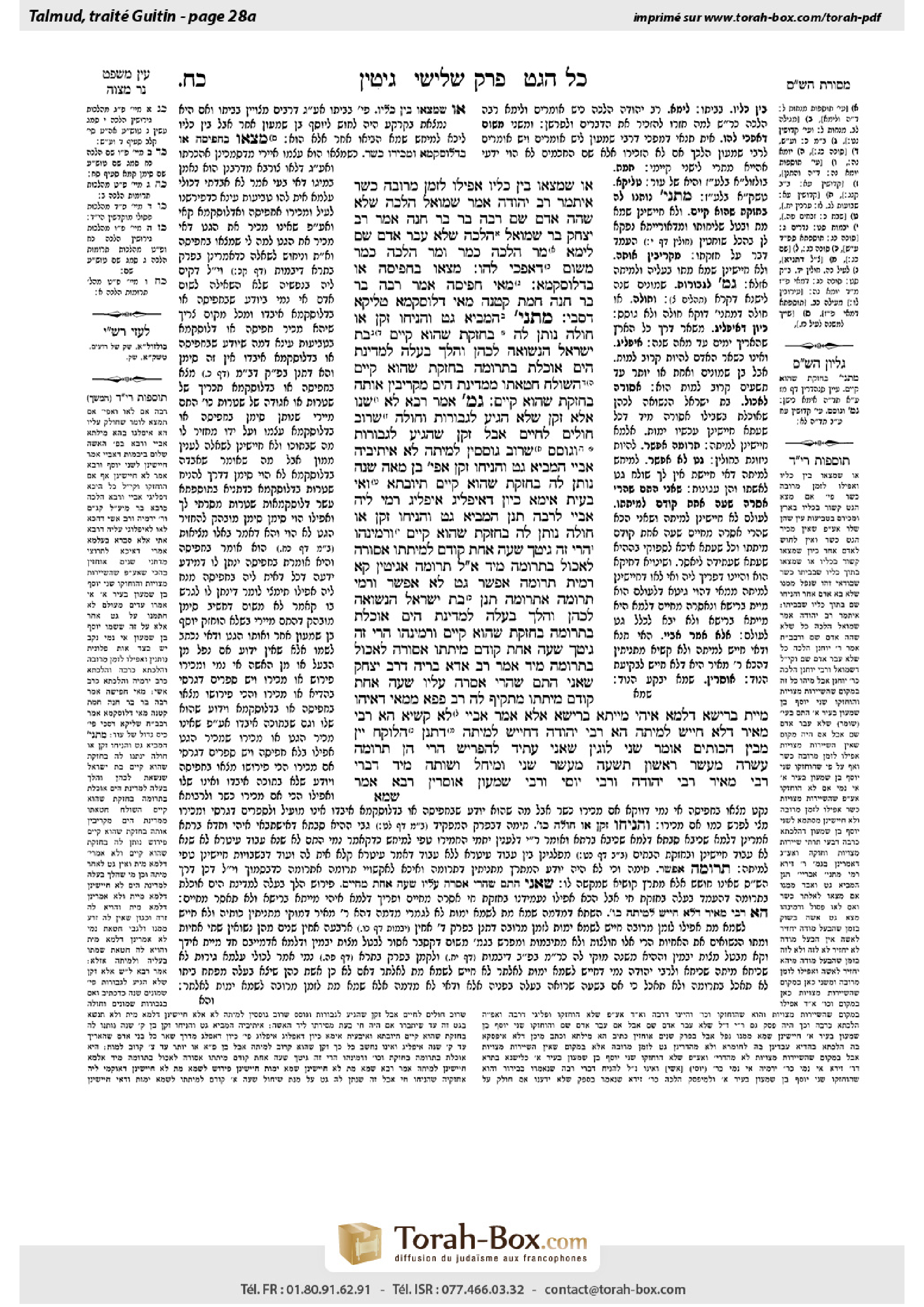
Gittin 28a: Talmud study for Daf Yomi
Study the Talmud for Daf Yomi with scanned pages, Hebrew text, English translations from Sefaria and AI-generated French translations.
Passage selection and English or AI-generated French translation are available where the scan has annotations. Daf Study is independent of Torah-Box and Sefaria.
Browse Gittin · גיטין · All tractatesGittin 28a text and translations
This page of Gittin includes the Aramaic text, an English translation and an AI-generated French translation, alongside the scan above.
גיטין כ״ח א · Aramaic and Hebrew text
אוֹ שֶׁמְּצָאוֹ בֵּין כֵּלָיו; אֲפִילּוּ לִזְמַן מְרוּבֶּה – כָּשֵׁר.
אִיתְּמַר: רַב יְהוּדָה אָמַר שְׁמוּאֵל, הֲלָכָה: שֶׁלֹּא שָׁהָה אָדָם שָׁם. רַבָּה בַּר בַּר חָנָה אָמַר רַב יִצְחָק בַּר שְׁמוּאֵל, הֲלָכָה: שֶׁלֹּא עָבַר אָדָם שָׁם.
לֵימָא מָר הֲלָכָה כְּמָר, וּמָר הֲלָכָה כְּמָר! מִשּׁוּם דְּאָפְכִי לְהוּ.
מְצָאוֹ בַּחֲפִיסָה אוֹ בִּדְלוֹסְקָמָא: מַאי ״חֲפִיסָה״? אָמַר רַבָּה בַּר בַּר חָנָה: חֵמֶת קְטַנָּה. מַאי ״דְּלוֹסְקָמָא״? טְלִיקָא דְסָבֵי.
מַתְנִי׳ הַמֵּבִיא גֵּט, וְהִנִּיחוֹ זָקֵן אוֹ חוֹלֶה – נוֹתֵן לָהּ בְּחֶזְקַת שֶׁהוּא קַיָּים.
בַּת יִשְׂרָאֵל הַנְּשׂוּאָה לְכֹהֵן, וְהָלַךְ בַּעְלָהּ לִמְדִינַת הַיָּם – אוֹכֶלֶת בִּתְרוּמָה בְּחֶזְקַת שֶׁהוּא קַיָּים. הַשּׁוֹלֵחַ חַטָּאתוֹ מִמְּדִינַת הַיָּם – מַקְרִיבִין אוֹתָהּ בְּחֶזְקַת שֶׁהוּא קַיָּים.
גְּמָ׳ אָמַר רָבָא: לֹא שָׁנוּ אֶלָּא זָקֵן שֶׁלֹּא הִגִּיעַ לִגְבוּרוֹת; וְחוֹלֶה – שֶׁרוֹב חוֹלִים לְחַיִּים; אֲבָל זָקֵן שֶׁהִגִּיעַ לִגְבוּרוֹת, וְגוֹסֵס – שֶׁרוֹב גּוֹסְסִין לְמִיתָה; לָא.
אֵיתִיבֵיהּ אַבָּיֵי: הַמֵּבִיא גֵּט וְהִנִּיחוֹ זָקֵן – אֲפִילּוּ בֶּן מֵאָה שָׁנָה, נוֹתֵן לָהּ בְּחֶזְקַת שֶׁהוּא קַיָּים! תְּיוּבְתָּא.
וְאִי בָּעֵית אֵימָא, כֵּיוָן דְּאִיפְּלִיג – אִיפְּלִיג.
רָמֵי לֵיהּ אַבָּיֵי לְרַבָּה, תְּנַן: הַמֵּבִיא גֵּט, וְהִנִּיחוֹ זָקֵן אוֹ חוֹלֶה – נוֹתֵן לָהּ בְּחֶזְקַת שֶׁהוּא קַיָּים. וּרְמִינְהוּ: ״הֲרֵי זֶה גִּיטִּיךְ״ – שָׁעָה אַחַת קוֹדֶם לְמִיתָתוֹ, אֲסוּרָה לֶאֱכוֹל בִּתְרוּמָה מִיָּד!
אֲמַר לֵיהּ: תְּרוּמָה אַגִּיטִּין קָא רָמֵית?! תְּרוּמָה אֶפְשָׁר, גֵּט לָא אֶפְשָׁר.
וְרָמֵי תְּרוּמָה אַתְּרוּמָה; תְּנַן: בַּת יִשְׂרָאֵל הַנְּשׂוּאָה לְכֹהֵן, וְהָלַךְ בַּעְלָהּ לִמְדִינַת הַיָּם – אוֹכֶלֶת בִּתְרוּמָה בְּחֶזְקַת שֶׁהוּא קַיָּים.
וּרְמִינְהוּ: ״הֲרֵי זֶה גִּיטִּיךְ״ – שָׁעָה אַחַת קוֹדֶם מִיתָתוֹ, אֲסוּרָה לֶאֱכוֹל בִּתְרוּמָה מִיָּד!
אָמַר רַב אַדָּא בְּרֵיהּ דְּרַב יִצְחָק: שָׁאנֵי הָתָם, שֶׁהֲרֵי אֲסָרָהּ עָלָיו שָׁעָה אַחַת קוֹדֶם מִיתָתוֹ. מַתְקֵיף לַהּ רַב פָּפָּא: מִמַּאי דְּאִיהוּ מָיֵית בְּרֵישָׁא? דִּלְמָא אִיהִי מָיְיתָא בְּרֵישָׁא!
אֶלָּא אָמַר אַבָּיֵי, לָא קַשְׁיָא: הָא רַבִּי מֵאִיר – דְּלָא חָיֵישׁ לְמִיתָה, הָא רַבִּי יְהוּדָה – דְּחָיֵישׁ לְמִיתָה.
דִּתְנַן: הַלּוֹקֵחַ יַיִן מִבֵּין הַכּוּתִים, אוֹמֵר: שְׁנֵי לוּגִּין שֶׁאֲנִי עָתִיד לְהַפְרִישׁ – הֲרֵי הֵן תְּרוּמָה; עֲשָׂרָה – מַעֲשֵׂר רִאשׁוֹן; תִּשְׁעָה – מַעֲשֵׂר שֵׁנִי; וּמֵיחֵל וְשׁוֹתֶה מִיָּד – דִּבְרֵי רַבִּי מֵאִיר.
רַבִּי יְהוּדָה וְרַבִּי יוֹסֵי וְרַבִּי שִׁמְעוֹן אוֹסְרִין.
רָבָא אָמַר:
Gittin 28a · English translation
or in a case where he found it among his utensils in his house, then even if a long time passed, the bill of divorce is valid.
It was stated that the amora’im disagreed with regard to the halakha in this dispute: Rav Yehuda says that Shmuel says: The halakha is that the bill of divorce is valid as long as no person stopped there. Rabba bar bar Ḥana says that Rav Yitzḥak bar Shmuel says: The halakha is that the bill of divorce is valid as long as no other person passed there.
The Gemara asks: Why is it necessary to state the actual opinion? Let this Sage, Rav Yehuda citing Shmuel, say that the halakha is in accordance with the opinion of this Sage, the opinion cited as: Some say; and let this Sage, Rabba bar bar Ḥana citing Rav Yitzḥak bar Shmuel, say that the halakha is in accordance with the opinion of this Sage, Rabbi Shimon ben Elazar. The Gemara answers: Because there are those who reverse the opinions of the tanna’im, they needed to state the opinions explicitly so that there would be no mistake with regard to the halakha.
§ The mishna teaches that if one found the bill of divorce in a ḥafisa or in a deluskema, then it is valid. The Gemara asks: What is the meaning of the word ḥafisa? Rabba bar bar Ḥana says: It is a small flask. What is the meaning of deluskema? It is a purse [telika] of the elderly.
MISHNA: In the case of an agent who brings a bill of divorce to a woman, and when he had left the husband was elderly or sick, the agent gives her the bill of divorce based on the presumption that the husband is still alive, and there is no concern that in the meantime he has died, thereby canceling the bill of divorce.
Similarly, with regard to an Israelite woman who is married to a priest and may therefore partake of teruma, and her husband went to a country overseas, she may continue to partake of teruma based on the presumption that her husband is still alive. Similarly, in the case of one who sends his sin-offering from a country overseas, the priests may offer it on the altar based on the presumption that the one who sent it is still alive.
GEMARA: Rava says: They taught that this presumptive status exists only concerning an elderly man who has not reached his years of strength, i.e., the age of eighty, and an ordinary sick person, as the majority of sick people continue to live and recover from their illnesses. But if the husband was an elderly man who had reached his years of strength, or if he was moribund, then, as the majority of moribund people proceed to die, he does not have this presumptive status.
Abaye raised an objection to Rava’s statement from a baraita: With regard to an agent who brings a bill of divorce and left the husband when he was old, even one hundred years old, he gives the bill of divorce to the wife, based on the presumption that her husband is still alive. The Gemara concludes: This is a conclusive refutation, and Rava’s statement is rejected.
The Gemara comments: And if you wish, say that this is not a conclusive refutation. In the case of the baraita, since it is so that the man reached an exceptionally old age, one cannot apply the general presumptions to him and must instead apply presumptions that are for one who has reached an exceptionally old age. However, in a case where someone has not demonstrated that he is an exception to the rule, once he reaches the age of eighty there is a concern that perhaps he has died in the interim.
§ Abaye raises a contradiction before Rabba: We learned in the mishna that in the case of an agent who brings a bill of divorce to a woman and left the husband when he was elderly or sick, the agent gives her the bill of divorce based on the presumption that the husband is still alive. And one can raise a contradiction from a baraita (Tosefta 6:11) that states: If one is leaving his place of residence, and in order to preclude a situation where his wife would have the status of a deserted wife he gives her a conditional bill of divorce and stipulates: This is your bill of divorce that will take effect one hour prior to my death, it is immediately prohibited for her to partake of teruma, due to the concern that he may die immediately after an hour has passed. Apparently, there is a concern that one may die at any point.
Rabba said to him: Do you raise a contradiction from the halakhot of teruma to the halakhot of bills of divorce? Concerning teruma, it is possible for the wife to eat only non-sacred produce in order to be stringent due to the possibility that her husband may die. However, concerning a bill of divorce it is not possible to take into account the possibility that her husband may die, as there would then be no way for a husband to send a bill of divorce to her with an agent.
And the Gemara raises a contradiction from the halakhot of teruma in the mishna to the halakhot of teruma in a baraita. We learned in the mishna: With regard to an Israelite woman who is married to a priest and may therefore partake of teruma, and her husband went to a country overseas, she may continue to partake of teruma based on the presumption that her husband is still alive.
And the Gemara raises a contradiction from a baraita: If one says to his wife: This is your bill of divorce that will take effect one hour prior to my death, it is immediately prohibited for her to partake of teruma due to the concern that he may die immediately after an hour has passed. These two halakhot appear to contradict one another.
Rav Adda, son of Rav Yitzḥak, said: It is different there, as he rendered her forbidden to himself one hour prior to his death, meaning that she will definitely be prohibited from partaking of teruma at some point. Therefore, it is considered to be an uncertainty immediately. Rav Pappa objects to this answer: From where is it known that he will die first and she will be prohibited from partaking of teruma? Perhaps she will die first, and the bill of divorce will never take effect.
Rather, Abaye said that this is not difficult: This mishna, which permits the woman to partake of teruma, is in accordance with the opinion of Rabbi Meir, who is not concerned about potential death. That baraita, which prohibits the woman from partaking of teruma, is in accordance with the opinion of Rabbi Yehuda, who is concerned about potential death.
As we learned in a baraita in the Tosefta (Demai 8:7): In the case of one who purchases wine from among the Samaritans, about whom it is assumed that they did not separate teruma and tithes, and he is not in a position to separate teruma, he acts as follows: If there are, for example, one hundred log of wine in the barrels, he says: Two log that I will separate in the future are teruma, as the mandated average measure of teruma is one-fiftieth; ten log are first tithe; and one-tenth of the remainder, which is approximately nine log, are second tithe. And he deconsecrates the second tithe that he will separate in the future, transferring its sanctity to money, and he may drink the wine immediately, relying on the separation that he will perform later, which will clarify retroactively what he designated for the tithes and for teruma. This is the statement of Rabbi Meir.
The baraita continues: However, Rabbi Yehuda and Rabbi Yosei and Rabbi Shimon prohibit this practice. These Sages, Rabbi Yehuda among them, were concerned that perhaps the wineskin would burst before he would manage to separate the teruma, whereas Rabbi Meir is not concerned about this occurring. Similarly, it is said that Rabbi Meir is not concerned about potential death, and Rabbi Yehuda is concerned.
Rava said:
Gittin 28a · Traduction française (IA)
ou s'il le trouva parmi ses ustensiles à la maison, même s'il s'est écoulé un long temps, le contrat de divorce est valide.
Il a été dit que les amoraïm étaient en désaccord sur la halakha dans ce débat : Rav Yehuda dit que Shmuel dit : La halakha est que le contrat de divorce est valide tant qu'aucune personne n'a pas été là. Rabba bar bar Ḥana dit que Rav Yitzḥak bar Shmuel dit : La halakha est que le contrat de divorce est valide tant qu'aucune autre personne n'a pas passé par là.
Le Guemara pose la question : Pourquoi est-il nécessaire d'indiquer clairement l'opinion ? Laissons ce sage, Rav Yehuda citant Shmuel, dire que la halakha suit l'opinion de ce sage, l'opinion citée comme : Certains disent ; et laissons ce sage, Rabba bar bar Ḥana citant Rav Yitzḥak bar Shmuel, dire que la halakha suit l'opinion de ce sage, Rabbi Shimon ben Elazar. Le Guemara répond : Parce qu'il y a ceux qui inversent les opinions des tannaïm, ils avaient besoin d'indiquer clairement les opinions afin qu'il n'y ait pas de confusion concernant la halakha.
§ La mitsva enseigne que si l'on trouve le contrat de divorce dans une ḥafisa ou dans une deluskema, il est valide. Le Guemara pose la question : Quelle est la signification du mot ḥafisa ? Rabba bar bar Ḥana dit : C'est une petite amphore. Quelle est la signification de deluskema ? C'est un sac [telika] des personnes âgées.
MICHNA : Dans le cas d'un agent qui apporte un contrat de divorce à une femme, et lorsqu'il est parti, le mari était âgé ou malade, l'agent lui donne le contrat de divorce en supposant que le mari est encore vivant, et il n'y a pas de crainte que le mari ait pu mourir en l'absence, annulant ainsi le contrat de divorce.
De même, concernant une femme israélite mariée à un prêtre et pouvant ainsi consommer la terouma, et son mari est parti dans un pays éloigné, elle peut continuer à consommer la terouma en supposant que son mari est encore vivant. De même, dans le cas d'une personne qui envoie son sacrifice expiatoire d'un pays éloigné, les prêtres peuvent l'offrir sur l'autel en supposant que la personne qui l'a envoyé est encore vivante.
GUEMARA : Rava dit : Ils ont enseigné que ce statut de présomption existe uniquement concernant un homme âgé qui n'a pas atteint son âge de force, c'est-à-dire l'âge de quatre-vingt ans, et un malade ordinaire, car la plupart des malades continuent de vivre et de guérir de leurs maladies. Mais si le mari était un homme âgé ayant atteint son âge de force, ou s'il était moribond, alors, comme la plupart des personnes moribondes meurent, il n'a pas ce statut de présomption.
Abaye a soulevé un objet contre l'affirmation de Rava à partir d'une baraïta : Concernant un agent qui apporte un contrat de divorce et a laissé le mari lorsqu'il était âgé, même cent ans, il donne le contrat de divorce à la femme en supposant que son mari est encore vivant. Le Guemara conclut : C'est une réfutation définitive, et l'affirmation de Rava est rejetée.
Le Guemara commente : Et si vous le souhaitez, dites que cela n'est pas une réfutation définitive. Dans le cas de la baraïta, puisque l'homme a atteint un âge exceptionnellement avancé, on ne peut pas appliquer les présomptions générales à lui et doit plutôt appliquer des présomptions pour une personne ayant atteint un âge exceptionnellement avancé. Cependant, dans un cas où quelqu'un n'a pas démontré qu'il est une exception à la règle, une fois qu'il atteint l'âge de quatre-vingt ans, il y a une crainte qu'il puisse être mort en l'absence.
§ Abaye soulève une contradiction devant Rabba : Nous avons appris dans la mitsna que dans le cas d'un agent qui apporte un contrat de divorce à une femme et a laissé le mari lorsqu'il était âgé ou malade, l'agent lui donne le contrat de divorce en supposant que le mari est encore vivant. On peut soulever une contradiction à partir d'une baraïta (Tosefta 6:11) qui stipule : Si l'on part de son lieu de résidence, et afin d'exclure une situation où sa femme aurait le statut de femme abandonnée, il lui donne un contrat de divorce conditionnel et stipule : C'est votre contrat de divorce qui entrera en vigueur une heure avant ma mort, il est immédiatement interdit à elle de consommer la terouma, en raison de la crainte qu'il meure immédiatement après une heure. Apparemment, il y a une crainte qu'une personne meure à tout moment.
Rabba lui dit : Voulez-vous soulever une contradiction entre les halakhot de la terouma et celles des contrats de divorce ? Concernant la terouma, il est possible que la femme mange uniquement des produits non sacrés afin d'être stricte en raison de la possibilité que son mari meure. Cependant, concernant un contrat de divorce, il n'est pas possible de prendre en compte la possibilité que son mari meure, car cela rendrait impossible pour un mari d'envoyer un contrat de divorce à sa femme via un agent.
Et le Guemara soulève une contradiction entre la halakha de la terouma dans la mitsna et la halakha de la terouma dans une baraïta. Nous avons appris dans la mitsna : Concernant une femme israélite mariée à un prêtre et pouvant ainsi consommer la terouma, et son mari est parti dans un pays éloigné, elle peut continuer à consommer la terouma en supposant que son mari est encore vivant.
Et la Guemara soulève une contradiction à partir d'une baraïta : Si l'on dit à sa femme : C'est votre acte de divorce qui entrera en vigueur une heure avant ma mort, il est immédiatement interdit à elle de consommer la terouma en raison de la crainte qu'il meure immédiatement après une heure. Ces deux halakhtot semblent s'opposer l'une à l'autre.
Rav Adda, fils de Rav Yitzḥak, dit : C'est différent là, car il l'avait rendue interdite à lui-même une heure avant sa mort, ce qui signifie qu'elle sera certainement interdite à l'avenir à l'égard du terouma. Par conséquent, cela est considéré comme une incertitude immédiate. Rav Pappa s'oppose à cette réponse : D'où sait-on qu'il mourra d'abord et qu'elle sera interdite à l'égard du terouma ? Peut-être qu'elle mourra d'abord, et le divorce ne prendra jamais effet.
En réalité, Abaye a dit que cela n'est pas difficile : cette mitsna, qui permet à la femme de consommer le terouma, est selon l'opinion de Rabbi Meir, qui n'a pas peur de la mort potentielle. Cette baraïta, qui interdit à la femme de consommer le terouma, est selon l'opinion de Rabbi Yehuda, qui craint la mort potentielle.
Comme nous avons appris dans une baraïta du Tosefta (Demai 8:7) : Dans le cas d'un homme qui achète du vin auprès des Samaritains, dont on suppose qu'ils n'ont pas séparé le terouma et les dîmes, et qu'il n'est pas en mesure de séparer le terouma, il agit ainsi : s'il y a, par exemple, cent log de vin dans les tonneaux, il dit : deux log que je séparerai à l'avenir sont le terouma, car la mesure obligatoire du terouma est un cinquantième ; dix log sont la première dîme ; et un dixième du reste, qui est environ neuf log, sont la deuxième dîme. Il désacralise la deuxième dîme qu'il séparera à l'avenir, transférant sa sanctité à l'argent, et il peut boire le vin immédiatement, en se fondant sur la séparation qu'il effectuera ultérieurement, ce qui clarifiera rétrospectivement ce qu'il a désigné pour les dîmes et pour le terouma. C'est l'opinion de Rabbi Meir.
La baraïta continue : Cependant, Rabbi Yehuda et Rabbi Yosei et Rabbi Shimon interdisent cette pratique. Ces Sages, Rabbi Yehuda parmi eux, craignaient que le sac à vin ne se déchire avant qu'il ne puisse séparer la terouma, tandis que Rabbi Meir n'a pas cette crainte. De même, on dit que Rabbi Meir n'a pas peur de la mort potentielle, et Rabbi Yehuda en a peur.
Rava dit :
Traduction française générée par IA à partir de l’édition anglaise de Sefaria. Vérifie toujours un passage avec le texte source.
Text from Sefaria: William Davidson Edition - Vocalized Aramaic (CC BY NC); William Davidson Edition - English (CC BY NC).