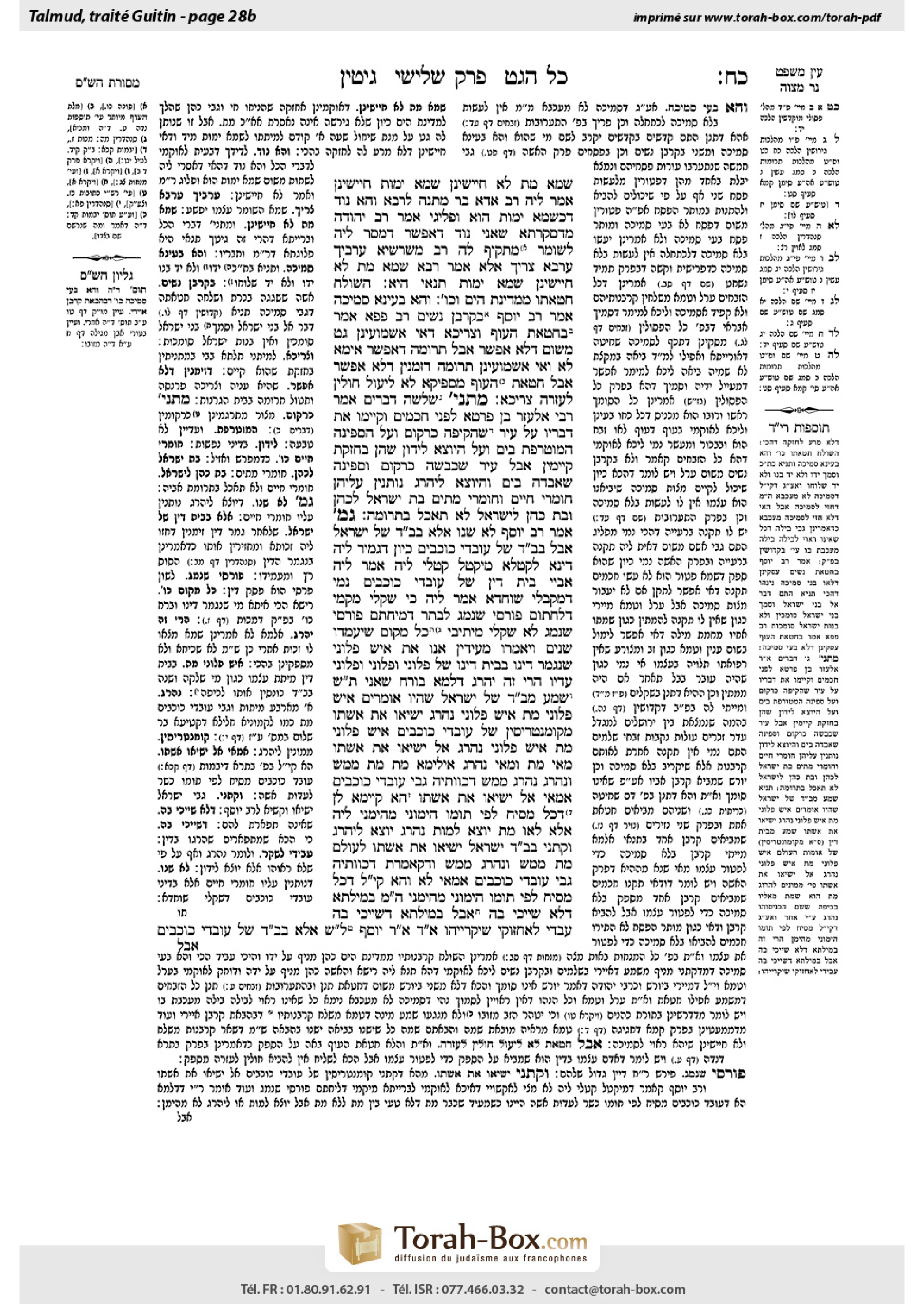
Gittin 28b: Talmud study for Daf Yomi
Study the Talmud for Daf Yomi with scanned pages, Hebrew text, English translations from Sefaria and AI-generated French translations.
Passage selection and English or AI-generated French translation are available where the scan has annotations. Daf Study is independent of Torah-Box and Sefaria.
Browse Gittin · גיטין · All tractatesGittin 28b text and translations
This page of Gittin includes the Aramaic text, an English translation and an AI-generated French translation, alongside the scan above.
גיטין כ״ח ב · Aramaic and Hebrew text
שֶׁמָּא מֵת לָא חָיְישִׁינַן, שֶׁמָּא יָמוּת חָיְישִׁינַן.
אֲמַר לֵיהּ רַב אַדָּא בַּר מַתְנָה לְרָבָא: וְהָא נוֹד דִּכְשֶׁמָּא יָמוּת הוּא, וּפְלִיגִי! אָמַר רַב יְהוּדָה מִדִּסְקַרְתָּא: שָׁאנֵי נוֹד דְּאֶפְשָׁר דְּמָסַר לֵיהּ לְשׁוֹמֵר.
מַתְקֵיף לַהּ רַב מְשַׁרְשְׁיָא: עָרְבָיךְ עָרְבָא צְרִיךְ! אֶלָּא אָמַר רָבָא: שֶׁמָּא מֵת – לָא חָיְישִׁינַן, שֶׁמָּא יָמוּת – תַּנָּאֵי הִיא.
הַשּׁוֹלֵחַ חַטָּאתוֹ מִמְּדִינַת הַיָּם וְכוּ׳: וְהָא בָּעֵינָא סְמִיכָה! אָמַר רַב יוֹסֵף: בְּקׇרְבַּן נָשִׁים. רַב פָּפָּא אָמַר: בְּחַטַּאת הָעוֹף.
וּצְרִיכָא; דְּאִי אַשְׁמְעִינַן גֵּט – מִשּׁוּם דְּלָא אֶפְשָׁר, אֲבָל תְּרוּמָה דְּאֶפְשָׁר – אֵימָא לָא.
וְאִי אַשְׁמְעִינַן תְּרוּמָה – דְּזִמְנִין דְּלָא אֶפְשָׁר; אֲבָל חַטַּאת הָעוֹף – מִסְּפֵיקָא לָא לֵיעוּל חוּלִּין לָעֲזָרָה, צְרִיכָא.
מַתְנִי׳ שְׁלֹשָׁה דְּבָרִים אָמַר רַבִּי אֶלְעָזָר בֶּן פַּרְטָא לִפְנֵי חֲכָמִים, וְקִיְּימוּ אֶת דְּבָרָיו: עַל עִיר שֶׁהִקִּיפָהּ כַּרְקוֹם, וְעַל הַסְּפִינָה הַמּוּטְרֶפֶת בַּיָּם, וְעַל הַיּוֹצֵא לִידּוֹן – שֶׁהֵן בְּחֶזְקַת קַיָּימִין.
אֲבָל עִיר שֶׁכְּבָשָׁהּ כַּרְקוֹם, וּסְפִינָה שֶׁאָבְדָה בַּיָּם, וְהַיּוֹצֵא לֵיהָרֵג – נוֹתְנִין עֲלֵיהֶן חוּמְרֵי חַיִּים וְחוּמְרֵי מֵתִים – בַּת יִשְׂרָאֵל לְכֹהֵן, וּבַת כֹּהֵן לְיִשְׂרָאֵל, לֹא תֹּאכַל בִּתְרוּמָה.
גְּמָ׳ אָמַר רַב יוֹסֵף: לֹא שָׁנוּ אֶלָּא בְּבֵית דִּין שֶׁל יִשְׂרָאֵל; אֲבָל בְּבֵית דִּין שֶׁל אוּמּוֹת הָעוֹלָם, כֵּיוָן דִּגְמִיר לֵיהּ דִּינָא לִקְטָלָא – מִיקְטָל קָטְלִי לֵיהּ.
אֲמַר לֵיהּ אַבָּיֵי: בֵּית דִּין שֶׁל אוּמּוֹת הָעוֹלָם נָמֵי, דִּמְקַבְּלִי שׁוּחְדָּא! אֲמַר לֵיהּ: כִּי שָׁקְלִי – מִקַּמֵּי דְּלַחְתּוֹם פּוּרְסִי שְׁנָמַג; לְבָתַר דְּמִיחְתַּם פּוּרְסִי שְׁנָמַג – לָא שָׁקְלִי.
מֵיתִיבִי, כׇּל מָקוֹם שֶׁיַּעַמְדוּ שְׁנַיִם וְיֹאמְרוּ: ״מְעִידִין אָנוּ אֶת אִישׁ פְּלוֹנִי שֶׁנִּגְמַר דִּינוֹ בְּבֵית דִּינוֹ שֶׁל פְּלוֹנִי, וּפְלוֹנִי וּפְלוֹנִי עֵדָיו״ – הֲרֵי זֶה יֵהָרֵג! דִּלְמָא בּוֹרֵחַ שָׁאנֵי.
תָּא שְׁמַע: שְׁמַע מִבֵּית דִּין שֶׁל יִשְׂרָאֵל שֶׁהָיוּ אוֹמְרִים ״אִישׁ פְּלוֹנִי מֵת״; ״אִישׁ פְּלוֹנִי נֶהֱרָג״ – יַשִּׂיאוּ אֶת אִשְׁתּוֹ. מֵקוֹמֶנְטָרִיסִין שֶׁל גּוֹיִם ״אִישׁ פְּלוֹנִי מֵת״; ״אִישׁ פְּלוֹנִי נֶהֱרַג״ – אַל יַשִּׂיאוּ אֶת אִשְׁתּוֹ.
מַאי ״מֵת״, וּמַאי ״נֶהֱרַג״? אִילֵימָא ״מֵת״ – מֵת מַמָּשׁ, וְ״נֶהֱרַג״ – נֶהֱרַג מַמָּשׁ; דִּכְווֹתֵיהּ גַּבֵּי גּוֹיִם, אַמַּאי אַל יַשִּׂיאוּ אֶת אִשְׁתּוֹ? הָא קַיְימָא לַן דְּכֹל מֵסִיחַ לְפִי תּוּמּוֹ הֵימוֹנֵי מְהֵימְנִי לֵיהּ!
אֶלָּא לָאו ״מֵת״ – יוֹצֵא לָמוּת, ״נֶהֱרַג״ – יוֹצֵא לֵיהָרֵג? וְקָתָנֵי: בְּבֵית דִּין יִשְׂרָאֵל יַשִּׂיאוּ אֶת אִשְׁתּוֹ!
לְעוֹלָם מֵת מַמָּשׁ וְנֶהֱרַג מַמָּשׁ, וּדְקָאָמְרַתְּ: דִּכְווֹתֵיהּ גַּבֵּי גּוֹיִם אַמַּאי לָא, וְהָא קַיְימָא לַן דְּכֹל מֵסִיחַ לְפִי תּוּמּוֹ הֵימוֹנֵי מְהֵימְנִי; הָנֵי מִילֵּי בְּמִילְּתָא דְּלָא שָׁיְיכִי בָּהּ, אֲבָל בְּמִילְּתָא דְּשָׁיְיכִי בַּהּ, עָבְדִי לְאַחְזוֹקֵי שִׁיקְרַיְיהוּ.
אִיכָּא דְאָמְרִי אָמַר רַב יוֹסֵף: לֹא שָׁנוּ אֶלָּא בְּבֵית דִּין שֶׁל אוּמּוֹת הָעוֹלָם,
Gittin 28b · English translation
There is a different distinction: We are not concerned that perhaps he has already died, which is why the mishna rules that she may continue to partake of teruma. However, in the case of one who stipulates that the bill of divorce will take effect one hour before his death, we are concerned that perhaps he will die at an unknown moment in the future and she will no longer be permitted to partake of teruma.
Rav Adda bar Mattana said to Rava: But the concern in the case of the wineskin is that it might burst before one is able to separate the teruma and tithes, which is similar to the concern that perhaps he will die, as both are concerns with respect to the future, and Rabbi Yehuda and Rabbi Meir disagree. Rav Yehuda of Diskarta said: A wineskin is different, as it is possible to give it to a watchman who will protect it from bursting, which is why Rabbi Meir is not concerned that it might burst. This reasoning does not apply to the concern that the husband might die.
Rav Mesharshiyya objects to this answer: Your guarantor himself needs a guarantor, as there is no way of knowing that the guardian will not be negligent, so the wineskin may burst. Rather, Rava said: Everyone agrees that we are not concerned that perhaps he has already died, in accordance with the mishna here. As to the issue of whether there is a concern that perhaps he will die, as in the case of the baraita, this is a dispute between tanna’im.
§ The mishna teaches that in the case of one who sends his sin-offering from a country overseas, the priests may sacrifice it on the altar, based on the presumption that the one who sent it is still alive. The Gemara asks: But doesn’t an offering require the placing of hands on the head of an offering by the one who brings the offering? In this case the owner of the offering is elsewhere and cannot place his hands on the offering. Rav Yosef says: The mishna states this ruling with regard to the offering of women, as women are not required to place their hands on the head of their offerings. Rav Pappa says: The mishna states this ruling with regard to a bird sacrificed as a sin-offering, where it is not required that the owner place his hands on the head of the offering.
Noting that the mishna states the same halakha, that the presumption is that one remains alive, in three different contexts, the Gemara comments: And it is necessary for the mishna to state this in all three cases, as, if it had taught us only the case of a bill of divorce, one might have said that it is due to the fact that it is not possible to take into account the possible death of the husband, as there would then be no way for the husband to send a bill of divorce to his wife with an agent. That is why the presumption that the husband is alive is relied upon. But with regard to teruma, where it is possible for the wife to partake of non-sacred produce, say the presumption is not relied upon, and there is a concern that he died.
And if it had taught us also the case of teruma, one might have said that there are times that it is not possible for the wife to avoid partaking of teruma, e.g., if she does not have sufficient non-sacred produce. But with regard to a bird sacrificed as a sin-offering, one might say that for a situation of uncertainty as to whether the sin-offering may be sacrificed, since its owners might not be alive, one should not bring non-sacred animals, i.e., an animal that may not be sacrificed, into the Temple courtyard. Therefore, it is necessary for the mishna to mention all of these cases.
MISHNA: Rabbi Elazar ben Perata said three statements before the Sages as testimony from previous generations, and they upheld his statements: He spoke concerning the residents of a town that was surrounded by a camp of besiegers [karkom]; and concerning the travelers in a ship that is cast about in the sea; and concerning one who is going out to be judged in a capital case; that they are all presumed to be alive.
However, concerning the residents of a town that was conquered by a camp of besiegers; and the travelers on a ship that was lost at sea; and one who is going out to be executed after receiving his verdict; in these cases one applies to them the stringencies of the living and the stringencies of the dead. How so? An Israelite woman married to a priest in one of these situations or a daughter of a priest married to an Israelite in one of these situations may not partake of teruma. The first woman may not do so because she may partake of teruma only while her husband is alive, and the second may not do so because she may partake of teruma only if he has died.
GEMARA: Rav Yosef says: They taught that one applies the stringencies of the living only to one who is being taken to be executed in a Jewish court, where even once he is being taken to be executed, he will be released if the court finds evidence for his innocence; but in a court of the nations of the world, once he is sentenced to death, he is killed in any case. Therefore, he should be considered as a dead man in every regard.
Abaye said to him: In a court of the nations of the world as well, perhaps they will not execute him, as they accept bribes. Rav Yosef said to him: When they take a bribe, it is only before the verdict [puresei shenmag] has been sealed; but after the verdict has been sealed, they do not take bribes.
According to Rav Yosef, in a Jewish court, even after one’s verdict is complete the presumption is that he is alive. The Gemara raises an objection to this from a mishna (Makkot 7a) concerning one who fled from the court after his verdict had been issued: Any place where two witnesses arise and say: We testify about so-and-so that his judgment was finalized in the court of so-and-so, and so-and-so and so-and-so were his witnesses, the halakha is that this person should be killed. It is evident from the mishna in tractate Makkot that there is no concern that the court may have later found a reason to release him. The Gemara answers: Perhaps one who flees is different, as the court will not reconsider his verdict once he has fled.
The Gemara suggests another proof: Come and hear: If one heard from a Jewish court that they were saying: The man so-and-so died, or: The man so-and-so was killed, then the court allows his wife to marry. If he heard from a gentile judicial registrar [komentirisin]: The man so-and-so died, or: The man so-and-so was killed, then the court does not allow his wife to marry.
The Gemara clarifies: What does it mean when it says: Died, and what does it mean when it says: Was killed? If we say that: Died, means that he actually died, and: Was killed, means that he was actually killed, such that the case concerning the gentiles is stated in a similar manner, i.e., that he heard from the gentile registrar that the person was actually dead, why may the court not allow his wife to marry? Don’t we maintain that with regard to any gentile who speaks offhandedly, the Sages deemed him credible? Therefore, the gentile should be deemed credible when he says that someone died or was killed.
Rather, is it not necessary to explain that when it says: Died, it means that he is going out to die, and when it says: Was killed, it means going out to be executed. And it teaches that if it occurred in a Jewish court then the court allows his wife to marry, as it is assumed that he was already executed, contrary to the statement of Rav Yosef.
The Gemara answers: Actually, it can be explained that he actually died, and actually was killed. And with regard to that which you said: Such that the case concerning the gentiles is stated in a similar manner, why may the court not allow his wife to marry? Don’t we maintain that with regard to any gentile who speaks offhandedly, the Sages deemed him credible? The answer is that this credibility applies only in a matter that is not relevant to the gentiles; but in a matter that is relevant to the gentiles, such as here, where they desire to publicize that they carried out their verdict, it is common for them to reinforce their false verdict, i.e., once they reach a verdict they will say that the accused was killed. Therefore, one cannot rely on their statements.
This is one version of the discourse; there is also another version: There are those who say that Rav Yosef said: They taught that one applies the stringencies of the living and the dead only in a court of the nations of the world;
Gittin 28b · Traduction française (IA)
Il existe une distinction différente : nous ne nous inquiétons pas du fait qu'il puisse avoir déjà décédé, ce qui est la raison pour laquelle la michna déclare qu'elle peut continuer à consommer la terouma. Cependant, dans le cas d'une personne qui stipule que le divorce prend effet une heure avant sa mort, nous nous inquiétons du fait qu'il puisse mourir à un moment inconnu à l'avenir et qu'elle ne puisse plus consommer la terouma.
Rav Adda bar Mattana a dit à Rava : Mais la préoccupation dans le cas du flacon est qu'il puisse éclater avant qu'on ne puisse séparer la terouma et les dîmes, ce qui est similaire à la préoccupation qu'il puisse mourir, car les deux sont des préoccupations concernant l'avenir, et Rabbi Yehuda et Rabbi Meir sont en désaccord. Rav Yehuda de Diskarta a dit : Le flacon est différent, car on peut le confier à un gardien qui le protégera contre l'éclatement, ce qui est la raison pour laquelle Rabbi Meir n'est pas préoccupé par l'éclatement. Ce raisonnement ne s'applique pas à la préoccupation que le mari puisse mourir.
Rav Mesharshiyya s'oppose à cette réponse : Le garant lui-même a besoin d'un garant, car il n'y a aucun moyen de savoir que le gardien ne sera pas négligent, donc le flacon peut éclater. Cependant, Rava a dit : Tout le monde convient que nous ne nous inquiétons pas du fait qu'il puisse avoir déjà décédé, conformément à la michna ici. En ce qui concerne la question de savoir s'il y a une préoccupation qu'il puisse mourir, comme dans le cas de la baraïta, c'est un débat entre les tannaïm.
§ La michna enseigne que dans le cas d'une personne qui envoie son sacrifice expiatoire d'un pays éloigné, les prêtres peuvent le sacrifier sur l'autel, en se basant sur l'assomption que la personne qui l'a envoyé est encore vivante. La Guemara pose la question : Mais ne nécessite-t-on pas que l'offrant place ses mains sur la tête de l'offrande par la personne qui l'apporte ? Dans ce cas, le propriétaire de l'offrande est ailleurs et ne peut pas placer ses mains sur l'offrande. Rav Yosef dit : La michna stipule cette décision concernant les offrandes des femmes, car les femmes ne sont pas tenues de placer leurs mains sur la tête de leurs offrandes. Rav Pappa dit : La michna stipule cette décision concernant un oiseau sacrifié comme sacrifice expiatoire, où il n'est pas requis que le propriétaire place ses mains sur la tête de l'offrande.
En notant que la michna stipule la même halakha, à savoir l'assomption que l'on reste vivant, dans trois contextes différents, la Guemara commente : Il est nécessaire que la michna énonce cela dans tous les trois cas, car, si elle avait enseigné seulement le cas du divorce, on aurait pu dire que c'est en raison du fait que cela n'est pas possible de prendre en compte la possible mort du mari, car alors il n'y aurait aucun moyen pour le mari de faire parvenir un divorce à sa femme via un agent. C'est pourquoi l'assomption que le mari est vivant est retenue. En ce qui concerne la terouma, où il est possible pour la femme de consommer des produits non sacrés, disent-ils que l'assomption n'est pas retenue et qu'il y a une préoccupation qu'il soit mort.
Et si elle avait enseigné aussi le cas de la terouma, on aurait pu dire qu'il y a des moments où il n'est pas possible pour la femme d'éviter de consommer la terouma, par exemple si elle n'a pas suffisamment de produits non sacrés. Mais concernant un oiseau sacrifié comme sacrifice expiatoire, on pourrait dire que dans un cas d'incertitude quant à savoir si le sacrifice expiatoire peut être sacrifié, car ses propriétaires pourraient ne pas être vivants, on ne devrait pas introduire des animaux non sacrés, c'est-à-dire un animal qui ne peut pas être sacrifié, dans le cour de l'Autel. C'est pourquoi il est nécessaire que la michna mentionne tous ces cas.
MICHNA : Rabbi Elazar ben Perata a dit trois déclarations avant les Sages comme témoignage des générations précédentes, et ils ont soutenu ses déclarations : Il parlait concernant les habitants d'une ville entourée par un camp de siège [karkom] ; concernant les voyageurs sur un bateau qui est balloté en mer ; et concernant celui qui sort pour être jugé dans un cas capital ; qu'ils sont tous présomption de vivre.
Cependant, concernant les habitants d'une ville conquise par un camp de siège ; et les voyageurs sur un bateau perdu en mer ; et celui qui sort pour être exécuté après avoir reçu son verdict ; dans ces cas, on applique à eux les stricteurs du vivant et du mort. Comment cela se passe-t-il ? Une femme israélite mariée à un prêtre dans l'un de ces cas ou une fille de prêtre mariée à un israélite dans l'un de ces cas ne peut pas consommer la terouma. La première femme ne peut pas le faire car elle peut consommer la terouma uniquement tant que son mari est vivant, et la seconde ne peut pas le faire car elle peut consommer la terouma uniquement si son mari est mort.
GUEMARA : Rav Yosef dit : Ils ont enseigné qu'on applique les stricteurs du vivant uniquement à celui qui est conduit à l'exécution dans un tribunal juif, où même une fois qu'il est conduit à l'exécution, il sera libéré si le tribunal trouve des preuves de son innocence ; mais dans un tribunal des nations du monde, une fois qu'il est condamné à mort, il est exécuté de toute façon. C'est pourquoi il devrait être considéré comme un mort en tout point.
Abaye a dit à lui : Dans un tribunal des nations du monde également, peut-être qu'ils ne l'exécuteront pas, car ils acceptent des rançons. Rav Yosef a dit à lui : Lorsqu'ils prennent une rançon, c'est seulement avant que le verdict [puresei shenmag] ne soit scellé ; mais après que le verdict ait été scellé, ils ne prennent pas de rançons.
Selon Rav Yosef, dans un tribunal juif, même après que le verdict soit complet, l'assomption est qu'il est vivant. La Guemara soulève une objection contre cela à partir d'une michna (Makkot 7a) concernant celui qui s'est enfui du tribunal après que son verdict ait été rendu : Tout lieu où deux témoins émergent et disent : Nous témoignons sur tel et tel que son jugement a été finalisé dans le tribunal de tel et tel, et tel et tel étaient ses témoins, la halakha est que cette personne doit être tuée. Il est évident à partir de la michna dans le traité Makkot que l'on ne s'inquiète pas du fait que le tribunal puisse avoir plus tard trouvé une raison de le libérer. La Guemara répond : Peut-être que celui qui s'est enfui est différent, car le tribunal ne reconsidère pas son verdict une fois qu'il a fui.
La Guemara suggère une autre preuve : Viens écouter : Si l'on a entendu d'un tribunal juif qu'ils disaient : L'homme tel et tel est mort, ou : L'homme tel et tel a été tué, alors le tribunal permet à sa femme de se marier. Si l'on a entendu d'un registraire judiciaire païen [komentirisin] : L'homme tel et tel est mort, ou : L'homme tel et tel a été tué, alors le tribunal ne permet pas à sa femme de se marier.
La Guemara clarifie : De quoi parle-t-on lorsqu'on dit : Est mort, et de quoi parle-t-on lorsqu'on dit : A été tué ? Si l'on dit que : Est mort signifie qu'il est effectivement mort, et : A été tué signifie qu'il a effectivement été tué, de sorte que le cas concernant les païens est exprimé de manière similaire, c'est-à-dire qu'il a entendu du registraire païen que la personne était effectivement morte, pourquoi le tribunal ne permet-il pas à sa femme de se marier ? N'entendons-nous pas que, concernant tout païen qui parle à la légère, les Sages ont considéré qu'il était crédible ? Ainsi, le païen devrait être considéré comme crédible lorsqu'il dit qu'une personne est morte ou a été tuée.
Plutôt, n'est-il pas nécessaire d'expliquer que lorsqu'on dit : Est mort, cela signifie qu'il sort pour mourir, et lorsqu'on dit : A été tué, cela signifie qu'il sort pour être exécuté. Et cela enseigne que si cela s'est produit dans un tribunal juif, alors le tribunal permet à sa femme de se marier, car on suppose qu'il a déjà été exécuté, contrairement à la déclaration de Rav Yosef.
La Guemara répond : En réalité, cela peut être expliqué qu'il est effectivement mort et effectivement tué. Et concernant ce que vous avez dit : De sorte que le cas concernant les païens est exprimé de manière similaire, pourquoi le tribunal ne permet-il pas à sa femme de se marier ? N'entendons-nous pas que, concernant tout païen qui parle à la légère, les Sages ont considéré qu'il était crédible ? La réponse est que cette crédibilité s'applique uniquement dans une affaire non pertinente pour les païens ; mais dans une affaire pertinente pour les païens, telle que celle-ci, où ils souhaitent publier qu'ils ont exécuté leur verdict, il est courant qu'ils renforcent leur verdict faux, c'est-à-dire qu'une fois qu'ils ont rendu un verdict, ils diront que l'accusé a été tué. Ainsi, on ne peut pas compter sur leurs déclarations.
C'est une version de la discussion ; il existe aussi une autre version : Il y a ceux qui disent que Rav Yosef a dit : Ils ont enseigné qu'on applique les stricteurs du vivant et du mort uniquement dans un tribunal des nations du monde ;
Traduction française générée par IA à partir de l’édition anglaise de Sefaria. Vérifie toujours un passage avec le texte source.
Text from Sefaria: William Davidson Edition - Vocalized Aramaic (CC BY NC); William Davidson Edition - English (CC BY NC).