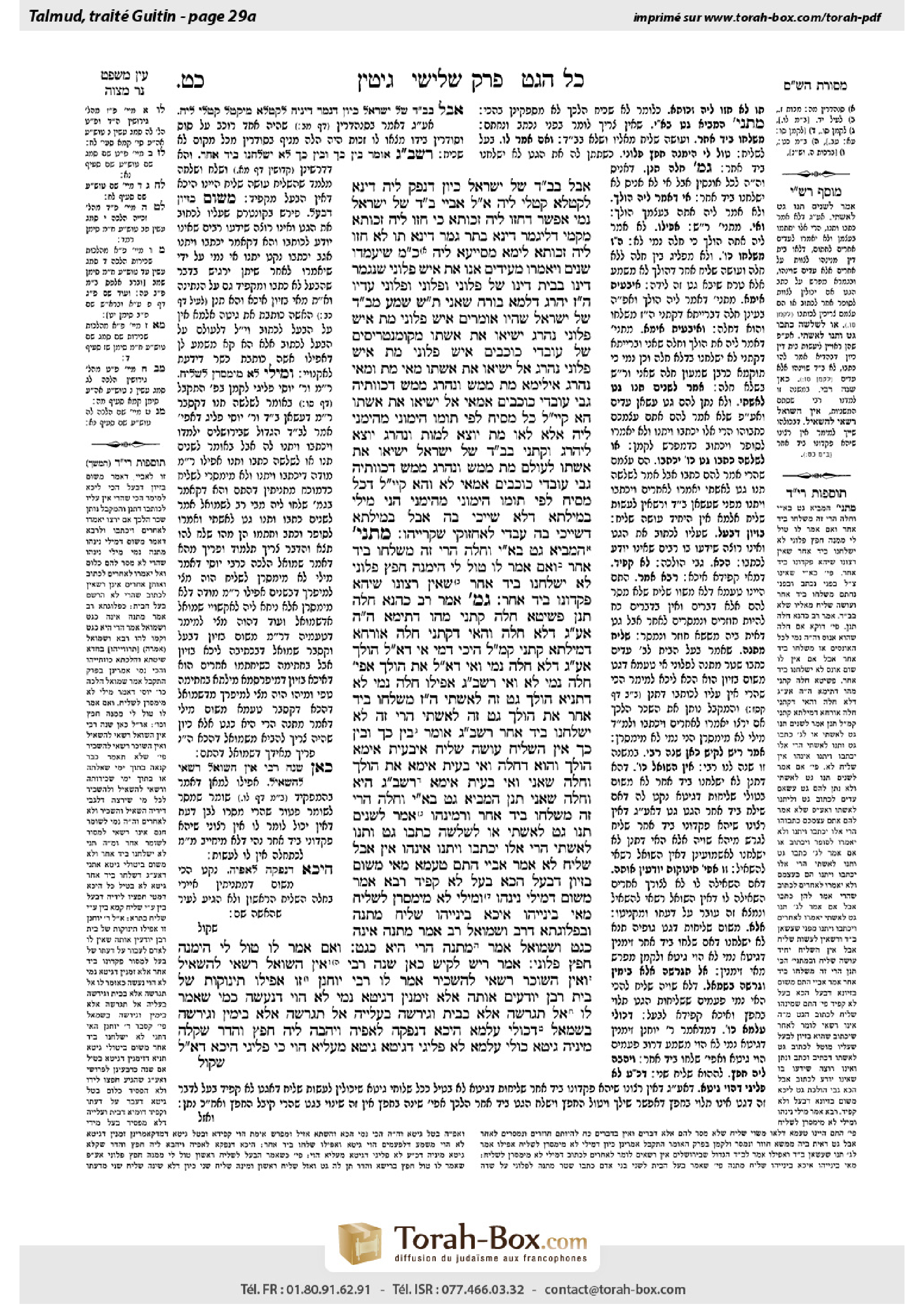
Gittin 29a: Talmud study for Daf Yomi
Study the Talmud for Daf Yomi with scanned pages, Hebrew text, English translations from Sefaria and AI-generated French translations.
Passage selection and English or AI-generated French translation are available where the scan has annotations. Daf Study is independent of Torah-Box and Sefaria.
Browse Gittin · גיטין · All tractatesGittin 29a text and translations
This page of Gittin includes the Aramaic text, an English translation and an AI-generated French translation, alongside the scan above.
גיטין כ״ט א · Aramaic and Hebrew text
אֲבָל בְּבֵית דִּין שֶׁל יִשְׂרָאֵל, כֵּיוָן דִּנְפַק לֵיהּ דִּינָא לִקְטָלָא – קָטְלִי לֵיהּ.
אֲמַר לֵיהּ אַבָּיֵי: בֵּית דִּין שֶׁל יִשְׂרָאֵל נָמֵי, אֶפְשָׁר דְּחָזוּ לֵיהּ זְכוּתָא! כִּי חָזוּ לֵיהּ זְכוּתָא – מִקַּמֵּי דְּלִיגְמַר דִּינָא, בָּתַר גְּמַר דִּינָא – תּוּ לָא חָזוּ לֵיהּ זְכוּתָא.
לֵימָא מְסַיְּיעָא לֵיהּ: כׇּל מָקוֹם שֶׁיַּעַמְדוּ שְׁנַיִם וְיֹאמְרוּ ״מְעִידִים אָנוּ אֶת אִישׁ פְּלוֹנִי שֶׁנִּגְמַר דִּינוֹ בְּבֵית דִּינוֹ שֶׁל פְּלוֹנִי, וּפְלוֹנִי וּפְלוֹנִי עֵדָיו״ – הֲרֵי זֶה יֵהָרֵג! דִּלְמָא בּוֹרֵחַ שָׁאנֵי.
תָּא שְׁמַע: שְׁמַע מִבֵּית דִּין שֶׁל יִשְׂרָאֵל שֶׁהָיוּ אוֹמְרִים ״אִישׁ פְּלוֹנִי מֵת״; ״אִישׁ פְּלוֹנִי נֶהֱרָג״ – יַשִּׂיאוּ אֶת אִשְׁתּוֹ. מִקּוֹמֶנְטָרִיסִים שֶׁל גּוֹיִם ״אִישׁ פְּלוֹנִי מֵת״; ״אִישׁ פְּלוֹנִי נֶהֱרַג״ – אַל יַשִּׂיאוּ אֶת אִשְׁתּוֹ.
מַאי ״מֵת״ וּמַאי ״נֶהֱרַג״? אִילֵימָא ״מֵת״ – מַמָּשׁ, וְ״נֶהֱרַג״ – מַמָּשׁ; דִּכְווֹתֵיהּ גַּבֵּי גּוֹיִם, אַמַּאי אַל יַשִּׂיאוּ אֶת אִשְׁתּוֹ? הָא קַיְימָא לַן, כֹּל מֵסִיחַ לְפִי תּוּמּוֹ הֵימוֹנֵי מְהֵימְנִי לֵיהּ!
אֶלָּא לָאו ״מֵת״ – יוֹצֵא לָמוּת, וְ״נֶהֱרַג״ – יוֹצֵא לֵיהָרֵג? וְקָתָנֵי: בְּבֵית דִּין שֶׁל יִשְׂרָאֵל יַשִּׂיאוּ אֶת אִשְׁתּוֹ!
לְעוֹלָם מֵת מַמָּשׁ וְנֶהֱרַג מַמָּשׁ; דִּכְווֹתֵיהּ גַּבֵּי גּוֹיִם אַמַּאי לָא, וְהָא קַיְימָא לַן דְּכֹל מֵסִיחַ לְפִי תּוּמּוֹ הֵימוֹנֵי מְהֵימְנִי – הָנֵי מִילֵּי בְּמִילְּתָא דְּלָא שָׁיְיכִי בַּהּ, אֲבָל בְּמִילְּתָא דְּשָׁיְיכִי בַּהּ, עָבְדִי לְאַחְזוֹקֵי שִׁקְרַיְיהוּ.
מַתְנִי׳ הַמֵּבִיא גֵּט בְּאֶרֶץ יִשְׂרָאֵל, וְחָלָה – הֲרֵי זֶה מְשַׁלְּחוֹ בְּיַד אַחֵר. וְאִם אָמַר לוֹ: ״טוֹל לִי הֵימֶנָּה חֵפֶץ פְּלוֹנִי״ – לֹא יְשַׁלְּחֶנּוּ בְּיַד אַחֵר, שֶׁאֵין רְצוֹנוֹ שֶׁיְּהֵא פִּקְדוֹנוֹ בְּיַד אַחֵר.
גְּמָ׳ אָמַר רַב כָּהֲנָא: ״חָלָה״ תְּנַן. פְּשִׁיטָא, ״חָלָה״ קָתָנֵי! מַהוּ דְּתֵימָא הוּא הַדִּין אַף עַל גַּב דְּלָא חָלָה, וְהַאי דְּקָתָנֵי ״חָלָה״ אוֹרְחָא דְּמִילְּתָא קָתָנֵי; קָא מַשְׁמַע לַן.
הֵיכִי דָּמֵי? אִי דַּאֲמַר לֵיהּ ״הוֹלֵךְ״ – אַף עַל גַּב דְּלָא חָלָה נָמֵי! וְאִי דַּאֲמַר לֵיהּ ״אַתְּ הוֹלֵךְ״ – אֲפִילּוּ חָלָה נָמֵי לָא! וְאִי רַבָּן שִׁמְעוֹן בֶּן גַּמְלִיאֵל, אֲפִילּוּ חָלָה נָמֵי לָא!
דְּתַנְיָא: ״הוֹלֵךְ גֵּט זֶה לְאִשְׁתִּי״ – הֲרֵי זֶה מְשַׁלְּחוֹ בְּיַד אַחֵר. ״אַתְּ הוֹלֵךְ גֵּט זֶה לְאִשְׁתִּי״ – הֲרֵי זֶה לֹא יְשַׁלְּחֶנּוּ בְּיַד אַחֵר. רַבָּן שִׁמְעוֹן בֶּן גַּמְלִיאֵל אוֹמֵר: בֵּין כָּךְ וּבֵין כָּךְ – אֵין הַשָּׁלִיחַ עוֹשֶׂה שָׁלִיחַ.
אִיבָּעֵית אֵימָא ״הוֹלֵךְ״, וְהוּא דְּחָלָה; וְאִי בָּעֵית אֵימָא ״אַתְּ הוֹלֵךְ״, וְחָלָה שָׁאנֵי; וְאִי בָּעֵית אֵימָא רַבָּן שִׁמְעוֹן בֶּן גַּמְלִיאֵל הִיא, וְחָלָה שָׁאנֵי.
תְּנַן: הַמֵּבִיא גֵּט בְּאֶרֶץ יִשְׂרָאֵל, וְחָלָה – הֲרֵי זֶה מְשַׁלְּחוֹ בְּיַד אַחֵר. וּרְמִינְהוּ, אָמַר לִשְׁנַיִם: ״תְּנוּ גֵּט לְאִשְׁתִּי״; אוֹ לִשְׁלֹשָׁה: ״כִּתְבוּ גֵּט וּתְנוּ לְאִשְׁתִּי״ – הֲרֵי אֵלּוּ יִכְתְּבוּ וְיִתְּנוּ. אִינְהוּ אִין, אֲבָל שָׁלִיחַ לָא!
אָמַר אַבָּיֵי: הָתָם טַעְמָא מַאי – מִשּׁוּם בִּזָּיוֹן דְּבַעַל, הָכָא בַּעַל לָא קָפֵיד.
רָבָא אָמַר: מִשּׁוּם דְּמִילֵּי נִינְהוּ, וּמִילֵּי לָא מִימַּסְרָן לְשָׁלִיחַ.
מַאי בֵּינַיְיהוּ? אִיכָּא בֵּינַיְיהוּ שְׁלִיחַ מַתָּנָה; וּבִפְלוּגְתָּא דְּרַב וּשְׁמוּאֵל – רַב אָמַר: מַתָּנָה אֵינָהּ כְּגֵט. וּשְׁמוּאֵל אָמַר: מַתָּנָה הֲרֵי הִיא כְּגֵט.
וְאִם אָמַר לוֹ ״טוֹל לִי הֵימֶנָּה חֵפֶץ פְּלוֹנִי״. אָמַר רֵישׁ לָקִישׁ: כָּאן שָׁנָה רַבִּי: אֵין הַשּׁוֹאֵל רַשַּׁאי לְהַשְׁאִיל, וְאֵין הַשּׂוֹכֵר רַשַּׁאי לְהַשְׂכִּיר.
אָמַר לוֹ רַבִּי יוֹחָנָן: זוֹ, אֲפִילּוּ תִּינוֹקוֹת שֶׁל בֵּית רַבָּן יוֹדְעִים אוֹתָהּ! אֶלָּא זִימְנִין דְּגִיטָּא נָמֵי לָא הָוֵי – דְּנַעֲשָׂה כְּמִי שֶׁאָמַר לוֹ ״אַל תְּגָרְשָׁהּ אֶלָּא בַּבַּיִת״, וְגֵירְשָׁהּ בָּעֲלִיָּיה; ״אַל תְּגָרְשָׁהּ אֶלָּא בְּיָמִין״, וְגֵירְשָׁהּ בִּשְׂמֹאל.
דְּכוּלֵּי עָלְמָא, הֵיכָא דְּנָפְקָה לְאַפֵּיהּ וְיָהֲבָה לֵיהּ חֵפֶץ, וַהֲדַר שָׁקְלָה מִינֵּיהּ גִּיטָּא; כּוּלֵּי עָלְמָא לָא פְּלִיגִי דְּגִיטָּא – גִּיטָּא מְעַלְּיָא הָוֵי. כִּי פְּלִיגִי הֵיכָא דַּאֲמַר לֵיהּ:
Gittin 29a · English translation
but in a Jewish court, once his verdict to be executed has emerged, they execute him.
Abaye said to him: In a Jewish court as well, it is possible that the court will see fit to acquit him afterward and he will be released. Rav Yosef said: When the court sees fit to acquit him, it is before the verdict; after the verdict the court will not further see fit to acquit him, as it is uncommon for the court to find a reason to acquit him after his verdict has been delivered.
The Gemara suggests: Let us say that a mishna (Makkot 7a) supports Rav Yosef’s opinion: Concerning one who fled from the court after his verdict was issued, the mishna states: Any place where two witnesses arise and say: We testify about so-and-so that his verdict was finalized in the court of so-and-so, and so-and-so and so-and-so were his witnesses, the halakha is that this person should be killed. It is evident from the mishna in tractate Makkot that there is no concern that the court might later have found a reason to release him. The Gemara answers: Perhaps one who flees is different, as the court will not reconsider his verdict once he has fled.
The Gemara suggests another proof: Come and hear: If one heard from a Jewish court that they were saying: The man so-and-so died, or: The man so-and-so was killed, then the court allows his wife to marry. If he heard from a gentile judicial registrar: The man so-and-so died, or: The man so-and-so was killed, then the court does not allow his wife to marry.
The Gemara clarifies: What does it mean when it says: Died, and what does it mean when it says: Was killed? If we say that it means that he actually died, and that he actually was killed, such that the case concerning the gentiles is stated in a similar manner, i.e., that he heard from the gentile registrar that the person was actually dead, why may the court not allow his wife to marry? Don’t we maintain that with regard to any gentile who speaks offhandedly, the Sages deemed him credible? Therefore, the gentile should be deemed credible when he says that someone died or was killed.
Rather, is it not necessary to explain that when it says: Died, it means that he is going out to die, and when it says: Was killed, it means that he is going out to be executed. And it teaches: If one heard in a Jewish court then the court allows his wife to marry, as it is assumed that he was already executed, in support of the statement of Rav Yosef.
The Gemara answers: Actually, it can be explained that he actually died, and was actually killed; and with regard to that which you said: Such that the case concerning the gentiles is stated in a similar manner, why may the court not allow his wife to marry? Don’t we maintain that with regard to any gentile who speaks offhandedly, the Sages deemed him credible? The answer is that this credibility applies only in a matter that is not relevant to the gentiles; but in a matter that is relevant to the gentiles, such as here, where they desire to publicize that they carried out their verdict, it is common for them to reinforce their false verdict.
MISHNA: With regard to an agent who brings a bill of divorce in Eretz Yisrael, where his only responsibility is to transmit the bill of divorce to the wife, and the agent became sick, this agent may send it in the possession of another agent. But if the husband said to the agent: When you transmit the bill of divorce to my wife, take for me such and such an item from her that I left with her as a deposit, then he may not send it in the possession of another agent. This is because it is assumed that it is not the desire of the husband that his deposit be in the possession of another person whom he did not appoint as his agent.
GEMARA: Rav Kahana said: We learned in the mishna that the agent became sick; otherwise, he may not appoint a second agent. The Gemara asks: This is obvious, as the mishna teaches explicitly that the agent became sick. The Gemara answers: Lest you say that the same is true, i.e., that he may transfer the bill of divorce to another agent, even though the agent did not become sick, and the reason that the mishna teaches specifically that he became sick is that the mishna teaches the matter in the manner in which it typically occurs, as an agent typically fulfills his agency, barring unavoidable circumstances, therefore, Rav Kahana teaches us that an agent may appoint another agent only when he becomes sick.
The Gemara clarifies: What are the circumstances of his appointment as an agent? If this is a case where the husband said to the agent: Deliver this bill of divorce to my wife, then even though the agent did not become sick, he may also appoint an agent in his place, as the husband did not state that he must be the one to deliver the bill of divorce. And if this is a case where he said to the agent: You, deliver this bill of divorce to my wife, then even if he became sick, he also may not appoint a second agent in his place, as the husband specified that he must be the one to deliver the bill of divorce. And if the mishna is in accordance with the opinion of Rabban Shimon ben Gamliel, then even if he became sick he also may not appoint a second agent, no matter what the husband said.
The Gemara explains: As it is taught in a baraita in the Tosefta (2:13): If the husband said to an agent: Deliver this bill of divorce to my wife, then this agent may send it in the possession of another agent. However, if the husband said: You, deliver this bill of divorce to my wife, then this agent may not send it in the possession of another agent. Rabban Shimon ben Gamliel says: Whether the husband said it like this or whether the husband said it like that, the agent may not designate another agent. Therefore, Rav Kahana’s statement is difficult.
The Gemara answers: If you wish, say that the mishna is referring to a case where the husband said to his agent: Deliver the bill of divorce, without specifying that he must be the one to do so, and Rav Kahana understood the baraita as follows: And this halakha, that he may send it in the possession of another agent, applies only when the agent became sick. And if you wish, say that the mishna is referring to a case where the husband said: You deliver, but one who became sick is different, and it is assumed that under those circumstances the husband would allow him to designate another agent. And if you wish, say that the mishna is even in accordance with the opinion of Rabban Shimon ben Gamliel, that an agent is ordinarily not permitted to designate another agent. But a case where the agent became sick is different, and the agent may designate another agent.
We learned in the mishna: With regard to an agent who brings a bill of divorce in Eretz Yisrael, and the agent became sick, this agent may send it in the possession of another agent. And the Gemara raises a contradiction from a mishna (66a): If the husband said to two people: Give a bill of divorce to my wife, or if he said to three people: Write a bill of divorce and give it to my wife, then these people should write it and give it. The Gemara infers from the mishna: They themselves, yes, they should do so, but one whom they appoint as an agent may not do so.
Abaye said: There, what is the reason that an agent may not be appointed? It is due to degradation of the husband, who does not want the matter to become known, and therefore they may not designate another agent. However, here, after he has already sent the bill of divorce, the husband is not particular that word not spread, and therefore the agent may designate another agent in his place.
Rava said: There is a different reason that in the case of the mishna (66a) the agent may not appoint another to write the bill of divorce; it is because of the fact that in the case there, the husband’s instructions are mere words, and verbal directives cannot be delegated to an agent, i.e., an agent cannot be deputized to give instructions on behalf of another. Therefore, they cannot take their oral instructions and transfer them to another. In the case of the mishna here, the agent is able to give the physical bill of divorce to another agent and thereby transfer his agency.
The Gemara asks: What is the difference between the explanations offered by Abaye and Rava? The Gemara answers: There is a practical difference between them in the case of an agent appointed to write a deed of a gift, and their disagreement is parallel to the dispute of Rav and Shmuel. Rav says: A deed of gift is not like a bill of divorce, as the gift giver does not care who writes the deed. Since it is not degrading to him if another agent writes the deed of gift instead of the agent that he appointed, the agent may appoint another agent. And Shmuel says: A deed of gift is like a bill of divorce, as the mere words instructing the agent to write the deed cannot be transferred to another agent.
§ The mishna teaches: But if the husband said to the agent: When you transmit the bill of divorce to my wife, take for me such and such an item from her, then the agent may not appoint a second agent, as it is not the desire of the husband that his deposit be in the possession of another. Reish Lakish says: Here, Rabbi Yehuda HaNasi taught that a borrower is not allowed to lend the item that he borrowed to someone else, and a renter is not allowed to rent out the item that he rented to someone else. In those cases, the same reasoning applies, i.e., that it is not the desire of the owner that his item be in the possession of another.
Rabbi Yoḥanan said to him: Even schoolchildren know this halakha, and this is not the novel idea expressed in the mishna. The novel idea expressed in the mishna is as follows: Not only is it not permitted for an agent to appoint another agent in this case, as it violates the desire of the husband, but sometimes it happens that the bill of divorce is also not valid if a second agent is appointed. This is because the first agent becomes as one that it was said to him: Divorce her only in the house, and he divorced her in the attic; or the husband said: Divorce her only with your right hand, and he divorced her with his left hand. Here as well, since the agent violated the instructions the divorce will not be valid.
The Gemara elaborates: Everyone agrees that when it happens that the wife went out to greet him and gave him the item that the husband requested, and then she took the bill of divorce from him, in this case everyone agrees that the bill of divorce is a proper bill of divorce. When they disagree is in a case when the husband said to the agent:
Gittin 29a · Traduction française (IA)
mais dans un tribunal juif, une fois que le verdict d’exécution a été rendu, on l’exécute.
Abaye dit à lui : Dans un tribunal juif également, il est possible que le tribunal décide ultérieurement de l’acquitter et qu’il soit libéré. Rav Yosef dit : Lorsque le tribunal décide d’acquitter une personne, c’est avant le verdict ; après le verdict, le tribunal ne décidera plus d’acquitter cette personne, car il est peu probable que le tribunal trouve une raison d’acquitter une personne après que le verdict a été rendu.
La Guemara suggère : Disons que la Michna (Makkot 7a) soutient l’opinion de Rav Yosef : Concernant celui qui s’est enfui du tribunal après que le verdict a été rendu, la Michna dit : Tout lieu où deux témoins affirment : Nous témoignons sur tel et tel que son verdict a été rendu dans le tribunal de tel et tel, et tel et tel étaient ses témoins, la halakha est que cette personne doit être tuée. Il est évident de la Michna dans le traité Makkot que l’on ne craint pas que le tribunal puisse ultérieurement trouver une raison de le libérer. La Guemara répond : Peut-être que celui qui s’est enfui est différent, car le tribunal ne réexaminera pas le verdict une fois qu’il a fui.
La Guemara suggère une autre preuve : Viens écouter : Si l’on a entendu d’un tribunal juif qu’ils disaient : L’homme tel et tel est mort, ou : L’homme tel et tel a été tué, alors le tribunal permet à sa femme de se marier. Si l’on a entendu d’un registraire judiciaire païen : L’homme tel et tel est mort, ou : L’homme tel et tel a été tué, alors le tribunal ne permet pas à sa femme de se marier.
La Guemara clarifie : De quoi parle-t-on lorsqu’on dit : Est mort, et de quoi parle-t-on lorsqu’on dit : A été tué ? Si l’on dit que cela signifie qu’il est effectivement mort et qu’il a effectivement été tué, de sorte que le cas concernant les païens est énoncé de manière similaire, c’est-à-dire qu’il a entendu du registraire païen que la personne était effectivement morte, pourquoi le tribunal ne permet-il pas à sa femme de se marier ? N’affirmons-nous pas que les Sages considèrent comme crédible tout païen qui parle à la légère ? Ainsi, le païen devrait être considéré comme crédible lorsqu’il dit qu’une personne est morte ou a été tuée.
Plutôt, n’est-il pas nécessaire d’expliquer que lorsqu’on dit : Est mort, cela signifie qu’il sort pour mourir, et lorsqu’on dit : A été tué, cela signifie qu’il sort pour être exécuté. Et cela enseigne : Si l’on a entendu dans un tribunal juif, alors le tribunal permet à sa femme de se marier, car on suppose qu’il a déjà été exécuté, en soutien de l’affirmation de Rav Yosef.
La Guemara répond : En réalité, cela peut être expliqué qu’il est effectivement mort et qu’il a effectivement été tué ; et concernant ce que vous avez dit : De sorte que le cas concernant les païens est énoncé de manière similaire, pourquoi le tribunal ne permet-il pas à sa femme de se marier ? N’affirmons-nous pas que les Sages considèrent comme crédible tout païen qui parle à la légère ? La réponse est que cette crédibilité s’applique uniquement à des choses non pertinentes pour les païens ; mais dans des choses pertinentes pour les païens, comme ici, où ils souhaitent faire savoir qu’ils ont exécuté leur verdict, il est courant qu’ils renforcent leur verdict faux.
MICHNA : Concernant un agent qui apporte un divorce dans la Terre d’Israël, où sa seule responsabilité est de transmettre le divorce à la femme, et que l’agent est malade, cet agent peut envoyer le divorce en possession d’un autre agent. Mais si le mari a dit à l’agent : Lorsque tu transmettras le divorce à ma femme, prends pour moi un tel objet de chez elle que j’ai laissé avec elle en dépôt, alors il ne peut pas envoyer le divorce en possession d’un autre agent. Cela est dû au fait qu’on suppose que ce n’est pas le désir du mari que son dépôt soit en possession d’une autre personne qu’il n’a pas désigné comme son agent.
GUEMARA : Rav Kahana a dit : Nous avons appris dans la Michna que l’agent est malade ; autrement, il ne peut pas désigner un autre agent. La Guemara pose la question : Cela est évident, car la Michna enseigne explicitement que l’agent est malade. La Guemara répond : De peur que vous disiez que c’est pareil, c’est-à-dire qu’il peut transférer le divorce à un autre agent, même si l’agent n’est pas malade, et la raison pour laquelle la Michna enseigne spécifiquement qu’il est malade est que la Michna enseigne la chose dans la manière dont elle se produit habituellement, comme un agent ordinairement accompli son mandat, à l’exception des circonstances impérieuses, donc Rav Kahana nous enseigne que l’agent peut désigner un autre agent uniquement lorsqu’il est malade.
La Guemara clarifie : Quelles sont les circonstances de son mandat ? Si c’est un cas où le mari a dit à l’agent : Délivre ce divorce à ma femme, alors même si l’agent n’est pas malade, il peut aussi désigner un agent à sa place, car le mari n’a pas dit qu’il devait être celui qui délivre le divorce. Et si c’est un cas où il a dit à l’agent : Tu, délivre ce divorce à ma femme, alors même s’il est malade, il ne peut pas non plus désigner un autre agent à sa place, car le mari a spécifié qu’il devait être celui qui délivre le divorce. Et si la Michna suit l’opinion de Rabban Shimon ben Gamliel, alors même s’il est malade, il ne peut pas non plus désigner un autre agent, indépendamment de ce que le mari a dit.
La Guemara explique : Comme il est enseigné dans une baraïta de la Tosefta (2:13) : Si le mari a dit à un agent : Delivre ce divorce à ma femme, alors cet agent peut envoyer le divorce en possession d’un autre agent. Cependant, si le mari a dit : Tu, delivre ce divorce à ma femme, alors cet agent ne peut pas envoyer le divorce en possession d’un autre agent. Rabban Shimon ben Gamliel dit : Quelle que soit la manière dont le mari ait dit, l’agent ne peut pas désigner un autre agent. Ainsi, l’affirmation de Rav Kahana est difficile.
La Guemara répond : Si vous le souhaitez, dites que la Michna fait référence à un cas où le mari a dit à son agent : « Fais parvenir le contrat de divorce », sans spécifier qu'il doit être lui-même celui qui le fasse, et que Rav Kahana a compris la baraïta ainsi : Et cette halakha, qu'il puisse le faire entre les mains d'un autre agent, s'applique uniquement lorsque l'agent est tombé malade. Et si vous le souhaitez, dites que la Michna fait référence à un cas où le mari a dit : « Tu le fais », mais celui qui est tombé malade est différent, et on suppose que dans ces circonstances le mari permettrait à l'agent de désigner un autre agent. Et si vous le souhaitez, dites que la Michna est même conforme à l'opinion de Rabban Shimon ben Gamliel, qui considère qu'un agent n'est généralement pas autorisé à désigner un autre agent. Mais dans un cas où l'agent est tombé malade, c'est différent, et l'agent peut désigner un autre agent.
Nous avons appris dans la Michna : Concernant un agent qui apporte un contrat de divorce en Terre d'Israël, et que l'agent est tombé malade, cet agent peut envoyer le contrat entre les mains d'un autre agent. Et la Guemara soulève une contradiction avec une Michna (66a) : Si le mari a dit à deux personnes : « Donnez un contrat de divorce à ma femme », ou s'il a dit à trois personnes : « Écrivez un contrat de divorce et donnez-le à ma femme », alors ces personnes doivent écrire le contrat et le donner. La Guemara déduit de la Michna : Ils eux-mêmes, oui, ils doivent le faire, mais celui qu'ils désignent comme agent ne peut pas le faire.
Abaye dit : Là, pourquoi un agent ne peut-il pas être désigné ? C'est en raison de la dégradation du mari, qui ne veut pas que l'affaire soit connue, et donc ils ne peuvent pas désigner un autre agent. Cependant, ici, après qu'il ait déjà envoyé le contrat de divorce, le mari n'est pas particulier que le mot ne se répande pas, et donc l'agent peut désigner un autre agent à sa place.
Rava dit : Il y a une autre raison pour laquelle, dans le cas de la Michna (66a), l'agent ne peut pas désigner un autre pour écrire le contrat de divorce ; c'est en raison du fait que dans ce cas, les instructions du mari sont simplement des paroles, et les directives verbales ne peuvent pas être déléguées à un agent, c'est-à-dire qu'un agent ne peut pas être désigné pour donner des instructions à la place d'un autre. Par conséquent, ils ne peuvent pas transmettre leurs instructions orales à un autre. Dans le cas de la Michna ici, l'agent peut donner le contrat de divorce physique à un autre agent et ainsi transférer son autorité.
La Guemara pose la question : Quelle est la différence entre les explications données par Abaye et Rava ? La Guemara répond : Il y a une différence pratique entre eux dans le cas d'un agent désigné pour écrire un acte de don, et leur désaccord est parallèle au débat entre Rav et Shmuel. Rav dit : Un acte de don n'est pas comme un contrat de divorce, car le donneur ne s'occupe pas de qui écrit l'acte. Puisque ce n'est pas dégradant pour lui si un autre agent écrit l'acte de don à la place de l'agent qu'il a désigné, l'agent peut désigner un autre agent. Et Shmuel dit : Un acte de don est comme un contrat de divorce, car les simples paroles indiquant à l'agent d'écrire l'acte ne peuvent pas être transférées à un autre agent.
§ La Michna enseigne : Mais si le mari a dit à l'agent : « Quand tu transmettras le contrat de divorce à ma femme, prends pour moi un tel objet d'elle », alors l'agent ne peut pas désigner un autre agent, car ce n'est pas le désir du mari que son dépôt soit en possession d'un autre. Reish Lakish dit : Ici, Rabbi Yehuda HaNasi a enseigné que le prêteur n'est pas autorisé à prêter l'objet qu'il a emprunté à quelqu'un d'autre, et le locataire n'est pas autorisé à louer l'objet qu'il a loué à quelqu'un d'autre. Dans ces cas, la même raisonnement s'applique, c'est-à-dire que ce n'est pas le désir de l'propriétaire que son objet soit en possession d'un autre.
Rabbi Yoḥanan a dit à lui : Même les enfants de l'école savent cette halakha, et cela n'est pas l'idée nouvelle exprimée dans la Michna. L'idée nouvelle exprimée dans la Michna est la suivante : Non seulement il n'est pas permis à un agent de désigner un autre agent dans ce cas, car cela viole le désir du mari, mais parfois il arrive que le contrat de divorce ne soit pas valide si un autre agent est désigné. Cela est dû au fait que le premier agent devient comme celui qui a dit : « Divorce-la seulement dans la maison », et il l'a divorcée dans le grenier ; ou le mari a dit : « Divorce-la seulement avec ta main droite », et il l'a divorcée avec sa main gauche. Ici aussi, puisque l'agent a violé les instructions, le divorce ne sera pas valide.
La Guemara développe : Tout le monde convient que lorsque la femme est sortie pour l'accueillir et lui a donné l'objet que le mari avait demandé, puis elle a pris le contrat de divorce de lui, dans ce cas tout le monde convient que le contrat de divorce est un contrat de divorce valide. Le désaccord est dans le cas où le mari a dit à l'agent :
Traduction française générée par IA à partir de l’édition anglaise de Sefaria. Vérifie toujours un passage avec le texte source.
Text from Sefaria: William Davidson Edition - Vocalized Aramaic (CC BY NC); William Davidson Edition - English (CC BY NC).