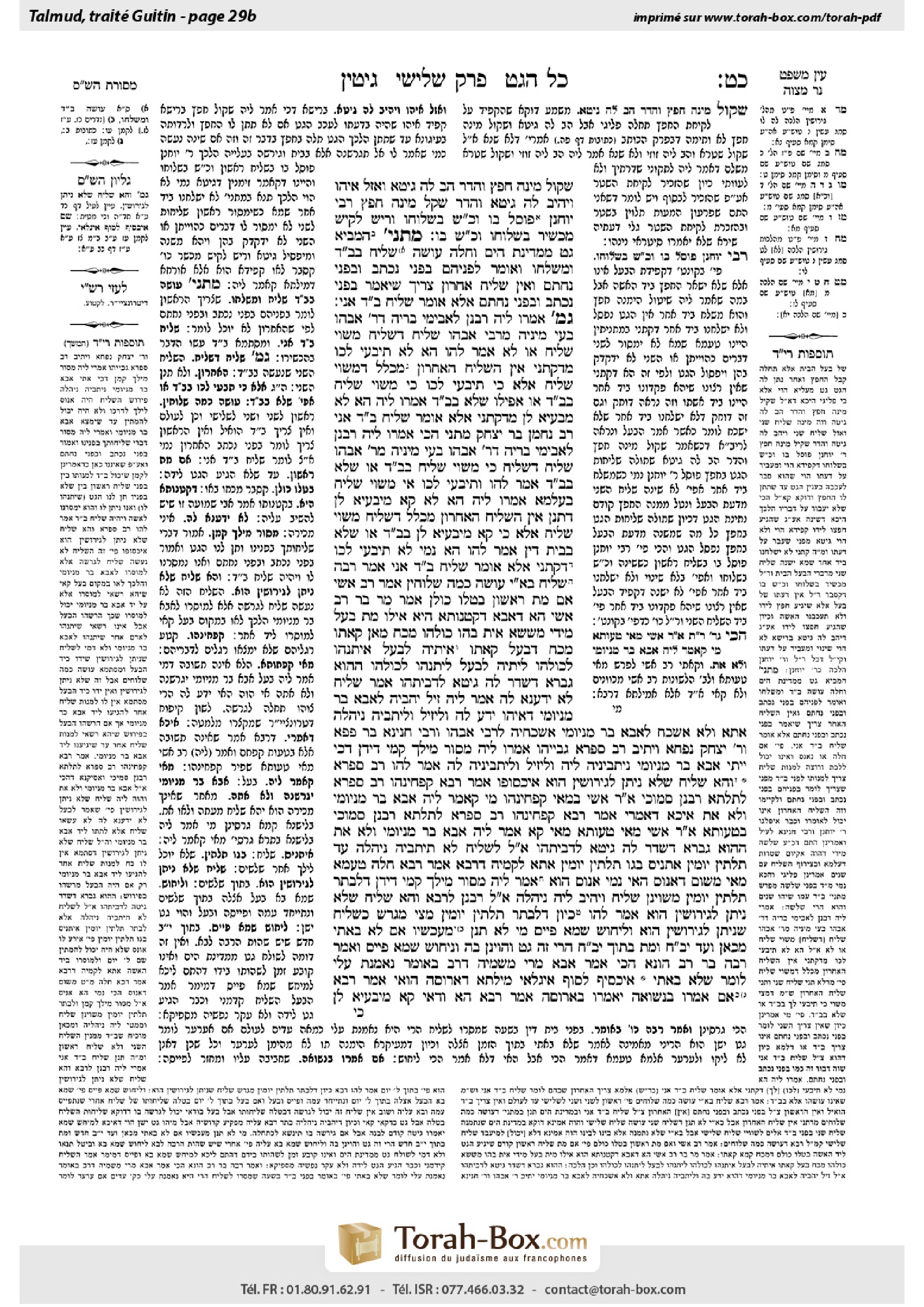
Gittin 29b: Talmud study for Daf Yomi
Study the Talmud for Daf Yomi with scanned pages, Hebrew text, English translations from Sefaria and AI-generated French translations.
Passage selection and English or AI-generated French translation are available where the scan has annotations. Daf Study is independent of Torah-Box and Sefaria.
Browse Gittin · גיטין · All tractatesGittin 29b text and translations
This page of Gittin includes the Aramaic text, an English translation and an AI-generated French translation, alongside the scan above.
גיטין כ״ט ב · Aramaic and Hebrew text
שְׁקוֹל מִינַּהּ חֵפֶץ וַהֲדַר הַב לַהּ גִּיטָּא; וַאֲזַל אִיהוּ וִיהַב לַהּ גִּיטָּא, וַהֲדַר שְׁקַל מִינַּהּ חֵפֶץ. רַבִּי יוֹחָנָן פּוֹסֵל בּוֹ, וְכׇל שֶׁכֵּן בִּשְׁלוּחוֹ, וְרֵישׁ לָקִישׁ מַכְשִׁיר בִּשְׁלוּחוֹ, וְכׇל שֶׁכֵּן בּוֹ.
מַתְנִי׳ הַמֵּבִיא גֵּט מִמְּדִינַת הַיָּם, וְחָלָה – עוֹשֶׂה שָׁלִיחַ בְּבֵית דִּין וּמְשַׁלְּחוֹ, וְאוֹמֵר לִפְנֵיהֶם: ״בְּפָנַי נִכְתַּב וּבְפָנַי נֶחְתַּם״; וְאֵין שָׁלִיחַ אַחֲרוֹן צָרִיךְ שֶׁיֹּאמַר ״בְּפָנַי נִכְתַּב וּבְפָנַי נֶחְתַּם״, אֶלָּא אוֹמֵר: שְׁלִיחַ בֵּית דִּין אֲנִי.
גְּמָ׳ אֲמַרוּ לֵיהּ רַבָּנַן לַאֲבִימִי בְּרֵיהּ דְּרַבִּי אֲבָהוּ: בָּעֵי מִינֵּיהּ מֵרַבִּי אֲבָהו,ּ שָׁלִיחַ דְּשָׁלִיחַ מְשַׁוֵּי שָׁלִיחַ, אוֹ לָא? אֲמַר לְהוּ: הָא לָא תִּיבְּעֵי לְכוּ, מִדְּקָתָנֵי ״אֵין הַשָּׁלִיחַ הָאַחֲרוֹן״, מִכְלָל דִּמְשַׁוֵּי שָׁלִיחַ;
אֶלָּא כִּי תִּיבְּעֵי לְכוּ: כִּי מְשַׁוֵּי שָׁלִיחַ – בְּבֵית דִּין, אוֹ אֲפִילּוּ שֶׁלֹּא בְּבֵית דִּין? אֲמַרוּ לֵיהּ: הָא לָא מִבַּעְיָא לַן, מִדְּקָתָנֵי: אֶלָּא אוֹמֵר ״שְׁלִיחַ בֵּית דִּין אֲנִי״.
רַב נַחְמָן בַּר יִצְחָק מַתְנֵי הָכִי: אֲמַרוּ לֵיהּ רַבָּנַן לַאֲבִימִי בְּרֵיהּ דְּרַבִּי אֲבָהוּ, בְּעִי מִינֵּיהּ מֵרַבִּי אֲבָהוּ: שָׁלִיחַ דְּשָׁלִיחַ, כִּי מְשַׁוֵּי שָׁלִיחַ – בְּבֵית דִּין, אוֹ שֶׁלֹּא בְּבֵית דִּין?
אֲמַר לְהוּ: וְתִיבְּעֵי לְכוּ אִי מְשַׁוֵּי שָׁלִיחַ בְּעָלְמָא! אֲמַרוּ לֵיהּ: הָא לָא קָא מִיבַּעְיָא לַן, דִּתְנַן: ״אֵין הַשָּׁלִיחַ הָאַחֲרוֹן״, מִכְּלָל דְּשָׁלִיחַ מְשַׁוֵּי שָׁלִיחַ; אֶלָּא כִּי קָא מִיבַּעְיָא לַן – בְּבֵית דִּין, אוֹ שֶׁלֹּא בְּבֵית דִּין? אֲמַר לְהוּ: הָא נָמֵי לָא תִּיבְּעֵי לְכוּ, דְּקָתָנֵי: אֶלָּא אוֹמֵר ״שְׁלִיחַ בֵּית דִּין אֲנִי״.
אָמַר רַבָּה: שָׁלִיחַ בְּאֶרֶץ יִשְׂרָאֵל, עוֹשֶׂה כַּמָּה שְׁלוּחִין. אָמַר רַב אָשֵׁי: אִם מֵת רִאשׁוֹן – בָּטְלוּ כּוּלָּן.
אָמַר מָר בַּר רַב אָשֵׁי: הָא דְּאַבָּא, דְּקַטְנוּתָא הִיא! אִילּוּ מֵת בַּעַל, מִידֵּי מְשָׁשָׁא אִית בְּהוּ?! כּוּלְּהוּ מִכֹּחַ מַאן קָאָתוּ – מִכֹּחַ דְּבַעַל קָאָתוּ; אִיתֵיהּ לְבַעַל – אִיתַנְהוּ לְכוּלְּהוּ, לֵיתֵיהּ לְבַעַל – לֵיתַנְהוּ לְכוּלְּהוּ.
הָהוּא גַּבְרָא דְּשַׁדַּר לַהּ גִּיטָּא לִדְבֵיתְהוּ, אֲמַר שָׁלִיחַ: לָא יָדַעְנָא לַהּ, אֲמַר לֵיהּ: זִיל יַהֲבֵיהּ לְאַבָּא בַּר מִנְיוֹמֵי, דְּאִיהוּ יָדַע לַהּ, וְלֵיזִיל וְלִיתְּבֵיהּ נִיהֲלַהּ. אֲתָא וְלָא אַשְׁכַּח לְאַבָּא בַּר מִנְיוֹמֵי. אַשְׁכְּחֵיהּ לְרַבִּי אֲבָהוּ וְרַבִּי חֲנִינָא בַּר פָּפָּא וְרַבִּי יִצְחָק נַפָּחָא, וְיָתֵיב רַב סָפְרָא גַּבַּיְיהוּ. אֲמַרוּ לֵיהּ: מְסוֹר מִילָּךְ קַמֵּי דִּידַן, דְּכִי יֵיתֵי אַבָּא בַּר מִנְיוֹמֵי נִיתְּבִינֵיהּ לֵיהּ, וְלֵיזִיל וְלִיתְּבִינֵיהּ לַהּ.
אֲמַר לְהוּ רַב סָפְרָא: וְהָא שְׁלִיחַ שֶׁלֹּא נִיתַּן לְגֵירוּשִׁין הוּא! אִיכְּסוּפוּ.
אָמַר רָבָא: קַפְּחִינְהוּ רַב סָפְרָא לִתְלָתָא רַבָּנַן סְמִוכֵי. אָמַר רַב אָשֵׁי: בְּמַאי קַפְּחִינְהוּ? מִי קָאָמַר לֵיהּ ״אַבָּא בַּר מִנְיוֹמֵי וְלָא אַתְּ״?!
אִיכָּא דְּאָמְרִי, אָמַר רָבָא: קַפְּחִינְהוּ רַב סָפְרָא לִתְלָתָא רַבָּנַן סְמִוכֵי, בְּטָעוּתָא. אָמַר רַב אָשֵׁי: מַאי טָעוּתָא? מַאי קָא אָמַר לֵיהּ: ״אַבָּא בַּר מִנְיוֹמֵי״ – וְלָא אַתְּ!
הָהוּא גַּבְרָא דְּשַׁדַּר לָהּ גִּיטָּא לִדְבֵיתְהוּ, אֲמַר לֵיהּ לְשָׁלִיחַ: לָא תִּיתְּבֵיהּ נִיהֲלַהּ עַד תְּלָתִין יוֹמִין. אִתְּנִיס בְּגוֹ תְּלָתִין יוֹמִין.
אֲתָא לְקַמֵּיהּ דְּרָבָא, אָמַר רָבָא: חָלָה טַעְמָא מַאי – מִשּׁוּם דַּאֲנִוס, הַאי נָמֵי [הָא אֲנִיס] (אָנוּס הוּא). אֲמַר לֵיהּ: מְסוֹר מִילָּךְ קַמֵּי דִּידַן, דִּלְבָתַר תְּלָתִין יוֹמִין מְשַׁוֵּינַן שָׁלִיחַ, וְיָהֵיב לֵיהּ נִיהֲלַהּ. אֲמַרוּ לֵיהּ רַבָּנַן לְרָבָא: וְהָא שָׁלִיחַ שֶׁלֹּא נִיתַּן לְגֵירוּשִׁין הוּא! אֲמַר לְהוּ: כֵּיוָן דִּלְבָתַר תְּלָתִין יוֹמִין מָצֵי מְגָרֵשׁ, כְּשָׁלִיחַ שֶׁנִּיתַּן לְגֵירוּשִׁין הוּא.
וְלֵיחוּשׁ שֶׁמָּא פִּיֵּיס! מִי לָא תְּנַן: ״מֵעַכְשָׁיו – אִם לֹא בָּאתִי מִכָּאן וְעַד שְׁנֵים עָשָׂר חֹדֶשׁ״, וּמֵת בְּתוֹךְ שְׁנֵים עָשָׂר חֹדֶשׁ – הֲרֵי זֶה גֵּט.
וְהָוֵינַן בַּהּ: וְנֵיחוּשׁ שֶׁמָּא פִּיֵּיס! וְאָמַר רַבָּה בַּר רַב הוּנָא, הָכִי אָמַר אַבָּא מָרִי מִשְּׁמֵיהּ דְּרַב: בְּאוֹמֵר ״נֶאֱמֶנֶת עָלַי לוֹמַר שֶׁלֹּא בָּאתִי״!
אִיכְּסִיף. לְסוֹף אִיגַּלַּאי מִילְּתָא דַּאֲרוּסָה הֲוַאי. אָמַר רָבָא: אִם אָמְרוּ בִּנְשׂוּאָה – יֹאמְרוּ בַּאֲרוּסָה?!
אָמַר רָבָא: הָא וַדַּאי קָא מִיבַּעְיָא לַן –
Gittin 29b · English translation
Take an item from her and then give her the bill of divorce, and he went and gave her the bill of divorce and then took the item from her. Rabbi Yoḥanan invalidates the bill of divorce even when given by the first agent, as he deviated from the husband’s instructions, and his agency is canceled, and all the more so does Rabbi Yoḥanan invalidate the bill of divorce when delivered by the first agent’s agent. And Reish Lakish deems the bill of divorce valid when it is delivered by the first agent’s agent, and all the more so when it is delivered by the first agent himself.
MISHNA: With regard to an agent who is bringing a bill of divorce from a country overseas, who must attest to the fact that he witnessed the writing and signing of the bill of divorce, and he became sick and cannot complete his agency, he appoints another agent in court and sends him. And the first agent says before the court: It was written in my presence and it was signed in my presence, and on the basis of this the court deems the bill of divorce to be valid. And the final agent does not need to say: It was written in my presence and it was signed in my presence. Rather, it is sufficient that he says: I am an agent of the court.
GEMARA: The Sages said to Avimei, son of Rabbi Abbahu: Raise the following dilemma before your father, Rabbi Abbahu: Can an agent of the first agent also appoint another agent, or not? He said to them: You should not raise this dilemma. From the fact that the mishna teaches: The final agent does not need to say, as opposed to: The second agent does not need to say, it can be seen by inference that the second agent can appoint an agent, resulting in the existence of a final agent, not just a second agent.
Rather, when you raise the dilemma, this is what you should ask: When the second agent appoints another agent, does he need to appoint him specifically in court, or can he do so even while not in court? They said to him: We do not raise this dilemma, as from the fact that it teaches: Rather, he says: I am an agent of the court, it is clear that any agent in this role must be appointed in court.
The Gemara cites another version of the discussion. Rav Naḥman bar Yitzḥak would teach like this: The Sages said to Avimei, son of Rabbi Abbahu: Raise the following dilemma before your father, Rabbi Abbahu: When the agent of the first agent appoints another agent, does he need to appoint him specifically in court, or can he do so even while not in court?
He said to them: And you should raise the dilemma as to whether generally the agent of the first agent can appoint another agent. They said to him: We do not raise this dilemma, as we learned in the mishna: The final agent does not need to say, and by inference it can be seen that the second agent can appoint an agent. Rather, when the dilemma was raised to us, it was with respect to whether this must take place in court, or if it can take place while not in court. He said to them: You should also not raise this dilemma, as the mishna teaches: Rather, he says: I am an agent of the court, which shows that the subsequent appointments must take place in court.
§ Rabba says: An agent in Eretz Yisrael can appoint several agents, i.e., he can appoint an agent, and the second agent can appoint another agent in his place. All of this can take place outside of court, because when a bill of divorce is sent within Eretz Yisrael there is no need to testify that it was written and signed in the agent’s presence. Rav Ashi says: If the first agent died, then they are all canceled, as all the agents act on the basis of the first agent. With his death, the agency is canceled.
Mar bar Rav Ashi said: This statement of my father is from the time of his youth, and it is not correct, as, if the husband dies, even if all of the agents are alive, is there is any significance to any of them? All of them, from whose authority do they come to deliver the bill of divorce? They come from the husband’s authority. Therefore, if the husband is alive, then they are all able to act as agents; if the husband is not alive, then they are all not agents. The status of the agents is dependent on the husband, not on the first agent.
§ The Gemara relates: There was an incident involving a certain man who sent a bill of divorce to his wife with an agent. The agent said: I do not know her. The husband said to him: Go give the bill of divorce to Abba bar Minyumi, as he knows her, and he will go and give it to her. The agent came and did not find Abba bar Minyumi, and he did not know what to do. He found Rabbi Abbahu and Rabbi Ḥanina bar Pappa and Rabbi Yitzḥak Nappaḥa, and Rav Safra was sitting among them. The agent asked them what he should do. The first three Sages said to him: Transfer your words, i.e., your agency, before us, as when Abba bar Minyumi comes, we will give the bill of divorce to him, and he will go and give it to her.
Rav Safra said to them: But isn’t he an agent who is not granted the ability to effect divorce, as he was given only the authority to transfer the bill of divorce to Abba bar Minyumi? Therefore, he cannot transfer the agency to another person. These Sages were embarrassed that they ruled improperly.
Rava said: Rav Safra struck [kappeḥinhu] a blow to three ordained Sages, as although he was from Babylonia and not ordained, he was correct. Rav Ashi said: With what did he strike them? He did not conclusively refute their opinion, as, did the husband say to the agent: Abba bar Minyumi should deliver the bill of divorce and not you? Rather, he appointed this agent to deliver the bill of divorce, and added that if he cannot find the wife, then he can transfer the bill of divorce to Abba bar Minyumi.
The Gemara cites another version of the discussion: There are those who say that Rava said: Rav Safra struck three ordained Sages mistakenly. Rav Ashi questioned Rava and said: What was the mistake? After all, what did the husband say to the agent? He said that Abba bar Minyumi should give his wife the bill of divorce, meaning that he and not you should give it, and Rav Safra’s ruling was correct.
The Gemara relates a similar incident: There was an incident involving a certain man who sent a bill of divorce to his wife with an agent. He said to the agent: Do not give the bill of divorce to her until thirty days have passed. Circumstances occurred within the thirty days that were beyond the agent’s control, and he saw that he would not be able to wait and give the wife the bill of divorce after thirty days, as per the husband’s instructions.
The agent came before Rava and asked what he should do. Rava said: What is the reason that the mishna permits an agent who became sick to appoint another agent in his place? It is because he is a victim of circumstances beyond his control, and in the case of this one as well, he is a victim of circumstances beyond his control. Rava said to the agent: Transfer your words, i.e., your agency, before us and we will serve as a court, so that after thirty days we will appoint an agent and he will give the bill of divorce to her. The Sages said to Rava: But isn’t he an agent who is not granted the ability to effect divorce, as within the thirty days he does not have the authority to divorce her? He said to them: Since it is so that after thirty days he is able to divorce her, he is considered an agent who is granted the ability to effect divorce.
The Sages challenged Rava again: But in any case where an agent does not deliver a bill of divorce immediately, let there be a concern that perhaps the husband was mollified and decided not to divorce his wife, thereby canceling the bill of divorce. Didn’t we learn in a mishna (76b): If, before traveling, a husband gives his wife a bill of divorce and says that it takes effect from now if I do not arrive from now until twelve months have passed, and he died within the twelve months, then this is a valid bill of divorce?
And we discussed this halakha: And let there be a concern that perhaps the husband was mollified and decided not to divorce his wife, and canceled the bill of divorce. And Rabba bar Rav Huna said: This is what my father, my master, Rav Huna, said in the name of Rav: The mishna is referring to a case where the husband says: My wife is deemed credible to say that I did not arrive. Since the husband abrogated his right to contest the validity of the divorce by granting absolute credibility to his wife, there is no concern that he may have canceled the bill of divorce, as even if he were to claim that he had done so, his claim would not be accepted. By contrast, in this incident, where the wife was never granted such credibility, there is a concern that perhaps he canceled the bill of divorce.
Rava was embarrassed that he ruled incorrectly. Ultimately, the matter was revealed that this woman was the husband’s betrothed and that they had not married. Rava said: If they said that there is a concern with regard to a married woman that perhaps he was mollified, would they say the same with regard to a betrothed woman, whom he does not know well? Therefore, my ruling was correct.
Rava said: We certainly raise this dilemma:
Gittin 29b · Traduction française (IA)
Prendre un objet de chez elle et lui donner le contrat de divorce, et il alla lui donner le contrat de divorce et prit ensuite l'objet de chez elle. Rabbi Yoḥanan annule le contrat de divorce même s'il est donné par le premier agent, car il s'est écarté des instructions du mari, et son autorité est annulée, et encore plus encore, Rabbi Yoḥanan annule le contrat de divorce lorsqu'il est remis par l'agent du premier agent. Et Reish Lakish considère le contrat de divorce comme valide lorsqu'il est remis par l'agent du premier agent, et encore plus encore lorsqu'il est remis directement par le premier agent lui-même.
MICHNA : En ce qui concerne un agent qui apporte un contrat de divorce d'un pays étranger, qui doit attester qu'il a vu l'écriture et la signature du contrat de divorce, et il est tombé malade et ne peut pas achever son mandat, il désigne un autre agent devant le tribunal et l'envoie. Et l'agent premier dit devant le tribunal : Il a été écrit devant moi et il a été signé devant moi, et sur cette base le tribunal considère le contrat de divorce comme valide. Et l'agent final n'a pas besoin de dire : Il a été écrit devant moi et il a été signé devant moi. Plutôt, il suffit qu'il dise : Je suis un agent du tribunal.
GUEMARA : Les Sages dirent à Avimei, fils du Rabbi Abbahu : Posez devant votre père, Rabbi Abbahu, cette question : Un agent de l'agent premier peut-il désigner un autre agent, ou non ? Il dit à eux : Vous ne devriez pas poser cette question. Du fait que la mishna enseigne : L'agent final n'a pas besoin de dire, contrairement à : L'agent second n'a pas besoin de dire, on peut en déduire que l'agent second peut désigner un agent, ce qui entraîne l'existence d'un agent final, pas seulement d'un agent second.
Plutôt, lorsque vous posez cette question, voici ce que vous devriez demander : Lorsque l'agent second désigne un autre agent, a-t-il besoin de le désigner spécifiquement devant le tribunal, ou peut-il le faire même en dehors du tribunal ? Ils dirent à lui : Nous ne posons pas cette question, car du fait que la Michna enseigne : Plutôt, il dit : Je suis un agent du tribunal, il est clair que tout agent dans ce rôle doit être désigné devant le tribunal.
La Guemara cite une autre version de la discussion. Rav Naḥman bar Yitzḥak enseignait ainsi : Les Sages dirent à Avimei, fils du Rabbi Abbahu : Posez devant votre père, Rabbi Abbahu, cette question : Lorsque l'agent de l'agent premier désigne un autre agent, a-t-il besoin de le désigner spécifiquement devant le tribunal, ou peut-il le faire même en dehors du tribunal ?
Il dit à eux : Et vous devriez poser la question sur le fait que généralement l'agent de l'agent premier peut-il désigner un autre agent. Ils dirent à lui : Nous ne posons pas cette question, car nous avons appris dans la Michna : L'agent final n'a pas besoin de dire, et par déduction on peut voir que l'agent second peut désigner un agent. Plutôt, lorsque la question a été posée à nous, c'était concernant le fait que cela doive avoir lieu devant le tribunal, ou si cela peut avoir lieu en dehors du tribunal. Il dit à eux : Vous devriez aussi ne pas poser cette question, car la Michna enseigne : Plutôt, il dit : Je suis un agent du tribunal, ce qui montre que les désignations ultérieures doivent avoir lieu devant le tribunal.
§ Rabba dit : Un agent en Eretz Yisrael peut désigner plusieurs agents, c'est-à-dire il peut désigner un agent, et l'agent second peut désigner un autre agent à sa place. Toute cette procédure peut avoir lieu en dehors du tribunal, car lorsque un contrat de divorce est envoyé en Eretz Yisrael, il n'est pas nécessaire de témoigner qu'il a été écrit et signé devant l'agent. Rav Ashi dit : Si l'agent premier est mort, alors ils sont tous annulés, car tous les agents agissent sur la base de l'agent premier. Avec sa mort, l'agentat est annulé.
Mar bar Rav Ashi dit : Cette déclaration de mon père vient de son jeune âge, et elle n'est pas correcte, car si le mari meurt, même si tous les agents sont vivants, y a-t-il quelque chose d'important dans aucun d'eux ? Tous ceux-ci, d'où viennent-ils leur autorité pour livrer le contrat de divorce ? Ils viennent de l'autorité du mari. Par conséquent, si le mari est vivant, alors ils sont tous capables d'agir en tant qu'agents ; si le mari n'est pas vivant, alors ils sont tous des agents invalides. Le statut des agents dépend du mari, pas de l'agent premier.
§ La Guemara rapporte : Il y avait un incident concernant un certain homme qui envoya un contrat de divorce à sa femme via un agent. L'agent dit : Je ne connais pas sa femme. Le mari dit à lui : Va donner le contrat de divorce à Abba bar Minyumi, car il la connaît, et il ira le lui donner. L'agent vint et ne trouva pas Abba bar Minyumi, et ne savait pas quoi faire. Il trouva Rabbi Abbahu et Rabbi Ḥanina bar Pappa et Rabbi Yitzḥak Nappaḥa, et Rav Safra était assis parmi eux. L'agent demanda à eux ce qu'il devait faire. Les trois premiers Sages dirent à lui : Transfère tes paroles, c'est-à-dire ton mandat, devant nous, car lorsque Abba bar Minyumi viendra, nous donnerons le contrat de divorce à lui, et il ira le lui donner.
Rav Safra dit à eux : Mais n'est-ce pas un agent qui n'a pas la capacité d'effectuer le divorce, car il a été confié seulement l'autorité de transférer le contrat de divorce à Abba bar Minyumi ? Par conséquent, il ne peut pas transférer son autorité à une autre personne. Ces Sages furent gênés qu'ils aient rendu un jugement inapproprié.
Rava dit : Rav Safra a frappé [kappeḥinhu] trois Sages ordonnés, car bien qu'il fût de Babylone et non ordonné, il avait raison. Rav Ashi dit : Avec quoi a-t-il frappé ? Il n'a pas définitivement réfuté leur opinion, car le mari a-t-il dit à l'agent : Abba bar Minyumi devrait livrer le contrat de divorce et pas toi ? Plutôt, il a désigné cet agent pour livrer le contrat de divorce, et a ajouté que s'il ne trouvait pas la femme, il pouvait transférer le contrat de divorce à Abba bar Minyumi.
La Guemara cite une autre version de la discussion : Certains disent que Rava a déclaré : Rav Safra a frappé trois Sages ordonnés par erreur. Rav Ashi a interrogé Rava et a dit : Quelle était l'erreur ? Après tout, que dit le mari à l'agent ? Il a dit que Abba bar Minyumi devait donner son divorce à sa femme, ce qui signifie qu'il et non toi devait le donner, et la décision de Rav Safra était correcte.
La Guemara rapporte un incident similaire : Il y avait un incident concernant un certain homme qui a envoyé un divorce à sa femme via un agent. Il a dit à l'agent : Ne donnez pas le divorce à elle avant que trente jours ne soient passés. Des circonstances se sont produites durant les trente jours qui étaient au-delà du contrôle de l'agent, et il a vu qu'il ne pourrait pas attendre et donner le divorce à sa femme après trente jours, selon les instructions du mari.
L'agent est venu devant Rava et a demandé ce qu'il devait faire. Rava a dit : Quel est le motif qui permet la mishna d'autoriser un agent devenu malade à désigner un autre agent à sa place ? C'est parce qu'il est la victime de circonstances au-delà de son contrôle, et dans ce cas-ci également, il est la victime de circonstances au-delà de son contrôle. Rava a dit à l'agent : Transfère tes paroles, c'est-à-dire ton autorité, devant nous et nous servirons de tribunal, de sorte que après trente jours nous désignerons un agent et il donnera le divorce à elle. Les Sages ont dit à Rava : Mais n'est-ce pas un agent qui n'a pas la capacité d'effectuer le divorce, puisque durant les trente jours il n'a pas l'autorité de divorcer ? Il a dit à eux : Puisque c'est ainsi que après trente jours il peut divorcer, il est considéré comme un agent qui a la capacité d'effectuer le divorce.
Les Sages ont encore mis en doute Rava : Mais dans tout cas où un agent ne livre pas un divorce immédiatement, il y a une crainte que peut-être le mari ait été rassuré et ait décidé de ne pas divorcer sa femme, annulant ainsi le divorce. N'avons-nous pas appris dans une mishna (76b) : Si, avant de partir, un mari donne à sa femme un divorce et dit que celui-ci prend effet dès maintenant si je ne reviens pas d'ici à douze mois, et qu'il meurt durant les douze mois, alors ce divorce est valide ?
Et nous avons discuté de cette halakha : Et il y a une crainte que peut-être le mari ait été rassuré et ait décidé de ne pas divorcer sa femme, et ait annulé le divorce. Et Rabba bar Rav Huna a dit : C'est ce que mon père, mon maître, Rav Huna, a dit au nom de Rav : La mishna fait référence à un cas où le mari dit : Ma femme est considérée comme crédible pour dire que je n'ai pas encore arrivé. Puisque le mari a abrogé son droit de contester la validité du divorce en accordant une crédibilité absolue à sa femme, il n'y a pas de crainte qu'il ait annulé le divorce, car même s'il affirmait l'avoir fait, sa déclaration ne serait pas acceptée. À l'inverse, dans cet incident, où la femme n'avait jamais été accordée une telle crédibilité, il y a une crainte que peut-être il ait annulé le divorce.
Rava s'est senti humilié par son erreur de jugement. Finalement, il s'est révélé que cette femme était la fiancée du mari et qu'ils n'étaient pas mariés. Rava a dit : Si l'on dit qu'il y a une crainte concernant une femme mariée que peut-être il ait été rassuré, dirait-on la même chose concernant une fiancée, à qui il ne connaît pas bien ? Donc, mon jugement était correct.
Rava a dit : Nous posons certainement cette question :
Traduction française générée par IA à partir de l’édition anglaise de Sefaria. Vérifie toujours un passage avec le texte source.
Text from Sefaria: William Davidson Edition - Vocalized Aramaic (CC BY NC); William Davidson Edition - English (CC BY NC).