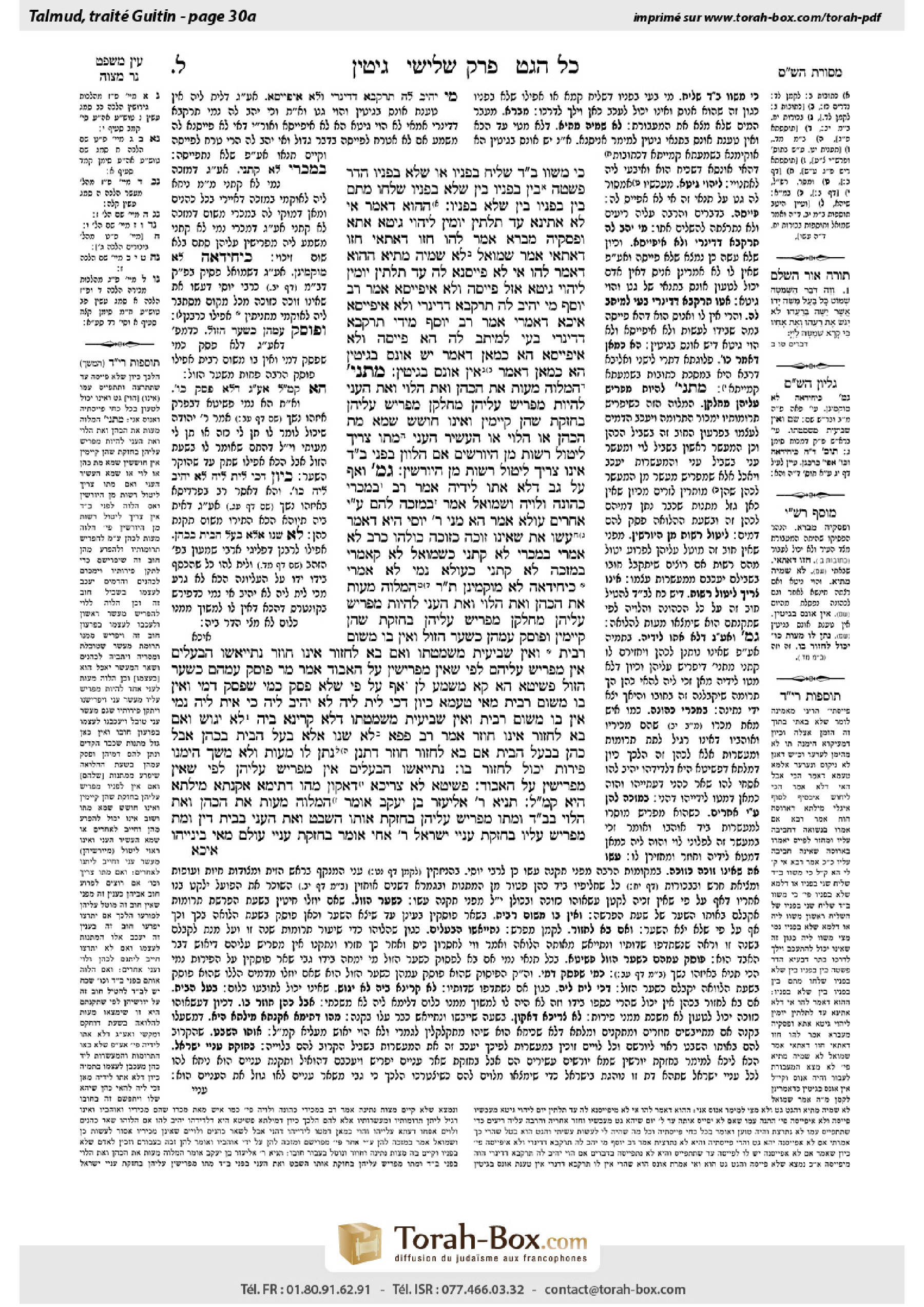
Gittin 30a: Talmud study for Daf Yomi
Study the Talmud for Daf Yomi with scanned pages, Hebrew text, English translations from Sefaria and AI-generated French translations.
Passage selection and English or AI-generated French translation are available where the scan has annotations. Daf Study is independent of Torah-Box and Sefaria.
Browse Gittin · גיטין · All tractatesGittin 30a text and translations
This page of Gittin includes the Aramaic text, an English translation and an AI-generated French translation, alongside the scan above.
גיטין ל׳ א · Aramaic and Hebrew text
כִּי מְשַׁוּוּ בֵּית דִּין שָׁלִיחַ; בְּפָנָיו, אוֹ שֶׁלֹּא בְּפָנָיו? הֲדַר פַּשְׁטַהּ: בֵּין בְּפָנָיו בֵּין שֶׁלֹּא בְּפָנָיו. שְׁלַחוּ מִתָּם: בֵּין בְּפָנָיו בֵּין שֶׁלֹּא בְּפָנָיו.
הָהוּא דַּאֲמַר: אִי לָא אָתֵינָא עַד תְּלָתִין יוֹמִין – לֶיהֱוֵי גִּיטָּא. אֲתָא וּפַסְקֵיהּ מַבָּרָא. אֲמַר לְהוּ: ״חֲזוֹ דַּאֲתַאי״, ״חֲזוֹ דַּאֲתַאי״. אֲמַר שְׁמוּאֵל: לָא שְׁמֵיהּ מַתְיָא.
הָהוּא דַּאֲמַר לְהוּ: אִי לָא [מְ]פַיֵּיסְנָא לַהּ עַד תְּלָתִין יוֹמִין – לֶיהֱוֵי גִּיטָּא. אֲזַל פַּיְּיסַהּ, וְלָא אִיפַּיַּיסָא. אָמַר רַב יוֹסֵף: מִי יְהַב לַהּ תַּרְקַבָּא דְּדִינָרֵי וְלָא אִיפַּיַּיסָא?!
אִיכָּא דְּאָמְרִי, אָמַר רַב יוֹסֵף: מִידֵּי תַּרְקַבָּא דְּדִינָרֵי בָּעֵי לְמִיתַּב לַהּ?! הָא פַּיְּיסַהּ, וְלָא אִיפַּיַּיסָא.
הָא – כְּמַאן דְּאָמַר יֵשׁ אוֹנֶס בְּגִיטִּין, הָא – כְּמַאן דְּאָמַר אֵין אוֹנֶס בְּגִיטִּין.
מַתְנִי׳ הַמַּלְוֶה מָעוֹת אֶת הַכֹּהֵן וְאֶת הַלֵּוִי וְאֶת הֶעָנִי, לִהְיוֹת מַפְרִישׁ עֲלֵיהֶן מֵחֶלְקָן; מַפְרִישׁ עֲלֵיהֶן בְּחֶזְקַת שֶׁהֵן קַיָּימִין, וְאֵינוֹ חוֹשֵׁשׁ שֶׁמָּא מֵת הַכֹּהֵן אוֹ הַלֵּוִי, אוֹ הֶעֱשִׁיר הֶעָנִי.
מֵתוּ – צָרִיךְ לִיטּוֹל רְשׁוּת מִן הַיּוֹרְשִׁים; אִם הִלְווֹן בִּפְנֵי בֵּית דִּין – אֵינוֹ צָרִיךְ לִיטּוֹל רְשׁוּת מִן הַיּוֹרְשִׁין.
גְּמָ׳ וְאַף עַל גַּב דְּלָא אָתוּ לִידֵיהּ?!
אָמַר רַב: בְּמַכָּרֵי כְּהוּנָּה וּלְוִיָּה. וּשְׁמוּאֵל אָמַר: בִּמְזַכֶּה לָהֶם עַל יְדֵי אֲחֵרִים. עוּלָּא אָמַר: הָא מַנִּי – רַבִּי יוֹסֵי הִיא, דְּאָמַר: עָשׂוּ אֶת שֶׁאֵינוֹ זוֹכֶה כְּזוֹכֶה.
כּוּלְּהוּ כְּרַב לָא אָמְרִי – בְּמַכָּרֵי לָא קָתָנֵי. כִּשְׁמוּאֵל לָא קָאָמְרִי – בִּמְזַכֶּה לָא קָתָנֵי. כְּעוּלָּא נָמֵי לָא אָמְרִי – כִּיחִידָאָה לָא מוֹקְמִינַן.
תָּנוּ רַבָּנַן: הַמַּלְוֶה מָעוֹת אֶת הַכֹּהֵן וְאֶת הַלֵּוִי וְאֶת הֶעָנִי, לִהְיוֹת מַפְרִישׁ עֲלֵיהֶן מֵחֶלְקָן, מַפְרִישׁ עֲלֵיהֶן בְּחֶזְקַת שֶׁהֵן קַיָּימִין;
וּפוֹסֵק עִמָּהֶן כְּשַׁעַר הַזּוֹל; וְאֵין בּוֹ מִשּׁוּם רִבִּית; וְאֵין שְׁבִיעִית מְשַׁמַּטְתּוֹ;
וְאִם בָּא לַחֲזוֹר – אֵינוֹ חוֹזֵר. נִתְיָיאֲשׁוּ הַבְּעָלִים – אֵין מַפְרִישׁ עֲלֵיהֶם, לְפִי שֶׁאֵין מַפְרִישִׁין עַל הָאָבוּד.
אָמַר מָר: פּוֹסֵק עִמָּהֶם כְּשַׁעַר הַזּוֹל – פְּשִׁיטָא! הָא קָא מַשְׁמַע לַן, אַף עַל פִּי שֶׁלֹּא פָּסַק – כְּמִי שֶׁפָּסַק דָּמֵי.
וְאֵין בּוֹ מִשּׁוּם רִבִּית – מַאי טַעְמָא? כֵּיוָן דְּכִי לֵית לֵיהּ – לָא יָהֵיב לֵיהּ, כִּי אִית לֵיהּ נָמֵי – אֵין בּוֹ מִשּׁוּם רִבִּית.
וְאֵין שְׁבִיעִית מְשַׁמַּטְתּוֹ – דְּלָא קָרֵינָא בֵּיהּ ״לֹא יִגּוֹשׂ״.
וְאִם בָּא לַחְזוֹר, אֵינוֹ חוֹזֵר – אָמַר רַב פָּפָּא: לֹא שָׁנוּ אֶלָּא בַּעַל הַבַּיִת בְּכֹהֵן; אֲבָל כֹּהֵן בְּבַעַל הַבַּיִת, אִם בָּא לַחְזוֹר – חוֹזֵר. דִּתְנַן: נָתַן לוֹ מָעוֹת וְלֹא מָשַׁךְ הֵימֶנּוּ פֵּירוֹת – יָכוֹל לַחְזוֹר בּוֹ.
נִתְיָיאֲשׁוּ הַבְּעָלִים אֵין מַפְרִישׁ עֲלֵיהֶן, לְפִי שֶׁאֵין מַפְרִישִׁין עַל הָאָבוּד – פְּשִׁיטָא! לָא צְרִיכָא, דַּאֲקוּן; מַהוּ דְּתֵימָא אֲקַנְתָּא מִילְּתָא הִיא, קָא מַשְׁמַע לַן.
תַּנְיָא, רַבִּי אֱלִיעֶזֶר בֶּן יַעֲקֹב אוֹמֵר: הַמַּלְוֶה מָעוֹת אֶת הַכֹּהֵן וְאֶת הַלֵּוִי בְּבֵית דִּין, וָמֵתוּ – מַפְרִישׁ עֲלֵיהֶן בְּחֶזְקַת אוֹתוֹ הַשֵּׁבֶט. וְאֶת הֶעָנִי בְּבֵית דִּין, וָמֵת – מַפְרִישׁ עָלָיו בְּחֶזְקַת עֲנִיֵּי יִשְׂרָאֵל. רַבִּי אַחַי אוֹמֵר: בְּחֶזְקַת עֲנִיֵּי עוֹלָם.
מַאי בֵּינַיְיהוּ?
Gittin 30a · English translation
When the court appoints a second agent, must they do so in the presence of the first agent, or may it be when not in his presence? He then resolves it: The second agent may be appointed either in his presence or not in his presence. Similarly, they sent from there, from Eretz Yisrael, this ruling: The court may appoint another agent either in the presence of the first agent or not in his presence.
§ The Gemara relates another incident, involving a certain man who said to the agents with whom he entrusted a bill of divorce: If I do not arrive from now until thirty days have passed, let this be a bill of divorce. He came at the end of the thirtieth day, but he was prevented from crossing the river by the fact that the ferry was located on the other side of the river, so he did not cross the river within the designated time. He said to the people across the river: See that I have arrived, see that I have arrived. Shmuel said: That is not considered to be an arrival, even though it is clear that he intended to arrive, so the bill of divorce is valid.
The Gemara relates: There was an incident involving a certain man who said to agents with whom he had deposited a bill of divorce: If I do not appease my wife within thirty days, let this be a bill of divorce. He went to appease her, but she was not appeased. Rav Yosef said: Did he give her a large vessel [tarkeva] full of dinars but she was not appeased? Although his inability to appease her was a result of his lack of financial means, since he did not properly fulfill his condition to appease her, the bill of divorce is valid.
There are those who say a different version of the statement, that Rav Yosef said: Did he need to give her a vessel full of dinars in order to appease her? This is a situation where he attempted to appease her, but she was not appeased. Therefore, he did fulfill his condition, and the bill of divorce is not effective, as it is not his fault that she was not appeased.
The Gemara explains the difference between the first and second versions of Rav Yosef’s statement: This second version, in which the bill of divorce does not take effect, is according to the one who says: Circumstances beyond one’s control have legal standing with regard to bills of divorce. Therefore, the bill of divorce is not valid, as the husband did all he could to appease her. This first version, in which the bill of divorce is valid, is according to the one who says: Circumstances beyond one’s control have no legal standing with regard to bills of divorce.
MISHNA: The mishna continues the discussion of the presumption that a person remains alive. With regard to one who lends money to a priest, or to a Levite, or to a poor person, with the understanding that he will separate their portion of the teruma and tithes from his produce on the basis of that money, i.e., he will subtract from the debt owed by the priest or Levite the value of the teruma and tithes separated from the produce, he may separate the teruma and tithes from his produce on the basis of that money with the presumption that they are still alive, and he need not be concerned that perhaps the priest or the Levite died in the interim, or that the poor person became rich and is no longer eligible to be given the poor man’s tithe. The priest or Levite benefits from this arrangement, as he receives his gifts up front in the form of a loan. The Israelite benefits in that he does not need to seek out a priest or Levite each time he has produce from which he must separate teruma and tithes.
If in fact they died, then he must obtain permission from the heirs in order to continue the arrangement. However, if he lent money to the deceased, and he stipulated in the presence of the court that the debt would be repaid in this manner, then he does not need to obtain permission from the heirs.
GEMARA: The mishna assumes that the priest, Levite, and poor person acquire the teruma and tithes that the creditor separates from his produce, but they agree at the time of the loan that the tithes and teruma will then be acquired by the creditor as payment of their debt. The Gemara asks: And can the priest, Levite, and poor person transfer possession of the terumot or tithes back to the creditor even though the produce did not come into their possession?
Rav says: This is stated with regard to associates of the priesthood and the Levites, i.e., people who have an arrangement with a specific priest or Levite to give him their teruma or tithes. The specific priest or Levite therefore has a presumptive status of ownership of the tithes or teruma and is considered to have acquired them. And Shmuel says: This is stated with regard to one who has the priest or Levite acquire the gifts through the act of acquisition of others, who acquire the teruma and tithes on their behalf. The lender is then able to reclaim the gifts as repayment of the loan. Ulla said: In accordance with whose opinion is this mishna? It is the opinion of Rabbi Yosei, who says in other contexts: The Sages, by means of an ordinance, rendered one who does not acquire like one who acquires. Here, too, the Sages instituted an ordinance to enable this arrangement.
The Gemara explains why each of the aforementioned Sages disagreed with the others. All the other Sages, i.e., Shmuel and Ulla, do not state their opinions in accordance with the opinion of Rav, because the mishna does not teach explicitly that the halakha is stated with regard to associates of the priesthood and the Levites. Rav and Ulla do not state their opinions in accordance with the opinion of Shmuel because the mishna does not teach that this halakha is stated with regard to one who has the priest or Levite acquire the gifts through the act of acquisition of others. Rav and Shmuel also do not state their opinions in accordance with the opinion of Ulla because we do not establish the mishna to be stated in accordance with an individual opinion, in this case Rabbi Yosei; rather, the assumption is that the ruling of the mishna is written in accordance with the majority opinion.
§ The Sages taught in a baraita (Tosefta 3:1): With regard to one who lends money to a priest, or to a Levite, or to a poor person with the understanding that he will separate their portion of the teruma and tithes from his produce on the basis of that money, he may separate the teruma and tithes from his produce on the basis of that money, with the presumption that they are still alive.
The baraita continues: And he may contract with them according to the low market rate, i.e., he may set a price for the gifts that he will separate in the future based on either their value at the time of the loan, or their value when they will be separated, whichever is lower. And this is not subject to the prohibition of interest, meaning that if the market rate falls, it will not be considered as though they are repaying in excess of the amount of the loan. And the Sabbatical Year does not cancel this loan; even after the Sabbatical Year, the lender may continue to collect his debt in this manner.
The baraita continues: And if the lender seeks to renege on this agreement, he may not renege. If the owner despaired of retrieving the loan, as he thought that he would not need to separate any teruma or tithes and therefore thought that he would not collect payment for the loan, although it later became clear that he was mistaken, he may not separate the teruma and tithes from his produce on the basis of that money, because one may not separate teruma and tithes on the basis of one’s loan that one had thought lost. Once he despaired of retrieving the loan, the sum of the loan is permanently acquired by the borrowers and the lender may not use the tithes and teruma to serve as repayment.
The Gemara clarifies the rulings of the baraita: The Master said: He may contract with them according to the low market rate. The Gemara asks: Isn’t this obvious? The Gemara answers: This teaches us that even though he did not contract explicitly that he would use the lower market price, he is considered like one who did so contract and may do so anyway.
The baraita also teaches: And this is not subject to the prohibition of interest. The Gemara asks: What is the reason for this? The Gemara answers: Since, when the priest or Levite has no teruma or tithes that he received from the creditor, e.g., when the grain in the field did not sprout due to a drought, he does not give anything to the creditor in repayment of the loan, this indicates that it is not a true loan. Therefore, when the priest or Levite has teruma and tithes, this also is not subject to the prohibition of interest.
The baraita also teaches: And the Sabbatical Year does not cancel this loan. The Gemara explains: The reason is that concerning this loan, one cannot read the verse stated with regard to the cancellation of debts by the occurrence of the Sabbatical Year: “He shall not exact it of his neighbor and his brother; because the Lord’s release has been proclaimed” (Deuteronomy 15:2). Since in any event one cannot claim repayment of this type of loan, it is not addressed by the verse in question.
The baraita also teaches: And if the lender seeks to renege on this agreement, he cannot renege. Rav Pappa said: They taught this only with regard to a homeowner, i.e., an owner of produce, who wishes to renege on his agreement with a priest. In that situation, the homeowner cannot demand repayment of the loan with money. However, with regard to a priest who wishes to renege on his agreement with a homeowner, if he seeks to renege, he may renege. What is the reason for this? As we learned in a mishna (Bava Metzia 44a): In any transaction, if the purchaser gave the seller money but did not yet pull the produce, then the seller can renege on the sale. Here, since the priest received money and the homeowner did not yet formally acquire the produce, the priest can renege on the agreement.
The baraita also teaches: If the owner despaired of retrieving the loan, he may not separate the teruma and tithes from his produce on the basis of that money because one may not separate teruma and tithes on the basis of a loan that he had thought lost. The Gemara asks: Isn’t this obvious, as he is no longer owed the money? The Gemara answers: No, it is necessary to teach this halakha in a case where the seeds produced stalks and became dried out. Lest you say that growth of stalks is a significant matter, as there is a chance that the produce will still grow and so he does not fully despair, the baraita teaches us that even in such a situation, since the produce is very unlikely to recover, he does despair of retrieving the loan.
§ It is taught in a baraita (Tosefta 3:1) that Rabbi Eliezer ben Ya’akov says: With regard to one who lends money to a priest or to a Levite in court and they died before repaying the loan, he separates teruma and tithes on the basis of that money with the presumption that there is one from that tribe who inherited from them, and he need not confirm that the deceased priest or Levite has immediate heirs. He then continues the arrangement based on the transfer of the debt to the heirs. And if he lent money to a poor person in court, and the poor person died before repaying the loan, the creditor separates tithes on the basis of that money with the presumption that the poor of the Jewish people would agree to continue the arrangement. Rabbi Aḥai says: It is with the presumption that the poor of the world would agree to continue the arrangement.
The Gemara asks: What is the difference between the opinion of Rabbi Eliezer ben Ya’akov and the opinion of Rabbi Aḥai? Rabbi Aḥai too must have meant only poor Jews and not poor gentiles, who are not given tithes.
Gittin 30a · Traduction française (IA)
Lorsque le tribunal désigne un deuxième agent, doit-il le faire en présence du premier agent, ou peut-il le faire en son absence ? Il résout alors la question : Le deuxième agent peut être désigné soit en présence du première agent, soit en son absence. De même, ils ont envoyé depuis Eretz Yisrael cette décision : Le tribunal peut désigner un autre agent soit en présence du premier agent, soit en son absence.
§ La Guemara rapporte un autre incident, concernant un certain homme qui a dit aux agents avec lesquels il avait confié un divorce : Si je n'arrive pas d'ici à ce que trente jours aient passé, que ce soit un divorce. Il est arrivé à la fin du trentième jour, mais il a été empêché de traverser le fleuve en raison du fait que le bateau était situé de l'autre côté du fleuve, donc il n'a pas traversé le fleuve dans le délai prévu. Il a dit aux gens de l'autre côté du fleuve : Voyez que je suis arrivé, voyez que je suis arrivé. Shmuel a dit : Cela ne constitue pas un arrivé, même si c'est clair qu'il avait l'intention d'arriver, donc le divorce est valide.
La Guemara rapporte : Il y avait un incident concernant un certain homme qui a dit aux agents avec lesquels il avait déposé un divorce : Si je n'apaise pas ma femme dans les trente jours, que ce soit un divorce. Il est allé l'apaiser, mais elle n'a pas été apaisée. Rav Yosef a dit : A-t-il donné à sa femme un grand récipient rempli de dinars mais elle n'a pas été apaisée ? Bien que son incapacité à l'apaiser soit due à son manque de moyens financiers, puisque il n'a pas correctement rempli sa condition d'apaiser sa femme, le divorce est valide.
Certains disent une autre version de la déclaration, que Rav Yosef a dit : A-t-il eu besoin de lui donner un récipient rempli de dinars pour l'apaiser ? C'est une situation où il a tenté d'apaiser sa femme, mais elle n'a pas été apaisée. Par conséquent, il a accompli sa condition, et le divorce n'est pas valide, car ce n'est pas sa faute si elle n'a pas été apaisée.
La Guemara explique la différence entre la première et la deuxième version de la déclaration de Rav Yosef : Cette deuxième version, dans laquelle le divorce ne prend effet, est selon celui qui dit : Les circonstances au-delà de son contrôle ont une portée juridique concernant les divorces. Par conséquent, le divorce n'est pas valide, car l'homme a fait tout ce qu'il pouvait pour l'apaiser. Cette première version, dans laquelle le divorce est valide, est selon celui qui dit : Les circonstances au-delà de son contrôle n'ont pas de portée juridique concernant les divorces.
MICHNA : La Michna continue la discussion de la présomption qu'une personne est encore vivante. Concernant celui qui prête de l'argent à un prêtre, ou à un Lévite, ou à un pauvre, avec l'intention qu'il sépare sa part de terouma et de dîmes de ses récoltes en fonction de cet argent, c'est-à-dire qu'il retranche de la dette du prêtre ou du Lévite la valeur de la terouma et des dîmes séparées des récoltes, il peut séparer la terouma et les dîmes de ses récoltes en fonction de cet argent avec la présomption qu'ils sont encore vivants, et il n'a pas besoin de s'inquiéter du fait que peut-être le prêtre ou le Lévite est mort entre-temps, ou que le pauvre est devenu riche et n'est plus éligible à recevoir la dîme du pauvre. Le prêtre ou le Lévite bénéficie de ce dispositif, car il reçoit ses dons à l'avance sous forme de prêt. L'Israelite bénéficie également, car il n'a pas besoin de chercher un prêtre ou un Lévite chaque fois qu'il a des récoltes à partir desquelles il doit séparer la terouma et les dîmes.
Si, en effet, ils sont morts, il doit obtenir le consentement des héritiers afin de poursuivre l'arrangement. Cependant, s'il a prêté de l'argent au défunt et s'il a stipulé en présence du tribunal que la dette serait remboursée ainsi, il n'a pas besoin d'obtenir le consentement des héritiers.
GUEMARA : La Michna suppose que le prêtre, le Lévite et le pauvre acquièrent la terouma et les dîmes que le créancier sépare de ses récoltes, mais ils conviennent à l'époque du prêt que les dîmes et la terouma seront acquis par le créancier comme paiement de leur dette. La Guemara pose la question : Et peut le prêtre, le Lévite et le pauvre transférer la possession des terouma ou des dîmes au créancier même si les récoltes n'ont pas été acquis par eux ?
Rav dit : Cela est dit concernant les associés du clergé et des Lévites, c'est-à-dire les personnes ayant un arrangement avec un prêtre ou un Lévite spécifique pour lui donner leur terouma ou leurs dîmes. Le prêtre ou le Lévite spécifique a donc un statut présomptif d'acquisition des dîmes ou de la terouma et est considéré comme l'ayant acquis. Et Shmuel dit : Cela est dit concernant celui qui fait acquérir les dons par le prêtre ou le Lévite grâce à l'acte d'acquisition d'autres personnes, qui acquièrent la terouma et les dîmes à leur place. Le prêteur peut alors récupérer les dons comme paiement du prêt. Ulla a dit : Selon l'opinion de qui est cette Michna ? C'est l'opinion de Rabbi Yosei, qui dit dans d'autres contextes : Les Sages, par l'intermédiaire d'un ordonnance, ont rendu celui qui n'acquiert pas comme celui qui acquiert. Ici aussi, les Sages ont institué un ordonnance pour permettre cet arrangement.
La Guemara explique pourquoi chacun des Sages mentionnés ci-dessus a désaccordé avec les autres. Tous les autres Sages, c'est-à-dire Shmuel et Ulla, ne déclarent pas leurs opinions conformément à celle de Rav, car la Michna ne précise pas explicitement que la halakha est établie concernant les associés du clergé et des Lévites. Rav et Ulla ne déclarent pas leurs opinions conformément à celle de Shmuel car la Michna ne précise pas que cette halakha est établie concernant celui qui fait acquérir les dons par le prêtre ou le Lévite grâce à l'acte d'acquisition d'autres personnes. Rav et Shmuel ne déclarent pas non plus leurs opinions conformément à celle d'Ulla car nous ne fondons pas la Michna sur l'opinion d'un individu, dans ce cas Rabbi Yosei ; plutôt, l'hypothèse est que la décision de la Michna est écrite conformément à l'opinion majoritaire.
§ Les Sages ont enseigné dans une baraïta (Tosefta 3:1) : Concernant celui qui prête de l'argent à un prêtre, ou à un Lévite, ou à un pauvre, en sachant qu'il séparera leur part de la terouma et des dîmes à partir de ses récoltes en fonction de cet argent, il peut séparer la terouma et les dîmes à partir de ses récoltes en fonction de cet argent, en supposant qu'ils sont encore vivants.
La baraïta continue : Et il peut conclure un accord avec eux selon le taux du marché bas, c'est-à-dire qu'il peut fixer un prix pour les dons qu'il séparera à l'avenir, soit selon leur valeur au moment du prêt, soit selon leur valeur au moment de leur séparation, selon la valeur la plus basse. Et cela n'est pas soumis à l'interdiction d'intérêt, ce qui signifie que si le taux du marché baisse, cela ne sera pas considéré comme un remboursement supérieur au montant du prêt. L'année sabbatique n'annule pas ce prêt ; même après l'année sabbatique, le prêteur peut continuer à récupérer son dette de cette manière.
La baraïta continue : Et si le prêteur tente de rompre cet accord, il ne peut pas le faire. Si l'emprunteur a perdu espoir de récupérer le prêt, en pensant qu'il ne devrait pas séparer de la terouma ou des dîmes et donc qu'il ne pourrait pas récupérer le prêt, bien qu'il s'avère plus tard qu'il s'était trompé, il ne peut pas séparer la terouma et les dîmes à partir de ses récoltes en fonction de cet argent, car on ne peut pas séparer la terouma et les dîmes en fonction d'un prêt que l'on croyait perdu. Une fois qu'il a perdu espoir de récupérer le prêt, le montant du prêt est définitivement acquis par les emprunteurs et le prêteur ne peut pas utiliser les dîmes et la terouma pour servir de remboursement.
La Guemara clarifie les décisions de la baraïta : Le Maître dit : Il peut conclure un accord avec eux selon le taux du marché bas. La Guemara demande : N'est-ce pas évident ? La Guemara répond : Cela nous apprend que même s'il n'a pas explicitement conclu un accord pour utiliser le taux du marché bas, il est considéré comme s'il avait conclu un tel accord et peut le faire de toute façon.
La baraïta enseigne également : Et cela n'est pas soumis à l'interdiction d'intérêt. La Guemara demande : Quelle est la raison de cela ? La Guemara répond : Parce que, lorsque le prêtre ou le Lévite n'a pas de terouma ou de dîmes qu'il a reçus du prêteur, par exemple, lorsque les céréales du champ n'ont pas germé en raison d'une sécheresse, il ne donne rien au prêteur en réparation du prêt, ce qui indique qu'il ne s'agit pas d'un prêt réel. Ainsi, lorsque le prêtre ou le Lévite a des terouma et des dîmes, cela n'est pas non plus soumis à l'interdiction d'intérêt.
La baraïta enseigne également : Et l'année sabbatique n'annule pas ce prêt. La Guemara explique : La raison est que concernant ce prêt, on ne peut pas interpréter la versette mentionnant l'annulation des dettes en raison de l'année sabbatique : « Il ne doit pas exiger cela de son voisin et de son frère ; car la libération du Seigneur a été proclamée » (Deutéronome 15:2). Puisque, de toute façon, on ne peut pas réclamer le remboursement de ce type de prêt, il n'est pas abordé par cette versette.
La baraïta enseigne également : Et si le prêteur tente de rompre cet accord, il ne peut pas le faire. Rav Pappa dit : Ils enseignent cela uniquement concernant un propriétaire, c'est-à-dire un propriétaire de récoltes, qui souhaite rompre son accord avec un prêtre. Dans ce cas, le propriétaire ne peut pas exiger le remboursement du prêt en argent. Cependant, concernant un prêtre qui souhaite rompre son accord avec un propriétaire, s'il tente de rompre, il peut le faire. Quelle est la raison de cela ? Comme nous l'avons appris dans une mitsva (Bava Metzia 44a) : Dans toute transaction, si l'acheteur a donné de l'argent au vendeur mais n'a pas encore retiré les récoltes, le vendeur peut rompre la vente. Ici, puisque le prêtre a reçu de l'argent et que le propriétaire n'a pas encore acquis formellement les récoltes, le prêtre peut rompre l'accord.
La baraïta enseigne également : Si l'propriétaire a perdu espoir de récupérer le prêt, il ne peut pas séparer la terouma et les dîmes à partir de ses récoltes en fonction de cet argent, car on ne peut pas séparer la terouma et les dîmes en fonction d'un prêt que l'on croyait perdu. La Guemara demande : N'est-ce pas évident, puisqu'il n'est plus dû l'argent ? La Guemara répond : Non, il est nécessaire d'enseigner cette halakha dans un cas où les graines ont produit des tiges et sont devenues sèches. De peur que la croissance des tiges soit une affaire importante, car il y a une chance que les récoltes puissent encore pousser et donc qu'il ne désespère pas totalement, la baraïta nous apprend que même dans ce cas, puisque les récoltes ont peu de chances de se récupérer, il désespère de récupérer le prêt.
§ Il est enseigné dans une baraïta (Tosefta 3:1) que Rabbi Eliezer ben Ya'akov dit : Concernant celui qui prête de l'argent à un prêtre ou à un Lévite devant un tribunal et qu'ils meurent avant de rembourser le prêt, il sépare la terouma et les dîmes en fonction de cet argent en supposant qu'il y a un membre de cette tribu qui a hérité d'eux, et il n'a pas besoin de confirmer que le prêtre ou le Lévite décédé a des héritiers immédiats. Il continue alors l'arrangement en fonction du transfert de la dette aux héritiers. Et si l'on prête de l'argent à un pauvre devant un tribunal, et que le pauvre meurt avant de rembourser le prêt, le créancier sépare les dîmes en fonction de cet argent en supposant que les pauvres du peuple juif accepteront de continuer l'arrangement. Rabbi Aḥai dit : C'est en supposant que les pauvres du monde accepteront de continuer l'arrangement.
La Guemara demande : Quelle est la différence entre l'opinion de Rabbi Eliezer ben Ya'akov et celle de Rabbi Aḥai ? Rabbi Aḥai a aussi dû entendre seulement les pauvres juifs et non les pauvres gentils, qui ne sont pas donnés des dîmes.
Traduction française générée par IA à partir de l’édition anglaise de Sefaria. Vérifie toujours un passage avec le texte source.
Text from Sefaria: William Davidson Edition - Vocalized Aramaic (CC BY NC); William Davidson Edition - English (CC BY NC).