Gittin 2b: Talmud study for Daf Yomi
Study the Talmud for Daf Yomi with scanned pages, Hebrew text, English translations from Sefaria and AI-generated French translations.
Passage selection and English or AI-generated French translation are available where the scan has annotations. Daf Study is independent of Torah-Box and Sefaria.
Browse Gittin · גיטין · All tractatesGittin 2b text and translations
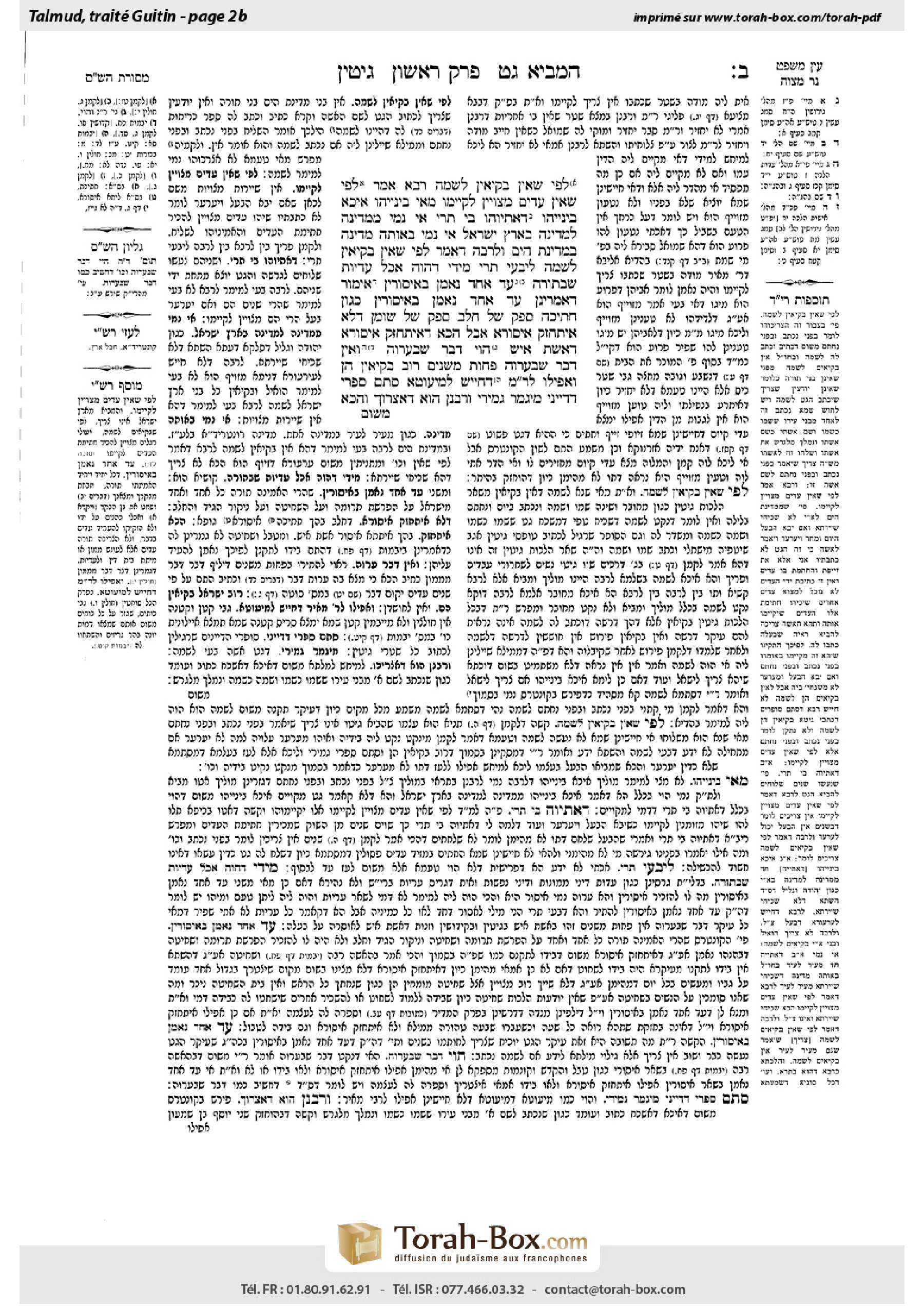
This page of Gittin includes the Aramaic text, an English translation and an AI-generated French translation, alongside the scan above.
גיטין ב׳ ב · Aramaic and Hebrew text
לְפִי שֶׁאֵין בְּקִיאִין לִשְׁמָהּ.
רָבָא אָמַר: לְפִי שֶׁאֵין עֵדִים מְצוּיִין לְקַיְּימוֹ.
מַאי בֵּינַיְיהוּ? אִיכָּא בֵּינַיְיהוּ דְּאַתְיוּהוּ בֵּי תְרֵי. אִי נָמֵי, מִמְּדִינָה לִמְדִינָה בְּאֶרֶץ יִשְׂרָאֵל.
אִי נָמֵי, בְּאוֹתָהּ מְדִינָה בִּמְדִינַת הַיָּם.
וּלְרַבָּה דְּאָמַר לְפִי שֶׁאֵין בְּקִיאִין לִשְׁמָהּ – לִיבְעֵי תְּרֵי, מִידֵּי דְּהָוֵה אַכֹּל עֵדֻיוֹת שֶׁבַּתּוֹרָה! עֵד אֶחָד נֶאֱמָן בְּאִיסּוּרִין.
אֵימוֹר דְּאָמְרִינַן עֵד אֶחָד נֶאֱמָן בְּאִיסּוּרִין, כְּגוֹן חֲתִיכָה סָפֵק שֶׁל חֵלֶב סָפֵק שֶׁל שׁוּמָּן, דְּלָא אִיתַּחְזַק אִיסּוּרָא;
אֲבָל הָכָא, דְּאִיתַּחְזַק אִיסּוּרָא דְּאֵשֶׁת אִישׁ, הָוֵי דָּבָר שֶׁבָּעֶרְוָה; וְאֵין דָּבָר שֶׁבְּעֶרְוָה פָּחוֹת מִשְּׁנַיִם!
רוֹב בְּקִיאִין הֵן. וַאֲפִילּוּ לְרַבִּי מֵאִיר דְּחָיֵישׁ לְמִיעוּטָא – סְתָם סָפְרֵי דְּדַיָּינֵי מִיגְמָר גְּמִירִי, וְרַבָּנַן הוּא דְּאַצְרוּךְ; וְהָכָא
Gittin 2b · English translation
It is because the people who live overseas are not experts in writing a bill of divorce for her sake. It is not sufficient for a bill of divorce to be written in a technically correct manner. It must also be written for the sake of the man and the woman who are divorcing. Therefore, when the witness comes before the court and says that it was written and signed in his presence, he is testifying that the writing and the signing of the bill of divorce were performed for the sake of the man and woman in question.
Rava says a different reason: It is because there are no witnesses available to ratify it. Since the bill of divorce was written in a distant place, it is possible that the husband, or someone else, might later claim that the bill of divorce is a forgery. For this reason the agent must say that the bill of divorce was written and signed in his presence, a declaration that bars any subsequent objection on the part of the husband.
The Gemara asks: What is the difference between these two explanations? The Gemara answers: There is a difference between them with regard to a case where two people brought the bill of divorce. In this case, two witnesses are available to ratify the bill of divorce if someone objects to its validity. Alternatively, the difference concerns a case where the agent brings the bill of divorce from one region to another region within Eretz Yisrael. Here there is no concern that the bill of divorce might not have been written for her sake, as the residents of Eretz Yisrael are aware of this requirement. However, witnesses are not necessarily available to confirm the document.
Alternatively, there is a difference between the two explanations in a case where the agent brings the bill of divorce within that same region in a country overseas. According to the opinion of Rabba, who says the concern is that the people there might not know that the document must be written for her sake, this problem is equally relevant in this case. However, according to the opinion of Rava, who says that the reason is because witnesses are not available, if the bill of divorce is brought in the same region then the witnesses will be available to ratify it.
The Gemara asks: And according to the opinion of Rabba, who said that the reason is because they are not experts in writing a bill of divorce for her sake, let us require two witnesses to testify about this, just as is the case with regard to all testimonies in the Torah. The Gemara answers: One witness is deemed credible with regard to prohibitions. In other words, if there is uncertainty as to whether a matter is prohibited or permitted, in the case of the heretofore married woman, the testimony of one witness is sufficient.
The Gemara asks: One can say that we say one witness is deemed credible with regard to prohibitions in a case such as where there is a piece of fat, and it is uncertain if it is forbidden fat [ḥelev] and uncertain if it is permitted fat. In this situation the piece can be rendered permitted by a single witness, as there is no presumption that it is forbidden. Therefore, as there is an uncertainty, and one witness said it is permitted fat, he is deemed credible.
However, here, where there is a presumption that this woman is forbidden, as she is a married woman, a status she retains until it is established that she has received a bill of divorce, if so, this is a matter of forbidden sexual relations, and the general principle is that there is no matter of testimony for forbidden sexual relations that can be attested to by fewer than two witnesses.
The Gemara answers: Rabba’s concern is not equivalent to a case of uncertainty, as most Jewish people are experts in the requirement that a bill of divorce must be written for the woman’s sake. And this is so even according to the opinion of Rabbi Meir, who is generally concerned about a minority in a matter of forbidden sexual relations. In this case Rabbi Meir concedes that one need not be concerned for the minority, as ordinary judicial scribes, who write bills of divorce, are learned in this halakha, and know that a bill of divorce must be written for the woman’s sake. And it is the Sages who required testimony about this matter, as an extra precaution. And here, with regard to this testimony,
Gittin 2b · Traduction française (IA)
C'est parce que les gens qui habitent à l'étranger ne sont pas des experts pour rédiger un acte de divorce en son nom. Il n'est pas suffisant que l'acte de divorce soit rédigé correctement sur le plan technique. Il doit aussi être rédigé en faveur du mari et de la femme qui divorcent. Ainsi, lorsque le témoin s'adresse devant la cour et dit qu'il a été rédigé et signé en sa présence, il témoigne que la rédaction et la signature de l'acte de divorce ont été effectuées en faveur du mari et de la femme en question.
Rava dit une raison différente : C'est parce qu'il n'y a pas de témoins disponibles pour valider l'acte. Puisque l'acte de divorce a été rédigé dans un lieu éloigné, il est possible que le mari ou quelqu'un d'autre affirme ultérieurement que l'acte de divorce est un faux. Pour cette raison, l'agent doit dire que l'acte de divorce a été rédigé et signé en sa présence, une déclaration qui empêche toute objection ultérieure de la part du mari.
La Guemara pose la question : Quelle est la différence entre ces deux explications ? La Guemara répond : Il y a une différence concernant un cas où deux personnes ont apporté l'acte de divorce. Dans ce cas, deux témoins sont disponibles pour valider l'acte de divorce si quelqu'un conteste sa validité. Alternativement, la différence concerne un cas où l'agent apporte l'acte de divorce d'une région à une autre région en Terre d'Israël. Ici, il n'y a pas de préoccupation que l'acte de divorce n'ait pas été rédigé en son nom, car les habitants de Terre d'Israël sont conscients de cette exigence. Cependant, les témoins ne sont pas nécessairement disponibles pour confirmer le document.
Alternativement, il y a une différence entre les deux explications dans un cas où l'agent apporte l'acte de divorce dans la même région d'un pays étranger. Selon l'opinion de Rabba, qui dit que la préoccupation est que les gens là-bas ne connaissent pas le fait que le document doit être rédigé en son nom, ce problème est également pertinent dans ce cas. Cependant, selon l'opinion de Rava, qui dit que la raison est que les témoins ne sont pas disponibles, si l'acte de divorce est apporté dans la même région, les témoins seront disponibles pour valider l'acte.
La Guemara pose la question : Et selon l'opinion de Rabba, qui dit que la raison est qu'ils ne sont pas des experts pour rédiger un acte de divorce en son nom, exigeons-nous deux témoins pour témoigner à ce sujet, comme c'est le cas pour tous les témoignages dans la Torah. La Guemara répond : Un témoin est considéré comme crédible concernant les prohibitions. En d'autres termes, si on est incertain quant à ce que quelque chose est interdit ou permis, dans le cas d'une femme mariée, le témoignage d'un seul témoin est suffisant.
La Guemara pose la question : On peut dire que nous disons qu'un témoin est considéré comme crédible concernant les prohibitions dans un cas tel que celui d'un morceau de graisse, et on est incertain s'il s'agit de graisse interdite [ḥelev] ou s'il s'agit de graisse permise. Dans ce cas, le morceau peut être rendu permis par un seul témoin, car il n'y a pas de présomption qu'il s'agit de graisse interdite. Ainsi, comme il y a une incertitude, et que le témoin a dit qu'il s'agit de graisse permise, il est considéré comme crédible.
Cependant, ici, où il y a une présomption que cette femme est interdite, car elle est une femme mariée, un statut qu'elle conserve jusqu'à ce qu'il soit établi qu'elle a reçu un acte de divorce, si tel est le cas, il s'agit d'une question de relations sexuelles interdites, et le principe général est que toute question de relations sexuelles interdites ne peut être attestée par moins de deux témoins.
La Guemara répond : La préoccupation de Rabba n'est pas équivalente à un cas d'incertitude, car la plupart des Juifs sont des experts sur la nécessité que l'acte de divorce soit rédigé en son nom. Et cela est vrai même selon l'opinion de Rabbi Meir, qui est généralement préoccupé par une minorité dans une question de relations sexuelles interdites. Dans ce cas, Rabbi Meir reconnaît qu'on n'a pas à craindre la minorité, car les scribes judiciaires ordinaires, qui rédigent des actes de divorce, sont instruits sur cette halakha, et savent qu'un acte de divorce doit être rédigé en son nom. Et c'est les Sages qui ont exigé un témoignage à ce sujet, comme mesure de précaution supplémentaire. Et ici, concernant ce témoignage,
Traduction française générée par IA à partir de l’édition anglaise de Sefaria. Vérifie toujours un passage avec le texte source.
Text from Sefaria: William Davidson Edition - Vocalized Aramaic (CC BY NC); William Davidson Edition - English (CC BY NC).