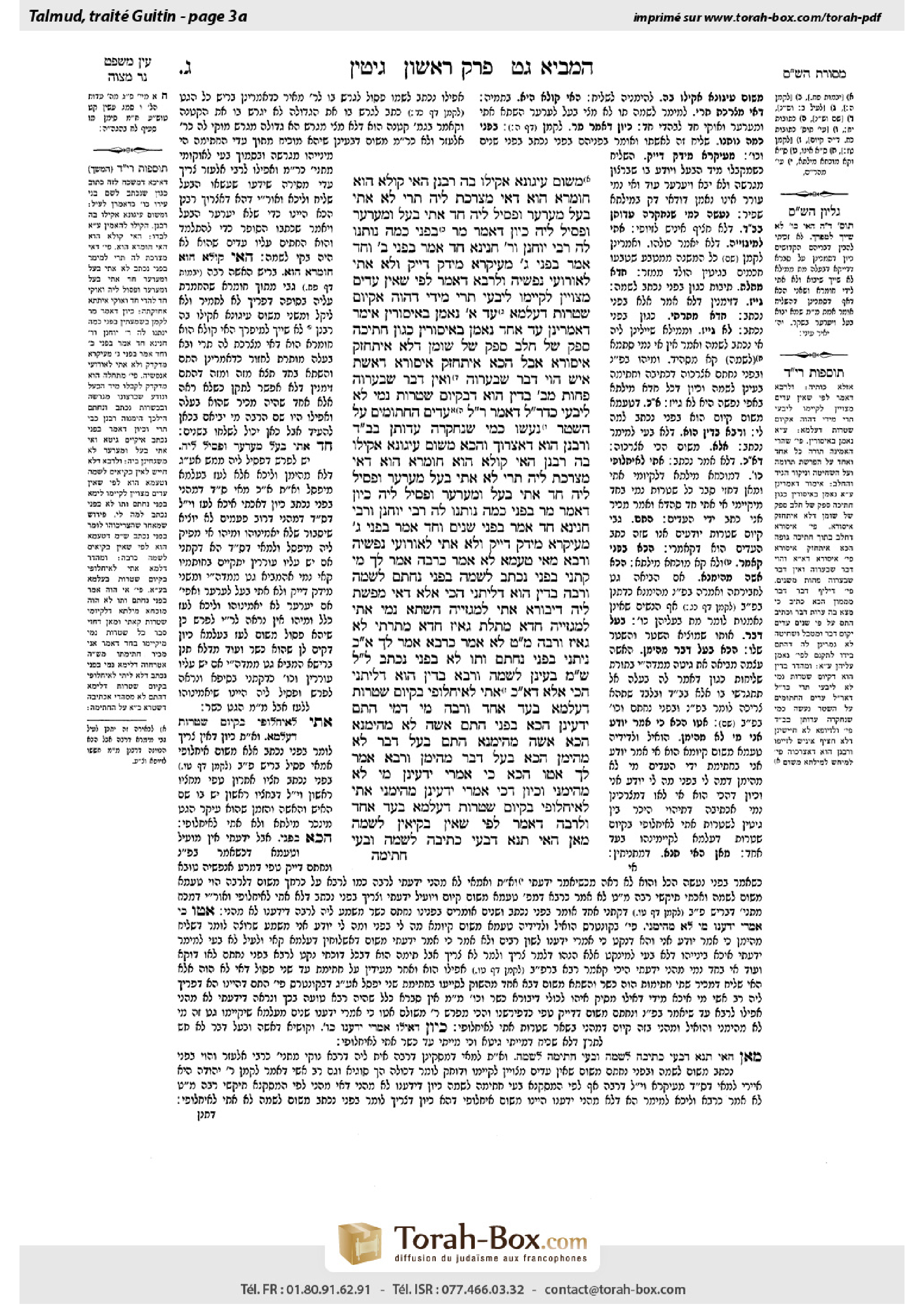
Gittin 3a: Talmud study for Daf Yomi
Study the Talmud for Daf Yomi with scanned pages, Hebrew text, English translations from Sefaria and AI-generated French translations.
Passage selection and English or AI-generated French translation are available where the scan has annotations. Daf Study is independent of Torah-Box and Sefaria.
Browse Gittin · גיטין · All tractatesGittin 3a text and translations
This page of Gittin includes the Aramaic text, an English translation and an AI-generated French translation, alongside the scan above.
גיטין ג׳ א · Aramaic and Hebrew text
מִשּׁוּם עִיגּוּנָא אַקִּילוּ בַּהּ רַבָּנַן.
הַאי קוּלָּא הוּא?! חוּמְרָא הוּא! דְּאִי מַצְרְכַתְּ לֵיהּ תְּרֵי – לָא אָתֵי בַּעַל מְעַרְעֵר וּפָסֵיל לֵיהּ; חַד – אָתֵי בַּעַל וּמְעַרְעֵר וּפָסֵיל לֵיהּ!
כֵּיוָן דְּאָמַר מָר: בִּפְנֵי כַּמָּה נוֹתְנוֹ לָהּ? רַבִּי יוֹחָנָן וְרַבִּי חֲנִינָא; חַד אָמַר: בִּפְנֵי שְׁנַיִם, וְחַד אָמַר: בִּפְנֵי שְׁלֹשָׁה; מֵעִיקָּרָא מִידָּק דָּיֵיק, וְלָא אָתֵי לְאוֹרוֹעֵי נַפְשֵׁיהּ.
וּלְרָבָא דְּאָמַר לְפִי שֶׁאֵין עֵדִים מְצוּיִין לְקַיְּימוֹ – לִיבְעֵי תְּרֵי, מִידֵּי דְּהָוֵה אַקִּיּוּם שְׁטָרוֹת דְּעָלְמָא! עֵד אֶחָד נֶאֱמָן בְּאִיסּוּרִין.
אֵימַר דְּאָמְרִינַן עֵד אֶחָד נֶאֱמָן בְּאִיסּוּרִין, כְּגוֹן חֲתִיכָה סָפֵק שֶׁל חֵלֶב סָפֵק שֶׁל שׁוּמָּן, דְּלָא אִיתַּחְזַק אִיסּוּרָא; אֲבָל הָכָא אִיתַּחְזַק אִיסּוּרָא דְּאֵשֶׁת אִישׁ – הָוֵי דָּבָר שֶׁבָּעֶרְוָה, וְאֵין דָּבָר שֶׁבָּעֶרְוָה פָּחוֹת מִשְּׁנַיִם!
בְּדִין הוּא דִּבְקִיּוּם שְׁטָרוֹת נָמֵי לָא לִיבְעֵי, כִּדְרֵישׁ לָקִישׁ – דְּאָמַר רֵישׁ לָקִישׁ: עֵדִים הַחֲתוּמִים עַל הַשְּׁטָר, נַעֲשׂוּ כְּמִי שֶׁנֶּחְקְרָה עֵדוּתָן בְּבֵית דִּין – וְרַבָּנַן הוּא דְּאַצְרוּךְ; וְהָכָא מִשּׁוּם עִיגּוּנָא אַקִּילוּ בַּהּ רַבָּנַן.
הַאי קוּלָּא הוּא?! חוּמְרָא הוּא! דְּאִי מַצְרְכַתְּ לֵיהּ תְּרֵי – לָא אָתֵי בַּעַל מְעַרְעֵר וּפָסֵיל לֵיהּ; חַד – אָתֵי בַּעַל וּמְעַרְעֵר וּפָסֵיל לֵיהּ! כֵּיוָן דְּאָמַר מָר: בִּפְנֵי כַּמָּה נוֹתְנוֹ לָהּ? רַבִּי יוֹחָנָן וְרַבִּי חֲנִינָא; חַד אָמַר: בִּפְנֵי שְׁנַיִם, וְחַד אָמַר: בִּפְנֵי שְׁלֹשָׁה; מֵעִיקָּרָא מִידָּק דָּיֵיק וְלָא אָתֵי לְאוֹרוֹעֵי נַפְשֵׁיהּ.
וְרָבָא, מַאי טַעְמָא לָא אָמַר כְּרַבָּה? אָמַר לָךְ: מִי קָתָנֵי ״בְּפָנַי נִכְתַּב לִשְׁמָהּ, בְּפָנַי נֶחְתַּם לִשְׁמָהּ״?!
וְרַבָּה? בְּדִין הוּא דְּלִיתְנֵי הָכִי, אֶלָּא דְּאִי מַפְּשַׁתְּ לֵיהּ דִּיבּוּרָא – אָתֵי לְמִגְזְּיֵיהּ.
הַשְׁתָּא נָמֵי אָתֵי לְמִגְזְּיֵיהּ! חֲדָא מִתְּלָת גָּאֵיז, חֲדָא מִתַּרְתֵּי לָא גָּאֵיז.
וְרַבָּה, מַאי טַעְמָא לָא אָמַר כְּרָבָא? אָמַר לָךְ: אִם כֵּן נִיתְנֵי ״בְּפָנַי נֶחְתַּם״ וְתוּ לָא; ״בְּפָנַי נִכְתַּב״ לְמָה לִי? שְׁמַע מִינַּהּ בָּעֵינַן לִשְׁמָהּ.
וְרָבָא? בְּדִין הוּא דְּלִיתְנֵי הָכִי, אֶלָּא דְּאִם כֵּן, אָתֵי לְאִיחַלּוֹפֵי בְּקִיּוּם שְׁטָרוֹת דְּעָלְמָא – בְּעֵד אֶחָד.
וְרַבָּה: מִי דָּמֵי?! הָתָם ״יָדְעִינַן״, הָכָא ״בְּפָנַי״;
הָתָם אִשָּׁה לָא מְהֵימְנָא, הָכָא אִשָּׁה מְהֵימְנָא; הָתָם בַּעַל דָּבָר לָא מְהֵימַן, הָכָא בַּעַל דָּבָר מְהֵימַן.
וְרָבָא אָמַר לָךְ: אַטּוּ הָכָא כִּי אָמְרִי ״יָדְעִינַן״ מִי לָא מְהֵימְנִי?! וְכֵיוָן דְּכִי אָמְרִי ״יָדְעִינַן״ מְהֵימְנִי, אָתֵי לְאִיחַלּוֹפֵי בְּקִיּוּם שְׁטָרוֹת דְּעָלְמָא – בְּעֵד אֶחָד.
וּלְרַבָּה דְּאָמַר לְפִי שֶׁאֵין בְּקִיאִין לִשְׁמָהּ, מַאן הַאי תַּנָּא דְּבָעֵי כְּתִיבָה לִשְׁמָהּ, וּבָעֵי
Gittin 3a · English translation
due to the possibility of desertion, i.e., that she may become like a deserted wife, the Sages were lenient with her by saying that the agent who brought the bill of divorce is deemed credible, despite the fact that he is a single witness. This is to prevent women from becoming uncertain of their marital status as a result of the lack of testimony needed to ratify the bill of divorce.
The Gemara asks: Is this ruling a leniency? It is a stringency, since if you require two witnesses to testify with regard to the bill of divorce, her husband cannot come to contest and invalidate it, as his testimony will not be accepted against that of the two witnesses. However, if only one agent brings the bill of divorce, the husband can come and contest and invalidate the document.
The Gemara answers: Since the Master says: In the presence of how many people must the agent who brings the bill of divorce give it to the woman? Rabbi Yoḥanan and Rabbi Ḥanina disagreed with regard to this issue. One said that he must deliver it to her in the presence of at least two people, and one said that he must deliver it to her in the presence of at least three people, as three individuals are considered a court. Therefore, at the outset the agent is careful to clarify the matter fully, and he will not act to his own detriment by bringing an invalid bill of divorce.
The Gemara asks: And according to the opinion of Rava, who said that the agent must say: It was written in my presence and it was signed in my presence, because there are no witnesses available to ratify it, let us require two witnesses, just as is the practice with regard to the typical case of ratification of legal documents, which must be performed via two witnesses. The Gemara answers as above: One witness is deemed credible with regard to prohibitions.
Again the Gemara asks: One can say that we say that one witness is deemed credible with regard to prohibitions in a case such as where there is a piece of fat, and it is uncertain if it is forbidden fat and uncertain if it is permitted fat. In this situation, the piece can be permitted by a single witness, as there is no presumption that it is forbidden. However, here there is a presumption that this woman is forbidden as a married woman. If so, this is a matter of forbidden sexual relations, and there is no matter of testimony for forbidden sexual relations that can be attested to by fewer than two witnesses.
The Gemara answers: By right it should be that with regard to the ratification of legal documents as well, the court should not require two witnesses, in accordance with the opinion of Reish Lakish. As Reish Lakish says: Witnesses signed on a legal document become like a pair of witnesses whose testimony has been examined in court, and the document should be accepted without further ratification. And it is the Sages who required the court to ratify documents. And here, with regard to bills of divorce, the Rabbis were lenient with her by allowing the document to be ratified through the agent’s testimony alone, due to the possibility of desertion.
The Gemara again asks: Is this ruling a leniency? It is a stringency, since if you require two witnesses to testify with regard to the bill of divorce, then her husband cannot come to contest and invalidate it, whereas if there is only one agent, her husband can come and contest and invalidate it. Once again the Gemara answers: Since the Master says: In the presence of how many people must the agent who brings the bill of divorce give it to the woman? Rabbi Yoḥanan and Rabbi Ḥanina disagreed with regard to this issue. One said that he must deliver it to her in the presence of at least two people, and one said that he must deliver it to her in the presence of at least three people, as three individuals are considered a court. Therefore, at the outset the agent is careful to clarify the matter fully, and he will not act to his own detriment by bringing an invalid bill of divorce.
After clarifying the basic dispute, the Gemara discusses the reasons for each opinion. And as for Rava, what is the reason that he did not say like Rabba, that the reason the agent must declare: It was written in my presence and it was signed in my presence, is due to the concern that the bill of divorce was not written for the woman’s sake? The Gemara answers that Rava could have said to you: Is it taught in the mishna that the agent must say: It was written in my presence for her sake, and it was signed in my presence for her sake? Since the agent does not testify that it was written for her sake, this indicates that the Sages did not institute the requirement that he state this declaration to ensure that it was written for her sake.
The Gemara asks: And how does Rabba respond to this claim? The Gemara answers: By right it is so that the mishna should teach in this manner. However, the Sages did not require him to say this, as if you increase the agent’s requirement to speak, by obligating him to state this lengthy declaration, he will likely come to shorten it. If he has too much to remember, he might forget some of the formula, and his error will render the bill of divorce invalid.
The Gemara asks: Now too, with regard to the formula as it stands, he will come to shorten it by omitting either it was written in my presence or it was signed in my presence. The Gemara answers: He is likely to shorten it by omitting one term out of three, such as: For her sake, from the three-term clause: It was written, in my presence, for her sake. However, he will not shorten his declaration by omitting one term of two. Consequently, when asked if it was written in his presence, he will answer with the full statement, and the same is true when he is asked if it was signed in his presence.
The Gemara asks concerning the other opinion: And as for Rabba, what is the reason that he did not say like Rava, that the reason for the decree is because witnesses may not be available to ratify the bill of divorce? The Gemara answers that Rabba could have said to you: If so, let the mishna teach: It was signed in my presence, and nothing more, as this is a confirmation that the signatures of the witnesses on the document are valid. Why do I need the agent to add: It was written in my presence? Conclude from it that the reason for this decree is because we need the bill of divorce to be written for her sake.
The Gemara asks: And how does Rava respond to this claim? The Gemara answers: Rava would answer that by right it is so that the mishna should teach in this manner. But if this were to be so, that the agent declares merely: It was signed in my presence, people will come to confuse the matter with the typical case of ratification of legal documents. In other words, they will think it is possible to ratify other documents via the testimony of one witness. Consequently, the Sages added that the agent must also declare: It was written in my presence, which is not generally stated with regard to the confirmation of other documents.
The Gemara comments: And Rabba would respond as follows: There is no concern that people will confuse the ratification of a bill of divorce with the typical case of the ratification of legal documents, as are the two cases comparable at all? There, with regard to the ratification of other documents, the witnesses need only say: We know that these are the signatures of the witnesses on the document. By contrast, here, in the case of a bill of divorce, the agent must say: It was signed in my presence.
Additionally, there, in the case of other documents, a woman is not deemed credible, whereas here, a woman is deemed credible when she brings a bill of divorce and declares that it was written and signed in her presence. Additionally, there, in the case of other documents, an interested party is not deemed credible to testify concerning the validity of the document. However, here, an interested party is deemed credible, as even the woman herself can bring her bill of divorce and testify that it was drafted in the correct manner.
And Rava, how would he respond to this claim? He could have said to you: Is that to say that here, in the case of a bill of divorce, if the witnesses of ratification say: We know, they are not deemed credible? They would be deemed credible even if they used that formula. And since when they say: We know, they are deemed credible, people will come to confuse it with the typical case of ratification of legal documents, which they will perform via one witness.
The Gemara asks: And according to the opinion of Rabba, who said that the reason for the declaration: It was written in my presence and it was signed in my presence, is because they are not experts in writing a bill of divorce for her sake, who is this tanna who requires that the writing of the bill of divorce must be performed for her sake, and also requires
Gittin 3a · Traduction française (IA)
En raison de la possibilité de désertion, c'est-à-dire qu'elle puisse devenir une épouse déserte, les Sages ont été indulgents envers elle en disant que l'agent qui apporte le document de divorce est considéré comme crédible, malgré le fait qu'il soit un seul témoin. Cela vise à empêcher les femmes de devenir incertaines de leur statut marital en raison du manque de témoignage nécessaire pour valider le document de divorce.
La Guemara demande : Ce règlement est-il une indulgence ? Il s'agit d'une stricte exigence, car si l'on exige deux témoins pour témoigner concernant le document de divorce, son époux ne pourra pas venir contester et annuler ce document, car son témoignage ne sera pas accepté contre celui des deux témoins. Cependant, si seul l'agent apporte le document de divorce, l'époux peut venir contester et annuler le document.
La Guemara répond : Puisque le Maître dit : En présence de combien de personnes l'agent qui apporte le document de divorce doit-il le donner à la femme ? Rabbi Yoḥanan et Rabbi Ḥanina s'opposaient sur ce point. L'un disait qu'il devait le lui donner en présence de deux personnes au minimum, et l'autre disait qu'il devait le lui donner en présence de trois personnes au minimum, car trois individus sont considérés comme un tribunal. Ainsi, dès le départ, l'agent est prudent pour clarifier la situation pleinement, et il ne s'exposera pas à son propre préjudice en apportant un document de divorce invalide.
La Guemara demande : Selon l'opinion de Rava, qui affirmait que l'agent doit dire : Il a été écrit en ma présence et il a été signé en ma présence, car il n'y a pas de témoins disponibles pour valider cela, demandons deux témoins, tout comme c'est la pratique concernant le cas typique de validation de documents légaux, qui doit être effectuée via deux témoins. La Guemara répond comme ci-dessus : Un seul témoin est considéré comme crédible concernant les prohibitions.
La Guemara demande à nouveau : On peut dire que nous disons qu'un seul témoin est considéré comme crédible concernant les prohibitions dans un cas tel que celui d'un morceau de graisse, et il est incertain s'il s'agit de graisse interdite ou s'il s'agit de graisse permise. Dans ce cas, le morceau peut être permis par un seul témoin, car il n'y a pas de présomption qu'il s'agit de graisse interdite. Cependant, ici, il y a une présomption que cette femme est interdite en tant que femme mariée. Si tel est le cas, il s'agit d'une question de relations sexuelles interdites, et il n'y a pas de question de témoignage concernant les relations sexuelles interdites qui puisse être attestée par moins de deux témoins.
La Guemara répond : Par droit, il devrait être que concernant la validation des documents légaux également, le tribunal ne devrait pas exiger deux témoins, conformément à l'opinion de Reish Lakish. Car Reish Lakish dit : Les témoins qui ont signé un document légal deviennent comme une paire de témoins dont le témoignage a été examiné en cour, et le document devrait être accepté sans autre validation. Et c'est les Sages qui ont exigé que le tribunal valide les documents. Et ici, concernant les documents de divorce, les Rabbins ont été indulgents envers elle en permettant la validation du document via le témoignage seul de l'agent, en raison de la possibilité de désertion.
La Guemara demande à nouveau : Ce règlement est-il une facilité ? Il s'agit d'une stricte exigence, car si l'on exige deux témoins pour témoigner concernant le document de divorce, alors son époux ne pourra pas venir contester et annuler ce document, alors que si seul l'agent apporte le document de divorce, son époux peut venir contester et annuler le document. La Guemara répond à nouveau : Puisque le Maître dit : En présence de combien de personnes l'agent qui apporte le document de divorce doit-il le donner à la femme ? Rabbi Yoḥanan et Rabbi Ḥanina s'opposaient sur ce point. L'un disait qu'il devait le lui donner en présence de deux personnes au minimum, et l'autre disait qu'il devait le lui donner en présence de trois personnes au minimum, car trois individus sont considérés comme un tribunal. Ainsi, dès le départ, l'agent est prudent pour clarifier la situation pleinement, et il ne s'exposera pas à son propre préjudice en apportant un document de divorce invalide.
Après avoir clarifié le débat de base, la Guemara discute des raisons de chaque opinion. Et concernant Rava, quelle est la raison qu'il n'a pas dit comme Rabba, que la raison pour laquelle l'agent doit déclarer : Il a été écrit en ma présence et il a été signé en ma présence, est due à la crainte que le document de divorce n'ait pas été écrit à son intention ? La Guemara répond que Rava aurait pu dire à vous : Est-ce que la mitsva enseigne que l'agent doit dire : Il a été écrit en ma présence à son intention, et il a été signé en ma présence à son intention ? Puisque l'agent ne témoigne pas qu'il a été écrit à son intention, cela indique que les Sages n'ont pas institué la nécessité qu'il fasse cette déclaration pour garantir qu'il ait été écrit à son intention.
La Guemara demande : Et comment Rabba répond-il à cette allégation ? La Guemara répond : Par droit, c'est ainsi que la mitsva devrait être enseignée. Cependant, les Sages n'ont pas exigé qu'il dise cela, car si l'on augmente la charge de l'agent à parler, en obligeant qu'il déclare cette déclaration longue, il est probable qu'il vienne à la raccourcir. S'il a trop à retenir, il pourrait oublier une partie de la formule, et son erreur rendrait le document de divorce invalide.
La Guemara demande : Et maintenant, concernant la formule telle qu'elle est, il viendra à la raccourcir en omettant soit qu'il a été écrit en ma présence, soit qu'il a été signé en ma présence. La Guemara répond : Il est probable qu'il vienne à la raccourcir en omettant un terme sur trois, comme : À son intention, parmi les trois termes : Il a été écrit, en ma présence, à son intention. Cependant, il ne viendra pas à la raccourcir en omettant un terme sur deux. Ainsi, lorsqu'on lui demande si c'était écrit en sa présence, il répondra avec la déclaration complète, et c'est pareil lorsqu'on lui demande si c'était signé en sa présence.
La Guemara pose la question concernant l'opinion contraire : Et quant à Rabbâ, quelle est la raison qu'il n'a pas dit comme Rava, que la raison du décret est que les témoins puissent ne pas être disponibles pour valider le contrat de divorce ? La Guemara répond que Rabbâ aurait pu dire à vous : Si c'est ainsi, que la mitsva enseigne : Il a été signé en ma présence, et rien de plus, car cela constitue une confirmation que les signatures des témoins sur le document sont valides. Pourquoi ai-je besoin de l'agent d'ajouter : Il a été écrit en ma présence ? Concluez-en que la raison de ce décret est que nous avons besoin que le contrat de divorce soit écrit à son intention.
La Guemara pose la question : Et comment Rava répond-il à cette allégation ? La Guemara répond : Rava répondrait que par droit, il devrait être ainsi que la mitsva enseigne de cette manière. Mais si c'était le cas, que l'agent déclare simplement : Il a été signé en ma présence, les gens viendraient à confondre cette affaire avec le cas typique de validation de documents légaux. En d'autres termes, ils penseraient qu'il est possible de valider d'autres documents via le témoignage d'un seul témoin. Ainsi, les Sages ont ajouté que l'agent doit également déclarer : Il a été écrit en ma présence, ce qui n'est généralement pas mentionné concernant la validation d'autres documents.
La Guemara commente : Et Rabbâ répondrait comme suit : Il n'y a pas de crainte que les gens confondent la validation d'un contrat de divorce avec le cas typique de validation de documents légaux, car ces deux cas sont-ils comparables du tout au tout ? Là-bas, concernant la validation d'autres documents, les témoins ont besoin de dire seulement : Nous savons que ces sont les signatures des témoins sur le document. En revanche, ici, dans le cas d'un contrat de divorce, l'agent doit dire : Il a été signé en ma présence.
De plus, là-bas, dans le cas d'autres documents, la femme n'est pas considérée comme crédible, tandis que ici, la femme est considérée comme crédible lorsqu'elle apporte un contrat de divorce et déclare qu'il a été écrit et signé en sa présence. De plus, là-bas, dans le cas d'autres documents, une partie intéressée n'est pas considérée comme crédible pour témoigner sur la validité du document. Cependant, ici, une partie intéressée est considérée comme crédible, car même la femme elle-même peut apporter son contrat de divorce et témoigner qu'il a été rédigé correctement.
Et Rava, comment répondrait-il à cette allégation ? Il aurait pu dire à vous : Est-ce que cela signifie que, dans le cas d'un contrat de divorce, si les témoins de validation disent : Nous savons, ils ne sont pas considérés comme crédibles ? Ils seraient considérés comme crédibles même s'ils utilisaient cette formule. Et puisque lorsqu'ils disent : Nous savons, ils sont considérés comme crédibles, les gens viendraient à confondre cela avec le cas typique de validation de documents légaux, qui est effectué via un seul témoin.
La Guemara pose la question : Et selon l'opinion de Rabbâ, qui a dit que la raison de la déclaration : Il a été écrit en ma présence et il a été signé en ma présence, est que ce sont des personnes non expertes dans la rédaction d'un contrat de divorce à son intention, qui est ce tanna qui exige que la rédaction du contrat de divorce soit effectuée à son intention, et exige également que la signature soit effectuée à son intention.
Traduction française générée par IA à partir de l’édition anglaise de Sefaria. Vérifie toujours un passage avec le texte source.
Text from Sefaria: William Davidson Edition - Vocalized Aramaic (CC BY NC); William Davidson Edition - English (CC BY NC).