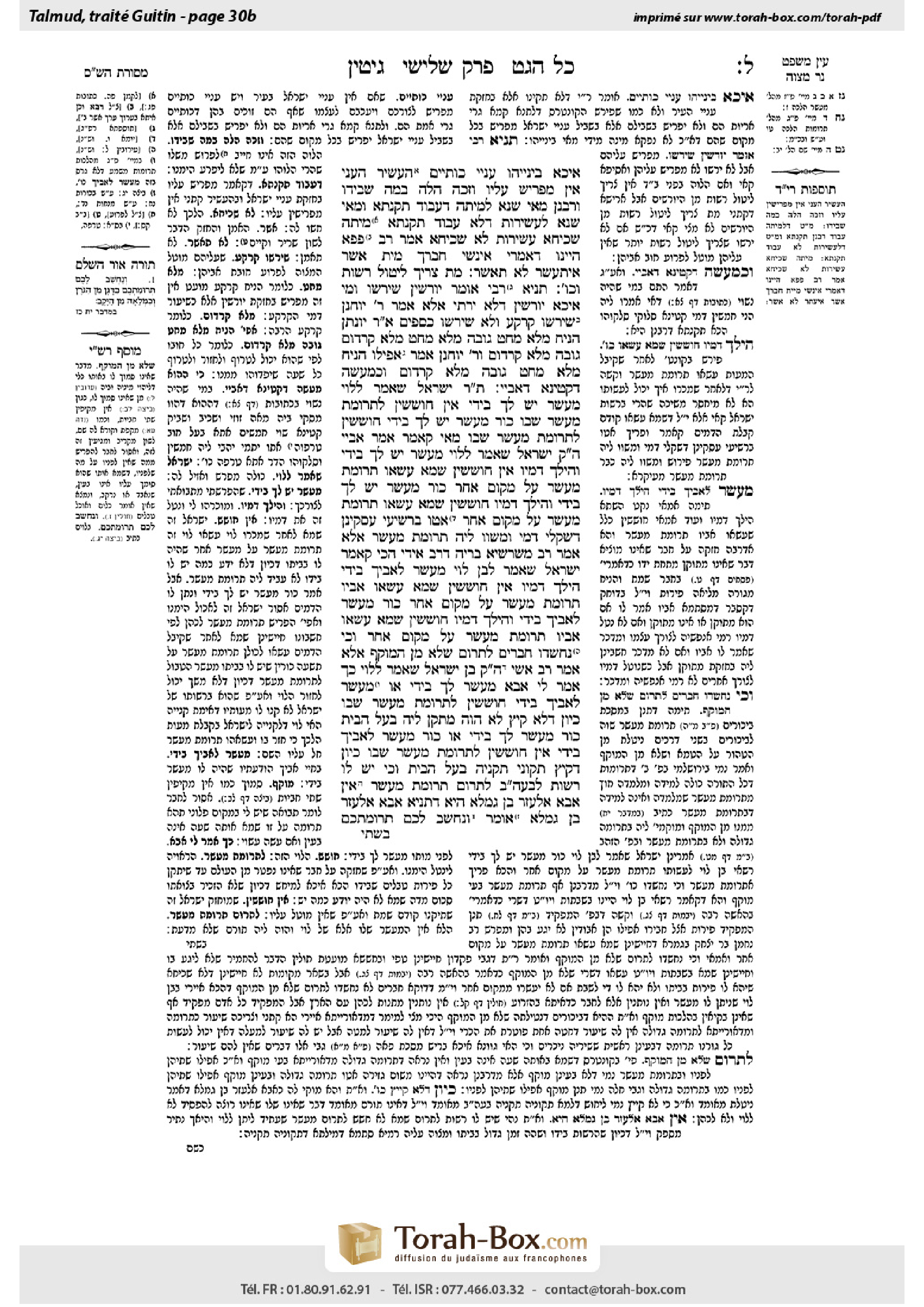
Gittin 30b: Talmud study for Daf Yomi
Study the Talmud for Daf Yomi with scanned pages, Hebrew text, English translations from Sefaria and AI-generated French translations.
Passage selection and English or AI-generated French translation are available where the scan has annotations. Daf Study is independent of Torah-Box and Sefaria.
Browse Gittin · גיטין · All tractatesGittin 30b text and translations
This page of Gittin includes the Aramaic text, an English translation and an AI-generated French translation, alongside the scan above.
גיטין ל׳ ב · Aramaic and Hebrew text
אִיכָּא בֵּינַיְיהוּ עֲנִיֵּי כוּתִיִּים.
הֶעֱשִׁיר הֶעָנִי – אֵין מַפְרִישׁ עָלָיו, וְזָכָה הַלָּה בְּמַה שֶּׁבְּיָדוֹ.
וְרַבָּנַן, מַאי שְׁנָא לְמִיתָה דַּעֲבוּד תַּקַּנְתָּא, וּמַאי שְׁנָא לַעֲשִׁירוּת דְּלָא עֲבוּד תַּקַּנְתָּא? מִיתָה שְׁכִיחָא, עֲשִׁירוּת לָא שְׁכִיחָא. אָמַר רַב פָּפָּא, הַיְינוּ דְּאָמְרִי אִינָשֵׁי: חַבְרָךְ מִית – אַשַּׁר, אִיתְעַשַּׁר – לָא תְּאַשַּׁר.
מֵת – צָרִיךְ לִיטּוֹל רְשׁוּת וְכוּ׳: תַּנְיָא, רַבִּי אוֹמֵר: יוֹרְשִׁין שֶׁיָּרְשׁוּ. וּמִי אִיכָּא יוֹרְשִׁין דְּלָא יָרְתִי?! אֶלָּא אָמַר רַבִּי יוֹחָנָן: שֶׁיָּרְשׁוּ קַרְקַע, וְלֹא שֶׁיָּרְשׁוּ כְּסָפִים.
אָמַר רַבִּי יוֹנָתָן: הִנִּיחַ מְלֹא מַחַט – גּוֹבֶה מְלֹא מַחַט. מְלֹא קַרְדּוֹם – גּוֹבֶה מְלֹא קַרְדּוֹם. וְרַבִּי יוֹחָנָן אָמַר: אֲפִילּוּ הִנִּיחַ מְלֹא מַחַט – גּוֹבֶה מְלֹא קַרְדּוֹם;
וּכְמַעֲשֶׂה דְּקַטִּינָא דְאַבָּיֵי.
תָּנוּ רַבָּנַן: יִשְׂרָאֵל שֶׁאָמַר לְלֵוִי: ״מַעֲשֵׂר יֵשׁ לְךָ בְּיָדִי״, אֵין חוֹשְׁשִׁין לִתְרוּמַת מַעֲשֵׂר שֶׁבּוֹ. ״כּוֹר מַעֲשֵׂר יֵשׁ לְךָ בְּיָדִי״ – חוֹשְׁשִׁין לִתְרוּמַת מַעֲשֵׂר שֶׁבּוֹ.
מַאי קָאָמַר? אָמַר אַבָּיֵי, הָכִי קָאָמַר: יִשְׂרָאֵל שֶׁאָמַר לְלֵוִי ״מַעֲשֵׂר יֵשׁ לְךָ בְּיָדִי, וְהֵילָךְ דָּמָיו״, אֵין חוֹשְׁשִׁין שֶׁמָּא עֲשָׂאוֹ תְּרוּמַת מַעֲשֵׂר עַל מָקוֹם אַחֵר. ״כּוֹר מַעֲשֵׂר יֵשׁ לְךָ בְּיָדִי, וְהֵילָךְ דָּמָיו״, חוֹשְׁשִׁין שֶׁמָּא עֲשָׂאוֹ תְּרוּמַת מַעֲשֵׂר עַל מָקוֹם אַחֵר.
אַטּוּ בְּרַשִּׁיעֵי עָסְקִינַן, דְּשָׁקְלִי דְּמֵי וּמְשַׁוּוּ לֵיהּ תְּרוּמַת מַעֲשֵׂר?!
אֶלָּא אָמַר רַב מְשַׁרְשְׁיָא בְּרֵיהּ דְּרַב אִידִי, הָכִי קָאָמַר: יִשְׂרָאֵל שֶׁאָמַר לְבֶן לֵוִי ״מַעֲשֵׂר לְאָבִיךְ בְּיָדִי, הֵילָךְ דָּמָיו״, אֵין חוֹשְׁשִׁין שֶׁמָּא עֲשָׂאוֹ אָבִיו תְּרוּמַת מַעֲשֵׂר עַל מָקוֹם אַחֵר. ״כּוֹר מַעֲשֵׂר לְאָבִיךְ בְּיָדִי, וְהֵילָךְ דָּמָיו״, חוֹשְׁשִׁין שֶׁמָּא עֲשָׂאוֹ אָבִיו תְּרוּמַת מַעֲשֵׂר עַל מָקוֹם אַחֵר.
וְכִי נֶחְשְׁדוּ חֲבֵרִים לִתְרוֹם שֶׁלֹּא מִן הַמּוּקָּף?!
אֶלָּא אָמַר רַב אָשֵׁי, הָכִי קָאָמַר: בֶּן יִשְׂרָאֵל שֶׁאָמַר לְלֵוִי ״כָּךְ אָמַר לִי אַבָּא: מַעֲשֵׂר לְךָ בְּיָדִי״ אוֹ ״מַעֲשֵׂר לְאָבִיךְ בְּיָדִי״ – חוֹשְׁשִׁין לִתְרוּמַת מַעֲשֵׂר שֶׁבּוֹ, כֵּיוָן דְּלָא קִיץ לָא הֲוָה מְתַקֵּן לֵיהּ בַּעַל הַבַּיִת. ״כּוֹר מַעֲשֵׂר לְךָ בְּיָדִי״ אוֹ ״כּוֹר מַעֲשֵׂר לְאָבִיךְ בְּיָדִי״ – אֵין חוֹשְׁשִׁין לִתְרוּמַת מַעֲשֵׂר שֶׁבּוֹ, כֵּיוָן דְּקִיץ תַּקּוֹנֵי תַּקְּנֵיהּ בַּעַל הַבַּיִת.
וְכִי יֵשׁ לוֹ רְשׁוּת לְבַעַל הַבַּיִת לִתְרוֹם תְּרוּמַת מַעֲשֵׂר?! אִין, אַבָּא אֶלְעָזָר בֶּן גַּמְלָא הִיא. דְּתַנְיָא, אַבָּא אֶלְעָזָר בֶּן גַּמְלָא אוֹמֵר: ״וְנֶחְשַׁב לָכֶם תְּרוּמַתְכֶם״ –
Gittin 30b · English translation
The Gemara answers: There is a difference between them where the only poor people to be found are poor Samaritans. According to Rabbi Eliezer ben Ya’akov, they are not considered to be converts (see Kiddushin 75b), and one may not continue the arrangement with them serving as the poor people. According to Rabbi Aḥai, they are considered converts, and one may continue the arrangement with them serving as the poor people.
It was taught in a baraita (Tosefta 3:1) that if the poor person became wealthy then the homeowner may no longer separate tithes based on his outstanding loan, and the borrower, who is now wealthy, acquires the money remaining in his possession. This is because from the outset the understanding was that the loan would be repaid only by separating the poor man’s tithe.
The Gemara asks: And according to the Sages, what is different about death, when the poor man dies, that they instituted an ordinance to enable the homeowner to continue to separate tithes based on other poor people, and what is different about wealth, when the poor man becomes wealthy, that they did not institute an ordinance? The Gemara answers: Death is common, whereas wealth is not common, and the Sages did not enact an ordinance for an uncommon circumstance. Rav Pappa said: This explains the folk saying that people say: If one says to you that your friend died, then believe it; but if one says to you that your friend became wealthy, do not believe it until it has been proven.
§ The mishna teaches that if the priest or Levite died, the lender needs to obtain permission from the heirs to continue the arrangement. It is taught in a baraita (Tosefta 3:1): Rabbi Yehuda HaNasi says that this is referring to heirs who inherited. The Gemara asks: And are there heirs who do not inherit? What is meant by the expression: Heirs who inherit? Rather, Rabbi Yoḥanan said: This means heirs who inherited land, as one can collect debts from land bequeathed by a borrower, and not heirs who inherited money, as lenders cannot collect debts from money bequeathed by a borrower.
With regard to this matter Rabbi Yonatan says: If the priest left his heirs enough land to fill a needle, i.e., a minimal amount, then the homeowner collects, i.e., separates teruma, in the amount of produce that has the value of a full needle of land. If he left enough land to fill an ax, i.e., a larger amount, then the homeowner collects the value of a full ax of land. And Rabbi Yoḥanan says: Even if he left for his heirs enough land to fill a needle, the homeowner collects the value of a full ax of land.
And this is like the incident involving the small portion of land in the court of Abaye. The children of a deceased man had inherited a small field that was worth only a fraction of the debt that their father had owed. The creditor seized the land in payment of the debt, and Abaye ruled that even after the orphans pay the creditor the value of the land to repurchase it, the creditor can seize the land again and the orphans will have to pay for it again, to have it returned, until the entire debt has been repaid.
§ The Sages taught in a baraita (Tosefta 3:2): With regard to an Israelite who said to a Levite: There is tithe of yours in my possession that I separated from my produce on your behalf, one is not concerned about the teruma of the tithe that is in it, i.e., the one-tenth of the tithe that is given to the priest and forbidden to both the Levite and the Israelite; rather it is assumed to be only first tithe. However, if he said to him: There is a kor of tithe of yours in my possession, then one is concerned about the teruma of the tithe that is in it.
The Gemara asks: What is the baraita saying? Abaye said: This is what it is saying: In the case of an Israelite who said to a Levite: There is tithe of yours in my possession, and here is money in exchange for it, then one is not concerned that perhaps the Levite converted the tithe that is now in the possession of the Israelite into teruma of the tithe for tithes that he has elsewhere. Since the Israelite did not specify how much tithe of the Levite’s he had, the Levite would not know how much of his other tithe could be exempted from teruma of the tithe by converting this tithe into teruma of the tithe. But if an Israelite said to a Levite: There is a kor of tithe of yours in my possession, and here is money in exchange for it, then one is concerned that since the Levite knows the amount of the tithe, perhaps he converted it into the teruma of the tithe for tithes that he has elsewhere.
The Gemara questions Abaye’s explanation: Is that to say that we are dealing with wicked people, who take money in exchange for the tithe and afterward convert it into the teruma of the tithe? Once the Levite takes money in exchange for the tithe, it is no longer his to convert it into teruma of the tithe. Why would the baraita address the case of a Levite who acts in this fashion?
Rather, Rav Mesharshiyya, son of Rav Idi, said that this is what the baraita is saying: In the case of an Israelite who said to the son of a Levite: There is tithe of your father’s in my possession, about which I had informed him while he was still alive; here is money in exchange for it, one is not concerned that perhaps before his death his father converted it into teruma of the tithe for tithes that he had elsewhere, and the son may accept the money. But if an Israelite said to the son of a Levite: There is a kor of tithe of your father’s in my possession, and here is money in exchange for it; then one is concerned that perhaps his father converted it into teruma of the tithe for tithes that he has elsewhere, and the son may not accept the money.
The Gemara questions Rav Mesharshiyya’s explanation: Why is there a concern that the father may have converted it into teruma of the tithe for tithes that he had elsewhere? If one has produce that needs to have teruma or teruma of the tithe separated from it, and he wants to perform the separation from other produce, to exempt all the produce, the Sages established that the other produce must be situated nearby. And are ḥaverim, who are meticulous in their observance of mitzvot, especially the halakhot of teruma and tithes, suspected of separating teruma from produce that is not situated near the produce they seek to exempt?
Rather, Rav Ashi said: This is what the baraita is saying: With regard to the son of an Israelite who said to a Levite: This is what my father told me, that there is tithe of yours in my possession, or that there is tithe of your father’s in my possession, then one is concerned about the teruma of the tithe that is in it that presumably was never separated. Since it is not a set amount, the homeowner would not have rendered the tithe fit for him by separating the teruma of the tithe. But if the son of an Israelite said to a Levite: My father told me that there is a kor of tithe of yours in my possession, or that there is a kor of tithe of your father’s in my possession, then one is not concerned about the teruma of the tithe that is in it. Since it is a set amount, the homeowner is assumed to have rendered the tithe fit by separating the teruma of the tithe.
The Gemara questions Rav Ashi’s explanation: And does the homeowner have permission to separate the teruma of the tithe from the tithe of the Levite? The Levite is the one who is required to separate the teruma of the tithe and to give it to a priest. The Gemara answers: Yes; the baraita is in accordance with the opinion of Abba Elazar ben Gamla. As it is taught in a baraita: Abba Elazar ben Gamla says: The verse states concerning the teruma of the tithe: “And the gift that you set apart [terumatkhem] shall be reckoned to you, as though it were the grain of the threshing floor” (Numbers 18:27).
Gittin 30b · Traduction française (IA)
Le Guemara répond : Il y a une différence entre eux dans le cas où les seuls pauvres trouvés sont des Samaritains pauvres. Selon Rabbi Eliezer ben Ya’akov, ils ne sont pas considérés comme des convertis (voir Kiddushin 75b), et on ne peut pas continuer l'arrangement avec eux servant de pauvres. Selon Rabbi Aḥai, ils sont considérés comme des convertis, et on peut continuer l'arrangement avec eux servant de pauvres.
Il a été enseigné dans une baraïta (Tosefta 3:1) que si le pauvre devient riche, le propriétaire ne peut plus séparer les dîmes en se basant sur son prêt restant, et le prêteur, qui est désormais riche, acquiert l'argent restant en son possession. Cela est dû au fait que dès le départ, on comprenait que le prêt serait remboursé uniquement en séparant la dîme du pauvre.
Le Guemara pose la question : Et selon les Sages, qu'est-ce qui diffère dans le cas de la mort, lorsque le pauvre meurt, qui a conduit à l'institution d'un ordonnance permettant au propriétaire de continuer à séparer les dîmes en se basant sur d'autres pauvres, et qu'est-ce qui diffère dans le cas de la richesse, lorsque le pauvre devient riche, qui a fait qu'ils n'ont pas institué un ordonnance ? Le Guemara répond : La mort est courante, tandis que la richesse ne l'est pas, et les Sages n'ont pas institué un ordonnance pour un cas inhabituel. Rav Pappa a dit : Cela explique la devise populaire que les gens disent : Si l'on te dit que ton ami est mort, crois-le ; mais si l'on te dit que ton ami est devenu riche, ne le crois pas avant qu'il ne soit prouvé.
§ La mitsna enseigne que si le prêtre ou le Lévi meurt, le prêteur doit obtenir le consentement des héritiers pour continuer l'arrangement. Il est enseigné dans une baraïta (Tosefta 3:1) : Rabbi Yehuda HaNasi dit que cela concerne les héritiers qui ont hérité. Le Guemara pose la question : Et y a-t-il des héritiers qui n'héritent pas ? Qu'entend-on par l'expression : Héritiers qui héritent ? Plutôt, Rabbi Yoḥanan a dit : Cela signifie des héritiers qui ont hérité de terre, car on peut récupérer des dettes à partir de la terre léguée par un prêteur, et non des héritiers qui ont hérité d'argent, car les prêteurs ne peuvent récupérer des dettes à partir d'argent légué par un prêteur.
Concernant cette affaire, Rabbi Yonatan dit : Si le prêtre a laissé à ses héritiers assez de terre pour remplir une aiguille, c'est-à-dire une quantité minimale, alors le propriétaire récupère, c'est-à-dire sépare la terouma, en quantité de produit ayant la valeur d'une aiguille de terre. Si il a laissé assez de terre pour remplir une hache, c'est-à-dire une quantité plus grande, alors le propriétaire récupère la valeur d'une hache de terre. Et Rabbi Yoḥanan dit : Même s'il a laissé à ses héritiers assez de terre pour remplir une aiguille, le propriétaire récupère la valeur d'une hache de terre.
Et cela ressemble à l'incident concernant la petite portion de terre dans la cour d'Abaye. Les enfants d'un homme décédé avaient hérité d'un petit champ qui ne valait qu'une fraction de la dette que leur père avait dû. Le créancier a saisi la terre pour rembourser la dette, et Abaye a décidé que même après que les orphelins paient au créancier la valeur de la terre pour la racheter, le créancier peut saisir la terre à nouveau et les orphelins devront la payer à nouveau pour l'obtenir, jusqu'à ce que toute la dette soit remboursée.
§ Les Sages ont enseigné dans une baraïta (Tosefta 3:2) : Concernant un Israélite qui a dit à un Lévi : Il y a une dîme à toi chez moi que j'ai séparée de mes produits à ton intention, on n'est pas inquiet concernant la terouma de la dîme qui est dedans, c'est-à-dire la dixième de la dîme donnée au prêtre et interdite à la fois au Lévi et à l'Israélite ; on suppose qu'il s'agit de la première dîme. Cependant, s'il a dit à lui : Il y a un kor de dîme à toi chez moi, alors on est inquiet concernant la terouma de la dîme qui est dedans.
Le Guemara pose la question : De quoi la baraïta parle-t-elle ? Abaye a dit : C'est ce qu'elle dit : Dans le cas d'un Israélite qui a dit à un Lévi : Il y a une dîme à toi chez moi, et voici de l'argent en échange, alors on n'est pas inquiet que le Lévi ait converti la dîme qui est maintenant en possession de l'Israélite en terouma de la dîme pour les dîmes qu'il a ailleurs. Puisque l'Israélite n'a pas spécifié combien de dîme du Lévi il avait, le Lévi ne saurait pas combien de sa dîme ailleurs pourrait être exempté de la terouma de la dîme en convertissant cette dîme en terouma de la dîme. Mais si un Israélite a dit à un Lévi : Il y a un kor de dîme à toi chez moi, et voici de l'argent en échange, alors on est inquiet que puisque le Lévi sait la quantité de la dîme, peut-être qu'il l'a convertie en terouma de la dîme pour les dîmes qu'il a ailleurs.
Le Guemara questionne l'explication d'Abaye : Est-ce que cela signifie que nous avons affaire à des gens méchants, qui prennent de l'argent en échange de la dîme et ensuite la convertissent en terouma de la dîme ? Une fois que le Lévi a pris de l'argent en échange de la dîme, celle-ci n'est plus à lui pour la convertir en terouma de la dîme. Pourquoi la baraïta aborde-t-elle le cas d'un Lévi agissant ainsi ?
Plutôt, Rav Mesharshiyya, fils de Rav Idi, a dit que c'est ce que la baraïta dit : Dans le cas d'un Israélite qui a dit au fils d'un Lévi : Il y a une dîme de ton père chez moi, à propos de laquelle j'ai informé lui pendant qu'il était encore vivant ; voici de l'argent en échange, on n'est pas inquiet que peut-être avant sa mort son père ait converti cela en terouma de la dîme pour les dîmes qu'il avait ailleurs, et le fils peut accepter l'argent. Mais si un Israélite a dit au fils d'un Lévi : Il y a un kor de dîme de ton père chez moi, et voici de l'argent en échange ; alors on est inquiet que peut-être son père ait converti cela en terouma de la dîme pour les dîmes qu'il avait ailleurs, et le fils ne peut pas accepter l'argent.
La Guemara questionne l'explication de Rav Mesharshiyya : Pourquoi y a-t-il une crainte que le père ait converti en terouma de la dîme les dîmes qu'il possédait ailleurs ? Si l'on possède des produits nécessitant la séparation de terouma ou de terouma de dîme, et qu'on veut effectuer la séparation à partir d'autres produits afin d'exempter tous les produits, les Sages ont établi que ces autres produits doivent être situés à proximité. Et les ḥaverim, qui sont rigoureux dans l'observation des mitsvot, notamment des halakhot de terouma et de dîmes, sont-ils soupçonnés de séparer la terouma à partir de produits non situés près de ceux qu'ils souhaitent exempter ?
Rav Ashi dit plutôt : C'est ce que dit la baraïta : En ce qui concerne le fils d'un Israélite qui dit à un Lévi : C'est ce que mon père m'a dit, qu'il y a une dîme à toi chez moi, ou qu'il y a une dîme de ton père chez moi, alors on craint que la terouma de la dîme qui y est contenue n'ait jamais été séparée. Puisque ce n'est pas une quantité déterminée, le propriétaire n'aurait pas rendu la dîme propre à lui en séparant la terouma de la dîme. Mais si le fils d'un Israélite dit à un Lévi : Mon père m'a dit qu'il y a un kor de dîme à toi chez moi, ou qu'il y a un kor de dîme de ton père chez moi, alors on ne craint pas que la terouma de la dîme qui y est contenue n'ait jamais été séparée. Puisque c'est une quantité déterminée, on suppose que le propriétaire a rendu la dîme propre à lui en séparant la terouma de la dîme.
La Guemara questionne l'explication de Rav Ashi : Le propriétaire a-t-il le droit de séparer la terouma de la dîme à partir de la dîme du Lévi ? Le Lévi est celui qui est tenu de séparer la terouma de la dîme et de la donner à un prêtre. La Guemara répond : Oui ; la baraïta suit l'opinion d'Abba Elazar ben Gamla. Comme il est enseigné dans une baraïta : Abba Elazar ben Gamla dit : La Parashah parle de la terouma de la dîme : « Et la donation que vous séparerez [terumatkhem] sera comptée pour vous, comme si elle était la céréale du moulin » (Nombres 18:27).
Traduction française générée par IA à partir de l’édition anglaise de Sefaria. Vérifie toujours un passage avec le texte source.
Text from Sefaria: William Davidson Edition - Vocalized Aramaic (CC BY NC); William Davidson Edition - English (CC BY NC).