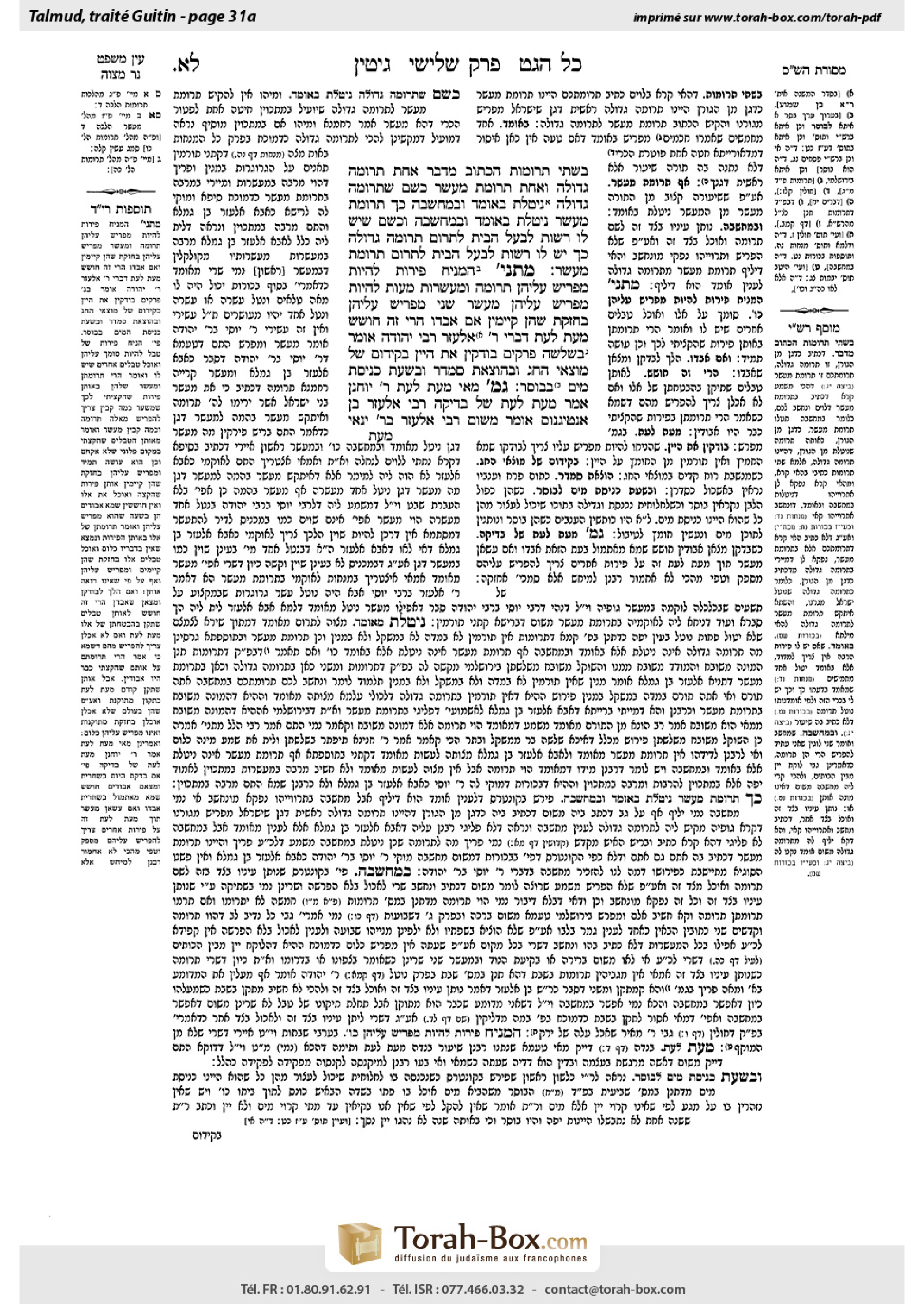
Gittin 31a: Talmud study for Daf Yomi
Study the Talmud for Daf Yomi with scanned pages, Hebrew text, English translations from Sefaria and AI-generated French translations.
Passage selection and English or AI-generated French translation are available where the scan has annotations. Daf Study is independent of Torah-Box and Sefaria.
Browse Gittin · גיטין · All tractatesGittin 31a text and translations
This page of Gittin includes the Aramaic text, an English translation and an AI-generated French translation, alongside the scan above.
גיטין ל״א א · Aramaic and Hebrew text
בִּשְׁתֵּי תְּרוּמוֹת הַכָּתוּב מְדַבֵּר: אַחַת תְּרוּמָה גְּדוֹלָה וְאַחַת תְּרוּמַת מַעֲשֵׂר; כְּשֵׁם שֶׁתְּרוּמָה גְּדוֹלָה נִיטֶּלֶת בְּאוֹמֶד וּבְמַחְשָׁבָה, כָּךְ תְּרוּמַת מַעֲשֵׂר נִיטֶּלֶת בְּאוֹמֶד וּבְמַחְשָׁבָה; וּכְשֵׁם שֶׁיֵּשׁ לוֹ רְשׁוּת לְבַעַל הַבַּיִת לִתְרוֹם תְּרוּמָה גְּדוֹלָה, כָּךְ יֵשׁ לוֹ רְשׁוּת לְבַעַל הַבַּיִת לִתְרוֹם תְּרוּמַת מַעֲשֵׂר.
מַתְנִי׳ הַמַּנִּיחַ פֵּירוֹת, לִהְיוֹת מַפְרִישׁ עֲלֵיהֶן תְּרוּמָה וּמַעַשְׂרוֹת; מָעוֹת, לִהְיוֹת מַפְרִישׁ עֲלֵיהֶן מַעֲשֵׂר שֵׁנִי – מַפְרִישׁ עֲלֵיהֶן בְּחֶזְקַת שֶׁהֵן קַיָּימִין. אִם אָבְדוּ – הֲרֵי זֶה חוֹשֵׁשׁ מֵעֵת לְעֵת, דִּבְרֵי רַבִּי אֶלְעָזָר.
רַבִּי יְהוּדָה אוֹמֵר: בִּשְׁלֹשָׁה פְּרָקִים בּוֹדְקִין אֶת הַיַּיִן – בְּקִידּוּם שֶׁל מוֹצָאֵי הַחַג, וּבְהוֹצָאַת סְמָדַר, וּבִשְׁעַת כְּנִיסַת מַיִם בְּבוֹסֶר.
גְּמָ׳ מַאי מֵעֵת לְעֵת? רַבִּי יוֹחָנָן אָמַר: מֵעֵת לְעֵת שֶׁל בְּדִיקָה. רַבִּי אֶלְעָזָר בֶּן אַנְטִיגְנוֹס אוֹמֵר מִשּׁוּם רַבִּי אֶלְעָזָר בְּרַבִּי יַנַּאי:
Gittin 31a · English translation
The verse speaks of two terumot; one is standard teruma and one is teruma of the tithe. Since they are mentioned together, they can be compared: Just as standard teruma is taken by estimate, as there is no requirement for the amount separated to be measured precisely, and it can be taken by thought, as one is not required to physically separate it before consuming the remaining produce, so too, teruma of the tithe may be taken by estimate and by thought. And this comparison also teaches that just as the homeowner has permission, i.e., the right, to separate standard teruma, so too, the homeowner has permission to separate teruma of the tithe.
MISHNA: With regard to one who sets aside produce with the understanding that he will separate terumot and tithes with it, so that when he has untithed produce he can render it fit by declaring that the teruma and tithes that must be separated will be from the produce that he had set aside for this purpose, or one who sets aside money with the understanding that he will separate and redeem second tithe with it, then he may later separate the teruma or tithe with them, based on the presumption that the produce or the money are extant. He need not be concerned that perhaps the produce or money was lost in the meantime. If he discovers that they were lost, then he must be concerned that the produce or money that he set aside was lost, from the time until the same time, as will be explained in the Gemara, and he must separate teruma and tithes from the produce a second time; this is the statement of Rabbi Elazar.
Rabbi Yehuda says: One checks the wine that is set aside to be used for separating terumot and tithes for other wine to see if it has turned to vinegar, which would render it unfit for this purpose, at three times during the year: When the east wind blows at the conclusion of the festival of Sukkot, and when the blossoms fall and the grape buds emerge and appear as small clusters, and at the time when water enters and fills the unripe grape. Since there is a change in the weather at these times, one should check to ensure that the wine has not turned to vinegar.
GEMARA: The mishna taught that if the produce or money was lost, then one must be concerned that it occurred from the time until the same time. The Gemara asks: What is meant by: From the time until the same time? Rabbi Yoḥanan said: It means from the time it was checked and found to be lost, until the same time of day on the previous day. If one had used that produce to render fit other produce within the twenty-four hours before noticing that it had been lost, one must separate teruma and tithes for that produce again. Rabbi Elazar ben Antigonus says in the name of Rabbi Elazar, son of Rabbi Yannai:
Gittin 31a · Traduction française (IA)
La parabole mentionne deux teroumats ; l'une est la terouma ordinaire et l'autre est la terouma de la dîme. Puisqu'elles sont mentionnées ensemble, elles peuvent être comparées : Tout comme la terouma ordinaire est prise par estimation, car il n'y a pas de nécessité de mesurer précisément la quantité séparée, et elle peut être prise par pensée, car l'on n'est pas tenu de séparer physiquement avant de consommer les produits restants, de même la terouma de la dîme peut être prise par estimation et par pensée. Et cette comparaison enseigne aussi que tout comme le propriétaire a le droit de séparer la terouma ordinaire, de même il a le droit de séparer la terouma de la dîme.
MICHNA : Concernant celui qui réserve des produits en sachant qu'il séparera des teroumats et des dîmes avec eux, de sorte qu'en cas de produits non titulés, il peut les rendre aptes en déclarant que les teroumats et dîmes à séparer proviendront des produits qu'il a réservés à cet effet, ou celui qui réserve de l'argent en sachant qu'il séparera et rachètera la dîme de second ordre avec, il peut plus tard séparer la terouma ou la dîme avec eux, en supposant que les produits ou l'argent sont encore présents. Il n'a pas à crainre que les produits ou l'argent aient pu être perdus en attendant. Si l'on découvre qu'ils ont été perdus, alors l'on doit craindre que les produits ou l'argent réservés aient été perdus depuis la même période jusqu'au même moment, comme expliqué dans la Guemara, et il doit séparer à nouveau la terouma et les dîmes à partir des produits ; c'est l'opinion du Rabbi Elazar.
Rabbi Yehuda dit : On examine le vin réservé à la séparation des teroumats et des dîmes, afin de le faire utiliser pour d'autres vins, pour vérifier s'il est devenu du vinaigre, ce qui le rendrait inapte à cette fin, trois fois par an : Lorsque le vent du levant souffle à la fin de la fête des Tabernacles, et lorsqu'arrivent les fleurs et que les bourgeons de raisin apparaissent comme des grappes, et au moment où l'eau entre et remplit les raisins non mûrs. Puisque les saisons changent à ces moments, on doit vérifier pour s'assurer que le vin n'a pas devenu du vinaigre.
GUEMARA : La Michna a enseigné que si les produits ou l'argent ont été perdus, alors l'on doit craindre qu'il ait eu lieu depuis le même moment jusqu'au même moment. La Guemara pose la question : De quoi est-ce que l'on parle : depuis le même moment jusqu'au même moment ? Rabbi Yoḥanan dit : Cela signifie depuis le moment où il a été trouvé perdu jusqu'au même moment de la veille. Si l'on avait utilisé ces produits pour rendre aptes d'autres produits dans les vingt-quatre heures avant de découvrir qu'ils avaient été perdus, il faudra séparer à nouveau la terouma et les dîmes pour ces produits. Rabbi Elazar ben Antigonna dit en nom de Rabbi Elazar, fils de Rabbi Yannai :
Traduction française générée par IA à partir de l’édition anglaise de Sefaria. Vérifie toujours un passage avec le texte source.
Text from Sefaria: William Davidson Edition - Vocalized Aramaic (CC BY NC); William Davidson Edition - English (CC BY NC).