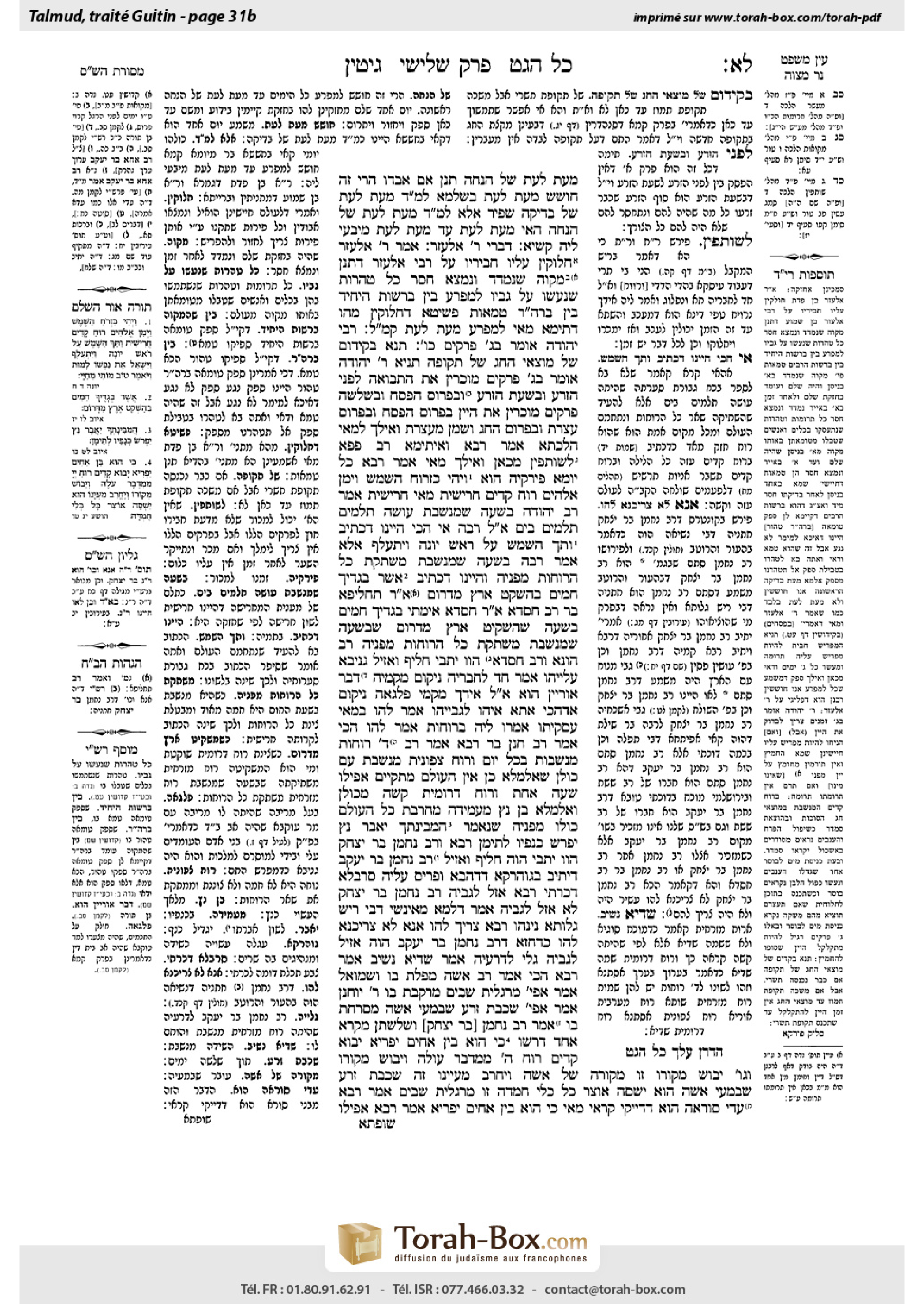
Gittin 31b: Talmud study for Daf Yomi
Study the Talmud for Daf Yomi with scanned pages, Hebrew text, English translations from Sefaria and AI-generated French translations.
Passage selection and English or AI-generated French translation are available where the scan has annotations. Daf Study is independent of Torah-Box and Sefaria.
Browse Gittin · גיטין · All tractatesGittin 31b text and translations
This page of Gittin includes the Aramaic text, an English translation and an AI-generated French translation, alongside the scan above.
גיטין ל״א ב · Aramaic and Hebrew text
מֵעֵת לְעֵת שֶׁל הַנָּחָה.
תְּנַן: אִם אָבְדוּ – הֲרֵי זֶה חוֹשֵׁשׁ מֵעֵת לְעֵת. בִּשְׁלָמָא לְמַאן דְּאָמַר מֵעֵת לְעֵת שֶׁל בְּדִיקָה – שַׁפִּיר;
אֶלָּא לְמַאן דְּאָמַר מֵעֵת לְעֵת שֶׁל הַנָּחָה – הַאי ״מֵעֵת לְעֵת״?! ״עַד מֵעֵת לְעֵת״ מִיבְּעֵי לֵיהּ! קַשְׁיָא.
דִּבְרֵי רַבִּי אֶלְעָזָר: אָמַר רַבִּי אֶלְעָזָר: חֲלוּקִין עָלָיו חֲבֵירָיו עַל רַבִּי אֶלְעָזָר – דִּתְנַן: מִקְוֶה שֶׁנִּמְדַּד וְנִמְצָא חָסֵר; כׇּל טְהָרוֹת שֶׁנַּעֲשׂוּ עַל גַּבָּיו לְמַפְרֵעַ – בֵּין בִּרְשׁוּת הַיָּחִיד, בֵּין בִּרְשׁוּת הָרַבִּים – טְמֵאוֹת.
פְּשִׁיטָא דַּחֲלוּקִין! מַהוּ דְּתֵימָא: מַאי ״לְמַפְרֵעַ״ – מֵעֵת לְעֵת, קָא מַשְׁמַע לַן.
רַבִּי יְהוּדָה אוֹמֵר, בִּשְׁלֹשָׁה פְּרָקִים כּוּ׳: תָּנָא: בְּקִידּוּם שֶׁל מוֹצָאֵי הַחַג שֶׁל תְּקוּפָה.
תַּנְיָא, רַבִּי יְהוּדָה אוֹמֵר: בִּשְׁלֹשָׁה פְּרָקִים מוֹכְרִין אֶת הַתְּבוּאָה – לִפְנֵי הַזֶּרַע, וּבִשְׁעַת הַזֶּרַע, וּבִפְרוֹס הַפֶּסַח. וּבִשְׁלֹשָׁה פְּרָקִים מוֹכְרִין אֶת הַיַּיִן – בִּפְרוֹס הַפֶּסַח, וּבִפְרוֹס עֲצֶרֶת, וּבִפְרוֹס הַחַג. וְשֶׁמֶן – מֵעֲצֶרֶת וְאֵילָךְ. לְמַאי הִלְכְתָא? אָמַר רָבָא, וְאִיתֵּימָא רַב פָּפָּא: לְשׁוּתָּפִין. מִכָּאן וְאֵילָךְ, מַאי? אָמַר רָבָא: כׇּל יוֹמָא פִּירְקֵיהּ הוּא.
״וַיְהִי כִּזְרוֹחַ הַשֶּׁמֶשׁ וַיְמַן אֱלֹהִים רוּחַ קָדִים חֲרִישִׁית״ – מַאי ״חֲרִישִׁית״? אָמַר רַב יְהוּדָה: בְּשָׁעָה שֶׁמְּנַשֶּׁבֶת, עוֹשֶׂה תְּלָמִים תְּלָמִים בַּיָּם.
אֲמַר לֵיהּ רַבָּה: אִי הָכִי, הַיְינוּ דִּכְתִיב: ״וַתַּךְ הַשֶּׁמֶשׁ עַל רֹאשׁ יוֹנָה וַיִּתְעַלָּף״?! אֶלָּא אָמַר רַבָּה: בְּשָׁעָה שֶׁמְּנַשֶּׁבֶת, מְשַׁתֶּקֶת כׇּל הָרוּחוֹת מִפָּנֶיהָ. וְהַיְינוּ דִּכְתִיב: ״אֲשֶׁר בְּגָדֶיךָ חַמִּים בְּהַשְׁקִט אֶרֶץ מִדָּרוֹם״. אָמַר רַבִּי תַּחְלִיפָא בַּר רַב חִסְדָּא, אָמַר רַב חִסְדָּא: אֵימָתַי בְּגָדֶיךָ חַמִּים? בְּשָׁעָה שֶׁהִשְׁקִיט אֶרֶץ מִדָּרוֹם. שֶׁבְּשָׁעָה שֶׁמְּנַשֶּׁבֶת מְשַׁתֶּקֶת כׇּל הָרוּחוֹת מִפָּנֶיהָ.
רַב הוּנָא וְרַב חִסְדָּא הֲווֹ יָתְבִי. חָלֵיף וְאָזֵיל גְּנִיבָא עֲלַיְיהוּ, אֲמַר חַד לְחַבְרֵיהּ: נֵיקוּם מִקַּמֵּיהּ, דְּבַר אוֹרְיָין הוּא. אֲמַר לֵיהּ אִידַּךְ: מִקַּמֵּי פָּלְגָאָה נֵיקוּם?! אַדְּהָכִי אֲתָא אִיהוּ לְגַבַּיְיהוּ, אֲמַר לְהוּ: בְּמַאי עָסְקִיתוּ? אֲמַרוּ לֵיהּ: בְּרוּחוֹת.
אֲמַר לְהוּ: הָכִי אָמַר רַב חָנָן בַּר רָבָא, אָמַר רַב: אַרְבַּע רוּחוֹת מְנַשְּׁבוֹת בְּכׇל יוֹם, וְרוּחַ צְפוֹנִית מְנַשֶּׁבֶת עִם כּוּלָּן; שֶׁאִלְמָלֵא כֵּן, אֵין הָעוֹלָם מִתְקַיֵּים אֲפִילּוּ שָׁעָה אַחַת. וְרוּחַ דְּרוֹמִית קָשָׁה מִכּוּלָּן, וְאִלְמָלֵא בֶּן נֵץ מַעֲמִידָהּ, מַחְרֶבֶת כָּל הָעוֹלָם כּוּלּוֹ מִפָּנֶיהָ, שֶׁנֶּאֱמַר: ״הֲמִבִּינָתְךָ יַאֲבֶר נֵץ יִפְרֹשׂ כְּנָפָיו לְתֵימָן״.
רָבָא וְרַב נַחְמָן בַּר יִצְחָק הֲווֹ יָתְבִי; הֲוָה חָלֵיף וְאָזֵיל רַב נַחְמָן בַּר יַעֲקֹב, דְּיָתֵיב בְּגוּהַרְקָא דְּדַהֲבָא וּפְרִיס עֲלֵיהּ סַרְבָּלָא דְכַרָּתֵי. רָבָא אֲזַל לְגַבֵּיהּ, רַב נַחְמָן בַּר יִצְחָק לָא אֲזַל לְגַבֵּיהּ. אָמַר: דִּלְמָא מֵאִינָשֵׁי דְּבֵי רֵישׁ גָּלוּתָא נִינְהוּ; רָבָא צָרִיךְ לְהוּ, אֲנָא לָא צְרִיכְנָא לְהוּ.
כְּדַחֲזָא דְּרַב נַחְמָן בַּר יַעֲקֹב הֲוָה, אָזֵיל לְגַבֵּיהּ. גַּלִּי לִדְרָעֵיהּ, אֲמַר: שַׁדְיָא נָשֵׁיב! אָמַר רָבָא, הָכִי אָמַר רַב: אִשָּׁה מַפֶּלֶת בּוֹ; וּשְׁמוּאֵל אָמַר: אֲפִילּוּ מַרְגָּלִית שֶׁבַּיָּם מַרְקֶבֶת בּוֹ; רַבִּי יוֹחָנָן אָמַר: אֲפִילּוּ שִׁכְבַת זֶרַע שֶׁבִּמְעֵי אִשָּׁה מַסְרַחַת בּוֹ.
אָמַר רַב נַחְמָן בַּר יִצְחָק, וּשְׁלׇשְׁתָּן מִקְרָא אֶחָד דָּרְשׁוּ: ״כִּי הוּא בֵּין אַחִים יַפְרִיא יָבוֹא קָדִים רוּחַ ה׳ מִמִּדְבָּר עוֹלֶה וְיֵבוֹשׁ מְקוֹרוֹ וְגוֹ׳״. ״יֵבוֹשׁ מְקוֹרוֹ״ – זוֹ מְקוֹרָהּ שֶׁל אִשָּׁה. ״וְיֶחֱרַב מַעְיָינוֹ״ – זֶה שִׁכְבַת זֶרַע שֶׁבִּמְעֵי אִשָּׁה. ״הוּא יִשְׁסֶה אוֹצַר כׇּל כְּלִי חֶמְדָּה״ – זוֹ מַרְגָּלִית שֶׁבַּיָּם.
אָמַר רָבָא: עָדֵי סוּרָאָה הוּא, דְּדָיְיקִי קְרָאֵי! מַאי ״כִּי הוּא בֵּין אַחִים יַפְרִיא״? אָמַר רָבָא: אֲפִילּוּ
Gittin 31b · English translation
It means from the time that it was set aside until the same time the day after it was set aside. In other words, he must be concerned about all of the untithed produce that he had rendered fit after the first twenty-four hour period from when he set aside the produce or money had passed.
We learned in the mishna: If he discovers that they were lost, then he must be concerned that the produce or money that he set aside was lost from the time until the same time. Granted, according to the one who said that this means from the time it was checked and found to be lost until the same time of day on the previous day, it works out well, as the wine is presumed to have turned to vinegar from that moment.
But according to the one who said that this means from the time that it was set aside until the same time the day after it was set aside, this expression: From the time until the same time, is imprecise, as the presumption is that the wine turned to vinegar dating back to the day after it had been set aside. Therefore, it should have said: One is concerned going back until then from the time it was set aside to the same time the following day, i.e., twenty-four hours after it had been set aside. The Gemara comments: The wording of the mishna is difficult according to that opinion.
The mishna teaches that this is the statement of the tanna Rabbi Elazar. The amora Rabbi Elazar says: Rabbi Elazar’s colleagues disagree with him, as we learned in a mishna (Mikvaot 2:2): In the case of a ritual bath that was known to have contained the requisite forty se’a, which was then measured and found deficient in its quantity of water, all pure items that had been rendered pure in it, retroactive to when the ritual bath was last measured, whether this ritual bath is found in the private domain or in the public domain, are impure.
The Gemara comments: It is obvious that those who ascribe to the statement of that mishna disagree with Rabbi Elazar the tanna. What novel idea is Rabbi Elazar the amora teaching? The Gemara answers: It is necessary lest you say that what the term retroactive is referring to is any item that was immersed and purified from the time it was found to be deficient until the same time the previous day, in accordance with the opinion of Rabbi Elazar. Therefore, he teaches us that in fact they disagree and deem impure all items immersed from the time that the ritual bath had last been checked.
§ The mishna teaches that Rabbi Yehuda says: One checks the wine at three times during the year. One of these times is when the east wind blows at the conclusion of the festival of Sukkot. A Sage taught: It is checked when the east wind blows at the conclusion of the festival of Sukkot in the season of Tishrei, i.e., autumn. However, if the summer continues until the festival of Sukkot, then in the event of this unusual occurrence one does not check the wine.
It is taught in a baraita: Rabbi Yehuda says that at three times during the year one sells the grain: Before the time of the sowing, and during the time of the sowing, and before the festival of Passover. And at three times of the year one sells the wine: Before the festival of Passover, and before the festival of Shavuot, and before the festival of Sukkot. And oil is sold from the festival of Shavuot and onward. The Gemara asks: With regard to what halakha was this stated? One may sell these products whenever he so desires. Rava said, and some say that it was Rav Pappa who said: This halakha was stated with regard to partners, as one partner may sell these products without the permission of the other only at these times of the year. At other times, he must first receive permission from his partner. From this point forward, i.e., after the latest of the three times has passed, what is the halakha? Rava said: Every day is its time to be sold.
§ Having mentioned the east wind, the Gemara quotes a related verse: “And it came to pass, when the sun arose, that God prepared a vehement [ḥarishit] east wind” (Jonah 4:8). The Gemara asks: What is the meaning of the word “ḥarishit”? Rav Yehuda says: It means a wind that plows [ḥoreshet], as at the time that the wind blows, it forms many furrows in the sea, as though it were plowing the sea.
Rabba said to him: If that is so, then that which is written in the continuation of the verse: “And the sun beat upon the head of Jonah and he fainted” (Jonah 4:8), is difficult; it seems from the continuation of the verse that the wind was extremely hot, not strong. Rather, Rabba says: At the time that it blows, it silences all the winds before it. Therefore, it is called ḥarishit, because all other winds are silent [maḥarishot] before it. Since only this wind was blowing, it became very hot. And this is as it is written: “You whose garments are hot, when the earth is still by reason of the south wind” (Job 37:17). Rabbi Taḥalifa bar Rav Ḥisda says that Rav Ḥisda says in explanation of this verse: When are your garments hot, i.e., when is there the greatest heat? It is when the earth is still by reason of the south wind, as at the time that the southern wind blows, it silences all the winds before it.
The Gemara relates that Rav Huna and Rav Ḥisda were sitting, and Geneiva passed by them. One said to the other: Let us stand before him, as he is a son of the Torah. The other said to him: Shall we stand before a quarrelsome person? In the meantime, Geneiva came to them and said to them: With what were you dealing when you were sitting together? They said to him: We were dealing with winds.
He said to them: This is what Rav Ḥanan bar Rava says that Rav says: Four winds blow on each day, and the north wind blows together with each of the other three; as, if this were not so and the northern wind did not blow, then the world would not survive for even one hour. And the south wind is harsher than all of them, and were it not for the angel called Ben Netz, who stops it from blowing even harder, then it would destroy the entire world before it, as it is stated: “Does the hawk [netz] soar by your wisdom, and stretch her wings toward the south?” (Job 39:26).
The Gemara also relates that Rava and Rav Naḥman bar Yitzḥak were sitting, and Rav Naḥman bar Ya’akov was passing by them while sitting on a gilt carriage [goharka] and with a green cloak [sarbela] spread over him. Rava went to him, but Rav Naḥman bar Yitzḥak did not go to him. He said: Perhaps they are members of the house of the Exilarch. Rava needs them, but I do not need them.
When he saw that it was Rav Naḥman bar Ya’akov, he also went to him. Rav Naḥman bar Ya’akov uncovered his arm due to the heat and said: The wind called Shadya is blowing. Rava says that this is what Rav says about this wind: A woman miscarries in its wake. And Shmuel says: Even a pearl [margalit] that is in the sea decomposes in its wake. Rabbi Yoḥanan says: Even the semen that is in a woman’s womb putrefies in its wake.
Rav Naḥman bar Yitzḥak, who was present, said about their statements: And the three of them derived their statements from one verse, as it is stated: “For though he be fruitful among the reed-plants, an east wind shall come, the wind of the Lord coming up from the wilderness, and his spring shall become dry, and his fountain shall be dried up; he shall spoil the treasure of all precious vessels” (Hosea 13:15). The statement that a woman miscarries in its wake is based on the phrase “His spring shall become dry,” as this is referring to a woman’s womb. With regard to the phrase “And his fountain shall be dried up,” this is referring to the semen that is in a woman’s womb. And with regard to the phrase “He shall spoil the treasure of all precious vessels,” this is referring to a pearl in the sea.
Rava says: This Sage is from Sura, as they are precise with verses. The Gemara asks: What is the meaning of: “Though he be fruitful [yafri] among the reed-plants”? Rava said: Even
Gittin 31b · Traduction française (IA)
Cela signifie de la période où il a été mis de côté jusqu'au même moment le jour suivant. En d'autres termes, il doit s'occuper de tous les produits non titrés qu'il a rendus aptes après la première période de vingt-quatre heures à partir du moment où il a mis les produits ou l'argent de côté, ou à partir du moment où l'argent avait passé.
Nous avons appris dans la Michna : Si l'on découvre qu'ils ont été perdus, il faut s'occuper du produit ou de l'argent qu'il a mis de côté, de la période jusqu'au même moment. Bien que selon celui qui dit que cela signifie de la période où il a été vérifié et trouvé perdu jusqu'au même moment de la veille, cela s'aligne bien, car le vin est supposé avoir viré en vinaigre à partir de ce moment-là.
Mais selon celui qui dit que cela signifie de la période où il a été mis de côté jusqu'au même moment le jour suivant, l'expression « de la période jusqu'au même moment » est imprecise, car on suppose que le vin a viré en vinaigre depuis le jour suivant où il a été mis de côté. Par conséquent, il aurait dû dire : On s'occupe en arrière jusqu'à ce moment-là, c'est-à-dire de la période où il a été mis de côté jusqu'au même moment le jour suivant, c'est-à-dire vingt-quatre heures après qu'il ait été mis de côté. La Guemara commente : La formulation de la Michna est difficile selon cet avis.
La mitsna enseigne que c'est l'opinion du tanna Rabbi Elazar. L'amora Rabbi Elazar dit : Les collègues de Rabbi Elazar s'y opposent, comme nous l'avons appris dans une mitsna (Mikvaot 2:2) : Dans le cas d'un mikva connu pour avoir contenu quarante se'ah, qui a ensuite été mesuré et trouvé insuffisant en quantité d'eau, tous les objets purs qui ont été purifiés dans ce mikva, rétroactivement à partir du moment où le mikva a été mesuré, qu'il soit trouvé dans le domaine privé ou public, sont impurs.
La Guemara commente : Il est évident que ceux qui attribuent cette mitsna s'opposent à Rabbi Elazar le tanna. Quelle idée nouvelle Rabbi Elazar l'amora enseigne-t-il ? La Guemara répond : Il est nécessaire de ne pas dire que le terme « rétroactivement » désigne tout objet immergé et purifié depuis le moment où il a été trouvé insuffisant jusqu'au même moment de la veille, selon l'opinion de Rabbi Elazar. Par conséquent, il nous enseigne que, en réalité, ils s'opposent et considèrent impurs tous les objets immergés depuis le moment où le mikva a été vérifié.
§ La mitsna enseigne que Rabbi Yehuda dit : On examine le vin trois fois par an. L'une de ces fois est lorsque le vent de l'est souffle à la fin du festival de la Tabernacle. Un Sage a enseigné : On l'examine lorsque le vent de l'est souffle à la fin du festival de la Tabernacle en Tishrei, c'est-à-dire en automne. Cependant, si l'été continue jusqu'au festival de la Tabernacle, alors, en cas d'occurrence inhabituelle, on ne l'examine pas.
Il est enseigné dans une baraïta : Rabbi Yehuda dit qu'on vend le grain trois fois par an : avant la saison de la semence, pendant la saison de la semence, et avant le festival de Pessah. Et on vend le vin trois fois par an : avant le festival de Pessah, avant le festival de Shavuot, et avant le festival de Sucot. Et l'huile est vendue à partir du festival de Shavuot. La Guemara pose la question : À quel halakha cette enseignement a-t-il été formulé ? On peut vendre ces produits à tout moment souhaité. Rava a dit, et certains disent que c'est Rav Pappa qui a dit : Cette halakha a été formulée concernant les partenaires, car un partenaire peut vendre ces produits sans l'autorisation de l'autre uniquement à ces moments de l'année. À d'autres moments, il doit d'abord obtenir l'autorisation de son partenaire. À partir de ce moment-là, c'est-à-dire après que le dernier des trois moments ait passé, quelle est la halakha ? Rava a dit : Chaque jour est son moment de vente.
§ Ayant mentionné le vent de l'est, la Guemara cite un verset lié : « Et il arriva, quand le soleil se leva, que Dieu prépara un vent de l'est violent [ḥarishit] » (Jonah 4:8). La Guemara pose la question : Quelle est la signification du mot « ḥarishit » ? Rav Yehuda dit : Cela signifie un vent qui laboure [ḥoreshet], car à l'époque où le vent souffle, il forme de nombreuses sillons dans la mer, comme s'il la labourait.
Rabba lui a dit : Si c'est ainsi, alors ce qui est écrit dans la continuation du verset : « Et le soleil brûlait la tête de Jonas et il s'évanouit » (Jonah 4:8), est difficile ; il semble, à partir de la continuation du verset, que le vent était extrêmement chaud, pas fort. Plutôt, Rabba dit : À l'époque où il souffle, il fait taire tous les vents avant lui. Par conséquent, il est appelé ḥarishit, car tous les autres vents sont silencieux [maḥarishot] avant lui. Seul ce vent soufflait, il est donc devenu très chaud. Et cela est comme il est écrit : « Vous dont les vêtements sont chauds, lorsque la terre est encore par raison du vent du sud » (Job 37:17). Rabbi Taḥalifa bar Rav Ḥisda dit que Rav Ḥisda explique ce verset ainsi : Quand sont vos vêtements chauds, c'est-à-dire quand y a-t-il le plus de chaleur ? C'est quand la terre est encore par raison du vent du sud, car à l'époque où le vent du sud souffle, il fait taire tous les vents avant lui.
La Guemara rapporte que Rav Huna et Rav Ḥisda étaient assis, et Geneiva passait devant eux. L'un a dit à l'autre : Allons nous tenir devant lui, car il est fils de la Torah. L'autre a dit à lui : Allons-nous tenir devant un homme querelleur ? En même temps, Geneiva est venu vers eux et a dit : Avec quoi étiez-vous occupés quand vous étiez assis ensemble ? Ils lui ont dit : Nous étions occupés par les vents.
Il a dit à eux : C'est ce que Rav Ḥanan bar Rava dit que Rav dit : Quatre vents soufflent chaque jour, et le vent du nord souffle avec chacun des trois autres ; car, si ce n'était pas le cas et que le vent du nord ne soufflait pas, alors le monde ne survivrait pas même une heure. Et le vent du sud est plus rude que tous les autres, et si ce n'était pas pour l'ange appelé Ben Netz, qui l'arrête de souffler encore plus fort, il détruirait tout le monde avant même cela, comme il est dit : « Est-ce que l'aigle [netz] vole par ta sagesse, et étire ses ailes vers le sud ? » (Job 39:26).
La Guemara rapporte également que Rava et Rav Naḥman bar Yitzḥak étaient assis, et que Rav Naḥman bar Ya’akov passait devant eux, assis sur un chariot d’or [goharka] et avec une cape verte [sarbela] étendue sur lui. Rava est allé vers lui, mais Rav Naḥman bar Yitzḥak n’est pas allé vers lui. Il a dit : Peut-être qu’ils sont membres de la maison de l’Exilarch. Rava a besoin d’eux, mais je n’ai pas besoin d’eux.
Lorsqu’il a vu que c’était Rav Naḥman bar Ya’akov, il est également allé vers lui. Rav Naḥman bar Ya’akov a levé son bras à cause de la chaleur et a dit : Le vent appelé Shadya souffle. Rava dit que c’est ce que Rav dit à propos de ce vent : Une femme avorte à cause de lui. Et Shmuel dit : Même une perle [margalit] qui est dans la mer se décompose à cause de lui. Rabbi Yoḥanan dit : Même le sperme qui est dans le ventre d’une femme se putride à cause de lui.
Rav Naḥman bar Yitzḥak, qui était présent, a dit à propos de leurs déclarations : Et les trois d’entre eux ont tiré leurs déclarations d’un seul verset, comme il est dit : « Car même s’il soit fécond parmi les roseaux, un vent d’est viendra, le vent du Seigneur venant du désert, et sa source deviendra sèche, et sa fontaine sèchera, il corrompra le trésor de tous les vases précieux » (Hosée 13:15). La déclaration selon laquelle une femme avorte à cause de lui est basée sur la phrase « Sa source deviendra sèche », car cela fait référence au ventre d’une femme. En ce qui concerne la phrase « Et sa fontaine sèchera », cela fait référence au sperme qui est dans le ventre d’une femme. Et en ce qui concerne la phrase « Il corrompra le trésor de tous les vases précieux », cela fait référence à une perle dans la mer.
Rava dit : Ce Sage est de Sura, car ils sont précis avec les versets. La Guemara demande : Quelle est la signification de « Même s’il soit fécond [yafri] parmi les roseaux » ? Rava dit : Même
Traduction française générée par IA à partir de l’édition anglaise de Sefaria. Vérifie toujours un passage avec le texte source.
Text from Sefaria: William Davidson Edition - Vocalized Aramaic (CC BY NC); William Davidson Edition - English (CC BY NC).