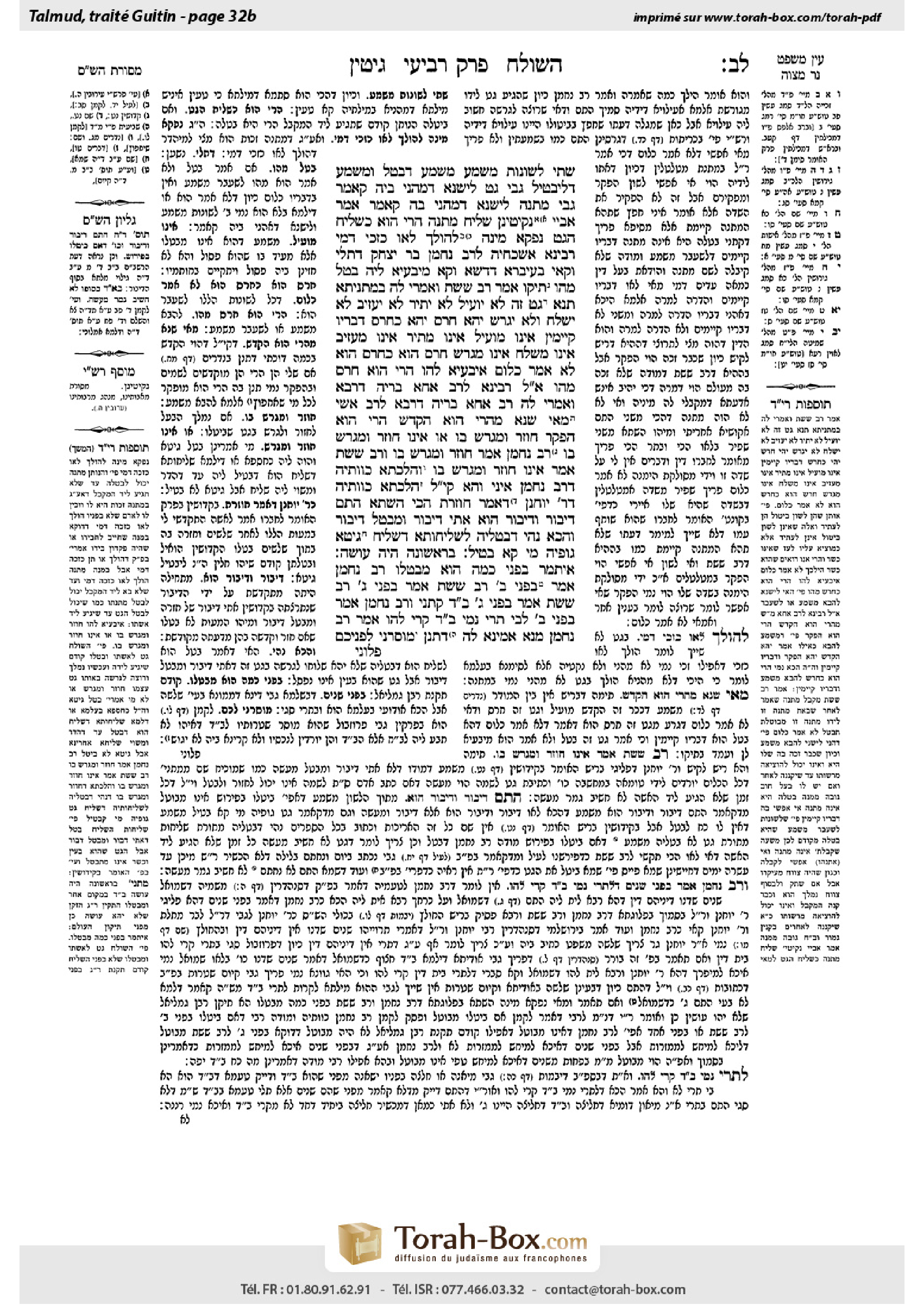
Gittin 32b: Talmud study for Daf Yomi
Study the Talmud for Daf Yomi with scanned pages, Hebrew text, English translations from Sefaria and AI-generated French translations.
Passage selection and English or AI-generated French translation are available where the scan has annotations. Daf Study is independent of Torah-Box and Sefaria.
Browse Gittin · גיטין · All tractatesGittin 32b text and translations
This page of Gittin includes the Aramaic text, an English translation and an AI-generated French translation, alongside the scan above.
גיטין ל״ב ב · Aramaic and Hebrew text
שְׁתֵּי לְשׁוֹנוֹת מַשְׁמַע – מַשְׁמַע דְּבָטֵל, וּמַשְׁמַע דְּלִיבְּטִיל. גַּבֵּי גֵּט לִישָּׁנָא דְּמַהֲנֵי בֵּיהּ קָאָמַר, גַּבֵּי מַתָּנָה לִישָּׁנָא דְּמַהֲנֵי בַּהּ קָאָמַר.
אָמַר אַבָּיֵי, נְקִיטִינַן: שְׁלִיחַ מַתָּנָה הֲרֵי הוּא כִּשְׁלִיחַ הַגֵּט; נָפְקָא מִינַּהּ לְ״הוֹלֵךְ״ לָאו כִּ״זְכִי״ דָּמֵי.
רָבִינָא אַשְׁכְּחֵיהּ לְרַב נַחְמָן בַּר יִצְחָק דִּתְלֵי וְקָאֵי בְּעִיבְרָא דְּדַשָּׁא, וְקָא מִיבַּעְיָא לֵיהּ: ״בָּטֵל״ מַהוּ? תֵּיקוּ.
אָמַר רַב שֵׁשֶׁת, וְאָמְרִי לַהּ בְּמַתְנִיתָא תָּנָא: ״גֵּט זֶה לֹא יוֹעִיל״; ״לֹא יַתִּיר״; ״לֹא יַעֲזִיב״; ״לֹא יְשַׁלַּח״; ״לֹא יְגָרֵשׁ״; ״יְהֵא חֶרֶס״; ״יְהֵא כְּחֶרֶס״ – דְּבָרָיו קַיָּימִין.
״אֵינוֹ מוֹעִיל״; ״אֵינוֹ מַתִּיר״; ״אֵינוֹ מַעֲזִיב״; ״אֵינוֹ מְשַׁלֵּחַ״; ״אֵינוֹ מְגָרֵשׁ״; ״חֶרֶס הוּא״; ״כְּחֶרֶס הוּא״ – לֹא אָמַר כְּלוּם.
אִיבַּעְיָא לְהוּ: ״הֲרֵי הוּא חֶרֶס״, מַהוּ? אֲמַר לֵיהּ רָבִינָא לְרַב אַחָא בְּרֵיהּ דְּרָבָא, וְאָמְרִי לַהּ רַב אַחָא בְּרֵיהּ דְּרָבָא לְרַב אָשֵׁי: מַאי שְׁנָא מֵ״הֲרֵי הוּא הֶקְדֵּשׁ״; ״הֲרֵי הוּא הֶפְקֵר״?
חוֹזֵר וּמְגָרֵשׁ בּוֹ, אוֹ אֵינוֹ חוֹזֵר וּמְגָרֵשׁ בּוֹ? רַב נַחְמָן אָמַר: חוֹזֵר וּמְגָרֵשׁ בּוֹ; וְרַב שֵׁשֶׁת אָמַר: אֵינוֹ חוֹזֵר וּמְגָרֵשׁ בּוֹ. וְהִלְכְתָא כְּווֹתֵיהּ דְּרַב נַחְמָן.
אִינִי?! וְהָא קַיְימָא לַן הִלְכְתָא כְּווֹתֵיהּ דְּרַבִּי יוֹחָנָן, דְּאָמַר: חוֹזֶרֶת.
הָכִי הַשְׁתָּא?! הָתָם – דִּיבּוּר וְדִיבּוּר הוּא, אָתֵי דִּיבּוּר וּמְבַטֵּל דִּיבּוּר; וְהָכָא – נְהִי דְּבַטְּלֵיהּ לִשְׁלִיחוּתָא דְּשָׁלִיחַ, גִּיטָּא גּוּפֵיהּ מִי קָא בָטֵיל?
בָּרִאשׁוֹנָה הָיָה עוֹשֶׂה. אִיתְּמַר, בִּפְנֵי כַּמָּה הוּא מְבַטְּלוֹ? רַב נַחְמָן אָמַר: בִּפְנֵי שְׁנַיִם; רַב שֵׁשֶׁת אָמַר: בִּפְנֵי שְׁלֹשָׁה.
רַב שֵׁשֶׁת אָמַר בִּפְנֵי שְׁלֹשָׁה – ״בֵּית דִּין״ קָתָנֵי. וְרַב נַחְמָן אָמַר בִּפְנֵי שְׁנַיִם – לְבֵי תְרֵי נָמֵי ״בֵּית דִּין״ קָרֵי לְהוּ. אָמַר רַב נַחְמָן: מְנָא אָמֵינָא לַהּ? דִּתְנַן: ״מוֹסְרַנִי לִפְנֵיכֶם
Gittin 32b · English translation
has two potential meanings, depending on the context. It means that it was void already, and it also means that it will become void in the future. With regard to a bill of divorce, he stated the formulation that is effective with regard to it, and since his statement can be understood to mean that the bill of divorce should be void from that point onward, it is interpreted as such. With regard to a gift, he stated the formulation that is effective with regard to it, and since one cannot nullify the acquisition of a gift after taking possession of it, his intention was that the gift was void from the outset, and his statement is interpreted as such.
Additionally Abaye said with regard to the relationship between a bill of divorce and a gift that we have a tradition: An agent sent to deliver a gift is considered like an agent sent to deliver a bill of divorce. The Gemara explains: The practical difference that is learned from this is that if one says to his agent: Take this gift to so-and-so, it is not considered as if he said to him: Acquire the gift on his behalf. Therefore, as long as the gift has not yet reached the intended recipient, the one who sent the gift can retract it, and it is not as if the intended recipient had taken possession of the gift from the moment that it was given to the agent.
The Gemara relates: Ravina found Rav Naḥman bar Yitzḥak as he was leaning on the bar of a door deep in thought, and Rav Naḥman bar Yitzḥak was considering the following dilemma: What is the halakha if a husband said only: This bill of divorce is void, but did not say: This bill of divorce, it is void? Does he mean to render the bill of divorce void from that point onward, which he has the ability to do, or is he merely noting the fact that this bill of divorce is void, in which case his statement does not affect the validity of the document? No answer is given to this question and therefore the dilemma shall stand unresolved.
Rav Sheshet says, and some say that it was taught in a baraita, that if the husband said one of these phrases: This bill of divorce shall not be effective, shall not release, shall not cause to leave, shall not send away, shall not divorce, shall be pottery, or shall be like pottery, in all of these cases his statement is effective, and the bill of divorce is rendered void.
If, however, the husband used one of the following formulations: This bill of divorce has no effect, does not release, does not cause to leave, does not send away, does not divorce, it is pottery, or it is like pottery, then it is as though he said nothing. The husband has the authority only to render the bill of divorce void. However, his descriptive statements with regard to the legal standing of the bill of divorce are meaningless.
A dilemma was raised before the Sages: What is the halakha if he said: It is hereby pottery? Is his intention to make a descriptive statement, that the bill of divorce is not valid, or does he intend to render it void? Ravina said to Rav Aḥa, son of Rava, and some say that Rav Aḥa, son of Rava, said to Rav Ashi: In what way is this formulation different from saying about one’s property: It is hereby consecrated property, or: It is hereby ownerless property, where it is clear that his intention is to designate the items as consecrated or ownerless property? With regard to bills of divorce as well, his statement is effective and it renders the bill of divorce void.
§ The Gemara asks: If the husband rendered void a bill of divorce, can he go back and divorce his wife with it, since perhaps he did not actually render void the bill of divorce but only nullified the agency for its delivery, so it can be used again in the future; or may he not go back and divorce with it, as the bill of divorce itself was rendered void? Rav Naḥman says: He may go back and divorce with it, and Rav Sheshet says: He may not go back and divorce with it. The Gemara concludes: And the halakha is in accordance with the opinion of Rav Naḥman, that the bill of divorce may be used.
The Gemara asks: Is that so? But don’t we maintain that the halakha is in accordance with the opinion of Rabbi Yoḥanan, who said: If a man gives a woman money for betrothal and says that the betrothal will take effect after thirty days, the woman can retract her agreement within the thirty days and decide that she does not wish to be betrothed. Rabbi Yoḥanan holds that as long as the change in status had not yet taken effect, she may nullify her earlier agreement by stating a retraction. Therefore, here too, when the husband states that the bill of divorce should be rendered void, since the divorce had not taken effect, it should be rendered void.
The Gemara rejects this argument: How can these cases be compared? There, in the case of betrothal, it is speech that accepts the betrothal and speech that retracts her acceptance; therefore, her speech comes and nullifies her previous speech, as the woman first stated that she agreed and then stated afterward that she retracted her agreement. But here, even though it is true that the husband rendered void the agency of the agent, does he also render void the bill of divorce itself? Since the bill of divorce is a tangible object, it cannot be made void through speech alone.
§ The mishna taught that initially a husband who wished to render void the bill of divorce would convene a court, even if he had already sent the document with an agent, and render the bill of divorce void in the presence of the court. It was stated: When the husband would state that the bill of divorce should be void, in the presence of how many people must he render it void? Rav Naḥman says: He must render it void in the presence of two people. Rav Sheshet says: He must render it void in the presence of three people.
The Gemara explains the reasoning of each amora: Rav Sheshet said that he must do so in the presence of three people, because the mishna teaches that this takes place in the presence of a court, and a court consists of three judges. And Rav Naḥman said that it may be done in the presence of two people, as two people are also called a court, and in exigent circumstances one may rely on this. Rav Naḥman said: From where do I say that two people are also called a court? As we learned in a mishna (Shevi’it 10:4): When one creates a document that prevents the Sabbatical Year from abrogating an outstanding debt [prosbol], he states: I transfer to you in your presence,
Gittin 32b · Traduction française (IA)
Ce texte a deux sens possibles, selon le contexte. Il signifie que le divorce était déjà nul, et il signifie également qu'il deviendra nul à l'avenir. En ce qui concerne un divorce, il a déclaré la formule qui est efficace concernant celui-ci, et puisque sa déclaration peut être interprétée comme signifiant que le divorce devrait être nul à partir de ce moment, il est ainsi interprété. En ce qui concerne un don, il a déclaré la formule qui est efficace concernant celui-ci, et puisque l'on ne peut pas annuler l'acquisition d'un don après que celui-ci ait été reçu, son intention était que le don était nul dès le départ, et sa déclaration est ainsi interprétée.
En outre, Abaye a dit concernant la relation entre un divorce et un don que nous avons une tradition : Un agent envoyé pour livrer un don est considéré comme un agent envoyé pour livrer un divorce. La Guemara explique : La différence pratique qui en découle est que si l'on dit à son agent : Apporte ce don à tel et tel, cela ne s'interprète pas comme si l'on disait à lui : Acquière le don à sa place. Ainsi, tant que le don n'a pas encore atteint le destinataire prévu, celui qui a envoyé le don peut le retirer, et ce n'est pas comme si le destinataire avait pris possession du don dès qu'il a été donné à l'agent.
La Guemara rapporte : Ravina a trouvé Rav Naḥman bar Yitzḥak en train de s'appuyer sur la barre d'une porte, profondément en réflexion, et Rav Naḥman bar Yitzḥak réfléchissait à la suivante : Quelle est la halakha si un mari a dit seulement : Ce divorce est nul, mais n'a pas dit : Ce divorce, il est nul ? Voulait-il rendre le divorce nul à partir de ce moment, ce qu'il a le pouvoir de faire, ou simplement noter le fait que ce divorce est nul, dans ce cas sa déclaration n'affecte pas la validité du document ? Aucune réponse n'a été donnée à cette question et donc ce dilemme restera sans solution.
Rav Sheshet dit, et certains disent qu'il a été enseigné dans une baraïta, que si le mari a dit l'une de ces phrases : Ce divorce n'aura pas d'effet, ne libérera pas, ne fera pas partir, ne renverra pas, ne divorce pas, sera de la poterie, ou sera comme de la poterie, dans tous ces cas sa déclaration est efficace, et le divorce est rendu nul.
Cependant, si le mari a utilisé l'une des formulations suivantes : Ce divorce n'a pas d'effet, ne libère pas, ne fait pas partir, ne renvoie pas, ne divorce pas, est de la poterie, ou est comme de la poterie, alors cela équivaut à dire rien. Le mari a le pouvoir de rendre le divorce nul. Cependant, ses déclarations descriptives concernant la validité du divorce sont vaines.
Un dilemme a été soulevé devant les Sages : Quelle est la halakha si l'on dit : C'est de la poterie ? Voulait-il exprimer une déclaration descriptive, que le divorce n'est pas valide, ou voulait-il le rendre nul ? Ravina a dit à Rav Aḥa, fils de Rava, et certains disent que Rav Aḥa, fils de Rava, a dit à Rav Ashi : Dans quelle mesure cette formulation diffère-t-elle de la formulation concernant ses biens : C'est de la propriété consacrée, ou : C'est de la propriété sans propriétaire, où il est clair que son intention est de désigner les objets comme propriété consacrée ou sans propriétaire ? Concernant les divorces également, sa déclaration est efficace et rend le divorce nul.
§ La Guemara pose la question : Si le mari a rendu nul un divorce, peut-il revenir et divorcer avec lui, car peut-être il n'a pas effectivement rendu nul le divorce mais seulement annulé l'agent chargé de le livrer, de sorte qu'il puisse être utilisé à nouveau à l'avenir ; ou peut-il ne pas revenir et divorcer avec lui, car le divorce lui-même a été rendu nul ? Rav Naḥman dit : Il peut revenir et divorcer avec lui, et Rav Sheshet dit : Il ne peut pas revenir et divorcer avec lui. La Guemara conclut : Et la halakha suit l'opinion de Rav Naḥman, que le divorce peut être utilisé.
La Guemara pose la question : Est-ce ainsi ? Mais ne maintenons-nous pas que la halakha suit l'opinion de Rabbi Yoḥanan, qui a dit : Si un homme donne à une femme de l'argent pour l'engagement et dit que l'engagement prendra effet après trente jours, la femme peut rétracter son accord dans les trente jours et décider qu'elle ne souhaite pas être engagée. Rabbi Yoḥanan considère que tant que le changement de statut n'avait pas encore pris effet, elle peut annuler son accord précédent en déclarant une rétractation. Ainsi, ici aussi, lorsque le mari déclare que le divorce doit être rendu nul, puisque le divorce n'avait pas encore pris effet, il doit être rendu nul.
La Guemara rejette cet argument : Comment peuvent ces cas être comparés ? Là, dans le cas d'un engagement, c'est un discours qui accepte l'engagement et un discours qui rétracte son acceptation ; donc, son discours annule son précédent discours, car la femme a d'abord déclaré qu'elle acceptait, puis a déclaré après qu'elle rétractait son accord. Mais ici, même si c'est vrai que le mari a annulé l'agent chargé de livrer le divorce, annule-t-il aussi le divorce lui-même ? Puisque le divorce est un objet tangible, il ne peut être rendu nul par un discours seul.
§ La Michna a enseigné que initialement, un mari qui souhaitait rendre nul un divorce convoquait un tribunal, même s'il avait déjà envoyé le document avec un agent, et rendait le divorce nul en présence du tribunal. Il a été dit : Lorsque le mari déclare que le divorce doit être nul, devant combien de personnes doit-il le rendre nul ? Rav Naḥman dit : Il doit le rendre nul devant deux personnes. Rav Sheshet dit : Il doit le rendre nul devant trois personnes.
La Guemara explique la raison de chaque amora : Rav Sheshet a dit qu'il doit le faire en présence de trois personnes, car la michna enseigne que cela a lieu en présence d'un tribunal, et un tribunal est composé de trois juges. Et Rav Naḥman a dit qu'il peut être fait en présence de deux personnes, car deux personnes sont aussi appelées un tribunal, et dans des circonstances urgentes on peut s'appuyer sur cela. Rav Naḥman a dit : D'où dis-je que deux personnes sont aussi appelées un tribunal ? Comme nous avons appris dans une michna (Shevi’it 10:4) : Lorsqu'on crée un document qui empêche l'année sabbatique de révoquer une dette en suspens [prosbol], on dit : Je vous transfère en votre présence,
Traduction française générée par IA à partir de l’édition anglaise de Sefaria. Vérifie toujours un passage avec le texte source.
Text from Sefaria: William Davidson Edition - Vocalized Aramaic (CC BY NC); William Davidson Edition - English (CC BY NC).