Gittin 33a: Talmud study for Daf Yomi
Study the Talmud for Daf Yomi with scanned pages, Hebrew text, English translations from Sefaria and AI-generated French translations.
Passage selection and English or AI-generated French translation are available where the scan has annotations. Daf Study is independent of Torah-Box and Sefaria.
Browse Gittin · גיטין · All tractatesGittin 33a text and translations
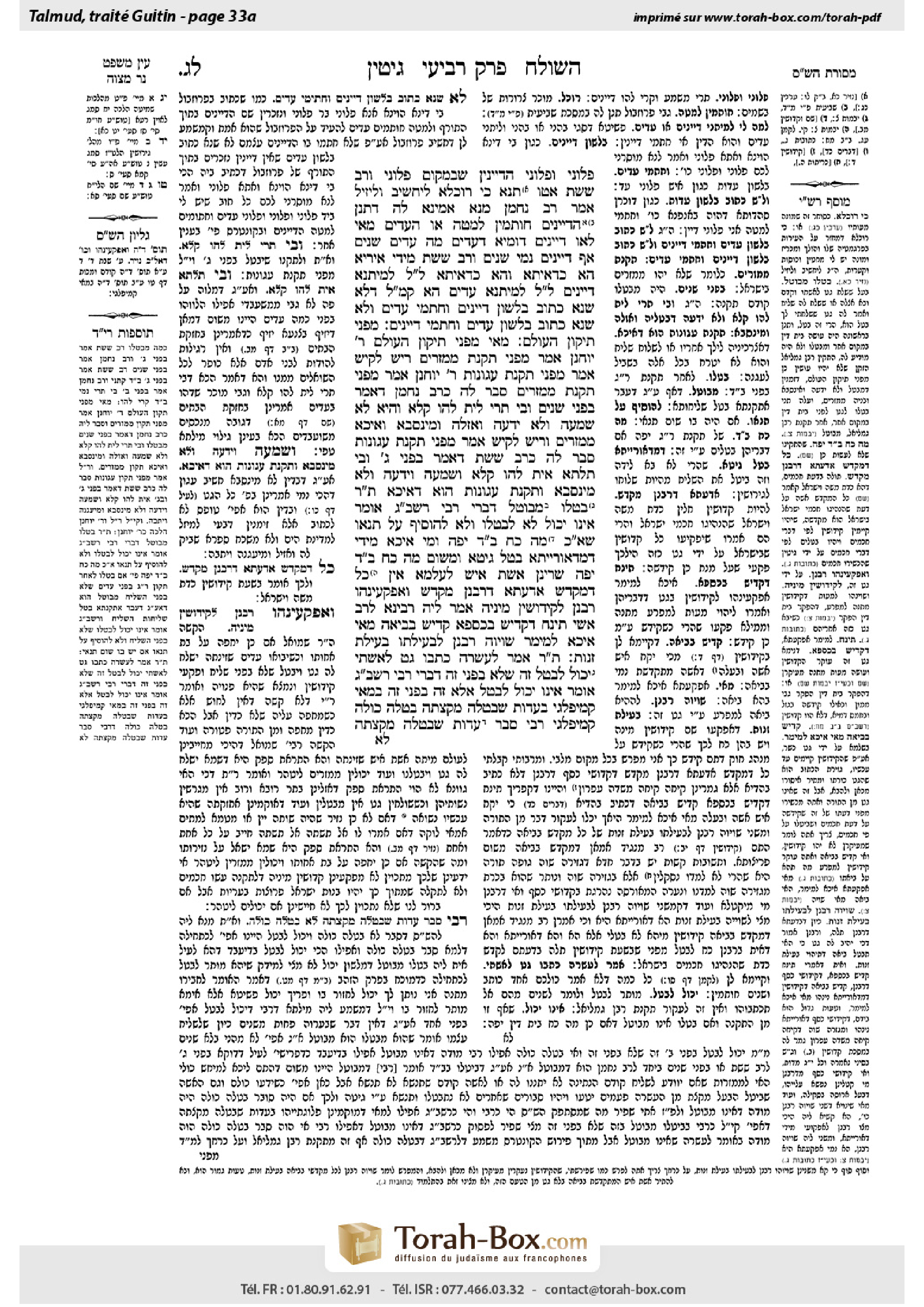
This page of Gittin includes the Aramaic text, an English translation and an AI-generated French translation, alongside the scan above.
גיטין ל״ג א · Aramaic and Hebrew text
פְּלוֹנִי וּפְלוֹנִי הַדַּיָּינִין שֶׁבְּמָקוֹם פְּלוֹנִי״.
וְרַב שֵׁשֶׁת – אַטּוּ תַּנָּא כִּי רוֹכְלָא לִיחְשֹׁיב וְלֵיזִיל?!
אָמַר רַב נַחְמָן: מְנָא אָמֵינָא לַהּ? דִּתְנַן: הַדַּיָּינִים חוֹתְמִין לְמַטָּה, אוֹ הָעֵדִים. מַאי, לָאו דַּיָּינִים דֻּומְיָא דְּעֵדִים – מָה עֵדִים שְׁנַיִם, אַף דַּיָּינִים נָמֵי שְׁנַיִם? וְרַב שֵׁשֶׁת – מִידֵּי אִירְיָא?! הָא כִּדְאִיתָא, וְהָא כִּדְאִיתָא.
לְמָה לִי לְמִיתְנֵא דַּיָּינִים, לְמָה לִי לְמִיתְנֵא עֵדִים? הָא קָא מַשְׁמַע לַן, דְּלָא שְׁנָא כָּתוּב בִּלְשׁוֹן דַּיָּינִים וְחָתְמִי עֵדִים, וְלָא שְׁנָא כָּתוּב בִּלְשׁוֹן עֵדִים וְחָתְמִי דַּיָּינִים.
מִפְּנֵי תִּיקּוּן הָעוֹלָם: מַאי ״מִפְּנֵי תִּיקּוּן הָעוֹלָם״? רַבִּי יוֹחָנָן אָמַר: מִפְּנֵי תַּקָּנַת מַמְזֵרִים. רֵישׁ לָקִישׁ אָמַר: מִפְּנֵי תַּקָּנַת עֲגוּנוֹת.
רַבִּי יוֹחָנָן אָמַר מִפְּנֵי תַּקָּנַת מַמְזֵרִים – סָבַר לַהּ כְּרַב נַחְמָן, דְּאָמַר בִּפְנֵי שְׁנַיִם; וּבֵי תְרֵי לֵית לְהוּ קָלָא; וְהִיא לָא שָׁמְעָה וְלָא יָדְעָה וְאָזְלָה וּמִינַּסְבָא, וְאִיכָּא מַמְזֵרִים.
וְרֵישׁ לָקִישׁ אָמַר מִפְּנֵי תַּקָּנַת עֲגוּנוֹת – סָבַר לַהּ כְּרַב שֵׁשֶׁת, דְּאָמַר בִּפְנֵי שְׁלֹשָׁה; וּבֵי תְלָתָא אִית לְהוּ קָלָא; וְשָׁמְעָה וְיָדְעָה וְלָא מִינַּסְבָא; וְתַקָּנַת עֲגוּנוֹת הוּא דְּאִיכָּא.
תָּנוּ רַבָּנַן: בִּטְּלוֹ – מְבוּטָּל, דִּבְרֵי רַבִּי. רַבָּן שִׁמְעוֹן בֶּן גַּמְלִיאֵל אוֹמֵר: אֵינוֹ יָכוֹל לֹא לְבַטְּלוֹ וְלֹא לְהוֹסִיף עַל תְּנָאוֹ, שֶׁאִם כֵּן, מָה כֹּחַ בֵּית דִּין יָפֶה?
וּמִי אִיכָּא מִידֵּי דְּמִדְּאוֹרָיְיתָא בָּטֵל גִּיטָּא, וּמִשּׁוּם ״מָה כֹּחַ בֵּית דִּין יָפֶה״, שָׁרֵינַן אֵשֶׁת אִישׁ לְעָלְמָא? אִין, כׇּל דִּמְקַדֵּשׁ – אַדַּעְתָּא דְּרַבָּנַן מְקַדֵּשׁ, וְאַפְקְעִינְהוּ רַבָּנַן לְקִידּוּשִׁין מִינֵּיהּ.
אֲמַר לֵיהּ רָבִינָא לְרַב אָשֵׁי: תִּינַח דְּקַדֵּישׁ בְּכַסְפָּא, קַדֵּישׁ בְּבִיאָה מַאי אִיכָּא לְמֵימַר? שַׁוְּיוּהָ רַבָּנַן לִבְעִילָתוֹ בְּעִילַת זְנוּת.
תָּנוּ רַבָּנַן, אָמַר לַעֲשָׂרָה: ״כִּתְבוּ גֵּט לְאִשְׁתִּי״, יָכוֹל לְבַטֵּל זֶה שֶׁלֹּא בִּפְנֵי זֶה, דִּבְרֵי רַבִּי. רַבָּן שִׁמְעוֹן בֶּן גַּמְלִיאֵל אוֹמֵר: אֵינוֹ יָכוֹל לְבַטֵּל אֶלָּא זֶה בִּפְנֵי זֶה.
בְּמַאי קָמִיפַּלְגִי? בְּעֵדוּת שֶׁבָּטְלָה מִקְצָתָהּ בָּטְלָה כּוּלָּהּ קָמִיפַּלְגִי; רַבִּי סָבַר: עֵדוּת שֶׁבָּטְלָה מִקְצָתָהּ
Gittin 33a · English translation
so-and-so and so-and-so the judges, in such and such a place, in order that I will collect any debt that I am owed by so-and-so whenever I wish. Despite the fact that the prosbol mentions only two people, it nevertheless refers to them as judges, in accordance with the statement of Rav Naḥman.
And Rav Sheshet would respond to this: Is that to say that the tanna should have continued counting judges like a peddler? The tanna twice used the expression so-and-so because he wished to note that one should mention the judges’ names; he did not intend to teach anything about the number of judges.
Rav Naḥman said: From where do I say that two judges are also considered a court? As we learned in a mishna with regard to a prosbol (Shevi’it 10:4): The judges sign below the text of the prosbol, or the witnesses do so. What, is it not possible to deduce: The mishna means that judges are similar to witnesses? Just as there are two witnesses, so too, there are also two judges. And Rav Sheshet would respond to this: Are the cases comparable? This case of the judges is as it is, and that case of the witnesses is as it is, each one with its respective requirement of three or two members.
The Gemara asks with regard to the mishna in Shevi’it: Why do I need the tanna to teach that it can be signed by judges, and why do I need him to teach that it can be signed by witnesses as well? Why is it necessary to mention both? The Gemara answers: This teaches us that there is no difference if the prosbol is written in the terminology of judges and witnesses sign it, and there is no difference if it is written in the terminology of witnesses and judges sign it. What is important is that the prosbol was written and then signed by the court, and the precise wording is not important.
§ The mishna taught that Rabban Gamliel the Elder instituted that one may not render a bill of divorce void in a court elsewhere for the betterment of the world. The Gemara asks: What problem did Rabban Gamliel ameliorate that this is considered to be for the betterment of the world? Rabbi Yoḥanan says: This is for the benefit of potential children born from an adulterous relationship [mamzerim], as the husband might render a bill of divorce void unbeknownst to his wife. She might remarry after having received the void bill of divorce, when in fact she is still married to her first husband, and children born from the second marriage will be mamzerim. To prevent this, Rabban Gamliel instituted that one may not render the bill of divorce void when not in the location of his wife. Reish Lakish says: For the betterment of deserted wives, lest women who received their bill of divorce by means of the husband’s agent refrain from remarrying out of the concern that perhaps their husband rendered the bill of divorce void.
The Gemara explains the two opinions: Rabbi Yoḥanan, who says the reason for this ordinance is for the betterment of potential mamzerim, holds in accordance with the opinion of Rav Naḥman, who says that the husband can render void the bill of divorce even in the presence of two people. And since matters that occur in the presence of two people do not generate publicity, it is possible that she does not hear that the bill of divorce was rendered void. And since she does not know that her husband rendered the bill of divorce void, she will go and marry, and there are mamzerim as a result of second marriages like these.
And Reish Lakish, who says that the reason is for the betterment of deserted wives, holds in accordance with the opinion of Rav Sheshet, who says: One can render void a bill of divorce only in the presence of three people. And since matters that occur in the presence of three people do generate publicity, she does hear and know that her husband rendered void the bill of divorce, and she would not marry again. Therefore, there is no concern that this will result in mamzerim, but there is a need to institute this ordinance for the betterment of deserted wives, as explained above.
§ The Sages taught: Even after Rabban Gamliel the Elder instituted that a husband cannot render void a bill of divorce when not in the presence of the wife or the agent, if he nevertheless rendered it void, the bill of divorce is rendered void; this is the statement of Rabbi Yehuda HaNasi. Rabban Shimon ben Gamliel says: He is unable to render it void, and he also cannot add on to his condition if the bill of divorce contained some condition, as if so, i.e., if he can render it void, what advantage does the court have, if an ordinance of the court of Rabban Gamliel can be ignored?
The Gemara asks: And is there anything that by Torah law renders the bill of divorce void and the wife remains married, and due to the reasoning of: What advantage does the court have, we do not recognize that the bill of divorce is void and permit a married woman to marry anyone? The Gemara answers: Yes, anyone who betroths a woman betroths her contingent upon the will of the Sages, and when one fails to conform to their will in matters of marriage and divorce the Sages expropriated his betrothal from him retroactively.
Ravina said to Rav Ashi: This works out well in a case where he betrothed his wife with money, as it is possible to say that the Sages expropriated the money used for the betrothal from the possession of its owner, resulting in a retroactive cancellation of the betrothal. But if he betrothed her by means of sexual intercourse then what is there to say? The Gemara answers: The Sages declared his sexual intercourse to be licentious sexual intercourse, which does not create a bond of betrothal.
§ The Sages taught: If a husband said to ten people: Write a bill of divorce for my wife, in which case any one of them may write the bill of divorce and two others will serve as witnesses, he can render his instructions void before this one, i.e., any one of them, by stating: Do not write the bill of divorce, even though it is not before that one, i.e., any other one of them; this is the statement of Rabbi Yehuda HaNasi. Rabban Shimon ben Gamliel says: He can render his instructions void only when this one is before that one of them, meaning that all ten people must be present.
The Gemara asks: With regard to what principle do they disagree? The Gemara answers: They disagree with regard to whether testimony that was partially invalidated is entirely invalidated. Rabbi Yehuda HaNasi holds: Testimony that was partially invalidated
Gittin 33a · Traduction française (IA)
tels que telle et tels que telle, les juges, dans telle et telle place, afin que je puisse récupérer toute dette que je dois à tels que telle à tout moment que je le désire. Malgré le fait que le prosbol mentionne seulement deux personnes, il les désigne toutefois comme des juges, conformément à la déclaration de Rav Naḥman.
Et Rav Sheshet répondrait à cela ainsi : Est-ce que cela signifie que le tanna aurait dû continuer à compter des juges comme un marchand ? Le tanna a utilisé deux fois l'expression tels que telle parce qu'il voulait indiquer qu'on devait mentionner les noms des juges ; il n'avait pas l'intention d'enseigner quelque chose sur le nombre des juges.
Rav Naḥman a dit : D'où dis-je que deux juges sont également considérés comme un tribunal ? Comme nous avons appris dans une mitsna concernant le prosbol (Shevi’it 10:4) : Les juges signent sous le texte du prosbol, ou les témoins le font. Qu'est-ce que cela ne permet pas de déduire : La mitsna veut dire que les juges sont semblables aux témoins ? Comme il y a deux témoins, ainsi aussi il y a deux juges. Et Rav Sheshet répondrait à cela ainsi : Les cas sont-ils comparables ? Ce cas des juges est comme il est, et celui des témoins est comme il est, chacun avec ses propres exigences de trois ou deux membres.
La Guemara pose une question concernant la mitsna dans Shevi’it : Pourquoi ai-je besoin du tanna pour enseigner que le prosbol peut être signé par des juges, et pourquoi ai-je besoin de lui pour enseigner qu'il peut être signé par des témoins également ? Pourquoi est-il nécessaire de mentionner les deux ? La Guemara répond : Cela nous apprend qu'il n'y a pas de différence si le prosbol est rédigé dans le langage des juges et que les témoins le signent, ou s'il est rédigé dans le langage des témoins et que les juges le signent. Ce qui importe est que le prosbol ait été rédigé et signé par le tribunal, et la formulation précise n'a pas d'importance.
§ La mitsna a enseigné que Rabban Gamliel l'Ancien a institué que l'on ne peut pas annuler un acte de divorce dans un tribunal ailleurs au bénéfice du monde. La Guemara pose une question : Quel problème Rabban Gamliel a-t-il résolu en considérant cela comme étant au bénéfice du monde ? Rabbi Yoḥanan dit : Cela est au bénéfice des enfants potentiels nés d'une relation adultère [mamzerim], car le mari pourrait annuler un acte de divorce sans que sa femme ne le sache. Elle pourrait se remarier après avoir reçu l'acte de divorce annulé, alors qu'en réalité elle est encore mariée à son premier mari, et les enfants nés de ce second mariage seront mamzerim. Pour y remédier, Rabban Gamliel a institué que l'on ne peut pas annuler l'acte de divorce lorsque l'on n'est pas en présence de sa femme. Reish Lakish dit : Pour le bénéfice des femmes abandonnées, afin que celles qui ont reçu leur acte de divorce par l'intermédiaire de l'agent de leur mari ne se remarient pas par crainte qu'il n'ait annulé l'acte de divorce.
La Guemara explique les deux opinions : Rabbi Yoḥanan, qui dit que la raison de cette ordonnance est au bénéfice des potentiels mamzerim, adopte l'opinion de Rav Naḥman, qui dit que le mari peut annuler l'acte de divorce même en présence de deux personnes. Et puisque les choses qui se passent en présence de deux personnes ne génèrent pas de publicité, il est possible que la femme ne sache pas que l'acte de divorce a été annulé. Et puisque elle ne sait pas que son mari a annulé l'acte de divorce, elle ira se remarier, et des mamzerim en résulteront à cause de ces mariages secondaires.
Et Reish Lakish, qui dit que la raison est au bénéfice des femmes abandonnées, adopte l'opinion de Rav Sheshet, qui dit : On peut annuler un acte de divorce uniquement en présence de trois personnes. Et puisque les choses qui se passent en présence de trois personnes génèrent de la publicité, elle sait et comprend que son mari a annulé l'acte de divorce, et elle ne se remariera pas. Ainsi, il n'y a pas de crainte que cela entraîne des mamzerim, mais il y a besoin d'instituer cette ordonnance au bénéfice des femmes abandonnées, comme expliqué ci-dessus.
§ Les Sages ont enseigné : Même après que Rabban Gamliel l'Ancien ait institué que le mari ne peut pas annuler un acte de divorce lorsqu'il n'est pas en présence de la femme ou de l'agent, si toutefois il annule tout de même l'acte de divorce, l'acte de divorce est annulé ; c'est la déclaration de Rabbi Yehuda HaNasi. Rabban Shimon ben Gamliel dit : Il ne peut pas l'annuler, et il ne peut pas ajouter une condition si l'acte de divorce contenait une condition, car si tel est le cas, c'est-à-dire s'il peut l'annuler, qu'avantage le tribunal a-t-il, si une ordonnance du tribunal de Rabban Gamliel peut être ignorée ?
La Guemara pose la question : Et y a-t-il quelque chose prévu par la loi divine qui annule l'acte de divorce et la femme reste mariée, et en raison de la raison : Quel avantage le tribunal a-t-il, nous ne reconnaissons pas que l'acte de divorce est annulé et permettons à une femme mariée de se remarier ? La Guemara répond : Oui, celui qui contracte un mariage contracte la femme conditionnellement à la volonté des Sages, et lorsqu'on ne se conforme pas à leur volonté en matière de mariage et de divorce, les Sages exproprièrent son mariage de lui de manière rétroactive.
Ravina a dit à Rav Ashi : Cela fonctionne bien dans le cas où il a marié sa femme avec de l'argent, car il est possible de dire que les Sages ont exproprié l'argent utilisé pour le mariage de la possession de son propriétaire, entraînant ainsi une annulation rétroactive du mariage. Mais si il l'a mariée par le moyen de l'acte sexuel, alors qu'est-ce que cela signifie ? La Guemara répond : Les Sages ont déclaré son acte sexuel comme étant un acte sexuel licencieux, qui ne crée pas un lien de mariage.
§ Les Sages enseignent : Si un mari dit à dix personnes : Écrivez un acte de divorce pour ma femme, dans ce cas n'importe lequel d'entre eux peut écrire l'acte de divorce et deux autres peuvent servir de témoins, il peut annuler ses instructions devant celui-ci, c'est-à-dire n'importe lequel d'entre eux, en disant : Ne rédigez pas l'acte de divorce, même s'il n'est pas devant celui-ci, c'est-à-dire n'importe lequel d'entre eux ; c'est la déclaration de Rabbi Yehuda HaNasi. Rabban Shimon ben Gamliel dit : Il peut annuler ses instructions uniquement lorsque celui-ci est devant celui-là parmi eux, c'est-à-dire que toutes les dix personnes doivent être présentes.
Le Guemara demande : Sur quel principe se déroule leur désaccord ? Le Guemara répond : Ils se disputent sur le fait que le témoignage partiellement invalidé est entièrement invalidé. Rabbi Yehuda HaNasi affirme : Le témoignage partiellement invalidé est entièrement invalidé.
Traduction française générée par IA à partir de l’édition anglaise de Sefaria. Vérifie toujours un passage avec le texte source.
Text from Sefaria: William Davidson Edition - Vocalized Aramaic (CC BY NC); William Davidson Edition - English (CC BY NC).