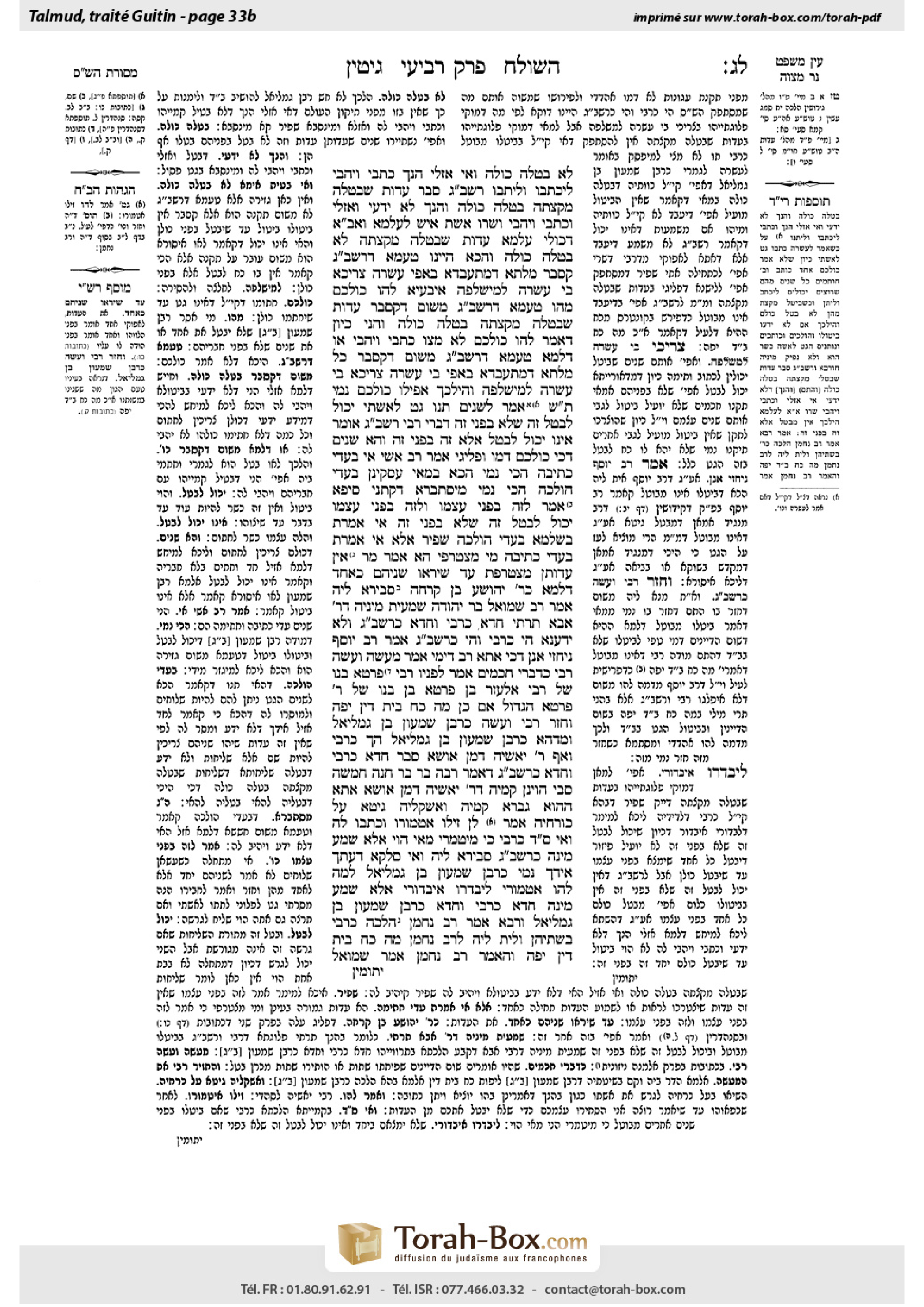
Gittin 33b: Talmud study for Daf Yomi
Study the Talmud for Daf Yomi with scanned pages, Hebrew text, English translations from Sefaria and AI-generated French translations.
Passage selection and English or AI-generated French translation are available where the scan has annotations. Daf Study is independent of Torah-Box and Sefaria.
Browse Gittin · גיטין · All tractatesGittin 33b text and translations
This page of Gittin includes the Aramaic text, an English translation and an AI-generated French translation, alongside the scan above.
גיטין ל״ג ב · Aramaic and Hebrew text
לֹא בָּטְלָה כּוּלָּהּ; וְאִי אָזְלִי הָנָךְ כָּתְבִי וְיָהֲבִי – לִיכְתְּבוּ וְלִיתְּבוּ;
רַבָּן שִׁמְעוֹן בֶּן גַּמְלִיאֵל סָבַר: עֵדוּת שֶׁבָּטְלָה מִקְצָתָהּ בָּטְלָה כּוּלָּהּ; וְהָנָךְ לָא יָדְעִי, וְאָזְלִי וְכָתְבִי וְיָהֲבִי; וְשָׁרוּ אֵשֶׁת אִישׁ לְעָלְמָא.
וְאִיבָּעֵית אֵימָא: דְּכוּלֵּי עָלְמָא עֵדוּת שֶׁבָּטְלָה מִקְצָתָהּ לֹא בָּטְלָה כּוּלָּהּ; וְהָכָא, הַיְינוּ טַעְמָא דְּרַבָּן שִׁמְעוֹן בֶּן גַּמְלִיאֵל – קָסָבַר: מִלְּתָא דְּמִתְעַבְדָא בְּאַפֵּי עַשְׂרָה – צְרִיכָא בֵּי עַשְׂרָה לְמִישְׁלְפַהּ.
אִיבַּעְיָא לְהוּ: ״כּוּלְּכֶם״, מַהוּ? טַעְמָא דְּרַבָּן שִׁמְעוֹן בֶּן גַּמְלִיאֵל מִשּׁוּם דְּקָסָבַר: עֵדוּת שֶׁבָּטְלָה מִקְצָתָהּ בָּטְלָה כּוּלָּהּ – וְהָנֵי, כֵּיוָן דַּאֲמַר לְהוּ ״כּוּלְּכֶם״, לָא מָצוּ כָּתְבִי וְיָהֲבִי;
אוֹ דִלְמָא, טַעְמָא דְּרַבָּן שִׁמְעוֹן בֶּן גַּמְלִיאֵל, מִשּׁוּם דְּקָסָבַר: כֹּל מִלְּתָא דְּמִתְעַבְדָא בְּאַפֵּי בֵּי עַשְׂרָה, צְרִיכָא בֵּי עַשְׂרָה לְמִישְׁלְפַהּ – וְהִילְכָּךְ, אֲפִילּוּ ״כּוּלְּכֶם״ נָמֵי?
תָּא שְׁמַע, אָמַר לִשְׁנַיִם: ״תְּנוּ גֵּט לְאִשְׁתִּי״, יָכוֹל לְבַטֵּל זֶה שֶׁלֹּא בִּפְנֵי זֶה, דִּבְרֵי רַבִּי. רַבָּן שִׁמְעוֹן בֶּן גַּמְלִיאֵל אוֹמֵר: אֵינוֹ יָכוֹל לְבַטֵּל אֶלָּא זֶה בִּפְנֵי זֶה. וְהָא שְׁנַיִם, דְּכִי ״כוּלְּכֶם״ דָּמוּ, וּפְלִיגִי!
אָמַר רַב אָשֵׁי: אִי בְּעֵדֵי כְתִיבָה – הָכִי נָמֵי; הָכָא בְּמַאי עָסְקִינַן, בְּעֵדֵי הוֹלָכָה.
הָכִי נָמֵי מִיסְתַּבְּרָא, דְּקָתָנֵי סֵיפָא: אָמַר לָזֶה בִּפְנֵי עַצְמוֹ וְלָזֶה בִּפְנֵי עַצְמוֹ – יָכוֹל לְבַטֵּל זֶה שֶׁלֹּא בִּפְנֵי זֶה. אִי אָמְרַתְּ בִּשְׁלָמָא בְּעֵדֵי הוֹלָכָה – שַׁפִּיר; אֶלָּא אִי אָמְרַתְּ בְּעֵדֵי כְתִיבָה, מִי מִצְטָרְפִי?! הָא אָמַר מָר: אֵין עֵדוּתָן מִצְטָרֶפֶת, עַד שֶׁיִּרְאוּ שְׁנֵיהֶם כְּאֶחָד! דִּלְמָא כְּרַבִּי יְהוֹשֻׁעַ בֶּן קָרְחָה סְבִירָא לֵיהּ.
אָמַר רַב שְׁמוּאֵל בַּר יְהוּדָה: שְׁמַעִית מִינֵּיהּ דְּרַבִּי אַבָּא תַּרְתֵּי – חֲדָא כְּרַבִּי, וַחֲדָא כְּרַבָּן שִׁמְעוֹן בֶּן גַּמְלִיאֵל; וְלָא יָדַעְנָא הֵי כְּרַבִּי וְהֵי כְּרַבָּן שִׁמְעוֹן בֶּן גַּמְלִיאֵל.
אָמַר רַב יוֹסֵף: נִיחְזֵי אֲנַן – דְּכִי אֲתָא רַב דִּימִי, אָמַר: מַעֲשֶׂה וְעָשָׂה רַבִּי כְּדִבְרֵי חֲכָמִים. אָמַר לְפָנָיו רַבִּי פַּרְטָא בְּנוֹ שֶׁל רַבִּי אֶלְעָזָר בֶּן פַּרְטָא בֶּן בְּנוֹ שֶׁל רַבִּי פַּרְטָא הַגָּדוֹל: אִם כֵּן, מָה כֹּחַ בֵּית דִּין יָפֶה? וְחָזַר רַבִּי וְעָשָׂה כְּרַבָּן שִׁמְעוֹן בֶּן גַּמְלִיאֵל.
וּמִדְּהָא כְּרַבָּן שִׁמְעוֹן בֶּן גַּמְלִיאֵל, הָךְ כְּרַבִּי.
וְאַף רַבִּי יֹאשִׁיָּה דְּמִן אוּשָׁא סָבַר, חֲדָא כְּרַבִּי וַחֲדָא כְּרַבָּן שִׁמְעוֹן בֶּן גַּמְלִיאֵל. דְּאָמַר רַבָּה בַּר בַּר חָנָה: חַמְשָׁה סָבֵי הֲוֵינַן קַמֵּיהּ דְּרַבִּי יֹאשִׁיָּה דְּמִן אוּשָׁא, אֲתָא הָהוּא גַּבְרָא קַמֵּיהּ, וְאַשְׁקְלֵיהּ גִּיטָּא עַל כּוּרְחֵיהּ. אֲמַר לַן: זִילוּ אִטַּמּוּרוּ וּכְתֻבוּ לַהּ.
וְאִי סָלְקָא דַעְתָּךְ כְּרַבִּי, כִּי מִיטַּמְּרִי מַאי הָוֵי? אֶלָּא שְׁמַע מִינַּהּ כְּרַבָּן שִׁמְעוֹן בֶּן גַּמְלִיאֵל סְבִירָא לֵיהּ;
וְאִי סָלְקָא דַּעְתָּךְ אִידַּךְ נָמֵי כְּרַבָּן שִׁמְעוֹן בֶּן גַּמְלִיאֵל, לְמָה לְהוּ אִטַּמּוֹרֵי? לִיבַּדְּרוּ אִיבַּדּוֹרֵי! אֶלָּא שְׁמַע מִינַּהּ – חֲדָא כְּרַבִּי, וַחֲדָא כְּרַבָּן שִׁמְעוֹן בֶּן גַּמְלִיאֵל.
וְרָבָא אָמַר רַב נַחְמָן: הֲלָכָה כְּרַבִּי בִּשְׁתֵּיהֶן. וְלֵית לֵיהּ לְרַב נַחְמָן ״מָה כֹּחַ בֵּית דִּין יָפֶה״?! וְהָאָמַר רַב נַחְמָן, אָמַר שְׁמוּאֵל:
Gittin 33b · English translation
is not entirely invalidated; and therefore, even though the husband nullified the agency of part of the group, if these other people whose agency was never nullified go and write the bill of divorce and give it to the wife, let them write and give the bill of divorce. There is nothing to be concerned about, as their agency was never nullified. Since the bill of divorce that they deliver is valid, there is no reason to institute an ordinance that a husband can nullify the agency only in the presence of the entire group.
Rabban Shimon ben Gamliel disagrees and holds: Testimony that was partially invalidated is entirely invalidated. And if the agency of part of the group was nullified when those agents were not in the presence of the rest of the group, then those others do not know that their agency has been nullified as well. And they might then go and write a bill of divorce and give it, and they will cause the court to mistakenly permit a married woman to marry anyone.
And if you wish, say instead that everyone agrees that testimony that was partially invalidated is not entirely invalidated; and here, this is the reason of Rabban Shimon ben Gamliel that the husband can nullify his instructions only in the presence of all of the agents: He holds that a matter that is performed in the presence of ten people requires the presence of ten people to revoke it. Since the husband instructed ten people to write the bill of divorce, he cannot revoke his instructions in the presence of only a portion of them.
A dilemma was raised before the Sages: If the husband said to them: All of you should write a bill of divorce for my wife, in which case all of them must sign the bill of divorce, what is the halakha according to Rabban Shimon ben Gamliel? The Gemara elaborates: Is the reason of Rabban Shimon ben Gamliel for prohibiting the husband from nullifying the instructions that he had given to ten people because he holds that testimony that was partially invalidated is entirely invalidated, and one should be concerned that the rest of the group will not know that their agency was nullified? And these people, since he said to them explicitly: All of you should write the bill of divorce, the rest of the group are not able to write and give the bill of divorce on their own. Therefore, the husband should be able to nullify his instructions when not in the presence of the entire group, as no mistake can occur because of his action.
Or perhaps the reason of Rabban Shimon ben Gamliel is because he holds that a matter that is performed in the presence of ten people requires the presence of ten people to revoke it. And therefore, even if he said: All of you should write the bill of divorce, he must nullify his instructions in all ten people’s presence as well.
The Gemara suggests: Come and hear a resolution from a baraita (Tosefta 4:1): If one said to two agents: Give a bill of divorce to my wife, he can render his instructions void before this one, i.e., either of them, even though it is not before that one, i.e., the other one; this is the statement of Rabbi Yehuda HaNasi. Rabban Shimon ben Gamliel says: He can render his instructions void only when this one is before that one, i.e., when the two of them are together. The Gemara now states the attempted proof. But two are equivalent to: All of you, as the bill of divorce cannot be written and given by fewer than two people, and there is no concern that perhaps one will sign without the other. And yet Rabbi Yehuda HaNasi and Rabban Shimon ben Gamliel still disagree, proving that Rabban Shimon ben Gamliel’s reason is that the husband can nullify his instructions only in the same manner that he gave them.
Rav Ashi said: If the baraita was speaking of witnesses of the writing of the bill of divorce, both of whom must sign the bill of divorce, this would indeed resolve the question. However, here we are dealing with witnesses of the delivery of the bill of divorce. In that case there is no need for two agents, so there is a concern that if the husband nullifies their agency in the presence of only one of them, then the second agent could mistakenly deliver the bill of divorce to the wife.
The Gemara comments: This too, stands to reason, as the latter clause of the baraita teaches: If one said to this one on his own and to that one on his own, then he can nullify each of their agencies before this one even though it is not before that one. Granted, if you say that this is referring to witnesses of the delivery of the bill of divorce, this works out well, as they need not be appointed together. However, if you say that this is referring to witnesses of the writing, can they combine together if they were appointed separately? But doesn’t the Master say: The testimony of two witnesses does not combine together until the two of them see the event as one, together? The Gemara rejects this proof: Perhaps he holds in accordance with the opinion of Rabbi Yehoshua ben Korḥa, who holds that in order for the witnesses to combine together and present their testimony it is not necessary for them to witness the event together.
Rav Shmuel bar Yehuda said: I heard from Rabbi Abba two rulings with regard to these questions; in one he ruled in accordance with the opinion of Rabbi Yehuda HaNasi and in one he ruled in accordance with the opinion of Rabban Shimon ben Gamliel, and I do not know which is in accordance with the opinion of Rabbi Yehuda HaNasi, and which is in accordance with the opinion of Rabban Shimon ben Gamliel.
Rav Yosef said: Let us see ourselves which argument was decided in favor of whom based on other sources, as when Rav Dimi came from Eretz Yisrael to Babylonia, he said: There was an incident and Rabbi Yehuda HaNasi acted in accordance with the statement of the Rabbis. Rabbi Perata, the son of Rabbi Elazar ben Perata and the son of the son of Rabbi Perata the Great, said before Rabbi Yehuda HaNasi: If so, what advantage does the court have? And Rabbi Yehuda HaNasi reversed his ruling and acted in accordance with the opinion of Rabban Shimon ben Gamliel. The claim of: If so, what advantage does the court have, is the reason behind Rabban Shimon ben Gamliel’s opinion with regard to the question of whether, in a case where the husband violates the ordinance and renders the bill of divorce void in the presence of a court but not before the agent, it is void after the fact.
And from the fact that this dispute is decided in accordance with the opinion of Rabban Shimon ben Gamliel, as Rabbi Yehuda HaNasi retracted his opinion and acted in accordance with Rabban Shimon ben Gamliel, by inference, in the case of that disagreement, with regard to one who gives instructions to ten people, the halakha must be in accordance with the opinion of Rabbi Yehuda HaNasi.
The Gemara comments: And Rabbi Yoshiya from the city of Usha also holds that one halakha is in accordance with the opinion of Rabbi Yehuda HaNasi and one is in accordance with the opinion of Rabban Shimon ben Gamliel. As Rabba bar bar Ḥana said: We were five elders sitting before Rabbi Yoshiya from Usha. A certain man came before him, and Rabbi Yoshiya extracted the authorization to write a bill of divorce from him against his will. Rabbi Yoshiya said to us: Go hide and write for her a bill of divorce, so that the husband will not find you and render the bill of divorce void after it has been written.
The Gemara explains the inference as to the ruling of Rabbi Yoshiya: And if it enters your mind that he rules in accordance with the opinion of Rabbi Yehuda HaNasi, that if a husband renders a bill of divorce void when not in the presence of the agent then the bill of divorce is void, then if they hide, what of it? The man could simply render the bill of divorce void in the presence of others. Rather, learn from it that he holds in accordance with the opinion of Rabban Shimon ben Gamliel, that one can render the bill of divorce void only in the presence of the agents.
The Gemara explains the second element: And if it enters your mind to say that with regard to the other dispute, where one instructs ten people to write the bill of divorce, he also holds in accordance with the opinion of Rabban Shimon ben Gamliel, then why would they need to hide? Let them scatter, and since the husband will not find all of them together, he will be unable to render the bill of divorce void. Rather, learn from it that he holds in one case in accordance with the opinion of Rabbi Yehuda HaNasi, and in one case in accordance with the opinion of Rabban Shimon ben Gamliel. This is one opinion with regard to the halakha in the two disputes of Rabban Shimon ben Gamliel and Rabbi Yehuda HaNasi.
And Rava says that Rav Naḥman says: The halakha is in accordance with the opinion of Rabbi Yehuda HaNasi in both cases. The Gemara asks: But doesn’t Rav Naḥman accept the argument that the court should have an advantage? But doesn’t Rav Naḥman say that Shmuel says,
Gittin 33b · Traduction française (IA)
Ce n'est pas entièrement invalidé ; et donc, même si le mari a annulé l'agence d'une partie du groupe, si ces autres personnes dont l'agence n'a jamais été annulée vont écrire le contrat de divorce et le donner à la femme, qu'ils écrivent et donnent le contrat de divorce. Il n'y a rien à crainre, car leur agence n'a jamais été annulée. Puisque le contrat de divorce qu'ils délivrent est valide, il n'y a pas de raison d'instaurer une ordonnance selon laquelle un mari peut annuler l'agence uniquement en présence de l'ensemble du groupe.
Rabban Shimon ben Gamliel est d'avis contraire et affirme : Le témoignage qui a été partiellement invalidé est entièrement invalidé. Et si l'agence d'une partie du groupe a été annulée lorsque ces agents n'étaient pas en présence des autres, ceux-ci ne savent pas que leur agence a été annulée. Et ils pourraient alors écrire un contrat de divorce et le donner, et ils pourraient entraîner le tribunal à permettre à une femme mariée de se marier avec n'importe qui.
Et si vous le souhaitez, dites plutôt que tout le monde est d'accord sur le fait que le témoignage qui a été partiellement invalidé n'est pas entièrement invalidé ; et ici, c'est la raison de Rabban Shimon ben Gamliel qui affirme que le mari peut annuler ses instructions uniquement en présence de tous les agents : il considère que toute affaire accomplie en présence de dix personnes nécessite la présence de dix personnes pour être révoquée. Puisque le mari a chargé dix personnes d'écrire le contrat de divorce, il ne peut pas révoquer ses instructions en présence qu'une partie d'entre elles.
Un dilemme a été soulevé devant les Sages : Si le mari a dit à eux : Tous, écrivez un contrat de divorce pour ma femme, dans ce cas, tous doivent signer le contrat de divorce, quelle est la halakha selon Rabban Shimon ben Gamliel ? La Guemara développe : Est-ce que la raison de Rabban Shimon ben Gamliel pour interdire au mari d'annuler ses instructions est qu'il considère que le témoignage partiellement invalidé est entièrement invalidé, et qu'on doit craindre que le reste du groupe ne sache pas que leur agence a été annulée ? Et ces personnes, puisqu'il a dit explicitement : Tous, écrivez le contrat de divorce, le reste du groupe ne peut pas écrire et donner le contrat de divorce seul. Par conséquent, le mari devrait pouvoir annuler ses instructions sans être en présence de l'ensemble du groupe, car aucun erreur ne peut résulter de son action.
Ou peut-être que la raison de Rabban Shimon ben Gamliel est qu'il considère qu'une affaire accomplie en présence de dix personnes nécessite la présence de dix personnes pour être révoquée. Et donc, même s'il a dit : Tous, écrivez le contrat de divorce, il doit annuler ses instructions en présence de tous les dix.
La Guemara suggère : Venez écouter une résolution tirée d'une baraïta (Tosefta 4:1) : Si l'on a dit à deux agents : Donnez un contrat de divorce à ma femme, il peut rendre ses instructions nulles devant l'un d'eux, c'est-à-dire l'un ou l'autre, même si ce n'est pas devant l'autre ; c'est l'opinion de Rabbi Yehuda HaNasi. Rabban Shimon ben Gamliel dit : Il peut rendre ses instructions nulles uniquement lorsque l'un est devant l'autre, c'est-à-dire lorsque les deux sont ensemble. La Guemara énonce maintenant la preuve tentée. Mais deux sont équivalents à : Tous, car le contrat de divorce ne peut être écrit et donné par moins de deux personnes, et il n'y a pas de crainte que l'un signe sans l'autre. Et pourtant, Rabbi Yehuda HaNasi et Rabban Shimon ben Gamliel continuent de s'opposer, prouvant que la raison de Rabban Shimon ben Gamliel est que le mari peut annuler ses instructions uniquement de la même manière qu'il les a données.
Rav Ashi a dit : Si la baraïta parlait de témoins de l'écriture du contrat de divorce, tous deux doivent signer le contrat de divorce, cela résoudrait effectivement la question. Cependant, ici nous sommes en présence de témoins de la livraison du contrat de divorce. Dans ce cas, il n'y a pas besoin de deux agents, donc il y a une crainte que si le mari annule leur agence en présence d'un seul d'entre eux, le second agent puisse délivrer par erreur le contrat de divorce à la femme.
La Guemara commente : Cela aussi est logique, car la dernière partie de la baraïta enseigne : Si l'on a dit à l'un seul et à l'autre séparément, il peut annuler l'agence de l'un d'eux devant l'autre même si ce n'est pas devant l'autre. Admettons que vous disiez que cela fait référence à des témoins de la livraison du contrat de divorce, cela s'aligne bien, car ils n'ont pas besoin d'être désignés ensemble. Cependant, si vous disiez que cela fait référence à des témoins de l'écriture, peuvent-ils s'unir s'ils ont été désignés séparément ? Mais n'est-ce pas ce que le Maître dit : Le témoignage de deux témoins ne s'unissent pas avant qu'ils n'aient tous deux vu l'événement ensemble ? La Guemara rejette cette preuve : Peut-être qu'il suit l'opinion de Rabbi Yehoshua ben Korḥa, qui considère que pour que les témoins s'unissent et présentent leur témoignage, il n'est pas nécessaire qu'ils aient tous deux vu l'événement ensemble.
Rav Shmuel bar Yehuda a dit : J'ai entendu de Rabbi Abba deux décisions concernant ces questions ; dans l'une il a rendu un jugement selon l'opinion de Rabbi Yehuda HaNasi et dans l'autre selon l'opinion de Rabban Shimon ben Gamliel, et je ne sais pas laquelle correspond à l'opinion de Rabbi Yehuda HaNasi et laquelle à celle de Rabban Shimon ben Gamliel.
Rav Yosef a dit : Examinons-nous quelle argumentation a été décidée en faveur de qui, selon d'autres sources, comme lorsque Rav Dimi est venu de la Terre d'Israël en Babylone, il a dit : Il y avait un incident et Rabbi Yehuda HaNasi agissait selon l'opinion des Rabbins. Rabbi Perata, fils de Rabbi Elazar ben Perata et fils du fils de Rabbi Perata le Grand, a dit devant Rabbi Yehuda HaNasi : Si c'est ainsi, quelle est l'avantage du tribunal ? Et Rabbi Yehuda HaNasi a rétracté son avis et agi selon l'opinion de Rabban Shimon ben Gamliel. La question : Si c'est ainsi, quelle est l'avantage du tribunal, est la raison derrière l'opinion de Rabban Shimon ben Gamliel concernant la question de savoir si, dans un cas où le mari viole l'ordonnance et annule le contrat de divorce en présence d'un tribunal mais pas devant l'agent, il est annulé après coup.
Et du fait que ce débat est décidé selon l'opinion de Rabban Shimon ben Gamliel, comme Rabbi Yehuda HaNasi a rétracté son avis et agi selon l'opinion de Rabban Shimon ben Gamliel, on en déduit que, dans le cas de ce désaccord, concernant celui qui donne des instructions à dix personnes, la halakha doit être selon l'opinion de Rabbi Yehuda HaNasi.
La Guemara commente : Et Rabbi Yoshiya de la ville d'Usha aussi maintient que l'une des halakhot est selon l'opinion de Rabbi Yehuda HaNasi et l'autre selon l'opinion de Rabban Shimon ben Gamliel. Comme Rabba bar bar Ḥana a dit : Nous étions cinq anciens assis devant Rabbi Yoshiya d'Usha. Un certain homme est venu devant lui, et Rabbi Yoshiya a extrait l'autorisation d'écrire un contrat de divorce de lui contre son gré. Rabbi Yoshiya a dit à nous : Allez vous cacher et écrivez pour elle un contrat de divorce, de sorte que le mari ne vous trouve pas et n'annule le contrat de divorce après qu'il ait été écrit.
La Guemara explique l'inférence concernant le jugement de Rabbi Yoshiya : Et si cela entre en votre tête qu'il juge selon l'opinion de Rabbi Yehuda HaNasi, à savoir que si un mari annule un contrat de divorce en l'absence de l'agent, alors le contrat de divorce est annulé, alors si ils se cachent, qu'y a-t-il ? L'homme pourrait simplement annuler le contrat de divorce en présence d'autres. Plutôt, apprenez-en qu'il juge selon l'opinion de Rabban Shimon ben Gamliel, à savoir qu'on peut annuler le contrat de divorce uniquement en présence des agents.
La Guemara explique l'élément second : Et si cela entre en votre tête pour dire que concernant l'autre débat, où l'on instruit dix personnes à écrire le contrat de divorce, il juge aussi selon l'opinion de Rabban Shimon ben Gamliel, alors pourquoi auraient-ils besoin de se cacher ? Fassent-ils disparaître, et puisque le mari ne trouvera pas tous ensemble, il ne pourra pas annuler le contrat de divorce. Plutôt, apprenez-en qu'il juge dans un cas selon l'opinion de Rabbi Yehuda HaNasi et dans un autre selon l'opinion de Rabban Shimon ben Gamliel. C'est une opinion concernant la halakha dans les deux débats de Rabban Shimon ben Gamliel et de Rabbi Yehuda HaNasi.
Et Rava dit que Rav Naḥman dit : La halakha est selon l'opinion de Rabbi Yehuda HaNasi dans les deux cas. La Guemara pose la question : Mais ne dit pas Rav Naḥman qu'il accepte l'argument selon lequel le tribunal doit avoir un avantage ? Mais ne dit-il pas Rav Naḥman que Shmuel dit,
Traduction française générée par IA à partir de l’édition anglaise de Sefaria. Vérifie toujours un passage avec le texte source.
Text from Sefaria: William Davidson Edition - Vocalized Aramaic (CC BY NC); William Davidson Edition - English (CC BY NC).