Gittin 34a: Talmud study for Daf Yomi
Study the Talmud for Daf Yomi with scanned pages, Hebrew text, English translations from Sefaria and AI-generated French translations.
Passage selection and English or AI-generated French translation are available where the scan has annotations. Daf Study is independent of Torah-Box and Sefaria.
Browse Gittin · גיטין · All tractatesGittin 34a text and translations
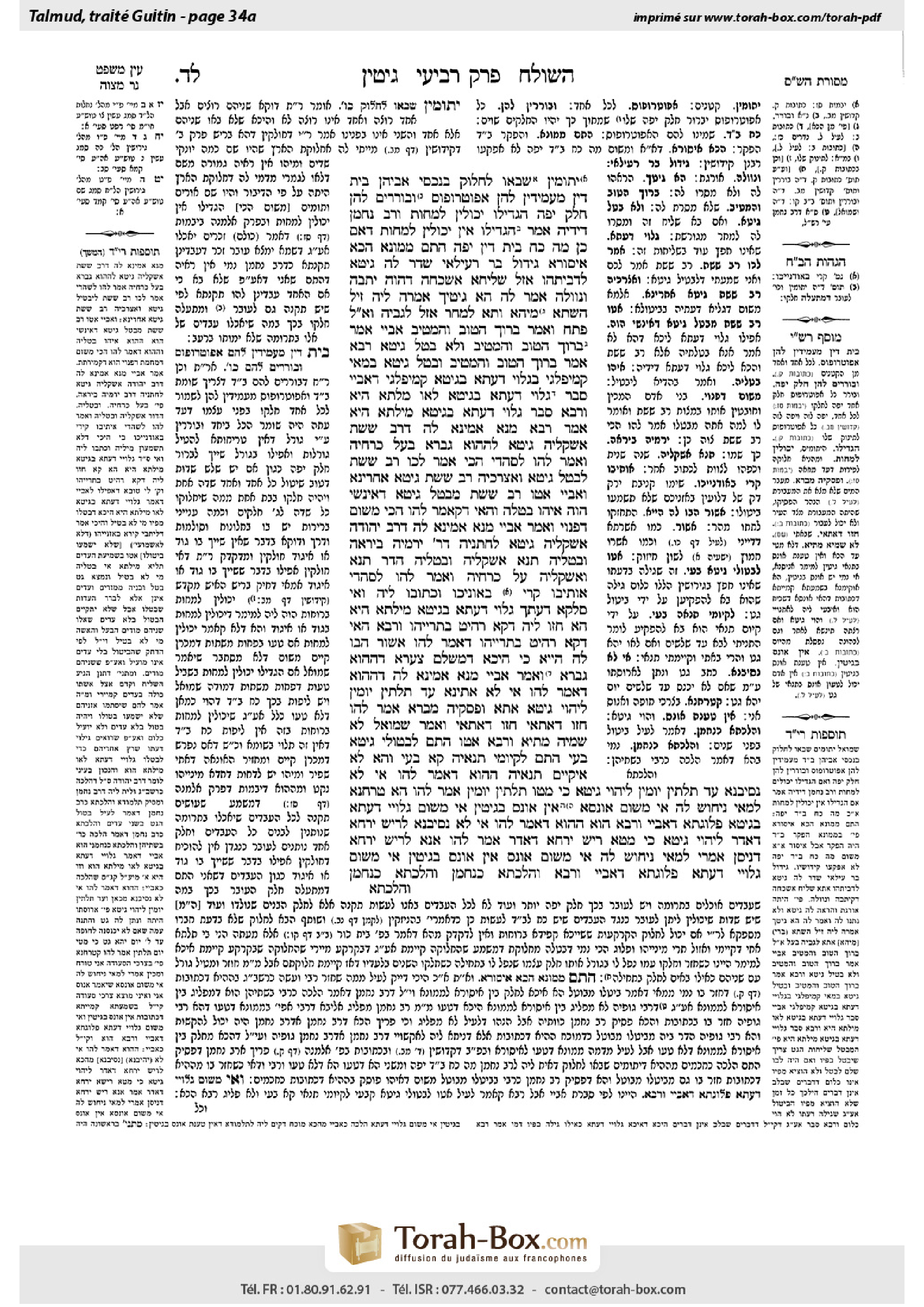
This page of Gittin includes the Aramaic text, an English translation and an AI-generated French translation, alongside the scan above.
גיטין ל״ד א · Aramaic and Hebrew text
יְתוֹמִין שֶׁבָּאוּ לַחֲלוֹק בְּנִכְסֵי אֲבִיהֶן, בֵּית דִּין מַעֲמִידִין לָהֶן אַפּוֹטְרוֹפּוֹס, וּבוֹרְרִים לָהֶן חֵלֶק יָפֶה. הִגְדִּילוּ – יְכוֹלִין לְמַחוֹת. וְרַב נַחְמָן דִּידֵיהּ אָמַר: הִגְדִּילוּ – אֵין יְכוֹלִין לְמַחוֹת; דְּאִם כֵּן, מָה כֹּחַ בֵּית דִּין יָפֶה?
הָתָם מָמוֹנָא, הָכָא אִיסּוּרָא.
גִּידּוּל בַּר רְעִילַאי שַׁדַּר לַהּ גִּיטָּא לִדְבֵיתְהוּ; אֲזַל שְׁלִיחָא, אַשְׁכְּחַהּ דַּהֲוָה יָתְבָה וְנָוְולָה, אֲמַר לַהּ: הֵא גִּיטִּיךְ. אֲמַרָה לֵיהּ: זִיל הַשְׁתָּא מִיהָא, וְתָא לִמְחַר. אֲזַל לְגַבֵּיהּ וַאֲמַר לֵיהּ. פְּתַח וַאֲמַר: ״בָּרוּךְ הַטּוֹב וְהַמֵּטִיב״.
אַבָּיֵי אָמַר: ״בָּרוּךְ הַטּוֹב וְהַמֵּטִיב״, וְלָא בָּטֵל גִּיטָּא. רָבָא אָמַר: ״בָּרוּךְ הַטּוֹב וְהַמֵּטִיב״, וּבָטֵל גִּיטָּא.
בְּמַאי קָמִיפַּלְגִי? בְּגִלּוּי דַעְתָּא בְּגִיטָּא קָמִיפַּלְגִי – דְּאַבָּיֵי סָבַר: גִּלּוּי דַעְתָּא בְּגִיטָּא לָאו מִלְּתָא הִיא, וְרָבָא סָבַר: גִּלּוּי דַעְתָּא בְּגִיטָּא מִילְּתָא הִיא.
אָמַר רָבָא: מְנָא אָמֵינָא לַהּ? דְּרַב שֵׁשֶׁת אַשְׁקְלֵיהּ גִּיטָּא לְהָהוּא גַּבְרָא בְּעַל כֻּרְחֵיהּ, וַאֲמַר לְהוּ לְסָהֲדִי: הָכִי אָמַר לְכוּ רַב שֵׁשֶׁת – לְבַטֵּל גִּיטָּא. וְאַצְרְכֵיהּ רַב שֵׁשֶׁת גִּיטָּא אַחֲרִינָא.
וְאַבָּיֵי – אַטּוּ רַב שֵׁשֶׁת מְבַטֵּל גִּיטָּא דְּאִינָשֵׁי הֲוָה?! אִיהוּ בַּטְּלַהּ; וְהַאי דְּקָאָמַר לְהוּ הָכִי, מִשּׁוּם דָּפְנוֹיֵ[י].
וְאָמַר אַבָּיֵי: מְנָא אָמֵינָא לַהּ? דְּרַב יְהוּדָה אַשְׁקְלֵיהּ גִּיטָּא לְחַתְנֵיהּ דְּרַבִּי יִרְמְיָה בִּירָאָה, וּבַטְּלֵיהּ; תְּנָא אַשְׁקְלֵיהּ, וּבַטְּלֵיהּ; הֲדַר תְּנָא וְאַשְׁקְלֵיהּ עַל כֻּרְחֵיהּ, וַאֲמַר לְהוּ לְסָהֲדִי: אוֹתִיבוּ קָרֵי בְּאוּנַּיְכוּ וּכְתוּבוּ לֵיהּ. וְאִי סָלְקָא דַעְתָּךְ גִּלּוּי דַעְתָּא בְּגִיטָּא מִילְּתָא הִיא, הָא חָזוּ לֵיהּ דְּקָא רָהֵיט בָּתְרַיְיהוּ!
וְרָבָא – הַאי דְּקָא רָהֵיט בָּתְרַיְיהוּ, דְּאָמַר לְהוּ: אַשּׁוּר הַבוּ לַהּ הַיָּיא, כִּי הֵיכָא דְּמִשְׁלַם צַעֲרָא דְּהָהוּא גַּבְרָא.
וְאָמַר אַבָּיֵי: מְנָא אָמֵינָא לַהּ? דְּהָהוּא דַּאֲמַר לְהוּ: אִי לָא אָתֵינָא עַד תְּלָתִין יוֹמִין, לֶיהֱוֵי גִּיטָּא. אֲתָא, וּפַסְקֵיהּ מַבָּרָא; אֲמַר לְהוּ: ״חֲזוֹ דַּאֲתַאי, חֲזוֹ דַּאֲתַאי״; וַאֲמַר שְׁמוּאֵל: לָא שְׁמֵיהּ מַתְיָא.
וְרָבָא – אַטּוּ הָתָם לְבַטּוֹלֵי גִּיטָּא בָּעֵי?! הָתָם לְקַיּוֹמֵי תְּנָאֵיהּ קָא בָעֵי, וְהָא לָא אִיקַּיַּים תְּנָאֵיהּ.
הָהוּא דַּאֲמַר לְהוּ: אִי לָא נָסֵיבְנָא עַד תְּלָתִין יוֹמִין – לֶיהֱוֵי גִּיטָּא. כִּי מְטוֹ תְּלָתִין יוֹמִין, אֲמַר לְהוּ: הָא טָרַחְנָא.
לְמַאי נֵיחוּשׁ לַהּ? אִי מִשּׁוּם אוּנְסָא – אֵין אוֹנֶס בְּגִיטִּין. אִי מִשּׁוּם גַּלּוֹיֵי דַּעְתָּא בְּגִיטָּא – פְּלוּגְתָּא דְּאַבָּיֵי וְרָבָא הוּא.
הָהוּא דַּאֲמַר לְהוּ: אִי לָא נָסֵיבְנָא לְרֵישׁ יַרְחָא דַּאֲדָר, לֶיהֱוֵי גִּיטָּא. כִּי מְטָא רֵישׁ יַרְחָא דַּאֲדָר, אֲמַר לְהוּ: אֲנָא לְרֵישׁ יַרְחָא דְנִיסָן אֲמַרִי. לְמַאי נֵיחוּשׁ לַהּ? אִי מִשּׁוּם אוֹנֶס – אֵין אוֹנֶס בְּגִיטִּין. אִי מִשּׁוּם גַּלּוֹיֵי דַּעְתָּא – פְּלוּגְתָּא דְּאַבָּיֵי וְרָבָא.
וְהִלְכְתָא כְּנַחְמָן; וְהִלְכְתָא כְּנַחְמָן;
Gittin 34a · English translation
with regard to the halakhot of a steward who cares for the estate of orphans: In the case of orphans who came to divide their father’s property, the court appoints a steward [apotropos] for them, and they select for them, i.e., for each of the orphans, a fine portion. When the orphans have grown up, they can protest the division and demand the redistribution of the property. And Rav Naḥman said his own statement: When they have grown up, they cannot protest, for if so, what advantage does the court have? This demonstrates that Rav Naḥman agrees with the principle of: If so, what advantage does the court have?
The Gemara answers: There is no contradiction between Rav Naḥman’s statement concerning the inheritance of orphans and his statement with regard to rendering a bill of divorce void. There, in the former case, it is in the realm of monetary matters, and the preservation of the court’s honor is more important than the accurate distribution of the property. Here, in the case of divorce, it is in the realm of matters of prohibition, and one would not permit a married woman to remarry in order to strengthen the authority of the court.
§ The Gemara relates: A man named Giddul bar Re’ilai sent a bill of divorce to his wife. The agent went and found that she was sitting and weaving [navla]. He said to her: This is your bill of divorce. She said to him: At least go away from here now and come tomorrow to give me the bill of divorce. The agent went to Giddul bar Re’ilai and told him what had occurred. Giddul bar Re’ilai opened his mouth and said: Blessed is He Who is good and does good, as he was happy that the bill of divorce was not delivered.
The Sages disagreed with regard to the status of this bill of divorce. Abaye said that he said: Blessed is He Who is good and does good, as he was happy that it was not delivered, but the bill of divorce is not rendered void through this statement. Rava said that he said: Blessed is He Who is good and does good, and the bill of divorce is rendered void.
The Gemara asks: With regard to what principle do they disagree? The Gemara answers: They disagree in their understanding of disclosure of intent with regard to a bill of divorce, i.e., when the husband demonstrates that he does not desire the bill of divorce to be delivered, but does not render it void explicitly. As Abaye holds: Disclosure of intent with regard to a bill of divorce is not a significant matter and does not render it void, and Rava holds: Disclosure of intent with regard to a bill of divorce is a significant matter, and does render it void.
Rava said: From where do I say this halakha? From a case where Rav Sheshet extracted the authorization to write a bill of divorce from a certain man against his will, and that man then said to the witnesses: This is what Rav Sheshet said to you: Let the bill of divorce be rendered void, and Rav Sheshet required him to write another bill of divorce. Evidently, though the man did not explicitly render the bill of divorce void with his statement, but only demonstrated that he did not want the bill of divorce to be given, Rav Sheshet considered the bill of divorce to be rendered void.
And Abaye would respond: Is that to say Rav Sheshet would render void the bills of divorce of other people? Rather, the husband rendered void the bill of divorce himself. And the reason why he told them this, that it was Rav Sheshet’s instructions that the bill of divorce be rendered void, was due to the lashes that he would have received from the court appointees if he said that he was rendering the bill of divorce void against the wishes of Rav Sheshet.
And Abaye said: From where do I say that disclosure of intent with regard to bills of divorce is disregarded? From the case where Rav Yehuda extracted the authorization to write a bill of divorce from the son-in-law of Rabbi Yirmeya Bira’a, and the man rendered the bill of divorce void. Rav Yehuda again extracted the authorization to write a bill of divorce, and the man rendered the bill of divorce void. Rav Yehuda returned and again extracted the authorization to write a bill of divorce against his will, and said to the witnesses: Place pieces of gourd in your ears and write the bill of divorce for him, so that you will not hear if he renders the bill of divorce void again. Abaye states his proof: And if it enters your mind that disclosure of intent with regard to bills of divorce is a significant matter, in this case the witnesses see that he is running after them even though they do not hear him, so the bill of divorce should be rendered void.
And Rava would respond: Since they cannot hear him, his intent is not disclosed; this, that he is running after them, does not prove that he wishes to render the bill of divorce void, as it could be that he wishes to say to them: Make haste [ashur], give her the bill of divorce speedily [hayya] in order to end the pain of that man, i.e., my pain, that I am divorcing my wife.
And Abaye said further: From where do I say that disclosure of intent with regard to bills of divorce is disregarded? From the case where there was a certain man who said to the agents with whom he entrusted the bill of divorce: If I do not arrive from now until thirty days have passed, let this be a bill of divorce. He came after thirty days had passed, but was prevented from crossing the river by the ferry that was located on the other side of the river, so he did not arrive within the designated time. He said to the people across the river: See that I have arrived, see that I have arrived, and Shmuel said: It is not considered to be an arrival, even though it is clear that this was his intention, and the bill of divorce is not void.
And Rava said: This case cannot serve as a proof; is that to say that there he desires to render the bill of divorce void? There, in that case, he desires to fulfill his stipulation, and he did not fulfill his condition, as he did not arrive. Therefore, the bill of divorce remains valid.
The Gemara relates: There was a certain man who said to witnesses when he gave a bill of divorce to his betrothed: If I do not marry her within up to thirty days, then this will be a bill of divorce. When thirty days arrived, he said to them: I took the trouble but I did not succeed in marrying her.
The Gemara asks: With regard to what need we be concerned in the case of this bill of divorce? If we are concerned because he attempted to marry her and there were circumstances beyond his control that prevented him from doing so, isn’t there a principle that unavoidable circumstances have no legal standing with regard to bills of divorce? If the concern is due to disclosure of intent with regard to bills of divorce, and the husband demonstrated that he does not want the bill of divorce to take effect, then this is a dispute of Abaye and Rava, and, as the Gemara explains later, the halakha is in accordance with the opinion of Abaye.
The Gemara relates: There was a certain man who said to witnesses: If I do not marry my betrothed by the New Moon of Adar then this will be a bill of divorce. When the New Moon of Adar arrived, he said to them: I said by the New Moon of Nisan. With regard to what need we be concerned? If we are concerned because he attempted to marry her and there were circumstances beyond his control that prevented him from doing so, isn’t there a principle that unavoidable circumstances have no legal standing with regard to bills of divorce? If the concern is due to disclosure of intent with regard to bills of divorce, and the husband demonstrated that he does not want the bill of divorce to take effect, then this is a dispute of Abaye and Rava, and, as the Gemara explains later, the halakha is in accordance with the opinion of Abaye.
The Gemara states several conclusions: And the halakha is in accordance with the opinion of Rav Naḥman, who ruled that one can render a bill of divorce void in the presence of two people. And the halakha is in accordance with the opinion of Rav Naḥman, who ruled that the halakha is in accordance with Rabbi Yehuda HaNasi in both of his disputes with Rabban Shimon ben Gamliel.
Gittin 34a · Traduction française (IA)
en ce qui concerne les halakhot d’un steward qui gère les affaires des orphelins : dans le cas d’orphelins qui viennent diviser la propriété de leur père, la cour désigne un steward [apotropos] pour eux, et ils choisissent pour eux, c’est-à-dire pour chaque orphelin, une part suffisante. Lorsque les orphelins sont devenus adultes, ils peuvent protester contre la division et exiger la redistribution de la propriété. Et Rav Naḥman a dit sa propre opinion : lorsqu’ils sont devenus adultes, ils ne peuvent pas protester, car sinon, qu’avantage la cour a-t-elle ? Cela démontre que Rav Naḥman est d’accord avec le principe suivant : si tel est le cas, qu’avantage la cour a-t-elle ?
La Guemara répond : il n’y a pas de contradiction entre l’affirmation de Rav Naḥman concernant l’héritage des orphelins et son affirmation concernant l’annulation d’un acte de divorce. Là, dans le premier cas, il s’agit de questions monétaires, et la préservation de l’honneur de la cour est plus importante que la distribution précise de la propriété. Ici, dans le cas du divorce, il s’agit de questions de prohibitions, et on ne permettrait pas une femme mariée de se remarier afin de renforcer l’autorité de la cour.
§ La Guemara rapporte : un homme nommé Giddul bar Re’ilai a envoyé un acte de divorce à sa femme. L’agent est allé et a trouvé qu’elle était assise et tissait [navla]. Il lui a dit : voici votre acte de divorce. Elle lui a répondu : au moins, va-t’en d’ici maintenant et viens demain pour lui donner l’acte de divorce. L’agent est allé à Giddul bar Re’ilai et lui a rapporté ce qui s’était produit. Giddul bar Re’ilai a ouvert la bouche et a dit : béni soit Il qui est bon et fait le bien, car il était heureux que l’acte de divorce ne soit pas livré.
Les Sages s’entendaient sur le statut de cet acte de divorce. Abaye a dit que celui-ci a dit : béni soit Il qui est bon et fait le bien, car il était heureux qu’il ne soit pas livré, mais l’acte de divorce n’est pas annulé par cette déclaration. Rava a dit que celui-ci a dit : béni soit Il qui est bon et fait le bien, et l’acte de divorce est annulé.
La Guemara pose la question : sur quel principe s’entendent-ils ? La Guemara répond : ils s’entendent sur leur compréhension de la déclaration d’intention concernant un acte de divorce, c’est-à-dire lorsque le mari montre qu’il ne désire pas que l’acte de divorce soit livré, mais ne l’annule pas explicitement. Comme Abaye considère que la déclaration d’intention concernant un acte de divorce n’est pas une affaire importante et ne l’annule pas, et Rava considère que la déclaration d’intention concernant un acte de divorce est une affaire importante et l’annule.
Rava a dit : d’où dis-je cette halakha ? D’un cas où Rav Sheshet a extrait l’autorisation d’écrire un acte de divorce d’un certain homme contre son gré, et cet homme a dit aux témoins : c’est ce que Rav Sheshet a dit à vous : annulez l’acte de divorce, et Rav Sheshet exigeait qu’il écrive un autre acte de divorce. Bien que cet homme n’ait pas explicitement annulé l’acte de divorce avec sa déclaration, mais seulement montré qu’il ne voulait pas que l’acte de divorce soit livré, Rav Sheshet a considéré que l’acte de divorce était annulé.
Et Abaye répondrait : est-ce que cela signifie que Rav Sheshet annulerait les actes de divorce d’autrui ? Plutôt, le mari a annulé lui-même l’acte de divorce. Et la raison pour laquelle il a dit cela, c’est que c’était les instructions de Rav Sheshet que l’acte de divorce soit annulé, et c’était à cause des coups de fouet qu’il aurait reçus des membres de la cour s’il avait dit qu’il annulait l’acte de divorce contre la volonté de Rav Sheshet.
Et Abaye a dit : d’où dis-je que la déclaration d’intention concernant les actes de divorce est négligée ? D’un cas où Rav Yehuda a extrait l’autorisation d’écrire un acte de divorce du fils de la sœur de Rabbi Yirmeya Bira’a, et l’homme a annulé l’acte de divorce. Rav Yehuda a à nouveau extrait l’autorisation d’écrire un acte de divorce, et l’homme a annulé l’acte de divorce. Rav Yehuda est revenu et a à nouveau extrait l’autorisation d’écrire un acte de divorce contre sa volonté, et a dit aux témoins : mettez des morceaux de citron dans vos oreilles et écrivez l’acte de divorce pour lui, afin que vous ne l’entendiez pas si il annule à nouveau l’acte de divorce. Abaye énonce sa preuve : et si cela entre dans votre esprit que la déclaration d’intention concernant les actes de divorce est une affaire importante, dans ce cas les témoins voient qu’il court après eux même s’ils ne l’entendent pas, donc l’acte de divorce devrait être annulé.
Et Rava répondrait : puisque ils ne peuvent pas l’entendre, son intention n’est pas déclarée ; cela, qu’il court après eux, ne prouve pas qu’il souhaite annuler l’acte de divorce, car cela pourrait être qu’il veut leur dire : accélère [ashur], donne-lui l’acte de divorce rapidement [hayya] afin de finir la souffrance de cet homme, c’est-à-dire ma souffrance, que je divorce de ma femme.
Et Abaye a dit encore : d’où dis-je que l’intention exprimée concernant les actes de divorce est négligée ? D’un cas où un certain homme a dit aux agents avec lesquels il avait confié l’acte de divorce : si je n’arrive pas d’ici à ce que trente jours passent, que cela soit un acte de divorce. Il est arrivé après que trente jours aient passé, mais il a été empêché de traverser le fleuve par le bateau qui était de l’autre côté du fleuve, donc il n’est pas arrivé à temps. Il a dit aux gens de l’autre côté du fleuve : voyez que j’ai arrivé, voyez que j’ai arrivé, et Shmuel a dit : cela n’est pas considéré comme un arrivé, même si c’est clair que c’était son intention, et l’acte de divorce n’est pas annulé.
Et Rava a dit : ce cas ne peut pas servir de preuve ; est-ce que cela signifie qu’il désirait annuler l’acte de divorce ? Là, dans ce cas, il désirait accomplir sa stipulation, et il n’a pas accompli sa condition, car il n’est pas arrivé. Donc, l’acte de divorce reste valide.
La Guemara rapporte : Il y avait un certain homme qui a dit aux témoins lorsqu'il a donné un acte de divorce à sa fiancée : Si je ne l'épouse pas dans les trente jours suivants, alors cela sera un acte de divorce. Lorsque les trente jours sont arrivés, il a dit aux témoins : J'ai pris la peine mais je n'ai pas réussi à l'épouser.
La Guemara pose la question : À l'égard de quelle situation devons-nous nous préoccuper dans le cas de cet acte de divorce ? Si nous nous préoccupons parce qu'il a tenté de l'épouser et qu'il y avait des circonstances hors de son contrôle qui l'ont empêché de le faire, n'y a-t-il pas un principe selon lequel les circonstances imprévues n'ont pas de valeur juridique concernant les actes de divorce ? Si la préoccupation est due à la déclaration de l'intention concernant les actes de divorce, et si l'époux a montré qu'il ne veut pas que l'acte de divorce prenne effet, alors c'est un débat entre Abaye et Rava, et, comme la Guemara l'explique plus tard, la halakha suit l'opinion d'Abaye.
La Guemara rapporte : Il y avait un certain homme qui a dit aux témoins : Si je ne me marie pas avec ma fiancée avant la nouvelle lune d'Adar, alors cela sera un acte de divorce. Lorsque la nouvelle lune d'Adar est arrivée, il a dit aux témoins : J'ai dit avant la nouvelle lune de Nisan. À l'égard de quelle situation devons-nous nous préoccuper ? Si nous nous préoccupons parce qu'il a tenté de l'épouser et qu'il y avait des circonstances hors de son contrôle qui l'ont empêché de le faire, n'y a-t-il pas un principe selon lequel les circonstances imprévues n'ont pas de valeur juridique concernant les actes de divorce ? Si la préoccupation est due à la déclaration de l'intention concernant les actes de divorce, et si l'époux a montré qu'il ne veut pas que l'acte de divorce prenne effet, alors c'est un débat entre Abaye et Rava, et, comme la Guemara l'explique plus tard, la halakha suit l'opinion d'Abaye.
La Guemara énonce plusieurs conclusions : La halakha suit l'opinion de Rav Naḥman, qui a décidé qu'on peut annuler un acte de divorce en présence de deux personnes. La halakha suit l'opinion de Rav Naḥman, qui a décidé que la halakha suit l'opinion de Rabbi Yéhouda HaNasi dans les deux de ses débats avec Rabban Shimon ben Gamliel.
Traduction française générée par IA à partir de l’édition anglaise de Sefaria. Vérifie toujours un passage avec le texte source.
Text from Sefaria: William Davidson Edition - Vocalized Aramaic (CC BY NC); William Davidson Edition - English (CC BY NC).