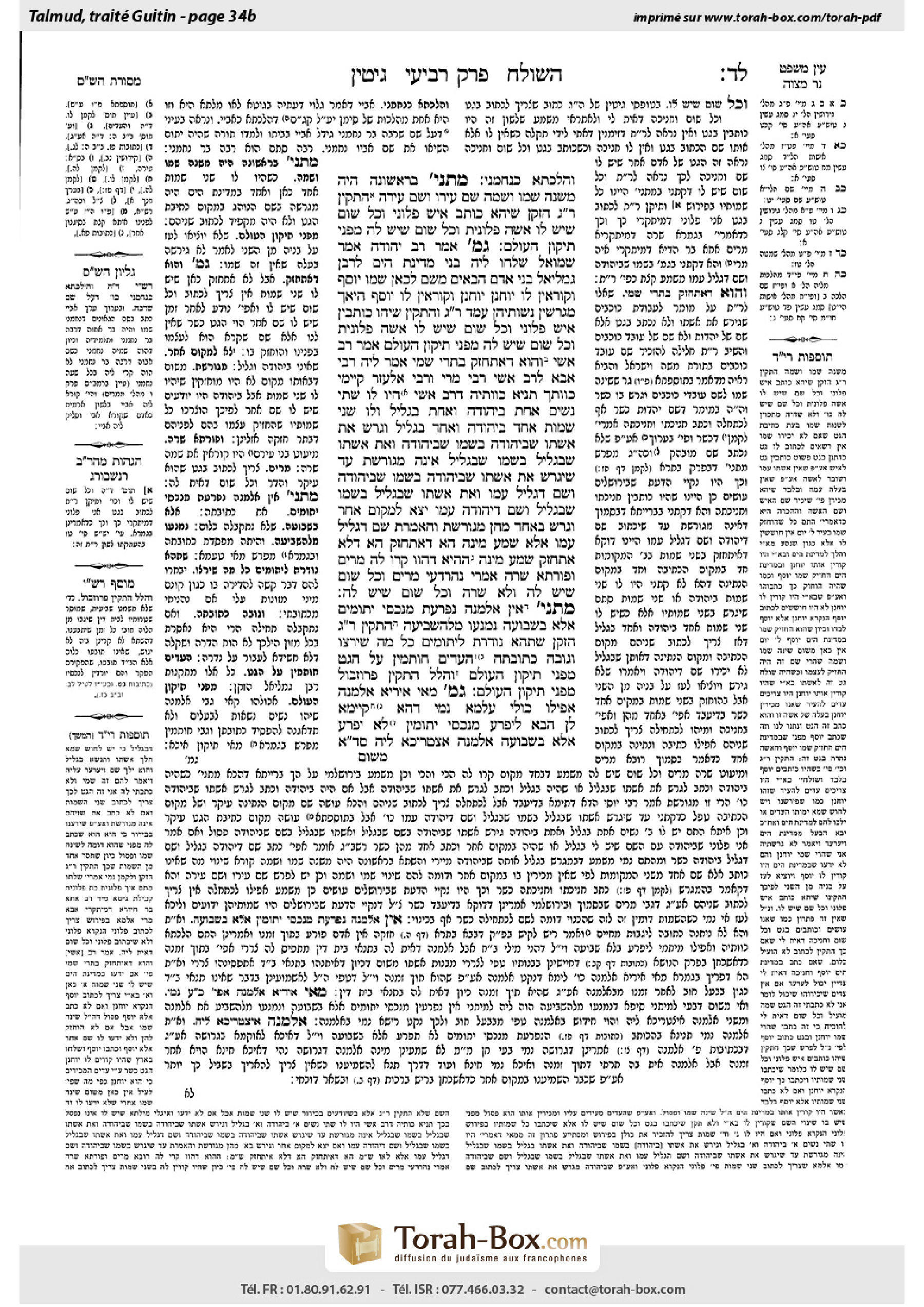
Gittin 34b: Talmud study for Daf Yomi
Study the Talmud for Daf Yomi with scanned pages, Hebrew text, English translations from Sefaria and AI-generated French translations.
Passage selection and English or AI-generated French translation are available where the scan has annotations. Daf Study is independent of Torah-Box and Sefaria.
Browse Gittin · גיטין · All tractatesGittin 34b text and translations
This page of Gittin includes the Aramaic text, an English translation and an AI-generated French translation, alongside the scan above.
גיטין ל״ד ב · Aramaic and Hebrew text
וְהִלְכְתָא כְּנַחְמָנִי.
מַתְנִי׳ בָּרִאשׁוֹנָה הָיָה מְשַׁנֶּה שְׁמוֹ וּשְׁמָהּ, שֵׁם עִירוֹ וְשֵׁם עִירָהּ. הִתְקִין רַבָּן גַּמְלִיאֵל הַזָּקֵן שֶׁיְּהֵא כּוֹתֵב: ״אִישׁ פְּלוֹנִי וְכׇל שׁוּם שֶׁיֵּשׁ לוֹ״, ״אִשָּׁה פְּלוֹנִית וְכׇל שׁוּם שֶׁיֵּשׁ לָהּ״ – מִפְּנֵי תִּיקּוּן הָעוֹלָם.
גְּמָ׳ אָמַר רַב יְהוּדָה אָמַר שְׁמוּאֵל, שְׁלַחוּ לֵיהּ בְּנֵי מְדִינַת הַיָּם לְרַבָּן גַּמְלִיאֵל: בְּנֵי אָדָם הַבָּאִים מִשָּׁם לְכָאן, שְׁמוֹ יוֹסֵף – וְקוֹרְאִין לוֹ יוֹחָנָן; יוֹחָנָן – וְקוֹרְאִין לוֹ יוֹסֵף, הֵיאַךְ מְגָרְשִׁין נְשׁוֹתֵיהֶן? עָמַד רַבָּן גַּמְלִיאֵל, וְהִתְקִין שֶׁיְּהוּ כּוֹתְבִין: ״אִישׁ פְּלוֹנִי וְכׇל שׁוּם שֶׁיֵּשׁ לוֹ״, ״אִשָּׁה פְּלוֹנִית וְכׇל שׁוּם שֶׁיֵּשׁ לָהּ״ – מִפְּנֵי תִּיקּוּן הָעוֹלָם. אָמַר רַב אָשֵׁי: וְהוּא דְּאִתַּחְזַק בִּתְרֵי שְׁמֵי. אֲמַר לֵיהּ רַבִּי אַבָּא לְרַב אָשֵׁי: רַבִּי מָרִי וְרַבִּי אֶלְעָזָר קָיְימִי כְּווֹתָךְ.
תַּנְיָא כְּווֹתֵיהּ דְּרַב אָשֵׁי: הָיוּ לוֹ שְׁתֵּי נָשִׁים – אַחַת בִּיהוּדָה וְאַחַת בַּגָּלִיל; וְלוֹ שְׁנֵי שֵׁמוֹת – אֶחָד בִּיהוּדָה וְאֶחָד בַּגָּלִיל; וְגֵרַשׁ אֶת אִשְׁתּוֹ שֶׁבִּיהוּדָה בִּשְׁמוֹ שֶׁבִּיהוּדָה, וְאֶת אִשְׁתּוֹ שֶׁבַּגָּלִיל בִּשְׁמוֹ שֶׁבַּגָּלִיל – אֵינָהּ מְגוֹרֶשֶׁת, עַד שֶׁיְּגָרֵשׁ אֶת אִשְׁתּוֹ שֶׁבִּיהוּדָה בִּשְׁמוֹ שֶׁבִּיהוּדָה – וְשֵׁם דְּגָלִיל עִמּוֹ; וְאֶת אִשְׁתּוֹ שֶׁבַּגָּלִיל בִּשְׁמוֹ שֶׁבַּגָּלִיל – וְשֵׁם דִּיהוּדָה עִמּוֹ. יָצָא לְמָקוֹם אַחֵר, וְגֵרַשׁ בְּאֶחָד מֵהֶן – מְגוֹרֶשֶׁת.
וְהָאָמְרַתְּ שֵׁם דְּגָלִיל עִמּוֹ! אֶלָּא שְׁמַע מִינַּהּ – הָא דְּאִתַּחְזַק, הָא דְּלָא אֶתַּחְזַק; שְׁמַע מִינַּהּ.
הָהִיא דַּהֲווֹ קָרוּ לַהּ מִרְיָם, וּפוּרְתָּא שָׂרָה. אָמְרִי נְהַרְדָּעֵי: מִרְיָם וְכֹל שׁוּם שֶׁיֵּשׁ לָהּ, וְלָא שָׂרָה וְכֹל שׁוּם שֶׁיֵּשׁ לָהּ.
מַתְנִי׳ אֵין אַלְמָנָה נִפְרַעַת מִנִּכְסֵי יְתוֹמִים, אֶלָּא בִּשְׁבוּעָה. נִמְנְעוּ מִלְּהַשְׁבִּיעָהּ; הִתְקִין רַבָּן גַּמְלִיאֵל הַזָּקֵן, שֶׁתְּהֵא נוֹדֶרֶת לַיְּתוֹמִים כֹּל מַה שֶּׁיִּרְצוּ, וְגוֹבָה כְּתוּבָּתָהּ.
הָעֵדִים חוֹתְמִין עַל הַגֵּט, מִפְּנֵי תִּיקּוּן הָעוֹלָם. וְהִלֵּל הִתְקִין פְּרוֹזְבּוּל, מִפְּנֵי תִּיקּוּן הָעוֹלָם.
גְּמָ׳ מַאי אִירְיָא אַלְמָנָה, אֲפִילּוּ כּוּלֵּי עָלְמָא נָמֵי; דְּהָא קַיְימָא לַן – הַבָּא לִיפָּרַע מִנִּכְסֵי יְתוֹמִין, לֹא יִפָּרַע אֶלָּא בִּשְׁבוּעָה! אַלְמָנָה אִצְטְרִיכָא לֵיהּ, סָלְקָא דַּעְתָּךְ אָמֵינָא:
Gittin 34b · English translation
And the halakha is in accordance with the opinion of Naḥmani, i.e., Abaye, that disclosure of intent with regard to bills of divorce is disregarded.
MISHNA: Initially, the husband would change his name and her name, from the names by which they were known where they formerly lived to the names by which they were known where the bill of divorce was written, and write the name of his city and the name of her city. One was not required to list all of the names by which the husband and the wife were known, but only the names in the place where the bill of divorce was being written. Rabban Gamliel the Elder instituted that the scribe should write in the bill of divorce: The man so-and-so, and any other name that he has, and: The woman so-and-so, and any other name that she has. The reason for this ordinance was for the betterment of the world, as perhaps the people of a different city would not recognize the name written in the bill of divorce, and would claim that this bill of divorce does not belong to her.
GEMARA: Rav Yehuda says that Shmuel says: The residents of a country overseas sent an inquiry to Rabban Gamliel: With regard to people who come from there, Eretz Yisrael, to here, for example, someone whose name is Yosef but here they call him Yoḥanan, or someone whose name is Yoḥanan, but here they call him Yosef, how do they write bills of divorce to effectively divorce their wives? Rabban Gamliel arose and instituted that they should write: The man so-and-so, and any other name that he has, the woman so-and-so, and any other name that she has, for the betterment of the world. Rav Ashi said: And this applies only when he is known by two names. Rabbi Abba said to Rav Ashi: Rabbi Mari and Rabbi Elazar hold in accordance with your opinion.
The Gemara adds: It is taught in a baraita in accordance with the opinion of Rav Ashi: If a husband has two wives, one in Judea and one in the Galilee; and he has two names, one that he is known by in Judea and one that he is known by in the Galilee; and he divorces his wife who is in Judea with a bill of divorce listing the name that he is known by in Judea, and he divorces his other wife who is in the Galilee with a bill of divorce listing the name that he is known by in the Galilee, then neither of his wives is divorced until he divorces his wife who is in Judea with a bill of divorce listing the name that he is known by in Judea and the name used by the people of the Galilee appended to it, and he also divorces his wife who is in the Galilee with the name that he is known by in the Galilee and the name used by the people of Judea appended to it. If he leaves to a different place, and divorces his wife with a bill of divorce listing one of these names, then she is divorced.
The Gemara asks: But didn’t you say that even in Judea his name used by people of the Galilee must be appended to it? Why then is he not required to list all of the names that he is known by? Rather, learn from it that there is a difference between the two cases: This former case is one where he is known to have several names, for example when those in Judea are aware that the husband is known by a different name in the Galilee. And this latter case is one where he is not known to have two names, as he traveled to a place where he was not known. Therefore, he is required to write only the name that he is known by in that place. The Gemara determines: Conclude from it that one must list all of the names that he is known by only if it is known that he has several names.
The Gemara relates: There was a certain woman who many people called Miriam, and a few people called her Sara; the Sages of Neharde’a said: In her bill of divorce, one must write: Miriam, and any other name that she has, and one should not write: Sara, and any other name that she has, as one must use the name that she is primarily known by.
MISHNA: A widow can collect payment of her marriage contract from the property of orphans only by means of an oath that she did not receive any part of the payment of the marriage contract during her husband’s lifetime. The mishna relates: The courts refrained from administering an oath to her, leaving the widow unable to collect payment of her marriage contract. Rabban Gamliel the Elder instituted that she should take, for the benefit of the orphans, any vow that the orphans wished to administer to her, e.g., that all produce will become prohibited to her if she received any payment of her marriage contract, and after stating this vow, she collects payment of her marriage contract.
The mishna lists additional ordinances that were instituted for the betterment of the world: The witnesses sign their names on the bill of divorce, even though the bill of divorce is valid without their signatures, for the betterment of the world, as the Gemara will explain. And Hillel instituted a document that prevents the Sabbatical Year from abrogating an outstanding debt [prosbol] for the betterment of the world, as the Gemara will explain.
GEMARA: The Gemara asks: Why discuss specifically a widow? This halakha should apply to everyone, as we maintain that anyone who comes to collect payment from the property of orphans can collect only by means of an oath. The Gemara answers: It was necessary for the mishna to mention a widow, as it might enter your mind to say:
Gittin 34b · Traduction française (IA)
Et la halakha suit l'opinion de Naḥmani, c'est-à-dire d'Abaye, selon laquelle l'intention concernant les lettres de divorce est ignorée.
MICHNA : Initialement, le mari changeait son nom et celui de sa femme, passant des noms par lesquels ils étaient connus dans leur ancien lieu de résidence aux noms par lesquels ils étaient connus où la lettre de divorce était écrite, et écrivait le nom de sa ville et celui de la ville de sa femme. On n'était pas tenu de lister tous les noms par lesquels le mari et la femme étaient connus, mais seulement les noms dans la ville où la lettre de divorce était écrite. Rabban Gamliel le Vieux institua que l'écrivain devait écrire dans la lettre de divorce : Le homme tel et tel, et tout autre nom qu'il a, et : La femme tel et tel, et tout autre nom qu'elle a. La raison de cette ordonnance était le bien-être du monde, car peut-être les habitants d'une autre ville ne reconnaîtraient pas le nom inscrit dans la lettre de divorce et affirmeraient que cette lettre de divorce ne lui appartient pas.
GUEMARA : Rav Yehuda dit que Shmuel dit : Les habitants d'un pays éloigné envoyèrent une question à Rabban Gamliel : Concernant les personnes qui viennent d'Eretz Yisrael ici, par exemple, quelqu'un dont le nom est Yosef mais ici on l'appelle Yoḥanan, ou quelqu'un dont le nom est Yoḥanan mais ici on l'appelle Yosef, comment doit-on écrire des lettres de divorce pour divorcer efficacement de leur épouse ? Rabban Gamliel se leva et institua qu'ils devaient écrire : Le homme tel et tel, et tout autre nom qu'il a, la femme tel et tel, et tout autre nom qu'elle a, pour le bien-être du monde. Rav Ashi dit : Et cela s'applique uniquement lorsqu'il est connu par deux noms. Rabbi Abba dit à Rav Ashi : Rabbi Mari et Rabbi Elazar suivent votre opinion.
La Guemara ajoute : Il est enseigné dans une baraïta selon l'opinion de Rav Ashi : Si un mari a deux épouses, une en Judée et une en Galilée ; et il a deux noms, un par lequel il est connu en Judée et un par lequel il est connu en Galilée ; et il divorce sa femme qui est en Judée avec une lettre de divorce indiquant le nom par lequel il est connu en Judée, et il divorce sa femme qui est en Galilée avec une lettre de divorce indiquant le nom par lequel il est connu en Galilée, alors aucune de ses épouses n'est divorcée jusqu'à ce qu'il divorce sa femme qui est en Judée avec une lettre de divorce indiquant le nom par lequel il est connu en Judée et le nom utilisé par les habitants de Galilée ajouté à celui-ci, et il divorce également sa femme qui est en Galilée avec le nom par lequel il est connu en Galilée et le nom utilisé par les habitants de Judée ajouté à celui-ci. Si il part vers un autre lieu et divorce sa femme avec une lettre de divorce indiquant l'un de ces noms, alors elle est divorcée.
La Guemara pose la question : Mais n'avez-vous pas dit que même en Judée, le nom utilisé par les habitants de Galilée doit être ajouté ? Pourquoi alors n'est-il pas tenu de lister tous les noms par lesquels il est connu ? Plutôt, apprenez-en que cela diffère entre les deux cas : Ce premier cas est celui où il est connu d'avoir plusieurs noms, par exemple lorsque ceux de Judée savent que le mari est connu par un autre nom en Galilée. Et ce second cas est celui où il n'est pas connu d'avoir deux noms, car il est parti vers un lieu où il n'était pas connu. Par conséquent, il est tenu d'écrire seulement le nom par lequel il est connu dans ce lieu. La Guemara conclut : En déduire que l'on doit lister tous les noms par lesquels il est connu uniquement si l'on sait qu'il a plusieurs noms.
La Guemara rapporte : Il y avait une certaine femme qui était appelée Miriam par beaucoup de personnes et Sara par quelques-unes ; les Sages de Neharde’a dirent : Dans sa lettre de divorce, on doit écrire : Miriam, et tout autre nom qu'elle a, et on ne doit pas écrire : Sara, et tout autre nom qu'elle a, car on doit utiliser le nom par lequel elle est principalement connue.
MICHNA : Une veuve peut récupérer le paiement de son contrat de mariage à partir des biens des orphelins uniquement par l'intermédiaire d'un serment selon lequel elle n'a pas reçu de part du paiement du contrat de mariage pendant la vie de son mari. La mishna rapporte : Les tribunaux se sont refusés à administrer un serment à elle, laissant la veuve incapable de récupérer le paiement de son contrat de mariage. Rabban Gamliel le Vieux institua qu'elle devait prendre, au bénéfice des orphelins, tout serment que les orphelins souhaitaient administrer à elle, par exemple que tous les produits deviennent interdits à elle si elle avait reçu un paiement de son contrat de mariage, et après avoir prononcé ce serment, elle récupère le paiement de son contrat de mariage.
La mishna liste d'autres ordonnances instituées pour le bien-être du monde : Les témoins signent leurs noms sur la lettre de divorce, même si la lettre de divorce est valide sans leurs signatures, pour le bien-être du monde, comme l'expliquera la Guemara. Et Hillel institua un document qui empêche l'année sabbatique de révoquer une dette en suspens [prosbol] pour le bien-être du monde, comme l'expliquera la Guemara.
GUEMARA : La Guemara pose la question : Pourquoi aborder spécifiquement une veuve ? Cette halakha devrait s'appliquer à toute personne, car nous maintenons que toute personne qui vient récupérer un paiement provenant des biens des orphelins ne peut le récupérer qu'à travers un serment. La Guemara répond : Il était nécessaire que la Michna mentionne une veuve, car cela pourrait entrer en votre esprit de dire :
Traduction française générée par IA à partir de l’édition anglaise de Sefaria. Vérifie toujours un passage avec le texte source.
Text from Sefaria: William Davidson Edition - Vocalized Aramaic (CC BY NC); William Davidson Edition - English (CC BY NC).