Gittin 35a: Talmud study for Daf Yomi
Study the Talmud for Daf Yomi with scanned pages, Hebrew text, English translations from Sefaria and AI-generated French translations.
Passage selection and English or AI-generated French translation are available where the scan has annotations. Daf Study is independent of Torah-Box and Sefaria.
Browse Gittin · גיטין · All tractatesGittin 35a text and translations
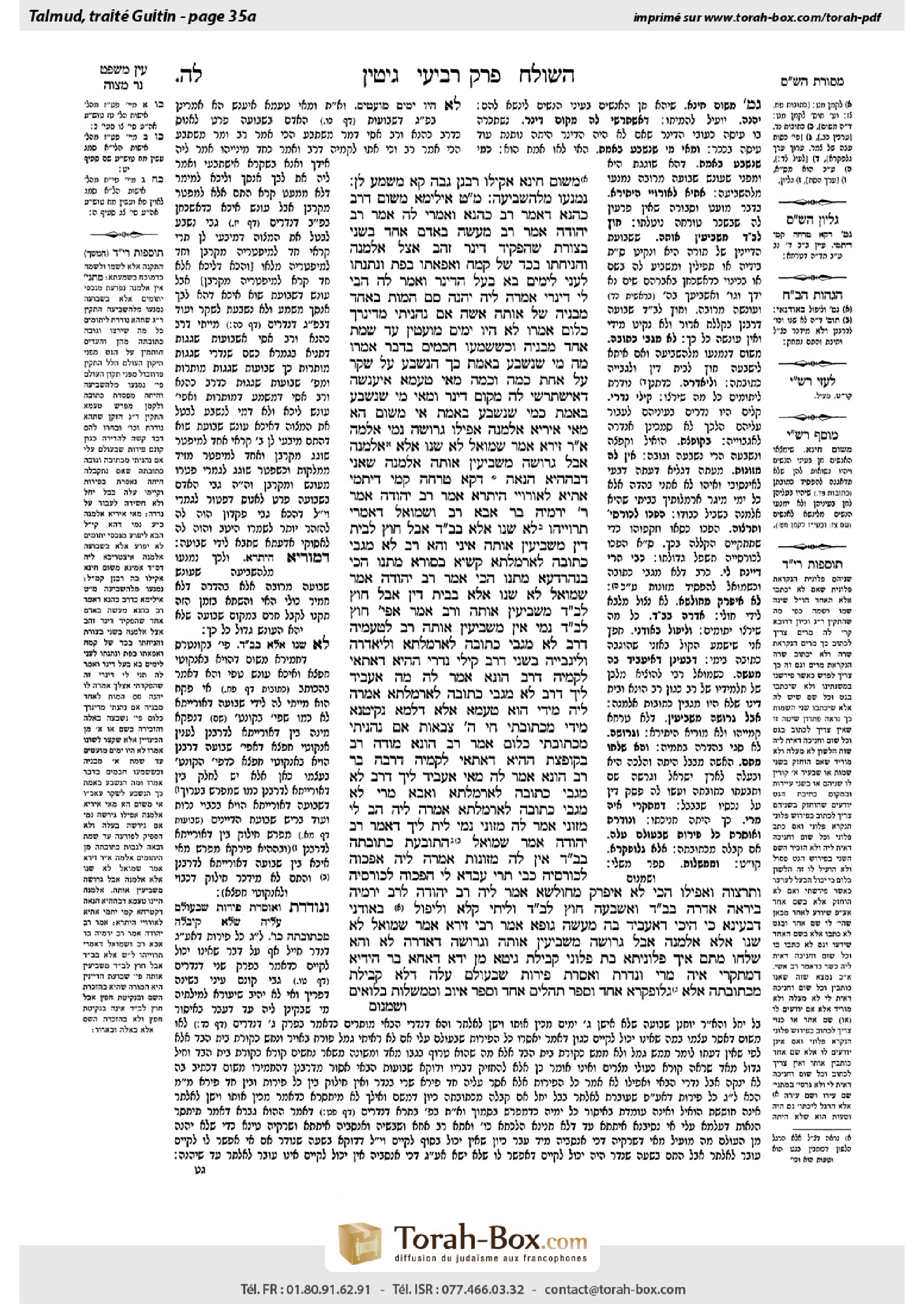
This page of Gittin includes the Aramaic text, an English translation and an AI-generated French translation, alongside the scan above.
גיטין ל״ה א · Aramaic and Hebrew text
מִשּׁוּם חִינָּא אַקִּילוּ רַבָּנַן גַּבַּהּ, קָא מַשְׁמַע לַן.
נִמְנְעוּ מִלְּהַשְׁבִּיעָהּ: מַאי טַעְמָא? אִילֵּימָא מִשּׁוּם דְּרַב כָּהֲנָא – דְּאָמַר רַב כָּהֲנָא; וְאָמְרִי לַהּ אָמַר רַב יְהוּדָה, אָמַר רַב: מַעֲשֶׂה בְּאָדָם אֶחָד בִּשְׁנֵי בַצּוֹרֶת, שֶׁהִפְקִיד דִּינַר זָהָב אֵצֶל אַלְמָנָה; וְהִנִּיחַתּוּ בְּכַד שֶׁל קֶמַח, וַאֲפָאַתּוּ בְּפַת, וּנְתָנַתּוּ לְעָנִי;
לְיָמִים בָּא בַּעַל הַדִּינָר, וַאֲמַר לַהּ: הָבִי לִי דִּינָרִי. אָמְרָה לֵיהּ: יְהַנֶּה סַם הַמָּוֶת בְּאֶחָד מִבָּנֶיהָ שֶׁל אוֹתָהּ אִשָּׁה, אִם נֶהֱנֵיתִי מִדִּינָרְךָ כְּלוּם! אָמְרוּ: לֹא הָיוּ יָמִים מוּעָטִין עַד שֶׁמֵּת אֶחָד מִבָּנֶיהָ; וּכְשֶׁשָּׁמְעוּ חֲכָמִים בַּדָּבָר, אָמְרוּ: מָה מִי שֶׁנִּשְׁבַּע בֶּאֱמֶת – כָּךְ, הַנִּשְׁבָּע עַל שֶׁקֶר – עַל אַחַת כַּמָּה וְכַמָּה.
מַאי טַעְמָא אִיעֲנַשָׁה? דְּאִישְׁתָּרַשׁ לַהּ מְקוֹם דִּינָר.
וּמַאי ״מִי שֶׁנִּשְׁבַּע בֶּאֱמֶת״? כְּמִי שֶׁנִּשְׁבַּע בֶּאֱמֶת.
אִי מִשּׁוּם הָא, מַאי אִירְיָא אַלְמָנָה? אֲפִילּוּ גְּרוּשָׁה נָמֵי! אַלְּמָה אָמַר רַבִּי זֵירָא, אָמַר שְׁמוּאֵל: לֹא שָׁנוּ אֶלָּא אַלְמָנָה, אֲבָל גְּרוּשָׁה מַשְׁבִּיעִין אוֹתָהּ?
אַלְמָנָה שָׁאנֵי; דִּבְהָהִיא הֲנָאָה דְּקָא טָרְחָה קַמֵּי דְּיַתְמֵי, אָתְיָא לְאוֹרוֹיֵי הֶיתֵּרָא.
אָמַר רַב יְהוּדָה, אָמַר רַבִּי יִרְמְיָה בַּר אַבָּא: רַב וּשְׁמוּאֵל דְּאָמְרִי תַּרְוַיְיהוּ, לֹא שָׁנוּ אֶלָּא בְּבֵית דִּין, אֲבָל חוּץ לְבֵית דִּין – מַשְׁבִּיעִין אוֹתָהּ. אִינִי?! וְהָא רַב לָא מַגְבֵּי כְּתוּבָּה לְאַרְמַלְתָּא! קַשְׁיָא.
בְּסוּרָא מַתְנוּ הָכִי. בִּנְהַרְדְּעָא מַתְנוּ הָכִי – אָמַר רַב יְהוּדָה אָמַר שְׁמוּאֵל: לֹא שָׁנוּ אֶלָּא בְּבֵית דִּין, אֲבָל חוּץ לְבֵית דִּין – מַשְׁבִּיעִין אוֹתָהּ. וְרַב אָמַר: אֲפִילּוּ חוּץ לְבֵית דִּין נָמֵי אֵין מַשְׁבִּיעִין אוֹתָהּ.
רַב לְטַעְמֵיהּ – דְּרַב לָא מַגְבֵּי כְּתוּבָּה לְאַרְמַלְתָּא. וְלִיאַדְּרַהּ וְלַיגְבְּיַיהּ! בִּשְׁנֵי דְּרַב קִילִי נִדְרֵי.
הָהִיא דַּאֲתַאי לְקַמֵּיהּ דְּרַב הוּנָא, אֲמַר לַהּ: מָה אֶעֱבֵיד לִיךְ, דְּרַב לָא מַגְבֵּי כְּתוּבָּה לְאַרְמַלְתָּא. אֲמַרָה לֵיהּ: מִידֵּי הוּא טַעְמָא – אֶלָּא דִּלְמָא נָקֵיטְנָא מִידֵּי מִכְּתוּבָּתִי, חַי ה׳ צְבָאוֹת אִם נֶהֱנֵיתִי מִכְּתוּבָּתִי כְּלוּם! אָמַר רַב הוּנָא: מוֹדֶה רַב בְּקוֹפֶצֶת.
הָהִיא דַּאֲתַאי לְקַמֵּיהּ דְּרַבָּה בַּר רַב הוּנָא, אֲמַר לַהּ: מַאי אֶעֱבֵיד לִיךְ, דְּרַב לָא מַגְבֵּי כְּתוּבָּה לְאַרְמַלְתָּא, וְאַבָּא מָרִי לָא מַגְבֵּי כְּתוּבָּה לְאַרְמַלְתָּא.
אֲמַרָה לֵיהּ: הַב לִי מְזוֹנֵי. אֲמַר לַהּ: מְזוֹנֵי נָמֵי לֵית לִיךְ; דְּאָמַר רַב יְהוּדָה, אָמַר שְׁמוּאֵל: הַתּוֹבַעַת כְּתוּבָּתָהּ בְּבֵית דִּין – אֵין לָהּ מְזוֹנוֹת.
אֲמַרָה לֵיהּ: אַפְכוּהּ לְכוּרְסְיֵהּ, כְּבֵי תְּרֵי עָבְדַתְּ לִי! הַפְכוּהּ לְכוּרְסְיֵהּ וְתָרְצוּהּ, וַאֲפִילּוּ הָכִי לָא אִיפְּרַק מֵחוּלְשָׁא.
אֲמַר לֵיהּ רַב יְהוּדָה לְרַב יִרְמְיָה בִּירָאָה: אַדְּרַהּ בְּבֵית דִּין, וְאַשְׁבְּעַהּ חוּץ לְבֵית דִּין, וְלֵיתֵי קָלָא וְלִיפּוֹל בְּאוּדְנִי, דְּבָעֵינָא כִּי הֵיכִי דְּאֶעֱבֵיד בָּהּ מַעֲשֶׂה.
גּוּפָא – אָמַר רַבִּי זֵירָא אָמַר שְׁמוּאֵל: לֹא שָׁנוּ אֶלָּא אַלְמָנָה, אֲבָל גְּרוּשָׁה – מַשְׁבִּיעִין אוֹתָהּ.
וּגְרוּשָׁה דְּאַדְּרַהּ לָא?! וְהָא שְׁלַחוּ מִתָּם: ״אֵיךְ פְּלוֹנִיתָא בַּת פְּלוֹנִי קַבִּילַת גִּיטָּא מִן יְדָא דְּאַחָא בַּר הִידְיָא דְּמִתְקְרֵי ״אַיָּה מָרִי״; וּנְדַרַת וַאֲסַרַת פֵּירוֹת שֶׁבָּעוֹלָם עֲלַהּ דְּלָא קַבִּילַת מִכְּתוּבְּתַהּ אֶלָּא גְּלוּפְקְרָא אֶחָד, וְסֵפֶר תְּהִלִּים אֶחָד, וְסֵפֶר אִיּוֹב, וּמִמְשָׁלוֹת בְּלוֹאִים;
Gittin 35a · English translation
Due to the increased desirability that this would bring her when trying to remarry, since this would ensure she would bring assets with her into a new marriage, the Sages were lenient with her, as the Sages issued several decrees in connection with the marriage contract in order to enable women to collect more easily. Therefore, the mishna teaches us that this is not the case.
§ The mishna taught that the court refrained from administering an oath to her. The Gemara asks: What is the reason that they refrained from administering oaths to widows? If we say that it is because of the statement of Rav Kahana, as Rav Kahana says, and some say that it was Rav Yehuda who says that Rav says: There was an incident involving a person during years of famine who deposited a gold dinar with a widow, and she placed the gold dinar in a jug of flour and unwittingly baked it in a loaf of bread along with the flour, and she gave the bread as charity to a poor man.
After a period of time, the owner of the dinar came and said to her: Give me my dinar. She said to him: May poison benefit, i.e., take effect on, one of the children of that woman, i.e., my children, if I derived any benefit from your dinar. It was said: Not even a few days passed until one of her children died, and when the Sages heard of this matter, they said: If one who takes an oath truthfully is punished in this way for sin, one who takes an oath falsely, all the more so.
The Gemara first clarifies the details of the incident: What is the reason that she was punished if she in fact did not derive any benefit from the dinar? The Gemara answers: Because she benefited [ishtarshi] from the place of the dinar, as the dinar took up space in the bread, enabling her to use less flour. Therefore, she did derive some small benefit from the dinar.
The Gemara asks: If she in fact did derive benefit from the dinar, then what is meant by the statement: One who takes an oath truthfully? Wasn’t her oath actually false? The Gemara answers: It means that she was like one who took an oath truthfully, as her oath was truthful to the best of her knowledge. In any case, this woman was punished severely for a small mistake. The severity of taking a false oath, even inadvertently, is why the Sages ceased administering oaths to widows.
The Gemara questions if this could be the reason for the ordinance: If they refrained from administering oaths due to this reason, then why would this be limited specifically to a widow? Even a divorcée should not be allowed to take an oath to collect her marriage contract as well. Why then does Rabbi Zeira say that Shmuel says: They taught this only with regard to a widow; however, with regard to a divorcée, the court does administer an oath to her? Why would this concern not apply in the case of a divorcée as well?
The Gemara answers: A widow is different, as she continues to live in the house with the orphans and performs many services for them in the running of the home. Therefore, there is a concern that due to the benefit they receive from her as a result of the efforts she exerts for the orphans, she will rationalize and permit herself to take an oath that she had not collected any of her marriage contract, when in fact she had received a part of it.
§ Rav Yehuda said that Rabbi Yirmeya bar Abba said: It is Rav and Shmuel who both say that they taught only that an oath is not administered to the widow in court, as the oath that one takes in court is a severe oath, which involves the mentioning of God’s name and the holding of a sacred object. However, outside of court, where an oath is not taken in this manner, the judges administer an oath to her. The Gemara asks: Is that so? But Rav does not collect payment of a marriage contract for a widow because she has not taken an oath, which indicates that he also would not administer an oath to her outside of the court. The Gemara answers: This is difficult, as it contradicts the statement of Rav Yehuda.
In the city of Sura they taught the statement with regard to the opinions of Rav and Shmuel like this, as stated above. However, in the city of Neharde’a they taught the statement with regard to the opinions of Rav and Shmuel like this: Rav Yehuda says that Shmuel says that they taught only that an oath is not administered to the widow in court; however, outside of court the judges administer an oath to her. And Rav says: Even outside of court as well, the judges do not administer an oath to her.
The Gemara points out that according to this version of their statements, Rav conforms to his standard line of reasoning, as Rav does not collect payment of a marriage contract for a widow in any case. The Gemara asks with regard to Rav’s practice: Let him administer a vow to the widow, instead of an oath, and collect the marriage contract in accordance with the mishna, which states that a widow can take a vow in place of the oath. The Gemara answers: In Rav’s time vows were treated lightly, and Rav was concerned that widows would not treat the prohibition created by the vow with appropriate severity. This would result in the orphans losing out on part of their inheritance, and the widows violating the prohibitions created by their vows.
The Gemara relates: There was an incident involving a certain widow who came before Rav Huna and attempted to collect payment of her marriage contract from the orphans. He said to her: What can I do for you, as Rav does not collect payment of a marriage contract for a widow. The widow said to him: Isn’t the reason that I cannot collect payment only because of a concern that perhaps I already took some payment of my marriage contract? I swear as the Lord of Hosts lives that I did not derive any benefit from my marriage contract. Rav Huna says: Even though the court does not administer an oath to a widow, Rav concedes with regard to one who leaps and takes an oath of her own initiative that her oath is accepted, and she can collect payment of her marriage contract.
The Gemara relates: There was an incident involving a certain widow who came before Rabba bar Rav Huna to collect payment of her marriage contract. He said to her: What can I do for you, as Rav does not collect payment of a marriage contract for a widow, and my father, my master, i.e., Rav Huna, does not collect payment of a marriage contract for a widow?
She said to him: If I cannot collect payment of the marriage contract, then provide sustenance for me from my husband’s property, to support me until I remarry. He said to her: You also do not have any right to sustenance, as Rav Yehuda says that Shmuel says: One who demands payment of her marriage contract in court has no right to receive sustenance any longer. The husband committed to provide for her sustenance only as long as she does not wish to remarry. Generally, once a widow demands payment of her marriage contract, she demonstrates that she wishes now to remarry and is no longer entitled to receive sustenance from her deceased husband’s property.
The widow became angry and said to Rabba bar Rav Huna: May his chair be overturned, i.e., he should fall from his position of power, as he ruled for me in accordance with the different opinions of two people. Since Rabba bar Rav Huna was concerned about her curse, he overturned his chair in order to fulfill the curse literally, and then stood it up, and even so, he was not saved from the weakness that resulted from her curse.
With regard to this issue, the Gemara recounts: Rav Yehuda, the student of Shmuel, said to Rav Yirmeya Bira’a: If a widow comes to collect payment of her marriage contract, administer a vow in court and administer an oath outside of court, and let the report be received in my ears that you did so, as I desire to perform an action, i.e., to enable a widow to collect payment of her marriage contract, in contrast to the statements of Rav’s students, who hold that a widow cannot collect payment of her marriage contract.
§ The Gemara returns to the matter itself. The mishna taught that the court does not administer an oath to a widow in order to enable her to collect payment of her marriage contract. Rabbi Zeira says that Shmuel says: They taught this only with regard to a widow; however, with regard to a divorcée, the court does administer an oath to her.
The Gemara asks: Is that to say that if the court administered a vow to a divorcée and not an oath, then this is not sufficient to enable her to collect payment of her marriage contract? But didn’t they send from there, from Eretz Yisrael, a document that states the following: How so-and-so, the daughter of so-and-so, received a bill of divorce from the hand of Aḥa bar Hidya, who is called Ayya Mari, and she took a vow and prohibited the produce of the world to herself, based on the truth of her statement that she did not receive from her marriage contract anything other than one coat [gelofkera], and one book of Psalms, and a book of Job, and a book of Proverbs, all of which were worn out.
Gittin 35a · Traduction française (IA)
En raison de l'augmentation du désir qu'elle éprouverait lors d'un nouveau mariage, puisque cela garantirait qu'elle apporterait des biens dans un nouveau mariage, les Sages ont été indulgents envers elle, car les Sages avaient émis plusieurs décrets en lien avec le contrat de mariage afin de permettre aux femmes de récupérer plus facilement leurs biens. Ainsi, la Michna nous enseigne que cela n'est pas le cas.
§ La Michna enseigne que le tribunal s'est abstenu d'administrer un serment à elle. La Guemara demande : Quelle est la raison pour laquelle ils s'abstiennent d'administrer des serments aux veuves ? Si nous disons que c'est en raison de la déclaration de Rav Kahana, comme Rav Kahana dit, et certains disent que c'est Rav Yéhuda qui dit que Rav dit : Il y avait un incident concernant une personne pendant les années de famine qui a déposé un dinar d'or chez une veuve, et elle a mis le dinar dans un tonneau de farine et l'a inconsciemment cuit dans un pain avec la farine, et elle a donné ce pain en charité à un pauvre.
Après un certain temps, l'homme propriétaire du dinar est venu lui dire : Donne-moi mon dinar. Elle lui a répondu : Que le poison profite, c'est-à-dire prenne effet sur, l'un des enfants de cette femme, c'est-à-dire mes enfants, si j'ai tiré quelque bénéfice de votre dinar. On a dit : Peu de jours ne s'étaient pas écoulés que l'un de ses enfants est mort, et lorsque les Sages ont appris cette affaire, ils ont dit : Si celui qui prend un serment sincère est puni ainsi pour un péché, celui qui prend un serment faux, encore davantage.
La Guemara commence par clarifier les détails de l'incident : Quelle est la raison qu'elle ait été punie si elle n'avait en réalité tiré aucun bénéfice du dinar ? La Guemara répond : Parce qu'elle a bénéficié [ishtarshi] du lieu du dinar, car le dinar occupait de l'espace dans le pain, permettant ainsi d'utiliser moins de farine. Ainsi, elle a tiré un petit bénéfice du dinar.
La Guemara demande : Si elle a effectivement tiré un bénéfice du dinar, alors quelle est la signification de la déclaration : Celui qui prend un serment sincère ? N'était-ce pas un serment faux ? La Guemara répond : Cela signifie qu'elle était comme celui qui prenait un serment sincère, car son serment était sincère selon ce qu'elle savait. En tout cas, cette femme a été sévèrement punie pour une petite erreur. La sévérité de prendre un serment faux, même involontairement, est la raison pour laquelle les Sages ont cessé d'administrer des serments aux veuves.
La Guemara questionne si cela pourrait être la raison de l'ordonnance : Si ils s'abstiennent d'administrer des serments en raison de cette raison, pourquoi cette restriction s'appliquerait spécifiquement à une veuve ? Une ex-épouse ne devrait pas non plus être autorisée à prendre un serment pour récupérer son contrat de mariage. Pourquoi alors Rabbi Zéira dit que Shmuel dit : Ils ont enseigné cela uniquement concernant une veuve ; cependant, concernant une ex-épouse, le tribunal administre un serment à elle ? Pourquoi ce souci ne s'appliquerait-il pas dans le cas d'une ex-épouse également ?
La Guemara répond : La veuve est différente, car elle continue de vivre dans la maison avec les orphelins et exerce de nombreuses tâches dans la gestion de la maison. Ainsi, il y a un souci que, en raison des bénéfices qu'elle reçoit à cause des efforts qu'elle exerce pour les orphelins, elle justifierait et permettrait à elle-même de prendre un serment qu'elle n'avait pas récupéré son contrat de mariage, alors qu'en réalité elle avait reçu une partie de celui-ci.
§ Rav Yéhuda a dit que Rabbi Yirméya bar Abba a dit : C'est Rav et Shmuel qui disent tous les deux que l'on a enseigné seulement que l'on ne donne pas de serment à la veuve devant le tribunal, car le serment que l'on prend devant le tribunal est un serment sévère, qui implique la mention du nom de Dieu et la possession d'un objet sacré. Cependant, en dehors du tribunal, où un serment n'est pas pris ainsi, les juges administrent un serment à elle. La Guemara demande : Est-ce ainsi ? Mais Rav ne collecte pas le paiement du contrat de mariage pour une veuve car elle n'a pas pris de serment, ce qui indique qu'il ne donnerait pas non plus un serment à elle en dehors du tribunal. La Guemara répond : Cela est difficile, car cela contredit la déclaration de Rav Yéhuda.
Dans la ville de Sura, ils ont enseigné la déclaration concernant les opinions de Rav et de Shmuel comme cela, comme indiqué ci-dessus. Cependant, dans la ville de Néharda, ils ont enseigné la déclaration concernant les opinions de Rav et de Shmuel comme cela : Rav Yéhuda dit que Shmuel dit que l'on a enseigné seulement que l'on ne donne pas de serment à la veuve devant le tribunal ; cependant, en dehors du tribunal, les juges administrent un serment à elle. Et Rav dit : Même en dehors du tribunal, les juges ne donnent pas de serment à elle.
La Guemara souligne que selon cette version de leurs déclarations, Rav correspond à sa ligne de raisonnement habituelle, car Rav ne collecte jamais le paiement du contrat de mariage pour une veuve. La Guemara demande concernant la pratique de Rav : Laissez-lui administrer un vœu à la veuve, au lieu d'un serment, et collectez le contrat de mariage conformément à la Michna, qui stipule que la veuve peut prendre un vœu à la place du serment. La Guemara répond : À l'époque de Rav, les vœux étaient traités avec légèreté, et Rav avait peur que les veuves ne traitent pas sérieusement la prohibition créée par le vœu, ce qui entraînerait la perte des orphelins d'une partie de leur héritage et la violation des prohibitions créées par leurs vœux.
La Guemara rapporte : Il y avait un incident concernant une certaine veuve qui est venue devant Rav Huna et a tenté de récupérer le paiement de son contrat de mariage auprès des orphelins. Il lui a dit : Que puis-je faire pour toi, car Rav ne collecte pas le paiement du contrat de mariage pour une veuve. La veuve lui a dit : N'est-ce pas que la raison pour laquelle je ne peux pas récupérer le paiement est seulement en raison de la crainte qu'on puisse penser que j'ai déjà reçu une partie du paiement de mon contrat de mariage ? Je jure par le Seigneur des armées que je n'ai pas tiré de bénéfice de mon contrat de mariage. Rav Huna dit : Même si le tribunal ne donne pas de serment à une veuve, Rav reconnaît que concernant celle qui saute et prend un serment de sa propre initiative, son serment est accepté, et elle peut récupérer le paiement de son contrat de mariage.
La Guemara rapporte : Il y avait un incident concernant une veuve qui s'adressa à Rabba bar Rav Huna pour récupérer le paiement de son contrat de mariage. Il lui dit : Que puis-je faire pour vous, puisque Rav ne récupère pas le paiement d'un contrat de mariage pour une veuve, et mon père, mon maître, c'est-à-dire Rav Huna, ne récupère pas non plus le paiement d'un contrat de mariage pour une veuve ?
Elle lui dit : Si je ne peux pas récupérer le paiement du contrat de mariage, alors fournissez-moi des vivres à partir des biens de mon mari pour m'entretenir jusqu'à ce que je me remarie. Il lui répondit : Vous n'avez pas non plus le droit à des vivres, car Rav Yéhuda dit que Shmuel dit : Celui qui exige le paiement de son contrat de mariage devant le tribunal n'a plus le droit de recevoir des vivres. Le mari s'est engagé à l'entretenir uniquement tant qu'elle ne souhaitait pas se remettre en ménage. Généralement, une fois qu'une veuve exige le paiement de son contrat de mariage, elle montre qu'elle souhaite maintenant se remettre en ménage et n'est plus éligible à recevoir des vivres des biens de son mari défunt.
La veuve s'énerva et dit à Rabba bar Rav Huna : Que son siège soit renversé, c'est-à-dire qu'il tombe de son pouvoir, car il a tranché en son faveur selon les opinions de deux personnes. Puisque Rabba bar Rav Huna s'inquiétait de sa malédiction, il renversa son siège afin de remplir la malédiction littéralement, puis le redressa, et même ainsi, il n'était pas sauvé de la faiblesse résultant de sa malédiction.
En ce qui concerne cette question, la Guemara rapporte : Rav Yéhuda, l'élève de Shmuel, dit à Rav Yirméya Bira'a : Si une veuve vient récupérer le paiement de son contrat de mariage, administrez-lui un serment devant le tribunal et un serment en dehors du tribunal, et que l'on m'apporte le rapport que vous l'avez fait, car je désire accomplir une action, c'est-à-dire permettre à une veuve de récupérer le paiement de son contrat de mariage, contrairement aux déclarations des élèves de Rav, qui pensent qu'une veuve ne peut pas récupérer le paiement de son contrat de mariage.
§ La Guemara retourne à la question elle-même. La Misha enseigne que le tribunal ne jure pas à une veuve afin de lui permettre de récupérer le paiement de son contrat de mariage. Rabbi Zéira dit que Shmuel dit : Ils ont enseigné cela uniquement concernant une veuve ; cependant, concernant une femme divorcée, le tribunal administre un serment à elle.
La Guemara pose la question : Voulait-on dire que si le tribunal administre un serment à une femme divorcée et non un juré, cela n'est pas suffisant pour lui permettre de récupérer le paiement de son contrat de mariage ? Mais n'ont-ils pas envoyé d'ici, d'Israël, un document indiquant ce qui suit : Comment telle personne, fille de telle personne, a reçu un divorce de la main d'Acha bar Hidya, qui s'appelle Ayya Mari, et elle a pris un serment et a interdit les produits du monde à elle-même, fondé sur la vérité de son déclaration qu'elle n'avait reçu de son contrat de mariage que une robe [gelofkera], un livre des Psaumes, un livre de Job et un livre des Proverbes, tous usagés.
Traduction française générée par IA à partir de l’édition anglaise de Sefaria. Vérifie toujours un passage avec le texte source.
Text from Sefaria: William Davidson Edition - Vocalized Aramaic (CC BY NC); William Davidson Edition - English (CC BY NC).