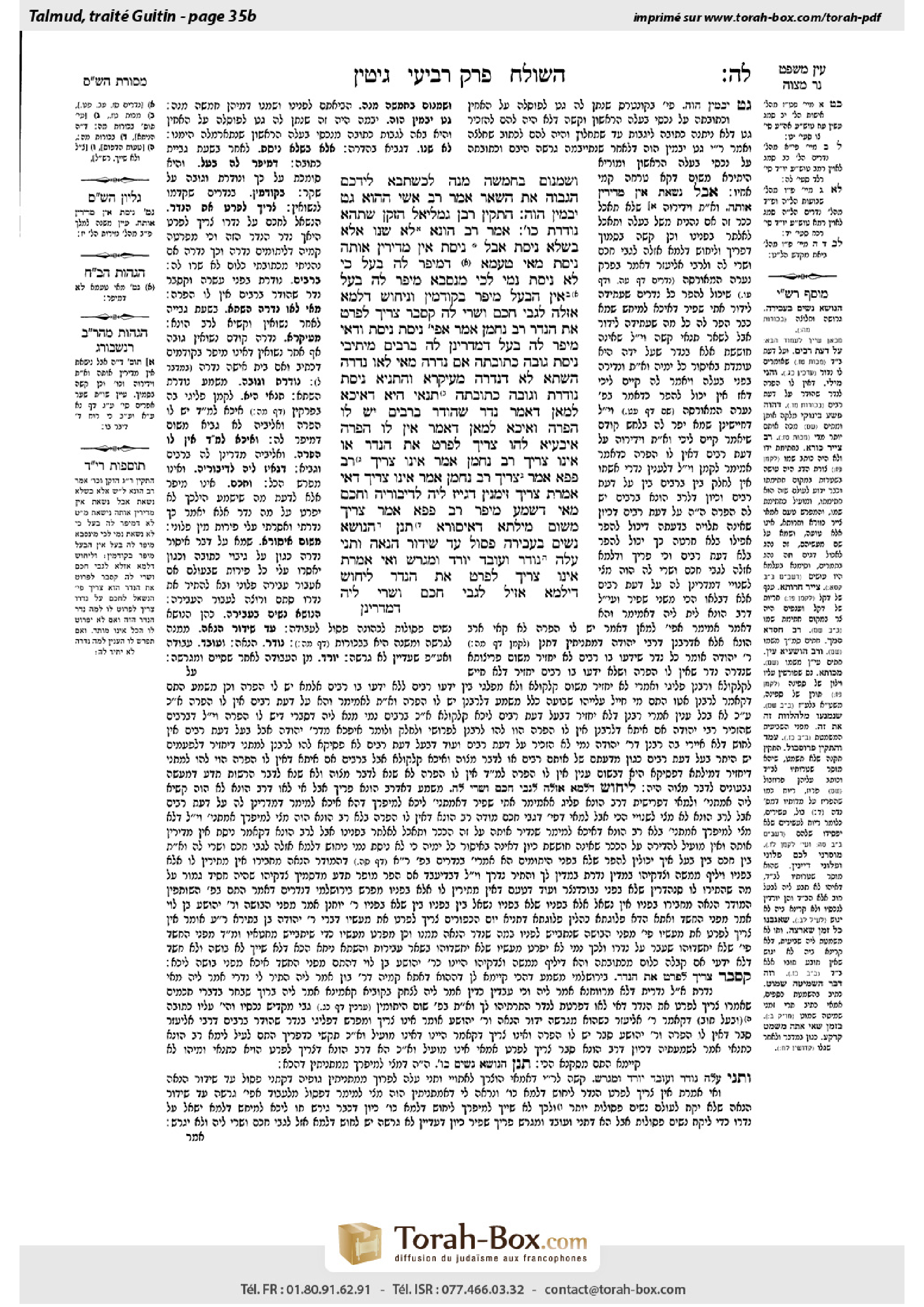
Gittin 35b: Talmud study for Daf Yomi
Study the Talmud for Daf Yomi with scanned pages, Hebrew text, English translations from Sefaria and AI-generated French translations.
Passage selection and English or AI-generated French translation are available where the scan has annotations. Daf Study is independent of Torah-Box and Sefaria.
Browse Gittin · גיטין · All tractatesGittin 35b text and translations
This page of Gittin includes the Aramaic text, an English translation and an AI-generated French translation, alongside the scan above.
גיטין ל״ה ב · Aramaic and Hebrew text
וְשַׁמְנוּם בַּחֲמִשָּׁה מָנֶה; לִכְשֶׁתָּבֹא לְיֶדְכֶם הַגְבּוּהָ אֶת הַשְּׁאָר״. אָמַר רַב אָשֵׁי: הָהוּא, גֵּט יְבָמִין הֲוָה.
הִתְקִין רַבָּן גַּמְלִיאֵל הַזָּקֵן שֶׁתְּהֵא נוֹדֶרֶת כּוּ׳: אָמַר רַב הוּנָא, לֹא שָׁנוּ אֶלָּא בְּשֶׁלֹּא נִיסֵּת, אֲבָל נִיסֵּת – אֵין מַדִּירִין אוֹתָהּ.
נִיסֵּת מַאי טַעְמָא – דְּמֵיפַר לַהּ בַּעַל; כִּי לֹא נִיסֵּת נָמֵי, לְכִי מִנַּסְבָא מֵיפַר לַהּ בַּעַל! אֵין הַבַּעַל מֵיפֵר בְּקוֹדְמִין.
וְנֵיחוּשׁ דִּלְמָא אָזְלָה לְגַבֵּי חָכָם וְשָׁרֵי לַהּ! קָסָבַר צָרִיךְ לְפָרֵט אֶת הַנֶּדֶר.
רַב נַחְמָן אָמַר: אֲפִילּוּ נִיסֵּת. נִיסֵּת, וַדַּאי מֵיפַר לַהּ בַּעַל! דְּמַדְּרִינַן לַהּ בָּרַבִּים.
מֵיתִיבִי: נִיסֵּת – גּוֹבָה כְּתוּבָּתָהּ אִם נָדְרָה. מַאי, לָאו נָדְרָה הַשְׁתָּא? לָא, דִּנְדַרָה מֵעִיקָּרָא.
וְהָתַנְיָא: נִיסֵּת – נוֹדֶרֶת וְגוֹבָה כְּתוּבָּתָהּ! תַּנָּאֵי הִיא, דְּאִיכָּא לְמַאן דְּאָמַר: נֶדֶר שֶׁהוּדַּר בָּרַבִּים – יֵשׁ לוֹ הֲפָרָה; וְאִיכָּא לְמַאן דְּאָמַר: אֵין לוֹ הֲפָרָה.
אִיבַּעְיָא לְהוּ: צָרִיךְ לְפָרֵט אֶת הַנֶּדֶר, אוֹ אֵינוֹ צָרִיךְ? רַב נַחְמָן אָמַר: אֵינוֹ צָרִיךְ; רַב פָּפָּא אָמַר: צָרִיךְ.
רַב נַחְמָן אָמַר אֵינוֹ צָרִיךְ – דְּאִי אָמְרַתְּ צָרִיךְ, זִימְנִין דְּגָיֵיז לֵיהּ לְדִיבּוּרֵיהּ, וְחָכָם מַאי דְּשָׁמַע מֵיפַר.
רַב פָּפָּא אָמַר צָרִיךְ – מִשּׁוּם מִילְּתָא דְּאִיסּוּרָא.
תְּנַן: הַנּוֹשֵׂא נָשִׁים בַּעֲבֵירָה – פָּסוּל, עַד שֶׁיִּדּוֹר הֲנָאָה. וְתָנֵי עֲלַהּ: נוֹדֵר וְעוֹבֵד, יוֹרֵד וּמְגָרֵשׁ. וְאִי אָמְרַתְּ אֵינוֹ צָרִיךְ לְפָרֵט אֶת הַנֶּדֶר, לֵיחוּשׁ דִּילְמָא אָזֵיל לְגַבֵּי חָכָם וְשָׁרֵי לֵיהּ!
Gittin 35b · English translation
And we appraised them, and found that their value is five hundred dinars. When she comes to you with this document, collect the rest of the payment for her from her husband’s property in Babylonia. This demonstrates that it is also sufficient for a divorcée to take a vow. Rav Ashi said: That bill of divorce was a levirate bill of divorce that she received from the brother of her deceased husband and not a standard bill of divorce. She therefore took a vow, and not an oath, in the manner of all widows, as she was demanding payment of her marriage contract from the property of her deceased husband.
§ The mishna taught: Rabban Gamliel the Elder instituted that she should take, for the benefit of the orphans, any vow that the orphans wished to administer to her. Rav Huna says: They taught this halakha only in a case where she did not marry again; however, if she married again, they do not administer a vow to her.
The Gemara raises a difficulty: What is the reason that a widow who married again may not take a vow in order to collect? It is because of a concern that perhaps she is lying and is not concerned about the vow that she took, as she relies on the fact that her husband will nullify her vow. If so, when she is not married one should also be concerned that she may rely on the fact that when she will marry again, her husband will nullify her vow. The Gemara answers: The halakha is that the husband does not have the ability to nullify with regard to vows his wife took prior to their marriage.
The Gemara asks: But let us be concerned that perhaps she in fact received payment of her marriage contract, and she relies on the fact that she will go to a halakhic authority and he will dissolve the vow for her. The Gemara answers: Rav Huna holds that one who wishes to have a vow dissolved must detail the vow before the halakhic authority who dissolves it. There is no concern that the halakhic authority, knowing that she vowed in order to collect the payment of the marriage contract, will dissolve it.
Rav Naḥman disagreed with Rav Huna and said: Even if she married again, the orphans can have the court administer a vow to the widow. The Gemara asks: If she married, then her husband will certainly nullify this vow. The Gemara answers that we, the court, administer the vow in public, and therefore her husband cannot nullify the vow.
The Gemara raises an objection to the opinion of Rav Huna from a baraita: In a case where she married again, she collects payment of her marriage contract if she has taken a vow. What, is it not the case that she takes a vow now, after she has remarried? The Gemara answers: No, it is possible to explain that it is referring to when she took a vow initially, before remarrying.
The Gemara raises another difficulty for Rav Huna: But isn’t it taught explicitly in a baraita: If she married again, she takes a vow and collects payment of her marriage contract. Here, it is clear that she takes the vow after remarrying. The Gemara answers: This is a dispute between tanna’im, as there is one who says: A vow that was taken in public has the possibility of nullification by the husband, and therefore, even if the widow takes the vow in public, her husband can nullify it. As a result, she can collect payment of her marriage contract only if she takes a vow before she remarries. And there is one who says: A vow that was taken in public does not have the possibility of nullification. Therefore, even after the widow remarries, she is still able to take a vow and collect payment, as she takes the vow in public.
§ Since Rav Huna’s statement included the fact that one who requests that a halakhic authority dissolve his vow must detail the vow, the Gemara mentions that a dilemma was raised before the Sages: Does one who comes to a halakhic authority and requests that he dissolve his vow need to detail the vow, or does he not need to do so? Rav Naḥman says: He does not need to detail the vow. Rav Pappa says: He needs to detail the vow.
The Gemara explains each one’s reasoning: Rav Naḥman says that he does not need to detail the vow, as if you say that he needs to do so, sometimes the person who took the vow will cut short his statement and not provide all of the details of the vow, and the halakhic authority dissolves only what he hears and does not dissolve the vow in its entirety. Nevertheless, the one who took the vow will act as though the vow has been dissolved entirely. Therefore, it is preferable that he just report that he took a vow, and the halakhic authority will dissolve it entirely, whatever it is.
Rav Pappa says that he needs to detail the vow, because the vow might concern a matter that is prohibited, such as the case of the mishna here where it is essential that the vow not be dissolved, as the purpose of the vow is to ensure that the widow will not lie. In such a case, if the halakhic authority is not aware of the circumstances that prompted the widow to take the vow, he could mistakenly dissolve it.
The Gemara attempts to bring a proof that one must detail the vow: We learned in a mishna (Bekhorot 45b): A priest who marries women in transgression of a prohibition is disqualified from taking part in the Temple service until he takes a vow not to derive benefit from his wives, thereby requiring him to divorce them. And it is taught with regard to this: He takes a vow and immediately serves in the Temple. He then descends from the service and divorces his wives. And if you say that he does not need to detail the vow, then let us be concerned lest he go to a halakhic authority and the halakhic authority dissolve the vow for him. He would then remain married to the women who are prohibited to him, and serve in the Temple despite being disqualified from doing so.
Gittin 35b · Traduction française (IA)
Et nous avons évalué leur valeur, et nous avons trouvé qu'elle est de cinq cents dinars. Lorsqu'elle viendra chez toi avec ce document, réclame le reste du paiement pour elle à partir des biens de son mari en Babylone. Cela montre que cela suffit également pour une veuve à prendre un vœu. Rav Ashi a dit : Ce divorce était un divorce de levirat, qu'elle a reçu du frère de son mari décédé, et non un divorce ordinaire. Elle a donc pris un vœu, et non un serment, dans la manière de toutes les veuves, car elle exigeait le paiement de son contrat de mariage à partir des biens de son mari décédé.
§ La mitsva a enseigné : Rabban Gamliel le Vieux a institué qu'elle doive prendre, au bénéfice des orphelins, tout vœu que les orphelins souhaitaient administrer à son égard. Rav Huna dit : Ils ont enseigné cette halakha uniquement dans le cas où elle n'avait pas remarié ; cependant, si elle avait remarié, ils ne lui administrent pas de vœu.
Le Guemara soulève une difficulté : Pourquoi une veuve qui a remarié ne peut-elle pas prendre un vœu pour obtenir le paiement ? C'est à cause d'une crainte qu'elle ment et n'est pas soucieuse du vœu qu'elle a pris, car elle repose sur le fait que son mari annulera son vœu. Si tel est le cas, lorsqu'elle n'est pas mariée, on devrait aussi avoir cette crainte qu'elle repose sur le fait que lorsqu'elle remarrera, son mari annulera son vœu. Le Guemara répond : La halakha est que le mari n'a pas la capacité d'annuler les vœux que sa femme a pris avant leur mariage.
Le Guemara pose la question : Mais soyons-nous inquiets que peut-être elle a effectivement reçu le paiement de son contrat de mariage, et qu'elle repose sur le fait qu'elle ira à une autorité halakhique et qu'il annulera son vœu pour elle. Le Guemara répond : Rav Huna considère que celui qui souhaite annuler un vœu doit détailler ce vœu devant l'autorité halakhique qui l'annule. Il n'y a pas de crainte que l'autorité halakhique, sachant qu'elle a pris un vœu afin d'obtenir le paiement de son contrat de mariage, l'annule.
Rav Naḥman s'est opposé à Rav Huna et a dit : Même si elle a remarié, les orphelins peuvent faire administrer un vœu à la veuve. Le Guemara pose la question : Si elle a remarié, son mari annulera certainement ce vœu. Le Guemara répond que nous, la cour, administrons le vœu en public, et donc son mari ne peut pas l'annuler.
Le Guemara soulève une objection contre l'opinion de Rav Huna à partir d'une baraïta : Dans le cas où elle a remarié, elle récupère le paiement de son contrat de mariage si elle a pris un vœu. Qu'est-ce que cela signifie, n'est-ce pas le cas qu'elle prenne un vœu après avoir remarié ? Le Guemara répond : Non, il est possible d'expliquer que cela fait référence à quand elle a pris un vœu initialement, avant de remarié.
Le Guemara soulève une autre difficulté pour Rav Huna : N'est-ce pas enseigné explicitement dans une baraïta : Si elle remarie, elle prend un vœu et reçoit le paiement de son contrat de mariage. Ici, il est clair qu'elle prend le vœu après avoir remarié. Le Guemara répond : C'est un débat entre les tannaïm, car il y a celui qui dit : Un vœu pris en public peut être annulé par le mari, et donc, même si la veuve prend le vœu en public, son mari peut l'annuler. En conséquence, elle peut recevoir le paiement de son contrat de mariage uniquement si elle prend un vœu avant de remarié. Et il y a celui qui dit : Un vœu pris en public ne peut pas être annulé. Par conséquent, même après que la veuve ait remarié, elle est encore capable de prendre un vœu et de recevoir le paiement, car elle prend le vœu en public.
§ Puisque l'affirmation de Rav Huna incluait le fait qu'une personne qui demande à une autorité halakhique d'annuler son vœu doit détailler le vœu, le Guemara mentionne qu'un dilemme a été soulevé devant les Sages : Une personne qui vient devant une autorité halakhique et demande qu'on annule son vœu a-t-il besoin de détailler le vœu, ou n'a-t-il pas besoin de le faire ? Rav Naḥman dit : Il n'a pas besoin de détailler le vœu. Rav Pappa dit : Il a besoin de détailler le vœu.
Le Guemara explique la raison de chacun : Rav Naḥman dit qu'il n'a pas besoin de détailler le vœu, car si vous dites qu'il a besoin de le faire, parfois la personne qui a pris le vœu raccourcira son discours et ne fournira pas tous les détails du vœu, et l'autorité halakhique annulera seulement ce qu'il entend et ne dissoudra pas le vœu dans son entier. Cependant, la personne qui a pris le vœu agira comme si le vœu avait été entièrement dissous. Par conséquent, il est préférable qu'il rapporte simplement qu'il a pris un vœu, et l'autorité halakhique dissoudra entièrement le vœu, qu'il soit ou non.
Rav Pappa dit qu'il a besoin de détailler le vœu, car le vœu pourrait concerner une affaire interdite, comme dans le cas de la mitsna ici où il est essentiel que le vœu ne soit pas annulé, car l'objectif du vœu est de garantir que la veuve ne mente pas. Dans ce cas, si l'autorité halakhique n'est pas informée des circonstances qui ont motivé la veuve à prendre le vœu, il pourrait annuler par erreur le vœu.
Le Guemara tente de rapporter une preuve que l'on doit détailler le vœu : Nous avons appris dans une mitsna (Bekhorot 45b) : Un prêtre qui épouse des femmes en transgression d'une interdiction est disqualifié de participer au service du Temple jusqu'à ce qu'il prenne un vœu de ne pas tirer profit de ses épouses, ce qui exige qu'il les divorce. Et cela est enseigné à propos de cela : Il prend un vœu et sert immédiatement dans le Temple. Il descend ensuite du service et divorce ses épouses. Et si vous dites qu'il n'a pas besoin de détailler le vœu, alors soyons-nous préoccupés qu'il aille à une autorité halakhique et que l'autorité halakhique annule le vœu pour lui. Il resterait alors marié aux femmes interdites et servirait dans le Temple malgré sa disqualification.
Traduction française générée par IA à partir de l’édition anglaise de Sefaria. Vérifie toujours un passage avec le texte source.
Text from Sefaria: William Davidson Edition - Vocalized Aramaic (CC BY NC); William Davidson Edition - English (CC BY NC).