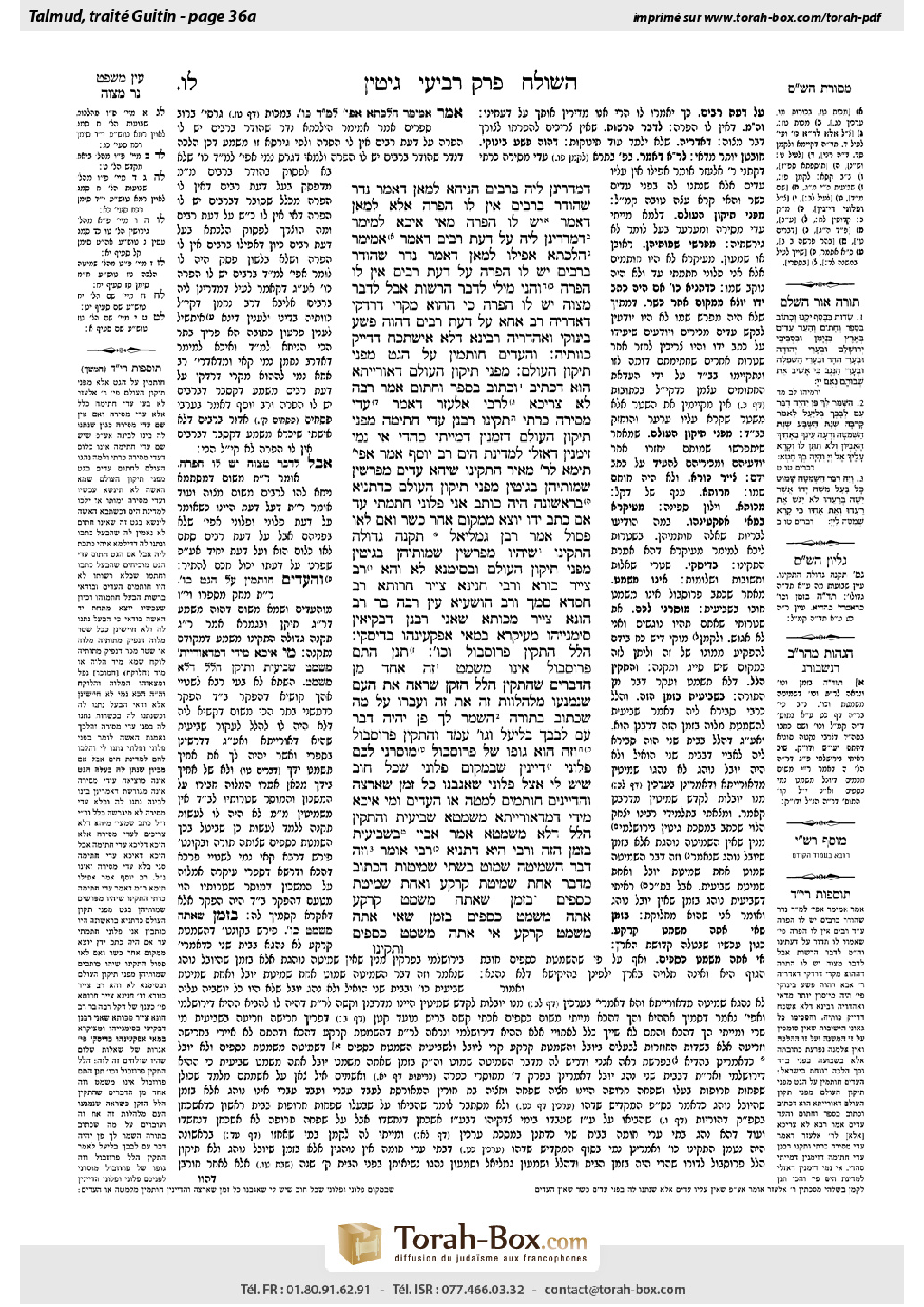
Gittin 36a: Talmud study for Daf Yomi
Study the Talmud for Daf Yomi with scanned pages, Hebrew text, English translations from Sefaria and AI-generated French translations.
Passage selection and English or AI-generated French translation are available where the scan has annotations. Daf Study is independent of Torah-Box and Sefaria.
Browse Gittin · גיטין · All tractatesGittin 36a text and translations
This page of Gittin includes the Aramaic text, an English translation and an AI-generated French translation, alongside the scan above.
גיטין ל״ו א · Aramaic and Hebrew text
דְּמַדְּרִינַן לֵיהּ בְּרַבִּים. הָנִיחָא לְמַאן דְּאָמַר נֶדֶר שֶׁהוּדַּר בְּרַבִּים – אֵין לוֹ הֲפָרָה; אֶלָּא לְמַאן דְּאָמַר יֵשׁ לוֹ הֲפָרָה, מַאי אִיכָּא לְמֵימַר?
דְּמַדְּרִינַן לֵיהּ עַל דַּעַת רַבִּים – דְּאָמַר אַמֵּימָר, הִלְכְתָא: אֲפִילּוּ לְמַאן דְּאָמַר נֶדֶר שֶׁהוּדַּר בְּרַבִּים יֵשׁ לוֹ הֲפָרָה, עַל דַּעַת רַבִּים – אֵין לוֹ הֲפָרָה.
וְהָנֵי מִילֵּי לִדְבַר הָרְשׁוּת, אֲבָל לִדְבַר מִצְוָה – יֵשׁ לוֹ הֲפָרָה. כִּי הָהוּא מַקְרֵי דַּרְדְּקֵי דְּאַדְּרֵיהּ רַב אַחָא עַל דַּעַת רַבִּים, דַּהֲוָה פָּשַׁע בְּיָנוֹקֵי; וְאַהְדְּרֵיהּ רָבִינָא, דְּלָא אִישְׁתְּכַח דְּדָיֵיק כְּווֹתֵיהּ.
וְהָעֵדִים חוֹתְמִין עַל הַגֵּט מִפְּנֵי תִּיקּוּן הָעוֹלָם: מִפְּנֵי תִּיקּוּן הָעוֹלָם?! דְּאוֹרָיְיתָא הוּא, דִּכְתִיב: ״וְכָתוֹב בַּסֵּפֶר וְחָתוֹם״!
אָמַר רַבָּה: לָא צְרִיכָא – לְרַבִּי אֶלְעָזָר, דְּאָמַר: עֵדֵי מְסִירָה כָּרְתִי; תַּקִּינוּ רַבָּנַן עֵדֵי חֲתִימָה, מִפְּנֵי תִּיקּוּן הָעוֹלָם – דְּזִמְנִין דְּמָיְיתִי סָהֲדִי, אִי נָמֵי זִימְנִין דְּאָזְלִי לִמְדִינַת הַיָּם.
רַב יוֹסֵף אָמַר: אֲפִילּוּ תֵּימָא לְרַבִּי מֵאִיר, הִתְקִינוּ שֶׁיְּהֵא עֵדִים מְפָרְשִׁין שְׁמוֹתֵיהֶן בְּגִיטִּין – מִפְּנֵי תִּיקּוּן הָעוֹלָם.
כִּדְתַנְיָא: בָּרִאשׁוֹנָה הָיָה כּוֹתֵב ״אֲנִי פְּלוֹנִי חָתַמְתִּי עֵד״; אִם כְּתַב יָדוֹ יוֹצֵא מִמָּקוֹם אַחֵר – כָּשֵׁר, וְאִם לָאו – פָּסוּל.
אָמַר רַבָּן גַּמְלִיאֵל: תַּקָּנָה גְּדוֹלָה הִתְקִינוּ, שֶׁיִּהְיוּ מְפָרְשִׁין שְׁמוֹתֵיהֶן בְּגִיטִּין – מִפְּנֵי תִּיקּוּן הָעוֹלָם.
וּבְסִימָנָא לָא?! וְהָא רַב צָיֵיר כְּוָרָא; וְרַבִּי חֲנִינָא צָיֵיר חֲרוּתָא; רַב חִסְדָּא סָמֶךְ; וְרַב הוֹשַׁעְיָא עַיִן; רַבָּה בַּר רַב הוּנָא צָיֵיר מָכוּתָא! שָׁאנֵי רַבָּנַן, דִּבְקִיאִין סִימָנַיְיהוּ.
מֵעִיקָּרָא בְּמַאי אַפְקְעִינְהוּ? בְּדִיסְקֵי.
הִלֵּל הִתְקִין פְּרוֹסְבּוּל וְכוּ׳: תְּנַן הָתָם, פְּרוֹסְבּוּל אֵינוֹ מְשַׁמֵּט. זֶה אֶחָד מִן הַדְּבָרִים שֶׁהִתְקִין הִלֵּל הַזָּקֵן; שֶׁרָאָה אֶת הָעָם שֶׁנִּמְנְעוּ מִלְּהַלְווֹת זֶה אֶת זֶה, וְעָבְרוּ עַל מַה שֶּׁכָּתוּב בַּתּוֹרָה ״הִשָּׁמֶר לְךָ פֶּן יִהְיֶה דָבָר עִם לְבָבְךָ בְלִיַּעַל וְגוֹ׳״, עָמַד וְהִתְקִין פְּרוֹסְבּוּל.
וְזֶה הוּא גּוּפוֹ שֶׁל פְּרוֹסְבּוּל: ״מוֹסְרַנִי לָכֶם פְּלוֹנִי [וּפְלוֹנִי] דַּיָּינִין שֶׁבְּמָקוֹם פְּלוֹנִי, שֶׁכׇּל חוֹב שֶׁיֵּשׁ לִי אֵצֶל פְּלוֹנִי, שֶׁאֶגְבֶּנּוּ כׇּל זְמַן שֶׁאֶרְצֶה״. וְהַדַּיָּינִים חוֹתְמִים לְמַטָּה, אוֹ הָעֵדִים.
וּמִי אִיכָּא מִידֵּי דְּמִדְּאוֹרָיְיתָא מְשַׁמְּטָא שְׁבִיעִית, וְהִתְקִין הִלֵּל דְּלָא מְשַׁמְּטָא?! אָמַר אַבָּיֵי: בַּשְּׁבִיעִית בִּזְמַן הַזֶּה, וְרַבִּי הִיא –
דְּתַנְיָא, רַבִּי אוֹמֵר: ״וְזֶה דְּבַר הַשְּׁמִיטָּה שָׁמוֹט״ – בִּשְׁתֵּי שְׁמִיטוֹת הַכָּתוּב מְדַבֵּר: אַחַת שְׁמִיטַּת קַרְקַע וְאַחַת שְׁמִיטַּת כְּסָפִים. בִּזְמַן שֶׁאַתָּה מְשַׁמֵּט קַרְקַע – אַתָּה מְשַׁמֵּט כְּסָפִים, בִּזְמַן שֶׁאִי אַתָּה מְשַׁמֵּט קַרְקַע, אִי אַתָּה מְשַׁמֵּט כְּסָפִים.
Gittin 36a · English translation
The Gemara answers that we administer the vow to the priest in public. The Gemara asks: This works out well according to the one who says that a vow that was taken in public has no possibility of nullification by a halakhic authority, but according to the one who says it has the possibility of nullification, what can be said?
The Gemara answers that we administer the vow to the priest based on the consent of the public, making it a type of vow that cannot be dissolved without their consent. As Ameimar said, the halakha is as follows: Even according to the one who says that a vow that was taken in public has the possibility of nullification, if it was taken based on the consent of the public, it has no possibility of nullification.
The Gemara comments: And this matter applies only to when the nullification of a vow is in order to enable one to perform an optional matter, but to enable one to perform a matter of a mitzva, it has the possibility of nullification. This is like the incident involving a certain teacher of children, upon whom Rav Aḥa administered a vow based on the consent of the public to cease teaching, as he was negligent with regard to the children by hitting them too much. And Ravina had his vow nullified and reinstated him, as they did not find another teacher who was as meticulous as he was.
§ The mishna taught: And the witnesses sign the bill of divorce for the betterment of the world. The Gemara asks: Is the reason that the witnesses sign the bill of divorce for the betterment of the world? It is by Torah law that they must sign, as it is written: “And subscribe the deeds, and sign them, and call witnesses” (Jeremiah 32:44).
Rabba said: No, it is necessary according to the opinion of Rabbi Elazar, who says: Witnesses of the transmission of the bill of divorce effect the divorce, and not the witnesses who sign the bill of divorce, and by Torah law it does not need to be signed. Nevertheless, the Sages instituted signatory witnesses for the betterment of the world, as sometimes it occurs that the witnesses who witnessed the transmission of the bill of divorce die, or sometimes it occurs that they go overseas, and the validity of the bill of divorce may be contested. Since they are not present, there are no witnesses who can ratify the bill of divorce. Once the Sages instituted that the witnesses’ signatures appear on the bill of divorce, then the bill of divorce can be ratified by authenticating their signatures.
Rav Yosef said: You can even say that it is according to the opinion of Rabbi Meir, that signatory witnesses on the bill of divorce effect the divorce, and the mishna should be understood as follows: They instituted that the witnesses must specify their full names on bills of divorce and not merely sign the document, for the betterment of the world.
As it is taught in a baraita (Tosefta 9:13): At first, the witness would write only: I, so-and-so, signed as a witness, but they did not state their full names. Therefore, the only way to identify the witness was to see if an identical signature could be found on a different document that had been ratified in court. Therefore, if another copy of a witness’s signature is produced from elsewhere, i.e., another court document, it is valid, but if not, then the bill of divorce is invalid even though it is possible that he was a valid witness, and as a result of this women were left unable to remarry.
Rabban Gamliel said: They instituted a great ordinance that the witnesses must specify their full names on bills of divorce, stating that they are so-and-so, son of so-and-so, and other identifying features, for the betterment of the world. This made it possible to easily clarify who the witnesses were and to ratify the bill of divorce by finding acquaintances of the witnesses who recognized their signatures.
The Gemara asks: But is it not sufficient to sign with a pictorial mark? But Rav drew a fish instead of a signature, and Rabbi Ḥanina drew a palm branch [ḥaruta]; Rav Ḥisda drew the letter samekh, and Rav Hoshaya drew the letter ayin; and Rabba bar Rav Huna drew a sail [makota]. None of these Sages would sign their actual names. The Gemara answers: The Sages are different, as everyone is well versed in their pictorial marks.
The Gemara asks: Initially, with what did they publicize these marks, as they could not use them in place of signatures before people were well versed in them? The Gemara answers: They initially used their marks in letters, where there is no legal requirement to sign their names. Once it became known that they would use these marks as their signatures, they were able to use them as signatures even on legal documents.
§ The mishna taught that Hillel the Elder instituted a document that prevents the Sabbatical Year from abrogating an outstanding debt [prosbol]. We learned in a mishna there (Shevi’it 10:3): If one writes a prosbol, the Sabbatical Year does not abrogate debt. This is one of the matters that Hillel the Elder instituted because he saw that the people of the nation were refraining from lending to one another around the time of the Sabbatical Year, as they were concerned that the debtor would not repay the loan, and they violated that which is written in the Torah: “Beware that there be not a base thought in your heart, saying: The seventh year, the year of release, is at hand; and your eye be evil against your needy brother, and you give him nothing” (Deuteronomy 15:9). He arose and instituted the prosbol so that it would also be possible to collect those debts in order to ensure that people would continue to give loans.
And this is the essence of the text of the prosbol: I transfer to you, so-and-so the judges, who are in such and such a place, so that I will collect any debt that I am owed by so-and-so whenever I wish, as the court now has the right to collect the debts. And the judges or the witnesses sign below, and this is sufficient. The creditor will then be able to collect the debt on behalf of the court, and the court can give it to him.
The Gemara asks about the prosbol itself: But is there anything like this, where by Torah law the Sabbatical Year cancels the debt but Hillel instituted that it does not cancel the debt? Abaye said: The baraita is referring to the Sabbatical Year in the present, and it is in accordance with the opinion of Rabbi Yehuda HaNasi.
As it is taught in a baraita that Rabbi Yehuda HaNasi says: The verse states in the context of the cancellation of debts: “And this is the manner of the abrogation: He shall abrogate” (Deuteronomy 15:2). The verse speaks of two types of abrogation: One is the release of land and one is the abrogation of monetary debts. Since the two are equated, one can learn the following: At a time when you release land, when the Jubilee Year is practiced, you abrogate monetary debts; at a time when you do not release land, such as the present time, when the Jubilee Year is no longer practiced, you also do not abrogate monetary debts.
Gittin 36a · Traduction française (IA)
La Guemara répond que nous administrons le serment au prêtre en public. La Guemara demande : cela fonctionne bien selon celui qui dit qu’un serment pris en public ne peut pas être annulé par une autorité halakhique, mais selon celui qui dit qu’il peut être annulé, que peut-on dire ?
La Guemara répond que nous administrons le serment au prêtre en vertu du consentement du public, le rendant ainsi un type de serment qui ne peut être annulé sans leur consentement. Comme Ameimar a dit, la halakha est la suivante : même selon celui qui dit qu’un serment pris en public peut être annulé, si celui-ci a été pris en vertu du consentement du public, il ne peut pas être annulé.
La Guemara commente : et cette affaire s’applique uniquement lorsqu’il s’agit d’annuler un serment afin de permettre à quelqu’un de réaliser une action facultative, mais afin de permettre à quelqu’un de réaliser une action de mitsva, il peut être annulé. C’est comme l’incident concernant un certain maître d’enfants, sur lequel Rav Aḥa a administré un serment en vertu du consentement du public pour cesser d’enseigner, car il était négligent envers les enfants en les frappant trop souvent. Et Ravina a annulé ce serment et a rétabli son enseignement, car ils n’ont pas trouvé d’autre maître aussi minutieux que lui.
§ La mitsna enseignait : les témoins signent le document de divorce pour le bien du monde. La Guemara demande : est-ce que la raison pour laquelle les témoins signent le document de divorce est le bien du monde ? C’est par la loi de la Torah qu’ils doivent signer, car il est écrit : « Et signez les actes, et y mettez vos noms, et appelez des témoins » (Jérémie 32:44).
Rabba dit : Non, il faut selon l’opinion de Rabbi Elazar, qui dit : les témoins de la transmission du document de divorce effectuent le divorce, et non les témoins qui signent le document de divorce, et par la loi de la Torah, il n’est pas nécessaire de signer. Cependant, les Sages ont institué des témoins signataires pour le bien du monde, car parfois il arrive que les témoins qui ont témoin de la transmission du document de divorce meurent, ou parfois qu’ils partent à l’étranger, et la validité du document de divorce peut être contestée. Puisque ces témoins ne sont pas présents, il n’y a pas de témoins qui puissent valider le document de divorce. Une fois que les Sages ont institué que les signatures des témoins apparaissent sur le document de divorce, alors ce document peut être validé en authentifiant leurs signatures.
Rav Yosef dit : On peut même dire qu’il s’agit de l’opinion de Rabbi Meir, qui dit que les témoins signataires sur le document de divorce effectuent le divorce, et la mitsna devrait être comprise comme suit : Ils ont institué que les témoins doivent spécifier leurs noms complets sur les documents de divorce et non simplement signer le document, pour le bien du monde.
Comme il est enseigné dans une baraïta (Tosefta 9:13) : d’abord, le témoin écrivait seulement : Je, tel et tel, ai signé en tant que témoin, mais ils ne mentionnaient pas leurs noms complets. Ainsi, la seule façon d’identifier le témoin était de voir si un signataire identique pouvait être trouvé sur un autre document qui avait été validé en cour. Ainsi, si un autre exemplaire du signataire d’un témoin est produit d’ailleurs, c’est-à-dire un autre document judiciaire, il est valide, mais si ce n’est pas le cas, le document de divorce est invalide même s’il est possible que ce témoin ait été un témoin valide, et en conséquence, des femmes ont été laissées incapables de se remarier.
Rabban Gamliel dit : Ils ont institué une grande ordonnance selon laquelle les témoins doivent spécifier leurs noms complets sur les documents de divorce, en indiquant qu’ils sont tels et tels, fils de tels et tels, et d’autres caractéristiques d’identification, pour le bien du monde. Cela a permis de clarifier facilement qui étaient les témoins et de valider le document de divorce en trouvant des connaissances des témoins qui reconnaissaient leurs signatures.
La Guemara demande : Mais n’est-il pas suffisant de signer avec un signe pictural ? Mais Rav a dessiné un poisson à la place d’un signataire, et Rabbi Ḥanina a dessiné un bâton [ḥaruta] ; Rav Ḥisda a dessiné la lettre samekh, et Rav Hoshaya a dessiné la lettre ayin ; et Rabba bar Rav Huna a dessiné une voile [makota]. Aucun de ces Sages ne signait leurs noms réels. La Guemara répond : les Sages sont différents, car chacun est bien versé dans leurs signes picturaux.
La Guemara demande : Initialement, avec quoi ont-ils fait connaître ces signes, car ils ne pouvaient pas les utiliser à la place des signatures avant que les gens ne soient bien versés dans eux ? La Guemara répond : Ils ont d’abord utilisé leurs signes dans les lettres, où il n’y a pas de nécessité légale de signer leurs noms. Une fois que cela a été connu qu’ils utiliseraient ces signes comme signatures, ils ont pu les utiliser comme signatures même sur des documents légaux.
§ La mitsna enseignait que Hillel le Vieil a institué un document qui empêche l’année sabbatique de révoquer une dette en suspens [prosbol]. Nous avons appris dans une mitsna là (Shevi’it 10:3) : Si l’on écrit un prosbol, l’année sabbatique ne révoque pas la dette. C’est l’une des choses que Hillel le Vieil a instituées car il a vu que le peuple du pays évitait de prêter à l’autre autour de la période de l’année sabbatique, car ils craignaient que le débiteur ne rembourse le prêt, et ils violaient ce qui est écrit dans la Torah : « Soyez attentifs afin qu’il n’y ait pas dans votre cœur un pensée basse, disant : L’année sabbatique, l’année de libération, est proche ; et votre œil soit mauvais envers votre frère pauvre, et vous lui donniez rien » (Deutéronome 15:9). Il s’est levé et a institué le prosbol afin qu’il soit aussi possible de récupérer ces dettes afin de garantir que les gens continuent à prêter.
Et c’est l’essence du texte du prosbol : Je transfère à vous, tels et tels juges, qui sont dans telle et telle place, afin que je puisse récupérer toute dette que je dois à tels et tels à tout moment que je le désire, car le tribunal a maintenant le droit de récupérer les dettes. Et les juges ou les témoins signent en dessous, et cela suffit. Le créancier pourra alors récupérer la dette au nom du tribunal, et le tribunal pourra lui donner.
La Guemara pose une question concernant le prosbol lui-même : Mais est-ce que cela existe, une telle chose, où selon la loi juive la année sabbatique annule la dette, mais Hillel a institué que cela ne l'annule pas ? Abaye dit : La baraïta fait référence à la année sabbatique actuelle, et cela correspond à l'opinion de Rabbi Yéhuda HaNasi.
Comme il est enseigné dans une baraïta que Rabbi Yéhuda HaNasi dit : La parole du texte s'inscrit dans le contexte de l'annulation des dettes : « Et c'est la manière de l'abrogation : il l'abroge » (Deutéronome 15:2). La parole parle de deux types d'abrogation : l'un est la libération des terres et l'autre est l'abrogation des dettes monétaires. Puisque les deux sont équivalents, on peut en déduire ceci : Lorsqu'on libère les terres, lorsqu'on pratique l'année jubilaire, on abroge les dettes monétaires ; lorsqu'on ne libère pas les terres, comme c'est le cas aujourd'hui, lorsqu'on ne pratique plus l'année jubilaire, on ne abroge pas non plus les dettes monétaires.
Traduction française générée par IA à partir de l’édition anglaise de Sefaria. Vérifie toujours un passage avec le texte source.
Text from Sefaria: William Davidson Edition - Vocalized Aramaic (CC BY NC); William Davidson Edition - English (CC BY NC).