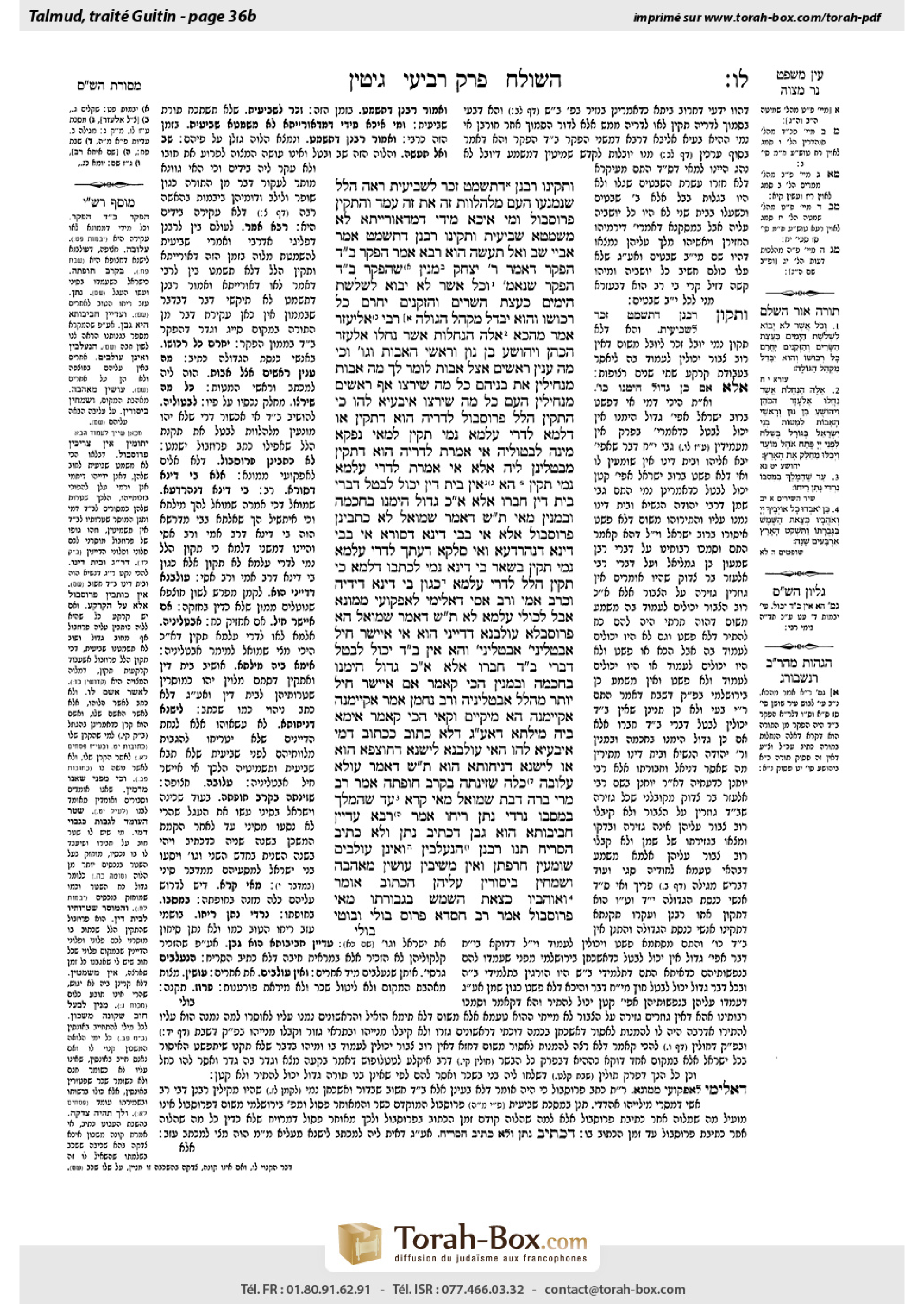
Gittin 36b: Talmud study for Daf Yomi
Study the Talmud for Daf Yomi with scanned pages, Hebrew text, English translations from Sefaria and AI-generated French translations.
Passage selection and English or AI-generated French translation are available where the scan has annotations. Daf Study is independent of Torah-Box and Sefaria.
Browse Gittin · גיטין · All tractatesGittin 36b text and translations
This page of Gittin includes the Aramaic text, an English translation and an AI-generated French translation, alongside the scan above.
גיטין ל״ו ב · Aramaic and Hebrew text
וְתַקִּינוּ רַבָּנַן דִּתְשַׁמֵּט, זֵכֶר לַשְּׁבִיעִית; רָאָה הִלֵּל שֶׁנִּמְנְעוּ הָעָם מִלְּהַלְווֹת זֶה אֶת זֶה, עָמַד וְהִתְקִין פְּרוֹסְבּוּל.
וּמִי אִיכָּא מִידֵּי דְּמִדְּאוֹרָיְיתָא לָא מְשַׁמְּטָא שְׁבִיעִית, וְתַקִּינוּ רַבָּנַן דִּתְשַׁמֵּט?!
אָמַר אַבָּיֵי: שֵׁב וְאַל תַּעֲשֶׂה הוּא. רָבָא אָמַר: הֶפְקֵר בֵּית דִּין – הֶפְקֵר. דְּאָמַר רַבִּי יִצְחָק: מִנַּיִן שֶׁהֶפְקֵר בֵּית דִּין – הֶפְקֵר? שֶׁנֶּאֱמַר: ״וְכֹל אֲשֶׁר לֹא יָבוֹא לִשְׁלֹשֶׁת הַיָּמִים כַּעֲצַת הַשָּׂרִים וְהַזְּקֵנִים, יׇחֳרַם כׇּל רְכוּשׁוֹ וְהוּא יִבָּדֵל מִקְּהַל הַגּוֹלָה״.
רַבִּי אֱלִיעֶזֶר אָמַר, מֵהָכָא: ״אֵלֶּה הַנְּחָלוֹת אֲשֶׁר נִחֲלוּ אֶלְעָזָר הַכֹּהֵן וִיהוֹשֻׁעַ בִּן נוּן וְרָאשֵׁי הָאָבוֹת וְגוֹ׳״. וְכִי מָה עִנְיַן רָאשִׁים אֵצֶל אָבוֹת? לוֹמַר לָךְ: מָה אָבוֹת מַנְחִילִין אֶת בְּנֵיהֶם כֹּל מַה שֶּׁיִּרְצוּ, אַף רָאשִׁים מַנְחִילִין הָעָם כֹּל מַה שֶּׁיִּרְצוּ.
אִיבַּעְיָא לְהוּ: כִּי הִתְקִין הִלֵּל פְּרוֹסְבּוּל – לְדָרֵיהּ הוּא דְּתַקֵּין, אוֹ דִלְמָא לְדָרֵי עָלְמָא נָמֵי תַּקֵּין?
לְמַאי נָפְקָא מִינַּהּ? לְבַטּוֹלֵיהּ. אִי אָמְרַתְּ לְדָרֵיהּ הוּא דְּתַקֵּין – מְבַטְּלִינַן לֵיהּ; אֶלָּא אִי אָמְרַתְּ לְדָרֵי עָלְמָא נָמֵי תַּקֵּין, הָא אֵין בֵּית דִּין יָכוֹל לְבַטֵּל דִּבְרֵי בֵּית דִּין חֲבֵרוֹ, אֶלָּא אִם כֵּן גָּדוֹל הֵימֶנּוּ בְּחׇכְמָה וּבְמִנְיָן. מַאי?
תָּא שְׁמַע, דְּאָמַר שְׁמוּאֵל: לָא כָּתְבִינַן פְּרוֹסְבּוּל אֶלָּא אִי בְּבֵי דִינָא דְּסוּרָא אִי בְּבֵי דִינָא דִּנְהַרְדְּעָא. וְאִי סָלְקָא דַעְתָּךְ לְדָרֵי עָלְמָא נָמֵי תַּקֵּין, בִּשְׁאָר בֵּי דִינָא נָמֵי לִכְתְּבוּ!
דִּלְמָא כִּי תַּקֵּין הִלֵּל לְדָרֵי עָלְמָא – כְּגוֹן בֵּי דִינָא דִּידֵיהּ, וּכְרַב אַמֵּי וְרַב אַסִּי, דְּאַלִּימֵי לְאַפְקוֹעֵי מָמוֹנָא; אֲבָל לְכוּלֵּי עָלְמָא – לָא.
תָּא שְׁמַע, דְּאָמַר שְׁמוּאֵל: הָא פְּרוֹסְבֻּלָא – עוּלְבָּנָא דְּדַיָּינֵי הוּא; אִי אֲיַישַּׁר חַיִל אֲבַטְּלִינֵּיהּ. אֲבַטְּלִינֵּיהּ?! וְהָא אֵין בֵּית דִּין יָכוֹל לְבַטֵּל דִּבְרֵי בֵּית דִּין חֲבֵרוֹ, אֶלָּא אִם כֵּן גָּדוֹל הֵימֶנּוּ בְּחָכְמָה וּבְמִנְיָן! הָכִי קָאָמַר: אִם אֲיַישֵּׁר חַיִל יוֹתֵר מֵהִלֵּל, אֲבַטְּלִינֵּיהּ.
וְרַב נַחְמָן אָמַר: אֲקַיְּימִנֵּהּ. אֲקַיְּימִנֵּהּ?! הָא מִיקַּיַּים וְקָאֵי! הָכִי קָאָמַר: אֵימָא בֵּיהּ מִילְּתָא, דְּאַף עַל גַּב דְּלֹא כָּתוּב כְּכָתוּב דָּמֵי.
אִיבַּעְיָא לְהוּ: הַאי עוּלְבָּנָא – לִישָּׁנָא דְחוּצְפָּא הוּא, אוֹ לִישָּׁנָא דְנִיחוּתָא הוּא? תָּא שְׁמַע, דְּאָמַר עוּלָּא: עֲלוּבָה כַּלָּה שֶׁזִּינְּתָה בְּקֶרֶב חוּפָּתָהּ.
אָמַר רַב מָרִי בְּרַהּ דְּבַת שְׁמוּאֵל: מַאי קְרָא? ״עַד שֶׁהַמֶּלֶךְ בִּמְסִבּוֹ נִרְדִּי נָתַן רֵיחוֹ״. אָמַר רָבָא: עֲדַיִין חַבִּיבוּתָא הוּא גַּבַּן, דִּכְתִיב ״נָתַן״, וְלָא כְּתִיב ״הִסְרִיחַ״.
תָּנוּ רַבָּנַן: הַנֶּעֱלָבִין וְאֵינָן עוֹלְבִים, שׁוֹמְעִין חֶרְפָּתָן וְאֵין מְשִׁיבִין, עוֹשִׂין מֵאַהֲבָה וּשְׂמֵחִין בְּיִסּוּרִין, עֲלֵיהֶן הַכָּתוּב אוֹמֵר: ״וְאוֹהֲבָיו כְּצֵאת הַשֶּׁמֶשׁ בִּגְבוּרָתוֹ״.
מַאי ״פְּרוֹסְבּוּל״? אָמַר רַב חִסְדָּא: פְּרוֹס בּוּלֵי וּבוּטֵי.
Gittin 36b · English translation
And the Sages instituted that despite this, the Sabbatical Year still will abrogate debt in the present, in remembrance of the Torah-mandated Sabbatical Year. Hillel saw that the people of the nation refrained from lending to each other so he arose and instituted the prosbol. According to this explanation, the ordinance of Hillel did not conflict with a Torah law; rather, he added an ordinance to counter the effect of a rabbinic law.
According to this explanation, the Sages instituted that even in the present the Sabbatical Year would bring a cancellation of debt, despite the fact that by Torah law the debt still stands. The Gemara asks: But is there anything like this, where by Torah law the Sabbatical Year does not cancel the debt, and the Sages instituted that it will cancel? It is as though the Sages are instructing the debtors to steal from their creditors, as by Torah law they still owe the money.
Abaye says: This is not actual theft; it is an instruction to sit passively and not do anything. The Sages have the authority to instruct one to passively violate a Torah law, so long as no action is taken. Rava says: The Sages are able to institute this ordinance because property declared ownerless by the court is ownerless. As Rabbi Yitzḥak says: From where is it derived that property declared ownerless by the court is ownerless? As it is stated: “And whoever did not come within three days according to the counsel of the princes and the Elders, all of his property shall be forfeited, and he shall be separated from the congregation of the captivity” (Ezra 10:8).
Rabbi Eliezer said: The halakha that property declared ownerless by the court is ownerless is derived from here: The verse states: “These are the inheritances, which Eleazar the priest, and Joshua the son of Nun, and the heads of the fathers’ houses of the tribes of the children of Israel distributed for inheritance” (Joshua 19:51). The Gemara asks: What do the heads have to do with the fathers? It comes to tell you: Just as fathers transmit anything that they wish to their children, so too, heads of the nation transmit to the people anything that they wish. This demonstrates that the court has the authority to take property from one person and to give it to another; therefore, the Sages have the authority to decide that all debts are canceled.
§ A dilemma was raised before the Sages: When Hillel instituted the prosbol, was it for his generation alone that he instituted it, and the custom developed to continue using it, or did he perhaps institute it also for all generations?
The Gemara asks: What difference is there whether it was instituted for his generation only or for all generations when either way, it is still in use? The Gemara explains: The difference arises with regard to nullifying the institution of prosbol. If you say that it was for his generation alone that he instituted it, then we can nullify it if we desire. But if you say that he instituted it also for all generations, then there is a principle that a court can nullify the action of another court only if it is greater than it in wisdom and in number. Therefore, we would not be able to nullify the ordinance instituted by Hillel and his court. What, then, is the halakha?
The Gemara suggests a resolution to the dilemma: Come and hear that which Shmuel said: We write a prosbol only in the court of Sura or in the court of Neharde’a, as they were the primary centers of Torah study, but not in any other court. And if it enters your mind to say that he instituted it also for all generations, then let them write a prosbol in the other courts as well.
The Gemara rejects this proof: Perhaps when Hillel instituted the prosbol, he did so for all generations, but only for courts such as his court, which was the primary court of his time, and courts like those of Rav Ami and Rav Asi, as they have the power to remove money from someone’s possession. However, for all other courts, which are not as authoritative, he did not institute this ordinance. Therefore, the statement of Shmuel cannot serve as a proof with regard to the manner in which the prosbol was instituted.
The Gemara suggests another proof: Come and hear that which Shmuel said: This prosbol is an ulbena of the judges; if my strength increases I will nullify it. The Gemara challenges this statement: How could Shmuel say: I will nullify it? But isn’t it the case that a court can nullify the action of another court only if it is greater than it in wisdom and in number? It must be that Shmuel holds that Hillel did not establish the prosbol for all generations, and in his time it carried the force of a mere custom. The Gemara rejects this proof: It can be explained that this is what he said: If my strength increases so that I become greater than Hillel, then I will nullify the prosbol.
By contrast, Rav Naḥman said: If my strength increases, I will uphold the institution of the prosbol. The Gemara asks: What is meant by: I will uphold it? Isn’t it upheld and standing? Why does the prosbol require further support? The Gemara explains: This is what he said: If my strength increases, I will say something about it, and I will institute that even though the prosbol was not written, it is considered as though it was written. Then people would no longer need to write a prosbol, as it would be considered as if everyone wrote one.
A dilemma was raised before the Sages: This ulbena of the judges that Shmuel speaks of, is it a term of insolence, in that the judges are, according to Shmuel, enabling lenders to insolently collect debts that are not due to them, or a term of convenience, in that the judges are saving themselves the inconvenience of having to actually collect the debts detailed in the promissory notes? The Gemara suggests a proof: Come and hear that which Ulla said in describing the Jewish people after they sinned with the Golden Calf immediately following the revelation at Sinai: Insolent [aluva] is the bride who is promiscuous under her wedding canopy.
Rav Mari, son of Shmuel’s daughter, says: What is the verse from which it is derived? “While the king sat at his table, my spikenard sent forth its fragrance” (Song of Songs 1:12). He understands the verse in the following manner: While the king was still involved in his celebration, i.e., God had just given the Torah, the perfume of the Jewish people gave off an unpleasant odor, i.e., they sinned with the Golden Calf. Rava says: Nevertheless, it is apparent from the verse that the affection of God is still upon us, as it is written euphemistically as “sent forth its fragrance” and the verse is not written: It reeked.
The Gemara continues discussing the meaning of the word ulbena. The Sages taught: Those who are insulted [ne’elavin] but do not insult others, who hear their shame but do not respond, who act out of love and are joyful in their suffering, about them the verse states: “And they that love Him are as the sun going forth in its might” (Judges 5:31).
§ The Gemara asks: What is the meaning of the word prosbol? Rav Ḥisda said: An ordinance [pros] of bulei and butei.
Gittin 36b · Traduction française (IA)
Et les Sages ont institué que malgré cela, l'année sabbatique annulera toujours les dettes à l'heure actuelle, en souvenir de l'année sabbatique prescrite par la Torah. Hillel a vu que le peuple du pays se refusait à prêter à ses concitoyens, et il s'est levé pour instituer le prosbol. Selon cette explication, l'ordonnance d'Hillel n'a pas entré en conflit avec une loi de la Torah ; plutôt, il a ajouté une ordonnance pour contrecarrer l'effet d'une loi rabbinique.
Selon cette explication, les Sages ont institué que même à l'heure actuelle, l'année sabbatique annulerait les dettes, malgré le fait que, selon la loi de la Torah, la dette reste en vigueur. La Guemara pose la question : Mais y a-t-il quelque chose de semblable, où selon la loi de la Torah l'année sabbatique n'annule pas la dette, et les Sages ont institué qu'elle l'annule ? Cela ressemblerait à ce que les Sages incitent les débiteurs à voler à leurs créanciers, puisque selon la loi de la Torah ils doivent encore l'argent.
Abaye dit : Ce n'est pas un vol réel ; c'est une instruction de rester passif et de ne pas agir. Les Sages ont le pouvoir d'instituer qu'on viole passivement une loi de la Torah, à condition que rien ne soit fait. Rava dit : Les Sages peuvent instituer cette ordonnance car la propriété déclarée sans propriétaire par la cour est effectivement sans propriétaire. Comme Rabbi Yitzḥak dit : D'où est tiré que la propriété déclarée sans propriétaire par la cour est effectivement sans propriétaire ? Comme il est dit : « Et celui qui n'est pas venu dans trois jours selon le conseil des princes et des anciens, toute sa propriété sera perdue, et il sera séparé de la congrégation de l'exil » (Ezra 10:8).
Rabbi Eliezer dit : La halakha selon laquelle une propriété déclarée sans propriétaire par la cour est effectivement sans propriétaire est tirée de là : Le verset dit : « Ces sont les héritages, que Eleazar le prêtre, et Josué fils de Nun, et les chefs des maisons des tribus des enfants d'Israël ont distribué pour héritage » (Josué 19:51). La Guemara pose la question : Quel est le rôle des chefs par rapport aux pères ? Il vient te dire : Comme les pères transmettent à leurs enfants tout ce qu'ils veulent, de même les chefs du peuple transmettent à la nation tout ce qu'ils veulent. Cela démontre que la cour a le pouvoir de prendre la propriété d'une personne et de la donner à une autre ; donc, les Sages ont le pouvoir de décider que toutes les dettes sont annulées.
§ Un dilemme a été soulevé devant les Sages : Lorsque Hillel a institué le prosbol, était-ce uniquement pour sa génération, et la coutume s'est développée pour le continuer, ou bien a-t-il peut-être institué cela aussi pour toutes les générations ?
La Guemara pose la question : Quelle différence y a-t-il si c'était uniquement pour sa génération ou pour toutes les générations, puisque dans les deux cas, cela est encore en usage ? La Guemara explique : La différence réside dans l'annulation de l'institution du prosbol. Si tu dis qu'il était uniquement pour sa génération, alors nous pouvons l'annuler si nous le voulons. Mais si tu dis qu'il l'a institué aussi pour toutes les générations, alors il y a un principe selon lequel une cour peut annuler l'action d'une autre cour uniquement si elle est supérieure en sagesse et en nombre. Donc, nous ne pourrions pas annuler l'ordonnance instituée par Hillel et sa cour. Quelle est alors la halakha ?
La Guemara suggère une résolution à ce dilemme : Viens écouter ce que Shmuel a dit : Nous écrivons un prosbol uniquement dans la cour de Sura ou dans la cour de Neharde’a, car elles étaient les centres principaux d'étude de la Torah, mais pas dans toute autre cour. Et si tu penses qu'il l'a institué aussi pour toutes les générations, alors laisse-les écrire un prosbol dans les autres cours également.
La Guemara rejette cette preuve : Peut-être que lorsqu'Hillel a institué le prosbol, il l'a fait pour toutes les générations, mais uniquement pour des cours telles que la sienne, qui était la cour principale de son époque, et des cours comme celles de Rav Ami et Rav Asi, car elles ont le pouvoir de retirer de l'argent d'une personne. Cependant, pour toutes les autres cours, qui ne sont pas aussi autoritaires, il n'a pas institué cette ordonnance. Donc, la déclaration de Shmuel ne peut pas servir de preuve concernant la manière dont le prosbol a été institué.
La Guemara suggère une autre preuve : Viens écouter ce que Shmuel a dit : Ce prosbol est une ulbena des juges ; si ma force augmente, je le nullifierai. La Guemara conteste cette déclaration : Comment Shmuel peut-il dire : Je le nullifierai ? Mais n'est-ce pas le cas que une cour ne peut nullifier l'action d'une autre cour que si elle est supérieure en sagesse et en nombre ? Il doit être que Shmuel considère que Hillel n'a pas établi le prosbol pour toutes les générations, et à son époque, cela portait la force d'une simple coutume. La Guemara rejette cette preuve : On peut expliquer que c'est ce qu'il a dit : Si ma force augmente jusqu'à ce que je devienne supérieur à Hillel, alors je nullifierai le prosbol.
Par contraste, Rav Naḥman a dit : Si ma force augmente, je maintiendrai l'institution du prosbol. La Guemara pose la question : De quoi est-ce que : Je le maintiendrai ? N'est-ce pas déjà maintenu et en place ? Pourquoi le prosbol a-t-il besoin de soutien supplémentaire ? La Guemara explique : C'est ce qu'il a dit : Si ma force augmente, je dirai quelque chose à ce sujet, et je ferai instituer que même si le prosbol n'a pas été écrit, il sera considéré comme s'il avait été écrit. Ainsi, les gens n'auront plus besoin d'écrire un prosbol, car cela sera considéré comme si tout le monde en avait écrit un.
Un dilemme a été soulevé devant les Sages : Cette ulbena des juges que parle Shmuel, est-elle un terme d'insolence, en ce sens que les juges, selon Shmuel, permettent aux prêteurs de collecter des dettes qui ne leur sont pas dues de manière insolente, ou un terme de commodité, en ce sens que les juges évitent l'inconfort de devoir réellement collecter les dettes mentionnées dans les promesses de prêt ? La Guemara suggère une preuve : Viens écouter ce que Ulla a dit en décrivant le peuple juif après qu'ils aient péché avec le Veau d'or immédiatement après la révélation au Sinaï : Insolente [aluva] est la mariée qui est promiscue sous son dais de mariage.
Rav Mari, fils de la fille de Shmuel, dit : De quel verset cela est-il déduit ? « Tandis que le roi était assis à sa table, mon nard à parfum exhala son odeur » (Cantique des Cantiques 1:12). Il comprend ce verset ainsi : Tandis que le roi était encore engagé dans sa fête, c'est-à-dire que Dieu avait récemment donné la Torah, l'odeur du peuple juif exhala une odeur désagréable, c'est-à-dire qu'ils péchèrent avec le Veau d'or. Rava dit : Cependant, il est clair à partir du verset que l'affection de Dieu est toujours sur nous, car il est écrit de manière équivoque « exhala son odeur » et le verset n'est pas écrit : « il exhala une odeur forte ».
Le Guemara continue d'explorer le sens du mot ulbena. Les Sages enseignèrent : Ceux qui sont insultés [ne'elavin] mais ne insultent pas les autres, ceux qui entendent leur honte mais ne répondent pas, ceux qui agissent par amour et sont joyeux dans leur souffrance, à leur sujet le verset dit : « Et ceux qui l'aiment sont comme le soleil qui sort en sa puissance » (Juges 5:31).
§ Le Guemara pose la question : Quel est le sens du mot prosbol ? Rav Ḥisda dit : Une ordonnance [pros] de bulei et butei.
Traduction française générée par IA à partir de l’édition anglaise de Sefaria. Vérifie toujours un passage avec le texte source.
Text from Sefaria: William Davidson Edition - Vocalized Aramaic (CC BY NC); William Davidson Edition - English (CC BY NC).