Gittin 37a: Talmud study for Daf Yomi
Study the Talmud for Daf Yomi with scanned pages, Hebrew text, English translations from Sefaria and AI-generated French translations.
Passage selection and English or AI-generated French translation are available where the scan has annotations. Daf Study is independent of Torah-Box and Sefaria.
Browse Gittin · גיטין · All tractatesGittin 37a text and translations
This page of Gittin includes the Aramaic text, an English translation and an AI-generated French translation, alongside the scan above.
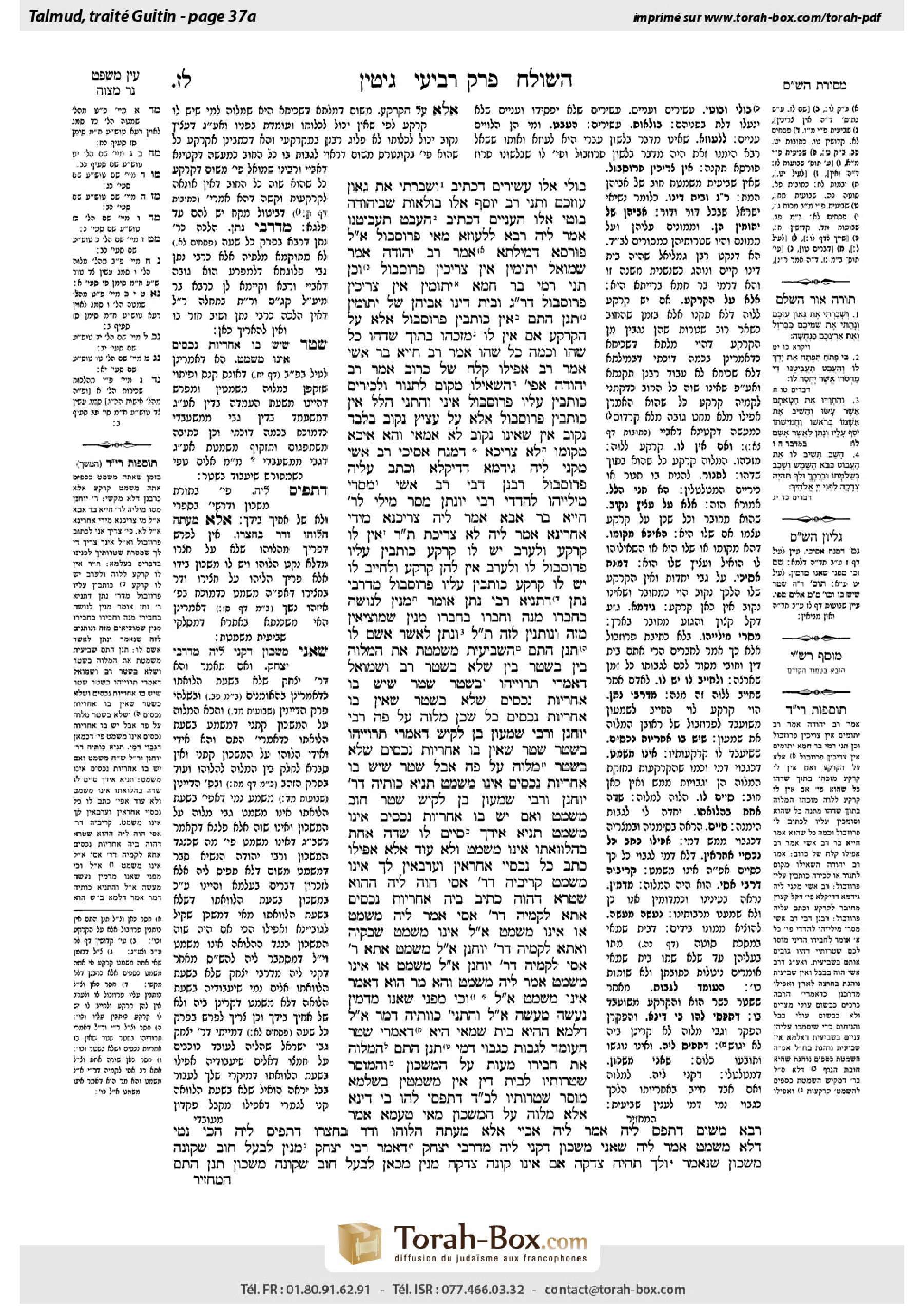
גיטין ל״ז א · Aramaic and Hebrew text
בּוּלֵי – אֵלּוּ עֲשִׁירִים, דִּכְתִיב: ״וְשָׁבַרְתִּי אֶת גְּאוֹן עוּזְּכֶם״, וְתָנֵי רַב יוֹסֵף: אֵלּוּ בּוּלָאוֹת שֶׁבִּיהוּדָה. בּוּטֵי – אֵלּוּ הָעֲנִיִּים, דִּכְתִיב: ״הַעֲבֵט תַּעֲבִיטֶנּוּ״. אֲמַר לֵיהּ רָבָא לְלָעוֹזָא: מַאי פְּרוֹסְבּוּל? אֲמַר לֵיהּ: פּוּרְסָא דְמִילְּתָא.
אָמַר רַב יְהוּדָה אָמַר שְׁמוּאֵל: יְתוֹמִין, אֵין צְרִיכִין פְּרוֹסְבּוּל. וְכֵן תָּנֵי רָמֵי בַּר חָמָא: יְתוֹמִין אֵין צְרִיכִין פְּרוֹסְבּוּל, דְּרַבָּן גַּמְלִיאֵל וּבֵית דִּינוֹ אֲבִיהֶן שֶׁל יְתוֹמִין.
תְּנַן הָתָם: אֵין כּוֹתְבִין פְּרוֹסְבּוּל אֶלָּא עַל הַקַּרְקַע. אִם אֵין לוֹ – מְזַכֵּהוּ בְּתוֹךְ שָׂדֵהוּ כׇּל שֶׁהוּ. וְכַמָּה כׇּל שֶׁהוּ? אָמַר רַב חִיָּיא בַּר אָשֵׁי אָמַר רַב: אֲפִילּוּ קֶלַח שֶׁל כְּרוּב. אָמַר רַב יְהוּדָה: אֲפִילּוּ הִשְׁאִילוֹ מָקוֹם לְתַנּוּר וּלְכִירַיִם – כּוֹתְבִין עָלָיו פְּרוֹסְבּוּל.
אִינִי?! וְהָתָנֵי הִלֵּל: אֵין כּוֹתְבִין פְּרוֹסְבּוּל אֶלָּא עַל עָצִיץ נָקוּב בִּלְבָד. נָקוּב – אִין, שֶׁאֵינוֹ נָקוּב – לָא;
אַמַּאי? וְהָא אִיכָּא מְקוֹמוֹ! לָא צְרִיכָא, דְּמַנַּח אַסִּיכֵּי.
רַב אָשֵׁי מַקְנֵי לֵיהּ גִּידְמָא דְּדִיקְלָא, וּכְתַב עֲלֵיהּ פְּרוֹסְבּוּל. רַבָּנַן דְּבֵי רַב אָשֵׁי מָסְרִי מִילַּיְיהוּ לַהֲדָדֵי. רַבִּי יוֹנָתָן מְסַר מִילֵּי לְרַבִּי חִיָּיא בַּר אַבָּא; אֲמַר לֵיהּ: צְרִיכְנָא מִידֵּי אַחֲרִינָא? אֲמַר לֵיהּ: לָא צְרִיכַתְּ.
תָּנוּ רַבָּנַן: אֵין לוֹ קַרְקַע, וְלֶעָרֵב יֵשׁ לוֹ קַרְקַע – כּוֹתְבִין עָלָיו פְּרוֹסְבּוּל. לוֹ וְלֶעָרֵב אֵין לָהֶן קַרְקַע, וְלַחַיָּיב לוֹ יֵשׁ לוֹ קַרְקַע – כּוֹתְבִין עָלָיו פְּרוֹסְבּוּל, מִדְּרַבִּי נָתָן –
דְּתַנְיָא, רַבִּי נָתָן אוֹמֵר: מִנַּיִן לַנּוֹשֶׁה בַּחֲבֵרוֹ מָנֶה, וַחֲבֵרוֹ בַּחֲבֵרוֹ, מִנַּיִן שֶׁמּוֹצִיאִין מִזֶּה וְנוֹתְנִין לָזֶה? תַּלְמוּד לוֹמַר: ״וְנָתַן לַאֲשֶׁר אָשַׁם לוֹ״.
תְּנַן הָתָם: הַשְּׁבִיעִית מְשַׁמֶּטֶת אֶת הַמִּלְוָה, בֵּין בִּשְׁטָר בֵּין שֶׁלֹּא בִּשְׁטָר. רַב וּשְׁמוּאֵל דְּאָמְרִי תַּרְוַיְיהוּ: בִּשְׁטָר – שְׁטָר שֶׁיֵּשׁ בּוֹ אַחְרָיוּת נְכָסִים, שֶׁלֹּא בִּשְׁטָר – שֶׁאֵין בּוֹ אַחְרָיוּת נְכָסִים; כׇּל שֶׁכֵּן מִלְוֶה עַל פֶּה.
רַבִּי יוֹחָנָן וְרַבִּי שִׁמְעוֹן בֶּן לָקִישׁ דְּאָמְרִי תַּרְוַיְיהוּ: בִּשְׁטָר – שְׁטָר שֶׁאֵין בּוֹ אַחְרָיוּת נְכָסִים, שֶׁלֹּא בִּשְׁטָר – מִלְוֶה עַל פֶּה. אֲבָל שְׁטָר שֶׁיֵּשׁ בּוֹ אַחְרָיוּת נְכָסִים – אֵינוֹ מְשַׁמֵּט.
תַּנְיָא כְּוָתֵיהּ דְּרַבִּי יוֹחָנָן וְרַבִּי שִׁמְעוֹן בֶּן לָקִישׁ: שְׁטַר חוֹב – מְשַׁמֵּט, וְאִם יֵשׁ בּוֹ אַחְרָיוּת נְכָסִים – אֵינוֹ מְשַׁמֵּט. תַּנְיָא אִידַּךְ: סִיֵּים לוֹ שָׂדֶה אַחַת בְּהַלְווֹאָתוֹ, אֵינוֹ מְשַׁמֵּט. וְלֹא עוֹד, אֶלָּא אֲפִילּוּ כָּתַב: ״כׇּל נְכָסַיי אַחְרָאִין וְעַרְבָאִין לָךְ״ – אֵינוֹ מְשַׁמֵּט.
קָרִיבֵיהּ דְּרַבִּי אַסִּי הֲוָה לֵיהּ הָהוּא שְׁטָרָא דַּהֲוָה כְּתִיב בֵּיהּ אַחְרָיוּת נְכָסִים, אֲתָא לְקַמֵּיהּ דְּרַבִּי אַסִּי, אֲמַר לֵיהּ: מְשַׁמֵּט אוֹ אֵינוֹ מְשַׁמֵּט? אֲמַר לֵיהּ: אֵינוֹ מְשַׁמֵּט. שַׁבְקֵיהּ, וַאֲתָא לְקַמֵּיהּ דְּרַבִּי יוֹחָנָן, אֲמַר לֵיהּ: מְשַׁמֵּט.
אֲתָא רַבִּי אַסִּי לְקַמֵּיהּ דְּרַבִּי יוֹחָנָן, אֲמַר לֵיהּ: מְשַׁמֵּט אוֹ אֵינוֹ מְשַׁמֵּט? אֲמַר לֵיהּ: מְשַׁמֵּט. וְהָא מָר הוּא דְּאָמַר אֵינוֹ מְשַׁמֵּט! אֲמַר לֵיהּ: וְכִי מִפְּנֵי שֶׁאָנוּ מְדַמִּין, נַעֲשֶׂה מַעֲשֶׂה?! אֲמַר לֵיהּ: וְהָתַנְיָא כְּווֹתֵיהּ דְּמָר! אֲמַר לֵיהּ: דִּלְמָא הָהִיא בֵּית שַׁמַּאי הִיא, דְּאָמְרִי: שְׁטָר הָעוֹמֵד לִגְבּוֹת – כְּגָבוּי דָּמֵי.
תְּנַן הָתָם: הַמַּלְוֶה אֶת חֲבֵירוֹ מָעוֹת עַל הַמַּשְׁכּוֹן, וְהַמּוֹסֵר שְׁטָרוֹתָיו לְבֵית דִין – אֵין מְשַׁמְּטִין. בִּשְׁלָמָא מוֹסֵר שְׁטָרוֹתָיו לְבֵית דִּין – דְּתָפְסִי לְהוּ בֵּי דִינָא. אֶלָּא מַלְוֶה עַל הַמַּשְׁכּוֹן, מַאי טַעְמָא?
אָמַר רָבָא: מִשּׁוּם דְּתָפֵס לֵיהּ. אֲמַר לֵיהּ אַבָּיֵי: אֶלָּא מֵעַתָּה, הִלְוָהוּ וְדָר בַּחֲצֵרוֹ – דְּתָפֵיס לֵיהּ, הָכִי נָמֵי דְּלָא מְשַׁמֵּט?!
אֲמַר לֵיהּ: שָׁאנֵי מַשְׁכּוֹן, דְּקָנֵי לֵיהּ מִדְּרַבִּי יִצְחָק – דְּאָמַר רַבִּי יִצְחָק: מִנַּיִן לְבַעַל חוֹב שֶׁקּוֹנֶה מַשְׁכּוֹן? שֶׁנֶּאֱמַר: ״וּלְךָ תִּהְיֶה צְדָקָה״ – אִם אֵינוֹ קוֹנֶה, צְדָקָה מִנַּיִן? מִכָּאן לְבַעַל חוֹב שֶׁקּוֹנֶה מַשְׁכּוֹן.
תְּנַן הָתָם:
Gittin 37a · English translation
Bulei, these are the wealthy, as it is written: “And I will break the pride of your power” (Leviticus 26:19), and Rav Yosef taught with regard to this verse: These are the bula’ot, the wealthy people, of Judea. Butei, these are the poor, who are in need of a loan, as it is written: “You shall not shut your hand from your needy brother; but you shall open your hand to him, and you shall lend him [ha’avet ta’avitenu] sufficient for his need” (Deuteronomy 15:7–8). Therefore, the prosbol was instituted both for the sake of the wealthy, so that the loans they would give to the poor person would not be canceled, and for the sake of the poor, so that they would continue to find those willing to lend them money. Rava said to a foreigner who spoke Greek: What is the meaning of the word prosbol? He said to him: It means the institution [pursa] of a matter.
§ Rav Yehuda says that Shmuel says: Orphans do not require a prosbol in order to collect payment of debts owed to them. And similarly, Rami bar Ḥama taught in a baraita: Orphans do not require a prosbol, as Rabban Gamliel and his court, i.e., any rabbinic court, are considered the fathers of orphans, meaning that all matters that relate to orphans are already managed by the court, including their promissory notes.
§ We learned in a mishna there (Shevi’it 10:6): One may write a prosbol only on the basis of the debtor owning land. If the debtor has no land, then the creditor transfers any amount of his own field to him so that he can write a prosbol. The Gemara asks: And how much is sufficient to be classified as any amount? Rav Ḥiyya bar Ashi says that Rav says: Even the amount of land sufficient to grow a stalk of cabbage is sufficient. Rav Yehuda says: Even if he lent him a place sufficient for an oven and a stove, one may write a prosbol on this basis.
The Gemara challenges this statement: Is that so? But didn’t Hillel teach (Tosefta, Shevi’it 8:10): One writes a prosbol only on the basis of the debtor owning merely a perforated pot placed on the ground. This demonstrates that a perforated pot can serve as the basis for the writing of a prosbol, as it is considered to be part of the ground due to the perforation; however, a pot that is not perforated cannot serve as the basis for the writing of a prosbol.
The Gemara continues the question: Since Rav Yehuda stated that possession of the place occupied by the oven is also considered possession of the land underneath with regard to this issue, why can’t a non-perforated pot serve as the basis for a prosbol; but isn’t there the place where the pot is resting? The Gemara answers: No, one cannot compare the case of Rav Yehuda to this case, as it is necessary for Hillel to state his halakha in a case where the pot is resting on stakes and the borrower has no possession of any land at all. Hillel teaches that even so, if the pot is perforated it is considered to be land and may serve as the basis for the writing of a prosbol.
The Gemara recounts a related incident: When Rav Ashi would lend money and wish to write a prosbol he would transfer to the borrower a stump of a palm tree that was still attached to the ground, and he wrote a prosbol based on this. The Sages of the school of Rav Ashi would transfer their matters, i.e., their debts, to each other without writing a prosbol, by stating: You are hereby a court, and the debt is given over to you. Rabbi Yonatan transferred a matter by means of such a statement to Rabbi Ḥiyya bar Abba. Rabbi Yonatan said to him: Do I need anything else? He said to him: You do not need anything else, as this statement alone is sufficient.
The Gemara discusses the requirement for the debtor to have land. The Sages taught: If the debtor has no land but the guarantor has land then one writes a prosbol on the basis of the land of the guarantor. If both he and the guarantor have no land, but another person who is obligated to pay money to the debtor has land, then one writes a prosbol on the basis of this land. This halakha is derived from a statement of Rabbi Natan.
As it is taught in a baraita that Rabbi Natan says: From where is it derived that when one lends one hundred dinars to his friend, and that friend lends an identical sum to his own friend, that the court appropriates the money from this one, the second debtor, and gives it to that one, the first creditor, without going through the middleman, who is both the first debtor and the second creditor? The verse states with regard to returning stolen property: “And gives it to him in respect of whom he has been guilty” (Numbers 5:7). The fact that the verse explains that the money is given to one: “In respect of whom he has been guilty,” indicates that the money should be given directly to the one to whom the money is ultimately owed. In this case as well, the second debtor possesses land, and as he owes money to the first debtor, it is considered as if the second debtor owes money to the first creditor, enabling the first creditor to write a prosbol.
§ We learned in a mishna there (Shevi’it 10:1): The Sabbatical Year abrogates debt both for loans that were contracted with a promissory note and for loans that were contracted without a promissory note. The amora’im disagree with regard to the interpretation of the mishna: It is Rav and Shmuel who both say: Loans that were contracted with a promissory note, is referring to loans that were contracted with a promissory note that contains a property guarantee; loans that were contracted without a promissory note, is referring even to loans that were contracted with a promissory note that does not contain a property guarantee. All the more so, a loan by oral agreement is canceled by the Sabbatical Year.
By contrast, it is Rabbi Yoḥanan and Rabbi Shimon ben Lakish who both say: Loans that were contracted with a promissory note is referring to loans that were contracted with a promissory note that does not contain a property guarantee, whereas loans that were contracted without a promissory note is referring to a loan by oral agreement. However, the Sabbatical Year does not abrogate a loan contracted with a promissory note that contains a property guarantee, as it is as though the creditor had already taken possession of the debtor’s land.
It is taught in a baraita in accordance with the opinion of Rabbi Yoḥanan and Rabbi Shimon ben Lakish: The Sabbatical Year abrogates a promissory note, but if the promissory note contains a property guarantee the Sabbatical Year does not abrogate it. Similarly, it is taught in another baraita: If the debtor specified one field for the repayment of his loan, then it is not canceled. And not only that, but even if he wrote: All of my property is pledged and guaranteed to you, then the Sabbatical Year does not abrogate it, even if he does not specify a field for the repayment of the loan.
The Gemara relates: The relative of Rabbi Asi had a certain promissory note that had a property guarantee written in it. He came before Rabbi Asi and said to him: Does the Sabbatical Year abrogate this loan, or does it not abrogate it? He said to him: It does not abrogate it. He left Rabbi Asi and came before Rabbi Yoḥanan and asked him the same question. Rabbi Yoḥanan said to him: It does abrogate it.
Rabbi Asi came before Rabbi Yoḥanan and said to him: Does the Sabbatical Year abrogate this loan, or does it not abrogate it? He said to him: It does abrogate it. Rabbi Asi challenged him: But wasn’t it the Master himself who said that the Sabbatical Year does not abrogate a promissory note that contains a property guarantee? Rabbi Yoḥanan said to him: Because we think that this should be the halakha should we perform an action based on this? Rabbi Asi said to him: But isn’t it taught in a baraita in accordance with the opinion of the Master? He said to him: Perhaps that baraita is in accordance with the opinion of Beit Shammai, who say more generally: A promissory note that stands to be collected is considered as though it has been collected, and this is why the loan is not abrogated, as it is considered as though the loan had already been repaid. And the halakha is not in accordance with the opinion of Beit Shammai in that issue.
§ We learned in a mishna there (Shevi’it 10:2): With regard to one who lends money to another based on collateral, and one who transfers his promissory notes to a court, the debt owed to them is not canceled. The Gemara asks: Granted, the debt is not canceled when one transfers his promissory notes to a court, as the court seizes the promissory notes, and they are able to collect this debt. But what is the reason that the debt is not canceled for one who lends money based on collateral?
Rava said: Due to the fact that the creditor has seized an item that belongs to the debtor, it is considered as though the debt has already been collected. Abaye said to him: If that is so, then if a creditor loaned money to someone and lives in his courtyard as a collateral for the loan, since he seizes the courtyard, which belongs to the debtor, would you also say that the Sabbatical Year does not abrogate the debt? That would contradict the accepted halakha that in this case the debt is canceled.
Rava said to him: Collateral is different, as the creditor acquires it for himself, as learned from the statement of Rabbi Yitzḥak, as Rabbi Yitzḥak says: From where is it derived that a creditor acquires collateral given to him and is considered its owner so long as the item is in his possession? As it is stated in the verse with regard to the obligation of a creditor to return collateral at night: “And it shall be righteousness for you” (Deuteronomy 24:13). Rabbi Yitzḥak infers: If the creditor does not acquire the collateral, then from where is the righteousness involved in returning it? He would be simply returning an item to its rightful owner. From here it is learned that a creditor acquires the collateral. Therefore, when he returns the collateral to the debtor he is performing an act of charity.
§ We learned in a mishna there (Shevi’it 10:8):
Gittin 37a · Traduction française (IA)
Bulei, ces gens sont riches, car il est écrit : « Et je briserai la hauteur de votre pouvoir » (Lévitique 26:19), et Rav Yosef enseignait à propos de cette versette : Ces sont les bula’ot, les gens riches de Juda. Butei, ces gens sont pauvres, qui ont besoin d’un prêt, car il est écrit : « Tu ne fermeras pas ton bras contre ton frère pauvre ; mais tu ouvriras ton bras à lui, et tu lui prêteras [ha’avet ta’avitenu] suffisamment pour sa nécessité » (Dt 15:7–8). Ainsi, l’institution du prosbol a été instituée à la fois pour le compte des riches, afin que les prêts qu’ils faisaient aux pauvres ne soient pas annulés, et pour le compte des pauvres, afin qu’ils continuent à trouver des personnes prêtes à leur prêter de l’argent. Rava dit à un étranger qui parlait grec : Quel est le sens du mot prosbol ? Il lui répondit : Cela signifie l’institution [pursa] d’une affaire.
§ Rav Yehuda dit que Shmuel dit : Les orphelins n’ont pas besoin d’un prosbol pour récupérer les dettes qui leur sont dues. De même, Rami bar Ḥama enseignait dans une baraïta : Les orphelins n’ont pas besoin d’un prosbol, car Rabban Gamliel et son tribunal, c’est-à-dire tout tribunal rabbinique, sont considérés comme les pères des orphelins, ce qui signifie que toutes les affaires concernant les orphelins sont déjà gérées par le tribunal, y compris leurs promesses de paiement.
§ Nous avons appris dans une mitsva là (Shevi’it 10:6) : On peut écrire un prosbol uniquement sur la base du débiteur possédant une terre. Si le débiteur n’a pas de terre, alors le créancier transfère une quantité de son propre champ à lui afin qu’il puisse écrire un prosbol. La Guemara pose la question : Et quelle quantité est suffisante pour être considérée comme une quantité ? Rav Ḥiyya bar Ashi dit que Rav dit : Même la quantité de terre suffisante pour cultiver un bâton de chou est suffisante. Rav Yehuda dit : Même si on lui prête un lieu suffisant pour une cheminée et une cuisinière, on peut écrire un prosbol sur cette base.
La Guemara remet en question cette déclaration : Est-ce ainsi ? Mais n’a-t-il pas été enseigné par Hillel (Tosefta, Shevi’it 8:10) : On écrit un prosbol uniquement sur la base du débiteur possédant simplement une marmite percée posée sur le sol. Cela démontre que la marmite percée peut servir de base à l’écriture d’un prosbol, car elle est considérée comme faisant partie du sol en raison de la perforation ; toutefois, une marmite non percée ne peut pas servir de base à l’écriture d’un prosbol.
La Guemara continue la question : Puisque Rav Yehuda a affirmé que la possession du lieu occupé par la cheminée est également considérée comme la possession de la terre sous-jacente concernant cette affaire, pourquoi ne pas considérer une marmite non percée comme une base pour un prosbol ; n’est-il pas nécessaire qu’il y ait le lieu où la marmite est posée ? La Guemara répond : Non, on ne peut pas comparer le cas de Rav Yehuda à ce cas, car il est nécessaire que Hillel énonce sa halakha dans un cas où la marmite est posée sur des pieux et que le prêteur n’a aucune possession de terre du tout. Hillel enseigne que même ainsi, si la marmite est percée, elle est considérée comme une terre et peut servir de base à l’écriture d’un prosbol.
La Guemara rapporte un incident lié à cela : Quand Rav Ashi voulait prêter de l’argent et écrire un prosbol, il transférait au prêteur un morceau de palmier encore attaché au sol, et il écrivait un prosbol sur cette base. Les Sages de l’école de Rav Ashi transféraient leurs affaires, c’est-à-dire leurs dettes, les uns aux autres sans écrire un prosbol, en disant : Tu es désormais un tribunal, et la dette est transférée à toi. Rabbi Yonatan transférait une affaire par telle déclaration à Rabbi Ḥiyya bar Abba. Rabbi Yonatan dit à lui : Ai-je besoin de quelque chose d’autre ? Il lui répondit : Tu n’as besoin de rien d’autre, car cette déclaration seule est suffisante.
La Guemara discute de la nécessité que le débiteur possède une terre. Les Sages enseignèrent : Si le débiteur n’a pas de terre mais le garant a de la terre, on écrit un prosbol sur la base de la terre du garant. Si à la fois lui et le garant n’ont pas de terre, mais une autre personne qui doit de l’argent au débiteur a de la terre, on écrit un prosbol sur la base de cette terre. Cette halakha est tirée d’une déclaration de Rabbi Natan.
Comme il est enseigné dans une baraïta que Rabbi Natan dit : D’où est tiré le fait que lorsqu’on prête cent dinars à son ami, et que ce dernier prête une somme identique à son propre ami, le tribunal récupère l’argent de ce dernier, le second débiteur, et le donne à celui-là, le premier créancier, sans passer par le milieu, qui est à la fois le premier débiteur et le second créancier ? La versette dit concernant la restitution d’un objet volé : « Et il le donne à lui en respect de celui à qui il a été coupable » (Nm 5:7). Le fait que la versette explique que l’argent est donné à l’un : « En respect de celui à qui il a été coupable », indique que l’argent doit être donné directement à celui à qui l’argent est finalement dû. Dans ce cas également, le second débiteur possède une terre, et comme il doit de l’argent au premier débiteur, cela est considéré comme si le second débiteur doit de l’argent au premier créancier, permettant au premier créancier d’écrire un prosbol.
§ Nous avons appris dans une mitsna là (Shevi’it 10:1) : L’année sabbatique annule la dette à la fois pour les prêts conclus avec une promesse de paiement et pour les prêts conclus sans promesse de paiement. Les amora’im s’entendent sur l’interprétation de la mitsna : C’est Rav et Shmuel qui disent tous les deux : Les prêts conclus avec une promesse de paiement, cela fait référence aux prêts conclus avec une promesse de paiement qui contient une garantie immobilière ; les prêts conclus sans promesse de paiement, cela fait référence même aux prêts conclus avec une promesse de paiement qui ne contient pas de garantie immobilière. Et encore plus, un prêt par accord oral est annulé par l’année sabbatique.
Par contre, Rabbi Yoḥanan et Rabbi Shimon ben Lakish disent tous les deux : Les prêts conclus par un billet de change concernent les prêts conclus par un billet de change qui ne comportent pas de garantie immobilière, tandis que les prêts conclus sans billet de change concernent un prêt conclu par un accord oral. Cependant, la année sabbatique ne révoque pas un prêt conclu par un billet de change qui comporte une garantie immobilière, car cela équivaut à ce que le créancier ait déjà pris possession de la terre du débiteur.
Il est enseigné dans une baraïta selon l'opinion de Rabbi Yoḥanan et Rabbi Shimon ben Lakish : La année sabbatique révoque un billet de change, mais si le billet de change comporte une garantie immobilière, la année sabbatique ne le révoque pas. De même, il est enseigné dans une autre baraïta : Si le débiteur indique un champ pour le remboursement de son prêt, alors ce prêt n'est pas révoqué. Et non seulement cela, mais même s'il écrit : Toute ma propriété est garantie et assurée à vous, alors la année sabbatique ne le révoque pas, même s'il ne spécifie pas un champ pour le remboursement du prêt.
La Guemara rapporte : Le parent de Rabbi Asi avait un certain billet de change qui comportait une garantie immobilière. Il vint devant Rabbi Asi et lui dit : La année sabbatique révoque-t-elle ce prêt, ou ne le révoque-t-elle pas ? Il lui répondit : Elle ne le révoque pas. Il quitta Rabbi Asi et vint devant Rabbi Yoḥanan et lui posa la même question. Rabbi Yoḥanan lui répondit : Elle le révoque.
Rabbi Asi vint devant Rabbi Yoḥanan et lui dit : La année sabbatique révoque-t-elle ce prêt, ou ne le révoque-t-elle pas ? Il lui répondit : Elle le révoque. Rabbi Asi le défia : Mais n'était-ce pas le Maître lui-même qui avait dit que la année sabbatique ne révoque pas un billet de change qui comporte une garantie immobilière ? Rabbi Yoḥanan lui répondit : Parce que nous pensons que cela devrait être la halakha, devons-nous agir en fonction de cela ? Rabbi Asi lui dit : Mais n'est-ce pas enseigné dans une baraïta selon l'opinion du Maître ? Il lui répondit : Peut-être que cette baraïta est selon l'opinion de Beit Shammai, qui disent généralement : Un billet de change qui est en attente de paiement est considéré comme s'il avait déjà été payé, et c'est pourquoi le prêt n'est pas révoqué, car il est considéré comme s'il avait déjà été remboursé. Et la halakha n'est pas selon l'opinion de Beit Shammai sur ce point.
§ Nous avons appris dans une mitsva là (Shevi’it 10:2) : En ce qui concerne celui qui prête de l'argent à un autre avec une garantie, et celui qui transfère ses billets de change à un tribunal, la dette qu'ils doivent est annulée. La Guemara pose la question : D'accord, la dette n'est pas annulée lorsque l'on transfère ses billets de change à un tribunal, car le tribunal saisit les billets de change et peut récupérer cette dette. Mais quelle est la raison pour laquelle la dette n'est pas annulée pour celui qui prête de l'argent avec une garantie ?
Rava dit : En raison du fait que le créancier a saisi un objet appartenant au débiteur, cela est considéré comme si la dette avait déjà été remboursée. Abaye dit à lui : Si c'est ainsi, alors si un créancier prête de l'argent à quelqu'un et vit dans son courtil en tant que garantie pour le prêt, puisqu'il saisi le courtil, qui appartient au débiteur, diriez-vous aussi que la année sabbatique ne révoque pas la dette ? Cela contredirait la halakha acceptée selon laquelle dans ce cas la dette est annulée.
Rava dit à lui : La garantie est différente, car le créancier l'acquiert pour lui-même, comme on l'apprend de la déclaration de Rabbi Yitzḥak, car Rabbi Yitzḥak dit : D'où est tiré le fait qu'un créancier acquiert la garantie qu'il reçoit et est considéré comme son propriétaire tant que l'objet est en son possession ? Comme il est dit dans la parole concernant l'obligation du créancier de rendre la garantie la nuit : « Et cela sera droit pour toi » (Deutéronome 24:13). Rabbi Yitzḥak infère : Si le créancier n'acquiert pas la garantie, alors d'où vient le droit de la rendre ? Il serait simplement de rendre un objet à son propriétaire légitime. D'où on tire que le créancier acquiert la garantie. Ainsi, lorsqu'il rend la garantie au débiteur, il commet un acte de charité.
§ Nous avons appris dans une mitsva là (Shevi’it 10:8) :
Traduction française générée par IA à partir de l’édition anglaise de Sefaria. Vérifie toujours un passage avec le texte source.
Text from Sefaria: William Davidson Edition - Vocalized Aramaic (CC BY NC); William Davidson Edition - English (CC BY NC).