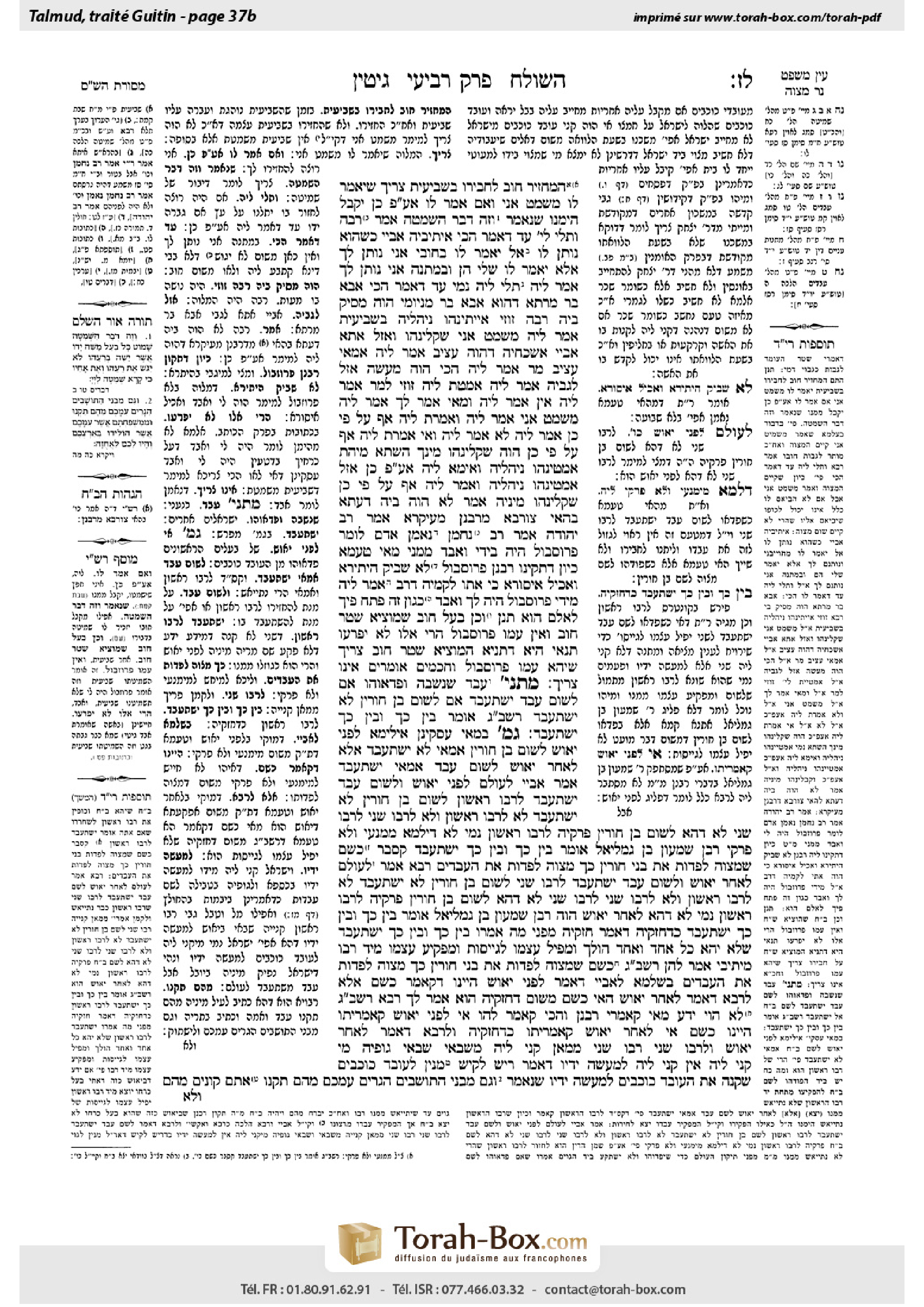
Gittin 37b: Talmud study for Daf Yomi
Study the Talmud for Daf Yomi with scanned pages, Hebrew text, English translations from Sefaria and AI-generated French translations.
Passage selection and English or AI-generated French translation are available where the scan has annotations. Daf Study is independent of Torah-Box and Sefaria.
Browse Gittin · גיטין · All tractatesGittin 37b text and translations
This page of Gittin includes the Aramaic text, an English translation and an AI-generated French translation, alongside the scan above.
גיטין ל״ז ב · Aramaic and Hebrew text
הַמַּחֲזִיר חוֹב לַחֲבֵירוֹ בַּשְּׁבִיעִית – צָרִיךְ שֶׁיֹּאמַר לוֹ: ״מְשַׁמֵּט אֲנִי״; וְאִם אָמַר לוֹ: ״אַף עַל פִּי כֵן״, יְקַבֵּל הֵימֶנּוּ. שֶׁנֶּאֱמַר: ״וְזֶה דְּבַר הַשְּׁמִטָּה״.
אָמַר רַבָּה: וְתָלֵי לֵיהּ עַד דְּאָמַר הָכִי. אֵיתִיבֵיהּ אַבָּיֵי: כְּשֶׁהוּא נוֹתֵן לוֹ, אַל יֹאמַר לוֹ: ״בְּחוֹבִי אֲנִי נוֹתֵן לָךְ״, אֶלָּא יֹאמַר לוֹ: ״שֶׁלִּי הֵן, וּבְמַתָּנָה אֲנִי נוֹתֵן לָךְ״! אֲמַר לֵיהּ: תָּלֵי לֵיהּ נָמֵי עַד דְּאָמַר הָכִי.
אַבָּא בַּר מָרְתָּא, דְּהוּא אַבָּא בַּר מִנְיוֹמֵי, הֲוָה מַסֵּיק בֵּיהּ רַבָּה זוּזֵי. אַיְיתִינְהוּ נִיהֲלֵיהּ בִּשְׁבִיעִית, אֲמַר לֵיהּ: מְשַׁמֵּט אֲנִי. שַׁקְלִינְהוּ וַאֲזַל. אֲתָא אַבָּיֵי, אַשְׁכְּחֵיהּ דַּהֲוָה עֲצִיב, אֲמַר לֵיהּ: אַמַּאי עֲצִיב מָר? אֲמַר לֵיהּ: הָכִי הֲוָה מַעֲשֶׂה.
אֲזַל לְגַבֵּיהּ, אֲמַר לֵיהּ: אַמְטֵית לֵיהּ זוּזֵי לְמָר? אֲמַר לֵיהּ: אִין. אֲמַר לֵיהּ: וּמַאי אֲמַר לָךְ? אֲמַר לֵיהּ: ״מְשַׁמֵּט אֲנִי״. אֲמַר לֵיהּ: וַאֲמַרְתְּ לֵיהּ ״אַף עַל פִּי כֵן״? אֲמַר לֵיהּ: לָא. אֲמַר לֵיהּ: וְאִי אֲמַרְתְּ לֵיהּ ״אַף עַל פִּי כֵן״, הֲוָה שַׁקְלִינְהוּ מִינָּךְ; הַשְׁתָּא מִיהַת אַמְטִינְהוּ נִיהֲלֵיהּ, וְאֵימָא לֵיהּ ״אַף עַל פִּי כֵן״. אֲזַל אַמְטִינְהוּ נִיהֲלֵיהּ, וַאֲמַר לֵיהּ ״אַף עַל פִּי כֵן״. שַׁקְלִינְהוּ מִינֵּיהּ, אָמַר: לָא הֲוָה בֵּיהּ דַּעְתָּא בְּהַאי צוּרְבָּא מֵרַבָּנַן מֵעִיקָּרָא.
אָמַר רַב יְהוּדָה אָמַר רַב נַחְמָן: נֶאֱמָן אָדָם לוֹמַר: ״פְּרוֹסְבּוּל הָיָה בְּיָדִי, וְאָבַד מִמֶּנִּי״. מַאי טַעְמָא? כֵּיוָן דְּתַקִּינוּ רַבָּנַן פְּרוֹסְבּוּל, לָא שָׁבֵיק הֶיתֵּירָא וְאָכֵיל אִיסּוּרָא.
כִּי אֲתוֹ לְקַמֵּיהּ דְּרַב, אֲמַר לֵיהּ: מִידֵּי פְּרוֹסְבּוּל הָיָה לְךָ וְאָבַד? כְּגוֹן זֶה, ״פְּתַח פִּיךָ לָאִלֵּם״ הוּא.
תְּנַן: וְכֵן בַּעַל חוֹב שֶׁמּוֹצִיא שְׁטַר חוֹב, וְאֵין עִמּוֹ פְּרוֹסְבּוּל – הֲרֵי אֵלּוּ לֹא יִפָּרְעוּ.
תַּנָּאֵי הִיא – דְּתַנְיָא: הַמּוֹצִיא שְׁטַר חוֹב – צָרִיךְ שֶׁיְּהֵא עִמּוֹ פְּרוֹסְבּוּל. וַחֲכָמִים אוֹמְרִים: אֵינוֹ צָרִיךְ.
מַתְנִי׳ עֶבֶד שֶׁנִּשְׁבָּה וּפְדָאוּהוּ, אִם לְשׁוּם עֶבֶד – יִשְׁתַּעְבֵּד; אִם לְשׁוּם בֶּן חוֹרִין – לֹא יִשְׁתַּעְבֵּד. רַבָּן שִׁמְעוֹן בֶּן גַּמְלִיאֵל אוֹמֵר: בֵּין כָּךְ וּבֵין כָּךְ יִשְׁתַּעְבֵּד.
גְּמָ׳ בְּמַאי עָסְקִינַן? אִילֵימָא לִפְנֵי יֵאוּשׁ, לְשׁוּם בֶּן חוֹרִין – אַמַּאי לָא יִשְׁתַּעְבֵּד? אֶלָּא לְאַחַר יֵאוּשׁ, לְשׁוּם עֶבֶד – אַמַּאי יִשְׁתַּעְבֵּד?
אָמַר אַבָּיֵי: לְעוֹלָם לִפְנֵי יֵאוּשׁ, וּלְשׁוּם עֶבֶד – יִשְׁתַּעְבֵּד לְרַבּוֹ רִאשׁוֹן, לְשׁוּם בֶּן חוֹרִין – לֹא יִשְׁתַּעְבֵּד לֹא לְרַבּוֹ רִאשׁוֹן וְלֹא לְרַבּוֹ שֵׁנִי; לְרַבּוֹ שֵׁנִי לָא, דְּהָא לְשׁוּם בֶּן חוֹרִין פַּרְקֵיהּ, לְרַבּוֹ רִאשׁוֹן נָמֵי לָא, דִּילְמָא מִמַּנְעִי וְלָא פָּרְקִי.
רַבָּן שִׁמְעוֹן בֶּן גַּמְלִיאֵל אוֹמֵר: בֵּין כָּךְ וּבֵין כָּךְ יִשְׁתַּעְבֵּד – קָסָבַר: כְּשֵׁם שֶׁמִּצְוָה לִפְדּוֹת אֶת בְּנֵי חוֹרִין, כָּךְ מִצְוָה לִפְדּוֹת אֶת הָעֲבָדִים.
רָבָא אָמַר: לְעוֹלָם לְאַחַר יֵאוּשׁ, וּלְשׁוּם עֶבֶד – יִשְׁתַּעְבֵּד לְרַבּוֹ שֵׁנִי, לְשׁוּם בֶּן חוֹרִין – לֹא יִשְׁתַּעְבֵּד לֹא לְרַבּוֹ רִאשׁוֹן וְלֹא לְרַבּוֹ שֵׁנִי; לְרַבּוֹ שֵׁנִי לָא, דְּהָא לְשׁוּם בֶּן חוֹרִין פַּרְקֵיהּ, לְרַבּוֹ רִאשׁוֹן נָמֵי לָא, דְּהָא לְאַחַר יֵאוּשׁ הֲוָה.
רַבָּן שִׁמְעוֹן בֶּן גַּמְלִיאֵל אוֹמֵר: בֵּין כָּךְ וּבֵין כָּךְ יִשְׁתַּעְבֵּד – כִּדְחִזְקִיָּה, דְּאָמַר חִזְקִיָּה: מִפְּנֵי מָה אָמְרוּ בֵּין כָּךְ וּבֵין כָּךְ יִשְׁתַּעְבֵּד? שֶׁלֹּא יְהֵא כׇּל אֶחָד וְאֶחָד הוֹלֵךְ וּמַפִּיל עַצְמוֹ לִגְיָיסוֹת, וּמַפְקִיעַ עַצְמוֹ מִיָּד רַבּוֹ.
מֵיתִיבִי, אָמַר לָהֶן רַבָּן שִׁמְעוֹן בֶּן גַּמְלִיאֵל: כְּשֵׁם שֶׁמִּצְוָה לִפְדּוֹת אֶת בְּנֵי חוֹרִין, כָּךְ מִצְוָה לִפְדּוֹת אֶת הָעֲבָדִים. בִּשְׁלָמָא לְאַבָּיֵי – דְּאָמַר לִפְנֵי יֵאוּשׁ, הַיְינוּ דְּקָאָמַר ״כְּשֵׁם״;
אֶלָּא לְרָבָא – דְּאָמַר לְאַחַר יֵאוּשׁ, הַאי ״כְּשֵׁם״?! מִשּׁוּם דְּחִזְקִיָּה הוּא!
אָמַר לָךְ רָבָא: רַבָּן שִׁמְעוֹן בֶּן גַּמְלִיאֵל לָא הָוֵי יָדַע מַאי קָאָמְרִי רַבָּנַן, וְהָכִי קָאָמַר לְהוּ: אִי לִפְנֵי יֵאוּשׁ קָאָמְרִיתוּ – הַיְינוּ ״כְּשֵׁם״; אִי לְאַחַר יֵאוּשׁ קָאָמְרִיתוּ – כִּדְחִזְקִיָּה.
וּלְרָבָא – דְּאָמַר לְאַחַר יֵאוּשׁ, וּלְרַבּוֹ שֵׁנִי; רַבּוֹ שֵׁנִי מִמַּאן קָנֵי לֵיהּ – מִשַּׁבַּאי, שַׁבַּאי גּוּפֵיהּ מִי קָנֵי לֵיהּ?!
אִין; קָנֵי לֵיהּ לְמַעֲשֶׂה יָדָיו – דְּאָמַר רֵישׁ לָקִישׁ: מִנַּיִן לְגוֹי, שֶׁקָּנָה אֶת הַגּוֹי לְמַעֲשֵׂה יָדָיו? שֶׁנֶּאֱמַר: ״וְגַם מִבְּנֵי הַתּוֹשָׁבִים הַגָּרִים עִמָּכֶם מֵהֶם תִּקְנוּ״ – אַתֶּם קוֹנִים מֵהֶם,
Gittin 37b · English translation
In the case of one who repays a debt to his friend during the Sabbatical Year, the creditor must say to him: I abrogate the debt, but if the debtor then said to him: Nevertheless, I want to repay you, he may accept it from him, as it is stated: “And this is the manner [devar] of the abrogation” (Deuteronomy 15:2). From the fact that the verse employed a term, devar, that can also mean: This is the statement of the cancellation, the Sages derived that the creditor must state that he cancels the debt, but he is allowed to accept the payment if the debtor insists on repaying.
Rabba said: And the creditor is permitted to lift up his eyes to him hopefully, demonstrating that he wishes to accept the payment, until the debtor says this, that he nevertheless wishes to repay him. Abaye raised an objection to Rabba’s statement from a baraita: When the debtor gives the creditor payment for a debt that has been canceled he should not say to him: I give this to you in payment of my debt; rather, he should say to him: This is my money and I give it to you as a gift. This indicates that the debt is repaid only by the initiative of the debtor. Rabba said to him: The creditor is permitted to lift up his eyes to him hopefully as well, until the debtor says this, that he gives it as a gift, but the initiative may come from the creditor.
The Gemara relates: There was a man by the name of Abba bar Marta, who is also known as Abba bar Minyumi, from whom Rabba was attempting to collect a debt. He brought it to him in the Sabbatical Year. Rabba said to him: I abrogate this debt. Abba bar Marta took the money and left. Abaye came before Rabba and found that he was sad. Abaye said to him: Why is the Master sad? Rabba said to him: This was the incident that occurred, explaining that Abba bar Marta understood his statement literally and did not repay the debt.
Abaye went to Abba bar Marta, and said to him: Did you bring the money to the Master? He said to him: Yes. Abaye said to him: And what did he say to you? He said to him that Rabba had responded: I abrogate this debt. Abaye said to him: And did you say to him: Nevertheless, I want to repay you? Abba bar Marta said to him: No. Abaye said to him: But if you had said to him: Nevertheless, I want to repay you, he would have taken it from you. Now, in any event, bring it to him and say to him: Nevertheless, I want to repay you. Abba bar Marta went and brought the money to Rabba and said to him: Nevertheless, I want to repay you, and Rabba took it from him. In the end, Rabba said: This Torah scholar was not knowledgeable from the beginning, as it was necessary to teach him how to react.
§ Rav Yehuda says that Rav Naḥman says: A person is deemed credible to say: I had a prosbol and I lost it, and collect payment of his debt. The Gemara explains: What is the reason for this? Since the Sages instituted the prosbol in a manner that allows anyone to write one without difficulty, in a situation such as this one does not leave aside a permitted item, i.e., collecting a debt after having written a prosbol, and eat a forbidden item, i.e., collecting a debt without having written a prosbol.
When they would come before Rav with a case where a creditor who did not have a prosbol was demanding payment of a debt after the Sabbatical Year, he would say to the creditor: Did you have any prosbol and it was lost? The Gemara explains that this is a case where the directive of the verse: “Open your mouth for the mute” (Proverbs 31:8) is applicable; this is not considered an intervention on behalf of one party, as it is only providing assistance for someone who was unaware of a claim that he should make.
The Gemara challenges: Didn’t we learn in a mishna (Ketubot 89a): And similarly, a creditor who presents a promissory note unaccompanied by a prosbol, these debts may not be collected. This demonstrates that even if a creditor himself claims that he had written a prosbol but it was lost, his claim is not accepted and the debt is canceled.
The Gemara answers: It is a dispute between tanna’im, as it is taught in a baraita: With regard to one who presents a promissory note after the Sabbatical Year, he must present a prosbol along with it in order to collect payment, and the Rabbis say: He does not need to present a prosbol, as it is assumed that he wrote one.
MISHNA: In the case of a Canaanite slave that was captured, and Jews who had not owned him redeemed him, if he was redeemed to be a slave then he will be a slave. If he was redeemed to be a freeman then he will not be a slave. Rabban Shimon ben Gamliel says: Both in this case and in that case he will be a slave.
GEMARA: With what are we dealing? If we say that the slave was redeemed before the first owner reached a state of despairing with regard to recovering the slave, then even if he was redeemed to be a freeman, he should still belong to his first owner; why would the mishna state that he will not be a slave? Rather, we might say that the slave was redeemed after the despairing of the first owner. Then, even if he was redeemed to be a slave, why will he be a slave? After his owner despairs of recovering him, he becomes ownerless property and consequently acquires his own freedom.
Abaye said: Actually, the mishna is referring to a case where the slave was redeemed before the despairing of the owner. Therefore, according to the unattributed opinion of the mishna, if he was redeemed to be a slave, he will be a slave to his first master. If he was redeemed to be a freeman, he will not be a slave, neither to his first master nor to his second master, i.e., the one who redeemed him. He will not be a slave to his second master because he redeemed him as a freeman and cannot now demand that he become a slave. He will also not be a slave to his first master lest people refrain from redeeming slaves. If they know that a redeemed slave remains a slave of his original owner, they will not see any reason to redeem them from captivity.
Abaye continues his explication of the mishna: Rabban Shimon ben Gamliel says: Both in this case and in that case he will be a slave to his first master. The Gemara explains: He holds that just as it is a mitzva to redeem freemen, so too, it is a mitzva to redeem slaves, and there is no concern that people will refrain from redeeming captured slaves.
Rava said: The mishna should be understood differently. Actually, the mishna is referring to a case where the slave was redeemed after the despairing of the owner. And therefore, according to the unattributed opinion in the mishna, if he was redeemed to be a slave then he will be a slave to his second master, as his original owner had despaired of recovering him. If he was redeemed to be a freeman then he will not be a slave, neither to his first master nor to his second master. He will not be a slave to his second master as he redeemed him as a freeman. He will also not be a slave to his first master, as he was freed after the despairing of the first master.
Rava continues his explication of the mishna: Rabban Shimon ben Gamliel says: Both in this case and in that case he will be a slave. This should be understood in accordance with the statement of Ḥizkiyya, as Ḥizkiyya said: For what reason did they say that both in this case and in that case he will be a slave? They said it so that each and every slave should not go and hand himself over to gentile troops, and in this manner release himself from the possession of his master.
The Gemara raises an objection to Rava’s explanation from a baraita: Rabban Shimon ben Gamliel said to them: Just as it is a mitzva to redeem freemen, so too, it is a mitzva to redeem slaves. Granted, according to Abaye this works out well as he said that the mishna is referring to a slave that was redeemed before the despairing of his owner, and the unattributed opinion of the mishna rules that he will not be a slave to his original owner due to a concern that people will refrain from redeeming slaves. This is the reason that he said: Just as, since he was explaining that this concern does not exist.
However, according to Rava, who said that the mishna is referring to a slave that was redeemed after the owner’s despairing, and the unattributed opinion of the mishna is not concerned that people will refrain from redeeming slaves, is this the rationale of Rabban Shimon ben Gamliel, that just as it is a mitzva to redeem freemen, so too, it is a mitzva to redeem slaves? His reason is because of the statement of Ḥizkiyya.
The Gemara answers: Rava could have said to you: Rabban Shimon ben Gamliel did not know what exactly the Rabbis said, and this is what he said to them: If you say this ruling with regard to a slave who was redeemed before his owner’s despairing, this is my response, that just as it is a mitzva to redeem freemen, so too, it is a mitzva to redeem slaves. If you say that this case was after his owner’s despairing, then the reason that I disagree is in accordance with the statement of Ḥizkiyya.
The Gemara asks: And according to Rava, who said that the mishna is referring to where the slave was redeemed after the despairing of the owner, and he will be a slave to his second master, one can ask: With regard to the second master, from whom did he acquire the slave? If you say that he acquired him from the captor, did the gentile captor himself acquire the slave? The ownership of the second master is contingent on his acquiring the slave from someone who himself had ownership over the slave.
The Gemara answers: Yes, he acquired ownership with regard to his labor, as Reish Lakish says: From where is it derived that a gentile can acquire another gentile as a slave with regard to his labor? As it is stated: “Moreover, of the children of the strangers who sojourn among you, of them you may acquire” (Leviticus 25:45). This indicates that you, Jews, can acquire slaves from them,
Gittin 37b · Traduction française (IA)
Dans le cas d'une personne qui rembourse un prêt à son ami pendant l'année sabbatique, le créancier doit dire à celui-ci : Je révoque le prêt, mais si le débiteur dit alors au créancier : Cependant, je veux tout de même te rembourser, il peut accepter le paiement, comme il est dit : « Et ceci est la manière [devar] de la révocation » (Deutéronome 15:2). Du fait que la versette utilise un terme, devar, qui peut aussi signifier : C'est la déclaration de la révocation, les Sages ont tiré la conclusion que le créancier doit déclarer qu'il révoque le prêt, mais il est autorisé à accepter le paiement si le débiteur insiste pour le rembourser.
Rabba a dit : Le créancier est autorisé à lever les yeux vers lui avec espoir, montrant qu'il souhaite accepter le paiement, jusqu'à ce que le débiteur dise cela, c'est-à-dire qu'il souhaite le rembourser. Abaye a soulevé une objection contre l'affirmation de Rabba à partir d'une baraïta : Lorsque le débiteur donne au créancier un paiement pour un prêt révoqué, il ne doit pas dire à celui-ci : Je te donne cela comme paiement de mon dette ; plutôt, il doit dire à celui-ci : C'est mon argent et je te le donne en cadeau. Cela indique que le prêt est révoqué uniquement par l'initiative du débiteur. Rabba a dit à lui : Le créancier est autorisé à lever les yeux vers lui avec espoir également, jusqu'à ce que le débiteur dise cela, c'est-à-dire qu'il le donne en cadeau, mais l'initiative peut venir du créancier.
La Guemara rapporte : Il y avait un homme nommé Abba bar Marta, également connu sous le nom d'Abba bar Minyumi, auprès duquel Rabba tentait de récupérer un prêt. Il l'a amené à lui pendant l'année sabbatique. Rabba a dit à lui : Je révoque ce prêt. Abba bar Marta a pris l'argent et est parti. Abaye est venu devant Rabba et a trouvé qu'il était triste. Abaye a dit à lui : Pourquoi le Maître est-il triste ? Rabba a dit à lui : C'était l'incident qui s'est produit, expliquant que Abba bar Marta avait compris sa déclaration littéralement et n'avait pas remboursé le prêt.
Abaye est allé à Abba bar Marta et a dit à lui : As-tu apporté l'argent au Maître ? Il a dit à lui : Oui. Abaye a dit à lui : Et que lui a-t-il répondu ? Il a dit que Rabba avait répondu : Je révoque ce prêt. Abaye a dit à lui : Et as-tu dit à lui : Cependant, je veux tout de même te rembourser ? Abba bar Marta a dit à lui : Non. Abaye a dit à lui : Mais si tu avais dit à lui : Cependant, je veux tout de même te rembourser, il l'aurait pris de toi. Maintenant, dans tous les cas, apporte-le-lui et dis-lui : Cependant, je veux tout de même te rembourser. Abba bar Marta est allé apporter l'argent à Rabba et a dit à lui : Cependant, je veux tout de même te rembourser, et Rabba l'a pris de lui. En fin de compte, Rabba a dit : Ce savant n'était pas compétent au départ, car il fallait l'enseigner comment réagir.
§ Rav Yehuda dit que Rav Naḥman dit : Une personne est considérée comme crédible lorsqu'elle dit : J'avais un prosbol et je l'ai perdu, et je collecte le paiement de ma dette. La Guemara explique : Quelle est la raison de cela ? Parce que les Sages ont institué le prosbol d'une manière permettant à quiconque de l'écrire sans difficulté, dans un cas tel que celui-ci, on ne néglige pas un objet permis, c'est-à-dire de collecter une dette après avoir écrit un prosbol, et on ne mange pas un objet interdit, c'est-à-dire de collecter une dette sans avoir écrit un prosbol.
Lorsqu'ils venaient devant Rav avec un cas où un créancier qui n'avait pas de prosbol exigeait le paiement d'une dette après l'année sabbatique, il disait au créancier : As-tu eu un prosbol et l'as-tu perdu ? La Guemara explique que c'est un cas où l'interprétation de la versette : « Ouvre ta bouche pour le muet » (Lévitique 31:8) s'applique ; cela n'est pas considéré comme une intervention en faveur d'une partie, car il s'agit simplement d'aider quelqu'un qui ne savait pas qu'il avait un droit à faire valoir.
La Guemara conteste : N'avons-nous pas appris dans une mitsva (Ketubot 89a) : Et de même, un créancier qui présente un billet de change sans prosbol, ces dettes ne peuvent pas être récupérées. Cela démontre que même si le créancier lui-même affirme avoir écrit un prosbol mais l'avoir perdu, sa revendication n'est pas acceptée et la dette est annulée.
La Guemara répond : C'est un débat entre les tannaïm, car il est enseigné dans une baraïta : Concernant celui qui présente un billet de change après l'année sabbatique, il doit présenter un prosbol avec pour pouvoir récupérer le paiement, et les Rabbins disent : Il n'a pas besoin de présenter un prosbol, car on suppose qu'il en a écrit un.
MITSVA : Dans le cas d'un esclave cananéen capturé, et de Juifs qui n'avaient pas possédé lui, qui l'ont racheté, si il a été racheté pour être un esclave, il sera un esclave. Si il a été racheté pour être un homme libre, il ne sera pas un esclave. Rabban Shimon ben Gamliel dit : Les deux dans ce cas et dans celui-là, il sera un esclave.
La Guemara pose la question : De quoi sommes-nous en train de parler ? Si nous disons que l'esclave a été racheté avant que l'propriétaire initial ne soit dans un état de désespoir de récupérer l'esclave, alors même s'il a été racheté pour être un homme libre, il devrait appartenir à son premier propriétaire ; pourquoi la mitsva dit-elle qu'il ne sera pas un esclave ? Plutôt, nous pouvons dire que l'esclave a été racheté après le désespoir de l'propriétaire initial. Alors, même s'il a été racheté pour être un esclave, pourquoi sera-t-il un esclave ? Après que l'propriétaire ait désespéré de le récupérer, il devient une propriété sans propriétaire et donc acquiert sa propre liberté.
Abaye a dit : En réalité, la mitsva parle d'un cas où l'esclave a été racheté avant que l'propriétaire ne soit dans un état de désespoir. Donc, selon l'opinion non attribuée de la mitsva, si il a été racheté pour être un esclave, il sera un esclave de son premier maître. Si il a été racheté pour être un homme libre, il ne sera pas un esclave, ni de son premier maître ni de son second maître, c'est-à-dire celui qui l'a racheté. Il ne sera pas un esclave de son second maître car il l'a racheté comme un homme libre et ne peut pas maintenant exiger qu'il devienne un esclave. Il ne sera pas non plus un esclave de son premier maître, de peur que les gens ne redoutent de racheter des esclaves. S'ils savent qu'un esclave racheté reste un esclave de son propriétaire original, ils ne trouveront pas de raison de racheter des esclaves en captivité.
Abaye continue son explication de la Michna : Rabban Shimon ben Gamliel dit : Dans ce cas comme dans celui-là, il sera esclave de son premier maître. La Guemara explique : Il considère que tout comme il est une mitsva de racheter les hommes libres, ainsi il est une mitsva de racheter les esclaves, et il n'y a pas de crainte que les gens ne se refusent à racheter les esclaves capturés.
Rava dit : La Michna devrait être comprise différemment. En réalité, la Michna fait référence à un cas où l'esclave a été racheté après que le maître ait perdu espoir de le récupérer. Et donc, selon l'opinion non attribuée dans la Michna, si on l'a racheté pour en faire un esclave, il sera esclave de son deuxième maître, car son maître original avait perdu espoir de le récupérer. Si on l'a racheté pour en faire un homme libre, alors il ne sera pas esclave, ni envers son premier maître ni envers son deuxième maître. Il ne sera pas esclave envers son deuxième maître car on l'a racheté comme homme libre. Il ne sera pas non plus esclave envers son premier maître, car il a été libéré après que le premier maître ait perdu espoir de le récupérer.
Rava continue son explication de la Michna : Rabban Shimon ben Gamliel dit : Dans ce cas comme dans celui-là, il sera esclave. Cela devrait être compris selon la déclaration de Ḥizkiyya, car Ḥizkiyya dit : Pourquoi disent-ils que dans ce cas comme dans celui-là, il sera esclave ? Ils disent cela afin que chaque esclave ne se précipite pas vers les troupes païennes et libère ainsi lui-même de la possession de son maître.
La Guemara soulève une objection contre l'explication de Rava, à partir d'une baraïta : Rabban Shimon ben Gamliel dit à ceux-ci : Tout comme il est un mitsva de racheter les hommes libres, ainsi il est un mitsva de racheter les esclaves. En effet, selon Abaye, cela s'explique bien car il a dit que la mitsva fait référence à un esclave racheté avant que le maître ne perde espoir de le récupérer, et l'opinion non attribuée de la mitsva considère qu'il ne sera pas esclave envers son maître original en raison de la crainte que les gens ne se refusent à racheter les esclaves. C'est la raison pour laquelle il a dit : Tout comme, puisqu'il expliquait que cette crainte n'existe pas.
Cependant, selon Rava, qui affirme que la Michna fait référence à un esclave racheté après que l'owner ait perdu espoir, et que l'opinion non attribuée de la Michna ne s'inquiète pas que les gens ne se refusent pas à racheter des esclaves, est-ce la raison de Rabban Shimon ben Gamliel, qui soutient que tout comme il est une mitsva de racheter des hommes libres, ainsi il est une mitsva de racheter des esclaves ? Sa raison est en raison de la déclaration de Ḥizkiyya.
La Guemara répond : Rava aurait pu te dire : Rabban Shimon ben Gamliel ne savait pas exactement ce que disaient les Rabbins, et c'est ce qu'il a dit à ceux-ci : Si vous dites cette décision concernant un esclave racheté avant que l'owner ne perde espoir, c'est ma réponse, que tout comme il est une mitsva de racheter des hommes libres, ainsi il est une mitsva de racheter des esclaves. Si vous dites que ce cas était après que l'owner ait perdu espoir, alors la raison pour laquelle je suis d'accord est en conformité avec la déclaration de Ḥizkiyya.
La Guemara pose la question : Et selon Rava, qui affirmait que la Michna fait référence à un cas où l'esclave a été racheté après que le maître ait perdu espoir, et qu'il deviendra esclave de son deuxième maître, on peut demander : Concernant le deuxième maître, de qui a-t-il acquis l'esclave ? Si vous dites qu'il l'a acquis du captif, le captif païen lui-même a-t-il acquis l'esclave ? La propriété du deuxième maître dépend de son acquisition de l'esclave auprès de quelqu'un qui avait lui-même la propriété de l'esclave.
La Guemara répond : Oui, il a acquis la propriété en raison de son travail, car Reish Lakish dit : D'où est-il tiré que les païens peuvent acquérir un autre païen comme esclave en raison de son travail ? Comme il est dit : « Et des enfants des étrangers qui habitent parmi vous, vous pouvez acheter » (Lévitique 25:45). Cela indique que vous, Juifs, pouvez acheter des esclaves auprès d'eux,
Traduction française générée par IA à partir de l’édition anglaise de Sefaria. Vérifie toujours un passage avec le texte source.
Text from Sefaria: William Davidson Edition - Vocalized Aramaic (CC BY NC); William Davidson Edition - English (CC BY NC).