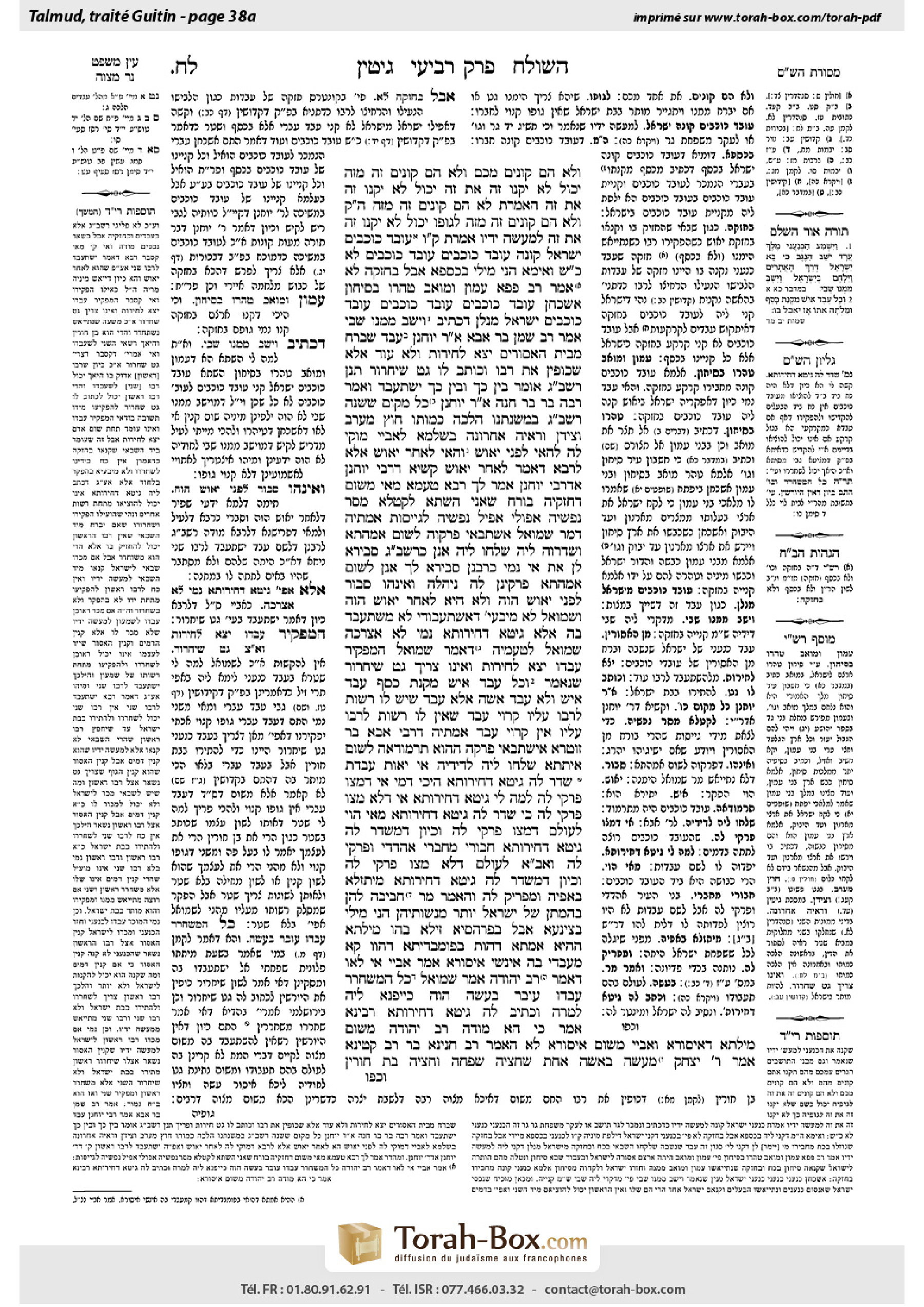
Gittin 38a: Talmud study for Daf Yomi
Study the Talmud for Daf Yomi with scanned pages, Hebrew text, English translations from Sefaria and AI-generated French translations.
Passage selection and English or AI-generated French translation are available where the scan has annotations. Daf Study is independent of Torah-Box and Sefaria.
Browse Gittin · גיטין · All tractatesGittin 38a text and translations
This page of Gittin includes the Aramaic text, an English translation and an AI-generated French translation, alongside the scan above.
גיטין ל״ח א · Aramaic and Hebrew text
וְלֹא הֵם קוֹנִים מִכֶּם, וְלֹא הֵם קוֹנִים זֶה מִזֶּה. יָכוֹל לֹא יִקְנוּ זֶה אֶת זֶה? יָכוֹל לֹא יִקְנוּ זֶה אֶת זֶה?! הָאָמְרַתְּ: לֹא הֵם קוֹנִים זֶה מִזֶּה! הָכִי קָאָמַר: וְלֹא הֵם קוֹנִים זֶה מִזֶּה לְגוּפוֹ.
יָכוֹל לֹא יִקְנוּ זֶה אֶת זֶה לְמַעֲשֵׂה יָדָיו? אָמַרְתָּ קַל וָחוֹמֶר: גּוֹי – יִשְׂרָאֵל, קוֹנֶה; גּוֹי – גּוֹי, לֹא כׇּל שֶׁכֵּן?!
וְאֵימָא: הָנֵי מִילֵּי בְּכַסְפָּא, אֲבָל בַּחֲזָקָה – לָא! אָמַר רַב פָּפָּא: עַמּוֹן וּמוֹאָב טָהֲרוּ בְּסִיחוֹן.
אַשְׁכְּחַן גּוֹי – גּוֹי; גּוֹי – יִשְׂרָאֵל, מְנָלַן? דִּכְתִיב: ״וַיִּשְׁבְּ מִמֶּנּוּ שֶׁבִי״.
אָמַר רַב שֶׁמֶן בַּר אַבָּא אָמַר רַבִּי יוֹחָנָן: עֶבֶד שֶׁבָּרַח מִבֵּית הָאֲסוּרִים – יָצָא לְחֵירוּת, וְלֹא עוֹד אֶלָּא שֶׁכּוֹפִין אֶת רַבּוֹ וְכוֹתֵב לוֹ גֵּט שִׁיחְרוּר.
תְּנַן, רַבָּן שִׁמְעוֹן בֶּן גַּמְלִיאֵל אוֹמֵר: בֵּין כָּךְ וּבֵין כָּךְ יִשְׁתַּעְבֵּד; וְאָמַר רַבָּה בַּר בַּר חָנָה אָמַר רַבִּי יוֹחָנָן: כׇּל מָקוֹם שֶׁשָּׁנָה רַבָּן שִׁמְעוֹן בֶּן גַּמְלִיאֵל בְּמִשְׁנָתֵנוּ – הֲלָכָה כְּמוֹתוֹ, חוּץ מֵעָרֵב וְצַיְדָן וּרְאָיָה אַחֲרוֹנָה.
בִּשְׁלָמָא לְאַבָּיֵי, מוֹקֵי לַהּ לְהַאי – לִפְנֵי יֵאוּשׁ, וְהַאי – לְאַחַר יֵאוּשׁ.
אֶלָּא לְרָבָא – דְּאָמַר לְאַחַר יֵאוּשׁ, קַשְׁיָא דְּרַבִּי יוֹחָנָן אַדְּרַבִּי יוֹחָנָן!
אָמַר לָךְ רָבָא: טַעְמָא מַאי – מִשּׁוּם דְּחִזְקִיָּה; בּוֹרֵחַ שָׁאנֵי – הַשְׁתָּא לִקְטָלָא מְסַר נַפְשֵׁיהּ, אַפּוֹלֵי אַפֵּיל נַפְשֵׁיהּ לִגְיָיסוֹת?!
אַמְתֵּיהּ דְּמָר שְׁמוּאֵל אִשְׁתְּבַאי. פַּרְקוּהָ לְשׁוּם אַמְהֻתָא, וְשַׁדְּרוּהָ לֵיהּ. שְׁלַחוּ לֵיהּ: אֲנַן – כְּרַבָּן שִׁמְעוֹן בֶּן גַּמְלִיאֵל סְבִירָא לַן, אַתְּ – אִי נָמֵי כְּרַבָּנַן סְבִירָא לָךְ, אֲנַן לְשׁוּם אַמְהֻתָא פָּרְקִינַן לַהּ (נִיהֲלַהּ).
וְאִינְהוּ סְבוּר – לִפְנֵי יֵאוּשׁ הֲוָה, וְלָא הִיא – לְאַחַר יֵאוּשׁ הֲוָה, וּשְׁמוּאֵל – לָא מִיבַּעְיָא דְּאִשְׁתַּעְבּוֹדֵי לָא מִשְׁתַּעְבַּד בַּהּ, אֶלָּא גִּיטָּא דְחֵירוּתָא נָמֵי לָא אַצְרְכָה.
שְׁמוּאֵל לְטַעְמֵיהּ, דְּאָמַר שְׁמוּאֵל: הַמַּפְקִיר עַבְדּוֹ – יָצָא לְחֵירוּת, וְאֵינוֹ צָרִיךְ גֵּט שִׁיחְרוּר, שֶׁנֶּאֱמַר: ״וְכׇל עֶבֶד אִישׁ מִקְנַת כָּסֶף״ – ״עֶבֶד אִישׁ״ וְלֹא ״עֶבֶד אִשָּׁה״?! אֶלָּא עֶבֶד שֶׁיֵּשׁ לוֹ רְשׁוּת לְרַבּוֹ עָלָיו – קָרוּי עֶבֶד; שֶׁאֵין לוֹ רְשׁוּת לְרַבּוֹ עָלָיו – אֵין קָרוּי עֶבֶד.
אַמְתֵּיהּ דְּרַבִּי אַבָּא בַּר זוּטְרָא אִישְׁתְּבַאי, פַּרְקַהּ הָהוּא תַּרְמוֹדָאָה לְשׁוּם אִיתְּתָא. שְׁלַחוּ לֵיהּ לְדִידֵיהּ: אִי יָאוּת עָבְדַתְּ, שַׁדַּר לַהּ גִּיטָּא דְחֵירוּתָא.
הֵיכִי דָמֵי? אִי דְּמָצוּ פָּרְקִי לַהּ, לְמָה לִי גִּיטָּא דְחֵירוּתָא? אִי דְּלָא מָצוּ פָּרְקִי לַהּ, כִּי שַׁדַּר לַהּ גִּיטָּא דְחֵירוּתָא מַאי הָוֵי?
לְעוֹלָם דְּמָצוּ פָּרְקִי לַהּ; וְכֵיוָן דִּמְשַׁדַּר לָהּ גִּיטָּא דְחֵירוּתָא, חַבּוֹרֵי מִחַבְּרִי אַהֲדָדֵי, וּפָרְקִי לַהּ. וְאִיבָּעֵית אֵימָא: לְעוֹלָם דְּלָא מָצוּ פָּרְקִי לַהּ, וְכֵיוָן דִּמְשַׁדַּר לַהּ גִּיטָּא דְחֵירוּתָא, מִיתַּזְלָא בְּאַפֵּיהּ, וּמְפָרֵיק לַהּ.
וְהָאָמַר מָר: חֲבִיבָה לָהֶן בְּהֶמְתָּן שֶׁל יִשְׂרָאֵל יוֹתֵר מִנְּשׁוֹתֵיהֶן! הָנֵי מִילֵּי בְּצִינְעָא, אֲבָל בְּפַרְהֶסְיָא זִילָא בְּהוּ מִילְּתָא.
הָהִיא אַמְתָּא דַּהֲוָת בְּפוּמְבְּדִיתָא, דַּהֲווֹ קָא מְעַבְּדִי בַּהּ אִינָשֵׁי אִיסּוּרָא. אָמַר אַבָּיֵי, אִי לָאו דְּאָמַר רַב יְהוּדָה אָמַר שְׁמוּאֵל: כׇּל הַמְשַׁחְרֵר עַבְדּוֹ עוֹבֵר בַּעֲשֵׂה; הֲוָה כָּיֵיפְנָא לֵיהּ לְמָרַהּ, וְכָתֵיב לַהּ גִּיטָּא דְחֵירוּתָא. רָבִינָא אָמַר: כִּי הָא מוֹדֶה רַב יְהוּדָה, מִשּׁוּם מִילְּתָא דְאִיסּוּרָא.
וְאַבָּיֵי – מִשּׁוּם אִיסּוּרָא לָא?! הָאָמַר רַב חֲנִינָא בַּר רַב קַטִּינָא אָמַר רַבִּי יִצְחָק: מַעֲשֶׂה בְּאִשָּׁה אַחַת שֶׁחֶצְיָהּ שִׁפְחָה וְחֶצְיָהּ בַּת חוֹרִין,
Gittin 38a · English translation
but the gentiles cannot acquire one of you, as they do not have the ability to acquire a Jew as a slave, and they cannot acquire each other as slaves. The Gemara begins to introduce a question: One might have thought that they shall not be able to acquire each other. The Gemara immediately clarifies its question: Can it be that one might have thought that they shall not be able to acquire each other; but didn’t you already say that they cannot acquire each other? Rather, this is what he said: Gentiles cannot acquire each other with regard to the slave himself.
The Gemara now restates the question: One might have thought that they shall not be able to acquire each other as slaves even for the rights to his labor. The Gemara answers: You can say an a fortiori inference: If a gentile can acquire a Jew for the rights to his labor, as stated explicitly in the Torah (Leviticus 25:47), all the more so is it not clear that a gentile can acquire a gentile?
The Gemara challenges: But I could say that this halakha, that a gentile can acquire a gentile as a slave for the rights to his labor, applies only to acquisition via money. However, via an act of possession, by taking him captive, he does not acquire him. Rav Pappa says in response: The land of Ammon and Moab became purified through the conquest of Sihon. After the conquest of Sihon, the land that had belonged to Ammon and Moab was considered the property of Sihon, and it was permitted for the Jewish people to conquer it although they had not been permitted to conquer the land of Ammon and Moab. In the same manner, a gentile can acquire a slave by taking possession of him as a captive.
The Gemara asks: We found a source for a gentile acquiring a gentile through conquest, which is an act of taking possession; from where do we derive that a gentile can also acquire a Jew through the act of possession such as conquest? The Gemara answers: As it is written: “And the Canaanites, who dwelt in the South, heard tell that Israel came by the way of Atharim; and he fought against Israel, and took of them captive” (Numbers 21:1). This indicates that even a Jew is acquired by a gentile through the act of possession, in this case, conquest in war.
§ Rav Shemen bar Abba says that Rabbi Yoḥanan says: A slave who escaped from prison is emancipated. He is no longer subjugated to his owner, as it is assumed that his owner has despaired of retrieving him. And moreover, his master is forced to write him a bill of manumission so that he can marry a Jewish woman.
We learned in the mishna that Rabban Shimon ben Gamliel says with regard to a slave who was redeemed from captivity: Both in this case and in that case he will be a slave. And Rabba bar bar Ḥana says that Rabbi Yoḥanan says: Every place where Rabban Shimon ben Gamliel taught a ruling in our mishna, the halakha is in accordance with his opinion, except for the following three cases: The responsibility of the guarantor, and the incident that occurred in the city of Tzaidan, and the dispute with regard to evidence in the final disagreement. Therefore, according to Rabbi Yoḥanan, the halakha is in accordance with the opinion of Rabban Shimon ben Gamliel in the mishna here, as it is not one of those three cases. This contradicts the ruling of Rabbi Yoḥanan cited above concerning a slave who escapes prison.
The Gemara clarifies: Granted, according to the opinion of Abaye, he establishes the mishna as referring to a slave who is redeemed before the owner’s despair. For this reason, Rabban Shimon ben Gamliel rules that the redeemed slave is not emancipated, and the halakha is in accordance with his ruling. And this statement of Rabbi Yoḥanan, that a slave who escapes from prison goes free, applies after the owner’s despair. Therefore, there is no contradiction between the two statements of Rabbi Yoḥanan.
However, according to the opinion of Rava, who said that the mishna here is referring to a slave who is redeemed after the despair of the owner, there is a difficulty. The difficulty is due to the contradiction between the statement of Rabbi Yoḥanan in which he rules against the opinion of Rabban Shimon ben Gamliel, as he holds that a slave who escapes prison is emancipated, and the statement of Rabbi Yoḥanan in which he rules that the halakha is in accordance with the opinion of Rabban Shimon ben Gamliel.
The Gemara answers: Rava could have said to you: What is the reason that a slave who was redeemed is not emancipated? It is because of the concern expressed by Ḥizkiyya, that perhaps slaves would allow themselves to be captured by foreign troops in the hope that they would be redeemed and consequently emancipated. However, the case of one who escapes from prison is different, as the concern raised by Ḥizkiyya is not applicable. If now it is apparent that he is willing to give himself over to death to escape captivity, as he would be put to death for attempting to escape prison, is there a concern that he will throw himself willingly into captivity by allowing himself to be captured by foreign troops?
The Gemara relates: The maidservant of Master Shmuel was taken captive. Some people redeemed her to be a maidservant and sent her to him. They sent him the following message: We hold in accordance with the opinion of Rabban Shimon ben Gamliel, and therefore we hold that in any case she remains your maidservant. Even if you hold in accordance with the opinion of the Rabbis in the mishna, then you should know that we redeemed her to be a maidservant, and even the Rabbis would agree that she remains your maidservant.
The Gemara adds: And they thought that this was before his despair, but that is not so. It was after his despair, and when Shmuel received the maidservant, it is not necessary to say that he did not enslave her. But also, he did not require her to receive a bill of manumission, as he held that she was a free woman in every respect.
The Gemara comments: In this matter, Shmuel conforms to his standard line of reasoning, as Shmuel says: With regard to one who renounces ownership of his slave, the slave is emancipated, and he does not even require a bill of manumission. Shmuel cited a proof from that which is stated: “But every slave man that is bought for money” (Exodus 12:44). Does this apply only to a slave who is a man, and not to a woman slave? Rather, it means: The slave of a man, i.e., a slave whose master has authority and control over him, is called a slave, since he is the slave of a particular man. However, with regard to a slave whose master does not have authority over him, such as one who has been declared ownerless, he is not called a slave but a freeman. Therefore, once Shmuel despaired of retrieving his maidservant, she was no longer under his control and did not require a bill of manumission.
The Gemara relates: The maidservant of Rabbi Abba bar Zutra was taken captive. A certain gentile tarmoda’a redeemed her to be his wife. The Sages sent a message to Rabbi Abba bar Zutra: If you wish to act correctly, send her a bill of manumission.
The Gemara asks: What are the circumstances? If this is a situation where the Jews are able to redeem her, why do I need a bill of manumission? They should redeem her to be a maidservant. If this is a situation where they are unable to redeem her, when he sends her a bill of manumission, what of it? What effect will it have, as she is currently under the control of this gentile?
The Gemara answers: Actually, it is referring to a situation where they are able to redeem her but are not doing so. And since he sends her a bill of manumission, the residents of the city will join together and redeem her, as she is now a full-fledged Jew, whereas they would not have redeemed her to be a maidservant. And if you wish, say instead: Actually, it is referring to a case where they are unable to redeem her, as the ransom was too expensive. And once he sends her a bill of manumission, she will be disrespected in the eyes of the gentile who redeemed her to marry her, as he will find out that she is a maidservant of a Jew, and he will allow her to be redeemed.
The Gemara challenges this statement: Would it be easier to redeem the maidservant once the gentile discovered that she is the maidservant of a Jew? But didn’t the Master say: The animals of Jews are more beloved to gentiles than their own wives? Apparently, the gentiles held the Jews in high regard, and the fact that she was a Jewish maidservant would not lower her in the gentile’s estimation. The Gemara answers: This statement applies only concerning matters that take place in private; however, in public, the matter is disrespected, and a gentile would not marry the maidservant of a Jew.
§ The Gemara relates: There was an incident involving a certain maidservant in Pumbedita with whom people were performing prohibited sexual acts, and her master was unable to prevent this. Abaye said: If not for the fact that Rav Yehuda says that Shmuel says that anyone who emancipates his slave violates a positive mitzva, as it is written in the Torah: “Of them may you take your bondmen forever” (Leviticus 25:46), I would force her master, and he would write and give her a bill of manumission, enabling her to marry a Jew, which would ensure that she would cease her promiscuous behavior. Ravina said: In a case like that, Rav Yehuda concedes that it is permitted to emancipate her, due to the prohibited matter that others are violating.
The Gemara asks: And does Abaye hold that one cannot emancipate a slave even due to a prohibition that is being violated? Didn’t Rav Ḥanina bar Rav Ketina say that Rav Yitzḥak says: There was an incident involving a woman who was a half-maidservant half-free woman, as she had belonged to two masters and was emancipated by one of them,
Gittin 38a · Traduction française (IA)
mais les Gentils ne peuvent pas acquérir l'un de vous, car ils n'ont pas la capacité d'acheter un Juif comme esclave, et ils ne peuvent pas non plus s'acquérir mutuellement comme esclaves. La Guemara commence par introduire une question : On aurait pu penser qu'ils ne pourraient pas s'acquérir mutuellement. La Guemara clarifie immédiatement sa question : peut-on penser qu'on aurait pu penser qu'ils ne pourraient pas s'acquérir mutuellement ; mais n'avez-vous pas déjà dit qu'ils ne peuvent pas s'acquérir mutuellement ? Plutôt, c'est ce que l'on dit : les Gentils ne peuvent pas s'acquérir mutuellement en ce qui concerne l'esclave lui-même.
La Guemara reformule maintenant la question : On aurait pu penser qu'ils ne pourraient pas s'acquérir mutuellement comme esclaves même pour les droits à son travail. La Guemara répond : on peut dire une inférence a fortiori : si un Gentil peut acquérir un Juif pour les droits à son travail, comme cela est explicitement dit dans la Torah (Lévitique 25:47), encore davantage est-il clair qu'un Gentil peut acquérir un Gentil.
La Guemara soulève un défi : mais je pourrais dire que cette halakha, selon laquelle un Gentil peut acquérir un Gentil comme esclave pour les droits à son travail, s'applique uniquement à l'acquisition par l'argent. Cependant, par un acte de possession, en capturant, il ne l'acquiert pas. Rav Pappa répond : la terre d'Amon et de Moab est devenue pure grâce à la conquête de Sihon. Après la conquête de Sihon, la terre qui appartenait à Amon et à Moab était considérée comme la propriété de Sihon, et elle était permise aux Juifs de conquérir, même s'ils n'étaient pas autorisés à conquérir la terre d'Amon et de Moab. De la même manière, un Gentil peut acquérir un esclave en prenant possession de lui comme captif.
La Guemara pose une question : nous avons trouvé une source selon laquelle un Gentil peut acquérir un Gentil par la conquête, qui est un acte de possession ; d'où tirons-nous que un Gentil peut aussi acquérir un Juif par l'acte de possession tel que la conquête ? La Guemara répond : comme il est écrit : « Et les Cananéens, qui habitaient au Sud, entendirent dire que l'Israélite venait par le chemin d'Atharim ; et il combattit contre l'Israélite, et prit de lui des captifs » (Nb 21:1). Cela indique que même un Juif est acquis par un Gentil par l'acte de possession, dans ce cas, la conquête en guerre.
§ Rav Shemen bar Abba dit que Rabbi Yoḥanan dit : un esclave qui s'est enfui d'une prison est libéré. Il n'est plus soumis à son maître, car on suppose que son maître a désespéré de le récupérer. De plus, son maître est contraint d'écrire un acte de manumission afin qu'il puisse épouser une femme juive.
Nous avons appris dans la mitsva que Rabban Shimon ben Gamliel dit concernant un esclave qui a été racheté de la captivité : dans ce cas comme dans celui-là, il restera esclave. Et Rabba bar bar Ḥana dit que Rabbi Yoḥanan dit : partout où Rabban Shimon ben Gamliel a donné un avis dans notre mitsva, la halakha suit son avis, sauf pour ces trois cas : la responsabilité du garant, l'incident survenu dans la ville de Tzaidan, et le débat concernant les témoins dans le dernier désaccord. Ainsi, selon Rabbi Yoḥanan, la halakha suit l'avis de Rabban Shimon ben Gamliel dans la mitsva ici, car ce n'est pas l'un de ces trois cas. Cela contredit l'avis de Rabbi Yoḥanan cité ci-dessus concernant un esclave qui s'échappe de la prison.
La Guemara clarifie : Évidemment, selon l'opinion d'Abaye, il établit la mitsva comme concernant un esclave racheté avant que le maître ne désespère. Pour cette raison, Rabban Shimon ben Gamliel décide que l'esclave racheté n'est pas libéré, et la halakha suit son avis. Et cette déclaration de Rabbi Yoḥanan, selon laquelle un esclave qui s'échappe de la prison est libéré, s'applique après que le maître ait désespéré. Ainsi, il n'y a pas de contradiction entre les deux déclarations de Rabbi Yoḥanan.
Cependant, selon l'opinion de Rava, qui a dit que la mitsva ici concerne un esclave racheté après que le maître ait désespéré, il y a un problème. Le problème provient de la contradiction entre la déclaration de Rabbi Yoḥanan, où il décide contre l'avis de Rabban Shimon ben Gamliel, car il considère que l'esclave qui s'échappe de la prison est libéré, et la déclaration de Rabbi Yoḥanan où il décide que la halakha suit l'avis de Rabban Shimon ben Gamliel.
La Guemara répond : Rava aurait pu dire à vous : pourquoi un esclave racheté n'est-il pas libéré ? C'est à cause de la préoccupation exprimée par Ḥizkiyya, que les esclaves pourraient permettre d'être capturés par les troupes étrangères en espérant être rachetés et ainsi libérés. Cependant, le cas d'un homme qui s'échappe de la prison est différent, car la préoccupation évoquée par Ḥizkiyya ne s'applique pas. Si maintenant il est évident qu'il est prêt à donner sa vie pour s'échapper de la captivité, comme il serait tué pour tenter d'échapper à la prison, y a-t-il une préoccupation qu'il se jette volontairement dans la captivité en permettant d'être capturé par les troupes étrangères ?
La Guemara rapporte : la servante de Maître Shmuel a été capturée. Certains l'ont rachetée pour qu'elle demeure une servante et l'ont envoyée à lui. Ils lui ont envoyé le message suivant : nous suivons l'avis de Rabban Shimon ben Gamliel, et donc nous considérons qu'elle reste votre servante dans tous les cas. Même si vous suivez l'avis des Sages selon la mitsva, vous devez savoir que nous l'avons rachetée pour qu'elle demeure votre servante, et même les Sages seraient d'accord qu'elle reste votre servante.
La Guemara ajoute : et ils pensaient que cela était avant son désespoir, mais ce n'en est pas ainsi. C'était après son désespoir, et quand Shmuel a reçu la servante, il n'était pas nécessaire de dire qu'il ne l'avait pas enchaînée. De plus, il n'a pas exigé qu'elle reçoive un acte de manumission, car il considérait qu'elle était une femme libre en tout point.
La Guemara commente : Dans cette affaire, Shmuel suit sa ligne de raisonnement habituelle, car Shmuel dit : Concernant celui qui renonce à la propriété de son serviteur, le serviteur est emancipé, et il n’a même pas besoin d’un acte de manumission. Shmuel cite une preuve tirée de ce qui est dit : « Mais tout serviteur masculin acheté à prix d’argent » (Exode 12:44). Ce texte s’applique-t-il uniquement à un serviteur masculin, et non à une servante ? En réalité, cela signifie : Le serviteur d’un homme, c’est-à-dire un serviteur dont le maître a l’autorité et le contrôle, est appelé serviteur, car il est le serviteur d’un homme particulier. Cependant, concernant un serviteur dont le maître n’a pas d’autorité, comme celui qui a été déclaré sans propriétaire, il n’est pas appelé serviteur mais homme libre. Ainsi, une fois que Shmuel a perdu espoir de récupérer sa servante, elle n’était plus sous son contrôle et n’avait pas besoin d’un acte de manumission.
La Guemara rapporte : La servante de Rabbi Abba bar Zutra a été enlevée. Un certain gentil tarmoda’a l’a rachetée pour l’épouser. Les Sages ont envoyé un message à Rabbi Abba bar Zutra : Si tu veux agir correctement, envoie-lui un acte de manumission.
La Guemara pose la question : Quelles sont les circonstances ? Si c’est une situation où les Juifs peuvent la racheter, pourquoi ai-je besoin d’un acte de manumission ? Ils devraient la racheter pour être une servante. Si c’est une situation où ils ne peuvent pas la racheter, quand il envoie un acte de manumission, à quoi cela servira-t-il ? Quel effet cela aura-t-il, puisqu’elle est actuellement sous le contrôle de ce gentil ?
La Guemara répond : En réalité, il s’agit d’une situation où ils peuvent la racheter mais ne le font pas. Et puisque l’on envoie un acte de manumission, les habitants de la ville se réuniront pour la racheter, car elle est désormais un Juif complet, alors qu’ils ne la rachèteraient pas pour être une servante. Et si tu veux, dis plutôt : En réalité, il s’agit d’un cas où ils ne peuvent pas la racheter, car le prix de rançon était trop élevé. Et une fois qu’il envoie un acte de manumission, elle sera méprisée aux yeux du gentil qui l’a rachetée pour l’épouser, car il découvrira qu’elle est une servante juive, et il permettra qu’elle soit rachetée.
La Guemara conteste cette déclaration : Serait-il plus facile de racheter la servante une fois que le gentil découvre qu’elle est la servante d’un Juif ? Mais n’a-t-il pas dit le Maître : Les bêtes des Juifs sont plus chères aux yeux des gentils que leurs propres épouses ? Apparemment, les gentils tenaient les Juifs en haute estime, et le fait qu’elle soit une servante juive ne la déshonorerait pas aux yeux du gentil. La Guemara répond : Cette déclaration s’applique uniquement aux affaires qui se déroulent en privé ; cependant, en public, cette affaire est déshonorante, et un gentil ne marierait pas la servante d’un Juif.
§ La Guemara rapporte : Il y avait un incident concernant une certaine servante à Pumbedita avec laquelle les gens commettaient des actes sexuels interdits, et son maître n’arrivait pas à l’en empêcher. Abaye dit : Si ce n’était pas pour le fait que Rav Yehuda dit que Shmuel dit que celui qui emancipe son serviteur viole une mitsva positive, car il est écrit dans la Torah : « De ceux-ci tu prendras tes serviteurs pour toujours » (Lévitique 25:46), je forcerai son maître à écrire et à lui donner un acte de manumission, permettant à la servante de se marier avec un Juif, ce qui assurera qu’elle cesse son comportement promiscue. Ravina dit : Dans un cas comme celui-ci, Rav Yehuda reconnaît que l’on peut emanciper la servante, en raison de l’acte interdit que d’autres commettent.
La Guemara pose la question : Et Abaye considère-t-il que l’on ne peut pas emanciper un serviteur même en raison d’un interdit qui est en cours ? N’a-t-il pas dit Rav Ḥanina bar Rav Ketina que Rav Yitzḥak dit : Il y avait un incident concernant une femme qui était à la fois servante et libre, car elle avait appartenu à deux maîtres et avait été emancipée par l’un d’eux,
Traduction française générée par IA à partir de l’édition anglaise de Sefaria. Vérifie toujours un passage avec le texte source.
Text from Sefaria: William Davidson Edition - Vocalized Aramaic (CC BY NC); William Davidson Edition - English (CC BY NC).