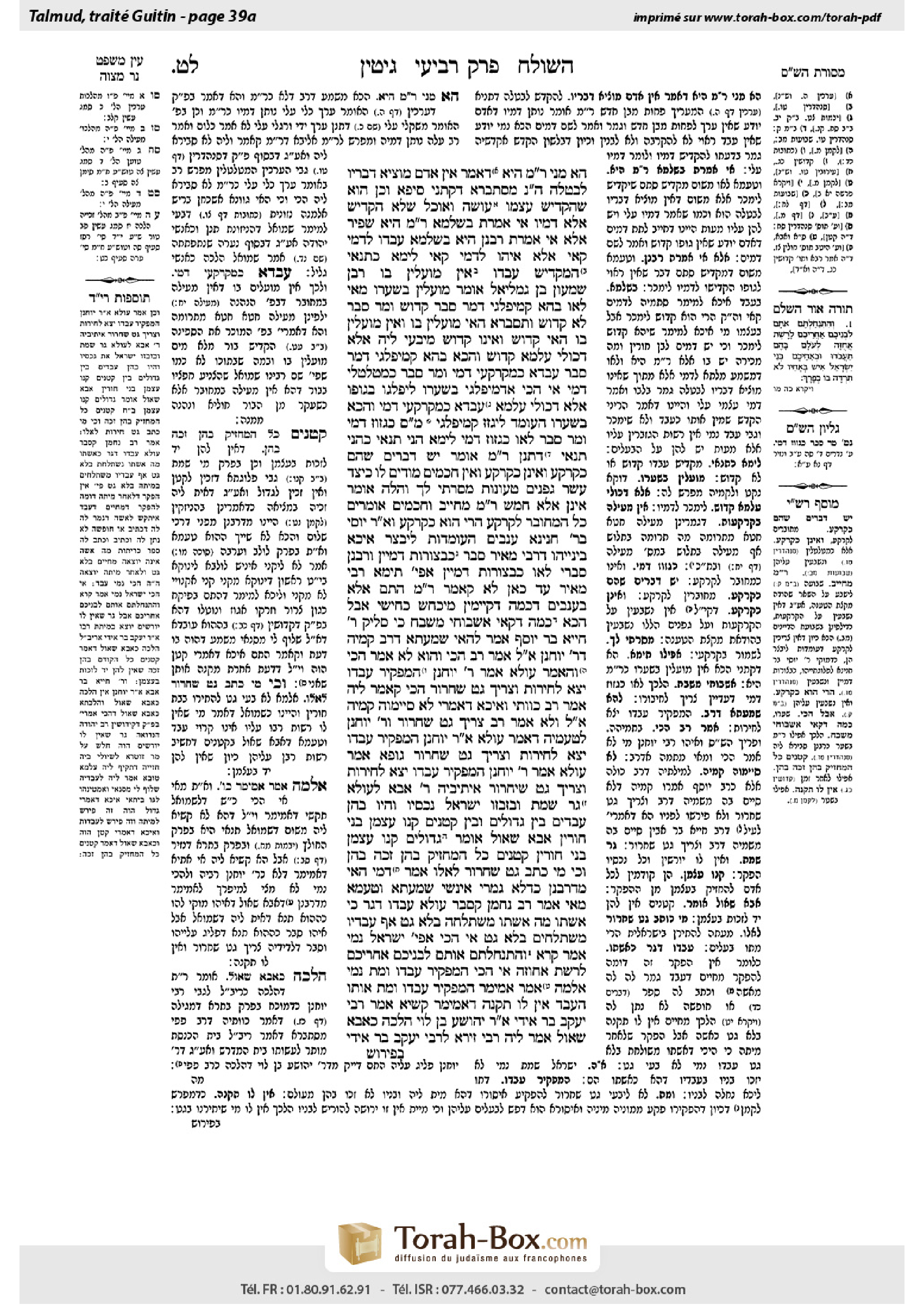
Gittin 39a: Talmud study for Daf Yomi
Study the Talmud for Daf Yomi with scanned pages, Hebrew text, English translations from Sefaria and AI-generated French translations.
Passage selection and English or AI-generated French translation are available where the scan has annotations. Daf Study is independent of Torah-Box and Sefaria.
Browse Gittin · גיטין · All tractatesGittin 39a text and translations
This page of Gittin includes the Aramaic text, an English translation and an AI-generated French translation, alongside the scan above.
גיטין ל״ט א · Aramaic and Hebrew text
הָא מַנִּי – רַבִּי מֵאִיר הִיא, דְּאָמַר: אֵין אָדָם מוֹצִיא דְּבָרָיו לְבַטָּלָה.
הָכִי נָמֵי מִסְתַּבְּרָא, דְּקָתָנֵי סֵיפָא: וְכֵן הוּא, שֶׁהִקְדִּישׁ עַצְמוֹ – עוֹשֶׂה וְאוֹכֵל, שֶׁלֹּא הִקְדִּישׁ אֶלָּא דָּמָיו. אִי אָמְרַתְּ בִּשְׁלָמָא רַבִּי מֵאִיר הִיא – שַׁפִּיר;
אֶלָּא אִי אָמְרַתְּ רַבָּנַן הִיא, בִּשְׁלָמָא עַבְדּוֹ – לִדְמֵי קָאֵי, אֶלָּא אִיהוּ – לִדְמֵי קָאֵי?!
לֵימָא כְּתַנָּאֵי – הַמַּקְדִּישׁ עַבְדּוֹ, אֵין מוֹעֲלִין בּוֹ. רַבָּן שִׁמְעוֹן בֶּן גַּמְלִיאֵל אוֹמֵר: מוֹעֲלִין בִּשְׂעָרוֹ. מַאי, לָאו בְּהָא קָמִיפַּלְגִי – דְּמָר סָבַר: קָדוֹשׁ; וּמָר סָבַר: לָא קָדוֹשׁ?
וְתִסְבְּרָא?! הַאי ״מוֹעֲלִין בּוֹ״ וְ״אֵין מוֹעֲלִין בּוֹ״?! הַאי ״קָדוֹשׁ״ וְ״אֵינוֹ קָדוֹשׁ״ מִיבְּעֵי לֵיהּ!
אֶלָּא דְּכוּלֵּי עָלְמָא קָדוֹשׁ, וְהָכָא בְּהָא קָמִיפַּלְגִי – דְּמָר סָבַר: עַבְדָּא כִּמְקַרְקְעֵי דָּמֵי; וּמָר סָבַר: כְּמִטַּלְטְלִי דָּמֵי.
אִי הָכִי, אַדְּמִיפַּלְגִי בִּשְׂעָרוֹ, לִיפַּלְגוּ בְּגוּפוֹ!
אֶלָּא דְּכוּלֵּי עָלְמָא עַבְדָּא כִּמְקַרְקְעֵי דָּמֵי, וְהָכָא בִּשְׂעָרוֹ הָעוֹמֵד לִיגָּזֵז קָמִיפַּלְגִי – מָר סָבַר: כְּגָזוּז דָּמֵי; וּמָר סָבַר: לָאו כְּגָזוּז דָּמֵי.
לֵימָא הָנֵי תַּנָּאֵי – כְּהָנֵי תַּנָּאֵי? דִּתְנַן, רַבִּי מֵאִיר אוֹמֵר: יֵשׁ דְּבָרִים שֶׁהֵם כַּקַּרְקַע וְאֵינָן כַּקַּרְקַע, וְאֵין חֲכָמִים מוֹדִים לוֹ. כֵּיצַד? ״עֶשֶׂר גְּפָנִים טְעוּנוֹת מָסַרְתִּי לָךְ״, וְהַלָּה אוֹמֵר: ״אֵינָן אֶלָּא חָמֵשׁ״ – רַבִּי מֵאִיר מְחַיֵּיב; וַחֲכָמִים אוֹמְרִים: כׇּל הַמְחוּבָּר לַקַּרְקַע הֲרֵי הוּא כַּקַּרְקַע.
וְאָמַר רַבִּי יוֹסֵי בְּרַבִּי חֲנִינָא: עֲנָבִים הָעוֹמְדוֹת לִיבָּצֵר אִיכָּא בֵּינַיְיהוּ; דְּרַבִּי מֵאִיר סָבַר: כִּבְצוּרוֹת דָּמְיָין; וְרַבָּנַן סָבְרִי: לָאו כִּבְצוּרוֹת דָּמְיָין.
אֲפִילּוּ תֵּימָא רַבִּי מֵאִיר – עַד כָּאן לָא קָאָמַר רַבִּי מֵאִיר הָתָם, אֶלָּא בַּעֲנָבִים – דְּכַמָּה דְּקָיְימָן מִיכְחָשׁ כְּחִישִׁי; אֲבָל הָכָא – כַּמָּה דְּקָאֵי אַשְׁבּוֹחֵי מַשְׁבַּח.
כִּי סְלֵיק רַבִּי חִיָּיא בַּר יוֹסֵף, אֲמַר לְהַאי שְׁמַעְתָּא דְרַב קַמֵּיהּ דְּרַבִּי יוֹחָנָן. אֲמַר לֵיהּ: אָמַר רַב הָכִי? וְהוּא – לָא אָמַר הָכִי?! וְהָאָמַר עוּלָּא אָמַר רַבִּי יוֹחָנָן: הַמַּפְקִיר עַבְדּוֹ יָצָא לְחֵירוּת, וְצָרִיךְ גֵּט שִׁחְרוּר!
הָכִי קָאָמַר לֵיהּ: אָמַר רַב כְּווֹתִי? וְאִיכָּא דְאָמְרִי: לָא סַיְּימוּהָ קַמֵּיהּ, אֲמַר לֵיהּ: וְלָא אָמַר רַב צָרִיךְ גֵּט שִׁחְרוּר?! וְרַבִּי יוֹחָנָן לְטַעְמֵיהּ – דְּאָמַר עוּלָּא אָמַר רַבִּי יוֹחָנָן: הַמַּפְקִיר עַבְדּוֹ יָצָא לְחֵירוּת, וְצָרִיךְ גֵּט שִׁחְרוּר.
גּוּפָא – אָמַר עוּלָּא אָמַר רַבִּי יוֹחָנָן: הַמַּפְקִיר עַבְדּוֹ – יָצָא לְחֵירוּת, וְצָרִיךְ גֵּט שִׁיחְרוּר.
אֵיתִיבֵיהּ רַבִּי אַבָּא לְעוּלָּא: גֵּר שֶׁמֵּת וּבִזְבְּזוּ יִשְׂרָאֵל נְכָסָיו, וְהָיוּ בָּהֶן עֲבָדִים – בֵּין גְּדוֹלִים וּבֵין קְטַנִּים, קָנוּ עַצְמָן בְּנֵי חוֹרִין. אַבָּא שָׁאוּל אוֹמֵר: גְּדוֹלִים – קָנוּ עַצְמָן בְּנֵי חוֹרִין; קְטַנִּים – כׇּל הַמַּחְזִיק בָּהֶן, זָכָה בָּהֶן.
וְכִי מִי כָּתַב גֵּט שִׁחְרוּר לְאֵלּוּ?
אָמַר: דָּמֵי הַאי מִדְּרַבָּנַן כִּדְלָא גָּמְרִי אִינָשֵׁי שְׁמַעְתָּא. וְטַעְמָא מַאי? אָמַר רַב נַחְמָן, קָסָבַר עוּלָּא: עַבְדּוֹ דְּגֵר כִּי אִשְׁתּוֹ – מָה אִשְׁתּוֹ מִשְׁתַּלַּחַת בְּלֹא גֵּט, אַף עֲבָדָיו מִשְׁתַּלְּחִים בְּלֹא גֵּט.
אִי הָכִי, אֲפִילּוּ יִשְׂרָאֵל נָמֵי! אָמַר קְרָא: ״וְהִתְנַחַלְתֶּם אוֹתָם לִבְנֵיכֶם אַחֲרֵיכֶם לָרֶשֶׁת אֲחוּזָּה״.
אִי הָכִי, הַמַּפְקִיר עַבְדּוֹ וָמֵת – נָמֵי; אַלְּמָה אָמַר אַמֵּימָר: הַמַּפְקִיר עַבְדּוֹ וָמֵת – אוֹתוֹ הָעֶבֶד אֵין לוֹ תַּקָּנָה? דְּאַמֵּימָר קַשְׁיָא.
אָמַר רַבִּי יַעֲקֹב בַּר אִידֵּי אָמַר רַבִּי יְהוֹשֻׁעַ בֶּן לֵוִי: הֲלָכָה כְּאַבָּא שָׁאוּל. אָמַר לֵיהּ רַבִּי זֵירָא לְרַבִּי יַעֲקֹב בַּר אִידִי:
Gittin 39a · English translation
The Gemara answers: In accordance with whose opinion is this baraita? It is in accordance with the opinion of Rabbi Meir, who says: A person does not make a statement of consecration for naught. If one declared an item consecrated, even if he did not use the correct formulation, his statement is interpreted in a manner to render it meaningful. Therefore, although the master did not say that the slave is consecrated with regard to his monetary value, his statement is interpreted in this way. However, Rav holds in accordance with the dissenting opinion of the Rabbis. In their opinion the slave is not consecrated.
The Gemara comments: This too stands to reason, as it teaches in the latter clause of the baraita: And so too, a freeman who consecrated himself works and is sustained from his labor, as he consecrated only his monetary value and he did not consecrate his body. Granted, if you say that this baraita is in accordance with the opinion of Rabbi Meir, then the entire baraita works out well. According to the opinion of Rabbi Meir, even when he consecrated himself, his statement is interpreted so that it is referring to a type of consecration that is meaningful.
Rather, if you say that it is the opinion of the Rabbis, granted, the first clause of the baraita that deals with one who consecrates his slave is understood, as his slave exists primarily for monetary value. It is logical that when the owner consecrates him he intends to consecrate his monetary value. However, in the case of the latter clause of the baraita, which is referring to one who consecrates himself, does he exist for monetary value? Therefore, the baraita must be in accordance with the opinion of Rabbi Meir.
The Gemara suggests: Let us say that this dispute with regard to one who consecrates his slave is parallel to a dispute between tanna’im. A baraita taught: With regard to one who consecrates his slave, if one then makes use of the slave, there is no misuse of property consecrated to the Temple. Rabban Shimon ben Gamliel says: One misuses property consecrated to the Temple if one makes use of his hair. What, is it not that they disagree about this issue, as one Sage, Rabban Shimon ben Gamliel, holds that the slave is consecrated, and therefore the halakhot of misuse of consecrated property apply, and one Sage, the first tanna, holds that the slave is not consecrated?
The Gemara asks: And how can you understand that to be their dispute? If that were the case, then these expressions of: One misuses property consecrated to the Temple, and: There is no misuse of property consecrated to the Temple, are not the correct expressions. They should have used these expressions, of: Consecrated, and: Not consecrated, if that were actually the subject of their dispute.
Rather, everyone agrees that the slave is consecrated, in opposition to the opinion of Rav. And here they disagree about this, as one Sage, the first tanna, holds that a slave is considered equivalent to land, as slaves are compared to land in several areas of halakha. Just as the misuse of consecrated property does not apply in the case of land, so too, it does not apply to slaves. And one Sage, Rabban Shimon ben Gamliel, holds that they are considered equivalent to movable property, and therefore the halakhot of misuse of consecrated property do apply to slaves.
The Gemara challenges this explanation: If that is so, and they disagree with regard to whether a slave is equivalent to land or movable property, instead of disagreeing with regard to whether making use of the slave’s hair constitutes a misuse of consecrated property, let them disagree with regard to whether making use of the slave himself constitutes a misuse of consecrated property.
Rather, it must be that everyone agrees that a slave is considered equivalent to land, and making use of the slave himself does not constitute a misuse of consecrated property. And here they disagree with regard to his hair that is ready to be cut, whether it is still considered a part of the slave. One Sage, Rabban Shimon ben Gamliel, holds that it is considered as if it were already cut and is no longer part of the slave. Since it is viewed as detached, it is subject to the halakhot of misuse of consecrated property, like all movable property. And one Sage, the first tanna, holds that it is not considered as if it were already cut. Until it is cut, the hair is part of the slave, and, like all land, is not subject to the halakhot of misuse of consecrated property.
The Gemara suggests: Let us say that the opinions of these tanna’im are parallel to the opinions of those tanna’im, as we learned in a mishna (Shevuot 42b) that Rabbi Meir says: There are certain things that are like land with regard to their form but are not treated like land from a halakhic perspective, but the Rabbis do not admit to him that this is so. How so? If one makes the claim: I gave you ten grapevines laden with fruit to guard, and the other one says: They are only five vines, then Rabbi Meir obligates the defendant to take an oath, for one who makes a partial admission to a claim concerning movable property is obligated to take an oath that he is stating the truth. And the Rabbis say: The halakhic status of anything that is attached to the ground is like the ground itself, and therefore one does not take an oath in this case, as one does not take an oath if one makes a partial admission to a claim concerning land.
The Gemara continues the comparison: And with regard to this, Rabbi Yosei, son of Rabbi Ḥanina, says that the practical difference between them is not concerning all vines. It exists only in a case of grapes that are ready to be harvested, as Rabbi Meir holds that since they are ready to be harvested, they are considered like they are already harvested, and the defendant must take an oath, as he is denying a claim concerning movable property. And the Rabbis hold that they are not considered like they are already harvested, and they still have the status of land. This dispute seems to be identical to the dispute between Rabban Shimon ben Gamliel and the Rabbis.
The Gemara rejects this suggestion: The dispute in the baraita with regard to a slave’s hair is not necessarily parallel to the dispute with regard to grapes. Even if you say the opinion of Rabbi Meir, that grapes that are about to be harvested are considered like they are already harvested, this does not dictate one’s opinion with regard to a slave’s hair that is ready to be cut. Rabbi Meir states his opinion only there, with regard to grapes, since the longer they remain on the vine after ripening the more they become withered and are ruined. Since they no longer benefit from their attachment to the ground, they are considered to be like movable property. However, here, with regard to hair, the longer it remains on the slave the more it improves, i.e., grows, and therefore it should not be considered as if it were already cut.
In connection with Rav’s statement that one who renounces ownership of his slave emancipates the slave, the Gemara recounts: When Rabbi Ḥiyya bar Yosef ascended from Babylonia to Eretz Yisrael, he stated this halakha of Rav, that one who renounces ownership of his slave emancipates the slave, before Rabbi Yoḥanan. Rabbi Yoḥanan said to him in astonishment: Did Rav actually say so? This indicates that Rabbi Yoḥanan disagreed with the statement of Rav, which leads the Gemara to ask: But didn’t Rabbi Yoḥanan himself say so? But didn’t Ulla say that Rabbi Yoḥanan says: With regard to one who renounces ownership of his slave, the slave is emancipated but nevertheless requires a bill of manumission. Why then was Rabbi Yoḥanan so surprised by Rav’s statement?
The Gemara answers: The Gemara answers that Rabbi Yoḥanan was not objecting to Rav’s opinion, but this is what he said to him: Did Rav actually say in accordance with my opinion? And alternatively, there are those who say that Rabbi Ḥiyya bar Yosef did not conclude Rav’s statement before Rabbi Yoḥanan by saying that nevertheless the slave requires a bill of manumission. Therefore, Rabbi Yoḥanan said to him: And didn’t Rav say that the slave requires a bill of manumission? And Rabbi Yoḥanan conforms to his standard line of reasoning, as Ulla says that Rabbi Yoḥanan says: With regard to one who renounces ownership of his slave, the slave is emancipated but nevertheless requires a bill of manumission.
§ The Gemara discusses the matter itself: Ulla says that Rabbi Yoḥanan says: With regard to one who renounces ownership of his slave, the slave is emancipated but nevertheless requires a bill of manumission to be fully considered a freeman and to be able to marry a Jewish woman.
Rabbi Abba raised an objection to Ulla from a baraita: If a convert died and Jews plundered his property, as his possessions became ownerless property with his death because he had no heirs, and among his possessions were slaves, then, whether the slaves were adults or minors, they acquire ownership of themselves and become freemen, as they can acquire themselves from the ownerless property. Abba Shaul says: Adult slaves acquire ownership of themselves and become freemen. However, with regard to minor slaves, anyone who takes possession of them acquires them.
This appears difficult for Rabbi Yoḥanan, as one could ask: But who wrote a bill of manumission for those slaves who became free men? Their owner died without freeing them, and nevertheless they are emancipated. Therefore, the baraita demonstrates that when a slave becomes ownerless, he is emancipated entirely and does not require a bill of manumission to be considered a freeman.
Ulla said in reply: This one of the Rabbis, Rabbi Abba, is like a person who has not studied halakha. He refused to address Rabbi Abba’s objection, as he did not think it was worthy of a response. The Gemara asks: And what is the reason that these slaves do not require a bill of manumission? Rav Naḥman said that Ulla holds as follows: A slave of a convert is comparable to his wife in this case. Just as his wife is freed by his death without a bill of divorce, and she is no longer considered married with regard to any halakhot, so too, his slaves are freed without a bill of manumission.
The Gemara challenges this answer: If so, if a slave is comparable to a wife, then even the slave of a Jew that dies should be freed entirely as well, just as his wife is. Why should this halakha apply only to the slave of a convert? The Gemara answers: The verse states with regard to slaves: “And you may make them an inheritance for your children after you, to hold for a possession” (Leviticus 25:46). Therefore, slaves are not emancipated with the death of their owner, as the heirs have a right to the slaves. However, in the case of a convert who does not have heirs, the slaves are emancipated.
The Gemara challenges: If so, then in a case of one who renounces ownership of his slave and dies, the slaves should not require a bill of manumission as well, as they are not part of the inheritance of the children. Why then did Ameimar say that with regard to one who renounces ownership of his slave and dies, there is no remedy for that slave and he cannot marry a Jewish woman, as there is no one to emancipate him? The Gemara states: This statement of Ameimar poses a difficulty to Rav Naḥman’s explanation of Ulla’s statement.
Rabbi Ya’akov bar Idi says that Rabbi Yehoshua ben Levi says: The halakha is in accordance with the opinion of Abba Shaul with regard to a convert who died and left behind slaves. Rabbi Zeira said to Rabbi Ya’akov bar Idi:
Gittin 39a · Traduction française (IA)
Le Guemara répond : Selon l'opinion de quel maître cette baraïta est-elle formulée ? Selon celle de Rabbi Meïr, qui dit : Une personne ne fait pas une déclaration de consécration à la légère. Si l'on déclare un objet consacré, même si l'on n'a pas utilisé la formule correcte, sa déclaration est interprétée de manière à la rendre significative. Ainsi, bien que le maître n'ait pas dit que l'esclave est consacré en ce qui concerne sa valeur monétaire, sa déclaration est interprétée ainsi. Cependant, Rav adopte l'opinion contraire des Sages. Selon leur opinion, l'esclave n'est pas consacré.
Le Guemara commente : Cela aussi est logique, car il enseigne dans la seconde partie de la baraïta : Et de même, un homme libre qui s'est consacré travaille et est nourri par son travail, car il a consacré seulement sa valeur monétaire et non son corps. Admettons que vous disiez que cette baraïta est selon l'opinion de Rabbi Meïr, alors toute la baraïta s'explique bien. Selon l'opinion de Rabbi Meïr, même lorsqu'il s'est consacré, sa déclaration est interprétée de manière à ce qu'elle fasse référence à un type de consécration significatif.
Au contraire, si vous dites qu'il s'agit de l'opinion des Sages, admettons que la première partie de la baraïta, concernant celui qui consacre son esclave, soit comprise, car l'esclave existe principalement pour sa valeur monétaire. Il est logique que lorsque l'propriétaire le consacre, il veuille consacrer sa valeur monétaire. Cependant, dans le cas de la seconde partie de la baraïta, qui parle de celui qui consacre lui-même, existe-t-il pour sa valeur monétaire ? Ainsi, la baraïta doit être selon l'opinion de Rabbi Meïr.
Le Guemara suggère : Disons que ce débat concernant celui qui consacre son esclave est parallèle à un débat entre des tannaïm. Une baraïta enseigne : Concernant celui qui consacre son esclave, si l'on utilise ensuite l'esclave, il n'y a pas d'abus de propriété consacrée au Temple. Rabban Shimon ben Gamliel dit : Il y a un abus de propriété consacrée au Temple si l'on utilise ses cheveux. Qu'est-ce que cela signifie ? N'est-ce pas que leur débat porte sur cette question, car un Sage, Rabban Shimon ben Gamliel, considère que l'esclave est consacré, et donc les halakhot de l'abus de propriété consacrée s'appliquent, et un autre Sage, le premier tanna, considère que l'esclave n'est pas consacré ?
Le Guemara demande : Et comment pouvez-vous comprendre cela comme leur débat ? Si c'était le cas, alors ces expressions : « Il y a un abus de propriété consacrée au Temple » et « Il n'y a pas d'abus de propriété consacrée au Temple » ne seraient pas les expressions correctes. Elles devraient avoir utilisé ces expressions : « Consacrée » et « Non consacrée », si c'était véritablement la question de leur débat.
Au contraire, tout le monde convient que l'esclave est consacré, contrairement à l'opinion de Rav. Et ici, ils divergent sur ce point, car un Sage, le premier tanna, considère que l'esclave est équivalent à la terre, car les esclaves sont comparés à la terre dans plusieurs domaines de halakha. Comme l'abus de propriété consacrée ne s'applique pas dans le cas de la terre, de même il ne s'applique pas aux esclaves. Et un autre Sage, Rabban Shimon ben Gamliel, considère qu'ils sont équivalents à des biens mobiliers, et donc les halakhot de l'abus de propriété consacrée s'appliquent aux esclaves.
Le Guemara remet en question cette explication : Si c'est le cas, et qu'ils divergent sur le fait que l'esclave est équivalent à la terre ou aux biens mobiliers, pourquoi ne divergent-ils pas sur le fait que l'utilisation de l'esclave lui-même constitue un abus de propriété consacrée ?
Au contraire, tout le monde convient que l'esclave est considéré comme équivalent à la terre, et l'utilisation de l'esclave lui-même ne constitue pas un abus de propriété consacrée. Et ici, ils divergent sur la question de ses cheveux prêts à être coupés, s'ils sont encore considérés comme faisant partie de l'esclave. Un Sage, Rabban Shimon ben Gamliel, considère qu'ils sont comme s'ils étaient déjà coupés et ne font plus partie de l'esclave. Puisque l'on les considère comme détachés, ils sont soumis aux halakhot de l'abus de propriété consacrée, comme tous les biens mobiliers. Un autre Sage, le premier tanna, considère qu'ils ne sont pas considérés comme s'ils étaient déjà coupés. Jusqu'à ce qu'ils soient coupés, les cheveux font partie de l'esclave, et, comme la terre, ne sont pas soumis aux halakhot de l'abus de propriété consacrée.
Le Guemara suggère : Disons que les opinions de ces tannaïm sont parallèles à celles de ces tannaïm, comme nous l'avons appris dans une mitsva (Shevuot 42b) que Rabbi Meïr dit : Il existe certaines choses qui sont comme la terre en ce qui concerne leur forme mais ne sont pas traitées comme la terre du point de vue halakhique, mais les Sages ne reconnaissent pas cela. Comment cela ? Si l'on affirme : J'ai donné à toi dix vignes chargées de fruits à garder, et l'autre dit : Ce sont seulement cinq vignes, Rabbi Meïr oblige le défendeur à prendre un serment, car celui qui fait une admission partielle à un droit concernant un bien mobilier est tenu de prendre un serment qu'il dit la vérité. Et les Sages disent : Le statut halakhique de toute chose attachée au sol est comme le sol lui-même, et donc on ne prend pas de serment dans ce cas, car on ne prend pas de serment si l'on fait une admission partielle à un droit concernant la terre.
Le Guemara continue la comparaison : Et concernant cela, Rabbi Yosei, fils de Rabbi Ḥanina, dit que la différence pratique entre eux ne concerne pas toutes les vignes. Elle existe uniquement dans le cas de des rais qui sont prêtes à être récoltées, car Rabbi Meïr considère qu'ayant été prêtes à être récoltées, elles sont considérées comme déjà récoltées, et le défendeur doit prendre un serment, car il nie un droit concernant un bien mobilier. Et les Sages considèrent qu'elles ne sont pas considérées comme déjà récoltées, et elles conservent le statut de la terre. Ce débat semble être identique au débat entre Rabban Shimon ben Gamliel et les Sages.
La Guemara rejette cette suggestion : le débat dans la baraïta concernant les cheveux d’un esclave n’est pas nécessairement parallèle au débat concernant les rais. Même si vous dites l’opinion de Rabbi Meir, selon laquelle les rais qui sont sur le point d’être récoltées sont considérées comme déjà récoltées, cela ne détermine pas votre opinion concernant les cheveux d’un esclave qui sont prêts à être coupés. Rabbi Meir exprime son opinion uniquement là, concernant les rais, car plus les rais restent sur la vigne après leur maturité, plus elles s’atrophient et se détériorent. Puisqu’elles ne bénéficient plus de leur attachement au sol, elles sont considérées comme de la propriété mobile. Cependant, ici, concernant les cheveux, plus ils restent sur l’esclave, plus ils s’améliorent, c’est-à-dire grandissent, et par conséquent ils ne devraient pas être considérés comme déjà coupés.
En lien avec la déclaration de Rav selon laquelle celui qui renonce à la propriété de son esclave libère l’esclave, la Guemara rapporte : lorsque Rabbi Ḥiyya bar Yosef est monté de Babylone en Terre d’Israël, il a déclaré cette halakha de Rav, selon laquelle celui qui renonce à la propriété de son esclave libère l’esclave, devant Rabbi Yoḥanan. Rabbi Yoḥanan lui a dit avec étonnement : Rav a vraiment dit cela ? Cela indique que Rabbi Yoḥanan était en désaccord avec la déclaration de Rav, ce qui conduit la Guemara à poser la question : Mais n’a-t-il pas lui-même dit cela ? Mais n’a-t-il pas dit Ulla que Rabbi Yoḥanan affirme : concernant celui qui renonce à la propriété de son esclave, l’esclave est libéré mais nécessite tout de même un acte de manumission ? Pourquoi alors Rabbi Yoḥanan a-t-il été si surpris par la déclaration de Rav ?
La Guemara répond : La Guemara explique que Rabbi Yoḥanan ne s’opposait pas à l’opinion de Rav, mais c’est ce qu’il a dit à lui : Rav a-t-il vraiment dit cela selon mon opinion ? Et de manière alternative, il y a ceux qui disent que Rabbi Ḥiyya bar Yosef n’a pas conclu la déclaration de Rav devant Rabbi Yoḥanan en disant que toutefois l’esclave nécessite un acte de manumission. Par conséquent, Rabbi Yoḥanan lui a dit : Et n’a-t-il pas dit Rav que l’esclave nécessite un acte de manumission ? Et Rabbi Yoḥanan suit sa ligne de raisonnement habituelle, comme Ulla dit que Rabbi Yoḥanan dit : concernant celui qui renonce à la propriété de son esclave, l’esclave est libéré mais nécessite toutefois un acte de manumission.
§ La Guemara discute la question elle-même : Ulla dit que Rabbi Yoḥanan dit : concernant celui qui renonce à la propriété de son esclave, l’esclave est libéré mais nécessite toutefois un acte de manumission pour être pleinement considéré comme libre et pouvoir épouser une femme juive.
Rabbi Abba a soulevé un objet contre Ulla à partir d’une baraïta : Si un converti est mort et que des Juifs ont pillé ses biens, comme ses possessions sont devenues propriété sans propriétaire avec sa mort car il n’avait pas d’héritier, et parmi ses possessions figuraient des esclaves, alors, que les esclaves fussent adultes ou mineurs, ils acquièrent la propriété de soi-même et deviennent libres, car ils peuvent acquérir leur propre propriété à partir de la propriété sans propriétaire. Abba Shaul dit : Les esclaves adultes acquièrent la propriété de soi-même et deviennent libres. Cependant, concernant les esclaves mineurs, celui qui prend possession d’eux acquiert leur propriété.
Cela semble difficile pour Rabbi Yoḥanan, car on pourrait demander : Mais qui a rédigé un acte de manumission pour ces esclaves qui sont devenus libres ? Leur propriétaire est mort sans les libérer, et pourtant ils sont libérés. Par conséquent, la baraïta démontre que lorsque un esclave devient propriété sans propriétaire, il est entièrement libéré et ne nécessite pas un acte de manumission pour être considéré comme libre.
Ulla a répondu en disant : Ce Rabbi Abba est comme une personne qui n’a pas étudié la halakha. Il a refusé de répondre à l’objection de Rabbi Abba, car il ne pensait pas qu’elle méritait une réponse. La Guemara pose la question : Et quelle est la raison pour laquelle ces esclaves n’ont pas besoin d’un acte de manumission ? Rav Naḥman a dit que Ulla tient l’opinion suivante : un esclave d’un converti est comparable à sa femme dans ce cas. Comme sa femme est libérée par sa mort sans un acte de divorce, et elle n’est plus considérée comme mariée concernant toute halakha, de même, ses esclaves sont libérés sans un acte de manumission.
La Guemara remet en question cette réponse : Si tel est le cas, alors même un esclave d’un Juif qui meurt devrait être entièrement libéré, comme sa femme. Pourquoi cette halakha s’appliquerait-elle uniquement aux esclaves d’un converti ? La Guemara répond : Le verset dit concernant les esclaves : « Et vous pouvez les rendre une héritage à vos enfants après vous, pour les posséder » (Lévitique 25:46). Par conséquent, les esclaves ne sont pas libérés avec la mort de leur propriétaire, car les héritiers ont un droit sur les esclaves. Cependant, dans le cas d’un converti qui n’a pas d’héritiers, les esclaves sont libérés.
La Guemara soulève un défi : Si tel est le cas, alors dans le cas d’un homme qui renonce à la propriété de son esclave et meurt, les esclaves ne devraient pas nécessiter un acte de manumission non plus, car ils ne font pas partie de l’héritage des enfants. Pourquoi alors Ameimar a-t-il dit que concernant un homme qui renonce à la propriété de son esclave et meurt, il n’y a pas de remède pour cet esclave et il ne peut pas épouser une femme juive, car il n’y a personne pour le libérer ? La Guemara dit : Cette déclaration d’Ameimar pose un problème pour l’explication de Rav Naḥman concernant la déclaration de Ulla.
Rabbi Ya’akov bar Idi dit que Rabbi Yehoshua ben Levi dit : La halakha suit l’opinion d’Abba Shaul concernant un converti qui est mort et a laissé derrière lui des esclaves. Rabbi Zeira a dit à Rabbi Ya’akov bar Idi :
Traduction française générée par IA à partir de l’édition anglaise de Sefaria. Vérifie toujours un passage avec le texte source.
Text from Sefaria: William Davidson Edition - Vocalized Aramaic (CC BY NC); William Davidson Edition - English (CC BY NC).