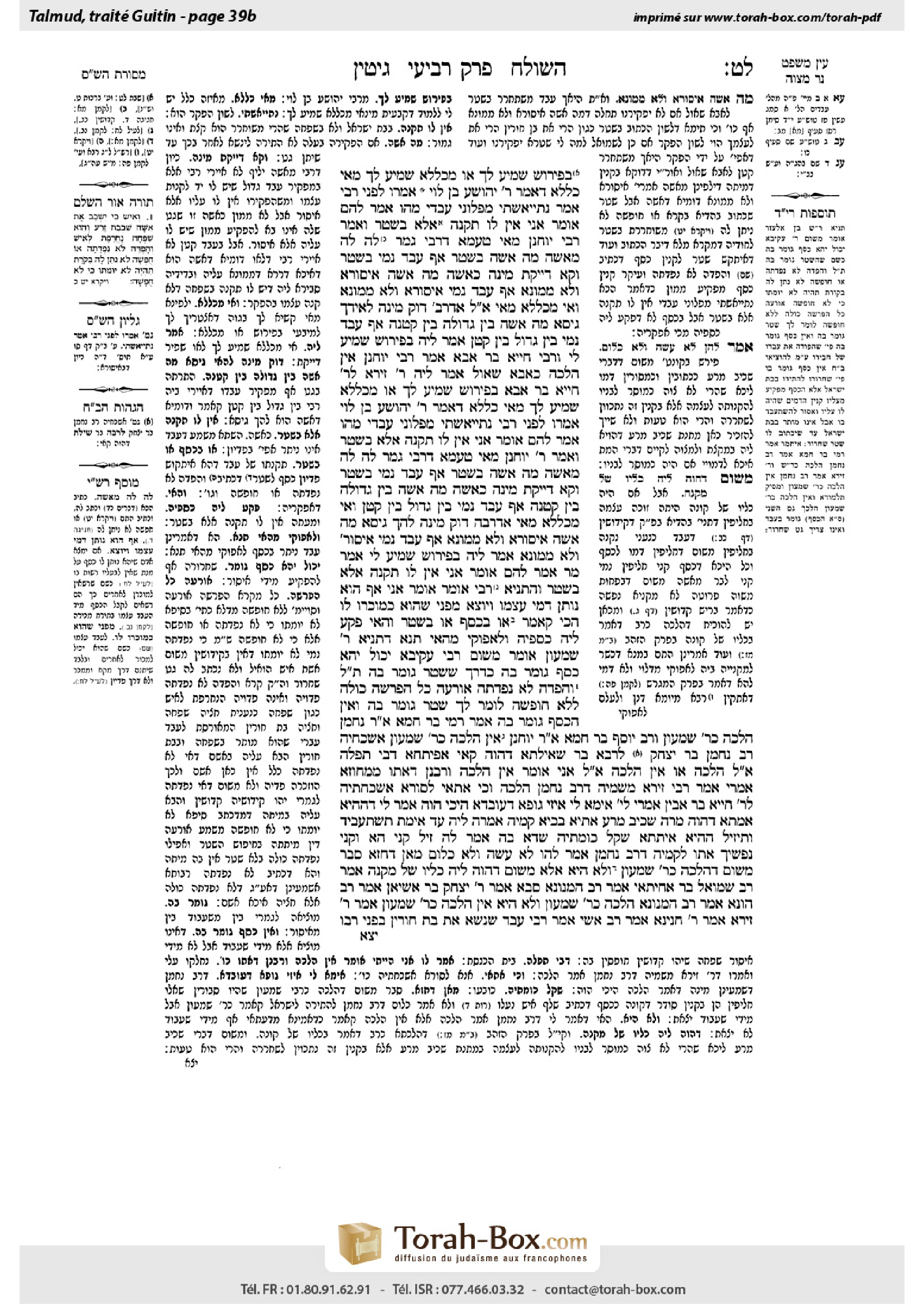
Gittin 39b: Talmud study for Daf Yomi
Study the Talmud for Daf Yomi with scanned pages, Hebrew text, English translations from Sefaria and AI-generated French translations.
Passage selection and English or AI-generated French translation are available where the scan has annotations. Daf Study is independent of Torah-Box and Sefaria.
Browse Gittin · גיטין · All tractatesGittin 39b text and translations
This page of Gittin includes the Aramaic text, an English translation and an AI-generated French translation, alongside the scan above.
גיטין ל״ט ב · Aramaic and Hebrew text
בְּפֵירוּשׁ שְׁמִיעַ לָךְ, אוֹ מִכְּלָלָא שְׁמִיעַ לָךְ? מַאי כְּלָלָא? דְּאָמַר רַבִּי יְהוֹשֻׁעַ בֶּן לֵוִי, אָמְרוּ לִפְנֵי רַבִּי: אָמַר ״נִתְיָיאַשְׁתִּי מִפְּלוֹנִי עַבְדִּי״, מַהוּ? אָמַר לָהֶם: אוֹמֵר אֲנִי, אֵין לוֹ תַּקָּנָה אֶלָּא בִּשְׁטָר.
וְאָמַר רַבִּי יוֹחָנָן: מַאי טַעְמָא דְּרַבִּי? גָּמַר ״לָהּ״–״לָהּ״ מֵאִשָּׁה – מָה אִשָּׁה בִּשְׁטָר, אַף עֶבֶד נָמֵי בִּשְׁטָר.
וְקָא דָיְיקַתְּ מִינַּהּ, כְּאִשָּׁה – מָה אִשָּׁה אִיסּוּרָא וְלָא מָמוֹנָא, אַף עֶבֶד נָמֵי אִיסּוּרָא וְלָא מָמוֹנָא.
וְאִי מִכְּלָלָא מַאי? אֲמַר לֵיהּ: אַדְּרַבָּה! דּוֹק מִינַּהּ לְאִידַּךְ גִּיסָא: מָה אִשָּׁה – בֵּין גְּדוֹלָה בֵּין קְטַנָּה, אַף עֶבֶד נָמֵי – בֵּין גָּדוֹל בֵּין קָטָן! אֲמַר לֵיהּ: בְּפֵירוּשׁ שְׁמִיעַ לִי.
וְרַבִּי חִיָּיא בַּר אַבָּא אָמַר רַבִּי יוֹחָנָן: אֵין הֲלָכָה כְּאַבָּא שָׁאוּל. אֲמַר לֵיהּ רַבִּי זֵירָא לְרַבִּי חִיָּיא בַּר אַבָּא: בְּפֵירוּשׁ שְׁמִיעַ לָךְ, אוֹ מִכְּלָלָא שְׁמִיעַ לָךְ? מַאי כְּלָלָא? דְּאָמַר רַבִּי יְהוֹשֻׁעַ בֶּן לֵוִי, אָמְרוּ לִפְנֵי רַבִּי: ״נִתְיָיאַשְׁתִּי מִפְּלוֹנִי עַבְדִּי״, מַהוּ? אָמַר לָהֶם: אוֹמֵר אֲנִי, אֵין לוֹ תַּקָּנָה אֶלָּא בִּשְׁטָר.
וְאָמַר רַבִּי יוֹחָנָן: מַאי טַעְמָא דְּרַבִּי? גָּמַר ״לָהּ״–״לָהּ״ מֵאִשָּׁה – מָה אִשָּׁה בִּשְׁטָר, אַף עֶבֶד נָמֵי בִּשְׁטָר.
וְקָא דָיְיקַתְּ מִינַּהּ, כְּאִשָּׁה – מָה אִשָּׁה בֵּין גְּדוֹלָה בֵּין קְטַנָּה, אַף עֶבֶד נָמֵי בֵּין גָּדוֹל בֵּין קָטָן.
וְאִי מִכְּלָלָא מַאי? אַדְּרַבָּה! דּוֹק מִינַּהּ לְהָךְ גִּיסָא: מָה אִשָּׁה – אִיסּוּרָא וְלָא מָמוֹנָא, אַף עֶבֶד נָמֵי – אִיסּוּרָא וְלָא מָמוֹנָא! אֲמַר לֵיהּ: בְּפֵירוּשׁ שְׁמִיעַ לִי.
אָמַר מָר, אָמַר לָהֶם: אוֹמֵר אֲנִי, אֵין לוֹ תַּקָּנָה אֶלָּא בִּשְׁטָר. וְהָתַנְיָא, רַבִּי אוֹמֵר: אוֹמֵר אֲנִי, אַף הוּא – נוֹתֵן דְּמֵי עַצְמוֹ וְיוֹצֵא, מִפְּנֵי שֶׁהוּא כְּמוֹכְרוֹ לוֹ!
הָכִי קָאָמַר: אוֹ בְּכֶסֶף אוֹ בִּשְׁטָר; וְהַאי – פְּקַע לֵיהּ כַּסְפֵּיהּ. וּלְאַפּוֹקֵי מֵהַאי תַּנָּא –
דְּתַנְיָא, רַבִּי שִׁמְעוֹן אוֹמֵר מִשּׁוּם רַבִּי עֲקִיבָא: יָכוֹל יְהֵא כֶּסֶף גּוֹמֵר בָּהּ, כְּדֶרֶךְ שֶׁשְּׁטָר גּוֹמֵר בָּהּ? תַּלְמוּד לוֹמַר: ״וְהׇפְדֵּה לֹא נִפְדָּתָה״ –
אוֹרְעָה כָּל הַפָּרָשָׁה כֻּולָּהּ לְ״לֹא חוּפָּשָׁה״, לוֹמַר לָךְ: שְׁטָר גּוֹמֵר בָּהּ, וְאֵין הַכֶּסֶף גּוֹמֵר בָּהּ.
אָמַר רָמֵי בַּר חָמָא אָמַר רַב נַחְמָן: הֲלָכָה כְּרַבִּי שִׁמְעוֹן. וְרַב יוֹסֵף בַּר חָמָא אָמַר רַבִּי יוֹחָנָן: אֵין הֲלָכָה כְּרַבִּי שִׁמְעוֹן.
אַשְׁכְּחֵיהּ רַב נַחְמָן בַּר יִצְחָק לְרָבָא בַּר שְׁאֵילְתָא, דַּהֲוָה קָאֵי אַפִּיתְחָא דְּבֵי תְפִלָּה. אֲמַר לֵיהּ: הֲלָכָה אוֹ אֵין הֲלָכָה? אֲמַר לֵיהּ: אֲנִי אוֹמֵר – אֵין הֲלָכָה; וְרַבָּנַן דַּאֲתוֹ מִמָּחוֹזָא אָמְרִי, אָמַר רַבִּי זֵירָא מִשְּׁמֵיהּ דְּרַב נַחְמָן: הֲלָכָה;
וְכִי אֲתַאי לְסוּרָא, אַשְׁכַּחְתֵּיהּ לְרַבִּי חִיָּיא בַּר אָבִין, אָמְרִי לֵיהּ: אֵימָא לִי אִיזִי, גּוּפָא דְעוֹבָדָא הֵיכִי הֲוָה? אֲמַר לִי: דְּהַהִיא אַמְתָּא דַּהֲוָה מָרַהּ שְׁכִיב מְרַע, אָתְיָא בָּכְיָא קַמֵּיהּ, אָמְרָה לֵיהּ: עַד אֵימַת תִּשְׁתַּעְבֵּיד וְתֵיזִיל הָהִיא אִיתְּתָא? שְׁקַל כּוּמְתֵּיהּ שְׁדָא בַּהּ, אֲמַר לַהּ: זִיל קְנִי הָא וּקְנִי נַפְשִׁיךְ. אֲתוֹ לְקַמֵּיהּ דְּרַב נַחְמָן, אֲמַר לְהוּ: לֹא עָשָׂה וְלֹא כְלוּם.
מַאן דַּחֲזָא, סָבַר מִשּׁוּם דַּהֲלָכָה כְּרַבִּי שִׁמְעוֹן; וְלָא הִיא, אֶלָּא מִשּׁוּם דְּהָוֵה לֵיהּ כֵּלָיו שֶׁל מַקְנֶה.
אָמַר רַב שְׁמוּאֵל בַּר אַחִיתַאי, אָמַר רַב הַמְנוּנָא סָבָא, אָמַר רַבִּי יִצְחָק בַּר אַשְׁיָאן, אָמַר רַב הוּנָא, אָמַר רַב הַמְנוּנָא: הֲלָכָה כְּרַבִּי שִׁמְעוֹן. וְלָא הִיא, אֵין הֲלָכָה כְּרַבִּי שִׁמְעוֹן.
אָמַר רַבִּי זֵירָא, אָמַר רַבִּי חֲנִינָא, אָמַר רַב אָשֵׁי, אָמַר רַבִּי: עֶבֶד שֶׁנָּשָׂא אֶת בַּת חוֹרִין בִּפְנֵי רַבּוֹ –
Gittin 39b · English translation
Did you hear it explicitly said by Rabbi Yehoshua ben Levi, or did you hear it by inference, i.e., did you infer it from some other statement of his? Rabbi Ya’akov bar Idi asked him: What inference could I have drawn? Rabbi Zeira answered: As Rabbi Yehoshua ben Levi says that they said before Rabbi Yehuda HaNasi: If one says: I have despaired of recovering so-and-so, my slave, what is the halakha? He said to them: I say that his slave has no remedy other than via a bill of manumission.
The Gemara continues explaining the possible inference. And Rabbi Yoḥanan said: What is the reasoning of Rabbi Yehuda HaNasi? He derived this by means of a verbal analogy, understanding the meaning of “to her [lah],” written with regard to a maidservant in the verse: “Nor was freedom given to her” (Leviticus 19:20), from the meaning of “for her [lah],” written with regard to a wife: “And he writes for her a bill of divorce” (Deuteronomy 24:3). Just as a wife is released from her husband via a bill of divorce, so too, a slave is also emancipated only via a bill of manumission.
You heard this statement and deduced from this comparison that with regard to his master’s death, a slave is comparable to a wife. Just as a wife is released by the death of her husband from a prohibition but not from a monetary bond, so too, a slave is also emancipated by his master’s death from a prohibition but not from a monetary bond. Therefore, an adult slave, who can acquire ownership of himself, is freed entirely by means of the death of his master. However, in the case of a minor slave, who cannot acquire possession of his own person, the monetary bond remains, in accordance with the opinion of Abba Shaul.
Rabbi Ya’akov bar Idi said to him: And if this was derived by inference, what of it? Rabbi Zeira said to him: If you derived this by inference from Rabbi Yehoshua ben Levi’s statement, then, on the contrary, deduce from this to the other side and say as follows: Just as a wife is released by her husband’s death and requires no bill of divorce whether she is an adult or a minor, so too, a slave is also emancipated when his master dies whether he is an adult or a minor, in opposition to the opinion of Abba Shaul. He said to him: I heard explicitly that Rabbi Yehoshua ben Levi said that the halakha is in accordance with the opinion of Abba Shaul.
And Rabbi Ḥiyya bar Abba says that Rabbi Yoḥanan says: The halakha is not in accordance with the opinion of Abba Shaul. Rabbi Zeira said to Rabbi Ḥiyya bar Abba: Did you hear it explicitly that Rabbi Yoḥanan said it, or did you hear it by inference? Rabbi Ḥiyya bar Abba asked: What inference could have been drawn? Rabbi Zeira answered: For Rabbi Yehoshua ben Levi says that they said before Rabbi Yehuda HaNasi: If one says: I have despaired of recovering so-and-so, my slave, what is the halakha? He said to them: I say that his slave has no remedy other than via a bill of manumission.
The Gemara continues explaining the possible inference. And Rabbi Yoḥanan said: What is the reasoning of Rabbi Yehuda HaNasi? He derived this halakha by means of a verbal analogy, understanding the meaning of the words “to her,” written with regard to a maidservant, from the meaning of “for her,” written with regard to a wife. Just as a wife can leave her husband only via a bill of divorce, so too, a slave is also emancipated only via a bill of manumission.
You heard this statement and deduced from this comparison that with regard to his master’s death, a slave is comparable to a wife. Just as a wife is released by her husband’s death whether she is an adult or a minor, so too, a slave is also emancipated whether he is an adult or a minor, and there is no distinction between a minor slave who receives a bill of manumission and a minor slave whose master dies.
Rabbi Ḥiyya bar Abba asked him: And if this was derived by inference, what of it? Rabbi Zeira said to him: If you derived this by inference, then, on the contrary, deduce from this to the other side and say as follows: Just as a wife is released by the death of her husband from a prohibition and not from a monetary bond, so too, a slave is also emancipated by his master’s death from a prohibition and not a monetary bond. He said to him: I heard this explicitly from Rabbi Yoḥanan.
§ In connection with the baraita cited above, the Gemara discusses the matter itself. The Master said above: Rabbi Yehuda HaNasi said to them: I say that his slave has no remedy other than via a bill of manumission. The Gemara challenges: But isn’t it taught in a baraita: Rabbi Yehuda HaNasi says: I say that even the slave himself can give his own monetary value and is emancipated, due to the fact that it is as if the Temple treasurer sold him to himself. This demonstrates that a slave can be emancipated by paying money in addition to receiving a bill of manumission.
The Gemara answers: This is what he is saying: A slave can be emancipated either via money or via a bill of manumission. And with regard to this master, who despaired of recovering his slave, his monetary hold over this slave is abrogated, and he can be emancipated only via a bill of manumission. And this statement, that generally a slave can be emancipated either via a bill of manumission or by paying money, serves to exclude the opinion of this tanna in the following baraita.
As it is taught in a baraita that Rabbi Shimon says in the name of Rabbi Akiva: One might have thought that paying money completes the emancipation of a Hebrew maidservant, just as a bill of manumission completes her emancipation. The verse states, concerning a Jewish man who engages in sexual intercourse with a maidservant who had been designated to cohabit with a Hebrew slave: “And whoever lies carnally with a woman that is a bondmaid designated for a man, and not at all redeemed, nor was freedom given to her; there shall be inquisition; they shall not be put to death, because she was not free” (Leviticus 19:20). In this case, neither the Jewish man nor the maidservant is liable to receive the death penalty, in contrast to a man who engages in sexual intercourse with a married woman.
The halakha of this entire portion of a maidservant who had been designated to cohabit with a Hebrew slave is linked to, i.e., dependent on, only the phrase “nor was freedom given her” by means of a bill of manumission. The reason she does not have the status of a free woman is that she was not granted her freedom by means of a bill of manumission. If the halakha of this portion would be dependent upon the phrase “and not at all redeemed,” this would indicate that the reason she does not have the status of a free woman is that she was not redeemed with money. This is in order to say to you: A bill of manumission completes her emancipation entirely, and money does not complete her emancipation. According to Rabbi Shimon, a slave can be emancipated only via a bill of manumission but not by paying money.
Rami bar Ḥama says that Rav Naḥman says: The halakha is in accordance with the opinion of Rabbi Shimon. And Rav Yosef bar Ḥama says that Rabbi Yoḥanan says: The halakha is not in accordance with the opinion of Rabbi Shimon.
The Gemara relates: Rav Naḥman bar Yitzḥak found Rava bar She’eilta when he was standing at the entrance to a house of prayer. He said to him, with regard to this issue: Is the halakha in accordance with the opinion of Rabbi Shimon, or is the halakha not in accordance with his opinion? He said to him: I say that the halakha is not in accordance with his opinion in this matter, and the Rabbis who came from Meḥoza say that Rabbi Zeira said in the name of Rav Naḥman: The halakha is in accordance with the opinion of Rabbi Shimon.
And when I came to Sura, I found Rabbi Ḥiyya bar Avin, and I said to him: Tell me, my friend [izi], the incident itself. What happened, and what exactly did Rav Naḥman say? He said to me that there was a certain maidservant whose master was on his deathbed. She came crying before him and said to him: Until when will that woman, i.e., I, continue to be subjugated? He took his hat [kumtei], threw it to her, and said to her: Go acquire this hat and thereby acquire yourself as a free woman. They came before Rav Naḥman for a ruling, and he said to them: He did nothing.
One who saw this incident thought that he ruled in this manner because he holds that the halakha is in accordance with the opinion of Rabbi Shimon, that a maidservant can be emancipated only via a bill of manumission. But that is not so. Rather, it was because this was a legal act of acquisition formalizing the transfer of ownership that was performed with the items of the one who transfers ownership, and this mode of acquisition takes effect only when the one who transfers ownership acquires an item belonging to the one to whom the ownership is being transferred. Since the item of the owner was used, the maidservant was not emancipated.
Rav Shmuel bar Aḥittai says that Rav Hamnuna the Elder says that Rabbi Yitzḥak bar Ashyan says that Rav Huna says that Rav Hamnuna says: The halakha is in accordance with the opinion of Rabbi Shimon. The Gemara concludes: And that is not so, as the halakha is not in accordance with the opinion of Rabbi Shimon.
Rabbi Zeira says that Rabbi Ḥanina says that Rav Ashi says that Rabbi Yehuda HaNasi says: In the case of a slave who marries a free woman in the presence of his master,
Gittin 39b · Traduction française (IA)
As-tu entendu explicitement dire par Rabbi Yéhoshua ben Lévi, ou as-tu entendu cela par déduction, c'est-à-dire as-tu déduit cela à partir d'une autre déclaration de sa part ? Rabbi Ya'akov bar Idi lui demanda : Quelle déduction pouvais-je faire ? Rabbi Zéira répondit : Comme Rabbi Yéhoshua ben Lévi dit que l'on avait dit devant Rabbi Yéhuda HaNasi : Si l'on dit : J'ai désespéré de récupérer tel ou tel, mon serviteur, quelle est la halakha ? Il leur dit : Je dis que son serviteur n'a de remède que par un acte de manumission.
La Guemara continue d'expliquer la possible déduction. Et Rabbi Yoḥanan dit : Quel est le raisonnement de Rabbi Yéhuda HaNasi ? Il a déduit cela par analogie verbale, comprenant le sens de « à elle [lah] », écrit concernant une servante dans la paracha : « Et la liberté n'était pas donnée à elle » (Lévitique 19:20), à partir du sens de « pour elle [lah] », écrit concernant une épouse : « Et il écrit pour elle un acte de divorce » (Dt 24:3). Tout comme une épouse est libérée de son mari par un acte de divorce, de même un serviteur est également libéré uniquement par un acte de manumission.
Tu as entendu cette déclaration et as déduit de cette comparaison que concernant la mort de son maître, un serviteur est comparable à une épouse. Tout comme une épouse est libérée par la mort de son mari d'une interdiction mais pas d'une obligation financière, de même un serviteur est également libéré par la mort de son maître d'une interdiction mais pas d'une obligation financière. Ainsi, un serviteur adulte, qui peut acquérir la propriété de lui-même, est entièrement libéré par la mort de son maître. Cependant, dans le cas d'un serviteur mineur, qui ne peut pas acquérir la propriété de son propre être, l'obligation financière reste, conformément à l'opinion d'Abba Shaul.
Rabbi Ya'akov bar Idi dit à lui : Et si cela a été déduit par déduction, qu'y a-t-il de particulier ? Rabbi Zéira dit à lui : Si tu as déduit cela par déduction à partir de la déclaration de Rabbi Yéhoshua ben Lévi, alors, au contraire, déduis-en à l'inverse et dis comme suit : Tout comme une épouse est libérée par la mort de son mari et n'a pas besoin d'un acte de divorce qu'elle soit adulte ou mineure, de même un serviteur est également libéré lors de la mort de son maître, qu'il soit adulte ou mineur, en opposition à l'opinion d'Abba Shaul. Il dit à lui : J'ai entendu explicitement que Rabbi Yéhoshua ben Lévi a dit que la halakha suit l'opinion d'Abba Shaul.
Et Rabbi Ḥiyya bar Abba dit que Rabbi Yoḥanan dit : La halakha ne suit pas l'opinion d'Abba Shaul. Rabbi Zéira dit à Rabbi Ḥiyya bar Abba : As-tu entendu explicitement que Rabbi Yoḥanan a dit cela, ou as-tu entendu cela par déduction ? Rabbi Ḥiyya bar Abba demanda : Quelle déduction pouvait-on faire ? Rabbi Zéira répondit : Pour Rabbi Yéhoshua ben Lévi dit que l'on avait dit devant Rabbi Yéhuda HaNasi : Si l'on dit : J'ai désespéré de récupérer tel ou tel, mon serviteur, quelle est la halakha ? Il leur dit : Je dis que son serviteur n'a de remède que par un acte de manumission.
La Guemara continue d'expliquer la possible déduction. Et Rabbi Yoḥanan dit : Quel est le raisonnement de Rabbi Yéhuda HaNasi ? Il a déduit cette halakha par analogie verbale, comprenant le sens des mots « à elle », écrit concernant une servante, à partir du sens de « pour elle », écrit concernant une épouse. Tout comme une épouse peut quitter son mari uniquement par un acte de divorce, de même un serviteur est également libéré uniquement par un acte de manumission.
Tu as entendu cette déclaration et as déduit de cette comparaison que concernant la mort de son maître, un serviteur est comparable à une épouse. Tout comme une épouse est libérée par la mort de son mari, qu'elle soit adulte ou mineure, de même un serviteur est également libéré, qu'il soit adulte ou mineur, et il n'y a pas de distinction entre un serviteur mineur qui reçoit un acte de manumission et un serviteur mineur dont le maître meurt.
Rabbi Ḥiyya bar Abba lui demanda : Et si cela a été déduit par déduction, qu'y a-t-il de particulier ? Rabbi Zéira lui dit : Si tu as déduit cela par déduction, alors, au contraire, déduis-en à l'inverse et dis comme suit : Tout comme une épouse est libérée par la mort de son mari d'une interdiction mais pas d'une obligation financière, de même un serviteur est également libéré par la mort de son maître d'une interdiction mais pas d'une obligation financière. Il lui dit : J'ai entendu cela explicitement de Rabbi Yoḥanan.
§ En lien avec la baraïta citée ci-dessus, la Guemara discute de la question elle-même. Le Maître dit ci-dessus : Rabbi Yéhuda HaNasi dit à eux : Je dis que son serviteur n'a de remède que par un acte de manumission. La Guemara conteste : Mais n'est-il pas enseigné dans une baraïta : Rabbi Yéhuda HaNasi dit : Je dis que même le serviteur lui-même peut donner sa valeur monétaire et est libéré, en raison du fait qu'il est comme si le trésor du Temple avait vendu lui-même à lui-même. Cela démontre qu'un serviteur peut être libéré en payant de l'argent en plus de recevoir un acte de manumission.
La Guemara répond : C'est ce qu'il dit : Un serviteur peut être libéré soit par de l'argent soit par un acte de manumission. Et concernant ce maître, qui a désespéré de récupérer son serviteur, son emprise monétaire sur ce serviteur est abrogée, et il peut être libéré uniquement par un acte de manumission. Et cette déclaration, selon laquelle généralement un serviteur peut être libéré soit par un acte de manumission soit en payant de l'argent, sert à exclure l'opinion de ce tanna dans la baraïta suivante.
Comme il est enseigné dans une baraïta que Rabbi Shimon dit en nom de Rabbi Akiva : On pouvait penser que le paiement d'argent complète la libération d'une servante juive, tout comme un acte de manumission complète sa libération. La paracha stipule, concernant un homme juif qui engage en relations sexuelles avec une servante désignée pour cohabiter avec un serviteur juif : « Et celui qui couchera avec une femme qui est une servante désignée pour un homme, et non pas du tout rachetée, ni la liberté n'était donnée à elle ; il y aura une enquête ; ils ne seront pas mis à mort, car elle n'était pas libre » (Lévitique 19:20). Dans ce cas, ni l'homme juif ni la servante ne sont tenus de recevoir la peine de mort, contrairement à un homme qui engage en relations sexuelles avec une femme mariée.
La halakha de cette portion entière d'une servante qui avait été désignée pour cohabiter avec un esclave hébreu est liée à, c'est-à-dire dépendante de, seule la phrase « ni ne fut-elle remise en liberté » par le biais d'un acte de manumission. La raison pour laquelle elle n'a pas le statut de femme libre est qu'elle n'a pas été remise en liberté par le biais d'un acte de manumission. Si la halakha de cette portion dépendait de la phrase « et non pas du tout rachetée », cela indiquerait que la raison pour laquelle elle n'a pas le statut de femme libre est qu'elle n'a pas été rachetée avec de l'argent. Cela est fait pour vous dire : un acte de manumission acheve entièrement sa libération, et l'argent ne l'acheve pas. Selon Rabbi Shimon, un esclave peut être libéré uniquement par un acte de manumission, mais pas par le paiement d'argent.
Rami bar Ḥama dit que Rav Naḥman dit : La halakha suit l'opinion de Rabbi Shimon. Et Rav Yosef bar Ḥama dit que Rabbi Yoḥanan dit : La halakha ne suit pas l'opinion de Rabbi Shimon.
La Guemara rapporte : Rav Naḥman bar Yitzḥak a trouvé Rava bar She’eilta lorsqu'il était debout à l'entrée d'une maison de prière. Il lui a dit, à propos de cette question : La halakha suit-elle l'opinion de Rabbi Shimon, ou la halakha ne suit-elle pas son opinion ? Il lui a répondu : Je dis que la halakha ne suit pas son opinion dans cette affaire, et les Rabbins qui sont venus de Meḥoza disent que Rabbi Zeira a dit en nom de Rav Naḥman : La halakha suit l'opinion de Rabbi Shimon.
Et lorsque je suis arrivé à Sura, j'ai trouvé Rabbi Ḥiyya bar Avin, et j'ai dit à lui : Dis-moi, mon ami [izi], l'incident lui-même. Qu'est-ce qui s'est passé, et exactement quoi a dit Rav Naḥman ? Il m'a dit que c'était une certaine servante dont le maître était sur son lit de mort. Elle est venue pleurer devant lui et lui a dit : Jusqu'à quand cette femme, c'est-à-dire moi, continuerai-je être soumise ? Il a pris son chapeau [kumtei], l'a lancé à elle, et lui a dit : Va acheter ce chapeau et ainsi acquière-toi comme femme libre. Ils sont venus devant Rav Naḥman pour une décision, et il a dit à eux : Il a fait rien.
Celui qui a vu cet incident a pensé qu'il avait rendu un jugement ainsi parce qu'il considère que la halakha suit l'opinion de Rabbi Shimon, que la servante peut être libérée uniquement par un acte de manumission. Mais cela n'est pas vrai. En réalité, c'était parce que c'était une action légale d'acquisition formalisant la transmission de propriété effectuée avec les biens de celui qui transfère la propriété, et ce mode d'acquisition prend effet uniquement lorsque celui qui transfère la propriété acquiert un objet appartenant à celui à qui la propriété est transférée. Puisque l'objet du propriétaire a été utilisé, la servante n'a pas été libérée.
Rav Shmuel bar Aḥittai dit que Rav Hamnuna le Vieux dit que Rabbi Yitzḥak bar Ashyan dit que Rav Huna dit que Rav Hamnuna dit : La halakha suit l'opinion de Rabbi Shimon. La Guemara conclut : Et cela n'est pas vrai, car la halakha ne suit pas l'opinion de Rabbi Shimon.
Rabbi Zeira dit que Rabbi Ḥanina dit que Rav Ashi dit que Rabbi Yehuda HaNasi dit : Dans le cas d'un esclave qui épouse une femme libre en présence de son maître,
Traduction française générée par IA à partir de l’édition anglaise de Sefaria. Vérifie toujours un passage avec le texte source.
Text from Sefaria: William Davidson Edition - Vocalized Aramaic (CC BY NC); William Davidson Edition - English (CC BY NC).