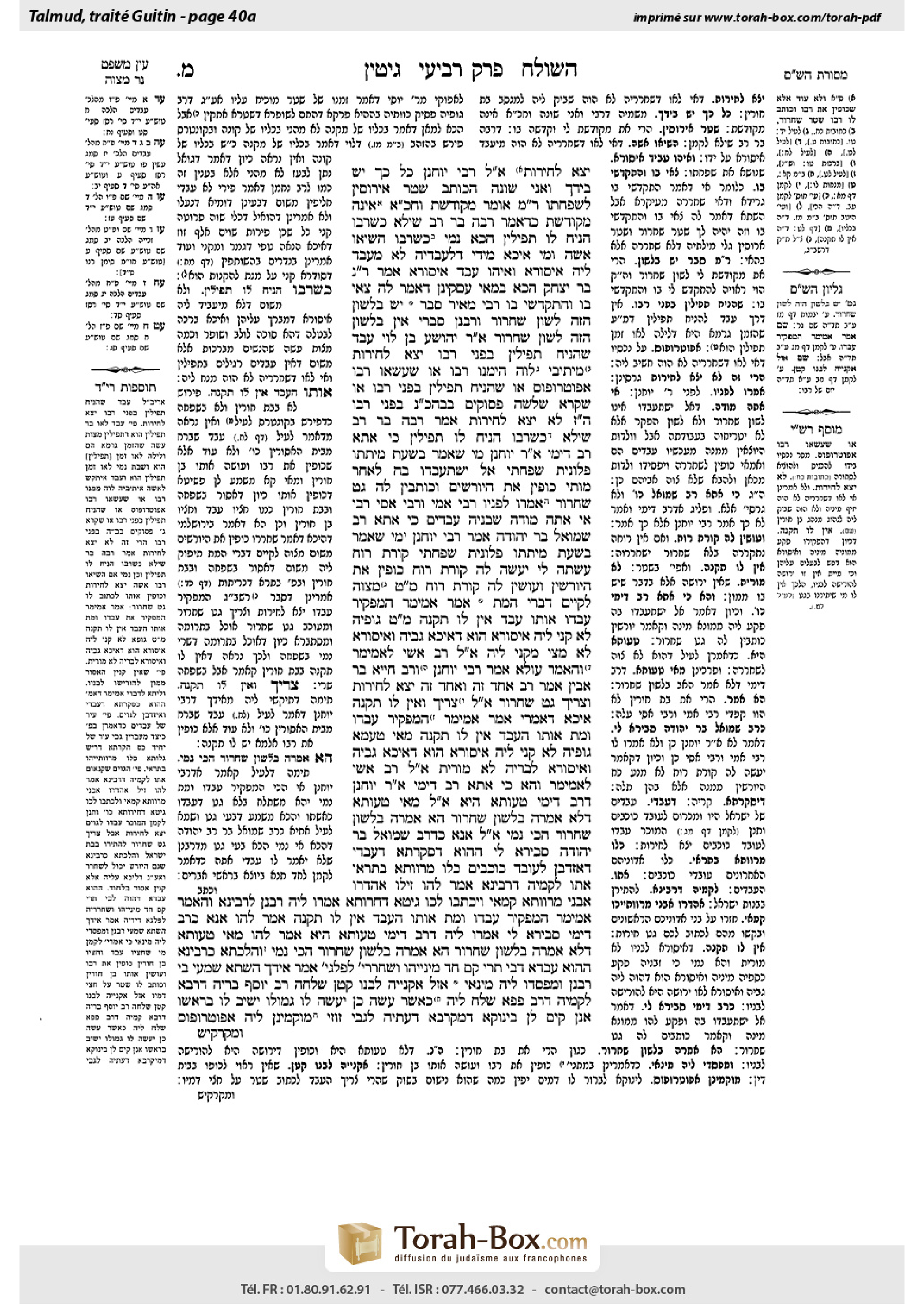
Gittin 40a: Talmud study for Daf Yomi
Study the Talmud for Daf Yomi with scanned pages, Hebrew text, English translations from Sefaria and AI-generated French translations.
Passage selection and English or AI-generated French translation are available where the scan has annotations. Daf Study is independent of Torah-Box and Sefaria.
Browse Gittin · גיטין · All tractatesGittin 40a text and translations
This page of Gittin includes the Aramaic text, an English translation and an AI-generated French translation, alongside the scan above.
גיטין מ׳ א · Aramaic and Hebrew text
יָצָא לְחֵירוּת. אָמַר לוֹ רַבִּי יוֹחָנָן: כָּל כָּךְ יֵשׁ בְּיָדְךָ?! וַאֲנִי שׁוֹנֶה: הַכּוֹתֵב שְׁטַר אֵירוּסִין לְשִׁפְחָתוֹ, רַבִּי מֵאִיר אוֹמֵר: מְקוּדֶּשֶׁת, וַחֲכָמִים אוֹמְרִים: אֵינָהּ מְקוּדֶּשֶׁת!
כִּדְאָמַר רַבָּה בַּר רַב שֵׁילָא – כְּשֶׁרַבּוֹ הִנִּיחַ לוֹ תְּפִילִּין; הָכָא נָמֵי – כְּשֶׁרַבּוֹ הִשִּׂיאוֹ אִשָּׁה.
וּמִי אִיכָּא מִידֵּי דִּלְעַבְדֵּיהּ – לָא מִעֲבַד לֵיהּ אִיסּוּרָא, וְאִיהוּ – עָבֵד אִיסּוּרָא?!
אָמַר רַב נַחְמָן בַּר יִצְחָק: הָכָא בְּמַאי עָסְקִינַן – דְּאָמַר לָהּ: ״צְאִי בּוֹ וְהִתְקַדְּשִׁי בּוֹ״; רַבִּי מֵאִיר סָבַר: יֵשׁ בַּלָּשׁוֹן הַזֶּה לְשׁוֹן שִׁחְרוּר, וְרַבָּנַן סָבְרִי: אֵין בַּלָּשׁוֹן הַזֶּה לְשׁוֹן שִׁחְרוּר.
אָמַר רַבִּי יְהוֹשֻׁעַ בֶּן לֵוִי: עֶבֶד שֶׁהִנִּיחַ תְּפִילִּין בִּפְנֵי רַבּוֹ – יָצָא לְחֵירוּת. מֵיתִיבִי: לָוָה הֵימֶנּוּ רַבּוֹ, אוֹ שֶׁעֲשָׂאוֹ רַבּוֹ אַפּוֹטְרוֹפּוֹס, אוֹ שֶׁהִנִּיחַ תְּפִילִּין בִּפְנֵי רַבּוֹ, אוֹ שֶׁקָּרָא שְׁלֹשָׁה פְּסוּקִים בְּבֵית הַכְּנֶסֶת בִּפְנֵי רַבּוֹ, הֲרֵי זֶה לֹא יָצָא לְחֵירוּת!
אָמַר רַבָּה בַּר רַב שֵׁילָא: כְּשֶׁרַבּוֹ הִנִּיחַ לוֹ תְּפִילִּין.
כִּי אֲתָא רַב דִּימִי, אָמַר רַבִּי יוֹחָנָן: מִי שֶׁאָמַר בִּשְׁעַת מִיתָתוֹ ״פְּלוֹנִית שִׁפְחָתִי אַל יִשְׁתַּעְבְּדוּ בָּהּ לְאַחַר מוֹתִי״ – כּוֹפִין אֶת הַיּוֹרְשִׁים וְכוֹתְבִין לָהּ גֵּט שִׁחְרוּר. אָמְרוּ לְפָנָיו רַבִּי אַמֵּי וְרַבִּי אַסִּי: רַבִּי, אִי אַתָּה מוֹדֶה שֶׁבָּנֶיהָ עֲבָדִים?
כִּי אֲתָא רַב שְׁמוּאֵל בַּר יְהוּדָה, אָמַר רַבִּי יוֹחָנָן: מִי שֶׁאָמַר בִּשְׁעַת מִיתָתוֹ ״פְּלוֹנִית שִׁפְחָתִי קוֹרַת רוּחַ עָשְׂתָה לִי; יֵעָשֶׂה לָהּ קוֹרַת רוּחַ״ – כּוֹפִין אֶת הַיּוֹרְשִׁין וְעוֹשִׂין לָהּ קוֹרַת רוּחַ. מַאי טַעְמָא? מִצְוָה לְקַיֵּים דִּבְרֵי הַמֵּת.
אָמַר אַמֵּימָר: הַמַּפְקִיר עַבְדּוֹ – אוֹתוֹ עֶבֶד אֵין לוֹ תַּקָּנָה. מַאי טַעְמָא? גּוּפֵיהּ לָא קָנֵי לֵיהּ – אִיסּוּרָא הוּא דְּאִיכָּא גַּבֵּיהּ, וְאִיסּוּרָא לָא מָצֵי מַקְנֵי לֵיהּ.
אֲמַר לֵיהּ רַב אָשֵׁי לְאַמֵּימָר: וְהָאָמַר עוּלָּא אָמַר רַבִּי יוֹחָנָן, וְרַב חִיָּיא בַּר אָבִין אָמַר רַב: אֶחָד זֶה וְאֶחָד זֶה יָצָא לְחֵירוּת, וְצָרִיךְ גֵּט שִׁחְרוּר! אֲמַר לֵיהּ: ״צָרִיךְ״ – וְאֵין לוֹ תַּקָּנָה.
אִיכָּא דְּאָמְרִי, אָמַר אַמֵּימָר: הַמַּפְקִיר עַבְדּוֹ וָמֵת – אוֹתוֹ הָעֶבֶד אֵין לוֹ תַּקָּנָה. מַאי טַעְמָא? גּוּפֵיהּ לָא קָנֵי לֵיהּ – אִיסּוּרָא הוּא דְּאִיכָּא גַּבֵּיהּ, וְאִיסּוּרָא לִבְרֵיהּ לָא מוֹרֵית. אֲמַר לֵיהּ רַב אָשֵׁי לְאַמֵּימָר: וְהָא כִּי אֲתָא רַב דִּימִי, אָמַר רַבִּי יוֹחָנָן!
דְּרַב דִּימִי טָעוּתָא הִיא. אֲמַר לֵיהּ: מַאי טָעוּתָא – דְּלָא אַמְרַהּ בִּלְשׁוֹן שִׁחְרוּר; הָא אַמְרַהּ בִּלְשׁוֹן שִׁחְרוּר – הָכִי נָמֵי! אֲמַר לֵיהּ: אֲנָא כִּדְרַב שְׁמוּאֵל בַּר יְהוּדָה סְבִירָא לִי.
הָהוּא דִּסְקַרְתָּא דְּעַבְדֵי דְּאִזְדַּבַּן לְגוֹי. כְּלוֹ מָרְווֹתָא בָּתְרָאֵי, אֲתוֹ לְקַמֵּיהּ דְּרָבִינָא, אֲמַר לְהוּ: זִילוּ אַהְדַּרוּ אַבְּנֵי מָרְווֹתָא קַמָּאֵי, וְיִכְתְּבוּ לְכוּ גִּיטָּא דְחֵרוּתָא. אֲמַרוּ לֵיהּ רַבָּנַן לְרָבִינָא, וְהָאָמַר אַמֵּימָר: הַמַּפְקִיר עַבְדּוֹ וָמֵת – אוֹתוֹ הָעֶבֶד אֵין לוֹ תַּקָּנָה!
אֲמַר לְהוּ: אֲנָא כְּרַב דִּימִי סְבִירָא לִי. אֲמַרוּ לֵיהּ: דְּרַב דִּימִי טָעוּתָא הִיא! אֲמַר לְהוּ: מַאי טָעוּתָא – דְּלָא אַמְרַהּ בִּלְשׁוֹן שִׁחְרוּר; הָא אַמְרַהּ בִּלְשׁוֹן שִׁחְרוּר – הָכִי נָמֵי! וְהִלְכְתָא כְּרָבִינָא.
הָהוּא עַבְדָּא דְּבֵי תְרֵי, קָם חַד מִינַּיְיהוּ וְשַׁחְרְרֵיהּ לְפַלְגֵיהּ, אֲמַר אִידַּךְ: הַשְׁתָּא שָׁמְעִי בִּי רַבָּנַן וּמַפְסְדוּ לֵיהּ מִינַּאי; אֲזַל אַקְנְיֵיהּ לִבְנוֹ קָטָן.
שַׁלְחַהּ רַב יוֹסֵף בְּרֵיהּ דְּרָבָא לְקַמֵּיהּ דְּרַב פָּפָּא, שְׁלַח לֵיהּ: ״כַּאֲשֶׁר עָשָׂה כֵּן יֵעָשֶׂה לּוֹ, גְּמוּלוֹ יָשִׁיב לוֹ בְּרֹאשׁוֹ״ – אֲנַן קִים לַן בְּיָנוֹקָא דִּמְקָרְבָא דַּעְתֵּיהּ לְגַבֵּי זוּזֵי; מוֹקְמִינַן לֵיהּ אַפּוֹטְרוֹפּוֹס,
Gittin 40a · English translation
he is emancipated. Rabbi Yoḥanan said to Rabbi Zeira: You possess such an extreme halakha, but I teach this halakha: With regard to one who writes a document of betrothal for his maidservant, stating: You are hereby betrothed to me, Rabbi Meir says: She is betrothed, and the Rabbis say: She is not betrothed, as even this, when he betroths her directly, does not serve as proof that he emancipates her.
The Gemara answers: Just as that which Rabba bar Rav Sheila says in a different context, that Rabbi Yehoshua ben Levi is referring to a case where a slave’s master placed phylacteries on him, here too, the context of Rabbi Zeira’s statement is not that of a slave who married a woman in his master’s presence but a case where the slave’s master himself provided a wife for him, as this is certainly proof that he had emancipated him.
The Gemara questions this answer: Is there anything like this, where for his slave he would not violate a prohibition, and by providing a wife for his slave he indicates that he must have emancipated the slave, but he himself might violate the prohibition, as he is suspected of marrying his maidservant without having freed her?
Rav Naḥman bar Yitzḥak said: With what are we dealing here? This is a case where he said to the maidservant when he gave her the document of betrothal: Become emancipated with this and become betrothed to me with this. Rabbi Meir holds that this formulation written in the document of betrothal: You are hereby betrothed to me, contains a formulation of emancipation and therefore serves both as a bill of manumission and a document of betrothal. And the Rabbis hold: This formulation is not a formulation of emancipation. That is why the Rabbis hold she is not betrothed in this case. However, according to everyone, a master is not suspected of marrying his maidservant without first freeing her.
With regard to this issue, Rabbi Yehoshua ben Levi says: A slave who dons phylacteries in the presence of his master is emancipated, as this is unusual behavior for a slave because slaves are not obligated in this mitzva. The Gemara raises an objection from a baraita: If a slave’s master borrowed money from him; or if his master appointed him as a steward over his possessions; or if the slave donned phylacteries in the presence of his master; or if he read three verses of the Torah reading in the synagogue in the presence of his master, although all of these activities are ordinarily performed only by freemen, this slave is not emancipated. This seems to contradict the opinion of Rabbi Yehoshua ben Levi.
Rabba bar Rav Sheila says: Rabbi Yehoshua ben Levi was referring to a case where the slave’s master placed phylacteries on him. In that case it is clear that the slave is donning phylacteries with the consent of his master, and a master would not place phylacteries on his slave unless he had already emancipated him.
§ When Rav Dimi came from Eretz Yisrael to Babylonia he reported that Rabbi Yoḥanan says: In a case of one who says at the moment of his death: With regard to so-and-so, my maidservant, my heirs should not treat her as a slave after my death, the court compels the heirs and they write for her a bill of manumission. Rabbi Ami and Rabbi Asi said before him: My teacher, don’t you admit that her children are slaves? The master meant only that his heirs should not subjugate her excessively. He did not intend to free her, and her children remain slaves. Why, then, are the heirs compelled to free the maidservant?
When Rav Shmuel bar Yehuda came from Eretz Yisrael to Babylonia, he reported a different version of what Rabbi Yoḥanan says: In a case of one who says at the moment of his death: So-and-so, my maidservant, gave me satisfaction and one should do for her something that gives her satisfaction, the court compels the heirs to give her satisfaction, and if she will be satisfied only by being emancipated, they must do so. What is the reason for this? It is a mitzva to fulfill the statement of the dead.
Ameimar says: With regard to one who renounces ownership of his slave, there is no halakhic remedy for that slave, and he cannot marry a Jewish woman. What is the reason for this? The slave himself does not belong to his master. However, there is the prohibition against marrying a Jewish woman that remains in the master’s possession, and the master cannot transfer ownership of the prohibition to the slave, as this is not something that can be transferred. A bill of manumission is not effective in this case because the slave already does not belong to him.
Rav Ashi said to Ameimar: But didn’t Ulla say that Rabbi Yoḥanan says, and similarly Rav Ḥiyya bar Avin says that Rav says: Both in this case of one who betroths his slave, and in that case of one who renounces ownership of his slave, the slave is emancipated but nevertheless requires a bill of manumission? This demonstrates that when one renounces ownership of his slave, the slave is no longer in his possession but can still become a freeman upon receiving a bill of manumission. Ameimar said to him: They meant that he requires a bill of manumission to be considered a freeman and to marry a Jewish woman, but there is no remedy for him, as the master cannot issue one.
There are those who say a different version of this exchange: Ameimar says: With regard to one who renounces ownership of his slave and dies, there is no halakhic remedy for that slave and he cannot marry a Jewish woman. What is the reason for this? The slave himself does not belong to his master; however, there is the prohibition against marrying a Jewish woman that remains in the master’s possession, and the master cannot bequeath the prohibition to his son. Rav Ashi said to Ameimar: But when Rav Dimi came from Eretz Yisrael, he reported that Rabbi Yoḥanan says that if one says that his heirs should not treat his maidservant as a slave, the heirs are compelled to write a bill of manumission. This demonstrates that the heirs can write a bill of manumission although they do not own the maidservant.
Ameimar answered: The report of Rav Dimi quoting Rabbi Yoḥanan is erroneous, and Rabbi Yoḥanan never stated that halakha. He said to him: What is erroneous about Rav Dimi’s statement? The reason it is erroneous is that the master did not state this using a formulation of emancipation, but if he had stated this using a formulation of emancipation, then indeed they would be able to write for her a bill of manumission? Why then do you not concede to his opinion? He said to him: I hold in accordance with the report of Rav Shmuel bar Yehuda, that Rabbi Yoḥanan was discussing a case where the master said that his heirs should give the maidservant satisfaction. Therefore, the master never stated that the heirs would not have ownership over the maidservant, only that they should fulfill his dying instruction to grant her satisfaction.
The Gemara relates: There was an incident involving a certain city [diskarta] of slaves that was sold to gentiles. When their final gentile masters died, the slaves came before Ravina and said that since they had no masters, they wanted to be considered full-fledged Jews. He said to them: Go and return to the children of your first masters and have them write for you bills of manumission so that you will be considered freemen in every respect. The Rabbis said to Ravina: But didn’t Ameimar say that with regard to one who renounces ownership of his slave and dies, there is no remedy for that slave? Similarly, if one sells his slave to a gentile, he no longer has the right to the slave’s labor and can no longer write a bill of manumission for him.
Ravina said to them: I hold in accordance with the report of Rav Dimi, who said that Rabbi Yoḥanan says that the heirs can give a bill of manumission. They, the Rabbis, said to him: That which Rav Dimi said is erroneous. He said to them: What is erroneous about Rav Dimi’s statement? The reason it is erroneous is that he did not state this using a formulation of emancipation, but if he had stated this using a formulation of emancipation, then indeed they would be able to write a bill of manumission. The Gemara concludes: And the halakha is in accordance with the opinion of Ravina, that the original masters can write a bill of manumission for the slaves.
§ The Gemara relates: There was a certain slave who belonged to two partners. One of them arose and emancipated his half of the slave. The other master said: Now the rabbis of the local court will hear that my slave is half emancipated and they will cause me to lose him, i.e., they will force me to release him, as is stated in the mishna (41b) that the court forces a master to release his slave who has been half emancipated. He went and transferred ownership of the slave to his minor son, who could not be forced by the court to emancipate him, so that the slave would remain in his possession.
Rav Yosef, son of Rava, sent before Rav Pappa the question of what the halakha is in this circumstance. He sent to him a response that paraphrased biblical verses: As he has done, so shall it be done to him, his dealing shall return upon his own head (see Leviticus 24:19 and Obadiah 1:15). In other words, since the master acted deceitfully to circumvent the ruling of the Sages, one should deal with him deceitfully. We know that a child is attracted to money. We will appoint a steward for the child, who will clarify the slave’s market value,
Gittin 40a · Traduction française (IA)
il est emancipé. Rabbi Yoḥanan a dit à Rabbi Zeira : Vous avez une halakha extrême, mais je tiens cette halakha : concernant celui qui écrit un document de mariage pour sa servante, en disant : Tu es désormais mariée à moi, Rabbi Meir dit : elle est mariée, et les Rabbins disent : elle n'est pas mariée, car même cela, lorsqu'il la fiance directement, ne sert pas de preuve qu'il l'ait emancipée.
La Guemara répond : Tout comme ce que Rabba bar Rav Sheila dit dans un contexte différent, à savoir que Rabbi Yehoshua ben Levi fait référence à un cas où le maître d'un esclave lui a mis des phylactères, ici aussi, le contexte de la déclaration de Rabbi Zeira n'est pas celui d'un esclave qui a épousé une femme devant son maître, mais un cas où le maître de l'esclave lui a lui-même donné une épouse, car cela est certainement une preuve qu'il l'avait emancipé.
La Guemara soulève une objection à cette réponse : y a-t-il quelque chose de semblable, où pour son esclave il ne violerait pas une interdiction, et en lui donnant une épouse il indique qu'il doit avoir emancipé l'esclave, mais lui-même pourrait violer l'interdiction, car il est soupçonné d'avoir épousé sa servante sans l'avoir libérée ?
Rav Naḥman bar Yitzḥak a dit : Avec quels éléments sommes-nous ici ? C'est un cas où il a dit à la servante lorsqu'il lui donnait le document de betrothal : Deviens emancipée avec cela et deviens mariée à moi avec cela. Rabbi Meir considère que cette formulation écrite dans le document de betrothal : Tu es désormais mariée à moi, contient une formulation d'emancipation et donc sert à la fois de certificat d'emancipation et de document de betrothal. Et les Rabbins considèrent que cette formulation n'est pas une formulation d'emancipation. C'est pourquoi les Rabbins considèrent qu'elle n'est pas mariée dans ce cas. Cependant, selon tout le monde, un maître n'est pas soupçonné d'avoir épousé sa servante sans l'avoir d'abord libérée.
Concernant cette question, Rabbi Yehoshua ben Levi dit : Un esclave qui porte des phylactères devant son maître est emancipé, car cela est un comportement inhabituel pour un esclave, car les esclaves ne sont pas obligés à cette mitsva. La Guemara soulève une objection tirée d'une baraïta : Si le maître d'un esclave emprunte de l'argent à lui ; ou si son maître le désigne comme steward de ses biens ; ou si l'esclave porte des phylactères devant son maître ; ou s'il lit trois versets de la lecture de la Torah dans la synagogue devant son maître, bien que toutes ces activités soient normalement accomplies seulement par les hommes libres, cet esclave n'est pas emancipé. Cela semble contredire l'opinion de Rabbi Yehoshua ben Levi.
Rabba bar Rav Sheila dit : Rabbi Yehoshua ben Levi faisait référence à un cas où le maître de l'esclave lui avait mis des phylactères. Dans ce cas, il est clair que l'esclave porte des phylactères avec le consentement de son maître, et un maître ne mettrait pas des phylactères sur son esclave à moins qu'il ne l'ait déjà emancipé.
§ Lorsque Rav Dimi est venu de la Terre d'Israël vers Babylone, il rapporta que Rabbi Yoḥanan dit : Dans le cas d'une personne qui dit au moment de sa mort : Concernant telle et telle, ma servante, mes héritiers ne devraient pas la traiter comme une esclave après ma mort, la cour force les héritiers à écrire un certificat d'emancipation pour elle. Rabbi Ami et Rabbi Asi dirent devant lui : Mon maître, ne reconnais-tu pas que ses enfants sont des esclaves ? Le maître voulait simplement que ses héritiers ne l'oppriment pas excessivement. Il n'avait pas l'intention de la libérer, et ses enfants restent des esclaves. Pourquoi, alors, les héritiers sont-ils contraints de libérer la servante ?
Lorsque Rav Shmuel bar Yehuda est venu de la Terre d'Israël vers Babylone, il rapporta une version différente de ce que Rabbi Yoḥanan dit : Dans le cas d'une personne qui dit au moment de sa mort : Telle et telle, ma servante, m'a donné du plaisir et on devrait lui faire quelque chose qui lui donne du plaisir, la cour force les héritiers à lui faire plaisir, et si elle est satisfaite uniquement en étant emancipée, ils doivent le faire. Quelle est la raison de cela ? C'est une mitsva de remplir la déclaration du défunt.
Ameimar dit : Concernant celui qui renonce à la propriété de son esclave, il n'y a pas de remède halakhique pour cet esclave et il ne peut pas épouser une femme juive. Quelle est la raison de cela ? L'esclave lui-même n'appartient pas à son maître. Cependant, il reste la prohibition d'épouser une femme juive qui appartient au maître, et le maître ne peut pas transférer cette prohibition à l'esclave, car cela n'est pas transférable. Un certificat d'emancipation n'est pas efficace dans ce cas car l'esclave n'appartient plus à son maître.
Rav Ashi dit à Ameimar : Mais n’a-t-il pas dit Ulla que Rabbi Yoḥanan dit, et de même Rav Ḥiyya bar Avin dit que Rav dit : dans les deux cas, celui d’une personne qui betrothe son esclave et celui d’une personne qui renonce à la propriété de son esclave, l’esclave est emancipé mais nécessite tout de même un certificat d’emancipation ? Cela démontre que lorsqu’une personne renonce à la propriété de son esclave, l’esclave n’appartient plus à son maître mais peut devenir libre en recevant un certificat d’emancipation. Ameimar dit à lui : Ils veulent dire qu’il a besoin d’un certificat d’emancipation pour être considéré comme libre et pour épouser une femme juive, mais il n’y a pas de remède pour lui, car le maître ne peut pas en émettre un.
Certains disent une version différente de ce dialogue : Ameimar dit : Concernant celui qui renonce à la propriété de son esclave et meurt, il n’y a pas de remède halakhique pour cet esclave et il ne peut pas épouser une femme juive. Quelle est la raison de cela ? L’esclave lui-même n’appartient pas à son maître ; cependant, il reste la prohibition d’épouser une femme juive qui appartient au maître, et le maître ne peut pas transmettre cette prohibition à son fils. Rav Ashi dit à Ameimar : Mais lorsque Rav Dimi est venu de la Terre d’Israël, il rapporta que Rabbi Yoḥanan dit que si l’on dit que ses héritiers ne devraient pas traiter sa servante comme une esclave, les héritiers sont contraints d’écrire un certificat d’emancipation. Cela démontre que les héritiers peuvent écrire un certificat d’emancipation même s’ils ne possèdent pas la servante.
Ameimar répondit : Le rapport de Rav Dimi citant Rabbi Yoḥanan est erroné, et Rabbi Yoḥanan n'a jamais affirmé cette halakha. Il lui demanda : En quoi le discours de Rav Dimi est-il erroné ? La raison pour laquelle il est erroné est que le maître n'a pas formulé cela en termes de manumission, mais s'il avait formulé cela en termes de manumission, alors effectivement ils pourraient écrire pour elle un acte de manumission. Pourquoi alors ne reconnais-tu pas son opinion ? Il lui répondit : Je suis en accord avec le rapport de Rav Shmuel bar Yehuda, selon lequel Rabbi Yoḥanan parlait d'un cas où le maître disait que ses héritiers devaient accorder la satisfaction à la servante. Ainsi, le maître n'a jamais dit que les héritiers ne possédaient pas la servante, mais seulement qu'ils devaient exécuter son dernier ordre de lui accorder la satisfaction.
Le Guemara rapporte : Il y avait un cas concernant une ville [diskarta] de serviteurs vendus aux gentils. Lorsque leurs derniers maîtres gentils moururent, les serviteurs vinrent devant Ravina et dirent qu'étant sans maîtres, ils souhaitaient être considérés comme des Juifs pleinement libres. Il leur dit : Allez retrouver les enfants de vos premiers maîtres et faites-leur écrire des actes de manumission afin d'être considérés comme des hommes libres en tout point. Les Rabbins dirent à Ravina : Mais n'a-t-il pas dit Ameimar que concernant celui qui renonce à la propriété de son serviteur et meurt, il n'y a pas de remède pour ce serviteur ? De même, si l'on vend son serviteur à un gentil, il n'a plus le droit au travail du serviteur et ne peut plus écrire un acte de manumission pour lui.
Ravina dit à eux : Je suis en accord avec le rapport de Rav Dimi, qui dit que Rabbi Yoḥanan affirme que les héritiers peuvent écrire un acte de manumission. Ils, les Rabbins, dirent à lui : Ce que Rav Dimi a dit est erroné. Il leur dit : En quoi le discours de Rav Dimi est-il erroné ? La raison pour laquelle il est erroné est qu'il n'a pas formulé cela en termes de manumission, mais s'il avait formulé cela en termes de manumission, alors effectivement ils pourraient écrire un acte de manumission. Le Guemara conclut : Et la halakha suit l'opinion de Ravina, selon laquelle les maîtres originels peuvent écrire un acte de manumission pour les serviteurs.
§ Le Guemara rapporte : Il y avait un serviteur appartenant à deux partenaires. L'un d'eux se leva et manumissa sa moitié du serviteur. L'autre maître dit : Maintenant, les rabbins du tribunal local apprendront que mon serviteur est partiellement manumisssé et ils causeront ma perte, c'est-à-dire qu'ils m'imposeront de le libérer, comme il est dit dans la mishna (41b) que le tribunal force un maître à libérer son serviteur qui est partiellement manumisssé. Il alla donc transférer la propriété du serviteur à son fils mineur, qui ne pouvait pas être forcé par le tribunal à le manumisser, afin que le serviteur reste en son possession.
Rav Yosef, fils de Rava, envoya devant Rav Pappa la question de ce que la halakha est dans ce cas. Il envoya à lui une réponse qui paraphrasait des versets bibliques : Comme il a fait, ainsi sera-t-il fait à lui, son agissement reviendra sur sa propre tête (voir Lévitique 24:19 et Obadie 1:15). En d'autres termes, puisque le maître a agi de manière trompeuse pour contourner la décision des Sages, on devrait agir de manière trompeuse envers lui. Nous savons qu'un enfant est attiré par l'argent. Nous désignerons un steward pour l'enfant, qui clarifiera la valeur marchande du serviteur,
Traduction française générée par IA à partir de l’édition anglaise de Sefaria. Vérifie toujours un passage avec le texte source.
Text from Sefaria: William Davidson Edition - Vocalized Aramaic (CC BY NC); William Davidson Edition - English (CC BY NC).