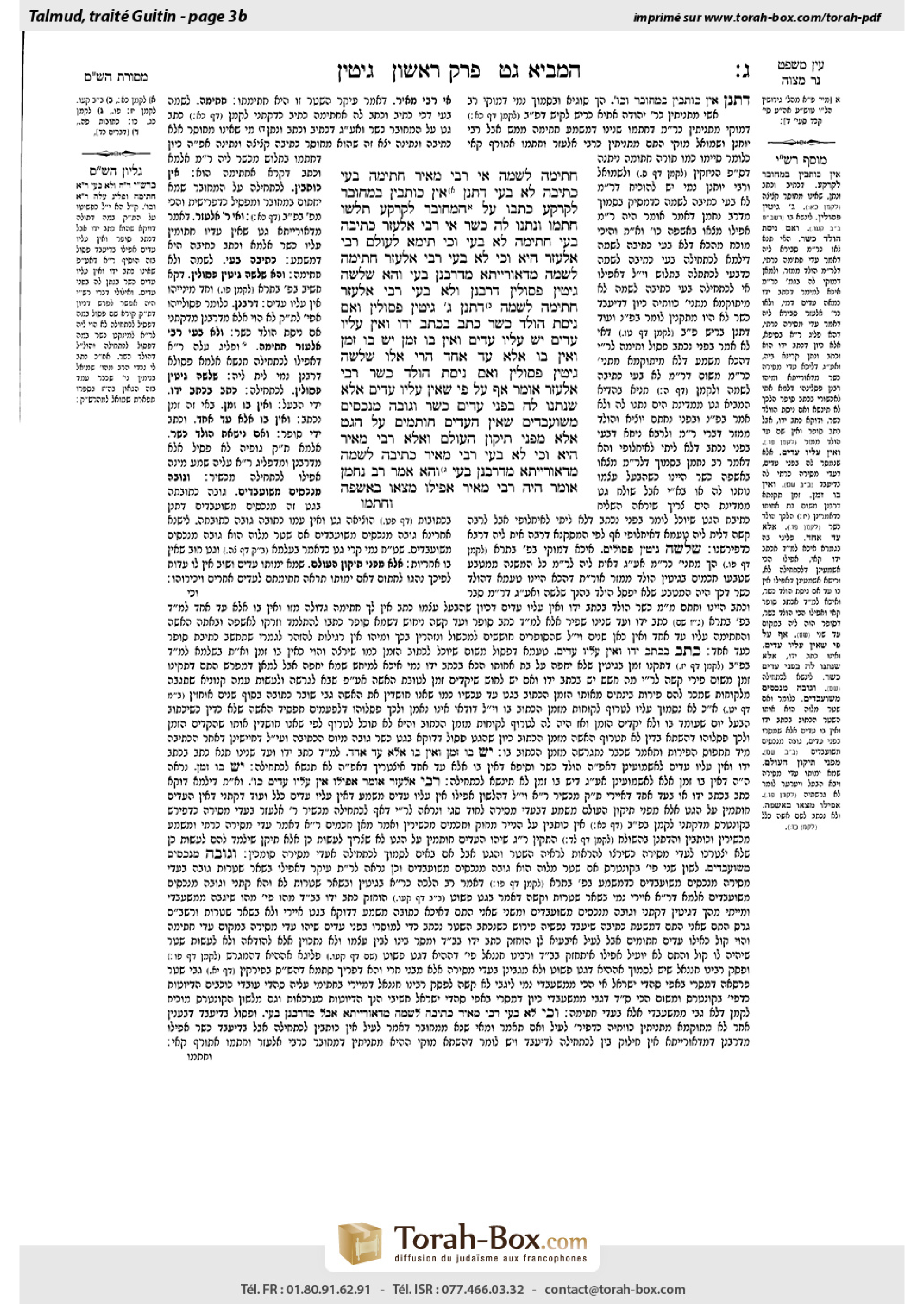
Gittin 3b: Talmud study for Daf Yomi
Study the Talmud for Daf Yomi with scanned pages, Hebrew text, English translations from Sefaria and AI-generated French translations.
Passage selection and English or AI-generated French translation are available where the scan has annotations. Daf Study is independent of Torah-Box and Sefaria.
Browse Gittin · גיטין · All tractatesGittin 3b text and translations
This page of Gittin includes the Aramaic text, an English translation and an AI-generated French translation, alongside the scan above.
גיטין ג׳ ב · Aramaic and Hebrew text
חֲתִימָה לִשְׁמָהּ? אִי רַבִּי מֵאִיר – חֲתִימָה בָּעֵי, כְּתִיבָה לָא בָּעֵי! דִּתְנַן: אֵין כּוֹתְבִין בִּמְחוּבָּר לַקַּרְקַע. כְּתָבוֹ עַל הַמְחוּבָּר לַקַּרְקַע, תְּלָשׁוֹ, חֲתָמוֹ וּנְתָנוֹ לָהּ – כָּשֵׁר!
אִי רַבִּי אֶלְעָזָר – כְּתִיבָה בָּעֵי, חֲתִימָה לָא בָּעֵי! וְכִי תֵּימָא לְעוֹלָם רַבִּי אֶלְעָזָר הִיא, וְכִי לָא בָּעֵי רַבִּי אֶלְעָזָר חֲתִימָה לִשְׁמָהּ – מִדְּאוֹרָיְיתָא, מִדְּרַבָּנַן – בָּעֵי; וְהָא שְׁלֹשָׁה גִּיטִּין פְּסוּלִין דְּרַבָּנַן, וְלָא בָּעֵי רַבִּי אֶלְעָזָר חֲתִימָה לִשְׁמָהּ!
דִּתְנַן: שְׁלֹשָׁה גִּיטִּין פְּסוּלִין, וְאִם נִיסַּת הַוָּלָד כָּשֵׁר: כָּתַב בִּכְתַב יָדוֹ וְאֵין עָלָיו עֵדִים, יֵשׁ עָלָיו עֵדִים וְאֵין בּוֹ זְמַן, יֵשׁ בּוֹ זְמַן וְאֵין בּוֹ אֶלָּא עֵד אֶחָד – הֲרֵי אֵלּוּ שְׁלֹשָׁה גִּיטִּין פְּסוּלִין, וְאִם נִיסַּת – הַוָּלָד כָּשֵׁר.
רַבִּי אֶלְעָזָר אוֹמֵר: אַף עַל פִּי שֶׁאֵין עָלָיו עֵדִים – אֶלָּא שֶׁנְּתָנוֹ לָהּ בִּפְנֵי עֵדִים; כָּשֵׁר, וְגוֹבֶה מִנְּכָסִים מְשׁוּעְבָּדִים. שֶׁאֵין הָעֵדִים חוֹתְמִים עַל הַגֵּט אֶלָּא מִפְּנֵי תִּיקּוּן הָעוֹלָם.
וְאֶלָּא רַבִּי מֵאִיר הִיא, וְכִי לָא בָּעֵי רַבִּי מֵאִיר כְּתִיבָה לִשְׁמָהּ – מִדְּאוֹרָיְיתָא, מִדְּרַבָּנַן בָּעֵי; וְהָא אָמַר רַב נַחְמָן, אוֹמֵר הָיָה רַבִּי מֵאִיר: אֲפִילּוּ מְצָאוֹ בְּאַשְׁפָּה,
Gittin 3b · English translation
that the signing must be performed for her sake? If it is in accordance with the opinion of Rabbi Meir, he requires signing for her sake; however, he does not require that the writing must be for her sake. As we learned in a mishna (21b): One may not write a bill of divorce on anything that is attached to the ground, e.g., a leaf attached to a tree. However, if he wrote it on something that is attached to the ground, and then he detached it, signed it, and gave it to her, it is valid. This indicates that the essential stage of writing a bill of divorce is when it is signed by witnesses. The Gemara says that this is Rabbi Meir’s opinion, as an unattributed ruling in the mishna typically follows the opinion of Rabbi Meir.
If it is in accordance with the opinion of Rabbi Elazar, who disagrees with Rabbi Meir and requires that the writing must be for her sake, he does not require that the signing must be for her sake. And if you would say that actually the mishna is in accordance with the opinion of Rabbi Elazar, and when Rabbi Elazar does not require signing for her sake, he means by Torah law, whereas by rabbinic law he requires that bills of divorce must be signed for her sake; but that is untenable, as the Sages listed three bills of divorce that are valid by Torah law but are invalid by rabbinic law, and when he disputes that ruling Rabbi Elazar does not require that the signing must be for her sake.
As we learned in a mishna (86a): Three bills of divorce are invalid ab initio, but if the woman married another man after having received one of these bills of divorce the offspring is of unflawed lineage. In other words, she is not considered to be a married woman who engaged in sexual intercourse with another man, which would render their child as one born from an adulterous relationship [mamzer]. And these three are: A bill of divorce that the husband wrote in his handwriting but there are no signatures of witnesses on the document; and if there are the signatures of witnesses on the document but there is no date written on it; and if there is a date written on it but it has only one witness signed on it. These are the three invalid bills of divorce concerning which the Sages said: And if she married, the offspring is of unflawed lineage.
The mishna continues: Rabbi Elazar says: Even though there are no signatures of witnesses on the document, but he gave it to her in the presence of two witnesses, it is a valid bill of divorce. And on the basis of this bill of divorce the woman can collect the amount written to her in her marriage contract even from liened property, as Rabbi Elazar maintains that witnesses sign the bill of divorce only for the betterment of the world. If no witnesses sign a bill of divorce the husband could contest its validity at any time by denying that he wrote it. In any case, it can be seen from this mishna that according to Rabbi Elazar the signatures of the witnesses are not an essential part of a bill of divorce. Consequently, it does not need to be signed for her sake, even by rabbinic law.
But rather, you can say that the mishna is in accordance with the opinion of Rabbi Meir, and when Rabbi Meir does not require that the writing must be for her sake, he meant by Torah law, whereas by rabbinic law he does require that the writing must be for her sake. However, the Gemara raises a difficulty against this explanation as well: But didn’t Rav Naḥman say that Rabbi Meir would say: A bill of divorce need not be written for her sake, and even if a husband found a bill of divorce in the garbage, and the names of the man and woman in the bill of divorce are the same as his name and that of his wife,
Gittin 3b · Traduction française (IA)
Que la signature doit être faite en son nom ? Si c'est selon l'opinion du Rabbi Meir, il exige la signature en son nom ; cependant, il ne requiert pas que l'écriture soit faite en son nom. Comme nous l'avons appris dans une mitsva (21b) : On ne peut pas écrire un acte de divorce sur quelque chose qui est attaché au sol, par exemple une feuille attachée à un arbre. Cependant, si l'on a écrit l'acte de divorce sur quelque chose qui est attaché au sol, puis qu'on l'a détaché, signé et donné à elle, cela est valide. Cela montre que la phase essentielle d'écrire un acte de divorce est lorsque l'acte est signé par des témoins. La Guemara dit que c'est l'opinion du Rabbi Meir, car une décision non attribuée dans la mitsva suit généralement l'opinion du Rabbi Meir.
Si c'est selon l'opinion du Rabbi Elazar, qui s'oppose au Rabbi Meir et exige que l'écriture soit faite en son nom, il ne requiert pas que la signature soit faite en son nom. Et si l'on disait que la mitsva est selon l'opinion du Rabbi Elazar, et que lorsque le Rabbi Elazar ne requiert pas la signature en son nom, cela signifie selon la loi divine, alors que selon la loi rabbinique il exige que les actes de divorce soient signés en son nom ; mais cela est inacceptable, car les Sages ont listé trois actes de divorce valides selon la loi divine mais invalides selon la loi rabbinique, et lorsque le Rabbi Elazar conteste cette décision, il ne requiert pas que la signature soit faite en son nom.
Comme nous l'avons appris dans une mitsva (86a) : Trois actes de divorce sont invalides dès leur émission, mais si la femme a épousé un autre homme après avoir reçu l'un de ces actes de divorce, l'enfant est de lignage pur. En d'autres termes, elle n'est pas considérée comme une femme mariée ayant eu des relations sexuelles avec un autre homme, ce qui rendrait leur enfant né d'une relation adultère [mamzer]. Et ces trois sont : Un acte de divorce que l'époux a écrit de sa propre main mais sans signatures de témoins sur le document ; et si les signatures des témoins sont présentes sur le document mais il n'y a pas d'écriture de date ; et si une date est écrite mais il n'y a qu'un seul témoin signé. Ces trois sont les actes de divorce invalides concernant lesquels les Sages ont dit : Et si elle s'est mariée, l'enfant est de lignage pur.
La mitsva continue : Le Rabbi Elazar dit : Même s'il n'y a pas de signatures de témoins sur le document, mais qu'il l'a donné à elle en présence de deux témoins, c'est un acte de divorce valide. Et sur la base de cet acte de divorce, la femme peut récupérer la somme écrite dans son contrat de mariage même sur des biens hypothéqués, car le Rabbi Elazar maintient que les témoins signent l'acte de divorce uniquement pour le bien du monde. Si aucun témoin ne signe un acte de divorce, le mari pourrait contester sa validité à tout moment en démentant avoir écrit cet acte. En tout cas, on peut voir à partir de cette mitsva que selon le Rabbi Elazar, les signatures des témoins ne sont pas une partie essentielle d'un acte de divorce. Par conséquent, il n'a pas besoin d'être signé en son nom, même selon la loi rabbinique.
Mais plutôt, on peut dire que la Michna suit l'opinion du Rabbi Meir, et lorsque le Rabbi Meir ne requiert pas que l'écriture soit faite en son nom, il signifie selon la loi divine, alors que selon la loi rabbinique il exige que l'écriture soit faite en son nom. Cependant, la Guemara soulève une difficulté contre cette explication également : N'a-t-on pas dit que le Rabbi Meir dirait : Un acte de divorce n'a pas besoin d'être écrit en son nom, et même si un mari trouvait un acte de divorce dans la poubelle, et les noms du mari et de la femme dans l'acte de divorce sont les mêmes que son nom et celui de sa femme,
Traduction française générée par IA à partir de l’édition anglaise de Sefaria. Vérifie toujours un passage avec le texte source.
Text from Sefaria: William Davidson Edition - Vocalized Aramaic (CC BY NC); William Davidson Edition - English (CC BY NC).