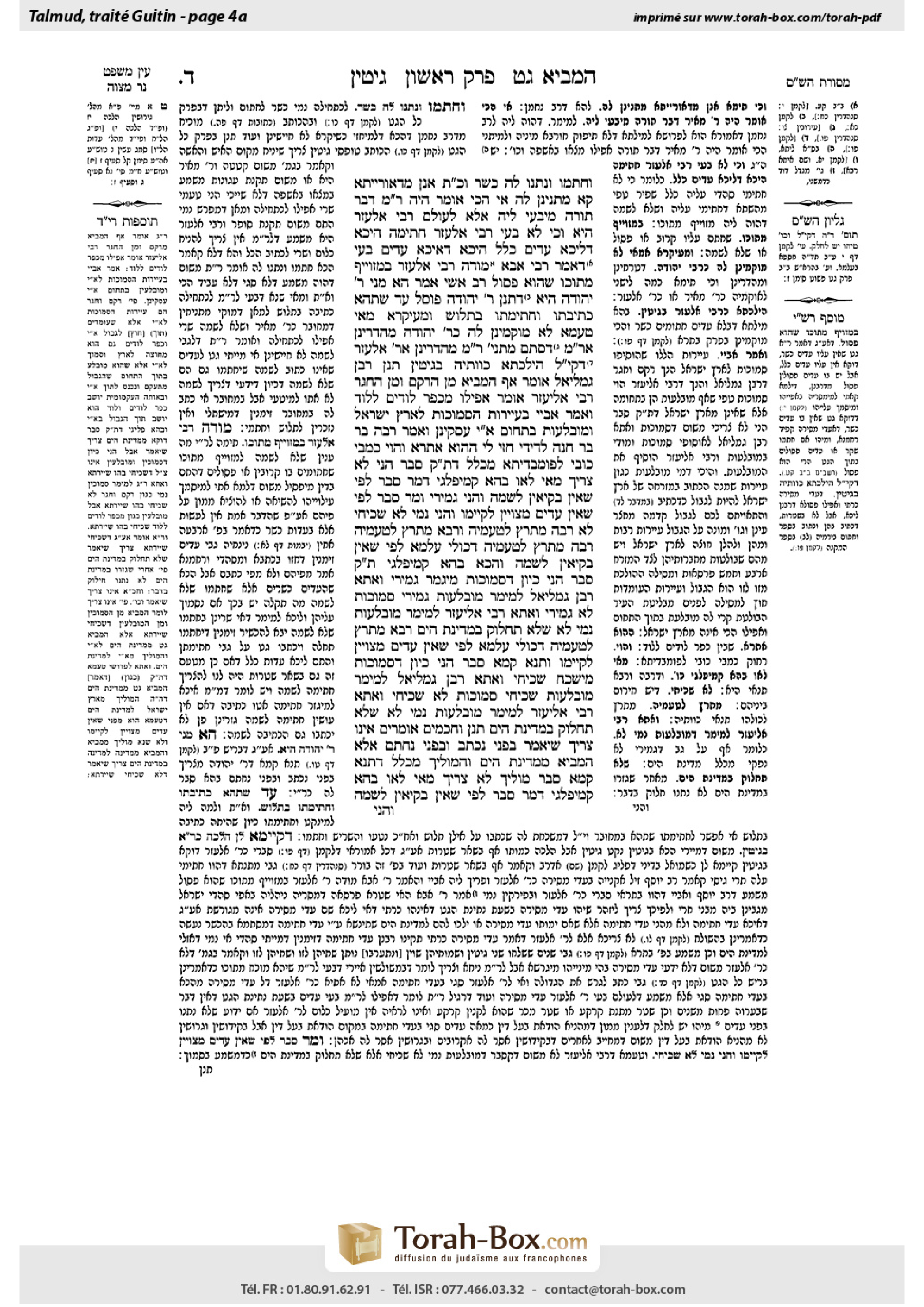
Gittin 4a: Talmud study for Daf Yomi
Study the Talmud for Daf Yomi with scanned pages, Hebrew text, English translations from Sefaria and AI-generated French translations.
Passage selection and English or AI-generated French translation are available where the scan has annotations. Daf Study is independent of Torah-Box and Sefaria.
Browse Gittin · גיטין · All tractatesGittin 4a text and translations
This page of Gittin includes the Aramaic text, an English translation and an AI-generated French translation, alongside the scan above.
גיטין ד׳ א · Aramaic and Hebrew text
וַחֲתָמוֹ וּנְתָנוֹ לָהּ – כָּשֵׁר! וְכִי תֵּימָא אֲנַן מִדְּאוֹרָיְיתָא קָא מַתְנִינַן לַהּ, אִי הָכִי, ״אוֹמֵר הָיָה רַבִּי מֵאִיר דְּבַר תּוֹרָה״ מִיבְּעֵי לֵיהּ!
אֶלָּא לְעוֹלָם רַבִּי אֶלְעָזָר הִיא, וְכִי לָא בָּעֵי רַבִּי אֶלְעָזָר חֲתִימָה – הֵיכָא דְּלֵיכָּא עֵדִים כְּלָל; הֵיכָא דְּאִיכָּא עֵדִים – בָּעֵי. דְּאָמַר רַבִּי אַבָּא: מוֹדֶה רַבִּי אֶלְעָזָר בִּמְזוּיָּיף מִתּוֹכוֹ, שֶׁהוּא פָּסוּל.
רַב אָשֵׁי אָמַר: הָא מַנִּי? רַבִּי יְהוּדָה הִיא, דִּתְנַן: רַבִּי יְהוּדָה פּוֹסֵל, עַד שֶׁתְּהֵא כְּתִיבָתוֹ וַחֲתִימָתוֹ בְּתָלוּשׁ.
וּמֵעִיקָּרָא מַאי טַעְמָא לָא מוֹקְמִינַן לַהּ כְּרַבִּי יְהוּדָה?
מְהַדְּרִינַן אַרַבִּי מֵאִיר, דִּסְתַם מַתְנִיתִין רַבִּי מֵאִיר; מְהַדְּרִינַן אַרַבִּי אֶלְעָזָר, דְּקַיְימָא לַן הִילְכְתָא כְּווֹתֵיהּ בְּגִיטִּין.
תְּנַן, רַבָּן גַּמְלִיאֵל אוֹמֵר: אַף הַמֵּבִיא מִן הָרְקָם וּמִן הַחֶגֶר. רַבִּי אֱלִיעֶזֶר אוֹמֵר: אֲפִילּוּ מִכְּפַר לוּדִּים לְלוֹד. וְאָמַר אַבָּיֵי: בַּעֲיָירוֹת הַסְּמוּכוֹת לְאֶרֶץ יִשְׂרָאֵל וּמוּבְלָעוֹת בִּתְחוּם אֶרֶץ יִשְׂרָאֵל עָסְקִינַן,
וְאָמַר רַבָּה בַּר בַּר חָנָה: לְדִידִי חֲזֵי לִי הָהוּא אַתְרָא, וְהָוֵי כְּמִבֵּי כוּבֵּי לְפוּמְבְּדִיתָא.
מִכְּלָל דְּתַנָּא קַמָּא סָבַר הָנֵי לָא צְרִיךְ; מַאי, לָאו בְּהָא קָמִיפַּלְגִי – דְּמָר סָבַר לְפִי שֶׁאֵין בְּקִיאִין לִשְׁמָהּ, וְהָנֵי גְּמִירִי; וּמָר סָבַר לְפִי שֶׁאֵין עֵדִים מְצוּיִין לְקַיְּימוֹ, וְהָנֵי נָמֵי לָא שְׁכִיחִי?
לָא; רַבָּה מְתָרֵץ לְטַעְמֵיהּ, וְרָבָא מְתָרֵץ לְטַעְמֵיהּ. רַבָּה מְתָרֵץ לְטַעְמֵיהּ: דְּכוּלֵּי עָלְמָא לְפִי שֶׁאֵין בְּקִיאִין לִשְׁמָהּ, וְהָכָא בְּהָא קָמִיפַּלְגִי – תַּנָּא קַמָּא סָבַר, הָנֵי כֵּיוָן דִּסְמוּכוֹת מִיגְמָר גְּמִירִי;
וַאֲתָא רַבָּן גַּמְלִיאֵל לְמֵימַר, מוּבְלָעוֹת גְּמִירִי, סְמוּכוֹת לָא גְּמִירִי; וַאֲתָא רַבִּי אֱלִיעֶזֶר לְמֵימַר, מוּבְלָעוֹת נָמֵי לָא, שֶׁלֹּא תַּחְלוֹק בִּמְדִינַת הַיָּם.
רָבָא מְתָרֵץ לְטַעְמֵיהּ: דְּכוּלֵּי עָלְמָא לְפִי שֶׁאֵין עֵדִים מְצוּיִין לְקַיְּימוֹ – וְתַנָּא קַמָּא סָבַר, הָנֵי כֵּיוָן דִּסְמוּכוֹת מִישְׁכָּח שְׁכִיחִי;
וַאֲתָא רַבָּן גַּמְלִיאֵל לְמֵימַר, מוּבְלָעוֹת שְׁכִיחִי, סְמוּכוֹת לָא שְׁכִיחִי; וַאֲתָא רַבִּי אֱלִיעֶזֶר לְמֵימַר, מוּבְלָעוֹת נָמֵי לָא, שֶׁלֹּא תַּחְלוֹק בִּמְדִינַת הַיָּם.
תְּנַן, וַחֲכָמִים אוֹמְרִים: אֵינוֹ צָרִיךְ שֶׁיֹּאמַר ״בְּפָנַי נִכְתַּב וּבְפָנַי נֶחְתַּם״, אֶלָּא הַמֵּבִיא מִמְּדִינַת הַיָּם וְהַמּוֹלִיךְ. מִכְּלָל דְּתַנָּא קַמָּא סָבַר מוֹלִיךְ לָא צְרִיךְ; מַאי, לָאו בְּהָא קָמִיפַּלְגִי – דְּמָר סָבַר לְפִי שֶׁאֵין בְּקִיאִין לִשְׁמָהּ,
Gittin 4a · English translation
and he signed it and gave it to his wife, it is a valid bill of divorce? And if you would say that we learned that this statement of Rav Naḥman applies by Torah law, whereas by rabbinic law Rabbi Meir concedes that a bill of divorce must be written for her sake, if so, Rav Naḥman should have said: Rabbi Meir would say that by Torah law if a husband found a document in the garbage he may use it.
Rather, the Gemara retracts the previous answer and states: Actually, the mishna is in accordance with the opinion of Rabbi Elazar, and when does Rabbi Elazar not require that the signing must be for her sake? Where there are no witnesses at all on the bill of divorce. However, where there are witnesses, he does require that all their signatures must be for her sake. The proof for this is that Rabbi Abba says: Rabbi Elazar concedes with regard to a document whose falsification is inherent in it, i.e., a document that is signed by disqualified witnesses, that it is invalid. This shows that although Rabbi Elazar maintains that a lack of signatures does not invalidate a bill of divorce, all signatures included in the bill of divorce must be valid; otherwise the document is rendered invalid.
Rav Ashi said a different explanation: In accordance with whose opinion is this mishna? It is in accordance with a third opinion, that of Rabbi Yehuda. As we learned in a mishna (21b): Rabbi Yehuda invalidates a bill of divorce unless its writing and signing are performed on an item that is detached from the ground. According to this opinion, both the writing and the signing must be done for her sake.
The Gemara asks: And initially, what is the reason we did not establish the mishna in accordance with the opinion of Rabbi Yehuda? Since Rabbi Yehuda’s opinion is explicitly stated in a mishna, isn’t it obvious that this mishna also follows his ruling?
The Gemara answers: We seek to explain the mishna in accordance with the opinion of Rabbi Meir, as there is a general principle that a ruling in an unattributed mishna is in accordance with the opinion of Rabbi Meir. Likewise, we seek to interpret the mishna in accordance with the ruling of Rabbi Elazar, as we maintain in general that the halakha is in accordance with his opinion with regard to bills of divorce. For these reasons, the Gemara first attempted to interpret the mishna in accordance with the opinion of one of these tanna’im, not that of Rabbi Yehuda.
§ The Gemara continues to explain the mishna in light of the dispute between Rabba and Rava. We learned in the mishna that Rabban Gamliel says: Even one who brings a bill of divorce from Rekem or from Ḥeger must say: It was written in my presence and it was signed in my presence. Rabbi Eliezer says: Even one who brings a bill of divorce from the village of Ludim to Lod. And Abaye said in explanation of this matter: We are dealing with towns that are not part of the land itself, but are near Eretz Yisrael and within the boundary of Eretz Yisrael.
And Rabba bar bar Ḥana said: I myself saw that place, i.e., the distance between the village of Ludim and Lod, and it was similar to the distance from Bei Kuvei to Pumbedita, which is only a short distance.
The Gemara analyzes the mishna: One can derive by inference that the first tanna of the mishna holds that in these places the agent is not required to testify that the bill of divorce was written and signed for the woman’s sake. What, is it not the case that they disagree with regard to this principle, as one Sage, the first tanna, holds that the reason for saying: It was written in my presence and it was signed in my presence, is because people living overseas are not experts in writing a bill of divorce for her sake, and the residents of these places are learned in this matter, as they are near Eretz Yisrael. And one Sage, Rabban Gamliel, holds: The reason is because there are no witnesses available to ratify it, and the residents of these places are also not frequently available, as they live on the other side of the border, and it is difficult to bring witnesses from one place to another.
The Gemara rejects this suggestion: No, there is no proof that this issue is a dispute among tanna’im, as Rabba resolves the different opinions in the mishna according to his line of reasoning, and Rava resolves them according to his line of reasoning. The Gemara elaborates: Rabba resolves them according to his line of reasoning, as everyone agrees that the reason is because they are not experts in writing a bill of divorce for her sake. And here they disagree with regard to this issue: The first tanna holds that since the residents of these cities are located near Eretz Yisrael, they are assumed to be learned in this halakha.
And Rabban Gamliel came to say: Granted, the residents of those cities that are within the boundary of Eretz Yisrael are learned in this halakha, however, the residents of these cities that are only near Eretz Yisrael are not learned. And Rabbi Eliezer came to say, when he mentioned the village of Ludim and the town of Lod, that the residents of those cities that are within the boundary of Eretz Yisrael are also not treated as learned, so that you should not make a distinction within separate areas of the country overseas. In other words, anywhere that is not part of the Jewish settlement of Eretz Yisrael is classified as outside, even if they are familiar with the halakhot of bills of divorce.
Likewise, Rava resolves the various opinions in the mishna according to his line of reasoning. He maintains that everyone agrees that the reason for the declaration: It was written in my presence and it was signed in my presence, is because there are no witnesses available to ratify it. And the first tanna holds: Since the residents of these cities are nearby they are frequently available.
And Rabban Gamliel came to say: The residents of cities within the boundary of Eretz Yisrael are frequently available. However, the residents of places that are merely near Eretz Yisrael are not frequently available. And Rabbi Eliezer came to say that the residents of those cities that are within the boundary of Eretz Yisrael are also not considered to be like Eretz Yisrael in this matter, despite their proximity to the Jewish settlement, so that you should not make a distinction within separate areas of a country overseas.
§ We learned in the mishna: And the Rabbis say that one is required to say: It was written in my presence and it was signed in my presence, only if he brings a bill of divorce from a country overseas to Eretz Yisrael, and the same applies to one who delivers a bill of divorce from Eretz Yisrael to a country overseas. The Gemara analyzes this statement: One can learn by inference that the first tanna of the mishna holds that one who delivers a bill of divorce from Eretz Yisrael to a country overseas is not required to say this declaration. What, is it not the case that they disagree with regard to this principle, as one Sage, the first tanna, holds that the reason for the declaration is because they are not experts in writing a bill of divorce for her sake,
Gittin 4a · Traduction française (IA)
et il l'a signé et le lui a donné, est-ce un divorce valide ? Et si l'on disait que nous avons appris que cette déclaration de Rav Naḥman s'applique selon la halakha, tandis que selon la loi rabbinique, le maître Rabbi Meïr reconnaît que le divorce doit être écrit à son intention, si tel est le cas, Rav Naḥman aurait dû dire : Rabbi Meïr dirait que selon la halakha, si un mari trouve un document dans la poubelle, il peut l'utiliser.
En réalité, la Guemara retire cette réponse précédente et affirme : En fait, la mitsva est selon l'opinion de Rabbi Elazar, et quand Rabbi Elazar ne requiert pas que la signature soit faite à son intention ? Lorsqu'il n'y a aucun témoin sur le document de divorce. Cependant, lorsqu'il y a des témoins, il exige que toutes leurs signatures soient faites à son intention. La preuve de cela est que Rabbi Abba dit : Rabbi Elazar reconnaît un document dont la falsification est inhérente, c'est-à-dire un document signé par des témoins inéligibles, comme invalide. Cela montre que bien que Rabbi Elazar maintienne que l'absence de signatures ne rend pas invalide un document de divorce, toutes les signatures incluses dans ce document doivent être valides ; autrement, le document est rendu invalide.
Rav Ashi a dit une autre explication : selon l'opinion de qui est cette mitsva ? Elle est selon une troisième opinion, celle de Rabbi Yéhuda. Comme nous avons appris dans une mitsva (21b) : Rabbi Yéhuda invalide un document de divorce à moins que l'écriture et la signature ne soient accomplies sur un objet détaché du sol. Selon cette opinion, à la fois l'écriture et la signature doivent être faites à son intention.
La Guemara demande : Et pourquoi, d'abord, n'avons-nous pas établi la mitsna selon l'opinion de Rabbi Yéhuda ? Puisque l'opinion de Rabbi Yéhuda est explicitement énoncée dans une mitsna, n'est-ce pas évident que cette mitsna suit également sa décision ?
La Guemara répond : Nous cherchons à expliquer la mitsna selon l'opinion de Rabbi Meïr, car il existe un principe général selon lequel une décision dans une mitsna non attribuée suit l'opinion de Rabbi Meïr. De même, nous cherchons à interpréter la mitsna selon la décision de Rabbi Elazar, car nous maintenons en général que la halakha suit son opinion concernant les documents de divorce. Pour ces raisons, la Guemara a d'abord tenté d'interpréter la mitsna selon l'opinion d'un de ces tannaïm, pas celle de Rabbi Yéhuda.
§ La Guemara continue d'expliquer la mitsna en lumière du débat entre Rabba et Rava. Nous avons appris dans la mitsna que Rabban Gamliel dit : Même celui qui apporte un document de divorce de Rekem ou de Ḥeger doit dire : Il a été écrit en mon présence et il a été signé en mon présence. Rabbi Eliezer dit : Même celui qui apporte un document de divorce de la ville de Ludim à Lod. Et Abaye a dit dans l'explication de cette affaire : Nous traitons de villes qui ne font pas partie du pays lui-même, mais qui sont proches de la Terre d'Israël et à l'intérieur de la frontière de la Terre d'Israël.
Et Rabba bar bar Ḥana a dit : Je l'ai moi-même vu, c'est-à-dire la distance entre la ville de Ludim et Lod, et elle était semblable à la distance entre Bei Kuvei et Pumbedita, qui est une courte distance.
La Guemara analyse la mitsna : On peut en déduire par l'inférence que le premier tanna de la mitsna maintient que dans ces lieux l'agent n'est pas requis de témoigner que le document de divorce a été écrit et signé à son intention. Qu'est-ce que cela n'est pas le cas, que ces sages ne s'opposent pas à ce principe, car un sage, le premier tanna, maintient que la raison de dire : Il a été écrit en mon présence et il a été signé en mon présence, est parce que les gens vivant à l'étranger ne sont pas experts pour écrire un document de divorce à son intention, et les habitants de ces lieux sont instruits dans cette matière, car ils sont proches de la Terre d'Israël. Et un autre sage, Rabban Gamliel, maintient : La raison est parce qu'il n'y a pas de témoins disponibles pour valider, et les habitants de ces lieux sont également peu disponibles, car ils habitent de l'autre côté de la frontière, et il est difficile d'apporter des témoins d'un lieu à un autre.
La Guemara rejette cette suggestion : Non, il n'y a pas de preuve que cette question soit un débat entre les tannaïm, car Rabba résout les différentes opinions de la mitsna selon sa ligne de raisonnement, et Rava résout également selon sa ligne de raisonnement. La Guemara développe : Rabba résout selon sa ligne de raisonnement, car tout le monde convient que la raison est parce qu'ils ne sont pas experts pour écrire un document de divorce à son intention. Et ici ils s'opposent à ce point : le premier tanna maintient que puisque les habitants de ces villes sont proches de la Terre d'Israël, ils sont supposés être instruits dans cette halakha.
Et Rabban Gamliel a dit : Bien sûr, les habitants de ces villes qui sont à l'intérieur de la frontière de la Terre d'Israël sont instruits dans cette halakha, cependant, les habitants de ces villes qui sont seulement proches de la Terre d'Israël ne le sont pas. Et Rabbi Eliezer a dit, lorsqu'il a mentionné la ville de Ludim et la ville de Lod, que les habitants de ces villes qui sont à l'intérieur de la frontière de la Terre d'Israël ne sont pas non plus traités comme instruits, de sorte que vous ne devriez pas faire de distinction au sein des différentes zones du pays à l'étranger. En d'autres termes, n'importe où qui n'est pas partie de la colonie juive de la Terre d'Israël est classé comme étant à l'extérieur, même s'ils sont familiers avec les halakhot des documents de divorce.
De même, Rava résout les différentes opinions de la Michna selon sa ligne de raisonnement. Il affirme que tout le monde convient que la raison de la déclaration : Il a été écrit en mon présence et il a été signé en mon présence, est parce qu'il n'y a pas de témoins disponibles pour valider. Et le premier tanna affirme : Puisque les habitants de ces villes sont proches, ils sont fréquemment disponibles.
Et Rabban Gamliel est venu dire : Les habitants des villes situées à l'intérieur des limites de la Terre d'Israël sont fréquemment disponibles. Cependant, les habitants des lieux simplement proches de la Terre d'Israël ne sont pas fréquemment disponibles. Et Rabbi Éliezer est venu dire que les habitants de ces villes situées à l'intérieur des limites de la Terre d'Israël ne sont pas considérés comme étant comme la Terre d'Israël en ce qui concerne cette affaire, malgré leur proximité avec le lieu de résidence juif, de sorte que vous ne devriez pas faire de distinction au sein des différentes zones d'un pays étranger.
§ Nous avons appris dans la Michna : Et les Sages disent qu'on est tenu de dire : Il a été écrit devant moi et il a été signé devant moi, seulement si l'on apporte un acte de divorce d'un pays étranger vers la Terre d'Israël, et la même chose s'applique à celui qui apporte un acte de divorce de la Terre d'Israël vers un pays étranger. La Guemara analyse cette déclaration : On peut en déduire par analogie que le premier tanna de la Michna considère que celui qui apporte un acte de divorce de la Terre d'Israël vers un pays étranger n'est pas tenu de dire cette déclaration. Qu'est-ce que cela signifie, n'est-ce pas que cela ne correspond pas à ce principe, puisque l'un des Sages, le premier tanna, considère que la raison de cette déclaration est qu'ils ne sont pas experts pour écrire un acte de divorce à son intention,
Traduction française générée par IA à partir de l’édition anglaise de Sefaria. Vérifie toujours un passage avec le texte source.
Text from Sefaria: William Davidson Edition - Vocalized Aramaic (CC BY NC); William Davidson Edition - English (CC BY NC).