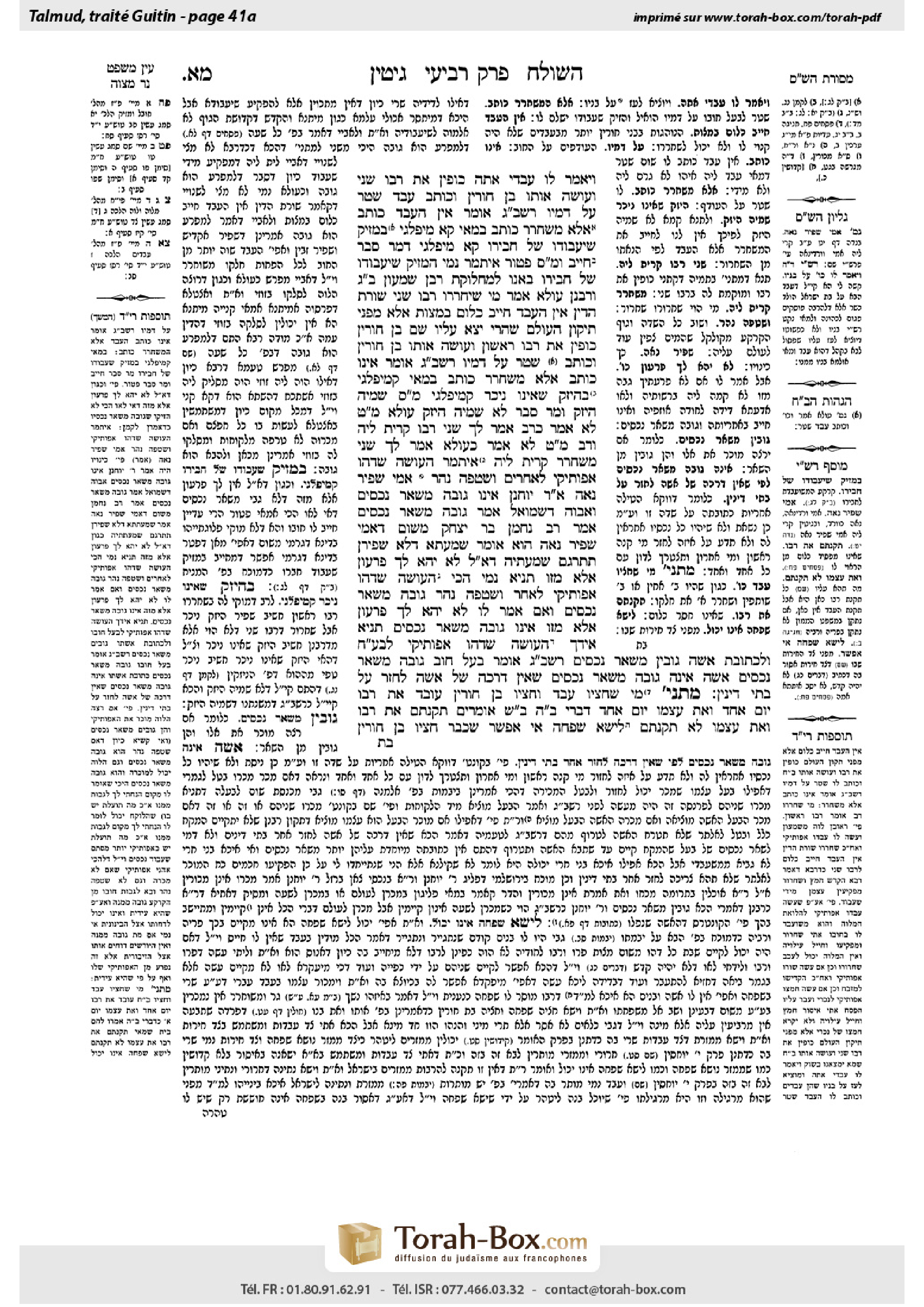
Gittin 41a: Talmud study for Daf Yomi
Study the Talmud for Daf Yomi with scanned pages, Hebrew text, English translations from Sefaria and AI-generated French translations.
Passage selection and English or AI-generated French translation are available where the scan has annotations. Daf Study is independent of Torah-Box and Sefaria.
Browse Gittin · גיטין · All tractatesGittin 41a text and translations
This page of Gittin includes the Aramaic text, an English translation and an AI-generated French translation, alongside the scan above.
גיטין מ״א א · Aramaic and Hebrew text
וְיֹאמַר לוֹ: ״עַבְדִּי אָתָּה״ – כּוֹפִין אֶת רַבּוֹ שֵׁנִי, וְעוֹשֶׂה אוֹתוֹ בֶּן חוֹרִין, וְכוֹתֵב עֶבֶד שְׁטָר עַל דָּמָיו. רַבָּן שִׁמְעוֹן בֶּן גַּמְלִיאֵל אוֹמֵר: אֵין הָעֶבֶד כּוֹתֵב אֶלָּא מְשַׁחְרֵר כּוֹתֵב.
בְּמַאי קָא מִיפַּלְגִי? בְּמַזִּיק שִׁיעְבּוּדוֹ שֶׁל חֲבֵירוֹ קָא מִיפַּלְגִי – דְּמָר סָבַר חַיָּיב, וּמָר סָבַר פָּטוּר.
אִיתְּמַר נָמֵי: הַמַּזִּיק שִׁיעְבּוּדוֹ שֶׁל חֲבֵירוֹ, בָּאנוּ לְמַחְלוֹקֶת רַבָּן שִׁמְעוֹן בֶּן גַּמְלִיאֵל וְרַבָּנַן.
עוּלָּא אָמַר: מִי שִׁיחְרְרוֹ – רַבּוֹ שֵׁנִי. שׁוּרַת הַדִּין אֵין הָעֶבֶד חַיָּיב כְּלוּם בְּמִצְוֹת; אֶלָּא מִפְּנֵי תִּיקּוּן הָעוֹלָם – שֶׁהֲרֵי יָצָא עָלָיו שֵׁם בֶּן חוֹרִין, כּוֹפִין אֶת רַבּוֹ רִאשׁוֹן וְעוֹשֶׂה אוֹתוֹ בֶּן חוֹרִין, וְכוֹתֵב שְׁטָר עַל דָּמָיו. רַבָּן שִׁמְעוֹן בֶּן גַּמְלִיאֵל אוֹמֵר: אֵינוֹ כּוֹתֵב, אֶלָּא מְשַׁחְרֵר כּוֹתֵב.
בְּמַאי קָמִיפַּלְגִי? בְּהֶיזֵּק שֶׁאֵינוֹ נִיכָּר קָמִיפַּלְגִי – מָר סָבַר: שְׁמֵיהּ הֶיזֵּק, וּמָר סָבַר: לָא שְׁמֵיהּ הֶיזֵּק.
עוּלָּא, מַאי טַעְמָא לָא אָמַר כְּרַב? אָמַר לָךְ: שֵׁנִי – ״רַבּוֹ״ קָרֵית לֵיהּ?!
וְרַב, מַאי טַעְמָא לָא אָמַר כְּעוּלָּא? אָמַר לָךְ: שֵׁנִי – ״מְשַׁחְרֵר״ קָרֵית לֵיהּ?!
אִיתְּמַר: הָעוֹשָׂה שָׂדֵהוּ אַפּוֹתֵיקֵי לַאֲחֵרִים, וּשְׁטָפָהּ נָהָר; אַמֵּי שַׁפִּיר נָאֶה אָמַר רַבִּי יוֹחָנָן: אֵינוֹ גּוֹבֶה מִשְּׁאָר נְכָסִים; וַאֲבוּהּ דִּשְׁמוּאֵל אָמַר: גּוֹבֶה מִשְּׁאָר נְכָסִים.
אָמַר רַב נַחְמָן בַּר יִצְחָק: מִשּׁוּם דְּאַמֵּי שַׁפִּיר נָאֶה הוּא, אוֹמֵר שְׁמַעְתָּא דְּלָא שַׁפִּירָן?! תְּתַרְגַּם שְׁמַעְתֵּיהּ, דַּאֲמַר לֵיהּ: ״לֹא יְהֵא לְךָ פֵּרָעוֹן אֶלָּא מִזּוֹ״.
תַּנְיָא נָמֵי הָכִי: הָעוֹשָׂה שָׂדֵהוּ אַפּוֹתֵיקֵי לְאַחֵר, וּשְׁטָפָהּ נָהָר – גּוֹבֶה מִשְּׁאָר נְכָסִים. וְאִם אָמַר לוֹ: ״לֹא יְהֵא לְךָ פֵּרָעוֹן אֶלָּא מִזּוֹ״ – אֵינוֹ גּוֹבֶה מִשְּׁאָר נְכָסִים.
תַּנְיָא אִידַּךְ: הָעוֹשֶׂה שָׂדֵהוּ אַפּוֹתֵיקֵי לְבַעַל חוֹב וְלִכְתוּבַּת אִשָּׁה – גּוֹבִין מִשְּׁאָר נְכָסִים. רַבָּן שִׁמְעוֹן בֶּן גַּמְלִיאֵל אוֹמֵר: בַּעַל חוֹב גּוֹבֶה מִשְּׁאָר נְכָסִים, אִשָּׁה אֵינָהּ גּוֹבָה מִשְּׁאָר נְכָסִים – שֶׁאֵין דַּרְכָּהּ שֶׁל אִשָּׁה לְחַזֵּר עַל בָּתֵּי דִינִין.
מַתְנִי׳ מִי שֶׁחֶצְיוֹ עֶבֶד וְחֶצְיוֹ בֶּן חוֹרִין – עוֹבֵד אֶת רַבּוֹ יוֹם אֶחָד, וְאֶת עַצְמוֹ יוֹם אֶחָד; דִּבְרֵי בֵּית הִלֵּל. בֵּית שַׁמַּאי אוֹמְרִים: תִּקַּנְתֶּם אֶת רַבּוֹ, וְאֶת עַצְמוֹ לֹא תִּקַּנְתֶּם – לִישָּׂא שִׁפְחָה אִי אֶפְשָׁר, שֶׁכְּבָר חֶצְיוֹ בֶּן חוֹרִין;
Gittin 41a · English translation
and will say to him: You are my slave, because he was designated to be used as repayment for the debt, and lest the future children of this emancipated slave acquire the reputation of being disqualified, the court forces his second master, i.e., the creditor, and he makes him a freeman, and the slave writes a promissory note for his value, that he owes his own value to the creditor. Rabban Shimon ben Gamliel says: The slave does not write a promissory note for his value. Rather, his first master, who emancipated him, writes a promissory note, and then pays the value of the slave to the creditor, as the master designated the slave to be used for repayment.
The Gemara explains: With regard to what halakha do they disagree? They disagree with regard to the halakha in the case of one who causes damage to his friend’s lien, as one Sage, Rabban Shimon ben Gamliel, holds that one who causes damage to his friend’s lien is liable to pay for the damage, although the liened object itself does not belong to his friend. Therefore, in the case of the mishna, the one who emancipated the slave is required to write a promissory note for his value. And one Sage, the first tanna, holds that he is exempt. Consequently, it is the slave who is required to write a promissory note for his value.
It was also stated that Rabban Shimon ben Gamliel and the Rabbis disagree with regard to that issue: When discussing one who causes damage to his friend’s lien, we have arrived at the dispute between Rabban Shimon ben Gamliel and the Rabbis, which supports the above analysis.
Ulla said another explanation of the dispute in the mishna: Who emancipated him? His second master, for whom he served as a lien for his debt. The mishna should be explained as follows: According to the letter of the law, the slave is not at all obligated in mitzvot as a result of this emancipation, because the creditor did not have the authority to emancipate him. However, for the betterment of the world, since a rumor has spread about him that he is a freeman as a result of the emancipation, his first master is forced to make him a freeman, and the slave writes a promissory note for his value to be paid to his original master, who was forced to emancipate his slave without receiving compensation. Rabban Shimon ben Gamliel says: The slave does not write a promissory note for his value. Rather, the one who emancipates, the creditor, writes a promissory note and pays the original master.
The Gemara explains: With regard to what principle do they disagree? They disagree with regard to damage that is not evident, i.e., a case where the value of an item was lowered due to a change that occurred that is not noticeable in the physical properties of that item. One Sage, Rabban Shimon ben Gamliel, holds that damage that is not evident is termed damage. Consequently, since the master is forced to emancipate his slave as a result of the action of the creditor, it is viewed as if the creditor has damaged the item of the master. And one Sage, the first tanna, holds that damage that is not evident is not termed damage, and the creditor is not liable to pay.
The Gemara asks: What is the reason that Ulla did not say an explanation in accordance with the explanation of Rav with regard to the proper understanding of the mishna? The Gemara answers: Ulla could have said to you: Do you call the second person: His master, which is the term employed in the mishna to describe the one who emancipated the slave? The creditor never was in fact the master of the slave, as the slave was only liened to him.
The Gemara asks: And what is the reason that Rav did not say in accordance with the explanation of Ulla with regard to the proper understanding of the mishna? The Gemara answers: Rav could have said to you: Do you call the second person: One who emancipates, which is the term employed in the mishna to describe the action taken? The action he performed is not emancipation, as he does not have the authority to emancipate a slave that does not belong to him.
§ It was stated that the Sages disagreed with regard to a similar question: In the case of one who sets aside his field as designated repayment for others to whom he owes a debt, and a river flooded the field in a way that caused permanent damage, the Sage known as Ami Shappir Na’e, literally meaning Ami the Beautiful, says that Rabbi Yoḥanan says: The creditor does not collect from other property, and because this field was ruined the creditor incurs a loss. And Shmuel’s father said: He collects from other property.
Rav Naḥman bar Yitzḥak said: Because Ami is beautiful [shappir na’e], does he say halakhot that are not beautiful and correct? Why should the creditor not be able to collect his debt from other property? Interpret his halakha as referring to a case where the debtor said explicitly to the creditor: Not only is this field liened property, but you will have payment only from this field. In such a case, Ami Shappir Na’e ruled that if that field is destroyed, the creditor has no recourse.
This is also taught in a baraita: In the case of one who sets aside his field as designated repayment for another to whom he owes a debt, and a river flooded the field, the creditor collects from other property. But if the debtor said to the creditor: You will have payment only from this field, then he does not collect from other property.
It is taught in another baraita (Tosefta, Ketubot 12:3): In the case of one who sets aside his field as designated repayment to a creditor or for a woman’s marriage contract, and he later sells that field, the creditor or the woman collects only from other property but not from the field that was sold. Rabban Shimon ben Gamliel says: A creditor collects only from other property, but a woman does not need to collect from other property. She may seize the field that had been designated. What is the reason for the distinction? Since it is not the way of a woman to go to court, it is assumed that that particular field was designated to pay her marriage contract in any event, to avoid the need for her to enter into litigation to claim her due.
MISHNA: In the case of one who is a half-slave half-freeman because only one of his two owners emancipated him, he serves his master one day and serves himself one day; this is the statement of Beit Hillel. Beit Shammai say: Through such an arrangement you have remedied his master, as his master loses nothing through this. However, you have not remedied the slave himself, as the slave himself remains in an unsustainable situation. It is not possible for him to marry a maidservant because he is already a half-freeman, as it is prohibited for a freeman to marry a maidservant.
Gittin 41a · Traduction française (IA)
et il dira à lui : Tu es mon serviteur, car il était destiné à être utilisé comme paiement de la dette, et afin que les enfants futurs de ce serviteur libéré ne s'acquièrent pas la réputation d'être disqualifiés, le tribunal force son deuxième maître, c'est-à-dire le créancier, à le rendre libre, et le serviteur écrit une promesse de paiement pour sa valeur, qu'il doit au créancier. Rabban Shimon ben Gamliel dit : Le serviteur ne doit pas écrire une promesse de paiement pour sa valeur. Plutôt, son premier maître, qui l'a libéré, écrit une promesse de paiement, et ensuite paie la valeur du serviteur au créancier, car le maître avait désigné le serviteur pour être utilisé comme paiement.
La Guemara explique : À quel halakha ces sages s'opposent-ils ? Ils s'opposent à la halakha dans le cas d'une personne qui cause un préjudice à la garantie de son ami, car un sage, Rabban Shimon ben Gamliel, affirme qu'une personne qui cause un préjudice à la garantie de son ami est tenue de payer pour le préjudice, même si l'objet garanti n'appartient pas à son ami. Ainsi, dans le cas du mitsna, celui qui a libéré le serviteur est tenu d'écrire une promesse de paiement pour sa valeur. Et un autre sage, le premier tanna, affirme qu'il est exempt. Par conséquent, c'est le serviteur qui est tenu d'écrire une promesse de paiement pour sa valeur.
Il a également été dit que Rabban Shimon ben Gamliel et les Rabbins s'opposent sur ce point : Lorsqu'on discute d'une personne qui cause un préjudice à la garantie de son ami, on arrive à la dispute entre Rabban Shimon ben Gamliel et les Rabbins, qui soutient l'analyse ci-dessus.
Ulla a dit une autre explication de la dispute dans la Michna : Qui l'a libéré ? Son deuxième maître, pour qui il était une garantie pour sa dette. La Michna devrait être expliquée comme suit : Selon la lettre de la loi, le serviteur n'est pas du tout tenu de faire des mitsvot en raison de cette libération, car le créancier n'avait pas le pouvoir de le libérer. Cependant, pour le bien du monde, puisque la rumeur s'est répandue qu'il est libre en raison de la libération, son premier maître est contraint de le rendre libre, et le serviteur écrit une promesse de paiement pour sa valeur à payer à son maître originel, qui a été contraint de libérer son serviteur sans recevoir de compensation. Rabban Shimon ben Gamliel dit : Le serviteur ne doit pas écrire une promesse de paiement pour sa valeur. Plutôt, celui qui le libère, le créancier, écrit une promesse de paiement et paie le maître originel.
La Guemara explique : À quel principe s'opposent-ils ? Ils s'opposent à un préjudice qui n'est pas évident, c'est-à-dire un cas où la valeur d'un objet a été réduite en raison d'un changement qui n'est pas perceptible dans les propriétés physiques de cet objet. Un sage, Rabban Shimon ben Gamliel, affirme que le préjudice qui n'est pas évident est considéré comme un préjudice. Ainsi, puisque le maître est contraint de libérer son serviteur en raison de l'action du créancier, cela est vu comme si le créancier avait endommagé l'objet du maître. Et un autre sage, le premier tanna, affirme que le préjudice qui n'est pas évident n'est pas considéré comme un préjudice, et le créancier n'est pas tenu de payer.
La Guemara pose la question : Pourquoi Ulla n'a-t-il pas donné d'explication conformément à celle de Rav concernant la bonne compréhension du mitsna ? La Guemara répond : Ulla aurait pu dire à vous : Appellez-vous le deuxième personnage : Son maître, qui est le terme utilisé dans le mitsna pour décrire celui qui a libéré le serviteur ? Le créancier n'était jamais effectivement le maître du serviteur, car le serviteur était seulement lié à lui.
La Guemara pose la question : Et pourquoi Rav n’a-t-il pas dit conformément à l’explication d’Ulla concernant la bonne compréhension du mitsna ? La Guemara répond : Rav aurait pu dire à vous : Appellez-vous le deuxième personnage : Celui qui libère, terme utilisé dans le mitsna pour décrire l’action accomplie ? L’action qu’il a accomplie n’est pas une libération, car il n’a pas le pouvoir de libérer un serviteur qui ne lui appartient pas.
§ Il a été dit que les Sages s’opposaient sur une question similaire : Dans le cas d’une personne qui désigne son champ comme rétribution pour d’autres à qui il doit une dette, et un fleuve inonde le champ de manière à causer un préjudice permanent, le Sage connu sous le nom d’Ami Shappir Na’e, littéralement signifiant Ami le Beau, dit que Rabbi Yoḥanan dit : Le créancier ne peut pas récupérer de la propriété d’autrui, et puisque ce champ a été ruiné, le créancier subit un préjudice. Et le père de Shmuel dit : Il récupère de la propriété d’autrui.
Rav Naḥman bar Yitzḥak dit : Parce que Ami est beau [shappir na’e], pourquoi dit-il des halakhot qui ne sont pas belles et correctes ? Pourquoi le créancier ne devrait-il pas pouvoir récupérer sa dette d'autres biens ? Interprétez sa halakha comme se référant à un cas où le débiteur a dit explicitement au créancier : Non seulement ce champ est une propriété liée, mais vous recevrez le paiement uniquement de ce champ. Dans ce cas, Ami Shappir Na’e a décidé que si ce champ est détruit, le créancier n'a aucun recours.
Cela est également enseigné dans une baraïta : Dans le cas d'une personne qui désigne son champ comme rétribution pour un autre à qui il doit une dette, et un fleuve inonde le champ, le créancier récupère d'autres biens. Mais si le débiteur a dit au créancier : Vous recevrez le paiement uniquement de ce champ, alors il ne récupère pas d'autres biens.
Il est enseigné dans une autre baraïta (Tosefta, Ketubot 12:3) : Dans le cas d'une personne qui désigne son champ comme rétribution pour un créancier ou pour un contrat de mariage d'une femme, et qu'il vend ensuite ce champ, le créancier ou la femme récupère uniquement d'autres biens, mais pas du champ vendu. Rabban Shimon ben Gamliel dit : Un créancier récupère uniquement d'autres biens, mais une femme n'a pas besoin de récupérer d'autres biens. Elle peut saisir le champ désigné. Quelle est la raison de cette distinction ? Parce que ce n'est pas la manière d'une femme de se rendre en justice, on suppose que ce champ a été désigné pour payer son contrat de mariage en tout cas, pour éviter la nécessité qu'elle entre en procédure pour réclamer son dû.
MICHNA : Dans le cas d’un homme qui est à la fois esclave et libre, car seul l’un de ses deux maîtres l’a emancipé, il sert son maître un jour et sert lui-même un jour ; c’est la déclaration de Beit Hillel. Beit Shammai disent : Par telle disposition vous avez réparé le maître, car le maître ne perd rien par cela. Cependant, vous n’avez pas réparé l’esclave lui-même, car l’esclave reste dans une situation insoutenable. Il n’est pas possible qu’il épouse une servante, car il est déjà demi-libre, car il est interdit à un homme libre de se marier avec une servante.
Traduction française générée par IA à partir de l’édition anglaise de Sefaria. Vérifie toujours un passage avec le texte source.
Text from Sefaria: William Davidson Edition - Vocalized Aramaic (CC BY NC); William Davidson Edition - English (CC BY NC).