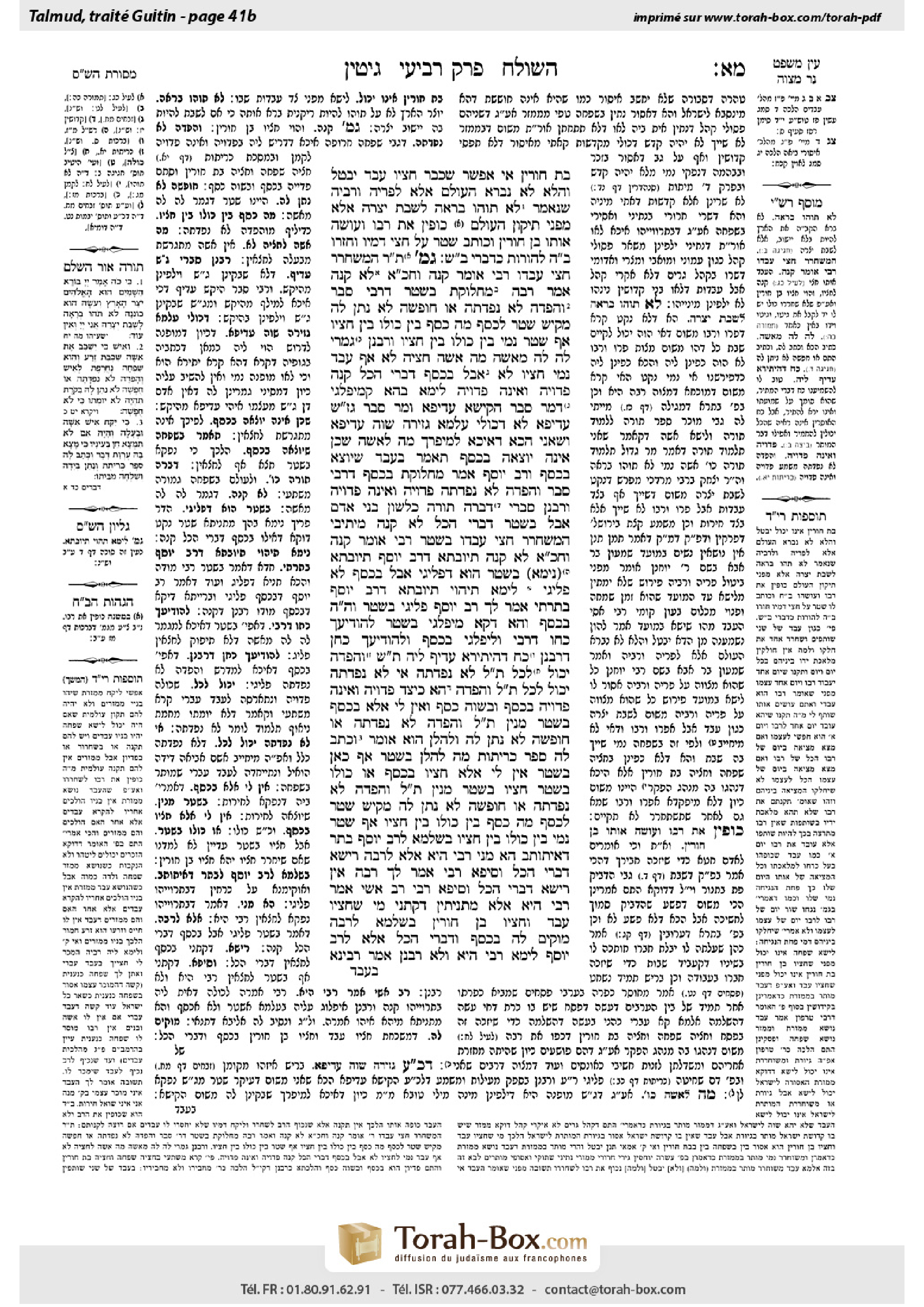
Gittin 41b: Talmud study for Daf Yomi
Study the Talmud for Daf Yomi with scanned pages, Hebrew text, English translations from Sefaria and AI-generated French translations.
Passage selection and English or AI-generated French translation are available where the scan has annotations. Daf Study is independent of Torah-Box and Sefaria.
Browse Gittin · גיטין · All tractatesGittin 41b text and translations
This page of Gittin includes the Aramaic text, an English translation and an AI-generated French translation, alongside the scan above.
גיטין מ״א ב · Aramaic and Hebrew text
בַּת חוֹרִין אִי אֶפְשָׁר, שֶׁכְּבָר חֶצְיוֹ עֶבֶד. יִבָּטֵל? וַהֲלֹא לֹא נִבְרָא הָעוֹלָם אֶלָּא לִפְרִיָּה וּרְבִיָּה, שֶׁנֶּאֱמַר: ״לֹא תוֹהוּ בְרָאָהּ לָשֶׁבֶת יְצָרָהּ״! אֶלָּא מִפְּנֵי תִּיקּוּן הָעוֹלָם – כּוֹפִין אֶת רַבּוֹ וְעוֹשֶׂה אוֹתוֹ בֶּן חוֹרִין, וְכוֹתֵב שְׁטָר עַל חֲצִי דָמָיו. וְחָזְרוּ בֵּית הִלֵּל לְהוֹרוֹת כְּדִבְרֵי בֵּית שַׁמַּאי.
גְּמָ׳ תָּנוּ רַבָּנַן: הַמְשַׁחְרֵר חֲצִי עַבְדּוֹ, רַבִּי אוֹמֵר: קָנָה, וַחֲכָמִים אוֹמְרִים: לֹא קָנָה.
אָמַר רַבָּה: מַחְלוֹקֶת בִּשְׁטָר – דְּרַבִּי סָבַר: ״וְהׇפְדֵּה לֹא נִפְדָּתָה אוֹ חוּפְשָׁה לֹא נִתַּן לָהּ״ –
מַקִּישׁ שְׁטָר לְכֶסֶף, מָה כֶּסֶף – בֵּין כּוּלּוֹ בֵּין חֶצְיוֹ, אַף שְׁטָר נָמֵי – בֵּין כּוּלּוֹ בֵּין חֶצְיוֹ;
וְרַבָּנַן גָּמְרִי ״לָהּ״–״לָהּ״ מֵאִשָּׁה – מָה אִשָּׁה חֶצְיָהּ לֹא, אַף עֶבֶד נָמֵי חֶצְיוֹ לֹא; אֲבָל בְּכֶסֶף – דִּבְרֵי הַכֹּל קָנָה, פְּדוּיָה וְאֵינָהּ פְּדוּיָה.
לֵימָא בְּהָא קָמִיפַּלְגִי – דְּמָר סָבַר: הֶקֵּישָׁא עֲדִיף, וּמָר סָבַר: גְּזֵרָה שָׁוָה עֲדִיפָא?
לָא; דְּכוּלֵּי עָלְמָא גְּזֵירָה שָׁוָה עֲדִיפָא, וְשָׁאנֵי הָכָא דְּאִיכָּא לְמִיפְרַךְ: מָה לְאִשָּׁה שֶׁכֵּן אֵינָהּ יוֹצְאָה בְּכֶסֶף, תֹּאמַר בְּעֶבֶד שֶׁיּוֹצֵא בְּכֶסֶף.
וְרַב יוֹסֵף אָמַר: מַחְלוֹקֶת בְּכֶסֶף – דְּרַבִּי סָבַר: ״וְהׇפְדֵּה לֹא נִפְדָּתָה״ – פְּדוּיָה וְאֵינָהּ פְּדוּיָה; וְרַבָּנַן סָבְרִי: דִּבְּרָה תּוֹרָה כִּלְשׁוֹן בְּנֵי אָדָם; אֲבָל בִּשְׁטָר – דִּבְרֵי הַכֹּל לֹא קָנָה.
מֵיתִיבִי: הַמְשַׁחְרֵר חֲצִי עַבְדּוֹ בִּשְׁטָר, רַבִּי אוֹמֵר: קָנָה, וַחֲכָמִים אוֹמְרִים: לֹא קָנָה. תְּיוּבְתָּא דְּרַב יוֹסֵף! תְּיוּבְתָּא.
(נֵימָא) בִּשְׁטָר הוּא דִּפְלִיגִי, אֲבָל בְּכֶסֶף לָא פְּלִיגִי; לֵימָא תֶּיהְוֵי תְּיוּבְתָּא דְּרַב יוֹסֵף בְּתַרְתֵּי!
אָמַר לְךָ רַב יוֹסֵף: פְּלִיגִי בִּשְׁטָר, וְהוּא הַדִּין בְּכֶסֶף. וְהָא דְּקָא מִיפַּלְגִי בִּשְׁטָר – לְהוֹדִיעֲךָ כֹּחוֹ דְּרַבִּי.
וְלִיפְלְגֻי בְּכֶסֶף, וּלְהוֹדִיעֲךָ כֹּחָן דְּרַבָּנַן! כֹּחַ דְּהֶיתֵּירָא עֲדִיף לֵיהּ.
תָּא שְׁמַע: ״וְהׇפְדֵּה״; יָכוֹל לַכֹּל? תַּלְמוּד לוֹמַר: ״לֹא נִפְדָּתָה״. אִי ״לֹא נִפְדָּתָה״, יָכוֹל לַכֹּל? תַּלְמוּד לוֹמַר: ״וְהׇפְדֵּה״. הָא כֵּיצַד? פְּדוּיָה וְאֵינָהּ פְּדוּיָה; בְּכֶסֶף וּבְשָׁוֶה כֶּסֶף.
וְאֵין לִי אֶלָּא בְּכֶסֶף, בִּשְׁטָר מִנַּיִן? תַּלְמוּד לוֹמַר: ״וְהׇפְדֵּה לֹא נִפְדָּתָה אוֹ חוּפְשָׁה לֹא נִתַּן לָהּ״, וּלְהַלָּן הוּא אוֹמֵר: ״וְכָתַב לָהּ סֵפֶר כְּרִיתוּת״ – מָה לְהַלָּן בִּשְׁטָר, אַף כָּאן בִּשְׁטָר.
אֵין לִי אֶלָּא חֶצְיוֹ בְּכֶסֶף, אוֹ כּוּלּוֹ בִּשְׁטָר; חֶצְיוֹ בִּשְׁטָר מִנַּיִן? תַּלְמוּד לוֹמַר: ״וְהׇפְדֵּה לֹא נִפְדָּתָה אוֹ חוּפְשָׁה לֹא נִתַּן לָהּ״ – מַקִּישׁ שְׁטָר לְכֶסֶף, מָה כֶּסֶף בֵּין כּוּלּוֹ בֵּין חֶצְיוֹ, אַף שְׁטָר נָמֵי בֵּין כּוּלּוֹ בֵּין חֶצְיוֹ.
בִּשְׁלָמָא לְרַב יוֹסֵף בָּתַר דְּאִיתּוֹתַב, הָא מַנִּי – רַבִּי הִיא. אֶלָּא לְרַבָּה – רֵישָׁא דִּבְרֵי הַכֹּל, וְסֵיפָא רַבִּי?!
אָמַר לָךְ רַבָּה: אִין, רֵישָׁא דִּבְרֵי הַכֹּל, וְסֵיפָא רַבִּי. רַב אָשֵׁי אָמַר: רַבִּי הִיא.
אֶלָּא מַתְנִיתִין דְּקָתָנֵי: מִי שֶׁחֶצְיוֹ עֶבֶד וְחֶצְיוֹ בֶּן חוֹרִין; בִּשְׁלָמָא לְרַבָּה – מוֹקֵים לַהּ בְּכֶסֶף, וְדִבְרֵי הַכֹּל; אֶלָּא לְרַב יוֹסֵף – לֵימָא רַבִּי הִיא וְלָא רַבָּנַן?! אָמַר רָבִינָא:
Gittin 41b · English translation
It is also not possible for him to marry a free woman, as he is still a half-slave. If you say he should be idle and not marry, but isn’t it true that the world was created only for procreation, as it is stated: “He did not create it to be a waste; He formed it to be inhabited” (Isaiah 45:18)? Rather, for the betterment of the world his master is forced to make him a freeman, and the slave writes a promissory note accepting his responsibility to pay half his value to his master. And Beit Hillel ultimately retracted their opinion, to rule in accordance with the statement of Beit Shammai, that a half-slave must be set free.
GEMARA: The Sages taught: With regard to a master who emancipates only half of his slave, Rabbi Yehuda HaNasi says: He has acquired himself, i.e., the transaction is complete and half of the slave is emancipated, and the Rabbis say: He has not acquired himself.
Rabba said: Their dispute pertains only to a case where the master emancipated him with a bill of manumission, as Rabbi Yehuda HaNasi holds: In the context of a Jewish man who engages in sexual intercourse with a maidservant who had been designated to cohabit with a Hebrew slave, the Torah writes that neither the Jewish man nor the maidservant is liable to receive the death penalty, though the man is liable to bring a guilt-offering. If the woman had been emancipated, she would be a regular married woman, and they would incur the death penalty for their act of intercourse. In describing the woman in that case, the Torah writes: “And not at all redeemed, nor was freedom given to her” (Leviticus 19:20). This is referring to two methods of emancipating a slave: Redemption via money, in the phrase: “And not at all redeemed,” and emancipation via a bill of manumission, in the phrase: “Nor was freedom given her.”
The verse juxtaposes the freeing of a slave via a bill of manumission to the freeing of a slave via payment of money, to teach that just as with money the slave can free either all of him or half of him, for if he were to pay half of his value to the master he would be half-redeemed, so too, by receiving a bill of manumission either all of him or half of him can be emancipated.
And the Rabbis derive their opinion, that a slave cannot acquire half of his freedom via a bill of manumission, from a verbal analogy of the word “her [lah]” written here: “Nor was freedom given to her [lah]” (Leviticus 19:20), and the word “her [lah]” written with regard to a man who divorces a woman: “And he writes her [lah] a scroll of severance” (Deuteronomy 24:1). Just as in the case of a woman, one is not able to divorce half of her with a bill of divorce, so too, in the case of a slave, one is not able to emancipate half of him with a bill of manumission. However, with regard to a slave who frees himself by giving money, everyone agrees that the slave acquires half of himself, and a female slave would also be partially redeemed but not fully redeemed.
The Gemara suggests: Let us say that they disagree about this: As one Sage, Rabbi Yehuda HaNasi, holds that a derivation from a juxtaposition is preferable, and consequently he derives the halakha of emancipation via a bill of manumission from the halakha stated in the same verse concerning redemption via money. And one Sage, i.e., the Rabbis, holds that a verbal analogy is preferable and therefore derives the halakha of emancipation via a bill of manumission from the halakha of the divorce of a woman, where the verse employs an analogous term.
The Gemara rejects this: No, everyone agrees that generally a verbal analogy is preferable, but it is different here because the verbal analogy can be refuted by stating the following: What is unique about a woman is that she cannot leave a marriage via money at all, shall you say that one should compare her case to that of a slave, who does leave his servitude via money? Since there are differences between divorce and emancipation, Rabbi Yehuda HaNasi holds that it is preferable to derive the halakha from a juxtaposition.
And Rav Yosef said: The dispute between Rabbi Yehuda HaNasi and the Rabbis pertains only to a case where the slave was freed via money, for Rabbi Yehuda HaNasi holds: The halakha that a slave can be half-freed can be derived from the phrase: “And not at all redeemed [vehofde lo nifdata]” (Leviticus 19:20), indicating that she has been partially redeemed but not fully redeemed. And the Rabbis hold: The Torah spoke in the language of people, and the repetition of the verb in the verse is not to be used as a source for deriving a halakha. However, when the slave is half-emancipated via a bill of manumission, everyone agrees that the slave has not acquired himself and remains a full slave.
The Gemara raises an objection against Rav Yosef’s statement based on what was taught in a baraita: With regard to one who emancipates half of his slave with a bill of manumission, Rabbi Yehuda HaNasi says: He has acquired himself, and the Rabbis say: He has not acquired himself. The Gemara concludes: The refutation of the opinion of Rav Yosef is a conclusive refutation.
The Gemara suggests: In this baraita, they disagree in a case where the slave is half-emancipated via a bill of manumission. However, they do not explicitly disagree in a case where the slave is half-redeemed with money. Shall we say that this is a conclusive refutation of the statement of Rav Yosef with regard to two aspects: First, as above, Rabbi Yehuda HaNasi holds that he is half-freed via a bill of manumission; second, according to his statement, the dispute pertains to redeeming with money, yet the baraita gives no indication that the Rabbis would hold that the slave can be half-redeemed with money?
The Gemara rejects this: Rav Yosef could have said to you: They disagree with regard to emancipation via a bill of manumission, and the same is true, that they would disagree, with regard to redeeming with money. And this, that they explicitly disagree with regard to emancipation via a bill of manumission, is to convey to you the far-reaching nature of the opinion of Rabbi Yehuda HaNasi, that a slave can be half-freed even by receiving a bill of manumission.
The Gemara asks: And let them disagree with regard to redeeming with money, and to convey to you the far-reaching nature of the opinion of the Rabbis, that they hold he cannot be half-freed even through redeeming with money. The Gemara responds: It is preferable to the tanna to emphasize the power of leniency, and therefore the dispute is presented as it is.
The Gemara suggests: Come and hear a proof with regard to this discussion based on a baraita: The verse in Leviticus employs the double expression “vehofde lo nifdata,” literally: And redeemed not redeemed, in discussing the designated maidservant. The baraita analyzes this wording. If the verse had stated only “and redeemed,” one might have thought that the verse discusses a maidservant that is entirely redeemed. Therefore, the verse states “not redeemed.” If it had stated only “not redeemed,” one might have thought that it means an entirely unredeemed maidservant, i.e., a full maidservant. Therefore, the verse states “and redeemed.” How can these texts be reconciled? The verse is discussing a case where she is partially redeemed but not fully redeemed. This was accomplished via money or an equivalent value of money.
The baraita continues. And I have derived only that she can be partially redeemed via money. From where do I derive that she can also be emancipated via a bill of manumission? The verse states: “And not at all redeemed, nor was freedom given to her” (Leviticus 19:20), and later on, in the case of divorce, it states: “And he writes her a scroll of severance” (Deuteronomy 24:1). Just as later on freedom is granted via a bill of divorce, so too here, a maidservant is freed via a bill of manumission.
I have derived only that half of a slave can be redeemed via money, as detailed above, or that all of him can be emancipated via a bill of manumission. From where do I derive that half of him can be emancipated via a bill of manumission? The verse states: “And not at all redeemed, nor was freedom given her,” and thereby juxtaposes a bill of manumission to money. Just as a slave can be either fully redeemed or half-redeemed via money, so too, he can be either fully emancipated or half-emancipated via a bill of manumission. This marks the end of the baraita.
The Gemara analyzes the baraita in light of the earlier opinions. Granted, according to Rav Yosef after he was conclusively refuted, who now holds that Rabbi Yehuda HaNasi and the Rabbis disagree both with regard to money and a bill of manumission, in accordance with whose opinion is this baraita? It is the opinion of Rabbi Yehuda HaNasi, for half of the slave is freed, whether via money or a bill of manumission. However, according to the opinion of Rabba, that Rabbi Yehuda HaNasi and the Rabbis disagree only with regard to a bill of manumission, but everyone agrees that the slave can redeem half of himself with money, do all agree with the statement of the first clause, but the last clause is in accordance with the opinion of only Rabbi Yehuda HaNasi?
Rabba could have said to you: Yes, all agree with the statement of the first clause, and the last clause is in accordance with only Rabbi Yehuda HaNasi. Rav Ashi said: This baraita is entirely in accordance with the opinion of Rabbi Yehuda HaNasi.
The Gemara asks: But with regard to the mishna that teaches: In the case of one who is a half-slave half-freeman, granted, according to the opinion of Rabba, he establishes the mishna as referring to a case where the slave was half-redeemed with money, and everyone agrees that this is effective. However, according to the opinion of Rav Yosef, shall we say that the mishna is in accordance with the opinion of only Rabbi Yehuda HaNasi and not in accordance with the opinion of the Rabbis? According to the opinion of Rav Yosef, the Rabbis hold that a slave cannot be half-free, regardless of whether he is freed via money or a bill of manumission. Ravina said:
Gittin 41b · Traduction française (IA)
Il n'est pas non plus possible qu'il épouse une femme libre, car il reste un demi-esclave. Si l'on dit qu'il devrait être libre et ne pas épouser, n'est-ce pas vrai que le monde a été créé uniquement pour la procréation, comme il est dit : « Il ne l'a pas créé pour qu'il soit inutile ; il l'a fait pour qu'il soit habité » (Isaïe 45:18)? Plutôt, pour le bien-être du monde, son maître est contraint de le rendre libre, et l'esclave écrit une promesse de paiement acceptant de payer la moitié de sa valeur à son maître. Et Beit Hillel a finalement rétracté leur opinion pour décider en conformité avec l'opinion de Beit Shammai, qui affirme qu'un demi-esclave doit être libéré.
GUEMARA : Les Sages enseignent : En ce qui concerne un maître qui libère seulement la moitié de son esclave, Rabbi Yehuda HaNasi dit : Il s'est acquis lui-même, c'est-à-dire la transaction est achevée et la moitié de l'esclave est libérée, et les Rabbins disent : Il n'a pas acquis lui-même.
Rabba dit : Leur débat concerne uniquement le cas où le maître libère son esclave par un acte de manumission, car Rabbi Yehuda HaNasi considère que : Dans le contexte d'un homme juif qui a des relations sexuelles avec une servante qui avait été désignée pour cohabiter avec un esclave hébreu, la Torah écrit que ni l'homme juif ni la servante ne sont tenus de recevoir la peine de mort, bien que l'homme soit tenu de présenter un sacrifice de culpabilité. Si la femme avait été libérée, elle serait une femme mariée normale, et ils auraient encouru la peine de mort pour leur acte de cohabitation. En décrivant la femme dans ce cas, la Torah écrit : « Et elle n'a pas été rachetée, ni la liberté ne lui a été donnée » (Lévitique 19:20). Cela fait référence à deux méthodes de libération d'un esclave : le rachat par argent, dans la phrase : « Et elle n'a pas été rachetée », et la libération par un acte de manumission, dans la phrase : « Ni la liberté ne lui a été donnée. »
La versette compare la libération d'un esclave par un acte de manumission à la libération d'un esclave par paiement d'argent, pour enseigner que tout comme avec l'argent l'esclave peut libérer soit tout son être soit la moitié de lui-même, car s'il payait la moitié de sa valeur à son maître, il serait partiellement racheté, de même, en recevant un acte de manumission, soit tout son être soit la moitié de lui-même peut être libéré.
Et les Rabbins dérivent leur opinion, selon laquelle un esclave ne peut pas acquérir la moitié de sa liberté par un acte de manumission, d'une analogie verbale du mot « elle [lah] » écrit ici : « Et la liberté ne lui a pas été donnée [lah] » (Lévitique 19:20), et du mot « elle [lah] » écrit concernant un homme qui divorce une femme : « Et il écrit à elle [lah] un livre de divorce » (Dn 24:1). Tout comme dans le cas d'une femme, on ne peut pas divorcer la moitié d'elle par un acte de divorce, de même, dans le cas d'un esclave, on ne peut pas le libérer par un acte de manumission. Cependant, concernant un esclave qui se libère en donnant de l'argent, tout le monde convient que l'esclave acquiert la moitié de lui-même, et une esclave serait également partiellement rachetée mais pas entièrement rachetée.
La Guemara suggère : Disons qu'ils diffèrent sur cela : Un Sage, Rabbi Yehuda HaNasi, considère que la dérivation d'une juxtaposition est préférable, et donc il dérive la halakha de la libération par un acte de manumission à partir de la halakha énoncée dans la même versette concernant le rachat par argent. Un autre Sage, c'est-à-dire les Rabbins, considère que l'analogie verbale est préférable et donc dérive la halakha de la libération par un acte de manumission à partir de la halakha du divorce d'une femme, où la versette utilise un terme analogue.
La Guemara rejette cela : Non, tout le monde convient que généralement l'analogie verbale est préférable, mais c'est différent ici car l'analogie verbale peut être réfutée en disant : Qu'est-ce qui est particulier à une femme, c'est qu'elle ne peut pas quitter un mariage par argent du tout, diras-tu qu'on devrait la comparer au cas d'un esclave, qui peut quitter son servage par argent ? Puisque les divorces et les libérations diffèrent, Rabbi Yehuda HaNasi considère que préférer la dérivation d'une juxtaposition est préférable.
Et Rav Yosef dit : Le débat entre Rabbi Yehuda HaNasi et les Rabbins concerne uniquement le cas où l'esclave est libéré par argent, car Rabbi Yehuda HaNasi considère que la halakha selon laquelle un esclave peut être partiellement libéré peut être dérivée de la phrase : « Et elle n'a pas été rachetée [vehofde lo nifdata] » (Lévitique 19:20), indiquant qu'elle a été partiellement rachetée mais pas entièrement rachetée. Et les Rabbins considèrent que la Torah parle la langue des gens, et la répétition du verbe dans la versette ne doit pas être utilisée comme une source pour dériver une halakha. Cependant, lorsque l'esclave est partiellement libéré par un acte de manumission, tout le monde convient que l'esclave n'a pas acquis lui-même et reste un esclave complet.
La Guemara soulève un objet contre l'affirmation de Rav Yosef basé sur ce qui a été enseigné dans une baraïta : En ce qui concerne celui qui libère la moitié de son esclave par un acte de manumission, Rabbi Yehuda HaNasi dit : Il s'est acquis lui-même, et les Rabbins disent : Il n'a pas acquis lui-même. La Guemara conclut : La réfutation de l'opinion de Rav Yosef est une réfutation concluante.
La Guemara suggère : Dans cette baraïta, ils diffèrent dans le cas où l'esclave est partiellement libéré par un acte de manumission. Cependant, ils ne diffèrent pas explicitement dans le cas où l'esclave est partiellement racheté avec de l'argent. Dirons-nous que cela constitue une réfutation concluante de l'affirmation de Rav Yosef concernant deux aspects : Premièrement, comme ci-dessus, Rabbi Yehuda HaNasi considère qu'il est partiellement libéré par un acte de manumission ; secondement, selon son affirmation, le débat concerne le rachat avec de l'argent, mais la baraïta ne donne aucune indication que les Rabbins pensent que l'esclave peut être partiellement racheté avec de l'argent ?
La Guemara rejette cette interprétation : Rav Yosef aurait pu te dire : Ils divergent concernant l’émancipation par un acte de manumission, et c’est la même chose, qu’ils divergent aussi concernant l’achat avec de l’argent. Et ce, qu’ils divergent explicitement concernant l’émancipation par un acte de manumission, est pour te faire comprendre la portée de l’opinion de Rabbi Yehuda HaNasi, selon laquelle un esclave peut être partiellement libéré même en recevant un acte de manumission.
La Guemara pose la question : Et si on diverge concernant l’achat avec de l’argent, et pour te faire comprendre la portée de l’opinion des Sages, qu’ils considèrent qu’un esclave ne peut être partiellement libéré même par l’achat avec de l’argent. La Guemara répond : Il est préférable au tanna de souligner la puissance de la leniété, et c’est pourquoi le débat est présenté ainsi.
La Guemara suggère : Viens écouter une preuve concernant ce débat, tirée d’une baraïta : La parole du Lévitique utilise l’expression double « vehofde lo nifdata », littéralement : Et racheté non racheté, lorsqu’elle parle de la servante désignée. La baraïta analyse cette formulation. Si la parole avait simplement dit « et racheté », on aurait pu penser qu’elle parle d’une servante entièrement rachetée. Ainsi, la parole dit « non racheté ». Si elle avait simplement dit « non racheté », on aurait pu penser qu’elle signifie une servante entièrement non rachetée, c’est-à-dire une servante complète. Ainsi, la parole dit « et racheté ». Comment ces textes peuvent-ils être conciliés ? La parole parle d’un cas où elle est partiellement rachetée mais pas entièrement rachetée. Cela a été accompli par de l’argent ou une valeur équivalente à l’argent.
La baraïta continue. Et j’ai déduit seulement qu’elle peut être partiellement rachetée par de l’argent. D’où déduis-je qu’elle peut aussi être libérée par un acte de manumission ? La Parashah dit : « Et non racheté, ni liberté donnée à elle » (Lévitique 19:20), et plus tard, dans le cas du divorce, elle dit : « Et il écrit à elle un livre de séparation » (Dt 24:1). Tout comme plus tard la liberté est donnée par un acte de divorce, ainsi ici, la servante est libérée par un acte de manumission.
J’ai déduit seulement que la moitié d’un esclave peut être rachetée par de l’argent, comme précisé ci-dessus, ou que tout lui peut être libéré par un acte de manumission. D’où déduis-je que la moitié de lui peut être libérée par un acte de manumission ? La Parashah dit : « Et non racheté, ni liberté donnée à elle », et ainsi juxtapose un acte de manumission à de l’argent. Tout comme un esclave peut être entièrement racheté ou partiellement racheté par de l’argent, ainsi aussi, il peut être entièrement libéré ou partiellement libéré par un acte de manumission. Cela marque la fin de la baraïta.
La Guemara analyse la baraïta en lumière des opinions précédentes. Bien sûr, selon Rav Yosef après qu’il ait été définitivement réfuté, qui maintenant considère que Rabbi Yehuda HaNasi et les Sages divergent à la fois concernant l’argent et un acte de manumission, selon quel opinion est-ce que cette baraïta ? C’est l’opinion de Rabbi Yehuda HaNasi, car la moitié de l’esclave est libérée, qu’il s’agisse d’argent ou d’un acte de manumission. Cependant, selon l’opinion de Rabba, que Rabbi Yehuda HaNasi et les Sages divergent seulement concernant un acte de manumission, mais que tout le monde convient que l’esclave peut racheter la moitié de lui-même avec de l’argent, tous conviennent de l’affirmation de la première partie, mais la dernière partie est selon l’opinion de seulement Rabbi Yehuda HaNasi ?
Rabba aurait pu te dire : Oui, tous conviennent de l'affirmation de la première partie, et la dernière partie est selon l'opinion de Rabbi Yehuda HaNasi. Rav Ashi dit : Cette baraïta est entièrement selon l'opinion de Rabbi Yehuda HaNasi.
La Guemara pose la question : Mais concernant la mitsna qui enseigne : Dans le cas d'un homme qui est un esclave et un libre à la fois, bien sûr, selon l'opinion de Rabba, il établit la mitsna comme concernant un cas où l'esclave a été partiellement racheté avec de l'argent, et tout le monde convient que cela est efficace. Cependant, selon l'opinion de Rav Yosef, devons-nous dire que la mitsna est selon l'opinion de seulement Rabbi Yehuda HaNasi et pas selon l'opinion des Sages ? Selon l'opinion de Rav Yosef, les Sages considèrent qu'un esclave ne peut être partiellement libre, qu'il s'agisse de sa libération par de l'argent ou par un acte de manumission. Ravina dit :
Traduction française générée par IA à partir de l’édition anglaise de Sefaria. Vérifie toujours un passage avec le texte source.
Text from Sefaria: William Davidson Edition - Vocalized Aramaic (CC BY NC); William Davidson Edition - English (CC BY NC).