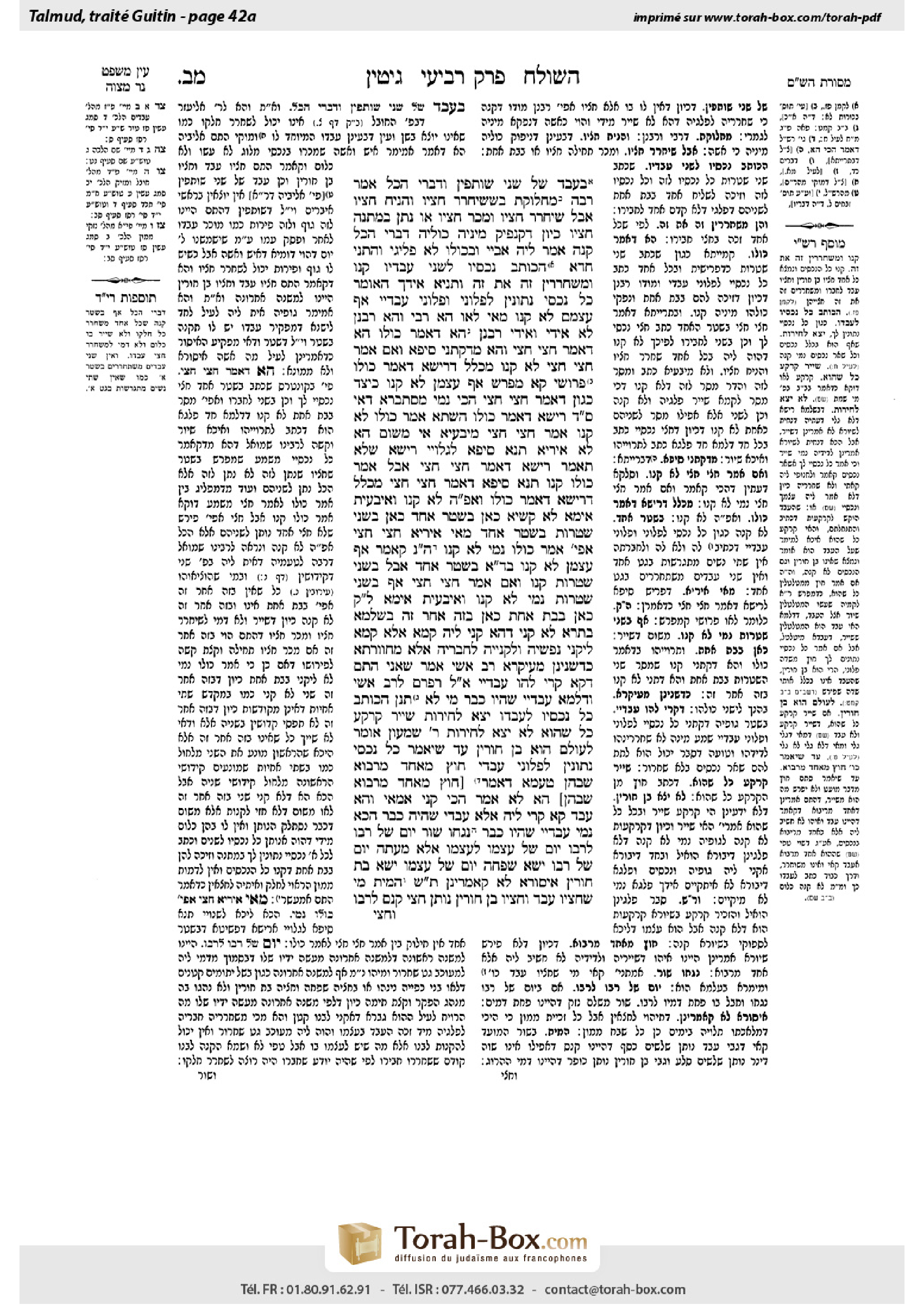
Gittin 42a: Talmud study for Daf Yomi
Study the Talmud for Daf Yomi with scanned pages, Hebrew text, English translations from Sefaria and AI-generated French translations.
Passage selection and English or AI-generated French translation are available where the scan has annotations. Daf Study is independent of Torah-Box and Sefaria.
Browse Gittin · גיטין · All tractatesGittin 42a text and translations
This page of Gittin includes the Aramaic text, an English translation and an AI-generated French translation, alongside the scan above.
גיטין מ״ב א · Aramaic and Hebrew text
בְּעֶבֶד שֶׁל שְׁנֵי שׁוּתָּפִין, וְדִבְרֵי הַכֹּל.
אָמַר רַבָּה: מַחֲלוֹקֶת – בְּשֶׁשִּׁיחְרֵר חֶצְיוֹ וְהִנִּיחַ חֶצְיוֹ; אֲבָל שִׁיחְרֵר חֶצְיוֹ, וּמָכַר חֶצְיוֹ אוֹ נָתַן בְּמַתָּנָה חֶצְיוֹ, כֵּיוָן דְּקָנָפֵיק מִינֵּיהּ כּוּלֵּיהּ – דִּבְרֵי הַכֹּל קָנָה.
אֲמַר לֵיהּ אַבָּיֵי: וּבְכוּלּוֹ – לָא פְּלִיגִי?! וְהָתָנֵי חֲדָא: הַכּוֹתֵב נְכָסָיו לִשְׁנֵי עֲבָדָיו – קָנוּ וּמְשַׁחְרְרִין זֶה אֶת זֶה. וְתַנְיָא אִידַּךְ, הָאוֹמֵר: ״כׇּל נְכָסַי נְתוּנִין לִפְלוֹנִי וּפְלוֹנִי עֲבָדַיי״ – אַף עַצְמָם לֹא קָנוּ.
מַאי, לָאו הָא רַבִּי, וְהָא רַבָּנַן?!
לָא, אִידִי וְאִידִי רַבָּנַן; הָא דְּאָמַר כּוּלּוֹ, הָא דְּאָמַר חֲצִי חֲצִי.
וְהָא מִדְּקָתָנֵי סֵיפָא: וְאִם אָמַר חֲצִי חֲצִי – לֹא קָנוּ, מִכְּלָל דְּרֵישָׁא דְּאָמַר כּוּלּוֹ! פָּרוֹשֵׁי קָא מְפָרֵשׁ – אַף עַצְמָן לֹא קָנוּ, כֵּיצַד? כְּגוֹן דְּאָמַר חֲצִי חֲצִי.
הָכִי נָמֵי מִסְתַּבְּרָא, דְּאִי סָלְקָא דַעְתָּךְ רֵישָׁא דְּאָמַר כּוּלּוֹ – הַשְׁתָּא אָמַר כּוּלּוֹ לֹא קָנוּ, אָמַר חֲצִי חֲצִי מִיבַּעְיָא?!
אִי מִשּׁוּם הָא לָא אִירְיָא – תְּנָא סֵיפָא לְגַלּוֹיֵי רֵישָׁא, שֶׁלֹּא תֹּאמַר: רֵישָׁא דְּאָמַר חֲצִי חֲצִי, אֲבָל אָמַר כּוּלּוֹ קָנוּ; תְּנָא סֵיפָא דְּאָמַר חֲצִי חֲצִי, מִכְּלָל דְּרֵישָׁא דְּאָמַר כּוּלּוֹ – וַאֲפִילּוּ הָכִי לֹא קָנוּ.
וְאִיבָּעֵית אֵימָא, לָא קַשְׁיָא: כָּאן בִּשְׁטָר אֶחָד, כָּאן בִּשְׁנֵי שְׁטָרוֹת.
בִּשְׁטָר אֶחָד, מַאי אִירְיָא חֲצִי חֲצִי? אֲפִילּוּ אָמַר כּוּלּוֹ נָמֵי לֹא קָנוּ! הָכִי נָמֵי קָאָמַר: אַף עַצְמָן לֹא קָנוּ, בַּמֶּה דְּבָרִים אֲמוּרִים – בִּשְׁטָר אֶחָד, אֲבָל בִּשְׁנֵי שְׁטָרוֹת – קָנוּ; וְאִם אָמַר חֲצִי חֲצִי – אַף בִּשְׁנֵי שְׁטָרוֹת נָמֵי לָא קָנוּ.
וְאִיבָּעֵית אֵימָא: לָא קַשְׁיָא – כָּאן בְּבַת אַחַת, כָּאן בְּזֶה אַחַר זֶה.
בִּשְׁלָמָא בָּתְרָא לָא קָנֵי, דְּהָא קָנֵי לֵיהּ קַמָּא; אֶלָּא קַמָּא, לִיקְנֵי נַפְשֵׁיהּ וְלִקְנְיֵיהּ לְחַבְרֵיהּ! אֶלָּא מְחַוַּורְתָּא כִּדְשַׁנִּינַן מֵעִיקָּרָא.
רַב אָשֵׁי אָמַר: שָׁאנֵי הָתָם, דְּקָא קָרֵי לְהוּ ״עֲבָדַיי״. אֲמַר לֵיהּ רַפְרָם לְרַב אָשֵׁי: וְדִלְמָא ״עֲבָדַיי״ – שֶׁהָיוּ כְּבָר!
מִי לָא תְּנַן: הַכּוֹתֵב כׇּל נְכָסָיו לְעַבְדּוֹ – יָצָא לְחֵירוּת; שִׁיֵּיר קַרְקַע כָּל שֶׁהוּא – לֹא יָצָא לְחֵירוּת. רַבִּי שִׁמְעוֹן אוֹמֵר: לְעוֹלָם הוּא בֶּן חוֹרִין, עַד שֶׁיֹּאמַר: ״כׇּל נְכָסַי נְתוּנִין לִפְלוֹנִי עַבְדִּי, חוּץ מֵאֶחָד מֵרִבּוֹא שֶׁבָּהֶן״.
טַעְמָא דְּאָמַר [״חוּץ מֵאֶחָד מֵרִבּוֹא שֶׁבָּהֶן״], הָא לָא אָמַר הָכִי – קָנֵי; אַמַּאי? וְהָא ״עֶבֶד״ קָא קָרֵי לֵיהּ! אֶלָּא ״עַבְדִּי״ שֶׁהָיָה כְּבָר, הָכָא נָמֵי ״עֲבָדַיי״ שֶׁהָיוּ כְּבָר.
נְגָחוֹ שׁוֹר; יוֹם שֶׁל רַבּוֹ – לְרַבּוֹ, יוֹם שֶׁל עַצְמוֹ – לְעַצְמוֹ. אֶלָּא מֵעַתָּה – יוֹם שֶׁל רַבּוֹ יִשָּׂא שִׁפְחָה, יוֹם שֶׁל עַצְמוֹ יִשָּׂא בַּת חוֹרִין! אִיסּוּרָא לָא קָאָמְרִינַן.
תָּא שְׁמַע: הֵמִית מִי שֶׁחֶצְיוֹ עֶבֶד וְחֶצְיוֹ בֶּן חוֹרִין – נוֹתֵן חֲצִי קְנָס לְרַבּוֹ,
Gittin 42a · English translation
The mishna is referring to a slave belonging to two partners, and in that case everyone agrees that each one of them can emancipate his portion of the slave. Consequently, there could be a half-slave half-freeman even according to Rav Yosef’s understanding of the opinion of the Rabbis.
§ The Gemara discusses another dispute with regard to one who emancipates half of his slave. Rabba said: The dispute between Rabbi Yehuda HaNasi and the Rabbis concerning whether the slave can be half-emancipated applies only when the master freed half of him and left the other half of him unaffected. However, if he freed half of him and sold the other half of him, or gave the other half of him as a gift to someone else, then, since the slave left him entirely, as the original master no longer owns any portion of the slave, everyone agrees that the slave has acquired half of his freedom.
Abaye said to him: And do they not disagree with regard to a case where he is released entirely? But it is taught in one baraita: In the case of one who writes his property to his two slaves, i.e., gives it to them via a document, they acquired the property and they free each other, because each one has ownership over half of the other slave. And it was taught in another baraita that in the case of one who says: All of my property is given to so-and-so and so-and-so my slaves, they did not acquire even themselves, and all the more so they did not acquire the property. Seemingly, the two baraitot contradict each other.
Abaye continues his question: What, is it not that the way to reconcile the baraitot is to say that this, the first baraita, is in accordance with the opinion of Rabbi Yehuda HaNasi, that emancipation can take effect with regard to half a slave? And that, the second baraita, is in accordance with the opinion of the Rabbis, who maintain that even when the master retains no hold on the slave, a slave cannot be partially released?
The Gemara offers a different reconciliation: No, both this and that baraita are in accordance with the opinion of the Rabbis. This first baraita is discussing a case where one said that he is giving all of his property to each one of the slaves. Since he gave everything to both of them, they each acquire the property, including each other, emancipate each other, and divide the property between them. That second baraita is discussing a case where one said that he is giving half of his property to one slave and half of it to the other, so neither is fully emancipated.
The Gemara challenges this explanation: But from the fact that the latter clause of the second baraita teaches: But if he said that he is giving half of his property to one slave and half of it to the other, they did not acquire the property, it may be inferred that the first clause is discussing a case where he said that he is giving all of his property to each one of them, and yet they do not acquire the property. The Gemara answers: There are not two separate cases in the baraita. Rather, the second clause is explaining the first clause of the baraita, as follows: They did not acquire even themselves. How so? For example, this is the halakha in a case where the master said that he is giving half of his property to one slave and half of it to the other.
The Gemara comments: So too, it is reasonable to say this, for if it enters your mind to say that the first clause of the baraita is discussing a case where he said that he gives all of his property to his slaves, and yet they do not acquire it, then the latter clause is unnecessary. Now that the mishna taught that if one said that he gives all of the property to his two slaves, then each slave did not acquire himself, is it necessary to state in the second clause that this is true when one gives half of his property to one slave and half of it to the other?
The Gemara answers: If it is due to that reason, there is no conclusive argument. One could say that the tanna taught the latter clause to shed light on the first clause, so that you do not say: The first clause is discussing only a case where one said that he gives half of his property to one slave and half to the other, but if one said that he gives all of it to both of them, then they did acquire the property. Therefore, the tanna taught the latter clause, where it explicitly discusses a case where he said that he gives half to one and half to the other, and by inference it is clear that the first clause must be discussing a case where he said that he gives all of it to both of them, and even so they did not acquire the property.
And if you wish, say instead that it is not difficult. It is possible to reconcile the two baraitot differently: Here, in the second baraita, where they did not acquire the property, this is a case where the master wrote everything in one document. The reason the slaves do not acquire themselves is that it is not possible to emancipate two slaves with one document. There, in the first baraita, which rules that they did acquire the property, the case is one where the master wrote the transfer of property in two documents.
The Gemara asks: If the second baraita is referring to a case where he wrote everything in one document, why specifically mention that the slaves do not acquire themselves when he gave half to one and half to the other? Even if he said all of it as well, they did not acquire the property, as was taught explicitly in the beginning of the baraita. The Gemara answers: That is also what the tanna is saying: They did not acquire even themselves. In what case is this statement said? In a case where the master wrote everything in one document. But if he wrote it in two documents, they acquired the property. And if the master said that he gives half to one and half to the other, then even if he wrote it in two documents they also did not acquire the property.
And if you wish, say instead that it is not difficult, and it is possible to reconcile the two baraitot differently: Here, the first baraita, where they did acquire the property, is referring to a case where he gave them the documents simultaneously. There, the second baraita, where they did not acquire, the property is referring to a case where he gave them the documents sequentially.
The Gemara questions this explanation: Granted, if the master gave the documents sequentially, the last slave did not acquire, for the first slave had already acquired him, as the second slave was among the possessions transferred via the first document. However, the first slave should acquire himself and should also acquire the other slave, as he was given all of the property in one document. Due to this objection, the Gemara concludes: Rather, it is clear as we initially answered, and in any case it is referring to when he gave both documents simultaneously.
Rav Ashi said: The contradiction between the baraitot can be resolved by noting that it is different there, in the second baraita, because the master calls them: My slaves. By writing: All of my property is given to so-and-so and so-and-so my slaves, he indicates that he does not intend to free them. Rafram said to Rav Ashi: But perhaps when he says: My slaves, he is referring to those who were his slaves in the past.
Rafram attempts to prove that the expression my slaves can be used in this manner. Didn’t we learn in a mishna (Pe’a 3:8): In the case of one who writes all of his property to his slave, i.e., gives it to him via a document, the slave has been emancipated. But if he reserved for himself even any amount of land, then he has not been emancipated. Rabbi Shimon says: Actually, the slave is a freeman until the master says the following: All of my property is given to so-and-so my slave except for one ten-thousandth of it, as in that case it is possible that the master meant to include the slave in the portion that he is not giving.
Rafram continues his proof: The reason the slave is not emancipated is specifically because the master said: Except for one ten-thousandth of it. But if he did not say this, then the slave acquires the property. Rafram asks: According to your reasoning, why does he acquire the property? Didn’t he call him a slave? Rather, it must be that when he called him: My slave, he meant that he was his slave in the past. Here also, when he said: My slaves, he meant: Those who were my slaves in the past. Therefore, Rav Ashi’s attempt to resolve the contradiction between the baraitot cannot be accepted.
§ If a half-slave half-freeman, who works for himself and his master on alternating days, was gored by an ox and damaged, then, if he was gored on the day of his master, the reimbursement for the damage caused is paid to his master. If it was on his own day, it is paid to the slave himself. The Gemara asks: However, if that is so, if he is viewed as entering and leaving a state of slavery each day, then on the day of his master he should be able to marry a maidservant and on his own day he should be able to marry a free woman. However, the mishna states that he cannot marry anyone. The Gemara answers: We are not saying that he is viewed as entering and leaving a state of slavery each day with regard to prohibitions.
Come and hear a proof with regard to this issue: When a Canaanite slave is killed by an ox, in addition to the ox being put to death, the owner of the ox pays a fixed penalty of thirty shekels to the slave’s owner. If a freeman is killed by an ox, in addition to the ox being put to death, the freeman’s value is paid to his heirs. If an ox killed a half-slave half-freeman, then the owner of the ox gives half of a penalty, i.e., fifteen shekels, to his master
Gittin 42a · Traduction française (IA)
La Michna fait référence à un esclave appartenant à deux partenaires, et dans ce cas, tout le monde est d'accord sur le fait que chacun d'eux peut libérer sa part de l'esclave. Par conséquent, il peut y avoir un esclave demi-libéré et demi-esclave même selon la compréhension de Rav Yosef sur l'opinion des Sages.
§ La Guemara discute d'un autre débat concernant celui qui libère la moitié de son esclave. Rabba dit : Le débat entre Rabbi Yehuda HaNasi et les Sages concernant la possibilité de libérer partiellement un esclave s'applique uniquement lorsque le maître libère la moitié de lui et laisse l'autre moitié intacte. Cependant, si il libère la moitié de lui et vend l'autre moitié, ou la donne en cadeau à quelqu'un d'autre, alors, puisque l'esclave est totalement libéré, comme le maître original ne possède plus aucune part de l'esclave, tout le monde est d'accord sur le fait que l'esclave a acquis la moitié de sa liberté.
Abaye dit à lui : Et ne s'agit-il pas d'un cas où il est totalement libéré ? Mais il est enseigné dans une baraïta : Dans le cas où l'on écrit ses biens à ses deux esclaves, c'est-à-dire qu'on les donne via un document, ils acquièrent les biens et ils se libèrent mutuellement, car chacun possède la moitié de l'autre esclave. Et il est enseigné dans une autre baraïta que dans le cas où l'on dit : Tous mes biens sont donnés à tel et tel et mes esclaves, ils n'ont pas même acquis eux-mêmes, et encore plus ils n'ont pas acquis les biens. Apparemment, ces deux baraitot s'opposent l'une à l'autre.
Abaye continue sa question : Qu'est-ce que cela signifie, n'est-ce pas que la manière de concilier ces baraitot est de dire que celle-ci, la première baraïta, est selon l'opinion de Rabbi Yehuda HaNasi, que la libération peut s'appliquer à la moitié d'un esclave ? Et celle-là, la seconde baraïta, est selon l'opinion des Sages, qui maintiennent que même lorsque le maître ne possède plus aucun contrôle sur l'esclave, un esclave ne peut pas être partiellement libéré ?
La Guemara propose une autre conciliation : Non, ces deux baraitot sont selon l'opinion des Sages. La première baraïta discute d'un cas où l'on dit qu'il donne tous ses biens à chaque esclave. Puisque l'on donne tout aux deux, ils acquièrent les biens, s'ils s'émancipent mutuellement et divisent les biens entre eux. La seconde baraïta discute d'un cas où l'on dit qu'il donne la moitié de ses biens à un esclave et la moitié à l'autre, donc aucun n'est pleinement libéré.
La Guemara conteste cette explication : Mais à partir du fait que la clause finale de la seconde baraïta enseigne : Mais s'il dit qu'il donne la moitié de ses biens à un esclave et la moitié à l'autre, ils n'ont pas acquis les biens, on peut en déduire que la première clause est un cas où il dit qu'il donne tous ses biens à chaque esclave, et pourtant ils n'ont pas acquis les biens. La Guemara répond : Il n'y a pas deux cas distincts dans la baraïta. Plutôt, la seconde clause explique la première clause de la baraïta, comme suit : Ils n'ont pas même acquis eux-mêmes. Comment cela ? Par exemple, c'est la halakha dans un cas où le maître dit qu'il donne la moitié de ses biens à un esclave et la moitié à l'autre.
La Guemara commente : De même, il est raisonnable de dire cela, car si cela entre dans votre esprit de dire que la première clause de la baraïta discute d'un cas où il dit qu'il donne tous ses biens à ses esclaves, et pourtant ils n'acquièrent pas les biens, alors la seconde clause est inutile. Maintenant que la Michna a enseigné que si l'on dit qu'il donne tous les biens à ses deux esclaves, alors chaque esclave n'acquiert pas lui-même, est-il nécessaire de dire dans la seconde clause que cela est vrai lorsque l'on donne la moitié de ses biens à un esclave et la moitié à l'autre ?
La Guemara répond : Si c'est pour cette raison, il n'y a pas d'argument concluant. On pourrait dire que le tanna a enseigné la seconde clause pour éclairer la première, afin que vous ne disiez pas : La première clause discute uniquement d'un cas où l'on dit qu'il donne la moitié de ses biens à un esclave et la moitié à l'autre, mais si l'on dit qu'il donne tout à tous les deux, alors ils ont acquis les biens. Par conséquent, le tanna a enseigné la seconde clause, où il explicite clairement un cas où il dit qu'il donne la moitié à un et la moitié à l'autre, et par conséquent, il est clair que la première clause doit discuter d'un cas où il dit qu'il donne tout aux deux, et même ainsi, ils n'ont pas acquis les biens.
Et si vous le souhaitez, dites plutôt que cela n'est pas difficile. Il est possible de concilier les deux baraitot différemment : Ici, dans la seconde baraïta, où ils n'acquièrent pas les biens, c'est un cas où le maître a écrit tout dans un seul document. La raison pour laquelle les esclaves n'acquièrent pas eux-mêmes est que l'on ne peut pas libérer deux esclaves avec un seul document. Là, dans la première baraïta, qui règle qu'ils ont acquis les biens, le cas est celui où le maître a écrit la transmission des biens dans deux documents.
La Guemara pose la question : Si la seconde baraïta fait référence à un cas où tout a été écrit dans un seul document, pourquoi mentionner spécifiquement que les esclaves n'ont pas acquis eux-mêmes lorsqu'on leur a donné la moitié à l'un et la moitié à l'autre ? Même si l'on dit tout, ils n'ont pas acquis les biens, comme cela a été enseigné explicitement au début de la baraïta. La Guemara répond : C'est aussi ce que le tanna dit : Ils n'ont pas même acquis eux-mêmes. Dans quel cas cette déclaration est-elle faite ? Dans un cas où le maître a écrit tout dans un seul document. Mais si l'on l'a écrit dans deux documents, ils ont acquis les biens. Et si le maître dit qu'il donne la moitié à l'un et la moitié à l'autre, alors même s'il l'a écrit dans deux documents, ils n'ont pas acquis les biens.
Et si tu veux, dis plutôt qu'il n'est pas difficile, et qu'il est possible de concilier les deux baraitot différemment : ici, la première baraïta, où ils ont acquis la propriété, fait référence à un cas où il leur a donné les documents simultanément. Là, la seconde baraïta, où ils n'ont pas acquis la propriété, fait référence à un cas où il leur a donné les documents séquentiellement.
La Guemara question cette explication : C'est vrai, si le maître a donné les documents séquentiellement, le dernier esclave n'a pas acquis, car le premier esclave avait déjà acquis lui-même, puisque le second esclave était parmi les biens transférés via le premier document. Cependant, le premier esclave devrait acquérir lui-même et l'autre esclave également, car il lui a donné toute la propriété dans un seul document. À cause de cette objection, la Guemara conclut : plutôt, il est clair comme nous l'avons dit initialement, et en tout cas, il fait référence à un cas où il a donné les deux documents simultanément.
Rav Ashi dit : La contradiction entre les baraitot peut être résolue en notant qu'il est différent là, dans la seconde baraïta, car le maître appelle eux : mes esclaves. En écrivant : Toute ma propriété est donnée à tel et tel, et tel et tel mes esclaves, il indique qu'il ne veut pas les libérer. Rafram dit à Rav Ashi : Mais peut-être que lorsqu'il dit : mes esclaves, il fait référence à ceux qui étaient ses esclaves dans le passé.
Rafram tente de prouver que l'expression « mes esclaves » peut être utilisée ainsi. N'avons-nous pas appris dans une mitsva (Pe’a 3:8) : Dans le cas d'une personne qui écrit toute sa propriété à son esclave, c'est-à-dire lui donne via un document, l'esclave est libéré. Mais si il réserve même une quantité minimale de terre, alors il n'est pas libéré. Rabbi Shimon dit : En réalité, l'esclave est un libre jusqu'à ce que le maître dise : Toute ma propriété est donnée à tel et tel, mon esclave, sauf un dix-millième d'elle, comme dans ce cas il est possible que le maître ait voulu inclure l'esclave dans la portion qu'il ne donne pas.
Rafram continue sa preuve : La raison pour laquelle l'esclave n'est pas libéré est spécifiquement parce que le maître a dit : Sauf un dix-millième d'elle. Mais si il n'a pas dit cela, alors l'esclave acquiert la propriété. Rafram demande : Selon votre raisonnement, pourquoi acquiert-il la propriété ? N'a-t-il pas appelé lui-même un esclave ? Plutôt, il faut que lorsqu'il a appelé lui : mon esclave, il ait voulu dire qu'il était son esclave dans le passé. Ici aussi, lorsqu'il a dit : mes esclaves, il a voulu dire : ceux qui étaient mes esclaves dans le passé. Ainsi, la tentative de Rav Ashi de résoudre la contradiction entre les baraitot ne peut pas être acceptée.
§ Si un demi-esclave demi-libre, qui travaille pour lui-même et son maître alternativement, a été mordu par un bœuf et a subi un dommage, alors, si l'attaque a eu lieu le jour de son maître, la réparation du dommage est payée à son maître. Si c'était le jour de l'esclave, elle est payée à l'esclave lui-même. La Guemara demande : Cependant, si c'est ainsi, si on le considère comme entrant et sortant de l'état d'esclave chaque jour, alors le jour de son maître il devrait pouvoir épouser une servante et le jour de l'esclave il devrait pouvoir épouser une femme libre. Cependant, la mitsva dit qu'il ne peut épouser personne. La Guemara répond : Nous ne disons pas qu'il est considéré comme entrant et sortant de l'état d'esclave chaque jour en ce qui concerne les interdits.
Viens écouter une preuve concernant cette question : Lorsqu'un esclave cananéen est tué par un bœuf, en plus du bœuf étant mis à mort, le propriétaire du bœuf paie une peine fixe de trente sicles à l'propriétaire de l'esclave. Si un libre est tué par un bœuf, en plus du bœuf étant mis à mort, la valeur du libre est payée à ses héritiers. Si un bœuf a tué un demi-esclave demi-libre, alors le propriétaire du bœuf paie la moitié de la peine, c'est-à-dire quinze sicles, à son maître
Traduction française générée par IA à partir de l’édition anglaise de Sefaria. Vérifie toujours un passage avec le texte source.
Text from Sefaria: William Davidson Edition - Vocalized Aramaic (CC BY NC); William Davidson Edition - English (CC BY NC).