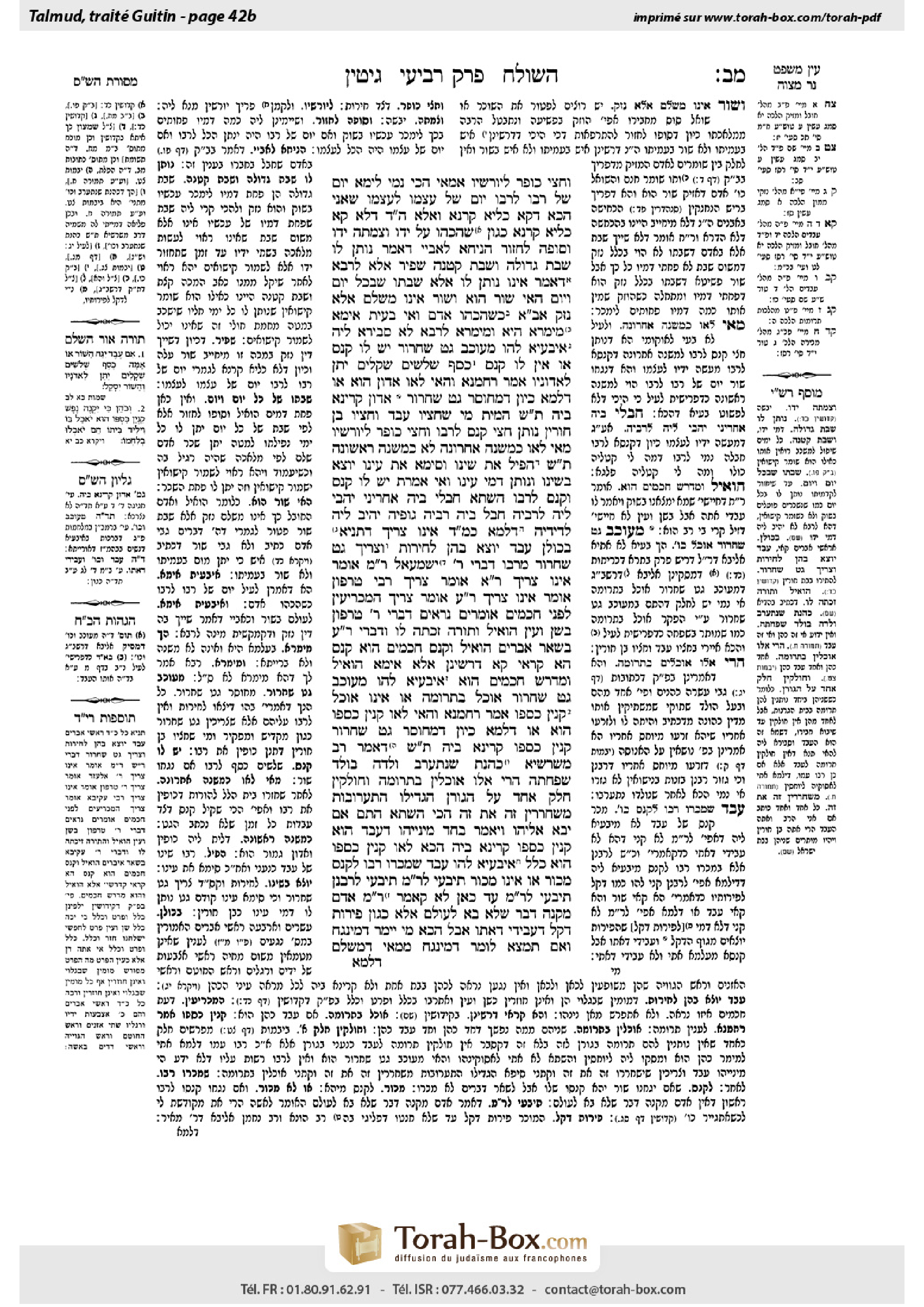
Gittin 42b: Talmud study for Daf Yomi
Study the Talmud for Daf Yomi with scanned pages, Hebrew text, English translations from Sefaria and AI-generated French translations.
Passage selection and English or AI-generated French translation are available where the scan has annotations. Daf Study is independent of Torah-Box and Sefaria.
Browse Gittin · גיטין · All tractatesGittin 42b text and translations
This page of Gittin includes the Aramaic text, an English translation and an AI-generated French translation, alongside the scan above.
גיטין מ״ב ב · Aramaic and Hebrew text
וַחֲצִי כוֹפֶר לְיוֹרְשָׁיו. אַמַּאי? הָכִי נָמֵי לֵימָא: יוֹם שֶׁל רַבּוֹ – לְרַבּוֹ, יוֹם שֶׁל עַצְמוֹ – לְעַצְמוֹ! שָׁאנֵי הָכָא דְּקָא כָלְיָא קַרְנָא.
וְאֶלָּא הֵיכִי דָּמֵי דְּלָא קָא כָלְיָא קַרְנָא? כְּגוֹן שֶׁהִכָּהוּ עַל יָדוֹ, וְצָמְתָה יָדוֹ וְסוֹפָהּ לַחֲזוֹר.
הָנִיחָא לְאַבָּיֵי, דְּאָמַר: נוֹתֵן לוֹ שֶׁבֶת גְּדוֹלָה, וְשֶׁבֶת קְטַנָּה – שַׁפִּיר.
אֶלָּא לְרָבָא, דְּאָמַר: אֵינוֹ נוֹתֵן לוֹ אֶלָּא שִׁבְתּוֹ שֶׁבְּכׇל יוֹם וָיוֹם; הַאי – שׁוֹר הוּא, וְשׁוֹר אֵינוֹ מְשַׁלֵּם אֶלָּא נֶזֶק!
אִיבָּעֵית אֵימָא: כְּשֶׁהִכָּהוּ אָדָם. וְאִי בָּעֵית אֵימָא: מֵימְרָא הִיא, וּמֵימְרָא לְרָבָא לָא סְבִירָא לֵיהּ.
אִיבַּעְיָא לְהוּ: מְעוּכָּב גֵּט שִׁחְרוּר, יֵשׁ לוֹ קְנָס אוֹ אֵין לוֹ קְנָס?
״כֶּסֶף שְׁלֹשִׁים שְׁקָלִים יִתֵּן לַאדוֹנָיו״ אָמַר רַחֲמָנָא – וְהַאי לָאו אָדוֹן הוּא, אוֹ דִלְמָא כֵּיוָן דִּמְחוּסָּר גֵּט שִׁחְרוּר, אָדוֹן קָרֵינָא בֵּיהּ?
תָּא שְׁמַע: הֵמִית מִי שֶׁחֶצְיוֹ עֶבֶד וְחֶצְיוֹ בֶּן חוֹרִין – נוֹתֵן חֲצִי קְנָס לְרַבּוֹ וַחֲצִי כוֹפֶר לְיוֹרְשָׁיו. מַאי, לָאו כְּמִשְׁנָה אַחֲרוֹנָה?
לֹא, כְּמִשְׁנָה רִאשׁוֹנָה.
תָּא שְׁמַע: הִפִּיל אֶת שִׁינּוֹ וְסִימָא אֶת עֵינוֹ – יוֹצֵא בְּשִׁינּוֹ, וְנוֹתֵן דְּמֵי עֵינוֹ. וְאִי אָמְרַתְּ יֵשׁ לוֹ קְנָס, וּקְנָס לְרַבּוֹ – הַשְׁתָּא חָבְלִי בֵּיהּ אַחֲרִינֵי יָהֲבִי לֵיהּ לְרַבֵּיהּ, חָבֵל בֵּיהּ רַבֵּיהּ גּוּפֵיהּ, יָהֵיב לֵיהּ לְדִידֵיהּ?!
דִּלְמָא כְּמַאן דְּאָמַר אֵינוֹ צָרִיךְ – דְּתַנְיָא: בְּכוּלָּן, עֶבֶד יוֹצֵא בָּהֶן לְחֵירוּת, וְצָרִיךְ גֵּט שִׁחְרוּר מֵרַבּוֹ, דִּבְרֵי רַבִּי יִשְׁמָעֵאל. רַבִּי מֵאִיר אוֹמֵר: אֵינוֹ צָרִיךְ, רַבִּי אֱלִיעֶזֶר אוֹמֵר: צָרִיךְ. רַבִּי טַרְפוֹן אוֹמֵר: אֵינוֹ צָרִיךְ, רַבִּי עֲקִיבָא אוֹמֵר: צָרִיךְ.
הַמַּכְרִיעִין לִפְנֵי חֲכָמִים, אוֹמְרִים: נִרְאִים דִּבְרֵי רַבִּי טַרְפוֹן – בְּשֵׁן וָעַיִן, הוֹאִיל וְתוֹרָה זִכְּתָה לוֹ, וְדִבְרֵי רַבִּי עֲקִיבָא – בִּשְׁאָר אֵבָרִים, הוֹאִיל וּקְנַס חֲכָמִים הוּא.
קְנָס?! הָא קְרָאֵי קָא דָרְשִׁינַן! אֶלָּא אֵימָא: הוֹאִיל וּמִדְרַשׁ חֲכָמִים הוּא.
אִיבַּעְיָא לְהוּ: מְעוּכָּב גֵּט שִׁחְרוּר, אוֹכֵל בִּתְרוּמָה אוֹ אֵינוֹ אוֹכֵל? ״קִנְיַן כַּסְפּוֹ״ אָמַר רַחֲמָנָא – וְהַאי לָאו קִנְיַן כַּסְפּוֹ הוּא, אוֹ דִלְמָא, כֵּיוָן דִּמְחוּסָּר גֵּט שִׁחְרוּר, ״קִנְיַן כַּסְפּוֹ״ קָרֵינָא בֵּיהּ?
תָּא שְׁמַע, דְּאָמַר רַב מְשַׁרְשְׁיָא: כֹּהֶנֶת שֶׁנִּתְעָרֵב וְלָדָהּ בִּוְלַד שִׁפְחָתָהּ, הֲרֵי אֵלּוּ אוֹכְלִין בִּתְרוּמָה, וְחוֹלְקִין חֵלֶק אֶחָד עַל הַגּוֹרֶן. הִגְדִּילוּ הַתַּעֲרוֹבוֹת – מְשַׁחְרְרִין זֶה אֶת זֶה!
הָכִי הַשְׁתָּא?! הָתָם, אִם יָבֹא אֵלִיָּהוּ וְיֹאמַר בְּחַד מִינַּיְיהוּ דְּעֶבֶד הוּא, ״קִנְיַן כַּסְפּוֹ״ קָרֵינָא בֵּיהּ; הָכָא, לָאו קִנְיַן כַּסְפּוֹ הוּא כְּלָל.
אִיבַּעְיָא לְהוּ: עֶבֶד שֶׁמְּכָרוֹ רַבּוֹ לִקְנָס, מָכוּר אוֹ אֵינוֹ מָכוּר?
תִּיבְּעֵי לְרַבִּי מֵאִיר, תִּיבְּעֵי לְרַבָּנַן; תִּיבְּעֵי לְרַבִּי מֵאִיר – עַד כָּאן לָא קָאָמַר רַבִּי מֵאִיר אָדָם מַקְנֶה דָּבָר שֶׁלֹּא בָּא לָעוֹלָם, אֶלָּא כְּגוֹן פֵּירוֹת דֶּקֶל – דַּעֲבִידִי דְּאָתוּ; אֲבָל הָכָא – מִי יֵימַר דְּמִינְּגַח? וְאִם תִּמְצָא לוֹמַר דְּמִינְּגַח – מִמַּאי דִּמְשַׁלֵּם?
Gittin 42b · English translation
and half of a ransom, i.e., half of the value of the deceased, to his heirs. According to what was stated earlier, why is this the halakha? So too, in this case let us say: If the ox killed him on the day of his master, then the full penalty of thirty shekels is paid to his master, but if it killed him on his own day, then the full ransom is paid to the slave himself, i.e., his heirs. The Gemara answers: This is different, for the principal is consumed. Since the slave is dead, even if the goring occurred on a day that he was working for himself, there is a permanent loss to the master, who is therefore entitled to be paid half of a penalty.
The Gemara asks: Rather, what are the circumstances when the principal is not consumed and the reimbursement is paid based on the day on which the ox gored the slave? The Gemara explains: It is a case where an ox struck him on his hand and his hand withered, but it will eventually return and heal. In this case, there is no permanent loss.
The Gemara challenges: This works out well according to the opinion of Abaye, who says: If one injures another and the injury causes him temporary paralysis, then he gives him the value of the major loss of livelihood, i.e., the decrease in his value, as measured by his price on the slave market, due to his temporary paralysis. And he also gives him the value of the minor loss of livelihood, i.e., the actual wages he lost during the time he was injured. This works out well, as in this case, the owner of the ox would have to pay the major loss of livelihood.
However, according to the opinion of Rava, who says: He gives him only the value of his loss of livelihood for each and every day but does not have to pay for the decrease in his value because the slave will be healed and will return to his previous value, this case is one of an ox that injured the half-slave half-freeman. And an ox, i.e., the owner of an ox, pays only damage, as measured by his price on the slave market, but he does not pay for loss of livelihood at all. How then does Rava explain this case?
The Gemara answers: If you wish, say that this is referring to a case where the slave was struck by a person, not an ox, so that the one who struck him must pay for the loss of livelihood. And if you wish, say instead: This halakha is merely a statement of an amora, and Rava is not bound to hold in accordance with a statement of an amora.
§ A dilemma was raised before the Sages: If a slave is detained in his master’s possession only due to not having received a bill of manumission, but he is no longer obligated to perform labor for his master, e.g., in a case where his master declared him to be ownerless, does he render liable one whose ox kills him to pay the penalty of thirty shekels to his master, or does he not render one liable to pay the penalty?
The Gemara analyzes this question: The Merciful One states in the Torah: “He shall give thirty shekels of silver to his master” (Exodus 21:32), and this is not a master, as in practice the slave has already been declared ownerless. Or perhaps, since he is lacking a bill of manumission, he is still called a master.
The Gemara suggests: Come and hear a proof for this based on what is taught in a baraita: If an ox killed one who is a half-slave half-freeman, then the owner of the ox gives half of a penalty, i.e., fifteen shekels, to the slave’s master and half of a ransom, i.e., half of the value of the deceased, to his heirs. What, is the baraita not in accordance with the ultimate version of the mishna, after Beit Hillel conceded to Beit Shammai that the master is forced to emancipate the half-slave half-freeman, and he is merely lacking a bill of manumission? Despite this, the baraita states that the master receives the money of half of a penalty.
The Gemara answers: No, this baraita is in accordance with the initial version of the mishna and in accordance with the opinion of Beit Hillel, that the slave works for his master and himself on alternating days. He is still an actual slave, and that is why the master receives the sum of half of a penalty.
The Gemara suggests: Come and hear a proof based on what is taught in a baraita: If the master knocked out the slave’s tooth and then blinded his eye, then the slave is emancipated due to the loss of his tooth, as the verse states: “He shall let him go free for his tooth’s sake” (Exodus 21:27). And his master gives him reimbursement for the value of his eye, as though he were a freeman. And if you say that a slave that did not yet receive a bill of manumission does render one whose ox kills him liable to pay the penalty, and the penalty is paid to his master, then one could ask: Now if other people injure him, then they give the payment to his master; if his master himself injures him, then should he give the payment for the slave’s eye to him?
The Gemara answers: Perhaps this baraita is in accordance with the one who said that when a slave is emancipated because his master knocked out his tooth he does not need a bill of manumission and is automatically emancipated the moment his tooth is knocked out, as it is taught in a baraita: For all of them, for all twenty-four limbs about which the Sages said that a slave is emancipated if his master damages one of them, a slave is emancipated by means of them, and he requires a bill of manumission from his master; this is the statement of Rabbi Yishmael. Rabbi Meir says: He does not require a bill of manumission. Rabbi Eliezer says: He requires it. Rabbi Tarfon says: He does not require it. Rabbi Akiva says: He requires it.
Those who rule before the Sages, i.e., those who attempt to rule by finding a middle ground between the different opinions, say as follows: The statement of Rabbi Tarfon, that the slave does not require a bill of manumission, seems correct in the case of a tooth or an eye, since the Torah transferred his freedom to him explicitly (Exodus 21:26–27). And the statement of Rabbi Akiva, that he does require a bill of manumission, seems correct in the case of other limbs, since it is a rabbinic penalty that he goes free.
The Gemara questions the wording used: Is it a rabbinic penalty? Don’t we interpret verses to conclude that a slave is emancipated when any of the twenty-four limbs are damaged by the master? Rather, say as follows: the statement of Rabbi Akiva seems correct in the case of other limbs, since it is an interpretation of the Sages, and it is not written explicitly in the Torah. This question of the Gemara remains unresolved.
§ A similar dilemma was raised before the Sages: If a priest’s slave was detained in his master’s possession only due to not having received a bill of manumission, may he partake of teruma, as the slave of a priest may, or may he not partake of it? The Gemara presents the sides of this dilemma: The Merciful One states in the Torah: “But if a priest buy any person, the purchase of his money, he may eat of it” (Leviticus 22:11), and this slave is not the purchase of his money, as the master cannot enslave him. Or perhaps since the slave is still lacking a bill of manumission, the words “the purchase of his money” are said about him.
The Gemara answers: Come and hear a solution to this question based on what Rav Mesharshiyya says: With regard to a woman married to a priest whose offspring was mixed with her maidservant’s offspring, and it is not known who is who, then these two children may partake of teruma. One is a priest and one is the slave of a priest, both of whom may partake of teruma. And they must divide one portion of teruma together at the threshing floor, because the slave of a priest is not allowed to collect teruma at the threshing floor. And when the mixed children have grown up, they free each other, and by doing so the one who was a slave is freed. This teaches that although the son of the maidservant was not enslaved for practical purposes, since his status as a slave could not be confirmed with certainty, he could still partake of teruma, as he was lacking a bill of manumission.
The Gemara rejects this: How can these cases be compared? There, in the case of the two children, if Elijah the prophet will come and say about one of them that he is a slave, then he is called “the purchase of his money,” because in reality he is a full-fledged slave. Here, in the dilemma before the Sages, the slave is not the purchase of his money at all because the master declared him ownerless. This question of the Gemara remains unresolved.
§ The Gemara discusses the penalty paid when an ox kills a slave: A dilemma was raised before the Sages: If a slave whose master sold him to another person only with regard to the penalty, meaning that if this slave were to be killed by an ox then the penalty would be paid to the purchaser, is he sold or is he not sold? In other words, does this sale take effect or not?
The Gemara explains: Raise the dilemma according to the opinion of Rabbi Meir, who holds that one can transfer ownership of an entity that has not yet come into the world, and raise the dilemma according to the opinion of the Rabbis, who hold that one cannot. Raise the dilemma according to the opinion of Rabbi Meir, as Rabbi Meir states that a person can transfer ownership of an entity that has not yet come into the world only in a case such as produce of a date palm, as this is an entity whose manner it is to come, and since one can be assured of the dates growing, one can sell them even beforehand. However, here, who will say that the slave will be gored? And even if you say that he will be gored, from where do you know that the owner of the ox who gored him will pay the penalty?
Gittin 42b · Traduction française (IA)
et la moitié d'une rançon, c'est-à-dire la moitié de la valeur du défunt, à ses héritiers. Selon ce qui a été dit plus tôt, pourquoi cette halakha ? De même, dans ce cas, disons : Si l'ox a tué le maître le jour de son maître, alors la totalité de la peine de trente sicles est payée à son maître, mais si l'ox l'a tué le jour où il travaillait pour lui-même, alors la totalité de la rançon est payée à l'esclave lui-même, c'est-à-dire à ses héritiers. La Guemara répond : C'est différent, car le principal est consumé. Puisque l'esclave est mort, même si l'attaque s'est produite un jour où il travaillait pour lui-même, il y a une perte permanente pour le maître, qui est donc dû la moitié de la peine.
La Guemara pose la question : Plutôt, quels sont les cas où le principal n'est pas consumé et la réparation est payée selon le jour où l'ox a blessé l'esclave ? La Guemara explique : C'est le cas où un ox a frappé sa main et sa main a atrophié, mais elle guérira un jour. Dans ce cas, il n'y a pas de perte permanente.
La Guemara soulève un défi : Cela s'aligne bien selon l'opinion d'Abaye, qui dit : Si l'on blesse un autre et que la blessure cause une paralysie temporaire, alors on lui donne la valeur de la perte de revenu majeure, c'est-à-dire la baisse de sa valeur, mesurée par sa valeur sur le marché des esclaves, due à sa paralysie temporaire. Et il lui donne aussi la valeur de la perte de revenu mineure, c'est-à-dire les salaires réels perdus pendant la période de blessure. Cela s'aligne bien, car dans ce cas, l'propriétaire de l'ox devrait payer la perte de revenu majeure.
Cependant, selon l'opinion de Rava, qui dit : Il lui donne seulement la valeur de sa perte de revenu pour chaque jour, mais il n'a pas à payer la baisse de sa valeur, car l'esclave guérira et retrouvera sa valeur initiale, ce cas est celui d'un bœuf qui a blessé un esclave demi-esclave et demi-libre. Et un bœuf, c'est-à-dire l'propriétaire d'un bœuf, paie seulement les dommages, mesurés par sa valeur sur le marché des esclaves, mais il ne paie pas la perte de revenu du tout. Comment alors Rava explique-t-il ce cas ?
La Guemara répond : Si tu veux, dis que cela fait référence à un cas où l'esclave a été frappé par une personne, pas par un bœuf, de sorte que celui qui l'a frappé doit payer la perte de revenu. Et si tu veux, dis plutôt : Cette halakha est simplement une déclaration d'un amora, et Rava n'est pas tenu de suivre une déclaration d'un amora.
§ Un dilemme a été soulevé devant les Sages : Si un esclave est détenu chez son maître uniquement en raison de ne pas avoir reçu un acte de manumission, mais qu'il n'est plus tenu de travailler pour son maître, par exemple dans un cas où son maître l'a déclaré propriétaire, est-il considéré comme un responsable dont l'ox qui le tue doit payer la peine de trente sicles à son maître, ou ne l'est-il pas ?
La Guemara analyse cette question : L'Éternel dit dans la Torah : « Il lui donnera trente sicles d'argent à son maître » (Exode 21:32), et cela n'est pas un maître, car en pratique l'esclave a déjà été déclaré propriétaire. Ou peut-être, puisque l'esclave manque d'un acte de manumission, il est encore appelé un maître.
La Guemara suggère : Viens écouter une preuve pour cela basée sur ce qui est enseigné dans une baraïta : Si un bœuf a tué une personne qui est un esclave demi-esclave et demi-libre, alors l'propriétaire du bœuf donne la moitié de la peine, c'est-à-dire quinze sicles, au maître de l'esclave et la moitié de la rançon, c'est-à-dire la moitié de la valeur du défunt, à ses héritiers. Qu'est-ce que cette baraïta n'est pas en accord avec la version finale de la mishna, après que Beit Hillel ait cédé à Beit Shammai que le maître est contraint de manumettre l'esclave demi-esclave et demi-libre, et qu'il manque simplement d'un acte de manumission ? Malgré cela, la baraïta dit que le maître reçoit l'argent de la moitié de la peine.
La Guemara répond : Non, cette baraïta est en accord avec la version initiale de la mishna et avec l'opinion de Beit Hillel, que l'esclave travaille pour son maître et lui-même sur des jours alternés. Il est encore un esclave réel, et c'est pourquoi le maître reçoit la somme de la moitié de la peine.
La Guemara suggère : Viens écouter une preuve basée sur ce qui est enseigné dans une baraïta : Si le maître a cassé la dent de l'esclave et a aveuglé son œil, alors l'esclave est libéré en raison de la perte de sa dent, car la Bible dit : « Il le libérera pour sa dent » (Exode 21:27). Et son maître lui répare la valeur de son œil, comme s'il était libre. Et si tu dis que l'esclave qui n'a pas encore reçu un acte de manumission rend responsable celui dont l'ox le tue de payer la peine, et la peine est payée à son maître, alors on pourrait demander : Maintenant, si d'autres personnes l'injurient, alors ils paient la réparation à son maître ; si son maître lui-même l'injurie, alors devrait-il payer la réparation de l'œil de l'esclave à lui ?
La Guemara répond : Peut-être que cette baraïta est en accord avec celui qui dit que lorsque l'esclave est libéré en raison de la perte de sa dent par son maître, il n'a pas besoin d'un acte de manumission et est automatiquement libéré dès que sa dent est cassée, comme il est enseigné dans une baraïta : Pour tous, pour les vingt-quatre membres sur lesquels les Sages ont dit que l'esclave est libéré si son maître endommage l'un d'eux, l'esclave est libéré par l'intermédiaire de ces membres, et il a besoin d'un acte de manumission de son maître ; c'est la déclaration de Rabbi Yishmael. Rabbi Meir dit : Il n'a pas besoin d'un acte de manumission. Rabbi Eliezer dit : Il a besoin d'un acte de manumission. Rabbi Tarfon dit : Il n'a pas besoin d'un acte de manumission. Rabbi Akiva dit : Il a besoin d'un acte de manumission.
Ceux qui veulent prendre le pouvoir avant les Sages, c'est-à-dire ceux qui cherchent à gouverner en adoptant une position intermédiaire entre les différentes opinions, disent ainsi : La déclaration du Rabbi Tarphon, selon laquelle l'esclave n'a pas besoin d'un document de manumission, semble correcte dans le cas d'une dent ou d'un œil, puisque la Torah a transféré sa liberté à lui de manière explicite (Exode 21:26–27). Et la déclaration du Rabbi Akiva, selon laquelle il a besoin d'un document de manumission, semble correcte dans le cas des autres membres, puisque c'est une sanction rabbinique qui le libère.
La Guemara questionne la formulation utilisée : S'agit-il d'une sanction rabbinique ? Ne nous interprétons-nous pas les versets pour conclure que l'esclave est libéré lorsqu'un des vingt-quatre membres est endommagé par le maître ? Plutôt, disons ainsi : la déclaration du Rabbi Akiva semble correcte dans le cas des autres membres, puisque c'est une interprétation des Sages, et cela n'est pas écrit explicitement dans la Torah. Cette question de la Guemara reste sans réponse.
§ Une similitude de dilemme a été soulevée devant les Sages : Si un esclave d'un prêtre était détenu dans la possession de son maître uniquement en raison de ne pas avoir reçu un document de manumission, peut-il participer à la terouma, comme l'esclave d'un prêtre, ou peut-il ne pas participer à celle-ci ? La Guemara présente les deux côtés de ce dilemme : L'Éternel dit dans la Torah : « Mais si un prêtre achète une personne, la vente de son argent, il peut manger de cela » (Lévitique 22:11), et cet esclave n'est pas la vente de son argent, car le maître ne peut l'enchaîner. Ou peut-être, puisque l'esclave manque encore d'un document de manumission, les mots « la vente de son argent » sont dits à son sujet.
La Guemara répond : Approchez-vous d'une solution à cette question basée sur ce que dit Rav Mesharshiyya : En ce qui concerne une femme mariée à un prêtre dont les enfants étaient mélangés avec ceux de sa servante, et il n'est pas connu qui est qui, alors ces deux enfants peuvent participer à la terouma. L'un est un prêtre et l'autre est l'esclave d'un prêtre, tous deux pouvant participer à la terouma. Et ils doivent partager une portion de terouma ensemble au moulin, car l'esclave d'un prêtre n'est pas autorisé à récolter la terouma au moulin. Et lorsque les enfants mélangés sont devenus adultes, ils s'offrent mutuellement leur liberté, et en le faisant, celui qui était un esclave est libéré. Cela enseigne que bien que le fils de la servante n'ait pas été enchaîné de manière pratique, puisque son statut d'esclave ne pouvait pas être confirmé avec certitude, il pouvait tout de même participer à la terouma, car il manquait un document de manumission.
La Guemara rejette cela : Comment peuvent ces cas être comparés ? Là, dans le cas des deux enfants, si Elie le prophète viendra et dira à l'un d'eux qu'il est un esclave, alors il est appelé « la vente de son argent », car en réalité il est un esclave complet. Ici, dans le dilemme devant les Sages, l'esclave n'est pas la vente de son argent du tout, car le maître l'a déclaré sans propriétaire. Cette question de la Guemara reste sans réponse.
§ La Guemara discute de la sanction payée lorsqu'un bœuf tue un esclave : Un dilemme a été soulevé devant les Sages : Si un esclave dont le maître l'a vendu à une autre personne uniquement en ce qui concerne la sanction, c'est-à-dire que si cet esclave était tué par un bœuf, la sanction serait payée à l'acheteur, est-il vendu ou n'est-il pas vendu ? En d'autres termes, cette vente est-elle efficace ou non ?
La Guemara explique : Soulevez le dilemme selon l'opinion du Rabbi Meir, qui considère que l'on peut transférer la propriété d'une entité qui n'a pas encore vu le jour, et soulevez le dilemme selon l'opinion des Rabbins, qui considèrent que l'on ne peut pas. Soulevez le dilemme selon l'opinion du Rabbi Meir, car le Rabbi Meir affirme qu'une personne peut transférer la propriété d'une entité qui n'a pas encore vu le jour uniquement dans un cas tel que les fruits d'un palmier dattier, car c'est une entité dont la manière est de venir, et puisque l'on peut être assuré que les dattes poussent, l'on peut les vendre même avant. Cependant, ici, qui dira que l'esclave sera mordu ? Et même si vous dites qu'il sera mordu, d'où savez-vous que l'propriétaire du bœuf qui l'a mordu paiera la sanction ?
Traduction française générée par IA à partir de l’édition anglaise de Sefaria. Vérifie toujours un passage avec le texte source.
Text from Sefaria: William Davidson Edition - Vocalized Aramaic (CC BY NC); William Davidson Edition - English (CC BY NC).