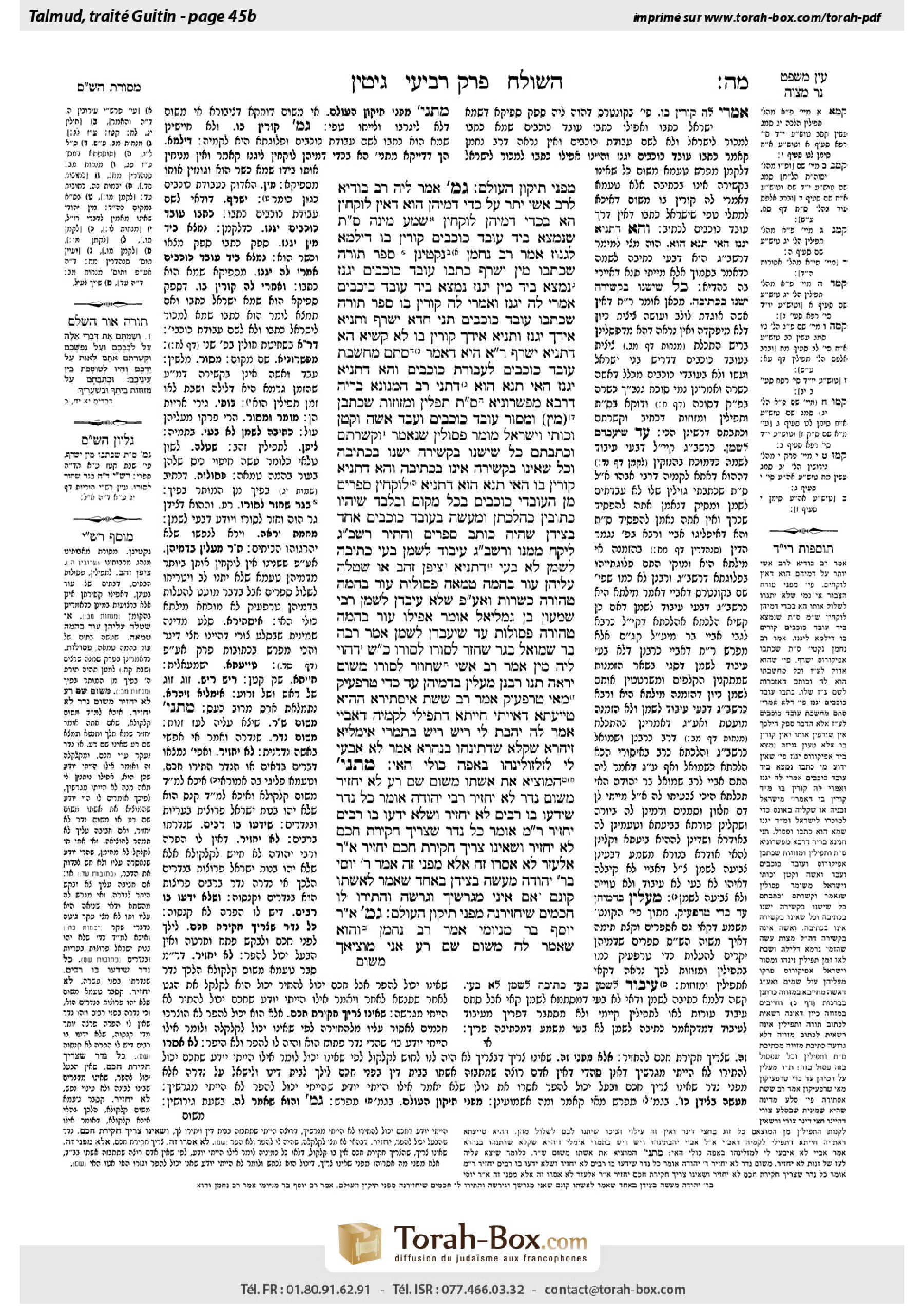
Gittin 45b: Talmud study for Daf Yomi
Study the Talmud for Daf Yomi with scanned pages, Hebrew text, English translations from Sefaria and AI-generated French translations.
Passage selection and English or AI-generated French translation are available where the scan has annotations. Daf Study is independent of Torah-Box and Sefaria.
Browse Gittin · גיטין · All tractatesGittin 45b text and translations
This page of Gittin includes the Aramaic text, an English translation and an AI-generated French translation, alongside the scan above.
גיטין מ״ה ב · Aramaic and Hebrew text
מִפְּנֵי תִּיקּוּן הָעוֹלָם.
גְּמָ׳ אֲמַר לֵיהּ רַב בּוּדְיָא לְרַב אָשֵׁי: יָתֵר עַל כְּדֵי דְמֵיהֶן הוּא דְּאֵין לוֹקְחִין, הָא בִּכְדֵי דְמֵיהֶן – לוֹקְחִין; שְׁמַע מִינַּהּ סֵפֶר תּוֹרָה שֶׁנִּמְצָא בְּיַד גּוֹי – קוֹרִין בּוֹ? דִּילְמָא לִגְנוֹז.
אָמַר רַב נַחְמָן, נָקְטִינַן: סֵפֶר תּוֹרָה שֶׁכְּתָבוֹ מִין – יִשָּׂרֵף, כְּתָבוֹ גּוֹי – יִגָּנֵז. נִמְצָא בְּיַד מִין – יִגָּנֵז. נִמְצָא בְּיַד גּוֹי – אָמְרִי לַהּ יִגָּנֵז, וְאָמְרִי לַהּ קוֹרִין בּוֹ.
סֵפֶר תּוֹרָה שֶׁכְּתָבוֹ גּוֹי – תָּנֵי חֲדָא: יִשָּׂרֵף, וְתַנְיָא אִידַּךְ: יִגָּנֵז, וְתַנְיָא אִידַּךְ: קוֹרִין בּוֹ!
לָא קַשְׁיָא, הָא דְּתַנְיָא ״יִשָּׂרֵף״ – רַבִּי אֱלִיעֶזֶר הִיא, דְּאָמַר: סְתָם מַחְשֶׁבֶת גּוֹי לַעֲבוֹדָה זָרָה.
וְהָא דְּתַנְיָא ״יִגָּנֵז״ – הַאי תַּנָּא הוּא, דְּתָנֵי רַב הַמְנוּנָא בְּרֵיהּ דְּרָבָא מִפַּשְׁרוּנְיָא: סֵפֶר תּוֹרָה, תְּפִלִּין וּמְזוּזוֹת שֶׁכְּתָבָן מִין, וּמָסוֹר, גּוֹי, וְעֶבֶד, אִשָּׁה, וְקָטָן, וְכוּתִי, וְיִשְׂרָאֵל מְשׁוּמָּד – פְּסוּלִין; שֶׁנֶּאֱמַר: ״וּקְשַׁרְתָּם״–״וּכְתַבְתָּם״ – כֹּל שֶׁיֶּשְׁנוֹ בִּקְשִׁירָה יֶשְׁנוֹ בִּכְתִיבָה, וְכֹל שֶׁאֵינוֹ בִּקְשִׁירָה אֵינוֹ בִּכְתִיבָה.
וְהָא דְּתַנְיָא ״קוֹרִין בּוֹ״ – הַאי תַּנָּא הוּא, דְּתַנְיָא: לוֹקְחִין סְפָרִים מִן הַגּוֹיִם בְּכׇל מָקוֹם, וּבִלְבַד שֶׁיִּהְיוּ כְּתוּבִין כְּהִלְכָתָן. וּמַעֲשֶׂה בְּגוֹי אֶחָד בְּצַיְדָּן שֶׁהָיָה כּוֹתֵב סְפָרִים, וְהִתִּיר רַבָּן שִׁמְעוֹן בֶּן גַּמְלִיאֵל לִיקַּח מִמֶּנּוּ.
וְרַבָּן שִׁמְעוֹן בֶּן גַּמְלִיאֵל – עִיבּוּד לִשְׁמָן בָּעֵי, כְּתִיבָה לִשְׁמָן לָא בָּעֵי?!
דְּתַנְיָא: צִיפָּן זָהָב אוֹ שֶׁטָּלָה עֲלֵיהֶן עוֹר בְּהֵמָה טְמֵאָה – פְּסוּלוֹת. עוֹר בְּהֵמָה טְהוֹרָה – כְּשֵׁרוֹת, וְאַף עַל פִּי שֶׁלֹּא עִיבְּדָן לִשְׁמָן. רַבִּי שִׁמְעוֹן בֶּן גַּמְלִיאֵל אוֹמֵר: אֲפִילּוּ עוֹר בְּהֵמָה טְהוֹרָה – פְּסוּלוֹת, עַד שֶׁיְּעַבְּדֵן לִשְׁמָן.
אָמַר רַבָּה בַּר שְׁמוּאֵל: בְּגֵר שֶׁחָזַר לְסוֹרוֹ. לְסוֹרוֹ?! כׇּל שֶׁכֵּן דְּהָוֵי לֵיהּ מִין! אָמַר רַב אָשֵׁי: שֶׁחוֹזֵר לְסוֹרוֹ מִשּׁוּם יִרְאָה.
תָּנוּ רַבָּנַן: מַעֲלִין בִּדְמֵיהֶן, עַד כְּדֵי טַרְפָּעִיק. מַאי טַרְפָּעִיק? אָמַר רַב שֵׁשֶׁת: אִיסְתֵּירָא.
הָהִיא טַיַּיעְתָּא דְּאַיְיתַי חַיְיתָא דִתְפִילֵּי לְקַמֵּיהּ דְּאַבָּיֵי. אֲמַר לַהּ: יָהֲבַתְּ לִי רֵישׁ רֵישׁ בְּתַמְרֵי? אִימַּלְיָא זִיהֲרָא, שְׁקַלָא שְׁדָתִינְהוּ בְּנַהֲרָא. אֲמַר: לָא אִבְּעַי לִי לְזַלְזוֹלִינְהוּ בְּאַפַּהּ כּוּלֵּי הַאי.
מַתְנִי׳ הַמּוֹצִיא אֶת אִשְׁתּוֹ מִשּׁוּם שֵׁם רַע – לֹא יַחְזִיר. מִשּׁוּם נֶדֶר – לֹא יַחְזִיר. רַבִּי יְהוּדָה אוֹמֵר: כׇּל נֶדֶר שֶׁיָּדְעוּ בּוֹ רַבִּים – לֹא יַחְזִיר, וְשֶׁלֹּא יָדְעוּ בּוֹ רַבִּים – יַחְזִיר.
רַבִּי מֵאִיר אוֹמֵר: כׇּל נֶדֶר שֶׁצָּרִיךְ חֲקִירַת חָכָם – לֹא יַחְזִיר, וְשֶׁאֵינוֹ צָרִיךְ חֲקִירַת חָכָם – יַחְזִיר. אָמַר רַבִּי אֶלְעָזָר: לֹא אָסְרוּ זֶה אֶלָּא מִפְּנֵי זֶה.
אָמַר רַבִּי יוֹסֵי בְּרַבִּי יְהוּדָה: מַעֲשֶׂה בְּצַיְדָּן, בְּאֶחָד שֶׁאָמַר לְאִשְׁתּוֹ: ״קֻוֽנָּם אִם אֵינִי מְגָרְשִׁיךְ״, וְגֵרְשָׁהּ, וְהִתִּירוּ לוֹ חֲכָמִים שֶׁיַּחְזִירֶנָּה, מִפְּנֵי תִּיקּוּן הָעוֹלָם.
גְּמָ׳ אָמַר רַב יוֹסֵף בַּר מִנְיוֹמֵי אָמַר רַב נַחְמָן: וְהוּא שֶׁאָמַר לָהּ: ״מִשּׁוּם שֵׁם רַע אֲנִי מוֹצִיאֵךְ״;
Gittin 45b · English translation
for the betterment of the world, so as not to cause an increase in the theft of sacred Jewish ritual objects in order to sell them for large sums of money.
GEMARA: Rav Budya said to Rav Ashi that one could infer the following from the mishna: It is for more than their actual monetary value that one may not purchase them; however, for their precise value, one may purchase them. Can one learn from the mishna that with regard to a Torah scroll that is found in the possession of a gentile, one can read from it after obtaining it from the gentile, and there is no concern that perhaps the gentile wrote it and it is unfit? Rav Ashi answered: Perhaps this does not mean that the Torah scroll is purchased in order to read from it, but rather in order to inter it and not to use it; however, it is nevertheless purchased so that it will not be desecrated by the gentiles.
Rav Naḥman says: We have a tradition that a Torah scroll that was written by a heretic should be burned; a Torah scroll written by a gentile should be interred; a Torah scroll found in the possession of a heretic, and it is not clear who wrote it, should be interred. With regard to a Torah scroll found in the possession of a gentile, some say it should be interred and some say that one may read from it.
The Gemara asks: With regard to a Torah scroll that was written by a gentile, it is taught in one baraita: It should be burned, and it is taught in another baraita: It should be interred, and it is taught in another baraita: One may read from it. There is a three-fold contradiction concerning the halakha of a Torah scroll written by a gentile.
The Gemara explains: This is not difficult: That which is taught in a baraita, that it should be burned, is the opinion of Rabbi Eliezer, who says: The unspecified intentions of a gentile are for idol worship, and therefore everything he wrote is assumed to be written for the sake of idolatrous worship and must be burned.
And that which is taught in a baraita, which said that it should be interred, is the opinion of this tanna, as Rav Hamnuna, son of Rava of Pashronya, taught: A Torah scroll, phylacteries, or mezuzot that were written by a heretic or an informer, a gentile or a slave, a woman or a minor, or a Samaritan or a Jewish apostate, are unfit, as it is stated: “And you shall bind them as a sign on your hand…and you shall write them on the doorposts of your house” (Deuteronomy 6:8–9). From this juxtaposition, one can derive the following: Anyone who is included in the mitzva of binding the phylacteries, i.e., one who is both obligated and performs the mitzva, is included in the class of people who may write Torah scrolls, phylacteries, and mezuzot; but anyone who is not included in the mitzva of binding is not included in the class of people who may write sacred texts. This baraita equates the halakha of a Torah scroll written by a gentile to the halakha of Torah scrolls written by these other types of people, which are interred.
And concerning that which is taught in a baraita, i.e., that one may read from it, that baraita is in accordance with the opinion of this following tanna, as it is taught in a baraita (Tosefta, Avoda Zara 3:6): One may purchase Torah scrolls from gentiles in any location, provided that they are written in accordance with their halakhot. And there was an incident involving a gentile in Tzaidan who would write Torah scrolls, and Rabban Shimon ben Gamliel permitted the Jews to purchase the Torah scrolls from him.
The Gemara asks: And does Rabban Shimon ben Gamliel require that the preparation of the parchment of Torah scrolls, phylacteries, and mezuzot be for their sake, i.e., for the sake of their use in a mitzva, but he does not require that the writing be for their sake?
The Gemara quotes the source that Rabban Shimon ben Gamliel requires that the parchment be prepared for their sake: As it is taught in a baraita: If one took phylacteries and coated them with gold or patched them with the skin of a non-kosher animal, then they are unfit. However, if one patched them with the skin of a kosher animal, then they are fit, and this is so even though he did not prepare them, i.e., the skin, for their sake, i.e., for the sake of their use in a mitzva. Rabban Shimon ben Gamliel says: Even if he patched them with the skin of a kosher animal they are unfit, until he prepares them for their sake. Being that he holds that the parchment needs to be prepared for their sake, their actual writing should certainly be done for their sake.
Rabba bar Shmuel says: That incident in Tzaidan involved a convert who returned to his previous corrupt ways [suro] by reverting to living like a gentile. He nevertheless remains a Jew. The Gemara asks: If he returned to his previous corrupt ways all the more so should the Torah scroll be rendered unfit, as he is a heretic. Once he learns the Jewish faith and abandons it, he is considered a heretic. Rav Ashi says: This means that he returned to his previous corrupt ways due to fear, and not because he rejected the Jewish faith. He ceased acting like a Jew out of fear of reprisal. Since he is a Jew, it is permitted for him to read from the Torah scrolls that he writes.
§ The Gemara clarifies the halakha from the mishna that one may not purchase sacred items from a gentile for more than their actual value. The Sages taught: One may increase payment beyond their value up to a terapa’ik. The Gemara asks: What is a terapa’ik? Rav Sheshet said: It is an istera, worth one half of a dinar.
The Gemara relates: There was a certain Arab merchant woman [taya’ata] who brought a sack [ḥayeta] of phylacteries in front of Abaye. He said to her: Would you give me each pair for a date? She became full of anger, and took the phylacteries and threw them into the river because Abaye offered her such a small amount in exchange for them. Abaye said in remorse: I should not have denigrated the phylacteries so much in her presence, but rather, I should have offered to pay her their actual value.
MISHNA: A man who divorces his wife due to her bad reputation, i.e., he heard that she had committed adultery, may not remarry her, even if it becomes clear that she did not in fact commit adultery. Similarly, if one divorces his wife due to a vow that she took, and he could not live with her under the conditions of her vow, he may not remarry her. Rabbi Yehuda says: If he divorces her due to any vow that the public was aware of, he may not remarry her, but if he divorces her due to a vow that the public was not aware of, he may remarry her.
The mishna continues: Rabbi Meir says: If he divorces her due to any vow that requires investigation and dissolution by a halakhic authority, he may not remarry her, but if he divorces her due to a vow that does not require investigation and dissolution by a halakhic authority, and is dissolved even without that, he may remarry her. Rabbi Elazar said: They prohibited him from remarrying her in this case, where she stated a vow that requires dissolution by a halakhic authority, only due to that case, where she stated a vow that does not require dissolution by a halakhic authority.
Rabbi Yosei, son of Rabbi Yehuda, said: There was an incident in Tzaidan involving one man who said to his wife: It is konam, i.e., it is forbidden like an offering, if I do not divorce you, and he divorced her; and the Sages permitted him to remarry her for the betterment of the world.
GEMARA: Rav Yosef bar Minyumi says that Rav Naḥman says: And the halakha stated in the mishna, which says that in certain cases a man who divorces his wife may not remarry her, is only applicable when he said to her explicitly: I am removing you from the house due to your bad reputation,
Gittin 45b · Traduction française (IA)
pour le bien du monde, afin d'éviter que cela ne provoque une augmentation du vol d'objets rituels juifs sacrés afin de les vendre pour de grandes sommes d'argent.
GUEMARA : Rav Budya dit à Rav Ashi que l'on pouvait déduire de la mitsna la chose suivante : On ne peut pas acheter ces objets pour plus de leur valeur réelle ; cependant, on peut les acheter à leur valeur exacte. Peut-on en déduire de la mitsna que, concernant un livre de la Torah trouvé en possession d'un non-Juif, on peut le lire après l'avoir obtenu des mains du non-Juif, et il n'y a pas de crainte qu'il ait été écrit par le non-Juif et qu'il soit donc inutilisable ? Rav Ashi répondit : Peut-être cela ne signifie pas que le livre de la Torah est acheté pour le lire, mais plutôt pour l'enterrer et ne pas l'utiliser ; cependant, il est tout de même acheté afin qu'il ne soit pas profané par les non-Juifs.
Rav Naḥman dit : Nous avons une tradition selon laquelle un livre de la Torah écrit par un hérétique doit être brûlé ; un livre de la Torah écrit par un non-Juif doit être enterré ; un livre de la Torah trouvé en possession d'un hérétique, et dont on ne sait pas qui l'a écrit, doit être enterré. Concernant un livre de la Torah trouvé en possession d'un non-Juif, certains disent qu'il doit être enterré et d'autres disent qu'on peut le lire.
La Guemara pose la question : Concernant un livre de la Torah écrit par un non-Juif, il est enseigné dans une baraïta : Il doit être brûlé, et il est enseigné dans une autre baraïta : Il doit être enterré, et il est enseigné dans une autre baraïta : On peut le lire. Il y a un conflit triple concernant la halakha d'un livre de la Torah écrit par un non-Juif.
La Guemara explique : Ce n'est pas difficile : ce qui est enseigné dans une baraïta, qu'il doit être brûlé, est l'opinion de Rabbi Eliezer, qui dit : Les intentions indéterminées d'un non-Juif sont pour l'idolâtrie, et donc tout ce qu'il a écrit est supposé avoir été écrit à des fins d'idolâtrie et doit être brûlé.
Et ce qui est enseigné dans une baraïta, qui dit qu'il doit être enterré, est l'opinion de ce tanna, comme Rav Hamnuna, fils de Rava de Pashronya, a enseigné : Un livre de la Torah, des phylactères ou des mezuzot écrits par un hérétique ou un espion, un non-Juif ou un esclave, une femme ou un mineur, ou un Samaritain ou un juif apostat, sont inutilisables, car il est dit : « Et tu les attacheras comme un signe sur ton bras… et tu les écriras sur les seuils de ta maison » (Deutéronome 6:8–9). De cette juxtaposition, on peut déduire ce qui suit : Tout celui qui est inclus dans la mitsva d'attacher les phylactères, c'est-à-dire celui qui est tenu de la mitsva et la pratique, est inclus dans la catégorie des personnes qui peuvent écrire des livres de la Torah, des phylactères et des mezuzot ; mais tout celui qui n'est pas inclus dans la mitsva d'attacher n'est pas inclus dans la catégorie des personnes qui peuvent écrire des textes sacrés. Cette baraïta équilibre la halakha d'un livre de la Torah écrit par un non-Juif à la halakha des livres de la Torah écrits par ces autres types de personnes, qui sont enterrés.
Et concernant ce qui est enseigné dans une baraïta, c'est-à-dire qu'on peut en lire, cette baraïta est selon l'opinion de ce tanna suivant, comme il est enseigné dans une baraïta (Tosefta, Avoda Zara 3:6) : On peut acheter des livres de la Torah auprès des non-Juifs dans tout lieu, à condition qu'ils soient écrits selon leurs halakhot. Il y avait un incident concernant un non-Juif à Tzaidan qui écrivait des livres de la Torah, et Rabban Shimon ben Gamliel a permis aux Juifs d'acheter les livres de la Torah de lui.
La Guemara pose la question : Et Rabban Shimon ben Gamliel exige-t-il que la préparation du parchemin des livres de la Torah, des phylactères et des mezuzot soit faite à leur intention, c'est-à-dire à l'intention de leur usage dans une mitsva, mais il ne requiert pas que l'écriture soit faite à leur intention ?
La Guemara cite la source selon laquelle Rabban Shimon ben Gamliel exige que le parchemin soit préparé à leur intention : comme il est enseigné dans une baraïta : Si l'on a pris des phylactères et les a recouverts d'or ou les a réparés avec la peau d'un animal non-kosher, alors ils sont inutilisables. Cependant, si l'on les a réparés avec la peau d'un animal kosher, alors ils sont utilisables, et cela même si l'on n'a pas préparé la peau, c'est-à-dire pour leur usage dans une mitsva. Rabban Shimon ben Gamliel dit : Même s'il les a réparés avec la peau d'un animal kosher, ils sont inutilisables, jusqu'à ce qu'il les prépare à leur intention. Puisque il considère que le parchemin a besoin d'être préparé à leur intention, leur écriture réelle devrait certainement être faite à leur intention.
Rabba bar Shmuel dit : Cet incident à Tzaidan concernait un converti qui est revenu à ses mauvaises habitudes en vivant comme un non-Juif. Il reste toutefois juif. La Guemara pose la question : Si il est revenu à ses mauvaises habitudes, d'autant plus que le livre de la Torah devrait être rendu inutilisable, car il est un hérétique. Une fois qu'il apprend la foi juive et l'abandonne, il est considéré comme un hérétique. Rav Ashi dit : Cela signifie qu'il est revenu à ses mauvaises habitudes en raison de la peur, et non parce qu'il a rejeté la foi juive. Il a cessé d'agir comme un Juif en raison de la peur de représailles. Puisque c'est un Juif, il est permis de le faire lire des livres de la Torah qu'il écrit.
§ La Guemara clarifie la halakha à partir de la mitsva selon laquelle on ne peut pas acheter des objets sacrés auprès d'un non-Juif pour plus de leur valeur réelle. Les Sages ont enseigné : On peut augmenter le prix au-delà de leur valeur jusqu'à un terapa’ik. La Guemara pose la question : Qu'est-ce qu'un terapa’ik ? Rav Sheshet a dit : C'est un istera, valant la moitié d'un dinar.
La Guemara rapporte : Il y avait une certaine femme arabe qui a apporté un sac de phylactères devant Abaye. Il a dit à elle : Voudrais-tu me donner chaque paire pour une date ? Elle est devenue en colère, et a pris les phylactères et les a jetés dans le fleuve parce que Abaye offrait un montant si petit en échange d'eux. Abaye a dit en regret : Je ne devrais pas avoir dénigré les phylactères à ce point devant elle, mais plutôt, je devrais avoir offert de payer leur valeur réelle.
MICHNA : Un homme qui divorce sa femme à cause de sa mauvaise réputation, c'est-à-dire qu'il a entendu qu'elle avait commis un adultère, ne peut pas la remarié, même si cela devient clair qu'elle n'a pas effectivement commis d'adultère. De même, si l'on divorce sa femme à cause d'une promesse qu'elle a faite, et qu'on ne peut pas vivre avec elle sous les conditions de cette promesse, on ne peut pas la remarié. Rabbi Yéhuda dit : Si l'on divorce sa femme à cause d'une promesse dont la population était consciente, on ne peut pas la remarié, mais si l'on divorce sa femme à cause d'une promesse dont la population n'était pas consciente, on peut la remarié.
La mishna continue : Rabbi Méir dit : Si l'on divorce sa femme à cause d'une promesse qui nécessite une enquête et une dissolution par un autorité halakhique, on ne peut pas la remarié, mais si l'on divorce sa femme à cause d'une promesse qui ne nécessite pas une enquête et une dissolution par un autorité halakhique, et qu'elle est dissoute même sans cela, on peut la remarié. Rabbi Eléazar a dit : Ils l'ont interdit de la remarié dans ce cas, où elle a déclaré une promesse qui nécessite une dissolution par un autorité halakhique, uniquement à cause de ce cas, où elle a déclaré une promesse qui ne nécessite pas une dissolution par un autorité halakhique.
Rabbi Yosei, fils de Rabbi Yéhuda, a dit : Il y avait un incident à Tzaidan concernant un homme qui a dit à sa femme : C'est konam, c'est-à-dire interdit comme un holocauste, si je ne te divorce pas, et il l'a divorcée ; et les Sages lui ont permis de la remarié pour le bien du monde.
GUEMARA : Rav Yosef bar Minyumi dit que Rav Naḥman dit : Et la halakha énoncée dans la mishna, qui dit que dans certains cas un homme qui divorce sa femme ne peut pas la remarié, s'applique uniquement lorsqu'il a dit explicitement à sa femme : Je t'expulse de la maison à cause de ta mauvaise réputation,
Traduction française générée par IA à partir de l’édition anglaise de Sefaria. Vérifie toujours un passage avec le texte source.
Text from Sefaria: William Davidson Edition - Vocalized Aramaic (CC BY NC); William Davidson Edition - English (CC BY NC).